AFP

'Stop killing us': anger and hope at LGBTQ club vigil

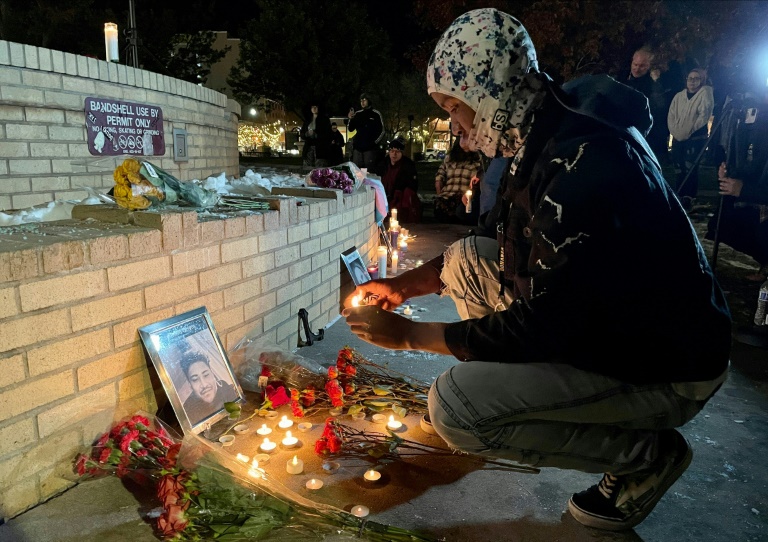
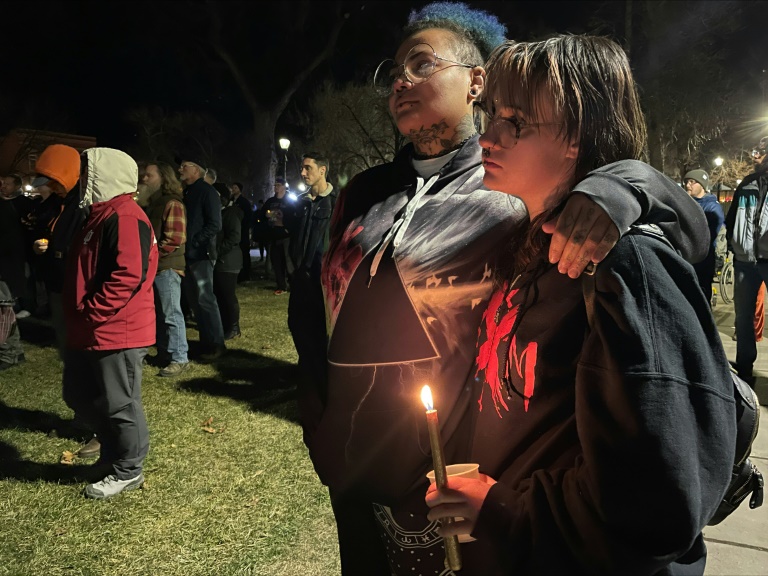
There were tears, hugs, anger and some smiles at a park in Colorado Springs on Monday, when hundreds gathered to pay tribute to the victims of a murderous gunman who stormed an LGBTQ club.

Groups huddled clutching candles, sharing memories of the five people whose lives were ended in the horrific violence of Saturday night, the latest example of a deadly mass shooting in America.

Other sobbed as speakers deplored the killing that they blamed on baseless hatred of people slain simply for who they loved.

“We shouldn’t have to be here tonight,” Allie Porter told the crowd. 

“This isn’t fair to them or any single one of you. We shouldn’t have to be here. This shouldn’t have had to happen.”

At the foot of a crumbling bandstand stood pictures of five people whose lives were cut short when bullets ripped through Club Q on Saturday just before midnight, shattering a safe haven for this Rocky Mountain city’s gay community.

Some on the stage shared memories of the victims, evoking smiles that turned into choked sobs, as the realisation of loss hit anew.

There were signs with messages like “Hate has no home here” and some speakers lashed out at what they said was the hateful rhetoric of right-wing politicians, which was amped up in the weeks before the midterm elections.

“We need to stop the political agenda against the LGBTQ community,” burlesque performer Bunny Bee told the crowd.

“Lesbian, gay, bisexual, transgender, and queer people in America continue to face discrimination in their daily lives because of anti-gay, anti-LGBTQ political agendas,” Bee said.

“We need to continue to fight the hate, the politicians endangering the lives of this community.”

Fellow performer Jimmy Gomez-Beisch said the intolerance had to end.

“Stop killing us. The violence just needs to stop. The hate needs to stop. We need to come together as a human race.”

Many gave testimony about how they had found the loving support they needed to become comfortable with their identity through the tight-knit LGBTQ community in Colorado Springs, and particularly at Club Q.

And it was that loving support that several speakers said they wanted to channel in the wake of the tragedy.

“I want everyone here to remember that you are loved,” one speaker named Cole said.

“You are wanted, you are not a waste of space. We belong here. We have every right to exist.” 

Bunnie Phantom, a 25-year-old body piercer, told AFP that the community was strong enough to overcome the awfulness of mass murder.

“I’m so glad that everybody was able to come together,” she said.

“To see everybody here, to have the support and representation in the community… literally means the world to me.”

When it reopens, Phantom said, she will be back at Club Q.

“Absolutely, just for the support and just because it’s still my safe space,” she said. 

“I’m not gonna hide because of this.”
Who will become history's first 'parastronaut'? 

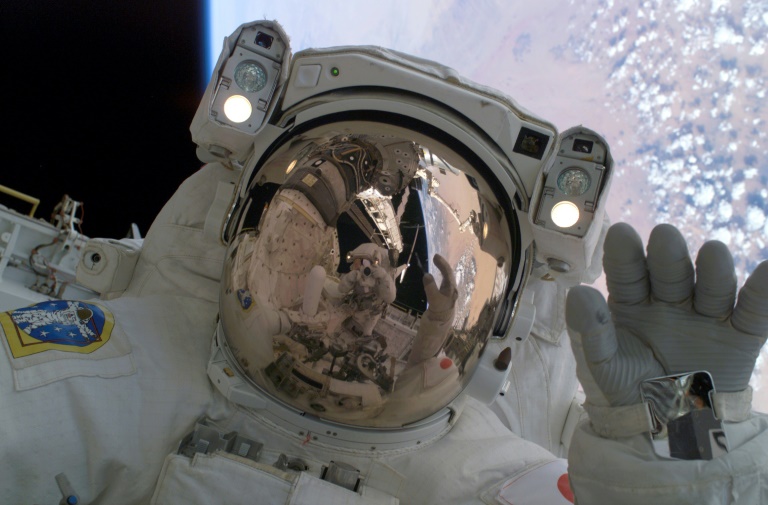
The first astronaut — or astronauts — with a physical disability could be announced as soon as Wednesday, according to the European Space Agency.

People with physical disabilities have previously been excluded from one of the most exclusive and demanding jobs on Earth — and beyond — due to strict selection requirements.

Guillaume Weerts, the ESA’s head of space medicine, told AFP that the agency’s “parastronaut project” required “a complete change in philosophy” about the concept of medical aptitude, which originally came from the military and the selection of fighter pilots.

After carrying out a feasibility study, the ESA said potential candidates could include people who have deficiencies in their lower limbs, whether from amputation or congenital defects.

Shorter people of up to 1.3 metres (4.3 feet) tall or those with different leg lengths were also eligible to apply.

The educational and psychological requirements for the candidates remained the same as for any other astronaut. Applications closed in June 2021.

The ESA is expected to name between four to six new European astronauts — without disabilities — during its ministerial council in Paris on Wednesday.

While Weerts said the parastronaut project runs somewhat separately, “there is a real possibility that as part of the announcement one or more people with disabilities” will also be presented.

– ‘Disability is not a limitation’ – 

In the extremely precise world of space travel, even small alterations can become extremely complicated — and expensive.

For example, the existing systems are designed for people of a certain height, Weerts said.

“What does that mean for someone who is a shorter size? How can we make sure that person can just reach the buttons?”

The ESA plans to work with those who are selected to find the best way to overcome such potential challenges.

As a member of the selection panel, Weerts could not reveal details about particular candidates.

But he said “a really great group of people” had applied and worked their way through the selection process.

“We have encountered absolutely marvellous individuals,” he said.

The process was an excellent “demonstration that disability is not a limitation”, he added.

“It’s really something that we all believe in,” he said, adding that there was a high level of commitment to the project from ESA’s partners.

So when could the first astronauts with a disability blast off?

“Space is a not a business for people who are in a hurry,” Weerts said.

The timeline is difficult to predict because “it really depends on what we encounter”, he said, adding that plenty more work would be carried out once the ESA has selected its candidates.

But he did say that an astronaut with a disability could launch into space “potentially in the next 10 years”.

– ‘Incredibly exciting’ – 

Kamran Mallick, the chief executive of the charity Disability Rights UK, said the project was “incredibly exciting”.

“Disabled people are excluded (from) large aspects of everything that we do in the world,” he told AFP.

“If we are truly to explore the universe, we have to accept that we can’t just have it solely for a particular group of individuals.”

Mallick praised the ESA’s plan to work with the astronauts to figure exactly what they need. 

“I’m a wheelchair user, and it is far better that people ask me what works for me, what I would need, rather than making assumptions of what someone can or cannot do,” he said.

Mallick said that while watching a space shuttle launch as a teenager, he dreamt of becoming an astronaut.

“Of course, I was quickly told that was not going to happen. Don’t aspire to be an astronaut,” he said.

“I wish I’d pursued it now.”

Who will become history's first 'parastronaut'? 

The first astronaut — or astronauts — with a physical disability could be announced as soon as Wednesday, according to the European Space Agency.

People with physical disabilities have previously been excluded from one of the most exclusive and demanding jobs on Earth — and beyond — due to strict selection requirements.

Guillaume Weerts, the ESA’s head of space medicine, told AFP that the agency’s “parastronaut project” required “a complete change in philosophy” about the concept of medical aptitude, which originally came from the military and the selection of fighter pilots.

After carrying out a feasibility study, the ESA said potential candidates could include people who have deficiencies in their lower limbs, whether from amputation or congenital defects.

Shorter people of up to 1.3 metres (4.3 feet) tall or those with different leg lengths were also eligible to apply.

The educational and psychological requirements for the candidates remained the same as for any other astronaut. Applications closed in June 2021.

The ESA is expected to name between four to six new European astronauts — without disabilities — during its ministerial council in Paris on Wednesday.

While Weerts said the parastronaut project runs somewhat separately, “there is a real possibility that as part of the announcement one or more people with disabilities” will also be presented.

– ‘Disability is not a limitation’ – 

In the extremely precise world of space travel, even small alterations can become extremely complicated — and expensive.

For example, the existing systems are designed for people of a certain height, Weerts said.

“What does that mean for someone who is a shorter size? How can we make sure that person can just reach the buttons?”

The ESA plans to work with those who are selected to find the best way to overcome such potential challenges.

As a member of the selection panel, Weerts could not reveal details about particular candidates.

But he said “a really great group of people” had applied and worked their way through the selection process.

“We have encountered absolutely marvellous individuals,” he said.

The process was an excellent “demonstration that disability is not a limitation”, he added.

“It’s really something that we all believe in,” he said, adding that there was a high level of commitment to the project from ESA’s partners.

So when could the first astronauts with a disability blast off?

“Space is a not a business for people who are in a hurry,” Weerts said.

The timeline is difficult to predict because “it really depends on what we encounter”, he said, adding that plenty more work would be carried out once the ESA has selected its candidates.

But he did say that an astronaut with a disability could launch into space “potentially in the next 10 years”.

– ‘Incredibly exciting’ – 

Kamran Mallick, the chief executive of the charity Disability Rights UK, said the project was “incredibly exciting”.

“Disabled people are excluded (from) large aspects of everything that we do in the world,” he told AFP.

“If we are truly to explore the universe, we have to accept that we can’t just have it solely for a particular group of individuals.”

Mallick praised the ESA’s plan to work with the astronauts to figure exactly what they need. 

“I’m a wheelchair user, and it is far better that people ask me what works for me, what I would need, rather than making assumptions of what someone can or cannot do,” he said.

Mallick said that while watching a space shuttle launch as a teenager, he dreamt of becoming an astronaut.

“Of course, I was quickly told that was not going to happen. Don’t aspire to be an astronaut,” he said.

“I wish I’d pursued it now.”

Inflation swells Spain's 'hunger queues'

With a secure job as a bricklayer, Hugo Ramirez never thought he would need the help of charity to feed his family.

But with the cost of living soaring across Europe, the 44-year-old father of three is one of a growing number of people in Spain turning to food banks to make ends meet.

“We see prices increase every week, even for basic goods,” he told AFP as he stood before wooden crates of fruits and vegetables at the entrance of a residential building in Madrid.

Driven by the war in Ukraine, Spanish food prices jumped 15.4 percent in October from a year earlier, their biggest increase in nearly three decades, according to the National Statistics Institute.

Sugar was up 42.8 percent, fresh vegetables rose 25.7 percent and eggs 25.5 percent as staple items soared.

In a bid to ease the pressure on squeezed households, Socialist Prime Minister Pedro Sanchez’s government — which faces an election next year — has spent billions of euros on extra welfare spending.

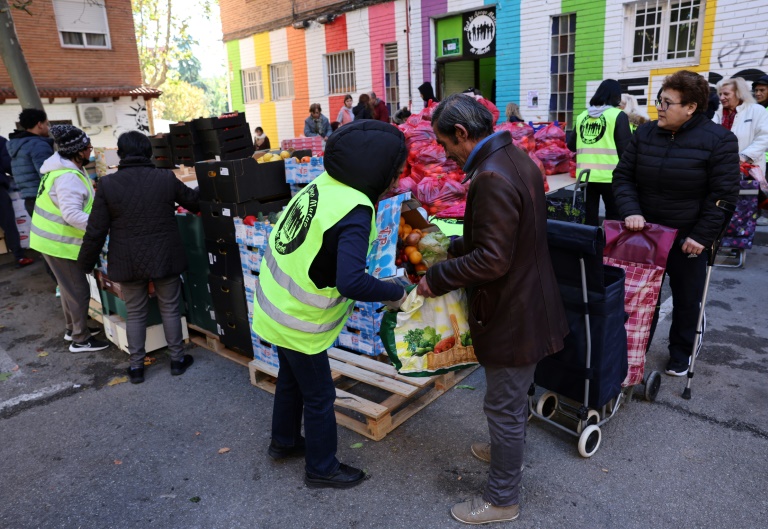
Every Saturday Ramirez, who is from Venezuela, comes to this food bank set up by a neighbourhood association in the working-class district of Aluche during the pandemic to pick up food supplies.

He earns 1,200 euros a month while his wife makes 600 euros working part time as a domestic helper.

After paying their monthly rent of 800 euros and 300 euros for utilities “there is not much left,” he said.

The line of people seeking help stretched far down the street. Many of them are immigrants.

Similar lines, dubbed “hunger queues”, can be seen regularly outside of other food banks across the country.

– Insufficient salaries –

“Every week we see new families in need, especially since the start of the war in Ukraine” in February, said Raul Calzado, a volunteer with the Aluche neighbourhood association.

Some mothers have stopped buying feminine hygiene products to be able to feed their children, he added.

The association currently offers aid to 350 households, a number Calzado expects will rise to around 400 by the end of the year.

Behind him dozens of other volunteers are busy at work, surrounded by boxes of pasta, canned goods and baby diapers.

“Some beneficiaries have no revenues. But we also have more and more retirees with small pensions or people who work but whose salaries are insufficent,” said the association’s vice president, Elena Bermejo.

Among the measures Spain has introduced are subsidies for transport, a one-off payment of 200 euros for the unemployed and a 15 percent increase in pensions for the most vulnerable such as widows.

But charities that work with the poor say the measures are not enough.

“For some families, even buying a litre of olive oil or a kilo of lentils has become difficult,” said Bermejo.

– Donations down –

Food banks, which had started to see dome relief as people returned to work after pandemic shutdowns, are struggling to meet the growing demand.

“With inflation, we are seeing a decrease in donations” since people have less money, said the spokesman for the Spanish Federation of Food Banks, Luis Miguel Ruperez.

And higher prices also means food banks can afford to buy less food themselves, he added.

The federation collected 125,000 tonnes of food since January, compared to 131,000 tonnes during the same time last year.

Food banks provide help to over 186,000 people in the Madrid region, and 1.35 million in total in Spain — roughly the same population as Barcelona, the country’s second biggest city.

One household in seven in Spain suffers food insecurity, meaning inadequate or insecure access to food due to low income, according to a study published earlier this year by the University of Barcelona.

“I hope it will get better but I’m afraid that won’t be the case,” said Ramirez as he clutched a bag of groceries from the food bank. 

Large quake rattles Solomon Islands

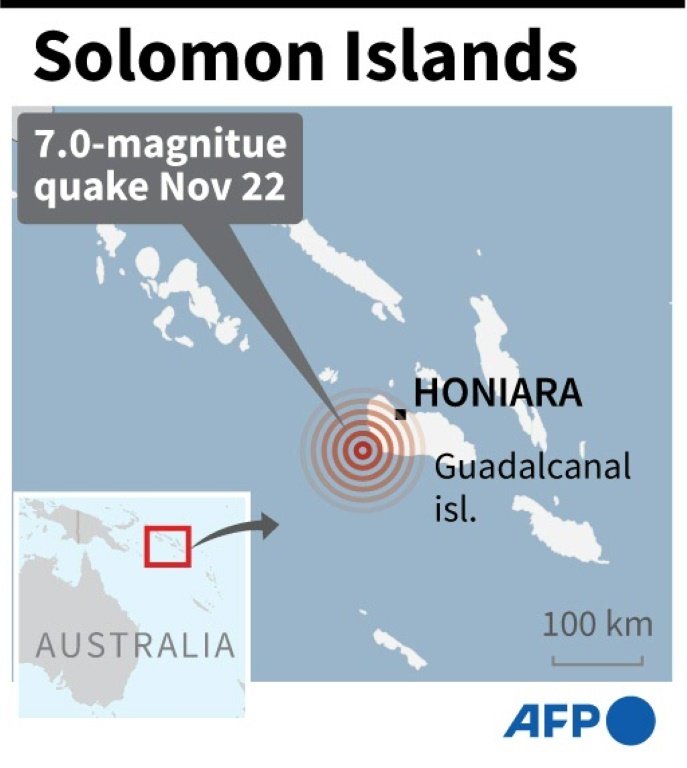
A 7.0-magnitude earthquake struck the Solomon Islands on Tuesday, swaying buildings, hurling items off shelves and briefly knocking out power in parts of the capital Honiara.

There were no reports of serious injuries or major structural damage.

“This was a big one,” Joy Nisha, a receptionist with the Heritage Park Hotel in the capital told AFP.

“Some of the things in the hotel fell. Everyone seems OK, but panicky.”

At one recently built mall, chunks of cladding were shaken loose, crushing the bonnet of a car and breaking the windshield.

The roof of an annexe at the Australian High Commission also collapsed, Prime Minister Anthony Albanese told parliament in Canberra, stating “there are no known injuries”.

An AFP reporter in Honiara said the shaking lasted for around 20 seconds.

Power was immediately knocked out in some areas of the capital and phone lines were also down.

Across the city, people fled their homes and workplaces for higher ground, fearing a tsunami.

“I was really scared because this is the first time I felt this kind of earthquake,” said a manager at the Pacific Casino Hotel, who asked not to be named.

“The building was really violently shaking,” she said. “It was really strong, it made you move side to side.”

Dozens of staff and guests fled the building to the relative safety of the car park, hoping not to be hit by debris on the way out.

The nation’s attorney general, John Muria, posted images on social media of office files that had spilled from several large metal filing cabinets. 

– Aftershocks –

The quake struck at a relatively shallow depth of 10 kilometres, just off the southwest coast of Guadalcanal island.

A tsunami warning had been issued for an area of the Solomons coast within 300 kilometres (185 miles) of the epicentre, but the UN-backed Pacific warning centre later said the threat had “largely” passed.

As nightfall approached, power was starting to return to Honiara, but local authorities urged caution.

“We expect aftershocks so people should stay alert around buildings and tall structures because of the size of the earthquake,” said David Hiba Hiriasia, director of the Solomon Islands Meteorological Service.

Staff at one hospital were readying to evacuate patients if needed.

According to UN data, about 20,000 people live within 50 kilometres of the epicentre.

The Solomons — a sprawling archipelago in the South Pacific — is home to about 800,000 people.

The quake hit exactly a year after anti-government riots that killed at least three people and caused tens of millions of dollars in damage. 

'Stop killing us': anger and hope at LGBTQ club vigil

There were tears, hugs, anger and some smiles at a park in Colorado Springs on Monday, when hundreds gathered to pay tribute to the victims of a murderous gunman who stormed an LGBTQ club.

Groups huddled clutching candles, sharing memories of the five people whose lives were ended in the horrific violence of Saturday night, the latest example of a deadly mass shooting in America.

Other sobbed as speakers deplored the killing that they blamed on baseless hatred of people slain simply for who they loved.

“We shouldn’t have to be here tonight,” Allie Porter told the crowd. 

“This isn’t fair to them or any single one of you. We shouldn’t have to be here. This shouldn’t have had to happen.”

At the foot of a crumbling bandstand stood pictures of five people whose lives were cut short when bullets ripped through Club Q on Saturday just before midnight, shattering a safe haven for this Rocky Mountain city’s gay community.

Some on the stage shared memories of the victims, evoking smiles that turned into choked sobs, as the realisation of loss hit anew.

There were signs with messages like “Hate has no home here” and some speakers lashed out at what they said was the hateful rhetoric of right-wing politicians, which was amped up in the weeks before the midterm elections.

“We need to stop the political agenda against the LGBTQ community,” burlesque performer Bunny Bee told the crowd.

“Lesbian, gay, bisexual, transgender, and queer people in America continue to face discrimination in their daily lives because of anti-gay, anti-LGBTQ political agendas,” Bee said.

“We need to continue to fight the hate, the politicians endangering the lives of this community.”

Fellow performer Jimmy Gomez-Beisch said the intolerance had to end.

“Stop killing us. The violence just needs to stop. The hate needs to stop. We need to come together as a human race.”

Many gave testimony about how they had found the loving support they needed to become comfortable with their identity through the tight-knit LGBTQ community in Colorado Springs, and particularly at Club Q.

And it was that loving support that several speakers said they wanted to channel in the wake of the tragedy.

“I want everyone here to remember that you are loved,” one speaker named Cole said.

“You are wanted, you are not a waste of space. We belong here. We have every right to exist.” 

Bunnie Phantom, a 25-year-old body piercer, told AFP that the community was strong enough to overcome the awfulness of mass murder.

“I’m so glad that everybody was able to come together,” she said.

“To see everybody here, to have the support and representation in the community… literally means the world to me.”

When it reopens, Phantom said, she will be back at Club Q.

“Absolutely, just for the support and just because it’s still my safe space,” she said. 

“I’m not gonna hide because of this.”
US LGBTQ club attack suspect faces murder, possible hate crime charges

A Colorado man was facing murder and potential hate crime charges on Monday after a shooting rampage at an LGBTQ nightclub, as a US Army veteran recounted how he “went into combat mode” to quickly subdue the gunman.

Anderson Lee Aldrich, 22, was arrested following the Saturday night shooting at Club Q in Colorado Springs that left five people dead and at least 18 injured, officials said.

Currently held without bond in hospital after being overpowered by club patrons, the alleged gunman will make a first court appearance in the next few days, El Paso County District Attorney Michael Allen said.

Formal charges have not yet been filed but Aldrich is expected to face first-degree murder charges and “if the evidence supports bias-motivated crimes, we will charge that as well,” Allen said.

Colorado Springs Mayor John Suthers praised “two heroes” who helped pin down the gunman after he entered the club and opened fire.

“I think in the opinion of everyone involved, (they) saved a lot of lives,” Suthers said.

The mayor said he had spoken to one of the men — Richard Fierro, a 15-year veteran of the US Army, according to The New York Times.

“I have never encountered a person who had engaged in such heroic actions that was so humble about it,” Suthers said. “He simply said to me, ‘I was trying to protect my family.'”

In an interview with the Times, Fierro said he was at the club with his wife, daughter and friends watching a drag show when the gunfire began.

The 45-year-old Fierro, who was deployed to Iraq and Afghanistan during his military service, said he tackled the gunman by grabbing a handle on the back of his body armor, took his pistol and beat him with it.

“I don’t know exactly what I did, I just went into combat mode,” he said. “I just know I have to kill this guy before he kills us.

“I grabbed the gun out of his hand and just started hitting him in the head, over and over,” he told the newspaper.

– ‘Vile rhetoric’ –

The attack was the deadliest on the LGBTQ community in the United States since a 2016 mass shooting at a nightclub in Orlando, Florida that claimed 49 lives.

GLAAD, an LGBTQ advocacy organization, noted that it came on the eve of the Transgender Day of Remembrance, which honors victims of transphobic attacks, and amid an uptick in hostility against the LGBTQ community in the United States.

“You can draw a straight line from the false and vile rhetoric about LGBTQ people spread by extremists and amplified across social media, to the nearly 300 anti-LGBTQ bills introduced this year, to the dozens of attacks on our community like this one,” GLAAD president Sarah Kate Ellis said in a statement.

Colorado Representative Brianna Titone, an openly transgender state legislator, also singled out anti-LGBTQ rhetoric.

“When politicians and pundits keep perpetuating tropes, insults, and misinformation about the trans and LGBTQ+ community, this is a result,” Titone tweeted.

Transgender rights were a hot-button issue in the United States leading up to midterm elections earlier this month, with Republicans putting forward a slew of legislative proposals to restrict them.

Adrian Vasquez, the Colorado Springs police chief, said the shooting suspect was armed with an “AR-style” rifle and a handgun.

Vasquez condemned what he called an “evil act” and pledged to do everything he can to make the community feel safe again.

Gun violence is alarmingly common in the United States. This year there have been more than 600 mass shootings across the country, according to the Gun Violence Archive, which defines such incidents as shootings of four or more people, not including any gunman.

– ‘We’ll keep going’ –

On Monday evening, hundreds of people gathered in a Colorado Springs park for an emotional candlelit vigil paying respect to those who were murdered.

Speakers praised the resilience of the LGBTQ community in the Rocky Mountain city, and insisted it would not be cowed by the horrific violence of Saturday night.

“I’m so glad that everybody was able to come together,” 25-year-old body piercer Bunnie Phantom told AFP.

“To see everybody here, to have the support and representation in the community… literally means the world to me.”

Allie Porter, who paid a tearful tribute from the stage to those killed, said she had felt the warm embrace of the local community for the 30 years she had lived in the city.

She vowed it would not be changed by the horrors of the weekend.

“We’ll keep going the same way as we always have. We’ve dealt with this for years, decades, and we’ve consistently rebuilt,” she said.

Asian markets struggle as China Covid worries build

Growing fears about China’s latest Covid-19 outbreaks Tuesday rattled investors, who fear authorities will revert to highly restrictive containment measures that have already dealt a chilling blow to the world’s number two economy this year.

After starting November with a rally thanks to easing inflation concerns and signs China was edging towards a looser approach to the disease, the optimism has been given a massive jolt since the country announced its first virus deaths in six months.

They come as infections rise across the country, with residents in Beijing worried that leaders will introduce lockdown measures similar to those seen earlier in the year in Shanghai, which lasted for months.

The flare-ups come just a week after China said it would begin rolling back some of the strict Covid rules that have been in place since the pandemic started in 2020, even as the rest of the world has moved on.

Analysts said the latest developments highlight the long road ahead for China in emerging from the crisis as President Xi Jinping sticks solidly to a zero-Covid strategy that is widely blamed for the country’s economic troubles.

“Risk sentiment has been under pressure on questions around China reopening,” said SPI Asset Management’s Stephen Innes.

“Some investors are convinced that China’s reopening is a formality and will be catalysed by the (World Health Organization) downgrading Covid to an endemic.

“We know that China’s reopening will be laced with fits and starts as the two-step-forward-one-step-back routine becomes the norm.”

Hong Kong, which thundered more than 10 percent higher in a three-day surge earlier this month, fell for a fifth straight day, while Shanghai was also lower along with Seoul, Taipei and Wellington.

Still, there were gains in Tokyo, Sydney, Singapore, Manila and Jakarta. 

That came after a drop on Wall Street, where trading is lighter than usual owing to the Thanksgiving break at the end of the week.

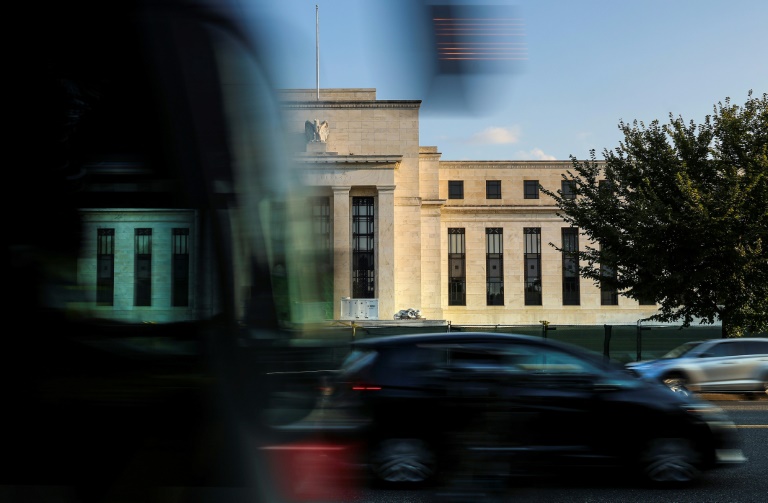
Wednesday sees the release of minutes from the Federal Reserve’s most recent policy meeting, which will be pored over for insight into officials’ thinking against the backdrop of four-decade-high inflation and signs of a slowing economy.

Hopes that the bank will begin to take its foot off the pedal were boosted earlier this month by figures showing inflation slowed more than expected, suggesting a series of hikes were beginning to bite.

Still, several members of the Fed’s top brass have warned against getting carried away and said more increases were needed to get on top of prices.

But JPMorgan Chase & Co’s Marko Kolanovic said markets would likely stumble into the new year and only pick up once the US central bank takes a more dovish stance on borrowing costs. JPMorgan saw risk assets to trade “rangebound with a more pronounced downside risk”.

– Key figures around 0230 GMT –

Tokyo – Nikkei 225: UP 0.7 percent at 28,150.50 (break)

Hong Kong – Hang Seng Index: DOWN 0.9 percent at 17,500.32

Shanghai – Composite: DOWN 0.1 percent at 3,083.51

Euro/dollar: UP at $1.0262 from $1.0245 on Monday

Dollar/yen: DOWN at 141.79 yen from 142.10 yen

Pound/dollar: UP at $1.1858 from $1.1823

Euro/pound: DOWN at 86.55 pence from 86.58 pence

West Texas Intermediate: UP 0.3 percent at $80.30 per barrel

Brent North Sea crude: UP 0.5 percent at $87.84 per barrel

New York – Dow: DOWN 0.1 percent at 33,700.28 (close)

London – FTSE 100: DOWN 0.1 percent at 7,376.85 (close)

— Bloomberg News contributed to this story —

Asian markets struggle as China Covid worries build

Growing fears about China’s latest Covid-19 outbreaks Tuesday rattled investors, who fear authorities will revert to highly restrictive containment measures that have already dealt a chilling blow to the world’s number two economy this year.

After starting November with a rally thanks to easing inflation concerns and signs China was edging towards a looser approach to the disease, the optimism has been given a massive jolt since the country announced its first virus deaths in six months.

They come as infections rise across the country, with residents in Beijing worried that leaders will introduce lockdown measures similar to those seen earlier in the year in Shanghai, which lasted for months.

The flare-ups come just a week after China said it would begin rolling back some of the strict Covid rules that have been in place since the pandemic started in 2020, even as the rest of the world has moved on.

Analysts said the latest developments highlight the long road ahead for China in emerging from the crisis as President Xi Jinping sticks solidly to a zero-Covid strategy that is widely blamed for the country’s economic troubles.

“Risk sentiment has been under pressure on questions around China reopening,” said SPI Asset Management’s Stephen Innes.

“Some investors are convinced that China’s reopening is a formality and will be catalysed by the (World Health Organization) downgrading Covid to an endemic.

“We know that China’s reopening will be laced with fits and starts as the two-step-forward-one-step-back routine becomes the norm.”

Hong Kong, which thundered more than 10 percent higher in a three-day surge earlier this month, fell for a fifth straight day, while Shanghai was also lower along with Seoul, Taipei and Wellington.

Still, there were gains in Tokyo, Sydney, Singapore, Manila and Jakarta. 

That came after a drop on Wall Street, where trading is lighter than usual owing to the Thanksgiving break at the end of the week.

Wednesday sees the release of minutes from the Federal Reserve’s most recent policy meeting, which will be pored over for insight into officials’ thinking against the backdrop of four-decade-high inflation and signs of a slowing economy.

Hopes that the bank will begin to take its foot off the pedal were boosted earlier this month by figures showing inflation slowed more than expected, suggesting a series of hikes were beginning to bite.

Still, several members of the Fed’s top brass have warned against getting carried away and said more increases were needed to get on top of prices.

But JPMorgan Chase & Co’s Marko Kolanovic said markets would likely stumble into the new year and only pick up once the US central bank takes a more dovish stance on borrowing costs. JPMorgan saw risk assets to trade “rangebound with a more pronounced downside risk”.

– Key figures around 0230 GMT –

Tokyo – Nikkei 225: UP 0.7 percent at 28,150.50 (break)

Hong Kong – Hang Seng Index: DOWN 0.9 percent at 17,500.32

Shanghai – Composite: DOWN 0.1 percent at 3,083.51

Euro/dollar: UP at $1.0262 from $1.0245 on Monday

Dollar/yen: DOWN at 141.79 yen from 142.10 yen

Pound/dollar: UP at $1.1858 from $1.1823

Euro/pound: DOWN at 86.55 pence from 86.58 pence

West Texas Intermediate: UP 0.3 percent at $80.30 per barrel

Brent North Sea crude: UP 0.5 percent at $87.84 per barrel

New York – Dow: DOWN 0.1 percent at 33,700.28 (close)

London – FTSE 100: DOWN 0.1 percent at 7,376.85 (close)

— Bloomberg News contributed to this story —

Turtles and see-through frogs on agenda at wildlife summit

A global wildlife summit in Panama will decide whether to take measures to protect the translucent glass frog and 12 types of freshwater turtles in its final week, which kicked off Monday.

Conservation experts and delegates from more than 180 nations began the week with a decision to maintain a ban on the trade of white rhinoceros horn, despite a request from Eswatini that was backed by Japan and several other African countries.

The tiny nation, formerly known as Swaziland, had argued the money from the sale of rhino horn would aid in conserving the threatened species.

Delegates also authorized the export of Brazil’s broad-snouted caiman and the saltwater crocodile from the Philippines for animals raised in captivity, but a ban on cross-border trade in Siamese crocodiles raised by Thai farmers was left intact.

The meeting in Panama City began on November 14 to discuss 52 proposals to modify protection levels set by the Convention on International Trade in Endangered Species of Wild Fauna and Flora (CITES).

The fate of several unique amphibians will be up for debate before the meeting wraps up on Friday.

“Freshwater turtles are among the main groups that are trafficked in the countries, and there is high pressure for international trade,” said Yovana Murillo, who heads a program against wildlife trafficking in the Andes, Amazon and Orinoco region for the Wildlife Conservation Society.

Brazil, Colombia, Costa Rica, and Peru want to list two species of matamata turtles, which live in the Amazon and Orinoco basins, on CITES Appendix II, which requires the tracking and regulation of trade.

Doris Rodriguez of Peru’s forestry service told AFP that the striking matamata turtles, with their beetle-like appearance, have become sought-after pets and “face many threats.”

These include habitat destruction, pollution, illegal trade, and being hunted for their meat and eggs.

– Glass frog –

Delegates will also debate regulating the trade of the nocturnal glass frog, found in several rainforests in Central and South America.

The amphibian is an increasingly popular pet. Some are a lime green color, while others have translucent bellies and chests. 

“They are being collected for their beauty. They are being trafficked and some are in critical danger,” said Rodriguez.

CITES, in force since 1975, regulates trade in some 36,000 species of plants and animals and provides mechanisms to help crack down on illegal trade. It sanctions countries that break the rules.

The meeting of the parties to the convention takes place every two or three years.

On Friday, delegates rejected a request by Zimbabwe to allow the ivory trade to resume in some southern African countries, a decision lauded by conservation NGOs. 

Another hot issue up for debate is the possible addition of protections for two major shark families, which could upend Hong Kong’s controversial shark fin trade.

– Beleaguered porpoise –

The conference has seen fierce debate over the vaquita, a species of porpoise that lives in Mexico’s Gulf of California and is at risk of extinction.

On the eve of the summit, CITES issued an ultimatum to Mexico, to show progress in protecting the world’s most endangered marine animal by February 2023, or face sanctions against its fish exports.

Washington has argued that its neighbor is not doing enough to protect the vaquita, while Mexico countered it had boosted naval surveillance in the Gulf.

Good news also emerged from the summit: the Aleutian cackling goose was moved from the list of most threatened species to those no longer threatened with extinction, after its numbers increased.

“This is a positive story about the recovery of a species,” highlighted the president of the committee which approved the move, Britain’s Vincent Fleming.

Close Bitnami banner
Bitnami