AFP

Health or jobs: Peruvian mining town at a crossroads

The Peruvian mining city of La Oroya, one of the most polluted places in the world, is seeking to reopen a heavy metal smelter that poisoned residents for almost a century.

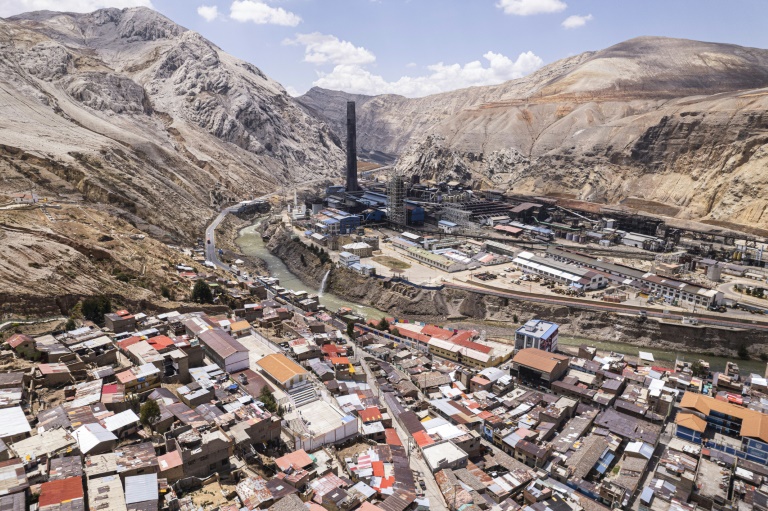
The Andean city, situated in a high-altitude valley at 3,750 meters (12,300 feet), is a grey, desolate place. 

Small houses and shops — many abandoned — cluster around towering black chimneys, surrounded by ashen mountain slopes corroded by heavy metals and long devoid of vegetation.

In 2009, the gigantic smelter that was the economic heartbeat of La Oroya went bankrupt, forcing residents to leave in droves and bringing local commerce to its knees. 

Since 1922, the plant processed copper, zinc, lead, gold, selenium, and other minerals from nearby mines.

If the metallurgical complex reopens, as announced by its new owners in October, it could breathe life back into the economy.

“The large majority of the population is eager and has waited a long time for this to start up again, because it is the source of life, the economic source,” said 48-year-old taxi driver Hugo Enrique.

But at what cost?

– A lifetime of disease –

In 2011, La Oroya was listed as the second-most polluted city on Earth, falling into fifth place two years later, according to the Blacksmith Institute, an NGO which works on pollution issues.

It was in insalubrious company, rubbing shoulders with Ukraine’s nuclear-sullied Chernobyl and Russia’s Dzerzhinsk, the site of Cold War-era factories producing chemical weapons.

According to the International Federation for Human Rights, in 2013, 97 percent of La Oroya children between six months and six years of age, and 98 percent between age seven and 12, had elevated levels of lead in their blood.

Manuel Enrique Apolinario, 68, a teacher who lives opposite the foundry, told AFP his body has high levels of lead, arsenic, and cadmium.

Residents had “gotten used to the way of life, surrounded by smoke and toxic gases,” he said.

“Those of us who have lived here for a lifetime have been ill with flu and bronchitis, especially respiratory infections.”

– Another 100 years?-

The foundry was opened in 1922, nationalized in 1974, and later privatized in 1997 when US natural resources firm Doe Run took it over.

In June 2009, Doe Run halted work after failing to comply with an environmental protection program and declared itself insolvent.

Now, despite years of residents accusing Lima and Doe Run of turning a blind eye to the harmful effects, some 1,270 former employees want to reopen the smelter next March — with the vow not to pollute.

Luis Mantari, one of the new owners, who is in charge of logistics, said the plant would operate “with social and environmental responsibility.”

“We want this unique complex to last another 100 years,” added human resources boss Jose Aguilar.

The company has stockpiled 14 million tonnes of copper and lead slag waste waiting to be converted into zinc.

“Those of us who fought against pollution have never opposed to the company working. Let it reopen with an environmental plan,” said Pablo Fabian Martinez, 67, who also lives near the site.

For many, though, the decision comes down to pure pocketbook issues.

“I want it to reopen because, without the company, La Oroya lost its entire economy,” added Rosa Vilchez, a 30-year-old businesswoman. Her husband left to work in another city after the closure.

– Respect health –

In 2006, La Oroya residents sued the Peruvian government at the Inter-American Commission on Human Rights for allowing the company to pollute at will.

Hearings began in October with the court sitting in the Uruguayan capital Montevideo, and residents recounted how they struggled with burning throats and eyes, headaches, and difficulty breathing.

Others told of tumors, muscular problems, and infertility blamed on pollution from the smelters.

The commission found last year that the state had failed to regulate and oversee the behavior of the mining company and “compromised its obligation to guarantee human rights.”

“We are aware that the metallurgical complex is a source of employment. We don’t deny that,” said Yolanda Zurita, one of the litigants, who plants trees to counter the pollution.

“But it must respect the population’s health.” 

Star soprano Renee Fleming returns to Met opera with 'The Hours'

A powerhouse trio of American song will interpret the voice of Virginia Woolf on New York’s prestigious Metropolitan Opera stage, as the highly anticipated run of “The Hours” makes its world premiere Tuesday.

The Pulitzer Prize-winning novel and Oscar-nominated film explores how threads of English writer Woolf’s “Mrs. Dalloway” tie three women of different generations together, and its darkly moving operatic adaption offers a new vision of the drama that probes themes including mental illness and the alienation from tradition that haunts its protagonists.

The production began with a pitch from Renee Fleming, widely considered the leading American soprano of her generation, whose role as the show’s Clarissa Vaughan marks her return to the Met after bidding adieu to her trademark role in Strauss’ “Der Rosenkavalier” in 2017.

“It was perfect for opera because of the complexity of the dealing with three periods,” Fleming said of “The Hours,” whose music was written by the Pulitzer Prize-winning composer Kevin Puts.

“Music gives a kind of a river, on which we can all sort of float — together or separately,” Fleming said of the three-pronged production.

Fleming’s Vaughan — a 1990s-era New Yorker who mirrors the character Clarissa Dalloway, and whose plotline centers on her party-planning for a friend, a renowned poet dying of AIDs — is joined onstage by the Broadway and opera star Kelli O’Hara, who performs as the depressed 1950s housewife Laura Brown.

Grammy-winning mezzo-soprano Joyce DiDonato plays the struggling Woolf herself.

“The possibilities were so exciting,” composer Puts told AFP, saying that “what you can do in music that you can’t really accomplish in a film or a book is that you can begin to present the three stories… simultaneously.”

“The idea of introducing those stories musically and then gradually bringing them together, until maybe all three of the leading ladies would sing trios together, was a really exciting idea,” Puts continued. 

“I loved the book so much, and I felt like I had the musical vocabulary for it.”

– Extraordinary women –

For Fleming — who prior to collaborating with Puts on “The Hours” was putting on a song cycle by the composer, which drew from the writings of the artist Georgia O’Keefe — part of the appeal of both that project and her latest venture was to tell stories of powerful women.

“Too many times in opera, historically, women have been sort of pawns,” she told AFP. “They’ve been victims, they’ve been really at the center of power struggles when they have no power or no agency.”

“I want to tell stories now about women who are extraordinary.”

Along with the force of the show’s vocals, “The Hours” integrates modern dance in a way not often seen in traditional opera houses, with dozens of performers physically manifesting the characters’ emotions.

Choreographer Annie-B Parson — who’s worked with the likes of Mikhail Baryshnikov, David Byrne and David Bowie — told AFP her process is generally “less about narrative, more about the worlds that I’m trying to create.”

“We spent a lot of choreographic currency on how to animate and inhabit the actual physical set and the moving parts,” she said; the Met’s stage is one of the most technologically advanced in the world, allowing for complex sets including at different levels.

“I liked the idea that these dancer beings would be the sinew — the interstitial, physical animation of the set,” Parson said.

Fleming said productions like “The Hours” can play a vital role in freshening the opera experience and drawing in new audiences, a major goal the Met has been working towards including by staging Terence Blanchard’s “Fire Shut Up In My Bones” last year.

The soprano emphasized the need to continue bringing in composers of diverse backgrounds and giving women more and larger creative roles.

The Grammy-winning performer herself was the first woman in the Met’s history to solo headline a season opening night gala, in 2008.

“All of our art forms really need to represent our population,” Fleming said.

“The Hours” runs at Manhattan’s Metropolitan Opera from November 22 through December 15.

Biden pardons turkeys 'Chocolate' and 'Chip' for Thanksgiving

Joe Biden on Monday used his powers as US president to pardon two turkeys, sparing them from winding up as the main course during an upcoming Thanksgiving dinner later this week.

“I hereby pardon Chocolate and Chip,” Biden said at the pardoning ceremony on the South Lawn, a lighthearted autumn event that has become something of a White House tradition.

The large white birds, which were raised on a farm in North Carolina, were named for the president’s favorite ice cream flavor, Biden told several schoolchildren who were present for the event.

“That’s a big bird,” Biden quipped as 46-pound (21-kilogram) Chocolate was placed on a table.

Biden used the backdrop of the recent US midterm elections — in which his Democrats fared better than many experts expected, retaining control of the Senate and only narrowly losing the House of Representatives to Republicans — to crack jokes about the time-honored turkey pardoning.

“The votes are in. They’ve been counted and verified. There’s no ballot stuffing. There’s no fowl play,” he said to laughter — and likely a few eyerolls.

“The only red wave this season (related to the traditional color of Republicans) is going to be a German Shepherd, Commander,” the president said, referring to his dog, who “knocks over the cranberry sauce on our table.” 

Turkey with stuffing is the traditional dish that Americans serve at a family feast on Thanksgiving, which is Thursday.

Biden mentioned how the Covid-19 pandemic had interrupted or curtailed such commemorations by Americans in recent years, and urged the invitees to feel gratitude for those who had protected US communities during the crisis, notably doctors, nurses and scientists.

“Two years ago, we couldn’t even safely have Thanksgiving with large family gatherings. Now we can,” he said. “That’s progress, and let’s keep it going.”

36 killed in central China factory fire: state media

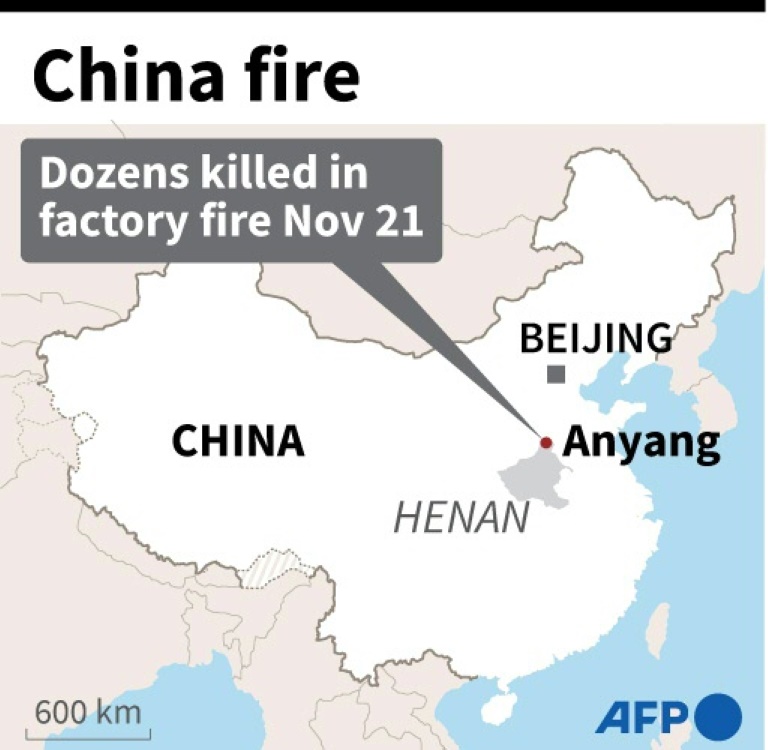
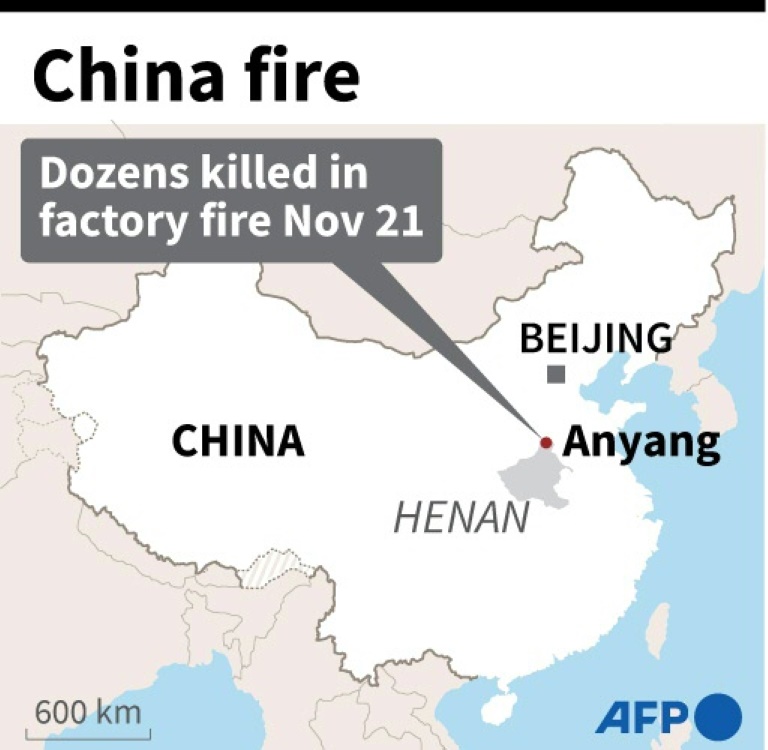
Thirty-six people were killed and two are missing after a fire at a plant in central China, state media said Tuesday, citing local authorities.

The fire took place “at a plant in Anyang City, central China’s Henan Province on Monday afternoon”, news agency Xinhua reported without sharing further details. 

State media said rescue services first received reports of a fire at 4:22 pm (0822 GMT) at Kaixinda Trading Co., Ltd.

“After receiving the alarm, the municipal fire rescue detachment immediately dispatched forces to the scene,” CCTV reported.

“Public security, emergency response, municipal administration, and power supply units rushed to the scene at the same time to carry out emergency handling and rescue work,” it said, adding the fire had been extinguished by around 11 pm local time.

In addition to the dead and missing, two are in hospital with non-life-threatening injuries, CCTV added.

Authorities said “criminal suspects” had been taken into custody in connection with the fire, but did not provide further details.

Industrial accidents are common in China due to weak safety standards and corruption among officials tasked with enforcing them.

In June, one person was killed and another injured in an explosion at a chemical plant in Shanghai. 

The fire at a Sinopec Shanghai Petrochemical Co. plant in the outlying Jinshan district sent thick clouds of smoke over a vast industrial zone as three fires blazed in separate locations, turning the sky black. 

And last year, a gas blast killed 25 people and reduced several buildings to rubble in the central city of Shiyan.

In March 2019, an explosion at a chemical factory in Yancheng, located 260 kilometres (161 miles) from Shanghai, killed 78 people and devastated homes in a several-kilometre radius.

Four years prior, a giant explosion in northern Tianjin at a chemical warehouse killed 165 people, one of China’s worst-ever industrial accidents. 

36 killed in central China factory fire: state media

Thirty-six people were killed and two are missing after a fire at a plant in central China, state media said Tuesday, citing local authorities.

The fire took place “at a plant in Anyang City, central China’s Henan Province on Monday afternoon”, news agency Xinhua reported without sharing further details. 

State media said rescue services first received reports of a fire at 4:22 pm (0822 GMT) at Kaixinda Trading Co., Ltd.

“After receiving the alarm, the municipal fire rescue detachment immediately dispatched forces to the scene,” CCTV reported.

“Public security, emergency response, municipal administration, and power supply units rushed to the scene at the same time to carry out emergency handling and rescue work,” it said, adding the fire had been extinguished by around 11 pm local time.

In addition to the dead and missing, two are in hospital with non-life-threatening injuries, CCTV added.

Authorities said “criminal suspects” had been taken into custody in connection with the fire, but did not provide further details.

Industrial accidents are common in China due to weak safety standards and corruption among officials tasked with enforcing them.

In June, one person was killed and another injured in an explosion at a chemical plant in Shanghai. 

The fire at a Sinopec Shanghai Petrochemical Co. plant in the outlying Jinshan district sent thick clouds of smoke over a vast industrial zone as three fires blazed in separate locations, turning the sky black. 

And last year, a gas blast killed 25 people and reduced several buildings to rubble in the central city of Shiyan.

In March 2019, an explosion at a chemical factory in Yancheng, located 260 kilometres (161 miles) from Shanghai, killed 78 people and devastated homes in a several-kilometre radius.

Four years prior, a giant explosion in northern Tianjin at a chemical warehouse killed 165 people, one of China’s worst-ever industrial accidents. 

IMF approves 530-mn-euro loan for North Macedonia

The International Monetary Fund on Monday announced it had approved a deal to give North Macedonia access to 530 million euros to help the country recover from the coronavirus pandemic and knock-on effects from the war in Ukraine.

Under the two-year arrangement, the Washington-based global lender will immediately disburse 110 million euros, to be followed by multiple follow-up disbursements provided Skopje adheres to the terms of the accord, the IMF said.

“North Macedonia has been hit by two consecutive global shocks. While recovering from the pandemic, the outlook deteriorated again following Russia’s invasion of Ukraine and sharply rising global commodity prices,” it said in a statement.

The IMF’s acting chair Bo Li hailed the country’s “sound policy framework” ahead of the pandemic, saying it had “fostered solid and broad-based growth, with moderate public debt and external current account deficits.”

“However, the macroeconomic situation deteriorated substantially due to the pandemic and the commodity price shock,” he added.

The IMF voiced confidence that North Macedonia would emerge from its so-called Precautionary Liquidity Line (PLL) program when the deal expires in 2024.

North Macedonia officially launched its membership negotiations with the European Union in July, 17 years after being named a candidate. 

Macedonia declared independence from Yugoslavia in 1991 and changed its name to North Macedonia in 2018 to overcome a bitter dispute with EU member state Greece.

Both that spat and a raft of complaints from Bulgaria about recognition of North Macedonia’s history, culture and language had blocked Skopje’s EU path.

Paramount says ending Simon&Schuster/Penguin deal after US antitrust ruling

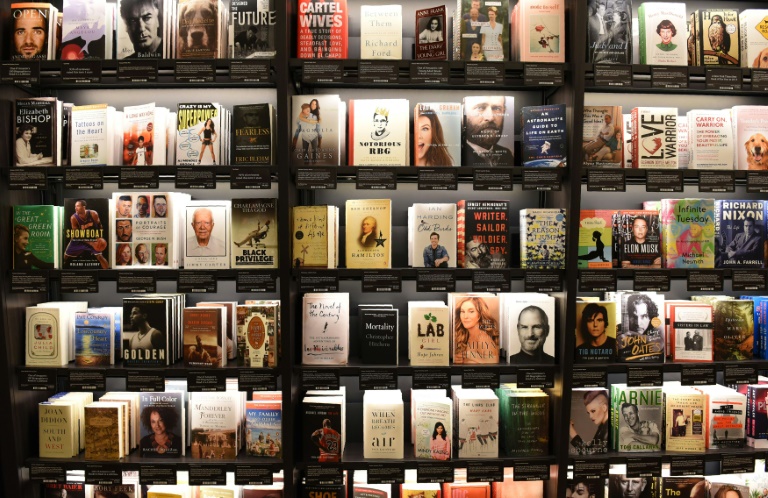
Paramount Global on Monday officially dropped a plan to sell its Simon & Schuster division to rival publisher Penguin Random House after a US judge blocked the $2.2 billion deal on antitrust grounds.

Paramount, formally known as ViacomCBS, said the transaction was “terminated” following the October 31 US judicial ruling against the deal. 

Penguin Random House, a subsidiary of the German Bertelsmann Group, must pay a $200 million termination fee, Paramount said.

The firm signaled it still intends to divest the unit, calling it “a non-core asset.”

“Simon & Schuster is a highly valuable business with a recent record of strong performance; however, it is not video-based and therefore does not fit strategically within Paramount’s broader portfolio,” the statement said.

In challenging the deal, the US Justice Department had argued that allowing Penguin Random House, the largest book publisher in the world, to buy a  major competitor would enable it to “exert outsized influence over which books are published in the United States and how much authors are paid for their work.”

Bertlesmann had argued that the argument was based on an “inaccurate” reading of the market and that the merger would have been good for competition.

US District Court Judge Florence Pan concluded the government had shown the merger would substantially lessen competition “in the market for the US publishing rights to anticipated top-selling books.”

German company confirmed in a statement Monday that it had reversed a previous plan to appeal the US district court ruling.

But the firm said it remained confident in growing its book publishing business.

“Penguin Random House is part of the Global Content Strategy, one of our five strategic priorities,” said Bertelsmann Chief Executive Thomas Rabe. “Bertelsmann plans to achieve annual growth of five to ten percent in this area -– organically, but also through acquisitions.”

Bacterial infections the 'second leading cause of death worldwide'

Bacterial infections are the second leading cause of death worldwide, accounting for one in eight of all deaths in 2019, the first global estimate of their lethality revealed on Tuesday.

The massive new study, published in the Lancet journal, looked at deaths from 33 common bacterial pathogens and 11 types of infection across 204 countries and territories.

The pathogens were associated with 7.7 million deaths — 13.6 percent of the global total — in 2019, the year before the Covid-19 pandemic took off.

That made them the second-leading cause of death after ischaemic heart disease, which includes heart attacks, the study said.

Just five of the 33 bacteria were responsible for half of those deaths: Staphylococcus aureus, Escherichia coli, Streptococcus pneumoniae, Klebsiella pneumoniae and Pseudomonas aeruginosa.

S. aureus is a bacterium common in human skin and nostrils but behind a range of illnesses, while E. coli commonly causes food poisoning. 

The study was conducted under the framework of the Global Burden of Disease, a vast research programme funded by the Bill and Melinda Gates Foundation involving thousands of researchers across the world. 

“These new data for the first time reveal the full extent of the global public health challenge posed by bacterial infections,” said study co-author Christopher Murray, the director of US-based Institute for Health Metrics and Evaluation.

“It is of utmost importance to put these results on the radar of global health initiatives so that a deeper dive into these deadly pathogens can be conducted and proper investments are made to slash the number of deaths and infections.”

The research points to stark differences between poor and wealthy regions. 

In Sub-Saharan Africa, there were 230 deaths per 100,000 population from the bacterial infections.

That number fell to 52 per 100,000 in what the study called the “high-income super-region” which included countries in Western Europe, North America and Australasia.

The authors called for increased funding, including for new vaccines, to lessen the number of deaths, also warning against “unwarranted antibiotic use”.

Hand washing is among the measures advised to prevent infection.

Disney seeks old magic in return of ex-CEO

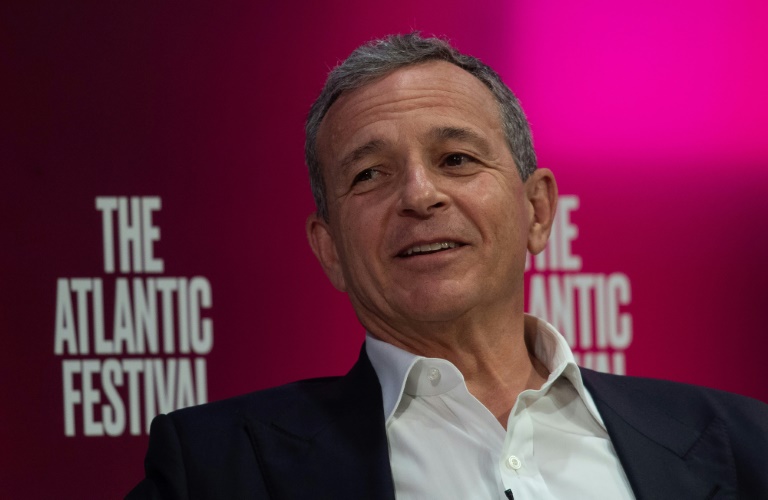
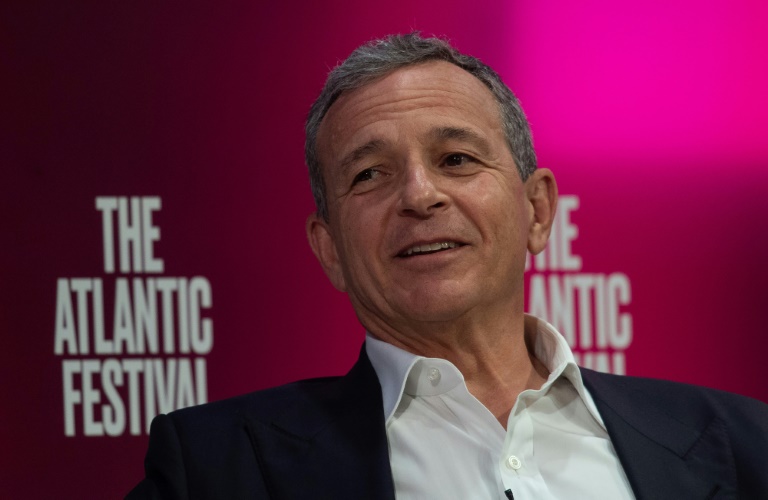
In a dramatic twist worthy of a “Star Wars” spin-off, Disney ditched CEO Bob Chapek and brought back Bob Iger, Hollywood’s most respected executive, who faces a huge challenge to revive the Magic Kingdom.

Iger’s return comes as Disney is trying to negotiate an uncertain era, where investors have lost faith in some of the most storied names in US media as companies bleed cash in the hunt for customers to streaming platforms.

Disney’s board of directors rehired Iger for a two-year contract that will add to the 15 years he ruled over the company until 2020, when he handed the reins to Chapek.

But Disney’s share price has slumped 40 percent this year and Chapek was unceremoniously fired after less than three years in the top job, much of it struggling to fill the big shoes left by Iger.

Iger’s leadership was extraordinary even by Hollywood’s standards.

The 71-year-old led Disney to new frontiers when he bought the Star Wars and Marvel franchises and launched the Disney+ streaming service to rival Netflix head-on.

He also bought 21 Century Fox from media baron Rupert Murdoch and held on to sports network ESPN despite calls to sell it, maintaining an empire that stretched from theme parks to local TV stations and cruise ships.

The return of Iger was cheered on by Wall Street, with Disney’s share price surging by six percent on Monday, and analysts recommending the stock for the first time since he exited the company.

– ‘Not guaranteed’ –

But some analysts were not so sure, warning that the world that Iger left in early 2020 — before Covid-19, before the streaming wars — had changed.

“The bold move might feel like the right one, however the business is at a different phase of growth,” said Paolo Pescatore, analyst at PP Foresight.

“It will take time and immediate success is not guaranteed.”

The core problem for Iger will be to turn a profit at Disney+ when, according to the latest figures in November, it burned through four billion dollars in just 12 months.

Launched in early 2020, Disney+ streams all that the Star Wars and Marvel franchises and Disney have to offer, releasing new content at a furious rate, but that weighs heavily on finances.

On the positive side, the Disney+ platform continues to gain subscribers and had 164 million customers at the end of September.

But the financial hole has put pressure on Disney’s other sectors: Theme parks and merchandising have succeeded for now to keep the Disney group in the green.

– ‘Expensive’ –

The pressure has grown worse as the economic outlook sours. 

Households are winnowing down entertainment subscriptions to just one or two, a cold reality that has seen the Netflix share price plummet by 50 percent in a year.

For Jonathan Kees of Daiwa Capital Markets America, Disney’s current troubles are also a result of choices made by Iger. 

“Iger pushed for the creation of Disney+, which has become an expensive business venture,” the analyst said. 

As for the 2019 purchase of 21st Century Fox, “that purchase alone loaded up the Disney balance sheet with an incredible amount of debt, which is not what investors are valuing in this current stock market.”

And even under the hugely respected Iger, Disney will face pressure from activist investors looking for quick results.

The Third Point fund, which increased its stake in Disney this summer, is among the most vocal on the matter. 

Dan Loeb, its founder and CEO, has previously demanded that Disney hive off the ESPN sports media business from the rest of the group before reversing his position.

And according to the Wall Street Journal, the return of Iger is decried by activist fund Trian, which acquired more than $800 million worth of Disney shares after the stock market tumbled after poor results.

“At the end of the day, it’s his legacy that’s at stake,” Pescatore said. 

Disney seeks old magic in return of ex-CEO

In a dramatic twist worthy of a “Star Wars” spin-off, Disney ditched CEO Bob Chapek and brought back Bob Iger, Hollywood’s most respected executive, who faces a huge challenge to revive the Magic Kingdom.

Iger’s return comes as Disney is trying to negotiate an uncertain era, where investors have lost faith in some of the most storied names in US media as companies bleed cash in the hunt for customers to streaming platforms.

Disney’s board of directors rehired Iger for a two-year contract that will add to the 15 years he ruled over the company until 2020, when he handed the reins to Chapek.

But Disney’s share price has slumped 40 percent this year and Chapek was unceremoniously fired after less than three years in the top job, much of it struggling to fill the big shoes left by Iger.

Iger’s leadership was extraordinary even by Hollywood’s standards.

The 71-year-old led Disney to new frontiers when he bought the Star Wars and Marvel franchises and launched the Disney+ streaming service to rival Netflix head-on.

He also bought 21 Century Fox from media baron Rupert Murdoch and held on to sports network ESPN despite calls to sell it, maintaining an empire that stretched from theme parks to local TV stations and cruise ships.

The return of Iger was cheered on by Wall Street, with Disney’s share price surging by six percent on Monday, and analysts recommending the stock for the first time since he exited the company.

– ‘Not guaranteed’ –

But some analysts were not so sure, warning that the world that Iger left in early 2020 — before Covid-19, before the streaming wars — had changed.

“The bold move might feel like the right one, however the business is at a different phase of growth,” said Paolo Pescatore, analyst at PP Foresight.

“It will take time and immediate success is not guaranteed.”

The core problem for Iger will be to turn a profit at Disney+ when, according to the latest figures in November, it burned through four billion dollars in just 12 months.

Launched in early 2020, Disney+ streams all that the Star Wars and Marvel franchises and Disney have to offer, releasing new content at a furious rate, but that weighs heavily on finances.

On the positive side, the Disney+ platform continues to gain subscribers and had 164 million customers at the end of September.

But the financial hole has put pressure on Disney’s other sectors: Theme parks and merchandising have succeeded for now to keep the Disney group in the green.

– ‘Expensive’ –

The pressure has grown worse as the economic outlook sours. 

Households are winnowing down entertainment subscriptions to just one or two, a cold reality that has seen the Netflix share price plummet by 50 percent in a year.

For Jonathan Kees of Daiwa Capital Markets America, Disney’s current troubles are also a result of choices made by Iger. 

“Iger pushed for the creation of Disney+, which has become an expensive business venture,” the analyst said. 

As for the 2019 purchase of 21st Century Fox, “that purchase alone loaded up the Disney balance sheet with an incredible amount of debt, which is not what investors are valuing in this current stock market.”

And even under the hugely respected Iger, Disney will face pressure from activist investors looking for quick results.

The Third Point fund, which increased its stake in Disney this summer, is among the most vocal on the matter. 

Dan Loeb, its founder and CEO, has previously demanded that Disney hive off the ESPN sports media business from the rest of the group before reversing his position.

And according to the Wall Street Journal, the return of Iger is decried by activist fund Trian, which acquired more than $800 million worth of Disney shares after the stock market tumbled after poor results.

“At the end of the day, it’s his legacy that’s at stake,” Pescatore said. 

Close Bitnami banner
Bitnami