AFP

'Toxic cover-up': UN draws red line around net zero greenwashing

The UN’s chief called Tuesday for an end to a “toxic cover-up” by companies as a sweeping report said they cannot claim to be net zero if they invest in new fossil fuels, cause deforestation or offset emissions instead of reducing them.

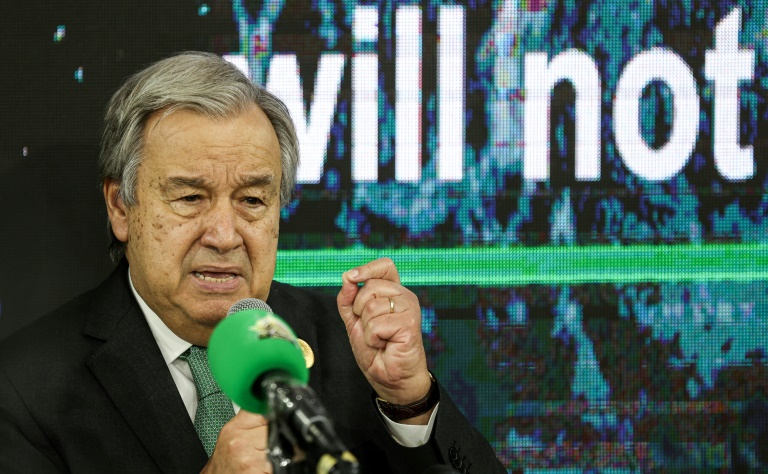
Antonio Guterres said businesses as well as cities and regions should update their voluntary net zero pledges within a year to comply with the recommendations by UN experts, as he trained his sights on fossil fuel firms and “their financial enablers”.

“Using bogus ‘net-zero’ pledges to cover up massive fossil fuel expansion is reprehensible. It is rank deception,” he said at the launch of the report at the COP27 conference in Egypt.  

“This toxic cover-up could push our world over the climate cliff. The sham must end.”

The UN expert panel, convened by Guterres after UN climate talks in Glasgow last year, set its sights on drawing a “red line” around greenwashing in net zero targets from companies, cities and regions.

A huge surge in decarbonisation pledges in recent months means that around 90 percent of the global economy is now covered by some sort of promise of carbon neutrality, according to Net Zero Tracker.      

“It’s very easy to make an announcement that you are going to be net zero by 2050. But you have to walk the talk and what we’ve seen is that there is not enough action,” said Catherine McKenna, Canada’s former environment and climate change minister, who led the panel.

“We have to do two things to reach net zero — we need to drastically reduce emissions, and we need to invest in clean (energy),” she told AFP.

She added it was currently “extremely hard” to properly evaluate whether firms were cutting emissions and called for greater transparency. 

The report lists a slew of recommendations, including calling on governments to begin putting in place binding regulations.  

– ‘Do the work’ –

A central recommendation from the panel is that net zero plans must be in line with the Paris Agreement’s most ambitious aim of limiting global warming to 1.5 degrees Celsius above pre-industrial temperatures. 

But to do that UN scientists say that global emissions must be slashed virtually in half by 2030, and after that they should be reduced to net zero by 2050. 

There have been growing concerns that some firms have not aligned their efforts with the latest climate science — by failing to account for emissions from key activities, or by saying they can make up for increasing pollution today with “carbon credits” from activities like tree planting.    

The report recommends that credits should not be used to “offset” emissions, until after a firm has done everything possible to cut emissions in line with the 1.5C target and that if they are used at all they should be from a reliable and verified source. 

“The reality is you can’t offset your way to net zero,” McKenna told AFP. 

“You don’t get an A for showing up in class. You get an A for doing the work and you can’t pay someone else to do it, you have got to do it yourself.”

The report added that net zero pledges should include short term targets every five years, beginning in 2025.

It stressed that these should cover all greenhouse gas emissions from all activities — including supply chains for businesses and investments for financial institutions. 

– ‘Watershed moment’ –

Net zero is “entirely incompatible” with any new fossil fuel investment, the report said, although McKenna said oil and gas companies could still have these pledges if they swiftly transition to renewables.

Firms would also not be able to continue activities that result in deforestation and still claim they are decarbonising.

“We find that too often too many businesses continue to rely on business models that result in the destruction of natural ecosystems,” said panel member Arunabha Ghosh, of the Council on Energy Environment and Water, a think tank.

“We want to show that any company doing this is working against net zero.”

The report also said businesses with net zero plans should not lobby against climate action.

“Today’s announcement is a watershed moment when it comes to corporate lobbying on climate policy, which has long stymied action from governments,” said Will Aitchison of the think tank InfluenceMap.

In September, an analysis by CDP, a non-profit that runs a global disclosure system for companies to manage their environmental impacts, found that the decarbonisation plans of major corporations from G7 nations put Earth on course to heat a potentially catastrophic 2.7C.
Adidas names CEO of rival Puma as new boss

Adidas on Tuesday named Bjorn Gulden, chief of rival outfitter Puma, as its new CEO as the German sportswear giant seeks to emerge from months of turbulence.

The Norwegian former professional football and handball player will take on the role from January next year, replacing current CEO Kasper Rorsted. 

He faces big challenges at Adidas, which has seen sales hit by coronavirus restrictions in key market China, and recently ended a profitable partnership with rapper Kanye West over his anti-Semitic outbursts.

“As CEO of Puma, he re-invigorated the brand and led the company to record results… Gulden will head Adidas into a new era of strength,” said Thomas Rabe, chairman of Adidas’s supervisory board. 

He “brings almost 30 years of experience in the sporting goods and footwear industry,” Rabe added. 

The 57-year-old is being given a five-year contract, an Adidas spokesman said.

Puma meanwhile announced that Arne Freundt, currently the company’s chief commercial officer, would take over as CEO with immediate effect. 

The sportswear groups, both based in the small town Herzogenaurach, Bavaria, were founded decades ago by two brothers, Adolf and Rudolf Dassler, who had a fierce rivalry.

Gulden, 57, had already spent seven years at Adidas in the 1990s. He has also held senior roles at companies including shoe retailer Deichmann and clothing and sports equipment company Helly Hansen.

He used to play football for FC Nuremberg in Germany, and Bryne and Stromsgodset in Norway.

– Tough task ahead –

In July, Adidas lowered its outlook for 2022 due in part to continuing curbs in China, which is pursuing a Covid-zero strategy of continued lockdowns.

The group said it sees net profit for the year coming in at 1.3 billion euros ($1.3 billion) compared to an earlier forecast of between 1.8 and 1.9 billion euros. 

The move to cut ties with rapper West — now known formally as Ye — in October came after he triggered an outcry with posts that Adidas labelled “unacceptable, hateful and dangerous”.

Adidas ended production of the highly successful “Yeezy” line designed together with West, a move that would slash the company’s net income in 2022 by “up to 250 million euros”.

West also triggered controversy when he appeared at a Paris fashion show wearing a shirt emblazoned with “White Lives Matter”, a slogan created as a part of a backlash to the Black Lives Matter movement.

Gulden’s “success at reinvigorating Puma will be relevant for Adidas and we expect him to hit the ground fast”, Deutsche Bank analysts said.

While noting the task ahead was “not easy… the Adidas brand is large and has a substantial back catalogue of designs and franchises. 

“We think with a positive energy injection from senior management a resurgence in the brand over the next three years is feasible.”

Adidas names CEO of rival Puma as new boss

Adidas on Tuesday named Bjorn Gulden, chief of rival outfitter Puma, as its new CEO as the German sportswear giant seeks to emerge from months of turbulence.

Gulden, a Norwegian former professional football and handball player, will take on the role from January next year, replacing current CEO Kasper Rorsted, Adidas said. 

The 57-year-old “brings almost 30 years of experience in the sporting goods and footwear industry,” said Thomas Rabe, chairman of the supervisory board of Adidas. 

“As CEO of Puma, he re-invigorated the brand and led the company to record results… Gulden will head Adidas into a new era of strength”.

Adidas has faced months of turmoil which have hit sales. The company lowered its outlook for 2022 in July due in part to continuing severe coronavirus restrictions in key market China.

The group also cut ties with Kanye West at the end of October after a series of anti-Semitic tweets by the rapper caused an outcry.

Adidas ended production of the highly successful “Yeezy” line designed together with West, a move that would slash the company’s net income in 2022 by “up to 250 million euros ($246 million)”.

Both Adidas and Puma are based in the Bavarian town of Herzogenaurach, close to Nuremberg.

The twin companies were founded by two brothers. Adolf Dassler began Adidas before his brother, Rudolf, with whom he had a fierce rivalry, established Puma.

Resolution of N.Ireland trade row possible before year-end: Dublin

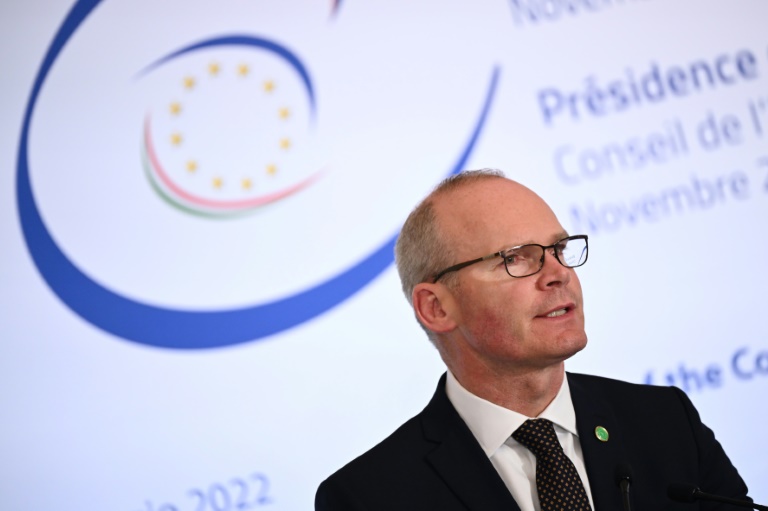
A deal between the EU and the UK on post-Brexit trading arrangements in Northern Ireland is possible before the end of the year, Ireland’s foreign minister said on Tuesday.

Simon Coveney’s optimism comes as the governments in Dublin and London prepare for talks at a British-Irish summit later this week.

Europe’s pointman on talks to resolve the row, Maros Sefcovic, on Monday said agreement could come within weeks with the right “political will”.

Ireland’s prime minister Micheal Martin will meet his UK counterpart Rishi Sunak at the summit in Blackpool, northwest England, on Thursday, Coveney added.

“We need to get this issue behind us in terms of the protocol in a way that respects an international treaty that’s been signed,” he said.

“I think it’s doable by the end of the year,” he told reporters in Dublin, stopping short of a definitive timeline for talks.

Relations between EU member Ireland and the UK, which left the bloc in 2021, have been damaged by disagreements over the implementation of trade arrangements in UK-run Northern Ireland. 

The deal signed by London and Brussels effectively keeps Northern Ireland within the European single market and customs union.

Northern Ireland has the UK’s only land border with the EU but it needs to be kept open under the terms of a 1998 peace deal that ended decades of violence over British rule.

It has led to checks on goods heading to the province from Great Britain — England, Scotland and Wales — which the UK and pro-UK parties in Northern Ireland oppose.

The UK wants to unilaterally overhaul the protocol through legislation currently making its way though parliament despite EU warnings it could spark reprisals and a possible trade war.

Coveney said this week’s summit would also give the UK the opportunity to provide “some clarity” on its approach to elections in Northern Ireland.

Last week, London backtracked on calling a December election to the region’s devolved assembly, which has been paralysed since February over unionist opposition to the Northern Ireland protocol.

The Democratic Unionist Party (DUP), the largest pro-UK party in the province, wants the arrangements overhauled or scrapped entirely, saying they threaten Northern Ireland’s constitutional place in the UK.

Coveney called for compromise on all sides, including in the DUP and said talks were the way forward.

In London, Sunak and his senior ministers agreed that restoring the Belfast assembly and protecting the Good Friday Agreement was their “absolute priority”.

Northern Ireland Secretary Chris Heaton-Harris told his colleagues he had carried out “extensive engagement” in the region in recent days, Sunak’s office said in a statement.

He was expected to outline his “informed approach” based on those discussions to parliament on Wednesday, it added.

S.Africa slams 'out of reach' climate aid for poorer nations

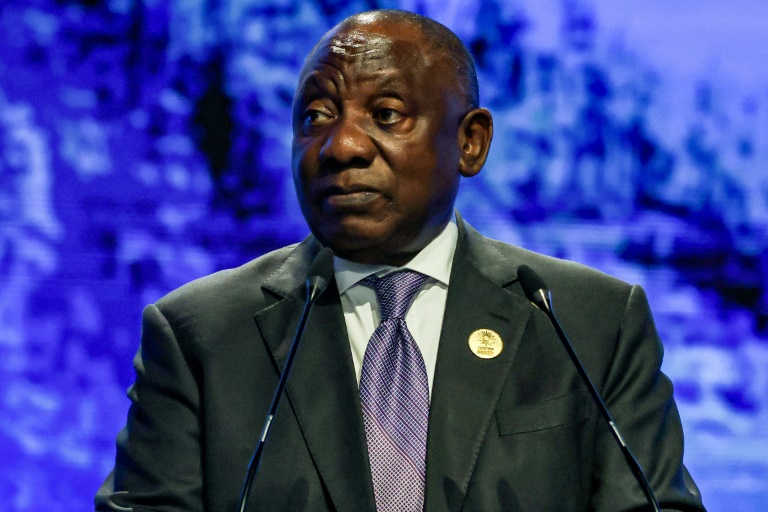
South Africa’s president, whose coal-dependent country is among the world’s biggest polluters, Tuesday criticised international funders for making it difficult for poorer nations to access aid to fight climate change.

Support from multilateral organisations “is out of reach of the majority of the world’s population due to lending policies that are risk-averse and carry onerous costs as well as conditionalities,” Cyril Ramaphosa told the UN COP27 climate summit.

Addressing the meeting in Egypt’s Sharm el-Sheikh, he said “funding institutions need to transform … the way in which they fund projects that will enable us to develop with regard to climate change”.

According to a UN-backed report released Tuesday, developing countries and emerging economies need investments well beyond $2 trillion annually by 2030 if the world is to stop the global warming juggernaut.

South Africa, one of the world’s top 12 polluters, last week revealed that it will require about $98 billion over the next five years to transition to net zero.

Last year, at the COP26 in Glasgow, Pretoria secured $8.5 billion in loans and grants from a group of rich countries towards its green transition.

“We need a clear roadmap to deliver on the Glasgow decision to double adaptation financing by 2025” Ramaphosa said in his address.

He called on rich nations to honour their commitments “because failing to honour these commitments breaks trust and confidence in the process”.

The head of state also assured the summit that South Africa, which generates about 80 percent of its electricity through coal, was on course to retire several of its ageing coal-fired power plants in the next eight years.

The World Bank last week granted South Africa $497 million to decommission one of its largest coal-fired power plants and promote renewable energy.

South Africa will require at least $500 billion dollars to achieve carbon neutrality by 2050, according to the bank.

burs-zam/sn/fz

Renault unveils sweeping overhaul for electric future

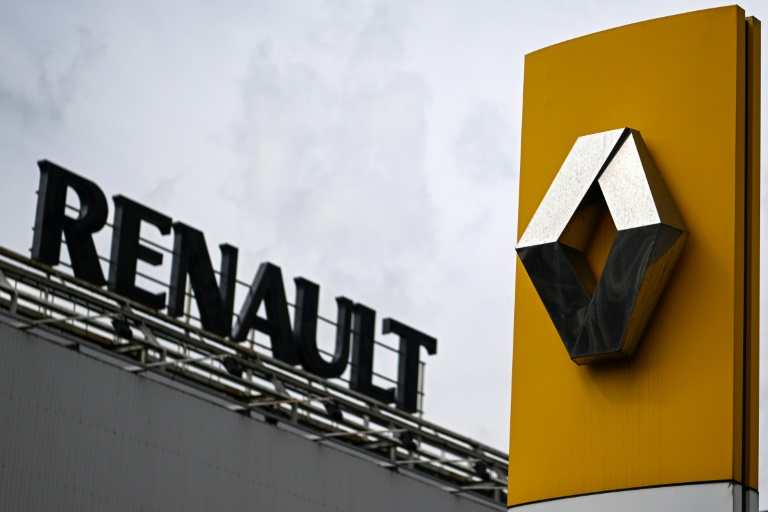
French automaker Renault unveiled a sweeping overhaul on Tuesday in a bid to attract investors as it expands its electric vehicle business amid an accelerating market.

Under the green revamp, Renault is to split its operations in two, with a new electric vehicle unit and a subsidiary for petrol, diesel and hybrid cars that will pair up with China’s Geely. 

The carmaker’s flagship division following the reorganisation will be Ampere, which aims to produce a million electric vehicles by 2031, the group said ahead of an investor day in Paris.

The new division will employ around 10,000 staff in France.

Renault is the latest automaker seeking to finance a shift towards electric.

The market for the greener vehicles is expected to grow rapidly in response to consumers’ worries about climate change, putting pressure on manufacturers to develop less polluting products.

The European Union last month agreed to phase out new CO2-emitting vehicles by 2035, a move set to turbo-charge the production of electric prototypes on the continent.

Renault follows the likes of US automaker Ford and Germany’s Volkswagen.

The latter launched its premium sports brand Porsche on the stock market in September to finance its investment in electric, connected and autonomous cars.

Ampere will produce the new Renault 5 and Renault 4 among other models in northern France and will target more than 30-percent growth annually over the next eight years and to break even by 2025.

Renault said it would list Ampere on the Euronext Paris stock exchange in the latter half of 2023 and invite investment but will retain “a strong majority”.

The group — in which the French state and carmaker Nissan each own 15 percent — has still to outline the part that its Japanese partner will play in the new electric division.

– Financing electric drive – 

For hybrid and internal-combustion vehicles, Renault plans to combine its technological, manufacturing and research and development activities with Chinese automaker Geely.

The 50-50 partnership with the Chinese group — owner of Volvo — will develop and produce engines, gear boxes and other components for hybrid and petrol and diesel vehicles.

It will employ 19,000 people across Europe, China and South America, and have 17 factories and five research and development centres.

Turnover for the division is expected to grow by four percent by 2027, the group said.

“We are designing an agile and innovative organisation to manage the volatility and accelerated technological evolution of our time,” said Renault chief executive Luca de Meo.

The group aims to see an operating margin — a key profitability yardstick — of above eight percent in 2025.

Shares in Renault fell on the Paris exchange shortly after trading began on Tuesday, before regaining ground by mid-morning. 

The group’s financial targets are “more ambitious than expected” but “raise questions”, analyst Tom Narayan of RBC said.

The company suffered a historic loss in 2020 due to the Covid-19 pandemic and its recovery was destabilised by its withdrawal from Russia following Moscow’s invasion of Ukraine.

In late July, Renault said that its decision to quit the Russian market had pushed it deep into the red in the first half of 2022.

Two months earlier, it had sold its 100-percent stake in Renault Russia and its 68-percent stake in AVTOVAZ. 

But with its new revamp, Renault said it planned to resume paying shareholders a dividend next year for the first time since 2019. 

The value of traditional car manufacturers pales in comparison to new players on the market specialising in electric vehicles such as Elon Musk’s Tesla or Chinese firm BYD.

US giant Ford has taken similar steps, announcing the creation of the “Model E” electric subsidiary earlier this year.

Renault’s sales of traditional internal-combustion vehicles are falling. 

In the first nine months of 2022, hybrid and electric vehicles represented 38 percent of the brand’s registrations in Europe, a year-on-year increase of 12 percent.

The separation of Renault’s electric and conventional production has concerned trade unions after several waves of job cuts.

EU leader's speech to major China trade expo cancelled: diplomats

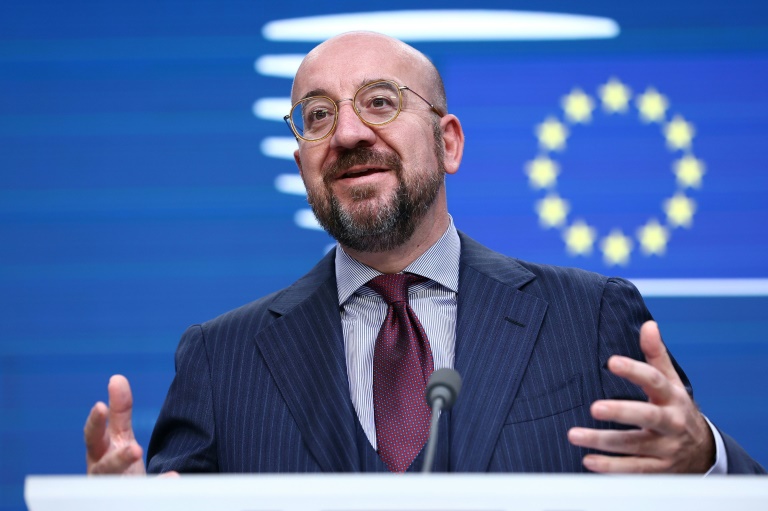
A speech by EU Council head Charles Michel scheduled to be broadcast at the opening of a major Chinese trade fair was abruptly cancelled due to wrangling over censorship, diplomats told AFP Tuesday.

The pre-recorded video address was meant to be shown at Friday’s opening of the China International Import Expo (CIIE) in Shanghai, but Michel’s spokesman and three Beijing-based diplomats confirmed it was not broadcast. 

“The Chinese wanted to censor parts of Charles Michel’s speech. Brussels preferred to cancel the speech altogether instead,” one European diplomat told AFP, requesting anonymity due to the sensitivity of the matter. 

Another European diplomat said Chinese authorities wanted to censor all parts of Michel’s speech about the Ukraine crisis, a sensitive issue for Beijing. China seeks to position itself as neutral in the crisis but has offered diplomatic backing to its strategic ally Russia.

The second diplomat said the EU had asked to discuss the censorship but the Chinese side refused, so the video address was cancelled.  

China’s foreign ministry spokesman Zhao Lijian denied any knowledge of the matter during a routine media briefing Tuesday.

Michel’s spokesman Barend Leyts told AFP the EU leader had been invited to address the 5th Hongqiao Forum/CIIE in Shanghai.

“As requested by the Chinese authorities, we had indeed provided a pre-recorded message which was ultimately not shown,” Leyts said.

“We have addressed this through the normal diplomatic channels.”

China-EU relations have deteriorated rapidly since both sides traded sanctions last year over China’s alleged human rights abuses in its Xinjiang region.

Beijing later slapped a trade embargo on virtually all Lithuanian goods in response to Vilnius’ deepening ties with Taiwan, a self-ruled island that China claims as its own territory. 

Since Russia invaded Ukraine in February, European Union leaders have repeatedly lobbied China to condemn Moscow’s actions and withdraw its support for Russia, but to little avail.

The bloc officially considers China a “partner, economic competitor and systemic rival” according to a formulation adopted in 2019. 

Michel, who is president of the EU body consisting of heads of member states, will attend next week’s G20 leaders’ summit in Bali along with senior EU official Ursula von der Leyen and Chinese President Xi Jinping.

Trade ties with China are still important to certain members of the bloc, with German Chancellor Olaf Scholz last week becoming the first G7 leader to visit China in person since the beginning of the Covid pandemic. 

Global markets mixed ahead of US midterms

Asian and European stock markets traded mixed Tuesday in jittery deals as Americans head to the polls in critical midterm elections.

The dollar clawed back some of its recent losses versus the euro, while oil continued to be weighed down by weaker Chinese demand expectations.

Frankfurt stocks gained ground after overnight Wall Street gains, but Paris flatlined and London slid in value.

“Those US midterm elections today might keep investors on the sidelines a bit before they make any major decisions,” noted Markets.com analyst Neil Wilson.

Hong Kong and Shanghai sank as speculation about a rollback of China’s strict zero-Covid policies fuelled market volatility, even after Beijing vowed to stick with its harsh lockdowns and testing regimes.

On the upside, Tokyo stocks won 1.3 percent.

Polls opened Tuesday in crucial US elections that could decide the political future of both President Joe Biden and his predecessor Donald Trump — who has all but announced he will seek the White House again in 2024.

Biden’s Democrats are facing a gargantuan struggle to hang on to Congress, after a race the president has cast as a “defining” moment for US democracy — while Trump’s Republicans have campaigned hard on kitchen-table issues like inflation and crime.

Polls show Republicans are likely to win at least one house of Congress — and some see the prospect of further Washington gridlock as a scenario that lessens the risk of policy uncertainty.

“Consensus is that investors prefer political deadlock as it prevents any significant shifts in policy,” added Scope Markets analyst James Hughes.

“With that looking like a real possibility, the real market turbulence may appear later in the week.”

– US on inflation watch –

On Monday, US stocks climbed, with the Dow Jones Industrial Average finishing up 1.3 percent and the broad-based S&P 500 rising 1.0 percent.

The next major data point that investors are watching is US inflation data due on Thursday.

SPI Asset Management analyst Stephen Innes said the data “will be the next marker for the (Federal Reserve) on how high to take interest rates”.

Back in Asia, Hong Kong closed down 0.2 percent after jumping nearly three percent in the previous session as investors continued to hope for a relaxation of China’s strict Covid-19 rules.

“Speculation about reopening continues to add some market volatility,” said Taylor Nugent, an economist at National Australia Bank.

“In a timely reminder of the potential for Covid policy to hit output, Apple warned iPhone shipments will be lower than previously expected after China lockdowns affected operations at a supplier’s factory,” he noted.

– Key figures around 1130 GMT –

London – FTSE 100: DOWN 0.1 percent at 7,293.16 points

Paris – CAC 40: FLAT at 6,416.83

Frankfurt – DAX: UP 0.4 percent at 13,581.88

EURO STOXX 50: UP 0.3 percent at 3,722.09

Tokyo – Nikkei 225: UP 1.3 percent at 27,872.11 (close)

Hong Kong – Hang Seng Index: DOWN 0.2 percent at 16,557.31 (close)

Shanghai – Composite: DOWN 0.4 percent at 3,064.49 (close)

New York – Dow: UP 1.3 percent at 32,827.00 (close)

Pound/dollar: DOWN at $1.1468 from $1.1514 on Monday

Euro/dollar: DOWN at $1.0005 from $1.0020

Dollar/yen: DOWN at 146.26 from 146.93 yen

Euro/pound: UP at 87.23 pence from 87.03 pence

West Texas Intermediate: DOWN 1.2 percent at $90.70 per barrel

Brent North Sea crude: DOWN 0.7 percent at $97.25 per barrel

Global markets mixed ahead of US midterms

Asian and European stock markets traded mixed Tuesday in jittery deals as Americans head to the polls in critical midterm elections.

The dollar clawed back some of its recent losses versus the euro, while oil continued to be weighed down by weaker Chinese demand expectations.

Frankfurt stocks gained ground after overnight Wall Street gains, but Paris flatlined and London slid in value.

“Those US midterm elections today might keep investors on the sidelines a bit before they make any major decisions,” noted Markets.com analyst Neil Wilson.

Hong Kong and Shanghai sank as speculation about a rollback of China’s strict zero-Covid policies fuelled market volatility, even after Beijing vowed to stick with its harsh lockdowns and testing regimes.

On the upside, Tokyo stocks won 1.3 percent.

Polls opened Tuesday in crucial US elections that could decide the political future of both President Joe Biden and his predecessor Donald Trump — who has all but announced he will seek the White House again in 2024.

Biden’s Democrats are facing a gargantuan struggle to hang on to Congress, after a race the president has cast as a “defining” moment for US democracy — while Trump’s Republicans have campaigned hard on kitchen-table issues like inflation and crime.

Polls show Republicans are likely to win at least one house of Congress — and some see the prospect of further Washington gridlock as a scenario that lessens the risk of policy uncertainty.

“Consensus is that investors prefer political deadlock as it prevents any significant shifts in policy,” added Scope Markets analyst James Hughes.

“With that looking like a real possibility, the real market turbulence may appear later in the week.”

– US on inflation watch –

On Monday, US stocks climbed, with the Dow Jones Industrial Average finishing up 1.3 percent and the broad-based S&P 500 rising 1.0 percent.

The next major data point that investors are watching is US inflation data due on Thursday.

SPI Asset Management analyst Stephen Innes said the data “will be the next marker for the (Federal Reserve) on how high to take interest rates”.

Back in Asia, Hong Kong closed down 0.2 percent after jumping nearly three percent in the previous session as investors continued to hope for a relaxation of China’s strict Covid-19 rules.

“Speculation about reopening continues to add some market volatility,” said Taylor Nugent, an economist at National Australia Bank.

“In a timely reminder of the potential for Covid policy to hit output, Apple warned iPhone shipments will be lower than previously expected after China lockdowns affected operations at a supplier’s factory,” he noted.

– Key figures around 1130 GMT –

London – FTSE 100: DOWN 0.1 percent at 7,293.16 points

Paris – CAC 40: FLAT at 6,416.83

Frankfurt – DAX: UP 0.4 percent at 13,581.88

EURO STOXX 50: UP 0.3 percent at 3,722.09

Tokyo – Nikkei 225: UP 1.3 percent at 27,872.11 (close)

Hong Kong – Hang Seng Index: DOWN 0.2 percent at 16,557.31 (close)

Shanghai – Composite: DOWN 0.4 percent at 3,064.49 (close)

New York – Dow: UP 1.3 percent at 32,827.00 (close)

Pound/dollar: DOWN at $1.1468 from $1.1514 on Monday

Euro/dollar: DOWN at $1.0005 from $1.0020

Dollar/yen: DOWN at 146.26 from 146.93 yen

Euro/pound: UP at 87.23 pence from 87.03 pence

West Texas Intermediate: DOWN 1.2 percent at $90.70 per barrel

Brent North Sea crude: DOWN 0.7 percent at $97.25 per barrel

US votes with Biden agenda at stake — and Trump in the wings

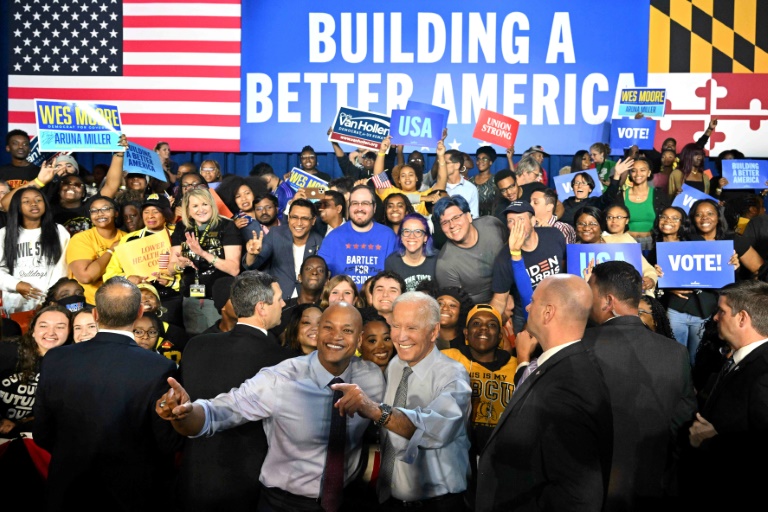
Polls opened Tuesday in crucial US midterm elections that could decide the political future of both President Joe Biden and his predecessor Donald Trump — who has all but announced he will seek the White House again in 2024.

Biden’s Democrats are facing a gargantuan struggle to hang on to Congress, after a race the president has cast as a “defining” moment for US democracy — while Trump’s Republicans campaigned hard on kitchen-table issues like inflation and crime.

Trump — who has been heavily hinting at a new run — grabbed the election eve spotlight to flag “a big announcement” on November 15, while Biden made a final appeal to Democrats to turn out en masse at the polls.

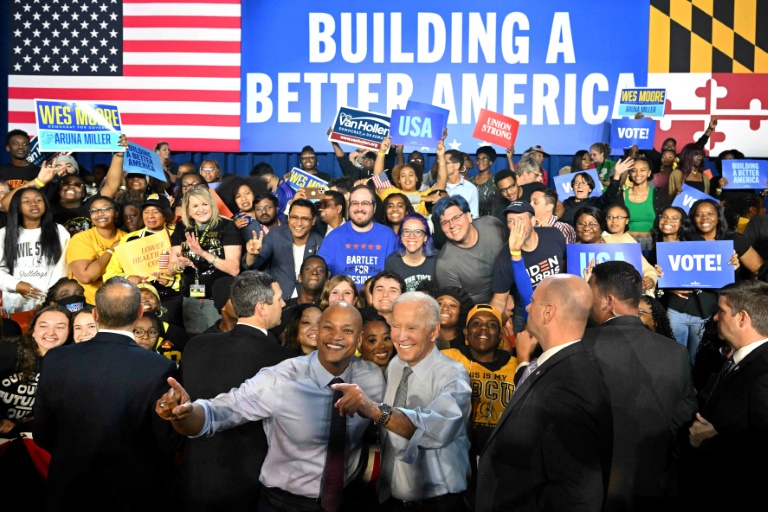
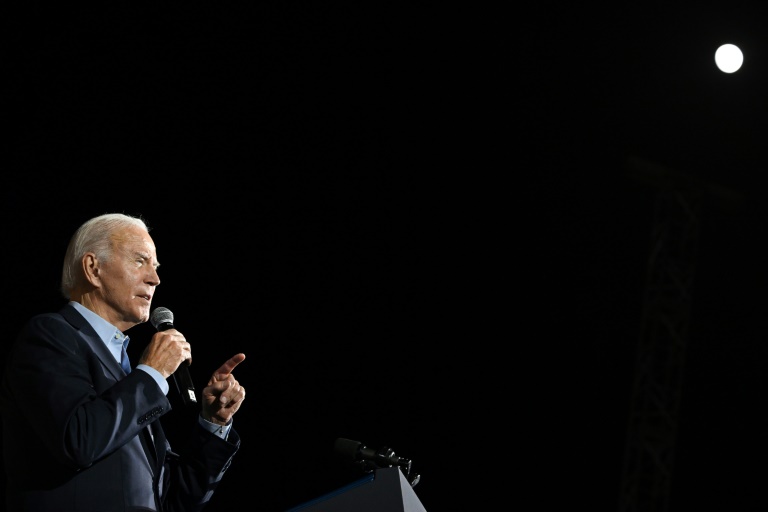
“The power’s in your hands,” Biden told a rally near the capital. “We know in our bones that our democracy is at risk and we know that this is your moment to defend it.”

With polls showing Republicans in line to seize the House of Representatives, the increasingly far-right party eyed snarling the rest of Biden’s first term in aggressive investigations and opposition to spending plans.

Returning to the White House Monday night, Biden told reporters he believed Democrats would win the Senate — though conceding “it’s going to be tough” to retain the House and that his life in Washington may become “more difficult.”

If both the House and Senate flip, Biden would be left as little more than a lame duck.

With Congress out of Democrats’ hands, he would see his legislative agenda collapse. 

That would raise questions over everything from climate crisis policies, which the president will be laying out at the COP27 conference in Egypt this week, to Ukraine, where Republicans are reluctant to maintain the current rate of US financial and military support.

An influx of far-right Trump backers in Congress would also accelerate the shift that has been taking place inside the Republican Party since the former real-estate tycoon stunned the world by defeating Hillary Clinton for the presidency in 2016.

Despite facing criminal probes over taking top secret documents from the White House and trying to overturn the 2020 election, Trump has been using the midterms to cement his status as the de facto Republican leader and presumptive presidential nominee.

In a typically dark, rambling speech to fans in Dayton, Ohio, Trump said, “if you support the decline and fall of America, then you must, you absolutely must vote for the radical left, crazy people.”

“If you want to stop the destruction of our country, then tomorrow you must vote Republican in a giant red wave,” he said — before teasing his 2024 announcement.

– Second Biden run? –

Across the country voters called on their fellow citizens to cast their ballot in the midterms, which historically have low turnout.

“I would emphasize vote, vote, vote,” 24-year-old student Luke Osuagwu told AFP in Atlanta, Georgia.

“If you’re not voting, you can’t really stand for society or anything like that,” agreed Alethia McClenton, a 45-year-old Georgia Aquarium employee. “It’s very important that everybody goes out to do their part.”

More than 40 million ballots were cast through early voting options, meaning the outcome had already begun to take shape before election day.

Polls started to open on the East Coast at 6:00 am (1100 GMT), and begin closing 12 hours later.

Up for grabs are all 435 House seats, a third of the 100 Senate seats, and a slew of state-level posts. Four states are also holding referendums on abortion — California, Vermont, Kentucky and Michigan.

Senate races in Pennsylvania, Nevada, Arizona, Georgia, Wisconsin, New Hampshire and Ohio have narrowed to projected photo finishes, and any one of them could swing the balance of power.

But final results may not be known until days — or in some cases even weeks — after election day, setting the stage for what promise to be acrimonious challenges.

Trump has already claimed baselessly that swing state Pennsylvania “rigged” the midterms — reprising his playbook from the 2020 election which he falsely asserted was stolen by Biden.

Citing growing support for voter conspiracy theories among Trump and his Republicans, as well as their push to curb abortion access, Biden has warned that democracy and basic rights are at stake on Tuesday.

Republicans have countered that a vote for Democrats means more soaring inflation and rising violent crime, seeking to make the midterms a referendum on the president.

The outcome will likely determine whether Biden, who turns 80 this month and is the oldest president ever, will seek a second term in 2024 — or step aside.

Close Bitnami banner
Bitnami