AFP

UAE, Egypt ink major wind energy deal on COP27 sidelines

The United Arab Emirates and Egypt agreed Tuesday to develop one of the world’s largest wind farms in a deal struck on the sidelines of the UN’s COP27 climate summit in Sharm el-Sheikh. 

The 10-gigawatt (GW) onshore wind project in Egypt will produce 47,790 GWh of clean energy annually once it is completed, the UAE’s state news agency WAM said in a statement, without specifying an exact timeframe. 

It will offset 23.8 million tonnes of carbon dioxide emissions – equivalent to around nine percent of Egypt’s current CO2 output, according to WAM.

The wind farm will also save Egypt an estimated $5 billion in annual natural gas costs and help create as many as 100,000 jobs, it said. 

Emirati President Sheikh Mohamed bin Zayed Al-Nahyan joined his Egyptian counterpart Abdel Fattah al-Sisi at the signing of the agreement between the UAE’s Masdar renewable energy firm and Egypt’s Infinity Power and Hassan Allam Utilities.

In a statement on Twitter, Sheikh Mohamed said the deal was “consistent with our commitment to advance renewable energy solutions that support sustainable development”.

The UN’s COP27 climate summit kicked off Sunday in Egypt with warnings against backsliding on efforts to cut emissions and calls for rich nations to compensate poor countries after a year of extreme weather disasters.  

“We will endeavour to take forward the gains made here at COP27, as the UAE prepares to host COP28 next year,” WAM quoted Emirati industry minister Sultan Ahmed Al Jaber as saying. 

COP28 will be held in the UAE from November 6-17, 2023. 

Renault unveils sweeping overhaul for electric future

French automaker Renault unveiled a sweeping green revamp Tuesday, splitting its operations in two: a new electric vehicle unit and a subsidiary for petrol, diesel and hybrid cars that will pair up with China’s Geely. 

The car maker’s flagship division following the reorganisation will be Ampere, which will aim to produce a million electric vehicles by 2031, the group said ahead of an investor day in Paris.

The new division will employ around 10,000 staff in France.

The overhaul comes amid expectations the electric vehicle market will grow rapidly in response to consumers’ worries about climate change, putting pressure on manufacturers to develop less polluting products.

The European Union last month agreed to phase out new CO2-emitting vehicles by 2035, a move set to turbo-charge the production of electric prototypes on the continent.

Ampere will produce the new Renault 5 and Renault 4 among other models in northern France and will target more than 30-percent growth annually over the next eight years.

Renault said it would list Ampere on the Euronext Paris stock exchange in the latter half of 2023 and invite investment but will retain “a strong majority”.

Renault — in which the French state and car maker Nissan each own 15 percent — has still to outline the part that its Japanese partner will play in the new electric division.

– Financing electric drive – 

For hybrid and internal-combustion vehicles, Renault plans to combine its technological, manufacturing and research and development activities with Chinese automaker Geely.

The 50-50 partnership with the Chinese group — owner of Volvo — will develop and produce engines, gear boxes and other components for hybrid and petrol and diesel vehicles.

It will employ 19,000 people across Europe, China and South America, and have 17 factories and five research and development centres.

“We are designing an agile and innovative organisation to manage the volatility and accelerated technological evolution of our time,” said Renault chief executive Luca de Meo.

Investors on Monday expressed their interest in Renault’s transformation, with the group’s shares climbing 3.77 percent on the Paris stock market.

The company suffered a historic loss in 2020 due to the Covid-19 pandemic and its recovery was destabilised by its withdrawal from Russia following Moscow’s invasion of Ukraine.

In late July, Renault said that its decision to quit the Russian market had pushed it deep into the red in the first half of 2022.

Two months earlier, it had sold its 100-percent stake in Renault Russia and its 68-percent stake in AVTOVAZ. 

But with its new revamp, Renault said it planned to resume paying shareholders a dividend next year for the first time since 2019. 

The value of traditional car manufacturers pales in comparison to new players on the market specialising in electric vehicles such as Elon Musk’s Tesla or Chinese firm BYD.

US giant Ford has taken similar steps, announcing the creation of the “Ford Model E” electric subsidiary earlier this year.

And German auto group Volkswagen launched its premium sports brand Porsche on the stock market to finance its investment in electric, connected and autonomous cars.

Renault’s sales of traditional internal-combustion vehicles are falling. 

In the first nine months of 2022, hybrid and electric vehicles represented 38 percent of the brand’s registrations in Europe, a year-on-year increase of 12 percent.

The planned separation of Renault’s electric and conventional production has concerned trade unions after several waves of job cuts.

Asian markets mixed ahead of US midterms

Asian markets were mixed on Tuesday following an upbeat session on Wall Street as investors look to crucial midterm elections that polls show could upend power in Washington.

Shares ended lower in Hong Kong and Shanghai as speculation about a rollback of China’s strict zero-Covid policies fuelled market volatility, even after the government vowed to stick with its harsh lockdowns and testing regimes.

But Tokyo stocks closed 1.3 percent higher, extending rallies in New York, where the dollar also retreated against the pound and the euro.

Early voting has begun in many states and most US voters go to the polls on Tuesday, with a Republican takeover of Congress likely dooming President Joe Biden’s ambitious proposals.

Polls show Republicans are likely to win at least one house of Congress — and some see the prospect of further Washington gridlock as a scenario that lessens the risk of policy uncertainty.

“This may very well be taken as a positive for equity markets over coming days,” Clifford Bennett, chief economist at ACY Securities, said in a note.

“The Biden administration, while welcomed to office by financial markets, has nonetheless delivered on being a very big spending government,” Bennett wrote.

“It is difficult to argue the extreme inflation and slowing economy are entirely the Biden administration’s fault, but voters will be very clear in their feelings on the matter just the same.”

– Not too bullish –

On Monday, US stocks climbed, with the Dow Jones Industrial Average finishing up 1.3 percent and the broad-based S&P 500 rising 1.0 percent.

The next major data point that investors are watching is US inflation data due on Thursday, “which will be the next marker for the (Federal Reserve) on how high to take interest rates”, said Stephen Innes of SPI Asset Management.

Before the US Consumer Price Index data is released, “traders are unlikely to live bullish life to the fullest”, he predicted.

Seoul gained 1.1 percent, Taipei rose 0.9 percent and Sydney was up 0.4 percent, with Singapore rising 0.3 percent.

But Hong Kong closed down 0.2 percent after jumping nearly three percent in the previous session as investors continued to hope for a relaxation of China’s strict Covid-19 rules.

“Speculation about reopening continues to add some market volatility,” said Taylor Nugent, an economist at National Australia Bank.

“In a timely reminder of the potential for Covid policy to hit output, Apple warned iPhone shipments will be lower than previously expected after China lockdowns affected operations at a supplier’s factory,” he noted.

Shanghai closed down 0.4 percent, while Jakarta fell 0.7 percent and Wellington dropped 1.2 percent.

European shares also fell in early trade. London was down 0.5 percent, Paris fell 0.4 percent and Frankfurt lost 0.1 percent.

– Key figures around 0830 GMT –

Tokyo – Nikkei 225: UP 1.3 percent at 27,872.11 (close)

Hong Kong – Hang Seng Index: DOWN 0.2 percent at 16,557.31 (close)

Shanghai – Composite: DOWN 0.4 percent at 3,064.49 (close)

London – FTSE 100: DOWN 0.5 percent at 7,266.12

Pound/dollar: DOWN at $1.1476 from $1.1513 on Monday

Euro/dollar: DOWN at $0.9997 from $1.0023

Dollar/yen: FLAT at 146.69 from 146.68 yen

Euro/pound: DOWN at 87.10 pence from 87.03 pence

West Texas Intermediate: DOWN 1.2 percent at $91.49 per barrel

Brent North Sea crude: DOWN 0.8 percent at $97.74 per barrel

New York – Dow: UP 1.3 percent at 32,827.00 (close)

Asian markets mixed ahead of US midterms

Asian markets were mixed on Tuesday following an upbeat session on Wall Street as investors look to crucial midterm elections that polls show could upend power in Washington.

Shares ended lower in Hong Kong and Shanghai as speculation about a rollback of China’s strict zero-Covid policies fuelled market volatility, even after the government vowed to stick with its harsh lockdowns and testing regimes.

But Tokyo stocks closed 1.3 percent higher, extending rallies in New York, where the dollar also retreated against the pound and the euro.

Early voting has begun in many states and most US voters go to the polls on Tuesday, with a Republican takeover of Congress likely dooming President Joe Biden’s ambitious proposals.

Polls show Republicans are likely to win at least one house of Congress — and some see the prospect of further Washington gridlock as a scenario that lessens the risk of policy uncertainty.

“This may very well be taken as a positive for equity markets over coming days,” Clifford Bennett, chief economist at ACY Securities, said in a note.

“The Biden administration, while welcomed to office by financial markets, has nonetheless delivered on being a very big spending government,” Bennett wrote.

“It is difficult to argue the extreme inflation and slowing economy are entirely the Biden administration’s fault, but voters will be very clear in their feelings on the matter just the same.”

– Not too bullish –

On Monday, US stocks climbed, with the Dow Jones Industrial Average finishing up 1.3 percent and the broad-based S&P 500 rising 1.0 percent.

The next major data point that investors are watching is US inflation data due on Thursday, “which will be the next marker for the (Federal Reserve) on how high to take interest rates”, said Stephen Innes of SPI Asset Management.

Before the US Consumer Price Index data is released, “traders are unlikely to live bullish life to the fullest”, he predicted.

Seoul gained 1.1 percent, Taipei rose 0.9 percent and Sydney was up 0.4 percent, with Singapore rising 0.3 percent.

But Hong Kong closed down 0.2 percent after jumping nearly three percent in the previous session as investors continued to hope for a relaxation of China’s strict Covid-19 rules.

“Speculation about reopening continues to add some market volatility,” said Taylor Nugent, an economist at National Australia Bank.

“In a timely reminder of the potential for Covid policy to hit output, Apple warned iPhone shipments will be lower than previously expected after China lockdowns affected operations at a supplier’s factory,” he noted.

Shanghai closed down 0.4 percent, while Jakarta fell 0.7 percent and Wellington dropped 1.2 percent.

European shares also fell in early trade. London was down 0.5 percent, Paris fell 0.4 percent and Frankfurt lost 0.1 percent.

– Key figures around 0830 GMT –

Tokyo – Nikkei 225: UP 1.3 percent at 27,872.11 (close)

Hong Kong – Hang Seng Index: DOWN 0.2 percent at 16,557.31 (close)

Shanghai – Composite: DOWN 0.4 percent at 3,064.49 (close)

London – FTSE 100: DOWN 0.5 percent at 7,266.12

Pound/dollar: DOWN at $1.1476 from $1.1513 on Monday

Euro/dollar: DOWN at $0.9997 from $1.0023

Dollar/yen: FLAT at 146.69 from 146.68 yen

Euro/pound: DOWN at 87.10 pence from 87.03 pence

West Texas Intermediate: DOWN 1.2 percent at $91.49 per barrel

Brent North Sea crude: DOWN 0.8 percent at $97.74 per barrel

New York – Dow: UP 1.3 percent at 32,827.00 (close)

Jailed activist begins hunger strike ahead of Biden's visit to Cambodia

A jailed outspoken American-Cambodian activist has begun a one-week hunger strike to protest conditions in prison ahead of US President Joe Biden’s visit to the kingdom.

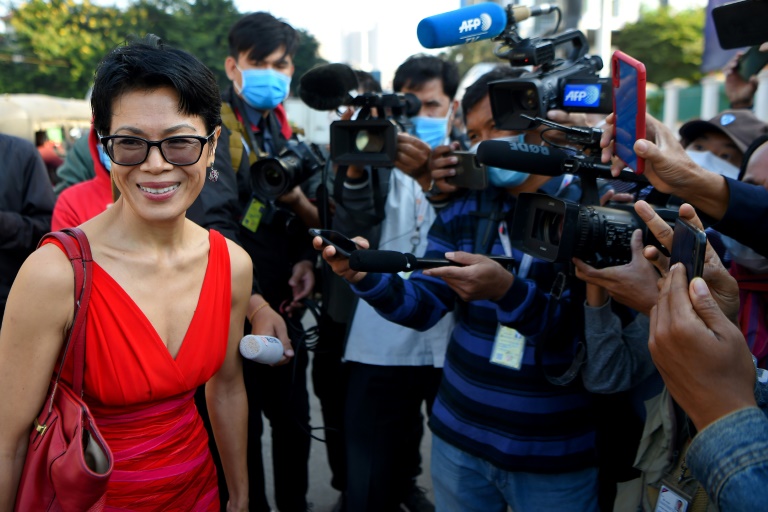
Lawyer and campaigner Theary Seng, a long-time critic of Cambodian Prime Minister Hun Sen, was imprisoned for six years for treason in June in a mass trial that also saw around 60 opposition figures convicted.

Her strike comes ahead of Biden’s visit to capital Phnom Penh later this week to attend the Association of Southeast Asian Nations (ASEAN) summit.

The US leader is also expected to meet with Hun Sen.

In a statement on Monday, the 51-year-old activist’s team “calls upon the President to press Hun Sen for Theary’s freedom”.

Jared Genser, a US-based lawyer representing her, said she had also been denied rights permitted to other prisoners “including having weekly access to Church services and the ability to regularly make phone calls”.

Currently in a prison in western Preah Vihear province, Theary Seng began her hunger strike Monday in a bid to compel authorities to transfer her to Prey Sar Prison in Phnom Penh.

Meanwhile, in a further push to raise awareness, six Cambodian youth activists launched a week-long hunger strike Monday, roughly 30 kilometres away from Theary Seng’s prison.

“We hope government leaders and especially US President to discuss this matter with Hun Sen,” group representative Hun Vannak told AFP.

The 70-year-old prime minister is Asia’s longest-serving leader, with critics alleging he has wound back democratic freedoms, used the courts to stifle opponents, and jailed scores of opposition activists and human rights defenders. 

Hun Sen has vowed to run for office again next year and has supported his eldest son Hun Manet to succeed him in the future.

Veteran French designer Philippe Starck now looks to space

Philippe Starck, the prolific French architect and designer who has made everything from lemon juicers to wind turbines, shows no sign of slowing down and is increasingly turning his eye to space.

Visiting an exhibition at the Museum of Decorative Arts in Paris featuring some his early work, the 73-year-old seemed bemused by the volume of items on display.

“I don’t have the software for periods and dates,” he told AFP when asked about the period. 

“To me, the 1980s were like being abandoned in an Amazon jungle with nothing to eat, wild animals everywhere, a rusty machete… I just did what I could. And when you do what you can, you don’t remember what’s going on elsewhere.”

Starck made his name as an interior decorator for Paris nightclubs in the 1970s, before landing a dream commission to refurbish the Elysee Palace apartments for president Francois Mitterrand in 1983. 

He went on to design luxurious hotels and restaurants around the world. 

But he also gave the world an uber-electic range of everyday items, from his futuristic lemon juicer to electric bikes, toothbrushes, water bottles — and on to boats, wind turbines and control towers.

– ‘Pure creativity’ –

There was always a hint of humour and surrealism, he said, but also a desire to “democratise design” by keeping things affordable. 

“We managed to remove two zeros from prices,” he said. “At the time, in today’s prices, sitting on something designer cost 20,000 euros, which wasn’t right. Today, it’s 700 euros, which isn’t bad.”

These days, Starck cares less about household objects and has his eyes on bigger things. 

There is a long-awaited “laboratory for pure creativity” being built in Qatar, and immediately after the exhibition, he was due at the launch of a new hydrogen energy project.

But his real focus appears to be skyward: working with US company Axiom Space on the living quarters it plans to connect to the International Space Station, and teaming up with NASA for a new astronaut training camp. 

The focus on space is part of our “necessary change” as a species, he said.

“Except when we’re dead, we’ve been fixed by gravity, but that’s clearly over, so I’m tackling it head-on.”

Some early memories remain — being left with some old toys and his grandfather’s workbench during the holidays as a young child: “I made my first items on that workbench and I haven’t stopped since.”

A surreal early inspiration comes to him: seeing Mick Jagger dancing around with a neon tube in some film. 

“I found it extraordinary and chic — I thought to myself that someone should make it for real so that everyone could be Jagger for a minute.”

Weak yen helps Nintendo lift annual net profit forecast

Nintendo raised its full-year net profit forecast on Tuesday, with the weak yen and a solid performance by new games helping compensate for falling sales of its Switch console.

The Kyoto-based Japanese gaming giant estimated net profit for the year to March 2023 at 400 billion yen ($2.7 billion), up from a previous projection of 340 billion yen.

Net profit for the half-year from April to September was also up 34.1 percent to 230 billion yen, the firm said.

“For software, sales for titles such as Splatoon 3 and Nintendo Switch Sports that were released during this fiscal year have continued to grow steadily,” it said.

“Titles released in previous fiscal years as well as titles from other software publishers have also performed well.”

Nintendo also saw a significant boost to its bottom line from foreign exchange gains driven by the depreciation of the yen, which has tumbled against the dollar this year to lows not seen since the 1990s.

In early October, it dropped beyond 151 to the greenback for the first time in 32 years, as Japan’s central bank sticks to its ultra-loose monetary policy while the Federal Reserve hikes rates to tackle inflation.

In 2020-21, Nintendo’s profits soared to an annual record of 480 billion yen due to soaring demand for indoor entertainment during pandemic lockdowns. 

The firm nearly matched that figure in the last financial year, with its blockbuster Switch console continuing to perform well and software sales staying strong.

But sales of the Switch have been slowing, and Nintendo said it now expects to sell 19 million units this fiscal year, two million units less than previously expected.

– Joint venture with DeNA –

Nintendo sold 6.68 million units of the various types of Switch consoles it offers in the first half of the fiscal year, down over 19 percent from a year earlier.

The slowing sales were due to a range of factors, including an ongoing global chip shortage, the firm said.

The revised forecast for Switch sales had been expected by some analysts, with Hideki Yasuda, senior analyst at Toyo Securities, telling AFP before the earnings estimate that Nintendo would “have a tough time” reaching its previous goal of 21 million unit sales.

But he said profits were expected to jump on the yen and the strong performance particularly by Splatoon 3, which had the fastest sales in the first three days of its release in Japan of any Switch title.

“A new Pokemon title will be launched in November and the company is seeing strong pre-orders in Japan,” Yasuda added.

The firm left its full-year operating profit forecast unchanged at 500 billion yen. Its sales forecast was revised up to 1.65 trillion yen from 1.60 trillion yen.

Nintendo on Tuesday also announced a joint venture with Tokyo-based mobile gaming company DeNA intended to “strengthen the digitalisation of Nintendo’s business”.

In a statement, Nintendo said the joint venture would research, develop and create “value-added services”, without giving further details.

The two firms announced an initial partnership in 2015 to develop games for smartphones.

Nintendo also bought a stake in DeNA as part of a deal to develop smartphone games based on its host of popular characters, possibly including Super Mario and Donkey Kong.

Nintendo said Tuesday’s joint venture announcement would have no effect on the company’s results for the current fiscal year.

The Switch manufacturer will hold 80 percent of the joint venture, to be called Nintendo Systems.

Weak yen helps Nintendo lift annual net profit forecast

Nintendo raised its full-year net profit forecast on Tuesday, with the weak yen and a solid performance by new games helping compensate for falling sales of its Switch console.

The Kyoto-based Japanese gaming giant estimated net profit for the year to March 2023 at 400 billion yen ($2.7 billion), up from a previous projection of 340 billion yen.

Net profit for the half-year from April to September was also up 34.1 percent to 230 billion yen, the firm said.

“For software, sales for titles such as Splatoon 3 and Nintendo Switch Sports that were released during this fiscal year have continued to grow steadily,” it said.

“Titles released in previous fiscal years as well as titles from other software publishers have also performed well.”

Nintendo also saw a significant boost to its bottom line from foreign exchange gains driven by the depreciation of the yen, which has tumbled against the dollar this year to lows not seen since the 1990s.

In early October, it dropped beyond 151 to the greenback for the first time in 32 years, as Japan’s central bank sticks to its ultra-loose monetary policy while the Federal Reserve hikes rates to tackle inflation.

In 2020-21, Nintendo’s profits soared to an annual record of 480 billion yen due to soaring demand for indoor entertainment during pandemic lockdowns. 

The firm nearly matched that figure in the last financial year, with its blockbuster Switch console continuing to perform well and software sales staying strong.

But sales of the Switch have been slowing, and Nintendo said it now expects to sell 19 million units this fiscal year, two million units less than previously expected.

– Joint venture with DeNA –

Nintendo sold 6.68 million units of the various types of Switch consoles it offers in the first half of the fiscal year, down over 19 percent from a year earlier.

The slowing sales were due to a range of factors, including an ongoing global chip shortage, the firm said.

The revised forecast for Switch sales had been expected by some analysts, with Hideki Yasuda, senior analyst at Toyo Securities, telling AFP before the earnings estimate that Nintendo would “have a tough time” reaching its previous goal of 21 million unit sales.

But he said profits were expected to jump on the yen and the strong performance particularly by Splatoon 3, which had the fastest sales in the first three days of its release in Japan of any Switch title.

“A new Pokemon title will be launched in November and the company is seeing strong pre-orders in Japan,” Yasuda added.

The firm left its full-year operating profit forecast unchanged at 500 billion yen. Its sales forecast was revised up to 1.65 trillion yen from 1.60 trillion yen.

Nintendo on Tuesday also announced a joint venture with Tokyo-based mobile gaming company DeNA intended to “strengthen the digitalisation of Nintendo’s business”.

In a statement, Nintendo said the joint venture would research, develop and create “value-added services”, without giving further details.

The two firms announced an initial partnership in 2015 to develop games for smartphones.

Nintendo also bought a stake in DeNA as part of a deal to develop smartphone games based on its host of popular characters, possibly including Super Mario and Donkey Kong.

Nintendo said Tuesday’s joint venture announcement would have no effect on the company’s results for the current fiscal year.

The Switch manufacturer will hold 80 percent of the joint venture, to be called Nintendo Systems.

Powerball draw for record $1.9 bn jackpot delayed

A Powerball draw for a staggering $1.9 billion jackpot — the largest prize in history — has been delayed, further fueling lottery fever across the United States.

California Lottery said late Monday the drawing was delayed because a participating lottery needed more time to complete security protocols.

“Powerball has strict security requirements that must be met by all 48 lotteries before a drawing can occur,” California Lottery tweeted.

“There is currently no estimated time for the drawing.”

With no ticket matching Saturday’s winning numbers, the pot was rolled over — leaving countless Americans dreaming big.

Even those who do not usually play the lottery were taking their chances, forming lines at convenience stores around the country to buy their tickets.

Business Insider finance reporter Hayley Cuccinello was among them, tweeting, “me: spending $24 for additional life insurance isn’t worth it, what are the odds also me: *buys $20 of powerball tix*.”

The odds of winning the jackpot are still 1 in 292.2 million. If there are duplicate winners, they will share the jackpot.

The last time someone claimed the Powerball jackpot was August 3, when a lucky ticket holder in Pennsylvania raked in an estimated $206.9 million. Since then, the Powerball jackpot has grown and grown.

While no one claimed the big prize on Saturday, 16 tickets matched the five main numbers to win $1 million each. To get the jackpot, you must also get the Powerball number.

Tickets cost $2 and a winner can choose either a lump sum payment, calculated for this jackpot at $929 million, or opt to be paid in installments over 29 years.

Most winners choose the lump sum payout.

Twitter was full of lottery hopefuls dreaming of what they could do with all that money, from using it to help the needy to buying every single one of their followers “a Classic Chocolate Frosty from @Wendys”.

Hope springs eternal for some enthusiasts.

“My psychic told me November 12th was gonna be the best day of my life, so if there’s still no powerball winner by then, I’m buying as many tickets as possible,” wrote one Twitter user.

Australian insurer warns of 'distressing' hack threat

A major Australian health insurer warned Tuesday of a “distressing” threat by a purported hacker to release client data within 24 hours, following a hack affecting 10 million people.

Medibank Private, one of Australia’s largest insurers, told customers to be “vigilant” after the reported threat, issued a day after it had ruled out paying any ransom demand.

The company revealed Monday that a hack originally thought to have breached the data of 3.9 million people had in fact given access to the names, birth dates, addresses, phone numbers and emails of about 9.7 million former and existing clients.

Those numbers included 1.8 million international customers.

On Tuesday, an anonymous poster on a hacking blog — widely cited by Australian media — said that data from the Medibank hack “will be publish in 24 hours”. 

It was not possible to confirm whether the poster was connected to the hack or had access to people’s stolen information.

“We knew the publication of data online by the criminal could be a possibility, but the criminal’s threat is still a distressing development for our customers,” Medibank chief executive David Koczkar said, calling for clients to be “vigilant”.

“We unreservedly apologise to our customers,” he added.

The hacker could also attempt to contact customers directly, the company warned.

– ‘Betrayal’ –

Medibank had said in Monday’s announcement that it believed “all of the customer data accessed could have been taken by the criminal”.

The data breach included some people’s health claims along with codes exposing their diagnoses and medical procedures, as well as the passport numbers and the visa details of international students. 

Medibank said it was working with the Australian government and with the police, who were trying to prevent the sharing and sale of the stolen data.

Cybercrime experts had advised that paying a ransom had only a “limited chance” of ensuring the return of the stolen data, the company said, explaining its decision to reject any ransom demand.

Two law firms said Tuesday they had joined forces to investigate a possible class action lawsuit against Medibank.

“We believe the data breach is a betrayal of Medibank Private’s customers and a breach of the Privacy Act,” said a joint statement by Bannister Law and Centennial Lawyers.

“Medibank has a duty to keep this kind of information confidential.”

The Medibank hack followed an attack on telecom company Optus in September that exposed the personal information of some nine million Australians.

As data theft becomes more common, it may raise questions over the need for Australian businesses to gather customers’ sensitive personal information, said Michael Duffy, associate professor of corporate law at Monash University.

Some of those data retention policies were dictated by government regulation, he added.

“Nevertheless, businesses requesting and keeping personal details that aren’t completely essential could become more legally problematic for them, if they are hacked.”

Close Bitnami banner
Bitnami