AFP

NASA rolls Moon rocket out to Kennedy Space Center launch pad

NASA rolled out its largest-ever rocket to a launch pad in Florida on Friday and will try again 10 days from now to blast off on a much-delayed uncrewed mission to the Moon.

After two launch attempts were scrubbed this summer because of technical problems, the rocket returned to the Vehicle Assembly Building to protect it from Hurricane Ian.

The US space agency used the time to carry out minor repairs and to recharge the batteries that power systems on the Space Launch System (SLS) rocket.

The SLS rocket’s four-mile (six-kilometer) journey from the Vehicle Assembly Building to the Kennedy Space Center’s Launch Pad 39B took nearly nine hours, NASA said.

The 322-foot (98-meter) rocket was rolled out slowly on a giant platform known as the crawler-transporter designed to minimize vibrations.

The next launch attempt is scheduled for 12:07 am Eastern Time (0407 GMT) on November 14 with backup dates on November 16 at 1:04 am and November 19 at 1:45 am.

“We’re comfortable launching at night,” NASA associate administrator Jim Free said at a briefing on Thursday.

Free said radar and infrared camera imaging will provide the necessary data to track the rocket’s performance.

If the rocket blasts off on November 16, the mission would last a little more than 25 days with the crew capsule splashing down in the Pacific Ocean on December 9.

The highly anticipated uncrewed mission, dubbed Artemis 1, will bring the United States a step closer to returning astronauts to the Moon five decades after humans last walked on the lunar surface.

The goal of Artemis 1, named after the twin sister of Apollo, is to test the SLS rocket and Orion crew capsule that sits on top.

Mannequins equipped with sensors are standing in for astronauts on the mission and will record acceleration, vibration and radiation levels.

The Orion capsule is to orbit the Moon to see if the vessel is safe for people in the near future. At some point, Artemis aims to put a woman and a person of color on the Moon for the first time.

And since humans have already visited the Moon, Artemis has its sights set on another lofty goal: a crewed mission to Mars.

During the trip, Orion will follow an elliptical course around the Moon, coming within 60 miles (100 kilometers) at its closest approach and 40,000 miles at its farthest — the deepest into space ever by a craft designed to carry humans.

Burnt-out teachers battle with inflation in Arizona

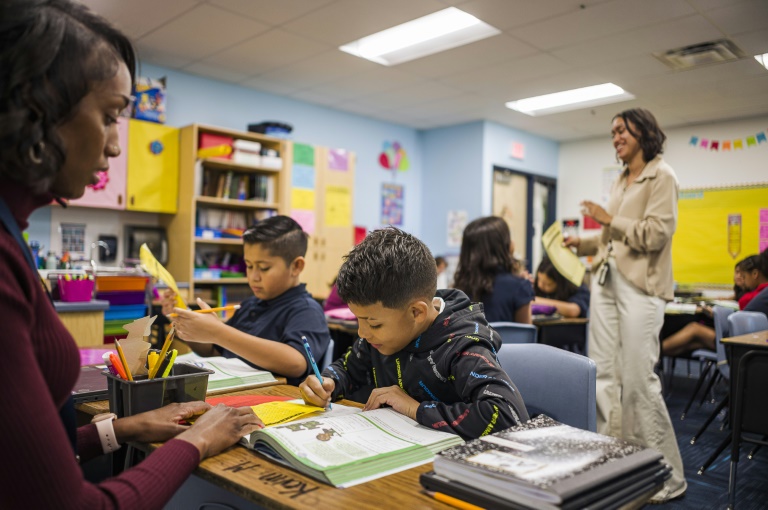
In recent months, Shivani Dalal has had to give up her favorite ramen noodles and find a second job, as soaring inflation has strained her meager teacher’s salary.

Teachers in Arizona are among the United States’ lowest paid, making the cost-of-living crisis even more acute for educators in this key battleground for the upcoming midterm elections.

Over the summer “I was cutting it very, very close,” the 27-year-old English teacher told AFP in her Phoenix apartment.

After rent, utilities and car loan payments, she had just $400 a month to live on — a major challenge at a time when the United States is experiencing its worst inflation in four decades.

Dalal gave up nights out at the movies, road trips through the desert and soy ramen, after seeing the price of Japanese noodles quadruple.

Since September, she has received a $300 monthly raise. But even that relief threatens to be subsumed by the explosion in prices.

While gas prices briefly fell, “now they’re slowly creeping back up, so that can be a little disconcerting,” she said. Her student loan payments, frozen during the pandemic, are also due to resume in 2023. 

To get by, Dalal now canvasses for the Democrats after her classes are finished, earning her an extra $250 to $300 per week until the midterms — shifts she is putting in on top of 70-hour weeks.

“I sometimes think that working as much is definitely very stressful,” said Dalal, who wants to stay in teaching, but is considering a move back to California where she could live with her family. 

Inflation is particularly troublesome in Arizona, where the capital city Phoenix clocked the nation’s highest price surge in August — a whopping 13 percent year-on-year.

That has placed enormous strain on educators in the southwestern US state, which ranks 44th out of 50 states in terms of teacher salary. The average pay is $52,157 per year, according to the National Education Association. 

– ‘Mental toll’ –

Kareem Neal, 48, has spent half his life working with disabled students, and finally managed to rent a dream apartment with a scenic view of downtown Phoenix.

Even while racking up professional awards, including his admission into the National Teachers Hall of Fame, Neal has supplemented his salary by working as a ride-share driver, nightclub bouncer, and recently as a motivational coach.

But the increase in prices over the past six months has stopped him from saving any money. In order to fulfil his dream of becoming a homeowner and saving for retirement, he is thinking of downsizing. 

“It takes a mental toll… Will I ever be able to not work two jobs?” he said. “Will I ever be able to slow down in my older age and start enjoying the world a bit more?”

Asked about the November 8 vote, Neal is jaded.

“I’ve been in Arizona for 23 years now, and since I’ve gotten here just about all politicians have said they’re pro-public education and… teachers deserve to get paid more,” he said.

Having witnessed inadequate salary rises over that time, “I don’t buy it at all,” he added.

At Neal’s high school, some teachers have left the profession. At the start of the school year, more than a quarter of Arizona teaching positions were vacant, according to the Arizona School Personnel Administrators Association.

“Many districts have been bringing teachers from places like the Philippines” as well as India, Vietnam, and other countries, said Paul Tighe, executive director of Arizona School Administrators.

– ‘Huge relief’ –

In a bid to retain teachers, Northern Arizona University launched a mentoring program this summer that allows students to learn the profession in the classroom of another teacher, without spending anything upfront on their master’s degree.

They earn a $15,000 scholarship their first year, then a teacher’s salary, and must teach in the state for at least three years.

“If I wasn’t in the program, I would probably have to take out student loans and I would probably have to pay for my own insurance,” said Aisha Thomas, 25, describing the scheme as “a huge relief.”

Officials running the Arizona Teacher Residency plan to take on 100 trainee teachers every year, and hope to soon offer housing to some of them. 

“That would even go further to be able to help them survive the kinds of inflation that they’re experiencing now,” said director Victoria Theisen-Homer. 

The renaissance of the world's largest pipe organ

You’ve never felt Bach’s Toccata and Fugue in D minor quite like this: in Atlantic City, the largest organ in the world is coming back to life.

The pipe organ in the New Jersey city’s Boardwalk Hall was constructed in the 1920s, during the seaside resort area’s golden age.

But the instrument suffered the wrath of a hurricane in 1944, and wear and tear after years of quasi-abandonment for a while left it unusable. Now, through private donations and careful restoration, it is coming back to ear-pleasing functionality.

From near the stage the antique wooden cabinet looks tiny, but inside it includes a record seven keyboards and rows of keys and pedals that control the pipes, only two-thirds of which are currently in working order.

“It’s an experience that’s hard to really describe,” said Dylan David Shaw, a 23-year-old organist.

“Every conceivable sound of the orchestra that you can think of is available at your fingertips: strings and woodwinds, orchestral trumpets, flutes,” Shaw said. “Anything you can possibly think of: percussions, glockenspiel, even a full grand piano in one of the side chambers.”

He added: “It’s a magical experience.”

The history of the instrument, which was constructed by the Midmer-Losh Organ Company, goes hand in hand with that of Boardwalk Hall itself.

The imposing arena facing the ocean has been the site of Miss America competitions, the 1964 Democratic convention, and boxer Mike Tyson fights.

The organ was built “to fill this enormous space with music,” said organ curator Nathan Bryson, who called the “enormous instrument” the “precursor of surround sound.”

– 50 percent playable –

The pipe organ has a stunning 33,112 pipes, the most in the world, in wooden rooms accessible by a narrow staircase and ladders.

By comparison, the famous Grand Organ of Notre Dame in Paris has fewer than 8,000 pipes.

When the organist plays “The Star-Spangled Banner,” listeners feel almost as if their bodies are vibrating with the notes of the US national anthem.

While Atlantic City holds the record for most pipes, just an hour’s drive away in Philadelphia stands the “Wanamaker,” the world’s largest organ in working order that’s inside a Macy’s department store. 

Since 2004 a historic organ restoration committee entirely financed through donations has been working to return Atlantic City’s organ to its full sonic power.

Behind the stage, Dean Norbeck, a retired electrical engineer, patiently mounts small magnets on a board, which conduct air in the pipes to produce sound.

Some repairs are easy to identify, but “sometimes it can be tricky to figure out why the pipes are not playing,” Bryson said, and “where the point of failure is along the way.”

For organist Shaw, the instrument is “over 50 percent playable.”

The total restoration will cost some $16 million, Bryson said. So far $5 million has been raised.

In US vote, misinformation in Spanish is a family affair

Shared among relatives and people they trust — that is how misinformation often moves among the estimated 34.5 million Americans of Hispanic origin eligible to vote in US midterm elections on November 8, experts say, with the specter of communism a common narrative.

Those contributing to the spread regularly appeal to the emotions of a community in which authority and familiarity play a fundamental role, with politicians looking to garner support with messaging that tugs at the heartstrings.

Misinformation evoking painful memories — such as the communist or socialist regimes which the families of many Hispanic Americans left behind to come to the United States — can quickly proliferate among a group that makes up around 14 percent of the US electorate.

Maria Corina Vegas, a Venezuelan living in Miami, Florida, says she receives numerous text messages associating the Democratic Party of Joe Biden with the “Chavista radical Left,” a reference to former socialist Venezuelan president Hugo Chavez.

Constant streams of polarized content cause family friction, according to Vegas.

“It has led me to avoid discussions,” she said, noting that some family members cannot stop themselves from arguing about the messages they’ve seen.

Vanessa Cardenas of America’s Voice, an immigrants’ rights organization, told AFP that purveyors of misinformation know false and misleading content can discourage electoral participation. Yet the very same information “is more credible when it comes from people you trust.”

This explains how Hispanics in the US are vulnerable to misinformation on WhatsApp, an encrypted messaging app used by 20 percent of the community, according to a survey by Equis Institute.

WhatsApp “is where family and people you trust are,” said Julio Rivera, head of campaigns for the NALEO Educational Fund, which promotes the participation of Latinos in US elections.

Cynthia Perez of Cubanos Pa’lante, an organization that encourages “progressive Cuban-Americans” to vote in Florida, agreed.

“The first generations of Latinos (to arrive in the US) have a lot of respect for authority,” she said.

“When they listen to the president, the governor, or a police officer, they don’t automatically think that person is telling lies. And they believe them because they are people they trust.”

– Fear of communism –

Although many misinformation narratives circulating ahead of the midterms are translated from English, others are created or adapted to exacerbate feelings in Hispanic communities, analysts say.

For example, many Cuban and Venezuelan emigres fleeing communism and socialism are the targets of campaigns spreading fear that what happened in their countries could happen in the US if they vote for certain candidates, Rivera said.

Evelyn Perez-Verdia, head of strategy at the consulting firm We Are Mas, echoed the same concern.

“The actors who create misinformation, domestic or foreign, understand the pain that word — communism — causes the Latin American or Caribbean community,” she said.

“In 2018, they started accusing anyone who was a Democrat, even right-wing centrists, of being socialist-communist because it immediately created fear in the community.”

As of that year, there were 1.3 million Cubans in the US, according to official data. There were more than 540,000 Venezuelans as of 2021, according to R4V, a platform for refugees and migrants from Venezuela co-led by the UN.

The evocation of communism has been visible in midterms campaigning, with Republicans such as US Congresswoman María Elvira Salazar of Florida characterizing Biden as a far-left politician.

Other posts circulating on WhatsApp make false claims about voting and abortion rights, particularly following the US Supreme Court’s reversal of Roe v. Wade, raising fears that vulnerable people will not seek medical attention when they need it.

Part of the problem, Rivera said, is that more resources and controls are needed to stop the flow of misinformation in Spanish in the US since such content “stays up longer” online compared to claims in English.

A report by Avaaz, an activist group that studies disinformation, indicates 70 percent of inaccurate content in Spanish on Facebook did not receive warning labels, compared to 29 percent in English.

On WhatsApp, news organizations such as AFP have established tip lines to fight disinformation by answering users with reliable information and facts.

Twitter mass layoffs begin as Musk launches overhaul

Thousands of Twitter employees were ordered to stay home Friday to await a bracing round of layoffs that could see half of the payroll axed as new owner Elon Musk launches his major overhaul of the company.

A company-wide email seen by AFP said Twitter employees would receive word on their future at the company via email at the start of business Friday, California time.

The cull is part of Musk’s push to find ways to pay for the mammoth $44 billion deal for which he took on billions of dollars in debt and sold $15.5 billion worth of Tesla shares, his electric car company.

Musk, the Tesla and SpaceX chief, has been scrambling to find new ways for Twitter to make money after his mammoth buyout, including an idea to charge users $8 a month for verified accounts.

The moves would help overcome the potential loss of advertisers, Twitter’s main source of revenue, with many of the world’s top brands putting their ad buys on hold, spooked by Musk’s well-known disdain for content moderation.

The mercurial tycoon on Friday complained on Twitter of a “massive drop in revenue” that he blamed on “activist groups” that were pressuring advertisers.

“We did everything we could to appease the activists. Extremely messed up! They’re trying to destroy free speech in America,” he added.

This appeared to refer to Musk’s recent meeting with civil rights groups in which he heard concerns that Twitter would open the floodgates to hate speech.

In an effort to soothe nerves, Musk had vowed that Twitter will not become a “free-for-all hellscape”, but his pledge was quickly followed by a tweet relaying a conspiracy theory about an assault on the husband of the US House Speaker.

Though extremely influential with opinion-makers and celebrities, the California company has long struggled to generate profit and has failed to keep pace with Facebook, Instagram and TikTok in gaining new users.

“In an effort to place Twitter on a healthy path, we will go through the difficult process of reducing our global workforce,” the company email said.

The email did not give a number but the Washington Post and New York Times reported that about half of Twitter’s 7,500 employees — mostly based in San Francisco — will be let go.

– ‘Return home’ –

The company said that in order to “ensure the safety” of employees and sensitive data, the main offices would remain closed and all badge access suspended.

“Those on the way to the office should turn around and return home,” the email added.

It also said that those still employed at the company would find out on their company email, while those shown the door would get notice on their personal email.

Some workers had already begun to learn their fates and took to Twitter to say goodbye to colleagues.

“Spoiler Alert: I do not have a job,” tweeted ex-employee Blake Herzinger as others reported losing access to company servers and email accounts.

Twitter employees have been bracing for this kind of bad news since Musk completed his acquisition late last week and quickly set about dissolving its board and firing its chief executive and top managers.

Late on Thursday, a group of five Twitter employees who had already been fired filed a class action complaint against the company on the grounds that they had not been given the required 60-day notice period as required by law.

The lawsuit references the US Worker Adjustment and Retraining Notification (WARN) Act, which provides workers a right to advance notice in cases of mass layoffs or plant closings.

Twitter mass layoffs begin as Musk launches overhaul

Thousands of Twitter employees were ordered to stay home Friday to await a bracing round of layoffs that could see half of the payroll axed as new owner Elon Musk launches his major overhaul of the company.

A company-wide email seen by AFP said Twitter employees would receive word on their future at the company via email at the start of business Friday, California time.

The cull is part of Musk’s push to find ways to pay for the mammoth $44 billion deal for which he took on billions of dollars in debt and sold $15.5 billion worth of Tesla shares, his electric car company.

Musk, the Tesla and SpaceX chief, has been scrambling to find new ways for Twitter to make money after his mammoth buyout, including an idea to charge users $8 a month for verified accounts.

The moves would help overcome the potential loss of advertisers, Twitter’s main source of revenue, with many of the world’s top brands putting their ad buys on hold, spooked by Musk’s well-known disdain for content moderation.

The mercurial tycoon on Friday complained on Twitter of a “massive drop in revenue” that he blamed on “activist groups” that were pressuring advertisers.

“We did everything we could to appease the activists. Extremely messed up! They’re trying to destroy free speech in America,” he added.

This appeared to refer to Musk’s recent meeting with civil rights groups in which he heard concerns that Twitter would open the floodgates to hate speech.

In an effort to soothe nerves, Musk had vowed that Twitter will not become a “free-for-all hellscape”, but his pledge was quickly followed by a tweet relaying a conspiracy theory about an assault on the husband of the US House Speaker.

Though extremely influential with opinion-makers and celebrities, the California company has long struggled to generate profit and has failed to keep pace with Facebook, Instagram and TikTok in gaining new users.

“In an effort to place Twitter on a healthy path, we will go through the difficult process of reducing our global workforce,” the company email said.

The email did not give a number but the Washington Post and New York Times reported that about half of Twitter’s 7,500 employees — mostly based in San Francisco — will be let go.

– ‘Return home’ –

The company said that in order to “ensure the safety” of employees and sensitive data, the main offices would remain closed and all badge access suspended.

“Those on the way to the office should turn around and return home,” the email added.

It also said that those still employed at the company would find out on their company email, while those shown the door would get notice on their personal email.

Some workers had already begun to learn their fates and took to Twitter to say goodbye to colleagues.

“Spoiler Alert: I do not have a job,” tweeted ex-employee Blake Herzinger as others reported losing access to company servers and email accounts.

Twitter employees have been bracing for this kind of bad news since Musk completed his acquisition late last week and quickly set about dissolving its board and firing its chief executive and top managers.

Late on Thursday, a group of five Twitter employees who had already been fired filed a class action complaint against the company on the grounds that they had not been given the required 60-day notice period as required by law.

The lawsuit references the US Worker Adjustment and Retraining Notification (WARN) Act, which provides workers a right to advance notice in cases of mass layoffs or plant closings.

Trump signals 2024 run as Democrats brace for punishing midterms

Donald Trump is planning to ride a wave of Republican victories in next week’s midterm elections by announcing a run for the presidency, US media reported Friday, as Democrats braced for a punishing night even in the most liberal corners of America.

The one-term president has hinted for almost two years a potential third tilt at the White House after losing to Joe Biden, but aides are firming up plans for an announcement on November 14, according to Axios.

Trump sent his clearest signal yet that he intends to announce his 2024 candidacy soon, as he addressed a rally Thursday in Iowa, the first state to hold its Republican nominating contest in presidential elections. 

“In order to make our country successful and safe and glorious, I will very, very, very probably do it again, OK? Very, very, very probably,” Trump teased to rapt applause at the event in Sioux City. 

“Get ready. That’s all I’m telling you. Very soon. Get ready. Get ready.”

Trump’s remarks came with polling pointing to a re-emerging “red wave” that will likely see the tycoon’s party dismantling the Democrats’ razor-thin majority in the House and possibly retaking the Senate.

Republicans are confident they can flip the one state they need for the upper chamber and are expecting gains in the House of 12 to 25 seats, easily enough to overcome the Democrats’ eight-member advantage.

– ‘I’ve got a plan’ –

The final weeks of the campaign have seen bullish Republicans even looking beyond the country’s swing states to Democratic bastions that once looked out of reach. 

Strategists from both parties are seeing districts across New York, Oregon and Connecticut that went for Biden by double digits in 2020 coming back into play. 

Hillary Clinton campaigned on Thursday in New York to boost the faltering fortunes of Governor Kathy Hochul while former president Barack Obama speaks in Pennsylvania Saturday.

With Democrats being dragged down by Biden’s underwater approval ratings, particularly on inflation, the president was due to pitch his party as the choice for growth and innovation at a tour of a San Diego communications company later Friday. 

Ahead of the visit, Biden hailed new figures for October showing the economy adding 261,000 jobs and unemployment at low levels.

“I’ve got a plan to bring costs down, especially for health care, energy, and other everyday expenses… The Republican plan is very different,” he said in a statement. 

“They want to increase prescription drug costs, health insurance costs, and energy costs, while giving more tax breaks to big corporations and the very wealthy.”

– ‘Speculation and rumors’ –

In one glimmer of hope for the Democrats, Oprah Winfrey endorsed Pennsylvania Senate candidate John Fetterman during a virtual get-out-the-vote event Thursday.

It was a notable snub of Fetterman’s Republican rival, celebrity surgeon Mehmet Oz, who rose to fame largely through appearances on Winfrey’s show. 

But with the Republicans confident of flipping Georgia and Nevada, the Keystone State might not even be needed for a takeover of the Senate. 

Trump had initially considered announcing before next Tuesday to get ahead of the field in the Republican primary.

But he was persuaded by close ally Kellyanne Conway that the move would leave him open to blame in the event of a bad night for Republicans.

The strategist, who ran Trump’s 2016 campaign and served as a top advisor in his administration, said Thursday at a campaign event he could be expected to “announce soon.”

Trump spokesman Taylor Budowich told AFP he was “not commenting on the never-ending media speculation and rumors” about a Trump return to the Oval Office.

“As President Trump has said, Americans should go vote up and down the ballot for Republicans, and he will continue that message tomorrow night in Pennsylvania,” he added.

Dolly Parton, Eminem among Rock Hall of Fame inductees

Music’s A-listers will celebrate a new crop of legends entering the Rock and Roll Hall of Fame this weekend, among them country queen Dolly Parton and rap agitator Eminem.

Pop futurists Eurythmics, smooth rocker Lionel Richie, new wave Brits Duran Duran, confessional lyricist Carly Simon and enduring rock duo Pat Benatar and Neil Giraldo round out the class of 2022.

The Cleveland-based Hall of Fame — which surveyed more than 1,000 musicians, historians and industry members to choose the entrants — will honor the seven acts in a star-studded gala concert on Saturday at Los Angeles’s Microsoft Theater.

The inclusion of Parton, 76, prompted a characteristically humble response from the beloved icon, who initially requested her name be taken out of the running.

“Even though I’m extremely flattered and grateful to be nominated for the Rock and Roll Hall of Fame, I don’t feel that I have earned that right,” said the music pioneer, who’s penned thousands of songs including “Jolene” and “I Will Always Love You.”

But voting was already under way, and the Hall of Fame insisted she was far more than a country star.

“With her trailblazing songwriting career, distinctive voice, campy glamour, business savvy and humanitarian work, Dolly Parton is a beloved icon who transcends the genre she transformed forever,” the organization said.

For years the institution has defined “rock” less in terms of genre than of spirit, with a number of rappers, pop, R&B and country stars included.

“I just felt like I would be taking away from someone that maybe deserved it, certainly more than me, because I never considered myself a rock artist,” Parton said later. 

“But obviously, there’s more to it than that.”

– Eclectic group –

The 2022 group of hall of famers is among the organization’s most eclectic in years.

Detroit rapper Eminem burst onto the world stage in the late 1990s with darkly comical hits off his major label debut “The Slim Shady LP” including “My Name Is.”

“The Marshall Mathers LP” cemented his superstar status, becoming one of the best-selling albums of all time and setting up the rapper as one of pop’s master provocateurs with a blistering flow.

He joins fellow rappers including Jay-Z, Tupac Shakur, Ice Cube and Grandmaster Flash along with his loyal producer and mentor Dr Dre in the hall of rock’s elite.

Eminem gained the recognition in his first year of eligibility: acts can be inducted 25 years after their first commercial music release.

Lionel Richie, the crooner behind enduring love songs “All Night Long” and “Hello,” earned the distinction after already scoring the majority of music’s top honors.

The 73-year-old artist has been inducted into the Songwriters Hall of Fame as well as designated a Kennedy Center Honoree and a winner of the Gershwin Prize for Popular Song.

Eurythmics — the duo comprised of Annie Lennox and Dave Stewart — earlier this year also entered the Songwriters Hall of Fame.

The synthpop innovators behind “Sweet Dreams (Are Made Of This)” will now take their place among rock’s greatest.

“We were always changing. That was the point,” Lennox told Rolling Stone shortly after the inductees were announced. “That’s what kept our spark going.”

Duran Duran is set to reunite with their former guitarists Andy Taylor and Warren Cuccurullo, at the night that’s more supergroup concert than ceremony.

“We didn’t have so-called ‘acrimonious splits.’ It was gentlemanly and it was understood. And pretty much mutual,” frontman Simon Le Bon told Rolling Stone.

Simon, the singer-songwriter behind the 1970s classic “You’re So Vain,” will finally be inducted following almost two decades of eligibility.

“There’s that first thought of, ‘I don’t believe it. It must be the House of Pancakes I just got into,'” said Simon.

And power couple Benatar and Giraldo, who dominated the 1980s with hits like “Hit Me With Your Best Shot,” will also finally get rock hall recognition for their prolific body of work.

Judas Priest along with Jimmy Jam and Terry Lewis will also receive awards for musical excellence, while Harry Belafonte and Elizabeth Cotten will be recognized for early influence prizes.

The gala will begin at 7:00 pm Pacific time, and will later be broadcast on November 19 on HBO.

US sees strong job gains in October as wages move higher

US job gains topped expectations in October, official data showed Friday, as hiring remained resilient and wages moved ever higher even as unemployment edged up, underscoring the challenges in lowering rampant inflation.

The data comes days ahead of midterm elections, where decades-high inflation has propelled economic issues to the top of voters’ minds and President Joe Biden faces a battle to avoid losing control of both chambers of Congress.

The figures will provide little comfort to the Federal Reserve, which has been battling to cool the economy, as policymakers fear high prices will become entrenched and rising pay will create an upward spiral — inflicting more harm on families and businesses.

American employers added 261,000 workers last month, far more than economists had forecast, though this eased from a revised 315,000 figure in September.

The jobless rate rose two-tenths to 3.7 percent, the Labor Department said in its closely-watched US employment report.

“Inflation is our top economic challenge… The global inflation that is raging in other countries is hitting us as well,” said Biden in a statement on Friday, although noting that unemployment remains relatively low.

He said policymakers will “do what it takes to bring inflation down.”

Average hourly earnings for private sector workers jumped another 12 cents or 0.4 percent, to $32.58, the data showed.

Wages have increased 4.7 percent over the last 12 months as firms have had to compete to find and retain workers in the tight labor market. 

That pace is slightly slower than the pace in September, which the Fed will welcome, but many employees are pushing for increases to avoid losing ground to elevated consumer costs.

– ‘Softening’ –

“The bottom line here is that the labor market is softening, but has not yet reached the point where the data are screaming at the Fed to stop tightening,” said Ian Shepherdson, chief economist at Pantheon Macroeconomics, in an analysis.

But if labor market trends continue, markets will start to push policymakers to “rethink the idea of continued hikes next year,” he added.

On Friday, the Labor Department’s report indicated notable job gains in health care, professional and technical services, and manufacturing.

The Fed has raised borrowing rates six times this year to cool demand, but there have been few signs it is having an impact on consumer spending or inflation.

The central bank said this week that it would have to continue hiking rates, although that has raised the risk that the world’s biggest economy will suffer a downturn.

But Susan Collins, president of the Boston Federal Reserve Bank added on Friday that she sees a chance to accomplish the task of reining in price increases without completely putting the brakes on growth.

While inflation so far is only slowly drifting down, “I do not believe a significant slowdown is required to accomplish our goal,” she said in a speech in Washington.

But she stressed that the Fed must continue to act as “current levels of inflation are simply too high, and are taking a significant toll on households and firms.”

While the policy tightening normally would be expected to lead to job losses, economists say employers are reluctant to shed workers that they struggled to find.

“The data are still showing strong positive momentum in the labor market which is not yet showing much adjustment in response to a rapid tightening of monetary policy,” said Rubeela Farooqi of High Frequency Economics. 

“These data will keep the Fed on track to keep raising rates into restrictive territory,” she said in an analysis.

US sees strong job gains in October as wages move higher

US job gains topped expectations in October, official data showed Friday, as hiring remained resilient and wages moved ever higher even as unemployment edged up, underscoring the challenges in lowering rampant inflation.

The data comes days ahead of midterm elections, where decades-high inflation has propelled economic issues to the top of voters’ minds and President Joe Biden faces a battle to avoid losing control of both chambers of Congress.

The figures will provide little comfort to the Federal Reserve, which has been battling to cool the economy, as policymakers fear high prices will become entrenched and rising pay will create an upward spiral — inflicting more harm on families and businesses.

American employers added 261,000 workers last month, far more than economists had forecast, though this eased from a revised 315,000 figure in September.

The jobless rate rose two-tenths to 3.7 percent, the Labor Department said in its closely-watched US employment report.

“Inflation is our top economic challenge… The global inflation that is raging in other countries is hitting us as well,” said Biden in a statement on Friday, although noting that unemployment remains relatively low.

He said policymakers will “do what it takes to bring inflation down.”

Average hourly earnings for private sector workers jumped another 12 cents or 0.4 percent, to $32.58, the data showed.

Wages have increased 4.7 percent over the last 12 months as firms have had to compete to find and retain workers in the tight labor market. 

That pace is slightly slower than the pace in September, which the Fed will welcome, but many employees are pushing for increases to avoid losing ground to elevated consumer costs.

– ‘Softening’ –

“The bottom line here is that the labor market is softening, but has not yet reached the point where the data are screaming at the Fed to stop tightening,” said Ian Shepherdson, chief economist at Pantheon Macroeconomics, in an analysis.

But if labor market trends continue, markets will start to push policymakers to “rethink the idea of continued hikes next year,” he added.

On Friday, the Labor Department’s report indicated notable job gains in health care, professional and technical services, and manufacturing.

The Fed has raised borrowing rates six times this year to cool demand, but there have been few signs it is having an impact on consumer spending or inflation.

The central bank said this week that it would have to continue hiking rates, although that has raised the risk that the world’s biggest economy will suffer a downturn.

But Susan Collins, president of the Boston Federal Reserve Bank added on Friday that she sees a chance to accomplish the task of reining in price increases without completely putting the brakes on growth.

While inflation so far is only slowly drifting down, “I do not believe a significant slowdown is required to accomplish our goal,” she said in a speech in Washington.

But she stressed that the Fed must continue to act as “current levels of inflation are simply too high, and are taking a significant toll on households and firms.”

While the policy tightening normally would be expected to lead to job losses, economists say employers are reluctant to shed workers that they struggled to find.

“The data are still showing strong positive momentum in the labor market which is not yet showing much adjustment in response to a rapid tightening of monetary policy,” said Rubeela Farooqi of High Frequency Economics. 

“These data will keep the Fed on track to keep raising rates into restrictive territory,” she said in an analysis.

Close Bitnami banner
Bitnami