AFP

Ukraine grain exports halted after Russia suspends deal participation

Ukraine’s maritime grain exports were halted Sunday after Russia suspended its participation in a landmark agreement that allowed the vital shipments, blaming drone attacks on its ships in Crimea.

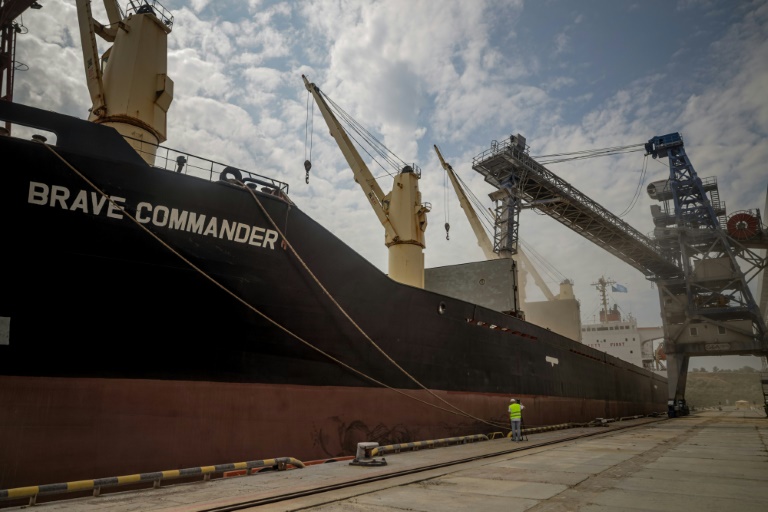
The July deal to unlock grain exports signed between Russia and Ukraine and brokered by Turkey and the UN, is critical to easing the global food crisis caused by the conflict.

The agreement had already allowed more than nine million tonnes of Ukrainian grain to be exported and was due to be renewed on November 19.

On Saturday, Russia said it was halting its participation after its army accused Kyiv of a “massive” drone attack on its Black Sea fleet, which Ukraine labelled a “false pretext”.

US President Joe Biden called the move “purely outrageous” while Secretary of State Antony Blinken said Moscow was “weaponising food”. 

The centre coordinating the logistics of the deal said in a statement that no traffic was planned for Sunday.

“A joint agreement has not been reached at the JCC for the movement of inbound and outbound vessels on 30 October,” it said. “There are more than ten vessels both outbound and inbound waiting to enter the corridor.”

Ukraine and the UN have urged that the agreement remains in force.

“I call on all states to demand that Russia stop its hunger games and recommit to fulfilling its obligations,” Ukrainian Foreign Minister Dmytro Kuleba said on Twitter. 

Ukrainian President Volodymyr Zelensky called the Russian move “an absolutely transparent intention of Russia to return the threat of large-scale famine to Africa and Asia”.

“Just today, more than two million tons of food are in the sea. This means that access to food has actually worsened for more than seven million consumers,” he said in his nightly address.

Stephane Dujarric, spokesman for the UN secretary-general, said: “It is vital that all parties refrain from any action that would imperil the Black Sea Grain Initiative which is a critical humanitarian effort”.

– ‘Peddling false claims’ –

Sevastopol in Moscow-annexed Crimea has been targeted several times in recent months and serves as the headquarters for the Black Sea fleet and a logistical hub for operations in Ukraine.

The Russian army claimed to have “destroyed” nine aerial drones and seven maritime ones in an attack on the port early Saturday. 

“In light of the terrorist act carried out by the Kyiv regime with the participation of British experts against ships of the Black Sea fleet and civilian vessels involved in the security of grain corridors, Russia suspends its participation in the implementation of the agreement on the export of agricultural products from Ukrainian ports,” the Russian defence ministry said on Telegram.

Moscow’s forces alleged British “specialists”, whom they said were based in the southern Ukrainian city of Ochakiv, had helped prepare and train Kyiv to carry out the strike. 

In a further singling out of the UK — which Moscow sees as one of the most unfriendly Western countries — Russia said the same British unit was involved in explosions on the Nord Stream gas pipelines last month.

Britain strongly rebutted both claims, saying “the Russian Ministry of Defence is resorting to peddling false claims of an epic scale”.

Russia’s foreign ministry spokeswoman Maria Zakharova said Saturday Moscow would raise the blasts and the alleged drone attack at the UN Security Council.

Moscow’s military said ships targeted at their Crimean base were involved in the grain deal.

The United Nations Coordinator for the Black Sea Grain Initiative, Amir Abdulla, reported that Russia had notified him earlier Saturday of “its concerns about the safety of movements of merchant vessels” under the agreement.

Russia had recently criticised the deal, saying its own grain exports have suffered due to Western sanctions. 

– ‘Massive’ attack –

Mikhail Razvozhayev, the Moscow-installed governor of Sevastopol, said Saturday’s drone attack was the “most massive” the peninsula had seen. 

City authorities said the harbour was “temporarily” closed to boats and ferries and urged people “not to panic”.

Attacks on Crimea, annexed by Moscow in 2014, have increased in recent weeks, as Kyiv presses a counter-offensive in the south to retake territory held by Moscow for months. 

Moscow-installed authorities in Kherson, just north of Crimea, have vowed to turn the city into a fortress, preparing for an inevitable assault. 

In early October, Moscow’s bridge linking Crimea to the Russian mainland — personally inaugurated by President Vladimir Putin in 2018 — was damaged by a blast that Putin blamed on Ukraine. 

The Russian fleet stationed in the port had also been attacked by a drone in August.  

Russia’s allegations Saturday came as the Ukrainian army reported fighting in the Lugansk and Donetsk regions in the east, including near Bakhmut — the only area where Moscow’s forces have advanced in recent weeks.  

Pro-Russian separatists fighting alongside Moscow also announced a new prisoner exchange with Kyiv, saying 50 will return home from each side. 

Annual tech gathering takes aim at crypto

One of the world’s biggest technology get-togethers kicks off in the Portuguese capital on Tuesday, with organisers saying a key aim is to ask tough questions about cryptocurrencies.

More than 100,000 people are expected to gather in Lisbon for the four-day Web Summit, the first full-scale edition since 2019 following the disruption of the pandemic.

The conference attempts to bring together start-ups, investors, business leaders and agenda-broadening speakers –- linguist Noam Chomsky and heavyweight boxing champion Oleksandr Usyk are among this year’s intake.

Several of the prime slots, though, are taken by cryptocurrency specialists led by Changpeng Zhao, boss of crypto exchange Binance.

And plenty of companies present — from start-ups to billion-dollar behemoths Yuga Labs and OpenSea — are promoting the technology that fans claim will be the future of the web, gaming and ultimately the entire financial system.

But crypto has so far been used largely as a tool to generate investment bubbles, hide illicit wealth and enable scams.

Conference organiser Paddy Cosgrave told AFP there were “a lot of questions to be answered” about crypto, describing it as “largely smoke and mirrors”.

“We’ve done our best to persuade many of the leading lights in the space to come, and some of them will get a bit of a kicking on stage, we’ll see how that goes,” he added.

Crypto sceptics including actor Ben McKenzie (Gotham, The O.C.) have also been given slots.

– Whistleblower focus –

Zhao’s company is the dominant player in the crypto sector, but it has been repeatedly accused of trying to dodge regulatory scrutiny — claims the company has denied.

And it became embroiled in one of the biggest stories of the week, with a $500-million investment to back Elon Musk’s takeover of Twitter.

But the wider crypto sector is struggling with plunging values and flatlining interest from the public.

And the tech industry as a whole is also struggling with supply chain problems, trade disputes between the US and China, and economic volatility that has sent investors fleeing.

Cosgrave, though, played down any suggestion that conferences like his had a role in helping to stimulate investment or turn around the fortunes of the sector.

“It’s not really about the establishment or the dominant companies of today,” he said.

“It’s a gathering of companies that in the future may play some significant role.”

As usual, though, the Web Summit will host plenty of figures from the dominant companies — officials from Amazon, Apple, Google and Meta will all be there.

But on a lower level than last year, when the conference played host to Facebook’s Nick Clegg and to whistleblower Frances Haughen, who accused his company of stoking hatred in return for clicks.

Cosgrave highlighted the event’s history of giving a platform to whistleblowers — this year Mark MacGann, who revealed details of Uber’s aggressive lobbying, will be giving a talk.

The organisers say more than 1,000 speakers will take part, giving talks on subjects from cybersecurity to artificial intelligence.

Scottish blueberry farmer donates 'unviable' crop to charity

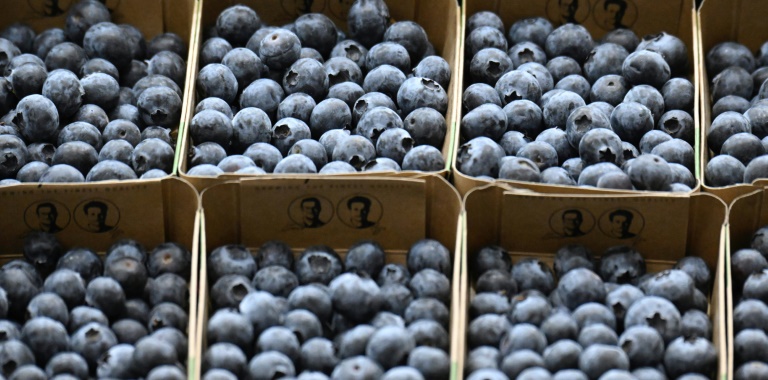
A Scottish farmer is giving away his entire crop of blueberries, worth £2 million, to charity, saying cheap imports and high labour costs have made harvesting the fruit economically unviable.

Peter Thomson has been growing blueberries at his farm in Blairgowrie, northeast Scotland, for more than four decades, producing 300 tonnes of fruit per year.

But now, he said, growers in Peru and South Africa can sell their berries in the UK at a far lower price, while a shortage of pickers caused by Brexit has made the harvest unviable.

“They’ve started planting huge areas of blueberries in the subtropics like Peru and South Africa,” said Thomson, who started growing blueberries in 1976.

“Their costs of production are so low that we can’t compete.”

Normally, said Thomson, 200 workers would have picked around 300 tonnes of blueberries this year with 50 more working in the packhouse.

In 2014, the price paid to Scottish farmers for blueberries was £17.50 per kilo, he said. Today however, supermarkets pay less than £7.

Labour costs meanwhile have risen from £7 an hour five years ago to £10.10 today, even before state pension contributions and holiday pay are taken into account.

This meant that the value of crop of berries, which would once have been worth £3 million or more, fell to £2 million this year.

Retailers are unwilling to pay a premium for Scottish produce as shoppers target bargains during the cost-of-living squeeze, Thomson said.

– The Brexit factor –

The cheaper imports started last year after countries including Peru and South Africa, where pickers are paid substantially less, started using a new cultivar of the blueberry plant. 

The sweet juicy berries grow densely on bushes with scarlet leaves that are planted in rows.

Blueberries usually require a frost before they flower, which meant farmers in Scotland had the market to themselves in September and October and could command a higher price.

The new cultivar, however, does not need a frost to thrive.

The new blueberry variety is also popular with supermarkets as the fruit are larger and firmer and can be shipped — rather than airfreighted — to UK supermarkets over a number of weeks without spoiling.

Another economic impact has come from Brexit, which has pushed up the price of labour and made it difficult to find skilled pickers.

Before Brexit, said Thomson, the farm’s village of caravans was filled with skilled European pickers, who were experienced and harvested the berries at a faster pace. 

Today the caravans stand empty.

“Brexit has had the consequence of making our labour more expensive,” Thomson said.

“We have to get labour now from places like Turkmenistan and Kyrgyzstan, Nepal, and it comes from so far that it is expensive.”

– ‘It is devastating’ –

Thomson said he had invited the public to fill up buckets of blueberries in exchange for a donation to a cancer charity. A portion of the berries is also being given to food banks.

Hundreds of local residents have responded to Thomson’s invitation to pick for charity, many of them arriving at the farm with buckets and boxes.

Local resident Amanda Taylor, who was one of those picking berries at the farm, said it was devastating to see the crops rotting in a field when so many cannot afford food.

“It’s quite an emotional thing actually, that we’re having to fly produce from Peru when I have this on my doorstep,” she said.

Pauline Cropper, who is volunteering to organise pickers at the farm, said people were finding it difficult to afford their shopping bills and were picking the cheapest options available. 

“Meanwhile, the berries here are sitting on the bushes and going to waste — they’re falling off the bushes, there’s so many of them, because it’s not viable for the local farmer to pay a decent wage,” she said.

Thomson said his plants could have kept producing berries for another 50 years, but continuing to prune and maintain them was too costly. 

“It is devastating for us, but it doesn’t make economic sense to take the fruit to the shops,” he said.

“We have no realistic prospect of making money unless the supermarkets are prepared to pay (more) for Scottish blueberries.”

He plans to continue farming his other crop, cherries, but may build houses on some of his land.

US retailers battle high costs clearing Christmas stockpiles

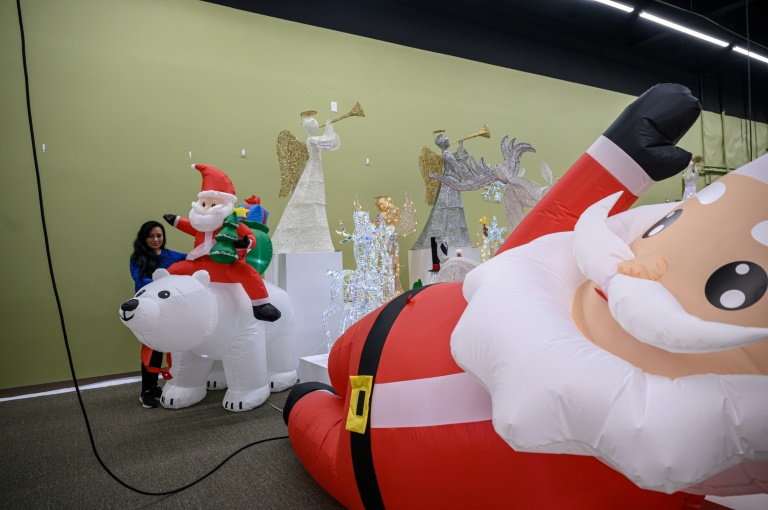
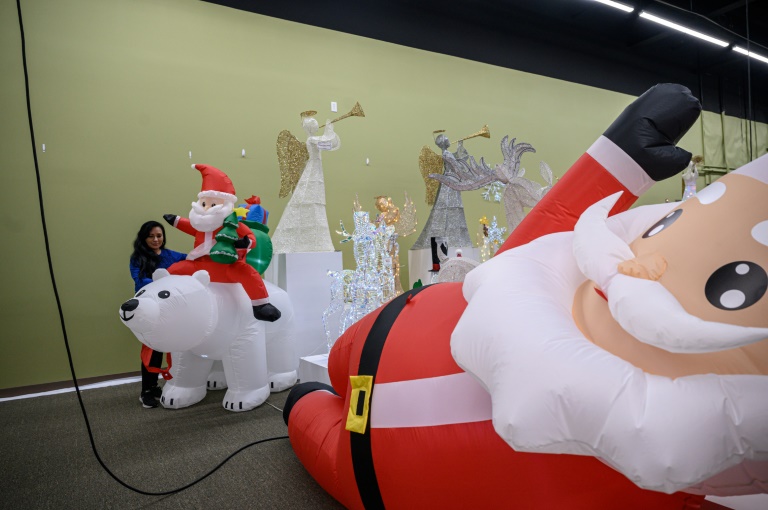
US retailers are hustling to sell their stockpiles of Christmas decorations as the festive season approaches, after tangled supply chains caused many shipments to arrive only after the holidays last year.

As major economies bounced back from the pandemic, companies had struggled to keep up with soaring demand, with manufacturing hit by factory shutdowns during virus outbreaks.

The situation was worsened by a shortage of shipping containers, along with delays at ports from a lack of workers to unload products and transport them to retailers.

It was “very difficult with supply” last year, especially to procure enough Christmas trees and products for customers, said Chris Butler, CEO of decorations seller National Tree.

“This year is a little bit of the opposite,” he told AFP.

“Every retailer, every manufacturer has a lot of trees, has a lot of garlands because everything came late,” he added.

Due to supply chain problems, retailers said part of their festive decorations arrived only in January or February.

“We went from ‘we don’t have enough’ to now ‘we have too much,'” said James Zahn, editor-in-chief at trade publication The Toy Book.

– Reduced spending –

But with soaring consumer prices weighing on household budgets, business executives have expressed concern that customers may tighten their purse strings.

“Consumers might not spend as much,” Butler said.

Inflation rose 8.2 percent from a year ago in September, and the elevated figure triggered concerns that price pressures have become more ingrained.

The Federal Reserve is now walking a tightrope trying to wrestle cost increases down without triggering a recession in the world’s biggest economy.

For toy makers such as Hasbro, which distributes Monopoly, Nerf guns and Transformers action figures, all this means adapting to parents’ reduced purchasing power.

Customers have “become increasingly price-sensitive as the year has progressed,” Hasbro CEO Chris Cocks told an earnings call this month, adding that promotions “will be key in the quarters ahead.”

Similarly, Mattel, the seller of Barbie dolls and Fisher-Price toys, said this week that it would have more discounts as the holidays approach.

“Instead of shippers ramping up activity to prepare for the holiday season, September brought a change of fortune as shipping volumes slowed and shipping prices declined,” said Oren Klachkin, lead US economist at Oxford Economics, in a recent note.

He cited weaker consumer demand and overstocked sellers, factors which experts say could result in steep discounting that cuts profit margins.

– Higher costs –

Some toys have become about 15 percent more expensive due to inflation, said Zahn of The Toy Book.

“That is going to make a difference for families that are already feeling a pinch when groceries and fuel are more expensive,” he said.

Even including storage costs and interest, goods that arrived too late for last year’s holiday season were “still a little cheaper” than those added to inventory this year, Costco chief financial officer Richard Galanti told a recent earnings call.

Merchants like clothing chain Express are opting to sell their products this year in factory outlets instead of clearing them out at lower margins, said chief financial officer Jason Judd at a September conference.

“Santa, snowmen and Christmas trees haven’t changed a lot,” said Jill Timm, chief financial officer at department store chain Kohl’s in a recent conference.

“They’re still going to sell,” he said.

US retailers battle high costs clearing Christmas stockpiles

US retailers are hustling to sell their stockpiles of Christmas decorations as the festive season approaches, after tangled supply chains caused many shipments to arrive only after the holidays last year.

As major economies bounced back from the pandemic, companies had struggled to keep up with soaring demand, with manufacturing hit by factory shutdowns during virus outbreaks.

The situation was worsened by a shortage of shipping containers, along with delays at ports from a lack of workers to unload products and transport them to retailers.

It was “very difficult with supply” last year, especially to procure enough Christmas trees and products for customers, said Chris Butler, CEO of decorations seller National Tree.

“This year is a little bit of the opposite,” he told AFP.

“Every retailer, every manufacturer has a lot of trees, has a lot of garlands because everything came late,” he added.

Due to supply chain problems, retailers said part of their festive decorations arrived only in January or February.

“We went from ‘we don’t have enough’ to now ‘we have too much,'” said James Zahn, editor-in-chief at trade publication The Toy Book.

– Reduced spending –

But with soaring consumer prices weighing on household budgets, business executives have expressed concern that customers may tighten their purse strings.

“Consumers might not spend as much,” Butler said.

Inflation rose 8.2 percent from a year ago in September, and the elevated figure triggered concerns that price pressures have become more ingrained.

The Federal Reserve is now walking a tightrope trying to wrestle cost increases down without triggering a recession in the world’s biggest economy.

For toy makers such as Hasbro, which distributes Monopoly, Nerf guns and Transformers action figures, all this means adapting to parents’ reduced purchasing power.

Customers have “become increasingly price-sensitive as the year has progressed,” Hasbro CEO Chris Cocks told an earnings call this month, adding that promotions “will be key in the quarters ahead.”

Similarly, Mattel, the seller of Barbie dolls and Fisher-Price toys, said this week that it would have more discounts as the holidays approach.

“Instead of shippers ramping up activity to prepare for the holiday season, September brought a change of fortune as shipping volumes slowed and shipping prices declined,” said Oren Klachkin, lead US economist at Oxford Economics, in a recent note.

He cited weaker consumer demand and overstocked sellers, factors which experts say could result in steep discounting that cuts profit margins.

– Higher costs –

Some toys have become about 15 percent more expensive due to inflation, said Zahn of The Toy Book.

“That is going to make a difference for families that are already feeling a pinch when groceries and fuel are more expensive,” he said.

Even including storage costs and interest, goods that arrived too late for last year’s holiday season were “still a little cheaper” than those added to inventory this year, Costco chief financial officer Richard Galanti told a recent earnings call.

Merchants like clothing chain Express are opting to sell their products this year in factory outlets instead of clearing them out at lower margins, said chief financial officer Jason Judd at a September conference.

“Santa, snowmen and Christmas trees haven’t changed a lot,” said Jill Timm, chief financial officer at department store chain Kohl’s in a recent conference.

“They’re still going to sell,” he said.

Obama tries to rescue Democrats from US midterm losses

In the run-up to the high-stakes midterm elections next week, President Joe Biden is out on the stump in many states.

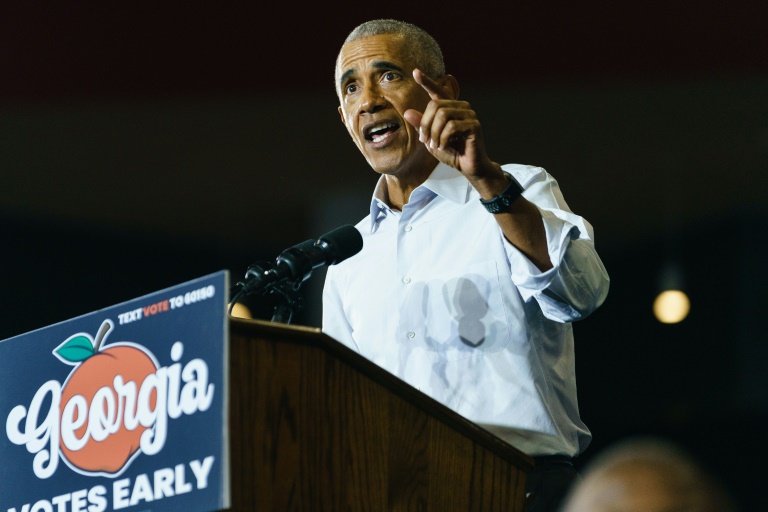
But his one-time boss, former president Barack Obama, is also campaigning hard to rescue a faltering Democratic Party.

On Friday, the two men spoke at the same time, in two different corners of the United States: Biden in Pennsylvania and Obama in Georgia, two crucial states for Democratic Party aspirations in Congress.

Both presidents have employed nearly the same speech: the need to save American democracy by blocking Donald Trump’s Republican Party.

– Stealing the show –

Long-known for his oratory skills, Obama has sometimes stolen the limelight from his former vice president, whose campaign appearances are more prosaic.

“If they win, there’s no telling what might happen,” Obama said on Friday about the Republicans, visibly enjoying the enthusiasm of his audience in Atlanta.

“I need you to get off your couch and vote! Put down your phone and give TikTok a rest and vote!”

It was a return to the stage for the former president, who governed for two terms ending in early 2017. Out of the public eye, Obama devoted himself to producing documentaries, writing and philanthropy.

But now, as a campaign surrogate, Obama is keeping very busy. After Georgia, Obama headed to Michigan and Wisconsin for campaign events Saturday. He will be in Nevada Tuesday, then on to Pennsylvania.

Obama’s deft handling of campaign crowds was on display Saturday in Detroit when a heckler interrupted him. “Right now, I’m talking,” Obama said calmly. “You’ll have a chance to talk sometime later… It’s not how we do things.”

Recent opinion polls offered the Democratic Party hope of retaining precarious control of the Senate, while losing control of the lower House of Representatives to the Republicans.

Even more recently, though, some right-wing candidates are rising in polls, including some of former president Trump’s fiercest Republican defenders. Now, the White House fears the losses in the House could be greater than expected.

If those losses spread to key Senate races, it would put both houses of Congress under Republican control.

– ‘Inherent danger’ –

Barack Obama is, in a way, well-placed to sound the alarm: his party suffered what he himself called a “shellacking” in the 2010 legislative elections marking the halfway point of his first term.

“There is an inherent danger in being in the White House and being in the bubble,” he said at the time, referring to the 160-year history of midterm elections that almost always punish the party in power.

Joe Biden, who prides himself on being a president of the “middle class,” far from the Washington bubble, has nevertheless given the impression since the beginning of the campaign that he does not relish straying into hostile electoral territory.

He travels regularly and raises funds for the Democratic Party, but the unpopular 79-year-old president has not ventured into some of the most highly contested states, such as Arizona. Biden will hold a final rally in Maryland, considered a very safe choice.

Obama, for his part, expressed concern in an interview posted online in mid-October about the direction Democrats were taking.

He fretted that they were mired in abstract polemics around complex social issues, appearing  disconnected from people’s everyday lives, while Republicans bashed Democrats on crime and the soaring cost of living.

Believing that politics should not be a matter of “buzzkill,” Obama warned the party should help people “not feel as if they are walking on eggshells.”

He urged the party to be “a little more real and a little more grounded,” saying that tack would go “a long way in counteracting what is… the systematic propaganda that I think is being pumped out by Fox News,” the preferred TV channel of Republicans.

Croatia prepares for euro switch amid soaring inflation

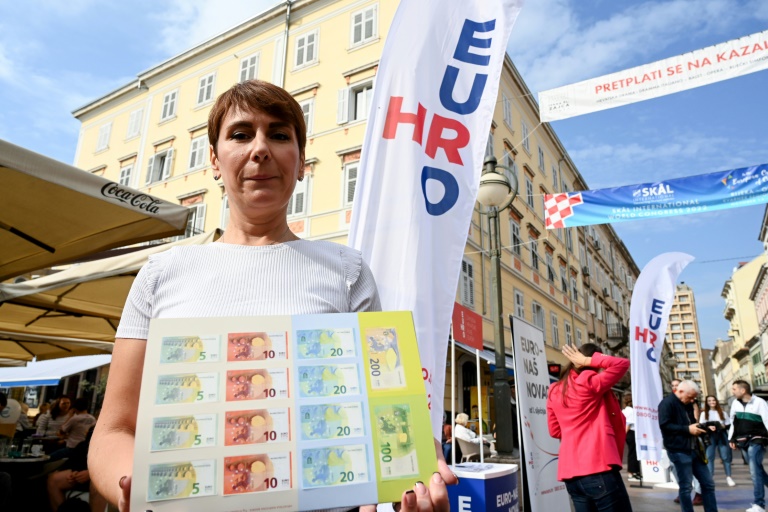
With inflation mounting and precarious geopolitical headwinds rattling Europe, Croatia hopes that its upcoming switch to the euro will bring some semblance of protection to the Balkan country in an uncertain world.

On January 1, Croatia will bid farewell to its currency — the kuna — to become the 20th member of the eurozone.

The former Yugoslav Republic, which joined the European Union nearly a decade ago, posted an annual inflation rate of almost 13 percent in September, compared to 10 percent in the eurozone.

In the build-up to the changeover, authorities have been constantly hammering home the advantages of adopting the euro for the country’s 3.9 million inhabitants.

“The euro brings resilience,” Ana Sabic of the Croatian National Bank told AFP, arguing that Zagreb will, if needed, have access to more favourable borrowing conditions amid economic hard times.

Since July, the European Central Bank has embarked on a policy of monetary tightening as it attempts to rein in galloping inflation caused by soaring energy and food prices triggered by the Russian war in Ukraine.

Analysts continue to argue that eastern European countries in the EU with currencies outside of the eurozone, such as Poland or Hungary, have been even more vulnerable to surging inflation. 

“It is actually an ideal moment for the euro switch,” said Goran Saravanja, the chief economist with the Croatian Chamber of Commerce.

“When major uncertainty dominates the global economy, for a small and open economy like Croatia it’s always better to be a part of a larger association like the eurozone,” he added.

Croatia’s main trading partners are in the eurozone, while the tourism sector — which accounts for 20 percent of its GDP — caters to large numbers of European visitors.

And Croatians have already adopted the euro to a large extent, with about 80 percent of bank deposits denominated in euros.

They have long valued their most prized possessions such as cars and apartments in euros, displaying lack of confidence in local currency dating back to the former Yugoslavia which was gripped by high inflation before its breakup.

During the Yugoslav era and after Croatia’s independence in 1991, properties were mostly valued in the German mark until the introduction of the euro two decades ago.

– Hopes and fears –

“Life will be easier, we calculate everything in euros anyway,” said Roman, an economist from Zagreb who refused to give his surname.

Milan Batur, a retired pharmacist, dismissed concerns from those who fear some traders are taking advantage of the coming transition to the currency to round up prices.

“It’s other things, wars, shortages that cause prices to rise. We can’t blame everything on the euro,” said Batur.

However some still worry they will take a financial hit by the move. 

“The calendar may not be ideal, we could perhaps have postponed it a little because of the situation in the world,” Zdravka Antonic, a florist at a market in Zagreb, told AFP. 

“People are already worried about how this is all going to end and the euro just adds to the uncertainty.”

Since early September, the price of bouquets, like those of other goods and services, bears a double label — with a conversion rate set by Brussels at 7.53 kuna to one euro. 

The system will remain in effect throughout 2023.

“A country that has its own currency is more independent. But when we joined the EU, we also accepted the euro,” said Ana Brkic, a vegetable seller.

Conservative and right-wing opposition groups protested the adoption of the new currency, saying the kuna represented an important symbol of national identity and argued that the euro only benefited larger countries like Germany and France.  

But an attempt last year at triggering a nation-wide referendum to challenge the adoption of the euro failed to gain any traction in the end.

Some Croatians fear that once they have adopted the euro the stark reality of how much poorer they are than many of their EU neighbours will only sink in further.  

According to the latest Eurostat survey published in 2018, the average monthly salary in Croatia was just 1,179 euros compared to more than 2,300 euros in the EU.

An estimated 300,000 Croatian retirees receive a pension of barely 260 euros a month.

“It will spark the feeling of poverty and misery,” said Ana Knezevic, director of  the national Consumer Protection Association.

Russia suspends participation in Ukraine grain deal

Moscow on Saturday suspended its participation in a landmark agreement that allowed vital grain exports from Ukraine, blaming drone attacks on Russian ships in Crimea.

Russia made the announcement after its army accused Kyiv earlier Saturday of a “massive” drone attack on its Black Sea fleet, which Ukraine labelled a “false pretext” and the UN urged the deal’s preservation.

US President Joe Biden called the move “purely outrageous” while Secretary of State Antony Blinken said Moscow was “weaponising food”.

The July deal to unlock grain exports signed between Russia and Ukraine and brokered by Turkey and the UN, is critical to easing the global food crisis caused by the conflict.

The agreement already allowed more than nine million tonnes of Ukrainian grain to be exported and was due to be renewed on November 19.

A Turkish security source told AFP that Ankara had not been “officially notified” of Russia’s suspension, while Ukraine and the UN pushed for the agreement to remain in force.

“I call on all states to demand that Russia stop its hunger games and recommit to fulfilling its obligations,” Ukrainian Foreign Minister Dmytro Kuleba said on Twitter. 

Ukrainian President Volodymyr Zelensky called the Russian move “an absolutely transparent intention of Russia to return the threat of large-scale famine to Africa and Asia”.

“Just today, more than two million tons of food are in the sea. This means that access to food has actually worsened for more than seven million consumers,” he said in his nightly address.

Stephane Dujarric, spokesman for the UN secretary-general, said: “It is vital that all parties refrain from any action that would imperil the Black Sea Grain Initiative which is a critical humanitarian effort”.

– ‘Peddling false claims’ –

Sevastopol in Moscow-annexed Crimea has been targeted several times in recent months and serves as the headquarters for the Black Sea fleet and a logistical hub for operations in Ukraine.

The Russian army claimed to have “destroyed” nine aerial drones and seven maritime ones, in an attack in the port early Saturday. 

“In light of the terrorist act carried out by the Kyiv regime with the participation of British experts against ships of the Black Sea fleet and civilian vessels involved in the security of grain corridors, Russia suspends its participation in the implementation of the agreement on the export of agricultural products from Ukrainian ports,” the Russian defence ministry said on Telegram.

Moscow’s forces alleged British “specialists”, whom they said were based in the southern Ukrainian city of Ochakiv, had helped prepare and train Kyiv to carry out the strike. 

In a further singling out of the UK — which Moscow sees as one of the most unfriendly Western countries — Russia said the same British unit was involved in explosions on the Nord Stream gas pipelines last month.

Britain strongly rebutted both claims, saying “the Russian Ministry of Defence is resorting to peddling false claims of an epic scale”.

Russia’s foreign ministry spokeswoman Maria Zakharova said Saturday Moscow would raise the blasts and the alleged drone attack at the UN Security Council.

The British defence ministry said this “invented story says more about arguments going on inside the Russian Government than it does about the West”.

Moscow’s military said ships targeted at their Crimean base were involved in the grain deal.

The United Nations Coordinator for the Black Sea Grain Initiative, Amir Abdulla, reported that Russia had notified him earlier Saturday of “its concerns about the safety of movements of merchant vessels” under the agreement.

Russia had recently criticised the deal, saying its own grain exports have suffered due to Western sanctions. 

– ‘Massive’ attack –

Mikhail Razvozhayev, the Moscow-installed governor of Sevastopol, said Saturday’s drone attack was the “most massive” the peninsula had seen. 

City authorities said the harbour was “temporarily” closed to boats and ferries and urged people “not to panic”.

Attacks on Crimea, annexed by Moscow in 2014, have increased in recent weeks, as Kyiv presses a counter-offensive in the south to retake territory held by Moscow for months. 

Moscow-installed authorities in Kherson, just north of Crimea, have vowed to turn the city into a fortress, preparing for an inevitable assault. 

On Thursday, Razvozhayev said a thermal power station had been attacked in Balaklava, in the Sevastopol area.

He claimed there was only minor damage and no casualties.  

In early October, Moscow’s bridge linking Crimea to the Russian mainland — personally inaugurated by President Vladimir Putin in 2018 — was damaged by a blast that Putin blamed on Ukraine. 

The Russian fleet stationed in the port had also been attacked by a drone in August.  

Russia’s allegations Saturday came as the Ukrainian army reported fighting in the Lugansk and Donetsk regions in the east, including near Bakhmut — the only area where Moscow’s forces have advanced in recent weeks.  

Pro-Russian separatists fighting alongside Moscow also announced a new prisoner exchange with Kyiv, saying 50 will return home from each side. 
Pelosi 'heartbroken and traumatized' over attack on husband

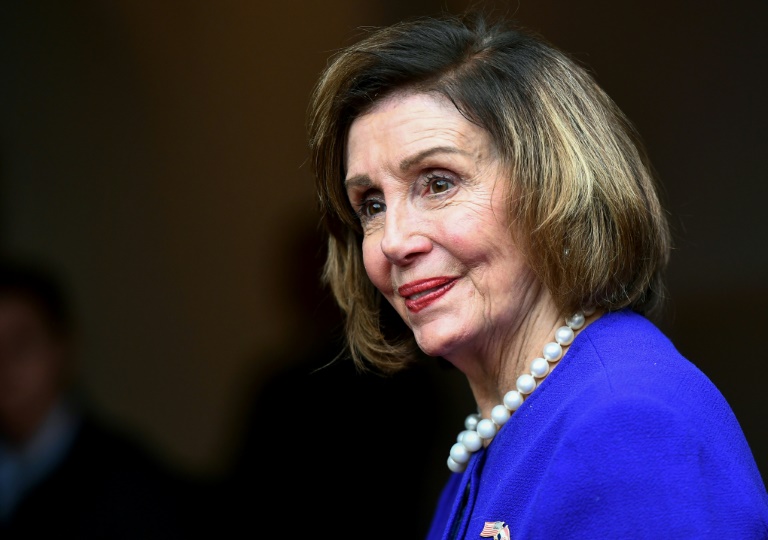
Speaker of the US House of Representatives Nancy Pelosi said Saturday she and her family were “heartbroken and traumatized” by the violent attack on her husband at their California home. 

An intruder had broken into the couple’s house in San Francisco early Friday morning and attacked the speaker’s husband Paul Pelosi with a hammer, fracturing his skull.

“Our children, our grandchildren and I are heartbroken and traumatized by the life-threatening attack on our Pop,” Pelosi said of the incident in a letter posted to Twitter Saturday evening. 

“We are grateful for the quick response of law enforcement and emergency services, and for the life-saving medical care he is receiving,” she said, in her first comment about the attack.

Paul Pelosi, 82 — who underwent surgery and is recovering in hospital — was at home alone, as his wife was working in Washington.

“His condition continues to improve,” Pelosi said in the letter. 

San Francisco police said officers found the assailant at the couple’s home just before 2:30 am (0930 GMT), where he and Paul Pelosi were scuffling over a hammer.

“The suspect pulled the hammer away from Mr. Pelosi and violently assaulted him with it,” San Francisco police chief Bill Scott told reporters, saying later that Paul Pelosi was hit at least once.

Police identified the assailant as 42-year-old David Depape, with Scott saying Depape would be charged with attempted homicide, assault with a deadly weapon, burglary and other felonies.

“This was not a random act,” Scott said. “This was intentional, and it is wrong.”

The suspect “demanded to confront me and brutally attacked my husband Paul,” Pelosi — who is second in line to the presidency — said in Saturday’s letter. 

– ‘This talk produces the violence’ –

US media, citing family sources, said the intruder told Paul Pelosi he was going to tie him up and wait for the speaker to get home.

Local media had earlier reported that the intruder shouted “Where’s Nancy?” during the assault, which came less than two weeks ahead of the midterm elections.

And speaking after voting in his home state of Delaware Saturday afternoon, President Joe Biden said he didn’t “know for certain, but it looks like this (assault) was intended for Nancy.”

He again denounced the attack, calling out increasingly polarizing political rhetoric.  

“You can’t condemn the violence unless you condemn those people who continue to argue the election was not real, that it’s being stolen — all the malarkey that’s been put out there to undermine democracy,” he said. 

“This talk produces the violence,” he added. 

The suspect, whom the Wall Street Journal reported broke in through a sliding-glass door, citing enforcement officers, had espoused extreme right-wing positions on social media, one of the officers told the newspaper.

Several Republicans also spoke out against the attack, including House minority whip Steve Scalise, who himself was shot at a congressional baseball practice in 2017 and said he was “disgusted” by Friday’s assault. 

With Twitter, Musk's influence enters uncharted territory

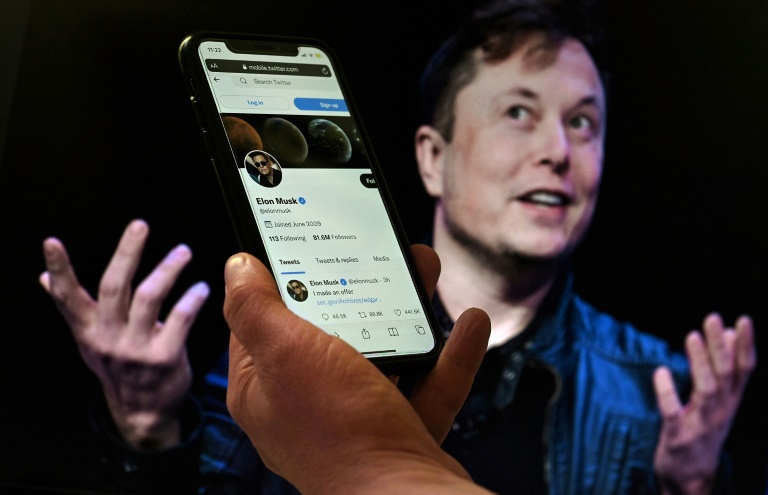
First, Elon Musk revolutionized the automobile industry, then he tackled space travel. By taking control of Twitter, the eccentric billionaire now wields a nearly untold level of influence.

In using his fortune to grab hold of such an important platform, experts say, he has even inserted himself squarely in today’s global political conversation.

“He is not just expressing views on an instrument of communication, he now owns it and sets the policy of how that instrument will be used,” Jeffrey Winters, a specialist in elites and oligarchs at Northwestern University, told AFP.  

The question now is what he will do with that power, starting with the topic on everyone’s mind: Whether or not Musk will allow former US president Donald Trump to return to the site. 

Without anyone to answer to, Musk “is going to change the constellation of political voices that are going to be expressed through Twitter,” Winters said. 

According to the professor, Musk represents a typical oligarch — a person whose fortune lends them social and political power not available to an average citizen — though Musk does not have any governments or militaries under his control.

– Oracle –

In the business world, Musk’s bona fides as an innovator are well-established. 

“He goes into directions that people just never go in, and he creates brand new products that proved to be highly effective and successful,” said Nicholas Colas, co-founder of DataTrek Research.

Musk did not invent the electric car, but with Tesla, “he showed it was possible in a big scalable way,” Colas explained. 

With SpaceX, Musk introduced internet satellites and reusable rockets, technologies that were “something that’s been promised but never really delivered until he came along,” Colas added. 

For Colas, Musk can in some ways be compared with inventors as prolific as Thomas Edison or iconic Apple founder Steve Jobs.

He has proven at least that he knows how to make money: Tesla is by far the highest-valued car company on the stock market and SpaceX is worth more than $125 billion. 

So when the richest man in the world gives his two cents on a business matter, such as his opinion on a company or on cryptocurrency, like an oracle — his fans listen. 

He can shake up the markets with just a few words. 

In 2021, when Musk edited his Twitter bio to simply say “#bitcoin,” the price of the virtual currency temporarily soared 20 percent. 

He could have stuck to his role as a businessman and adopted a low profile. According to Winters, that’s what most rich people do, fearing hostile reactions to their wealth. 

They employ lawyers and lobbyists to discreetly protect their interests, sometimes financing political campaigns. 

But “Elon Musk is unafraid to be very rich and very visible,” Winters said. 

– Red line? –

“The creation of Tesla as an iconic brand brought him to people’s attention and great wealth,” said Arizona State University communication and marketing specialist Mark Hass. 

“Then he just was willing to put himself out there continually on social media on issues that other CEOs would never publicly engage (with) the way he did,” he added. 

“He’s not afraid to say what is on his mind, regardless of who he insults, regardless of which regulator he angers,” said Hass. 

When Musk took to Twitter to propose a peace deal between Kyiv and Moscow, he probably viewed himself “as just giving his opinion like anyone else,” Winters said. 

“When you control the satellites that are important for Ukrainians’ ability to communicate, your opinion has massive ripple effects,” he explained. 

But in Washington, Musk still has less influence than other financial heavy-hitters such as JP Morgan’s Jamie Dimon or Goldman Sachs’ David Solomon, who “control the banking system,” Colas said. 

In buying Twitter — largely with his own money, but also with significant backing from investors who expect a return on their own risk — Musk has taken on a huge potential liability. 

“He can’t just flip a switch and make an anarchy there (at Twitter), because every big advertiser will back away,” Colas cautioned. 

“He likes to push things to the edge,” Hass said. And so far, “he’s never self-destructed.”

But in controlling Twitter, Musk has a more direct line to the public than ever before, and “I don’t know where his red line is,” Hass added. 

Close Bitnami banner
Bitnami