AFP

ECB poised for bumper rate hike despite recession gloom

The European Central Bank is expected to roll out another super-size rate hike Thursday to combat runaway inflation, despite concerns higher borrowing costs could deepen the pain of a looming eurozone recession.

The ECB’s 25-member governing council is likely to lift its key interest rates by 75 basis points for the second consecutive time, economists say.

The Frankfurt institution is under pressure to rein in record-high inflation, driven by surging food and especially energy prices in the wake of Russia’s war in Ukraine.

Eurozone inflation stood at just under 10 percent in September, nearly five times the ECB’s two-percent target.

ECB president Christine Lagarde warned recently that inflation was “far too high” and more action was required to prevent price shocks from becoming “entrenched”.

Like other central banks, the ECB is fighting back with a series of rate hikes intended to dampen demand by making credit more expensive for households and businesses — at the risk of triggering an economic downturn.

“The 75 basis point rate hike looks like a done deal,” said ING economist Carsten Brzeski.

“The ECB has turned a blind eye on recession risks,” he added.

– Political pushback –

The outlook for the eurozone economy has darkened in recent weeks as the 19-nation region grapples with the fallout from the Ukraine war, soaring tensions with Moscow and pandemic-induced global supply chain woes.

If Russia completely cuts off gas flows to Europe, the eurozone economy could shrink by nearly one percent in 2023, ECB vice-president Luis de Guindos has warned.

That scenario has become more likely after Russia in late August shut down the crucial Nord Stream 1 pipeline to Europe’s economic powerhouse Germany.

The German economy is already forecast to shrink by 0.4 percent next year.

As European governments race to unveil multi-billion-euro support measures to help citizens through a cost-of-living crisis this winter, the ECB’s monetary policy tightening has come under scrutiny.

Italian Prime Minister Giorgia Meloni this week slammed the ECB’s “rash choice” to keep hiking rates, saying it created “further difficulties for member states that have elevated public debt”, Bloomberg News reported.

French President Emmanuel Macron has also expressed “concern” that the ECB was “shattering demand” in Europe.

The ECB has already increased rates twice since July, ending over a decade of ultra-low and even negative interest rates.

Lagarde has repeatedly urged governments not to fall into the trap of spending so much that they end up boosting inflation and working against the ECB.

In the United States inflation has been fuelled not by energy costs but by pandemic-era stimulus spending. 

The Federal Reserve has hiked rates faster and more aggressively, leaving the ECB open to criticism that it was slow to jump into action.

– Balance sheet in focus –

The ECB is also expected to use this week’s meeting to discuss bringing other monetary policy levers in line with its inflation-busting efforts.

Policymakers are likely to announce changes to the 2.1 trillion euros (dollars) in super cheap, long-term loans (TLTROs) offered to banks in recent years to help the eurozone through several crises — sometimes at negative rates.

As a consequence of the rate hikes, lenders can now make an easy profit by parking their excess TLTRO cash at the ECB and pocketing the new, higher deposit rate — prompting policymakers to look for ways to incentivise early repayment of the loans.

The ECB may also ponder how best to shrink the five-trillion-euros worth of bonds on its balance sheet, after years of hoovering up government and corporate debt to drive up stubbornly low inflation.

But given the uncertain outlook and the risk of rattling financial markets, analysts say the start of any “quantitative tightening” — letting the bonds mature or actively selling them — is some way off.

“The recent events in the UK, which forced the Bank of England into a major U-turn on bond purchases, could be viewed as a useful reminder that any aggressive withdrawal of liquidity risks being highly disruptive for the bond market and the transmission of monetary policy,” said Ducrozet.


Packing heat and pumping gas, Texas voter defends gun rights

At a gas station in Houston, David Blanco fills up the tank of his car, a Glock 19 pistol clearly visible on his left hip. 

The Hispanic Texan says that in the crucial mid-term US elections coming up in less than two weeks, “the criteria that would mainly make me want to go out (and vote) is strictly firearms at the moment.”

Blanco, a serious-looking 33-year-old, had never been interested much in politics before, and didn’t normally vote.

But things changed, he said, when politicians “started threatening the Second Amendment, saying that, ‘Oh, we’re gonna ban AR-15s and high-capacity magazines.'”

“I was like, ‘You know what, maybe I should get involved now, maybe I should look more into it, and see who’s for protecting my rights that are guaranteed to me” under the US Constitution.

Blanco now scrutinizes the past of candidates for Congress, governor and county judge, among the positions contested in the November 8 elections, watching for any questioning of the right to bear arms which is so important to him.

The choice is not as clear-cut as it might seem. “There are some politicians on the Republican or conservative side that are anti-gun also,” he said, even if Republicans traditionally tend to favor gun rights.

In Texas, which has some of the most lax gun laws in the nation, the weapon is king — something no politician wishing to make a career here can afford to ignore.

But in Houston, a Democratic stronghold in a fiercely Republican state, seeing residents walking around armed is rare.

If Blanco wants to show off his firearm, he says it is to deter any would-be attacker. 

He has eight pistols and rifles, because “if anything bad happens, you can arm your neighbors and they can help you with, you know, any situation that happens to come along.”

He also uses them to practice shooting, his favorite hobby. 

– Suicide –

A city dweller of Hispanic origin, Blanco does not fit the typical profile of the American gun owner, who is generally white and rural. 

In 2021, 47 percent of white adults said they lived in a household with firearms, compared to just 26 percent of those of Hispanic origin, according to the Pew Research Center.

Blanco lives with a roommate in a neighborhood where shootings are not uncommon. 

It is also the area where he grew up, raised by a Mexican mother who always lived in fear of being robbed. 

He is constantly on guard. As a cyclist passes, he watches, wary he could be a thief on the prowl. 

Three events in his youth convinced him to carry a gun: a burglary at a friend’s place, a shooting in a neighboring house and, finally, Hurricane Ike, which plunged his neighborhood into darkness for several days in 2008.

During nights punctuated by regular gunshots, the family protected their house from looters with a rifle belonging to Blanco’s older brother, Humberto. The experience marked David deeply. 

He is, however, well placed to understand the tragedies that firearms cause.

Two years after Hurricane Ike, he heard his older brother handling his shotgun one day. 

Frightened, Blanco called the police, who on arrival discovered Humberto had committed suicide.

Gun violence is a national crisis in the United States, where mass shootings have become commonplace. In 2020, the most recent year with complete data available, more than 45,200 people died from gun-related injuries.

More than half of gun deaths in America are suicides, a fact regularly advanced by those who defend stricter gun control laws.

Blanco doesn’t see it that way. “He could have hanged himself,” he said of his brother.

– AR-15 –

In May, Texas was rocked by one of the worst school shootings in US history.

A young gunman killed 19 children and two teachers in an elementary school in Uvalde, using an AR-15 semi-automatic rifle, a type of weapon regularly used in this type of slaughter. 

“It’s very sad what happened,” said Blanco. But condemning the crime is not, in his opinion, the same thing as condemning the weapon. 

To those who say the average citizen doesn’t need such guns to defend themselves, he replies “there’s all kinds of situations that you could use an AR-15 for.”

He has two of them, and thinks this could allow him to respond more quickly to a possible threat. 

These are words that Greg Abbott, the current Texas governor and a candidate for re-election, would agree with. 

Last year, the Republican allowed almost all Texans to carry a gun openly, without training and without a license.

He is the big favorite against Democrat Beto O’Rourke, who is calling for tougher restrictions.

After the mass killing in Uvalde, O’Rourke stood out when he interrupted Abbott during a press conference, reproaching him for his inaction.

But even O’Rourke says on his web site he is “proud of Texas’ long tradition of responsible gun ownership.”

New York struggling with influx of asylum seekers

After a treacherous trip from his native Venezuela, Gustavo Mendez has survived two months in New York, finding work and a host family to live with on his path to a new future.

But he’s among the lucky ones to have a roof and a job in a city struggling to accomodate a recent influx of asylum seekers — 17,000 people since April — many of whom are being sent to makeshift tent camps.

Tens of thousands of Venezuelan migrants have been intercepted at the southern border over the past year, and in recent months several Republican-led border states started transferring asylum seekers north to Democratic stronghold cities — an explosive ploy ahead of the upcoming midterm vote.

Just weeks before that November 8 poll, which will see Democrats and Republicans fight for control of Congress, President Joe Biden limited the number of Venezuelan asylum seekers allowed to enter to 24,000.

The federal program offers a limited number of Venezuelans legal entry at US airports. But the Biden administration will expel those who attempt to cross via the land border, invoking a Donald Trump-era emergency health rule that denies them the right to apply for asylum, citing the need to quell Covid-19.

– Limited access to work –

Mendez can’t work legally but the cook and television technician did find a source of income a week after his arrival, at a restaurant in Queens that also sells refreshments out of a food truck at sporting events.

“I wanted to work as a cook or in television, and that’s what I came here for,” the 40-year-old told AFP.

He is making between $800 and $1,200 per week, a far cry from the $600 he took in monthly in his home country, where his two teenage children remain.

But Mendez is among the relatively fortunate.

Finding work is of singular importance for these migrants fleeing danger or persecution in their home countries.

But as things stand now, asylum seekers must wait 150 days after filing their initial application before they can request employment authorization.

“Since the middle of August, we have seen a large increase of asylum seekers,” Jay Alfaro, the manager of social services and partnerships at the Church of the Holy Apostles in Manhattan.

“The number one of questions here is, ‘Hey, do you know where to get a job?'”

The church provides food, legal services, housing counseling and medical assistance, operating one of the largest programs of its kind in the country.

Venezuelan Naisary Angulo, her husband and her three-year-old daughter came to the church seeking a rare warm meal.

After journeying for 50 days the 29-year-old and her family have been sleeping in one of the hotels set up by the mayor’s office.

– Work delays –

New York is the only city in the country obliged by law to offer shelter to anyone who asks for it.

For registered newcomers, the city is also to offer access to medical care, English language classes and skills training, as well as schooling for children.

But many asylum seekers say the process to gain legal work access is rife with delays; Mendez does not have an appointment with migration services until 2024.

Mayor Eric Adams, who has been open about his presidential ambitions, urged the federal government to pass legislation allowing asylum seekers to seek work “now, not in six months.”

Alongside the city’s shelters — originally meant to house its staggering homeless population — authorities have set up hotel rooms for asylum seekers.

Last week New York also began filling a gigantic tent set up on Randall’s Island in the East River, which can house 500 single men. 

There are also talks to set up a cruise ship to accommodate new arrivals.

– ‘Not sustainable’ –

At the moment those in these temporary shelter systems do not have limits to their stays.

Alfaro cited the overwhelming cost of rent in the city, which also has a housing shortage, in explaining the challenges faced by new arrivals.

According to a recent study published by the news outlet CNBC, a worker earning the city’s minimum wage of $15 dollars per hour would need to work 111 hours a week to pay for a one-bedroom apartment.

New York’s Mayor Adams has deemed the current situation “not sustainable,” with the city’s comptroller, Brad Lander, estimating the metropolis will spend between $500 million and $1 billion to temporarily house the influx of people.

Adams argues that all US cities should share the burden, saying that New York never made “any agreement to take on the job of supporting thousands of asylum seekers.”

Credit Suisse chief unveils master plan to fix bank's woes

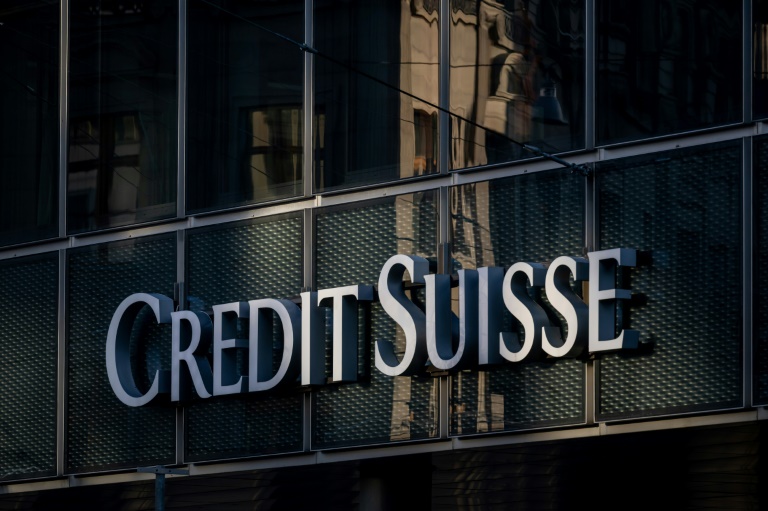
New Credit Suisse chief executive Ulrich Koerner is set to unveil his strategic master plan on Thursday, aimed at turning around the beleaguered bank following a string of scandals.

Analysts, rating agencies, banking regulators and regular customers will all be fixed on the roadmap rolled out by Koerner, who is considered a specialist in bank restructuring and has had a hundred days to diagnose the problems at Switzerland’s second-biggest bank.

Speculation in the build-up to Thursday’s announcement has concentrated on whether thousands of job cuts will be announced, or if a capital increase or disposals to finance the restructuring are on the cards.

The amount of capital that the bank could need is estimated at between four and nine billion Swiss francs ($4-9 billion), according to various specialists in the sector.

“We think the group may need to raise between six and nine billion Swiss francs before disposals to execute a credible restructuring plan,” said Barclays analysts.

The bank could sell assets in order to wait for better conditions to launch a capital increase, according to Flora Bocahut, an analyst at the US investment bank Jefferies.

“Strategic changes need to happen,” she said, as the bank, due to its losses, will eventually no longer achieve its medium-term solvency objectives.

Rumours are swirling around securitised products that make it possible to transform illiquid assets into securities that can be sold on the financial markets.

According to The Wall Street Journal business newspaper, the bank is about to seal their sale despite it being a very profitable business.

– Sluggish market –

The market context is not particularly buoyant.

On Tuesday, Switzerland’s biggest bank UBS, like the major US investment banks, reported a drop in income in its investment bank arm.

In the third quarter, high market volatility caused by Russia’s war in Ukraine, combined with recession fears, dampened demand for transactions such as debt issues, initial public offerings or mergers and acquisitions.

“The fast-deteriorating economic environment and recent market turbulence may complicate the execution of management’s restructuring plans,” the rating agency Standard and Poor’s warned in early October.

– Business woes –

The markets will be watching out for Koerner’s plans on Credit Suisse’s investment banking arm. Investors have been calling for reform for several years.

The capital-guzzling branch was the source of heavy losses that plunged Credit Suisse’s accounts into the red, eclipsing its other, more stable activities such as wealth management or its Swiss domestic banking services.

Credit Suisse’s investment bank suffered a loss of 3.7 billion Swiss francs in 2021 and backed that up with a 992 million Swiss franc loss in the first half of 2022.

It was hit by the implosion of the US fund Archegos, which cost Credit Suisse more than $5 billion.

Meanwhile its asset management branch was rocked by the bankruptcy of British financial firm Greensill, in which some $10 billion had been committed through four funds.

– Share price plunge –

In October 2021, Credit Suisse was also fined $475 million by the US and British authorities for its loans to state-owned companies in Mozambique, at the heart of a corruption case.

The bank already went through a major restructuring under Tidjane Thiam, its chief executive from 2015 to early 2020.

Credit Suisse is one of 30 banks globally deemed too big to fail, forcing it to set aside more cash to weather a crisis.

Banking experts are therefore dismissing social media rumours earlier this month of a “Lehman Brothers moment”, referencing the US bank which collapsed, triggering the 2008 financial crisis.

While many industry experts think a bankruptcy highly improbable, these rumours helped drag its share price down to a low of 3.158 Swiss francs.

Credit Suisse shares closed Wednesday at 4.763 Swiss francs on the Swiss stock exchange’s main SMI index.

Russia undertakes nuclear drills as fighting heavy near Bakhmut

Russia’s strategic forces carried out drills Wednesday, including a test launch of a ballistic missile from a submarine, further stoking concerns that a nuclear weapon could be deployed in the Ukraine war.

Russian President Vladimir Putin surveyed the drills carried out by his nuclear-capable forces as Moscow persisted in claiming, without offering evidence, that Kyiv was developing a “dirty bomb.”

On Monday the Russian foreign ministry posted photographs of ostensible nuclear materials on social media it said depicted “Ukraine’s capacities to create the ‘dirty bomb.'”

But on Wednesday Slovenia said the photo came from its own nuclear waste management agency and dated to 2010.

According to Dragan Barbutovski, an advisor of Slovenian Prime Minister Robert Golob, it depicted smoke detectors.

– Heavy fighting on main fronts – 

Ukraine President Volodymyr Zelensky said fighting remained intense in the eastern Donbas region near Bakhmut, a town Russia’s elite Wagner troops have made a concerted push to seize.

“The situation on the front line hasn’t changed significantly,” Zelensky said in his daily address to the nation. “The fiercest battles are in the Donetsk region, towards Bakhmut and Avdiyivka.”

In the main southern front, Russians were apparently fortifying their positions in Kherson city as civilians were evacuating the region. 

At least 70,000 people have left their homes in Kherson province in the space of a week, a Moscow-installed official, Vladimir Saldo, told a regional TV channel.

Pro-Kremlin authorities have sought to move residents to the Russian-controlled areas on the left bank of the Dnipro river, as Ukraine troops are expected to make a bid for the main urban area on the right bank.

Saldo banned entry to the right bank area of the region for a period of seven days “due to the tense situation on the contact line.”  

“The Russians do appear to be digging in to defend that region,” said Pentagon spokesman Pat Ryder on Tuesday.

– Submarine missile launch –

Western officials downplayed the Kremlin’s war games, a regular event for which Moscow gave foreign counterparts advance warning.

“Under the leadership of… Vladimir Putin, a training session was held with ground, sea and air strategic deterrence forces, during which practical launches of ballistic and cruise missiles took place,” the Kremlin said in a statement.

Russian state-run media ran footage of a submarine crew preparing the launch of a Sineva ballistic missile from the Barents Sea in the Arctic.

The drills also included launching test missiles from the Kamchatka peninsula in the Russian Far East. 

In calls to Chinese and Indian correspondents, Russia’s Defence Minister Sergei Shoigu continued to press his allegations that Ukraine planned to detonate “dirty bomb” — a crude, small weapon filled with radioactive, biological or chemical materials — which it would blame on Russia.

Indian Defense Minister Rajnath Singh said that in his call with Shoigu, he “pointed out that the nuclear option should not be resorted to by any side as the prospect of the usage of nuclear or radiological weapons goes against the basic tenets of humanity.”

– Cultural damage studied  – 

Meanwhile the UN culture agency UNESCO said it is using before-and-after satellite imagery to monitor the cultural destruction inflicted by Russia’s war in Ukraine, and would make its tracking platform public soon.

UNESCO said it had verified damage to 207 cultural sites in Ukraine since the Russian invasion began on February 24, including religious sites, museums, buildings of historical and or artistic interest, monuments and libraries.

“Our conclusion is it’s bad, and it may continue to get even worse,” UNESCO’s cultural and emergencies director Krista Pikkat told reporters at a briefing in Geneva.

“Cultural heritage is very often collateral damage during wars but sometimes it’s specifically targeted as it’s the essence of the identity of countries,” said Pikkat.

Earlier this month, Zelensky requested that UNESCO add the historic port city of Odessa to its World Heritage List in a bid to protect it from Russian air strikes.

UNESCO is working with the Odessa authorities to make sure that its main monuments and cultural sites are marked with a blue shield — the emblem used during armed conflicts to denote cultural property that should be protected.

Ford reports loss as it ends VW-backed autonomous driving venture

Ford announced Wednesday it is ending an autonomous driving program with Volkswagen, resulting in quarterly loss, as the auto giants retreat from a joint venture that had sought to revolutionize transport.

The Michigan auto titan recorded a $2.7 billion impairment in the third quarter on the dissolution of Argo AI program, which Ford first began supporting in 2017 and which VW later joined in 2019, in the hopes of quickly attaining full autonomy that did not require any driver engagement.

In a parallel move, Volkswagen said it was also ending its investment in Argo AI to focus on different autonomous and automated driving ventures.

The Argo AI initiative had sought to develop and commercialize Level 4-capable autonomy, which would not need a driver and would enable a rider to nap while traveling.

But with such a product more than five years away and requiring billions in investment, Ford opted to focus its investment on more attainable breakthroughs that CEO Jim Farley said could still provide drivers with more time, “the most valuable commodity in modern life.”

The impairment meant Ford reported a loss of $827 million compared with profits of $1.8 billion in the year-ago period. Revenues rose 10.4 percent to $39.4 billion. 

Ford also lowered some of its full-year financial projections, citing difficulties with suppliers. 

Farley said its focus would be on technological leaps in Level 2 and Level 3 autonomy.

“It’s mission-critical for Ford to develop great and differentiated L2+ and L3 applications that at the same time make transportation even safer,” Farley said.

“We’re optimistic about a future for (Level 4), but profitable, fully autonomous vehicles at scale are a long way off and we won’t necessarily have to create that technology ourselves.” 

Ford said when it announced its initial $1 billion investment in Argo AI in 2017, it hoped to bring Level 4 technology to market by 2021.

According to JD Power, Level 3 represents “conditional driving automation,” that employs driver assistance systems and artificial intelligence to make decisions.

While people inside the auto do not need to supervise the technology, “a human driver must be present, alert, and able to take control of the vehicle at any time, especially in the case of an emergency due to system failure,” according to JD Power.

By contrast, Level 4 autonomy “does not require any human interaction in the vehicle’s operation because it is programmed to stop itself in the event of system failure,” according to JD Power. “Since a human driver is never needed, a Level 4 vehicle may not have a steering wheel and pedals.”

Ford shares fell 1.1 percent to $12.68 in after-hours trading.

Euro bounces back above dollar parity

The euro on Wednesday jumped back above parity with the dollar, the US currency sliding against its main rivals on concerns over the world’s biggest economy and the prospect of slower interest rate hikes.

The euro bounced back above one dollar for the first time since mid-September, helped also by expectations of a big interest-rate hike from the European Central Bank on Thursday.

There were large gains against the dollar also for the British pound and yen, helping them recover some ground following the recent sharp losses.

The dollar retreated following “a string of negative (US) economic data released since the beginning of the week,” noted ActivTrades senior analyst Ricardo Evangelista.

Poorly received data, including slower house price growth and weaker consumer confidence, showed that big rate hikes from the Federal Reserve are “starting to open some cracks in the American economy,” he said.

“The Federal Reserve has been hiking rates aggressively in an attempt to bring inflation under control, and the country’s economy is starting to suffer as a result,” Evangelista added.

– Risk investments rebound –

A string of poor economic news has been welcomed by investors as it opens up the possibility that the Fed can slow down or end its interest rate hikes sooner. The recent news has seen risk investments like equities rebound in recent weeks.

The Bank of Canada on Wednesday increased its main rate by a smaller than expected 0.5 percentage points.

Market analyst Michael Hewson at CMC Markets said the move “suggests that central banks are starting to wake up to the possibility that too aggressive rate rises could do more harm than good.”

He added: “It’s also got markets asking the question, could the Fed follow suit next week after another poor set of housing numbers from the US.”

Wall Street stocks, which had rallied the last three days on hopes of expectations of moderating Fed policy, mostly fell following disappointing results from Boeing and tech giants Microsoft and Google parent Alphabet. 

In Europe, London, Frankfurt and Paris stocks all ended the day higher.

Sterling on Wednesday jumped more than one percent against the dollar, winning a boost also from markets welcoming the appointment of Rishi Sunak as British prime minister.

The move was seen as offering stability to the UK economy after weeks of upheaval fuelled by predecessor Liz Truss’s tax-cutting budget.

“The pound pushed back above the 1.1600 area against the US dollar today and risen against the euro despite the prospect that next week’s budget statement has been delayed until 17th November in order to allow time” for updated fiscal forecasts, said Hewson.

– Key figures around 2300 GMT –

Euro/dollar: UP at $1.0087 from $0.9966 on Tuesday

Pound/dollar: UP at $1.1621 from $1.1472 

Dollar/yen: DOWN at 146.39 yen from 147.93 yen

Euro/pound: DOWN at 86.77 pence from 86.88 pence

New York – Dow: FLAT at 31,839.11 (close)

New York – S&P 500 DOWN 0.7 percent at 3,830.60 (close)

New York – Nasdaq: DOWN 2.0 percent at 10,970.99 (close)

London – FTSE 100: UP 0.6 percent at 7,056.07 (close) 

Frankfurt – DAX: UP 1.1 percent at 13,195.81 (close)

Paris – CAC 40: UP 0.4 percent at 6,276.31 (close)

EURO STOXX 50: UP 0.6 percent at 3,605.31 (close)

Tokyo – Nikkei 225: UP 0.7 percent at 27,431.84 (close)

Hong Kong – Hang Seng Index: UP 1.0 percent at 15,317.67 (close)

Shanghai – Composite: UP 0.8 percent at 2,999.50 (close)

Brent North Sea crude: UP 2.3 percent at $95.69 per barrel

West Texas Intermediate: UP 3.0 percent at $87.91 per barrel

burs-jmb/st

Meta's quarterly profit dives as tough economy hits tech

Facebook-parent Meta reported Wednesday that its profit more than halved to $4.4 billion in the third quarter from $9.2 billion a year earlier, and said it plans “significant changes” to bolster efficiency in a tough economic environment.

The social networking giant, which faces stagnating user numbers and cuts in advertising budgets, also said revenue slipped to $27.7 billion from $29 billion a year earlier.

“We’re approaching 2023 with a focus on prioritization and efficiency that will help us navigate the current environment and emerge an even stronger company,” said Meta chief Mark Zuckerberg.

Meta shares plunged 19.1 percent to $105 in after-market trades, the price less than a third of what it was at the start of this year.

“While we continue to navigate some challenging dynamics – a volatile macro economy, increasing competition, ad signal loss and growing costs from our long term investments — I have to say that our product trends look better from what I see then some of the commentary I’ve seen suggests,” Zuckerberg told analysts on an earnings call.

The number of monthly active users at Facebook was up just two percent to 2.96 billion at the end of September, Meta reported.

Meanwhile, the number of employees at the tech titan tallied 87,314, a 28 percent increase from a year earlier, the earnings report stated.

“We are making significant changes across the board to operate more efficiently,” Meta said in the release.

The Silicon Valley-based tech firm said that it expects to hold headcount levels in check over the next year.

Zuckerberg said that while tightening its belt, Meta will focus on its artificial intelligence that powers recommendations at offerings such as short-form video feature Reels, as well as ad messaging platforms and its vision for the metaverse.

– Apple squeeze –

Big tech platforms have been suffering from the economic climate, which is forcing advertisers to cut back on marketing budgets, and Apple’s data privacy changes, which have reduced leeway for ad personalization.

“Meta is on shaky legs when it comes to the current state of its business,” said Insider Intelligence principal analyst Debra Aho Williamson.

“Mark Zuckerberg’s decision to focus his company on the future promise of the metaverse took his attention away from the unfortunate realities of today.”

Those realities include Meta being under pressure due to global economic conditions, competition including TikTok, and Apple letting iPhone users curb collection of data “signals” for targeting money-making ads, according to the analyst.

Apple last year began letting iPhone users decide whether to allow their online activity to be tracked for the purpose of targeting ads — a change which it said shows its focus is on privacy, but which critics note does not prevent the company itself from tracking.

Meta expected that policy, which impacts the precision of the ads it sells and thus their price, to cost the social media giant $10 billion in lost revenue this year.

This week, Apple updated its App Store rules to require that apps offered there use its payment system for sales of “boosted” posts, which are essentially ad messages promoted to the top of social media feeds for a price.

The App Store is the lone gateway for digital content to get onto iPhones or iPads.

The change means that Apple will be able to collect its 30 percent commission on that type of advertising at Facebook and Instagram, where all the money made previously had gone to Meta because they used their own payment system.

“Apple continues to evolve its policies to grow their own business while undercutting others in the digital economy,” Meta said in reply to an AFP inquiry.

“Apple previously said it didn’t take a share of developer advertising revenue, and now apparently changed its mind.”

Meta had long delivered seemingly endless upward growth, but reported early this year its first decline in global daily users.

In July, Meta reported its first quarterly revenue drop and a plunging profit.

Brazil's central bank holds 13.75% interest rate amid 'high' inflation

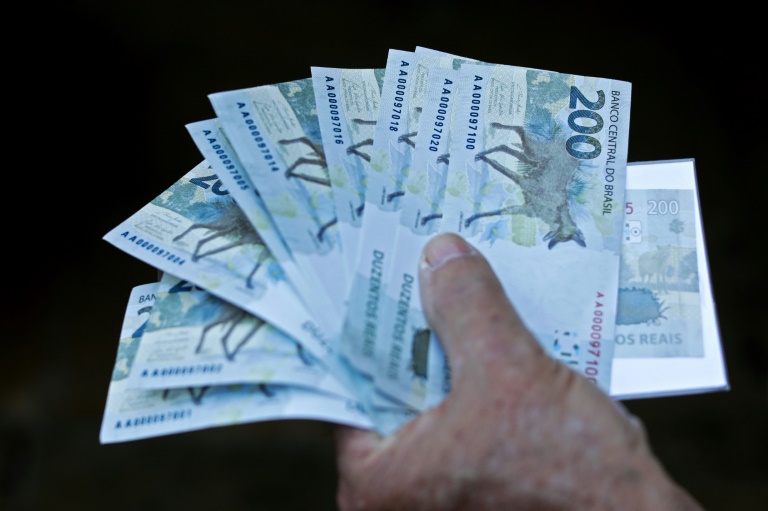
Brazil’s central bank held its benchmark interest rate at 13.75% on Wednesday, remarking that inflation “remains high” despite receding for three months in a row, just four days before a presidential election.

It is the second meeting in a row that the bank’s monetary policy committee left the Selic interest rate unchanged after putting the brakes on 12 straight increases.

In a statement, the monetary committee said it remained “vigilant” and that the high interest rate level would be maintained “as long as it takes to control inflation.”

The committee did not rule out a “resumption of the cycle of increases” if prices do not lower “as expected.” For now, “inflation remains high” despite dropping for several months.

The decision comes as the country braces for a divisive second-round presidential election between far-right President Jair Bolsonaro and leftist former leader Luiz Inacio Lula da Silva on Sunday.

The interest rate decision was in line with market forecasts, which were reflected in a survey of more than a hundred consultants and financial institutions by the Valor economic newspaper.

The benchmark interest rate has remained at the same level since August, when the committee applied the last increase of half a percentage point.

Haunted by a history of hyperinflation, Brazil was among the first countries to start raising interest rates after the monetary easing of the coronavirus pandemic when the Selic stood at a record low of two percent.

Since March 2021, the central bank had rapidly raised its key rate from an all-time low of two percent, including three whopping hikes of 1.5 percentage points from October 2021 to February 2022.

The long period of high inflation in Latin America’s largest economy has been fueled by rising global food and oil prices spurred on by the war between Russia and Ukraine.

– Slowing inflation –

This trend has slowed in recent months. 

The consumer price index was negative in July (-0.68 percent), August (-0.36 percent) and September (-0.29 percent). 

Annual inflation stood at 7.17 percent in September, prior to the first round of the presidential elections on October 2.

The successive declines reduced market forecasts, and inflation is now expected to lower to 5.60 percent by the end of the year, almost half of what was initially projected, according to a survey released by the central bank (BCB) this week. 

Bolsonaro has highlighted the “unprecedented deflation” during his campaign.

He is currently polling 45 percent to Lula’s 49 percent ahead of the second round, according to Datafolha polling data published Friday.

Economists warn, however, that the negative trend is not yet established and that price increases are still a latent threat.

By keeping the Selic at the current high level, the monetary committee hopes that 2023 inflation will lower to the 3.25 percent target set by the central bank.

Only then can they begin cutting rates, analysts say.

Analysts have warned about the impact of high interest rates on GDP, which is projected to grow 2.76 percent by the end of this year, far from the stagnation that was expected in early 2022, according to the BCB Focus survey.

Brazil is easing up on its interest rate as the US Federal Reserve and European Central Bank have shifted into full-on tightening to curb inflation.

Biden discusses Iranian drones in Ukraine with Israeli president

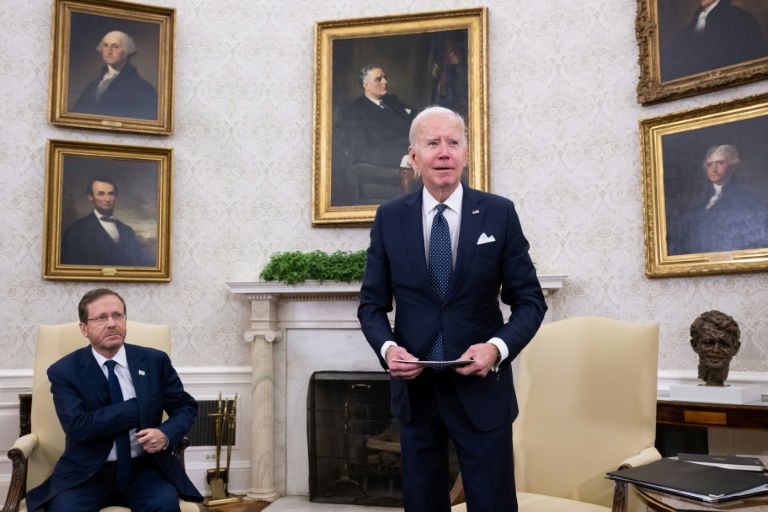
US President Joe Biden and Israel’s President Isaac Herzog on Wednesday discussed the growing threat to Ukraine from Russia’s Iranian-supplied war drones, as Israel comes under pressure to help Kyiv.

Herzog told reporters at the White House after his talks that they “mainly” discussed Iran’s nuclear program, the crushing of protesters demonstrating against strict Iranian religious laws, and the issue of Tehran’s drone sales to Russia.

The weapons are “killing innocent Ukrainian citizens,” Herzog said.

Israel has been reluctant to get involved in a US-led alliance helping pro-Western Ukraine to repel a bloody Russian invasion. 

But Herzog’s trip to Washington underlined Israeli concern at the growing role of Iran in the conflict, with Tehran accused of supplying fleets of deadly drones used by Russia against Ukrainian civilian targets.

On Tuesday, Herzog met with US Secretary of State Antony Blinken and announced he was sharing intelligence to prove that Iran has been supplying military drones to the Russians.

Ukrainian President Volodymyr Zelensky welcomed this Wednesday, saying “this is a positive trend in relations with Israel…. After a long pause, I see us moving forward.”

Biden and Herzog also discussed Iran’s ongoing tussle with the international community over its nuclear program, which it insists has only civilian goals. Israel opposes a push by the Biden administration to salvage a deal that would reinstate international inspections in Iran in exchange for sanctions relief.

“They consulted on a wide range of global and regional issues of mutual concern, including the threats posed by Iran and its proxies. The president emphasized his administration’s pledge to ensure Iran will never acquire a nuclear weapon,” the White House said in a statement after the talks.

– Maritime border ‘breakthrough’ –

Sitting alongside Herzog in the White House Oval Office, Biden praised Israel for reaching a long-delayed accord with Lebanon on their sea border. The deal was brokered by the United States.

Biden hailed the “historic breakthrough.”

“It took a lot of courage for you to step up and step into it,” he told Herzog. “It took some real guts. It took principled and persistent diplomacy to get it done.”

Biden said the newly agreed border would allow both countries to develop energy fields, and it would “create new hope and economic opportunities.”

However he pressed the Israeli president on the need to “deescalate” the violent standoff in the Palestinian West Bank and “underscored that a negotiated two-state solution remains the best avenue to achieve a lasting peace” with the Palestinians, the White House readout said.

Biden “underlined the need to take continued steps to improve the lives of Palestinians, which are critical to peace, security and prosperity.”

Herzog indicated that Biden would be attending the COP27 climate summit in Egypt next month — something not yet confirmed by the White House — and said the climate crisis “can serve as a common denominator for so many nations.”

Herzog’s visit comes days ahead of Israel’s fifth election in less than four years. Hawkish ex-prime minister Benjamin Netanyahu, who has had tense relations with Democratic US administrations, is seeking a comeback.

It also comes less than two weeks before Americans vote in the midterm elections that are predicted to strip Biden’s Democrats of their control of Congress.

“We have elections in Israel and you’re having midterm elections in the United States but one thing is clear — I think this visit epitomizes that our friendship, our strong bond transcends all political differences,” Herzog told Biden.

Close Bitnami banner
Bitnami