AFP

UK reports further bleak economic data

UK government borrowing surged and retail sales slumped in September, official data showed Friday, dealing a further economic blow to a country in political crisis.

Public sector net borrowing stood at £20 billion ($22 billion), the second-largest September level on record, as decades-high inflation sees interest on debt repayments balloon.

Retail sales volumes tumbled 1.4 percent as sky-high prices curbed consumer purchasing. The figure was better, however, than the 1.7-percent slide in August.

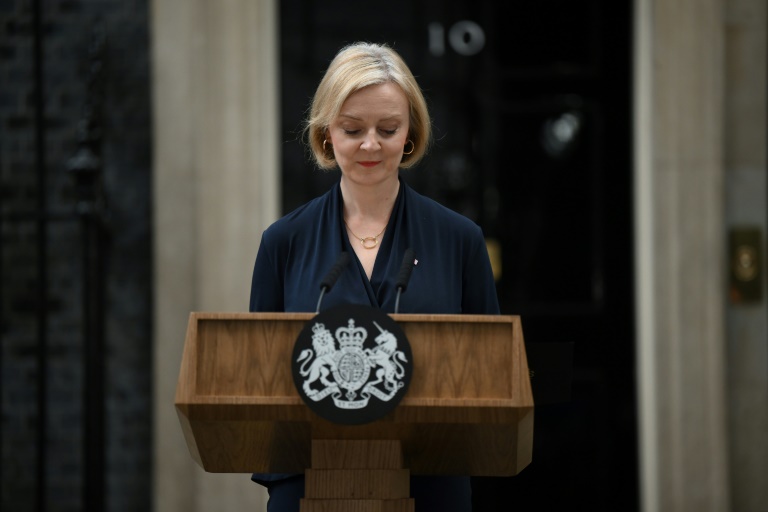
The data comes one day after Prime Minister Liz Truss resigned in the wake of markets turmoil triggered by her budget of tax cuts funded by debt.

The public borrowing figure exceeded analysts’ consensus of £17.2 billion, which was already far above the government’s own prediction.

“The weakness in retail sales and further overshoot of the… (government) public borrowing forecast won’t make the next prime minister’s task any easier in navigating the economy through” various crises, concluded Ruth Gregory, senior UK economist at Capital Economics.

Interest payments on government debt surged to £7.7 billion in September, “largely reflecting the broader economic environment of soaring inflation”, noted CEBR economist Pushpin Singh.

Government borrowing is linked to the wider RPI measure of inflation, which stands at a huge 12.6 percent in Britain.

– Next PM –

Contenders bidding to succeed Truss on Friday opened a hectic weekend of campaigning, but opposition parties demanded that UK voters get their own say to end months of political chaos via a general election.

Truss succeeded Boris Johnson on September 6 after a weeks-long campaign against Tory rival Rishi Sunak, who is now a favourite to take over in the coming days.

Former finance minister Sunak had warned in the battle to succeed Johnson that tax cuts promised by Truss when government debt had already soared on Covid interventions was the wrong policy to pursue.

He was proved right as the budget sent the pound crashing to a record-low close to parity with the dollar and triggered yields on government bonds to soar.

That caused Truss to U-turn on most of her planned tax cuts, ultimately costing her the job of prime minister.

On Friday, sterling slid one percent against the dollar, before recovering slightly, while the yield on the British government’s 30-year bond climbed back above four percent.

“Uncertainty in British politics remains rife, which will do little to inspire confidence in UK assets,” said Matthew Ryan, head of market strategy at global financial services firm Ebury. 

Separate data Friday showed British consumer confidence stuck near historic lows despite a slight improvement this month.

GfK’s Consumer Confidence Index rose two points to minus 47.
Johnson eyes comeback as UK Tories race to replace Truss

Contenders to succeed British Prime Minister Liz Truss canvassed for support Friday, with her predecessor Boris Johnson reportedly considering a sensational comeback as he picks up dozens of early nominations from Conservative MPs.

Truss’s announcement Thursday that she will resign after less than seven weeks in office has also prompted renewed calls from opposition parties for an early general election to end months of political chaos.

After her tax-slashing mini-budget last month sparked economic turmoil, two departures from her new cabinet and an eventual revolt by Tory lawmakers, Truss admitted she “cannot deliver the mandate” party members had handed her in the prior leadership contest.

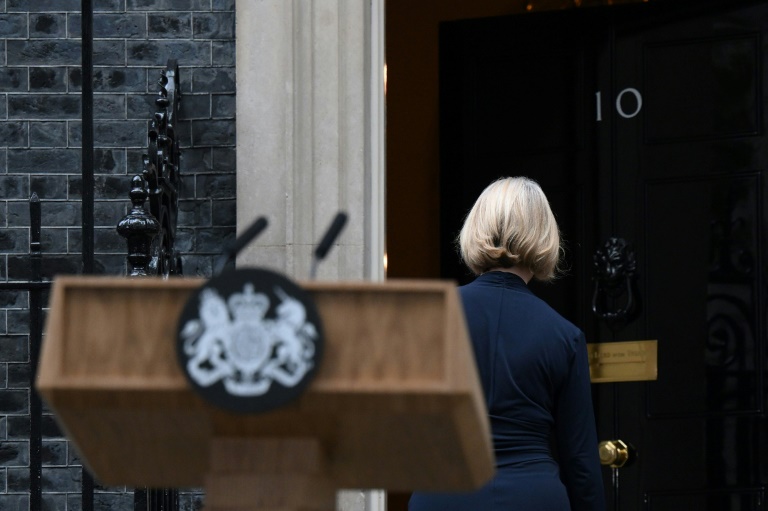
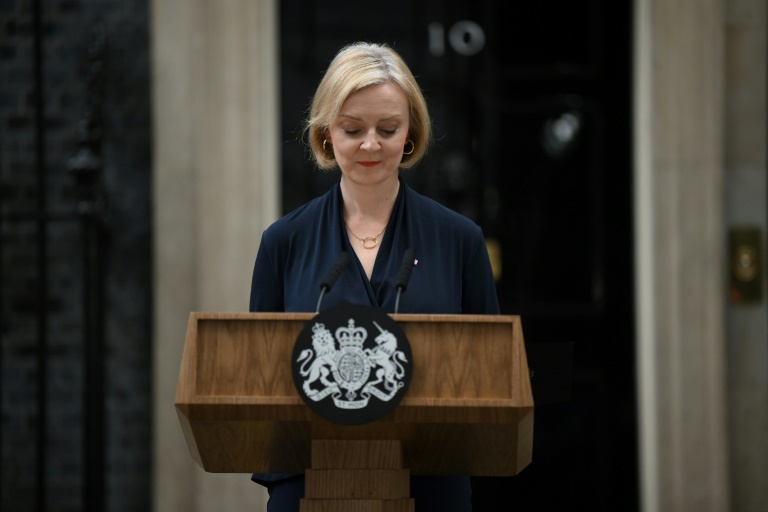
British newspapers featured sombre images of Truss’s last speech outside the door of No. 10 Downing Street, with leftwing broadsheet The Guardian headlining its front page: “The bitter end”.

Truss only succeeded Johnson on September 6 after a weeks-long campaign against Tory rival Rishi Sunak, vowing a radical overhaul as Britons struggle with a cost-of-living crisis.

Having warned correctly of the disastrous consequences of her debt-fuelled tax promises, former finance minister Sunak has emerged as an early favourite to succeed Truss.

But the scandal-tarred Johnson may also be in the mix for a dramatic comeback bid, despite leaving Downing Street with dismal poll ratings.

“He couldn’t could he…” read the front page headline of the Tory-supporting Daily Express tabloid.

Conservative party managers announced a truncated election process, which requires candidates to garner 100 nominations from colleagues by Monday afternoon, ahead of another possible vote of members next Friday if two remain in the race.

– ‘Mandate’ –

So far there are no formal contenders, but the contest was widely expected to be a three-horse race between Sunak, Johnson and senior cabinet member Penny Mordaunt. 

Political website Guido Fawkes, which is running a rolling spreadsheet of Tory MPs’ declared support, had Johnson on 52, Sunak on 47 and Mordaunt on 18 by early Friday. 

Rightwing broadsheet The Daily Telegraph reported Johnson was set to fly back from a holiday in the Caribbean and was urging MPs to back him.

An ally told the paper that if the Tories want to avoid losing the next general election, “they need to revert” to Johnson as “the guy with a mandate who is a seasoned campaigner”.

There are precedents, The Telegraph wrote, with Harold Wilson and Winston Churchill both returning for a second stint after leaving office — albeit not mere weeks after being forced out. 

Johnson in his final question time in parliament in July dropped a hint, saying: “hasta la vista baby”.

The Times reported some Tory MPs were threatening to quit the party if the divisive figure returned as leader, however.

Tory MP Crispin Blunt told the BBC that Johnson was a “fantastic communicator” but Sunak was “a much more serious personality” who could impart a “serious message” to the country.

Some senior figures including new finance minister Jeremy Hunt have already ruled themselves out, while others such as Defence Secretary Ben Wallace have remained silent.

Other candidates could include a representative of the party’s right such as Suella Braverman, whose resignation as interior minister Wednesday helped trigger Truss’s downfall.

– ‘Soap opera’ –

Contenders have until 2:00 pm (1300 GMT) on Monday to produce the minimum 100 nominations from their fellow Tory MPs.

That means a maximum of three candidates will emerge from among the 357 Conservatives in the House of Commons.

If necessary, they will vote to leave two candidates standing, and hold another “indicative” vote to tell the party membership their preferred option.

If no single candidates emerges, the rank-and-file will then have their say in an online ballot next week.

The Telegraph called the truncated process “sensible” in an editorial. 

But for Labour and other opposition parties, the governing party is showing contempt towards the electorate.

Demanding an immediate general election, more than two years ahead of schedule, Labour leader Keir Starmer said Britain “cannot have another experiment”.

“This is not just a soap opera at the top of the Tory party — it’s doing huge damage to the reputation of our country,” he said as the Labour Party showed a runaway lead in the polls.

The Guardian backed an early general election, saying only this would “give the British people the fresh start that they need and deserve”.

But former Tory minister Nicky Morgan told Times Radio that a general election was “the last thing that the country needs”.

Dollar extends gains on Fed rate hike expectations

The dollar extended gains Friday on expectations the Federal Reserve will press ahead with its programme of bumper interest rate hikes for the rest of the year.

Traders were girding for another possible intervention by Tokyo after the yen sank past 150 per dollar, while sterling remained under pressure owing to uncertainty in Westminster after Prime Minister Liz Truss resigned after just six weeks in office.

The fear that has gripped markets for most of the year returned after a brief respite at the start of the week, sending equity markets back into the red, with a series of better-than-expected earnings results unable to lift the gloom.

The dollar burst to a new 32-year high against the yen on Thursday as investors bet the Fed will ramp up borrowing costs much more as it struggles to rein in prices, while the Bank of Japan refuses to budge from its ultra-loose policies citing the need to support the torpid economy.

Even data Friday showing Japanese inflation hit an eight-year high last month — or more than 30 years when excluding VAT rises — was unable to change expectations that the central bank will continue to hold firm.

In a sign of growing rate hike expectations, US 10-year Treasury yields rose to their highest level since the financial crisis in 2008, which in turn hit equities.

“In October, inflation may reach 3.3 percent or 3.4 percent as many food prices are going up, mobile phone fees are giving a lift and service prices are rising,” said Mari Iwashita of Daiwa Securities Co.

“The BoJ seems to focus on downside risks overseas to conclude that it will need to keep up monetary easing. It strikes me that they have already made the decision to maintain easing.”

With the dollar sitting below 150.50 yen, there is a growing sense that authorities in Tokyo will step in to support their currency, though analysts warned that such moves rarely have a lasting effect. The last intervention was on September 22, when the dollar hit 145.90 yen.

– ‘Unmitigated disaster’ –

Finance Minister Shunichi Suzuki again said on Friday that the government was prepared to move and that the recent sudden, one-sided yen weakness was undesirable. 

But Hiroyuki Machida, at ANZ in Tokyo, said: “If moves reflect the rise in US yields on rate hike prospects and the pace is slow, it makes it difficult for Japan to intervene and the dollar-yen looks set to slowly grind higher toward 155.

“But the slow pace of the pair’s climb after touching 150 shows market players are wary of intervention and are cautiously treading water.”

The dollar was also elevated against sterling after a day after Truss resigned, having removed her finance and interior ministers within days and seeing her debt-fuelled, tax-cutting mini-budget torn up.

The pound initially rallied on the news Thursday but fell back as traders contemplated more government drift, and it remained weighed down on Friday.

“Truss has no doubt been an unmitigated disaster and I’m not sure who exactly will make the country feel at ease at this point,” said OANDA’s Craig Erlam.

“There will obviously be calls for a general election but that won’t provide any certainty or leadership for the country in the midst of a crisis. It would appear there are only bad options on the table so we probably shouldn’t expect a positive outcome.”

Equity markets fell again, extending Thursday’s losses and tracking another sell-off on Wall Street as expectations for more rate hikes by central banks around the world continue to grow owing to stubbornly high inflation.

Observers say the Fed could lift rates to as high as five percent before they take their foot off the pedal, and even then keep them there until officials are happy that prices are under control. They are currently at 3.0-3.25 percent.

Asia equity markets were mostly lower, with concerns about fresh lockdowns adding to the unease, after President Xi Jinping reiterated his commitment to the zero-Covid strategy.

Tokyo, Hong Kong, Sydney, Seoul, Singapore, Wellington, Taipei and Manila were all in the red, though Shanghai, Bangkok, Mumbai and Jakarta edged up.

London, Paris and Frankfurt were all down.

– Key figures around 0810 GMT –

Tokyo – Nikkei 225: DOWN 0.4 percent at 26,890.58 (close)

Hong Kong – Hang Seng Index: DOWN 0.4 percent at 16,211.12 (close)

Shanghai – Composite: UP 0.1 percent at 3,038.93 (close)

London – FTSE 100: DOWN 0.3 percent at 6,923.67

Pound/dollar: DOWN at $1.1183 from $1.1224 on Thursday

Dollar/yen: UP at 150.48 yen from 150.19 yen

Euro/dollar: DOWN at $0.9785 from $0.9787 

Euro/pound: UP at 87.36 pence from 87.17 pence

West Texas Intermediate: DOWN 0.2 percent at $84.32 per barrel

Brent North Sea crude: DOWN 0.2 percent at $92.17 per barrel

New York – Dow: DOWN 0.3 percent at 30,333.59 (close)

— Bloomberg News contributed to this story —

Dollar extends gains on Fed rate hike expectations

The dollar extended gains Friday on expectations the Federal Reserve will press ahead with its programme of bumper interest rate hikes for the rest of the year.

Traders were girding for another possible intervention by Tokyo after the yen sank past 150 per dollar, while sterling remained under pressure owing to uncertainty in Westminster after Prime Minister Liz Truss resigned after just six weeks in office.

The fear that has gripped markets for most of the year returned after a brief respite at the start of the week, sending equity markets back into the red, with a series of better-than-expected earnings results unable to lift the gloom.

The dollar burst to a new 32-year high against the yen on Thursday as investors bet the Fed will ramp up borrowing costs much more as it struggles to rein in prices, while the Bank of Japan refuses to budge from its ultra-loose policies citing the need to support the torpid economy.

Even data Friday showing Japanese inflation hit an eight-year high last month — or more than 30 years when excluding VAT rises — was unable to change expectations that the central bank will continue to hold firm.

In a sign of growing rate hike expectations, US 10-year Treasury yields rose to their highest level since the financial crisis in 2008, which in turn hit equities.

“In October, inflation may reach 3.3 percent or 3.4 percent as many food prices are going up, mobile phone fees are giving a lift and service prices are rising,” said Mari Iwashita of Daiwa Securities Co.

“The BoJ seems to focus on downside risks overseas to conclude that it will need to keep up monetary easing. It strikes me that they have already made the decision to maintain easing.”

With the dollar sitting below 150.50 yen, there is a growing sense that authorities in Tokyo will step in to support their currency, though analysts warned that such moves rarely have a lasting effect. The last intervention was on September 22, when the dollar hit 145.90 yen.

– ‘Unmitigated disaster’ –

Finance Minister Shunichi Suzuki again said on Friday that the government was prepared to move and that the recent sudden, one-sided yen weakness was undesirable. 

But Hiroyuki Machida, at ANZ in Tokyo, said: “If moves reflect the rise in US yields on rate hike prospects and the pace is slow, it makes it difficult for Japan to intervene and the dollar-yen looks set to slowly grind higher toward 155.

“But the slow pace of the pair’s climb after touching 150 shows market players are wary of intervention and are cautiously treading water.”

The dollar was also elevated against sterling after a day after Truss resigned, having removed her finance and interior ministers within days and seeing her debt-fuelled, tax-cutting mini-budget torn up.

The pound initially rallied on the news Thursday but fell back as traders contemplated more government drift, and it remained weighed down on Friday.

“Truss has no doubt been an unmitigated disaster and I’m not sure who exactly will make the country feel at ease at this point,” said OANDA’s Craig Erlam.

“There will obviously be calls for a general election but that won’t provide any certainty or leadership for the country in the midst of a crisis. It would appear there are only bad options on the table so we probably shouldn’t expect a positive outcome.”

Equity markets fell again, extending Thursday’s losses and tracking another sell-off on Wall Street as expectations for more rate hikes by central banks around the world continue to grow owing to stubbornly high inflation.

Observers say the Fed could lift rates to as high as five percent before they take their foot off the pedal, and even then keep them there until officials are happy that prices are under control. They are currently at 3.0-3.25 percent.

Asia equity markets were mostly lower, with concerns about fresh lockdowns adding to the unease, after President Xi Jinping reiterated his commitment to the zero-Covid strategy.

Tokyo, Hong Kong, Sydney, Seoul, Singapore, Wellington, Taipei and Manila were all in the red, though Shanghai, Bangkok, Mumbai and Jakarta edged up.

London, Paris and Frankfurt were all down.

– Key figures around 0810 GMT –

Tokyo – Nikkei 225: DOWN 0.4 percent at 26,890.58 (close)

Hong Kong – Hang Seng Index: DOWN 0.4 percent at 16,211.12 (close)

Shanghai – Composite: UP 0.1 percent at 3,038.93 (close)

London – FTSE 100: DOWN 0.3 percent at 6,923.67

Pound/dollar: DOWN at $1.1183 from $1.1224 on Thursday

Dollar/yen: UP at 150.48 yen from 150.19 yen

Euro/dollar: DOWN at $0.9785 from $0.9787 

Euro/pound: UP at 87.36 pence from 87.17 pence

West Texas Intermediate: DOWN 0.2 percent at $84.32 per barrel

Brent North Sea crude: DOWN 0.2 percent at $92.17 per barrel

New York – Dow: DOWN 0.3 percent at 30,333.59 (close)

— Bloomberg News contributed to this story —

China scrubs reports of teen quarantine death from internet

Chinese censors on Friday scrubbed reports that a teenager had died in a quarantine facility, after the case sparked anger and prompted citizens to question the country’s zero-Covid policy.

China is the last major country committed to a zero-tolerance Covid strategy, responding to dozens of outbreaks with lockdowns and sending entire neighbourhoods out to makeshift quarantine facilities.

But the public has chafed against virus restrictions, sometimes responding to fresh lockdowns with protests, while scuffles have broken out between citizens and officials.

Posts circulated on Chinese social media this week saying a 14-year-old girl had died in the central city of Ruzhou after falling ill in a quarantine facility and being denied prompt medical care.

The reports caused renewed anger, at a sensitive time for the country’s rulers.

China’s political elite are holding a key Communist Party meeting in Beijing this week, expected to secure a historic third term for President Xi Jinping, with the country’s propaganda and security apparatus on high alert for any source of instability.

Unverified videos on the Chinese version of TikTok appeared to show a person lying in a bunk bed suffering seizures, while others in the room screamed for help.

“At the start the kid was fine… then she went (into quarantine) for four days and had a high fever and now she’s gone,” a woman — described in other videos as the child’s aunt — tells viewers, crying.

The woman says the girl “had convulsions, vomiting and a high fever, and didn’t get medical attention in time”, complaining that local health authorities did not respond to calls while the child was in critical condition.

AFP could not independently verify the videos, and calls to Ruzhou city’s propaganda, health and Covid prevention departments on Friday were not answered.

– Hashtags disabled –

Chinese media, which have given cursory attention to similar lockdown-related scandals in the past, were noticeably silent this week on the Ruzhou case.

By Friday afternoon, censors had removed nearly all traces of the incident from the Chinese internet, disabling Weibo hashtags for “Ruzhou Girl” and “Girl from Ruzhou dies in quarantine”, and removing most of the videos mentioning the girl’s alleged death.

The hashtag page for “Ruzhou Girl” had recorded 255,000 views and 158 posts on Friday morning, according to the official statistics at the top of the page, though only four posts remained visible before the page was blocked completely later in the day.

“Have the lessons of Shanghai been forgotten so completely?” one of the last remaining posts on the page asked, referring to the megacity’s lockdown in the spring that left people without adequate food and supplies.

The poster demanded to know why “there wasn’t even a doctor to care for a girl who needed to see one”.

The incident comes a month after 27 people died in a traffic accident while they were being ferried before dawn to a quarantine facility in rural Guizhou province.

And in the lead-up to the Congress, censors removed virtually all references to reports of a rare protest in Beijing, that involved banners denouncing President Xi, as well as the Covid policies.

US charges seven Chinese nationals over forced repatriation campaign

The United States charged seven Chinese nationals on Thursday for participating in an alleged campaign to force a US resident back to China as part of an “international extralegal repatriation” operation run by Beijing.

The Justice Department said the defendants were engaged in Beijing’s Operation Fox Hunt, which US authorities have said involves extra-judicial “repatriation squads” that clandestinely attempt to force expatriates to return to China.

Beijing has defended the operation as part of an anti-corruption campaign and said its law enforcement agencies follow international laws when abroad.

The seven people charged on Thursday allegedly surveilled and harassed the family of an “elite” overseas Chinese national they called John Doe-1 as part of a forced repatriation campaign against him. 

“The defendants engaged in a unilateral and uncoordinated law enforcement action on U.S. soil on behalf of the government of the People’s Republic of China, in an effort to cause the forced repatriation of a U.S. resident to China,” Justice Department attorney Breon Peace said in a statement. 

“The United States will firmly counter such outrageous violations of national sovereignty and prosecute individuals who act as illegal agents of foreign states.”

Two of those charged — lead defendant, Quanzhong An, 55, and his daughter Guangyang An, 34, — were arrested Thursday, while the other five accused remain at large. 

The Justice Department said Quanzhong An, described as a New York businessman, was Beijing’s key US-based liaison.

“Quanzhong An admitted that he was acting as an agent of the Provincial Commission to increase his standing in the PRC,” the Justice Department said, adding that he met with the targeted expatriate’s son several times to “cause the return of John Doe-1.”

The campaign also saw one of John Doe-1’s relatives sent from China to the US in 2018 to convey threats to his son “that were intended to coerce” his return.  

Spanish-based rights group Safeguard Defenders released a report in January citing government data to estimate that almost 10,000 Chinese nationals had been forcibly returned since 2014.

Through two programs, Operation Fox Hunt and Operation Sky Net, those targeted were pressured to return to China against their will using a combination of non-judicial methods — including kidnappings, harassment and intimidation, according to the report.

In July, the US charged nine people with “acting as and conspiring to act as unregistered agents” of China under Operation Fox Hunt. 

In October, five people were arrested for targeting an unnamed Chinese person living in the US.

Google fined $162 mn by Indian watchdog over market dominance

Google has been fined more than $160 million by India’s anti-trust watchdog after a probe found the tech behemoth was abusing its commanding position in the local smartphone market. 

The California-based company’s Android mobile operating system is by far the dominant player in India and is run on 95 percent of all the country’s smartphones, according to research agency Counterpoint.

But the Competition Commission of India (CCI) said the operating system was configured to unlawfully crowd out rivals to YouTube, web browser Chrome and other popular Google apps.

Android had a suite of Google apps pre-installed on its phones, including the company’s own search engine, “which accorded significant competitive edge to Google’s search services over its competitors”, a CCI statement said late Thursday. 

“Markets should be allowed to compete on merits and the onus is on (Google) that its conduct does not impinge this competition on merits,” it added. 

The commission levied a fine of 13.4 billion rupees ($162 million) and instructed the company to allow Android users to remove pre-installed Google apps. 

It also told Google not to enter into any agreement with smartphone makers that would encourage them to only sell Android-based devices or exclusively use its software.

Google faced a similar anti-trust ruling in the European Union that found the company had imposed “unlawful restrictions” on smartphone makers to benefit its search engine. 

Last month the EU’s second-highest court upheld a $4.1 billion fine against the company. 

Global regulators have followed suit, with Google facing a barrage of cases in the United States and Asia based on similar accusations.

India is home to the second-highest number of smartphone users in the world, after China.

Its smartphone market grew 27 percent year on year in 2021, according to Counterpoint, with annual sales exceeding 169 million units.

More than 60 percent of phones sold in the country come from leading Chinese manufacturers including Xiaomi and Oppo.  

Apple remains a minor player in the budget-conscious market but has seen some inroads in recent years, and the company last month announced plans to locally manufacture its flagship iPhone 14. 

Google fined $162 mn by Indian watchdog over market dominance

Google has been fined more than $160 million by India’s anti-trust watchdog after a probe found the tech behemoth was abusing its commanding position in the local smartphone market. 

The California-based company’s Android mobile operating system is by far the dominant player in India and is run on 95 percent of all the country’s smartphones, according to research agency Counterpoint.

But the Competition Commission of India (CCI) said the operating system was configured to unlawfully crowd out rivals to YouTube, web browser Chrome and other popular Google apps.

Android had a suite of Google apps pre-installed on its phones, including the company’s own search engine, “which accorded significant competitive edge to Google’s search services over its competitors”, a CCI statement said late Thursday. 

“Markets should be allowed to compete on merits and the onus is on (Google) that its conduct does not impinge this competition on merits,” it added. 

The commission levied a fine of 13.4 billion rupees ($162 million) and instructed the company to allow Android users to remove pre-installed Google apps. 

It also told Google not to enter into any agreement with smartphone makers that would encourage them to only sell Android-based devices or exclusively use its software.

Google faced a similar anti-trust ruling in the European Union that found the company had imposed “unlawful restrictions” on smartphone makers to benefit its search engine. 

Last month the EU’s second-highest court upheld a $4.1 billion fine against the company. 

Global regulators have followed suit, with Google facing a barrage of cases in the United States and Asia based on similar accusations.

India is home to the second-highest number of smartphone users in the world, after China.

Its smartphone market grew 27 percent year on year in 2021, according to Counterpoint, with annual sales exceeding 169 million units.

More than 60 percent of phones sold in the country come from leading Chinese manufacturers including Xiaomi and Oppo.  

Apple remains a minor player in the budget-conscious market but has seen some inroads in recent years, and the company last month announced plans to locally manufacture its flagship iPhone 14. 

Australia 'concerned' about trade deal after UK turmoil

Australian Prime Minister Anthony Albanese on Friday voiced fears that Britain’s political convulsions and the exit of his counterpart Liz Truss could derail a pending trade deal between the two countries.

“I am concerned about any delay that would occur to the Australia-UK Free Trade Agreement,” the Australian prime minister said.

The agreement was finalised in December 2021 to much fanfare, but has yet to be ratified by either country.

Albanese said he had asked Truss — who now has days left in office before her Conservative party selects a new leader — to fast-track the ratification process.

“We had discussed trying to get it concluded this year to make sure the appropriate parliamentary processes went through,” the centre-left Australian leader said.

“I will of course speak to whoever it is that will become the next prime minister of the United Kingdom about doing that.” 

He added a subtle dig at his counterparts in London, which ruled Australia for over a century until 1901. 

“I must say, I’ve been in office about five months, I’ve met with two British prime ministers so far, and obviously will have contact with the third.”

Australia is no stranger to political tumult, having seen seven changes of prime minister in 15 years, but rules put in place by both leading parties have stemmed the habit of members ousting their own leaders.

“Here in Australia my government is stable, is orderly, the adults are in charge,” Albanese said.

The UK-Australia accord was the first free trade deal to be signed since Britain’s formal departure from the European Union at the start of 2021.

Britain claimed the deal would unlock annual bilateral trade worth £10.4 billion (US$12.4 billion).

But a cross-party UK parliamentary trade committee warned then-prime minister Boris Johnson against “overselling the benefits”.

The British economy has struggled with fraying ties with its largest trading partners inside the EU.

Ukraine warns Russia planning to destroy hydro dam

Kyiv accused Russia of planning to destroy a hydroelectric dam in the eastern Kherson region, where Ukrainian soldiers have been steadily advancing and Moscow-installed authorities have begun evacuations.

Ukrainian President Volodymyr Zelensky said Russian forces had mined the Kakhovka hydroelectric power plant with the intent of blowing it up, in what would amount to a “catastrophe on a grand scale”.

Hundreds of thousands of people around the lower Dnipro River would be in danger of rapid flooding if the dam was destroyed, Zelensky warned in a speech Thursday to European leaders.

He said cutting water supplies to the south could also impact the cooling systems of the Zaporizhzhia nuclear power plant, Europe’s largest.

And the North Crimean canal, which provides a crucial water supply to Crimea — occupied since 2014 by Russia — could be destroyed.

Russia’s goal is to halt the Ukrainian advance in the region and protect Russian troops, according to Zelensky’s adviser, Mykhailo Podolyak.

– Energy battlefield-

Cities across Ukraine began curbing electricity consumption ahead of winter Thursday as authorities warned that heavy damage to the country’s energy grid by Russian attacks would spark a new wave of refugees from the country.

“Russia’s leadership has given the order to turn the energy system itself into a battlefield. The consequences of this are very dangerous, again for all of us in Europe,” Zelensky said in an address to the EU council

Energy-saving measures were put in place across the country after Russian missile and drone strikes destroyed at least 30 percent of the country’s power stations in a week, according to authorities.

Following blackouts in parts of Kyiv overnight, the city’s mayor Vitali Klitschko urged businesses to limit screens and signage lights “as much as possible”.

“Even small savings and a reduction in electricity consumption in every home will help stabilise the operation of the national energy system,” he said.

Ukrainians responded defiantly.

“It’s not going to change our attitude, maybe we will only hate them more,” said Olga, a resident of Dnipro in central Ukraine who declined to give her last name.

“I would rather sit in the cold with no water and electricity than be in Russia,” she said.

People were rushing to buy auxiliary power supplies like generators and batteries, according to Kyrylo, an electronics vendor.

Speaking of the coming winter, he said: “I think that there will be nothing that we cannot survive.”

“There will be some kind of heating in any case, and the fact that it will be 16 (degrees Celsius, or 61 Fahrenheit) instead of 20 doesn’t matter much.  Just put on a thermal and socks,” he said.

– Iranians on the ground –

The White House meanwhile said it had evidence of Iranians taking a direct role in the war, helping Russians direct their Iranian-made “kamikaze drones” — which are destroyed in attacks on Ukrainian targets such as power stations.

“Tehran is now directly engaged on the ground, and through the provision of weapons that are impacting civilians and civilian infrastructure in Ukraine,” said White House national security spokesman John Kirby.

He added that there was also concern Iran might supply surface-to-surface missiles to Russia for use in the war.

“The United States is going to pursue all means to expose, deter and confront Iran’s provision of these munitions against the Ukrainian people,” he added.

The European Union and United Kingdom announced sanctions on three Iranian generals and an arms firm accused of supplying Russia with drones.

However, bipartisan support for military aid to Ukraine is starting to wane in Washington, with Republicans signalling that funding could be cut after congressional midterm elections next month.

“They said that if they win they’re not likely to fund, to continue to fund Ukraine,” US President Joe Biden said while campaigning in Pennsylvania.

“They have no sense of American foreign policy.”

– Kherson evacuation-

Little changed along the long front lines, where Russia has been sending many of the 200,000 troops newly called up to the fight.

Russian President Vladimir Putin on Thursday visited a training centre for mobilised troops south-east of Moscow where he embraced soldiers and fired a gun.

Some fighters opened their rucksacks to show him what they had been equipped with, and he asked one about his family, who replied he had a five-year-old daughter.

Putin hugged him and wished him “good luck.” 

Meanwhile Russia continued to evacuate people from Kherson city as Ukrainian forces inched closer to the southern hub, in Moscow’s hands since the earliest days of the invasion in February.

Moscow-installed authorities in Kherson said that around 15,000 people have been moved out.

Russia’s Rossiya 24 TV showed images of people waiting to board ferries, unable to use bridges damaged by Ukraine.

Kirill Stremousov, a pro-Russian official, said on Telegram that the evacuations would give Russian forces more room to fight, and said they would not cede the city back to the Ukrainians.

“Remember, nobody is going to give up Kherson,” he said.

But Ukrainians said the exit of civilians from the area was in fact forced deportations to Russia.

The US-based Institute for the Study of War, in its daily analysis, said that as Ukrainian forces continue to close in on Kherson city, Russian authorities “are likely setting information conditions to justify planned Russian retreats and significant territorial losses.”

Close Bitnami banner
Bitnami