AFP

Yen sinks to 150 per dollar, lowest since 1990

The falling yen hit 150 per dollar for the first time since 1990 on Thursday, driven down by the contrast between Japanese monetary easing and aggressive US interest rate hikes.

The currency has plunged from February levels of around 115 as the Bank of Japan sticks to its longstanding ultra-loose policies, designed to encourage sustainable growth in the world’s third-largest economy.

At the same time the US Federal Reserve has sharply increased borrowing costs in an attempt to quell sky-high inflation fuelled by factors including the war in Ukraine.

The Japanese unit sank to as low as 150.08 per dollar, before easing back soon after.

Analysts say the yen will continue to slide as long as the two policies differ, with more dramatic Fed interest-rate hikes likely as US prices increase faster than expected.

And speculation is growing that Japan could move to prop up its currency again after spending 2.8 trillion yen in September (then around $20 billion) on an intervention that involves selling dollars and buying yen.

Finance Minister Shunichi Suzuki called volatile fluctuations in forex markets “absolutely intolerable” on Thursday, reiterating verbal warnings that authorities will take an “appropriate response” to promote stability.

Earlier this week, Suzuki declined to confirm whether any unannounced “stealth” interventions had recently taken place.

“It’s probably fair to say that… the Japanese government is engaged in a game of chicken with the market” on the yen, Jane Foley, head of FX strategy at Rabobank, told AFP.

“There isn’t a limit,” she said, explaining that in the short term, “interest rate differentials suggest there is a strong drag on the dollar-yen to go higher.”

A weaker yen inflates profits for Japanese exporters, but can also weigh on the country’s trade balance.

Japan is heavily reliant on imported energy and also buys in other goods including much of its food.

September’s intervention “managed to stabilise the dollar-yen rate for a while, because traders are frightened of intervention”, which can cause them to lose money, said Foley.

But the effect of such interventions will be limited if the gap between Japanese and US monetary policy remains, she added.

“It’s very unlikely that anything is going to change from policy at least until the spring,” when key wage negotiations take place in Japan, she said.

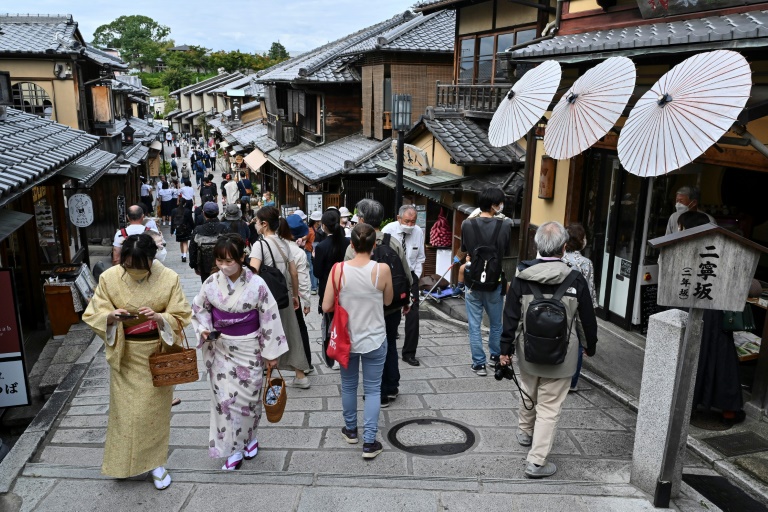
Japan scrapped its Covid-19 border restrictions and reopened to tourists this month, and many visitors will find shopping, eating out and domestic travel a bargain thanks to the weak yen and years of stubbornly low inflation.

Prices are now rising in Japan, although at a slower pace than in other major economies.

In August, inflation came in at 2.8 percent, the highest level since 2014, in part because of soaring energy prices linked to the Ukraine war.

That is above the Bank of Japan’s target for sustained two percent inflation, but it views the price increases as temporary and so has kept its easy-money policies in place.

US must prepare now for China invasion of Taiwan: admiral

The US military must be ready to respond to a potential invasion of Taiwan as soon as this year, a senior admiral said Wednesday, signaling heightened alarm over Beijing’s intentions towards the island.

Admiral Michael Gilday, chief of US naval operations, is the latest senior official in Washington to raise concerns that China’s President Xi Jinping may be much more willing than previously thought to seize Taiwan. 

His comments came as Taiwan’s top security official warned any attempt to invade the island would fail and turn China into an international pariah. 

Xi is on the cusp of securing a third five-year term at the helm of the world’s most populous nation, delivering a landmark Communist Party Congress speech on Sunday where he restated his vow to one day “reunify,” or forcefully take, Taiwan.

In a discussion with a think-tank, Gilday was asked about Xi’s speech and whether he agreed with comments by another US admiral that Beijing would be ready to take Taiwan by 2027. 

“It’s not just what President Xi says, it’s how the Chinese behave and what they do,” Gilday told the Atlantic Council. 

“And what we’ve seen over the past 20 years is that they have delivered on every promise they’ve made earlier than they said they were going to deliver on it.”

“So when we talk about the 2027 window in my mind, that has to be a 2022 window or potentially a 2023 window,” he added. 

“I can’t rule that out. I don’t mean at all to be alarmist by saying that. It’s just that we can’t wish that away.”

– ‘No chance’ –

China’s Communist Party has never controlled Taiwan but it claims the self-ruled island as its own.

Taiwan is not a treaty ally of the United States, but Congress is bound by law to sell Taipei defensive weapons and there is bipartisan support for protecting what has become a progressive democracy and vital global trade partner.

Beijing’s stance has long been that it seeks “peaceful reunification” with Taiwan but reserves the right to use force if necessary, especially if the island formally declares independence.

The rhetoric and actions towards Taiwan have become more pronounced under Xi, China’s most assertive leader in a generation, and the military has ramped up equipment purchases aimed at pulling off an invasion.

Xi has tied taking Taiwan to his vision of the “great rejuvenation of the Chinese nation” and said the goal of reunification cannot continue to be passed indefinitely from generation to generation.

Russia’s recent invasion of Ukraine, which China has not condemned, has also raised fears that Beijing might take similar moves against Taiwan’s 23 million people.

Military analysts have long warned that even with strength in numbers invading Taiwan is a difficult task, given its location and terrain.

Taiwan’s national security chief Chen Ming-tong echoed that sentiment and delivered his own warning to Xi. 

“I want to solemnly tell the Beijing authorities that there is no chance of winning to attack Taiwan by force,” he told reporters on Thursday in Taipei. 

“It would lead to international economic sanctions and diplomatic isolation, ruining his (Xi’s) ‘great rejuvenation of the Chinese nation’ and making him a sinner of the Chinese nation.”

On Monday, US Secretary of State Anthony Blinken warned that Beijing wants to seize Taiwan “on a much faster timeline” than previously considered, adding that “a very different China” had emerged under Xi. 

Blinken also warned any war over Taiwan would have an “enormous” impact on global trade. 

Biden campaigns in Pennsylvania, ground zero for midterms

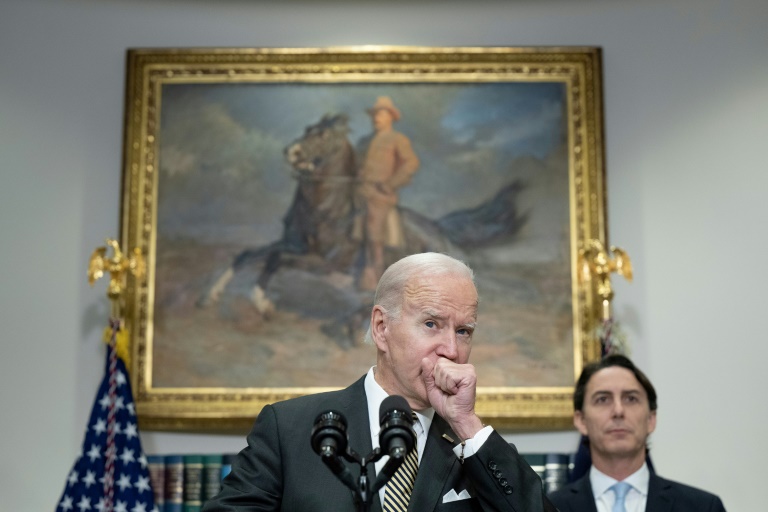
US President Joe Biden will campaign Thursday alongside Senate candidate John Fetterman in Pennsylvania, ground zero in the Democrats’ struggle to avoid a wipeout in the midterms — and two years of political trench warfare for the White House.

Biden will visit both Pittsburgh and Philadelphia, touting his administration’s signature infrastructure spending package.

Fetterman, whose love of hoodies and cargo shorts makes him one of the most unusual-looking figures on the campaign trail, was once a runaway favorite in the battle against Republican candidate Mehmet Oz, a celebrity doctor.

But the race has tightened, reflecting sinking Democratic hopes of maintaining the party’s already fragile control of Congress. The latest average of polls shows Fetterman’s nearly 11-point lead in mid-September whittled down to about five points.

Analysts say Pennsylvania is among a handful of races Democrats must win to keep the Senate after November 8, while the tussle for the House is even tougher.

Biden’s attempts to shift momentum have so far had limited effect. He is also unpopular, with an average of 42.3 percent in approval ratings, so his campaign appearances may not help.

The Thursday trip follows speeches in Washington where Biden vowed to protect abortion access and called for lower energy prices.

But three weeks from voting day, Americans appear to be veering toward the Republican message.

That raises the likelihood of Republicans taking control of at least the House and quite possibly the Senate. 

Even just the House would give the increasingly far-right Republican party the ability to shut down Biden’s agenda and — as prominent figures are already threatening — attempt impeachment.

– Numbers don’t add up –

A New York Times/Siena poll this week showed that, of likely voters, 26 percent named worries over the economy as the top issue while 18 percent listed inflation, which is at its highest rate in four decades.

That is not something Biden can fix quickly. This week also saw Bloomberg’s latest probability model giving a 100 percent chance of a recession in the next 12 months.

Even on issues where Biden feels he has a winning hand, there are limits.

During his impassioned speech on abortion, the president tapped into widespread anger over the Supreme Court’s decision to overturn the half-century-old Roe v. Wade ruling that enshrined national abortion rights.

Predicting a revolt by women voters at the ballot box, Biden said Republicans “ain’t seen nothing yet.” 

But the Siena poll does not bear that out: just five percent of likely voters named abortion as their top issue.

Parties controlling the White House nearly always suffer a loss of seats in Congress during midterms, so a heavy Democratic loss would be no surprise. 

Analysts with Larry Sabato’s Crystal Ball election newsletter at the University of Virginia said that after giddy hopes of somehow defying gravity, the Democrats seem to be coming back to earth.

“The usual midterm headwinds remain for Democrats. It’s just tough for a party to thrive with an unpopular president and with the public having significant concerns about issues, like the economy and inflation,” they said Wednesday.

“This is why the House remains very likely to flip to the Republicans and why, despite the aforementioned challenges, Republican chances to win the Senate remain no worse than a coin flip.”

New Zealand farmers protest livestock 'burp and fart' tax

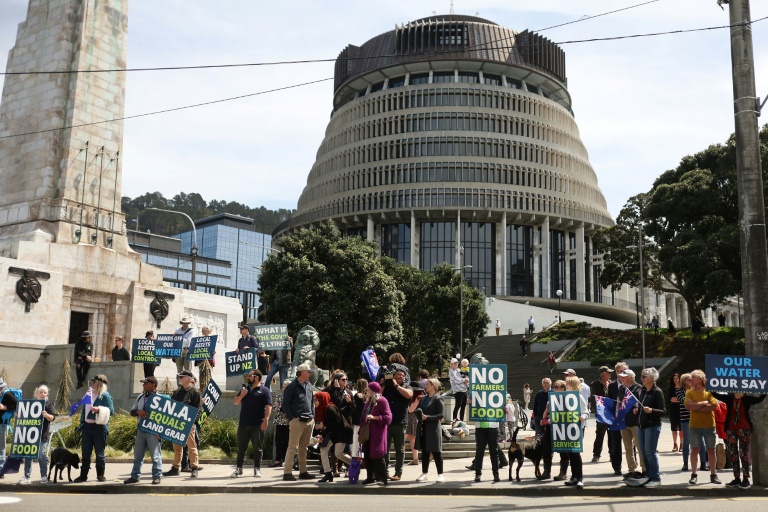
Farmers quit their fields and hit the streets of New Zealand’s cities Thursday in countrywide protests against plans to tax greenhouse emissions from farm animals.

Convoys of tractors, 4x4s and farmyard vehicles disrupted traffic in Wellington, Auckland and other major hubs, as protestors demanded the centre-left government ditch plans for an animal “burp and fart” tax.

Earlier this month, Prime Minister Jacinda Ardern touted a “world first” levy on emissions of methane and nitrous oxide produced by the nation’s six million cows and 26 million sheep as a step to tackling climate change.

Thousands of farmers gathered Thursday brandishing signs saying the policy “stinks” and warning that the tax would make food more costly, while putting their livelihoods at risk. 

“Most farmers have had enough,” said one Wellington protestor who gave his name only as Chris. “It’s getting hard to carry on farming and this government isn’t really supporting us — it’s a tough gig at the moment.”

Animals produce methane and nitrous oxide as a byproduct of munching on grass and feed.

Methane is much less abundant than carbon dioxide and does not linger as long in the atmosphere, but is a much more potent warming agent.

Scientists believe methane is responsible for roughly 30 percent of the global rise in temperatures despite being a fraction of the greenhouse gas mix.

Ardern has argued the tax is needed to reach climate targets and could even benefit farmers if they can charge more for climate-friendly meat.

She also signalled a possible willingness to compromise. 

“We are out talking to our farmers and food producers as to the best possible design,” she told reporters in Auckland. 

– ‘Stress and heartbreak’ –

Bryan McKenzie of protest organisers Groundswell NZ said the tax was “punitive” and “an existential threat to rural communities”.

“After years of faux consultation, the government has given up on all pretence of a fair and workable agricultural emissions policy.”

While the government hopes the tax will reduce livestock emissions by 20 percent, McKenzie argues that any “reductions will be replaced by less efficient foreign farmers”. 

Urban supporters also joined the protest in some regions, with one sign in the southern city of Dunedin reading “Farming tax affects us all”.

In a joint statement, several mayors from New Zealand’s remote west coast regions said they “stand strongly in support” of the protest. 

Environmentalists argue that protesting farmers are stuck in the mud.

“This country’s rural and agricultural sector has been hard hit by floods, intense storms and droughts this year alone,” said Emily Bailey of Climate Justice Taranaki.

“That cost millions in damages and loads of stress and heartbreak for those losing homes, sheds, stock and fences… It’s only getting worse,” she said. 

“Farmers can either adapt and rapidly bring down their emissions or they, and everyone else, will suffer more.”

Receding ice leaves Canada's polar bears at rising risk

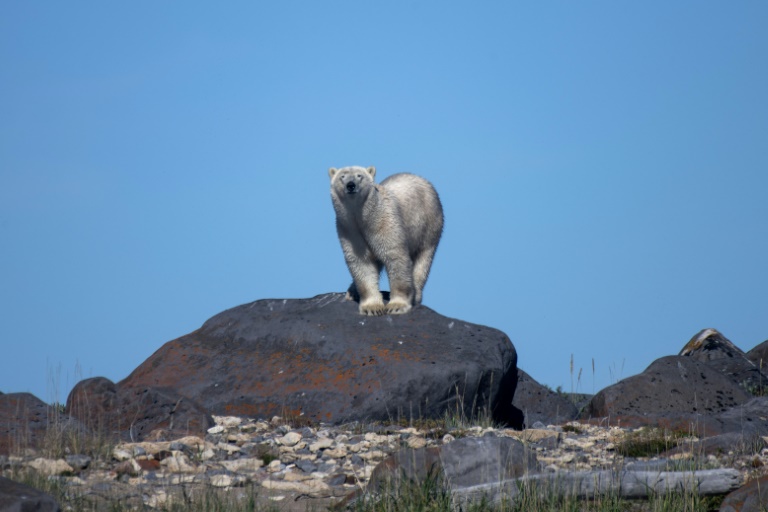
Sprawled on rocky ground far from sea ice, a lone Canadian polar bear sits under a dazzling sun, his white fur utterly useless as camouflage. 

It’s mid-summer on the shores of Hudson Bay and life for the enormous male has been moving in slow motion, far from the prey that keeps him alive: seals.

This is a critical time for the region’s polar bears.

Every year from late June when the bay ice disappears — shrinking until it dots the blue vastness like scattered confetti — they must move onto shore to begin a period of forced fasting.

But that period is lasting longer and longer as temperatures rise — putting them in danger’s way. 

Once on solid ground, the bears “typically have very few options for food,” explains Geoff York, a biologist with Polar Bears International (PBI).

York, an American, spends several weeks each year in Churchill, a small town on the edge of the Arctic in the northern Canadian province of Manitoba. There, he follows the fortunes of the endangered animals.

This is one of the best spots from which to study life on Hudson Bay, though transportation generally requires either an all-terrain vehicle adapted to the rugged tundra, or an inflatable boat for navigating the bay’s waters. 

York invited an AFP team to join him on an expedition in early August.

Near the impressively large male bear lazing in the sun is a pile of fishbones — nowhere near enough to sustain this 11-foot (3.4-meter), 1,300-pound (590-kilo) beast.

“There could be a beluga whale carcass they might be able to find, (or a) naive seal near shore, but generally they’re just fasting,” York says.

“They lose nearly a kilogram of body weight every day that they’re on land.”

Climate warming is affecting the Arctic three times as fast as other parts of the world — even four times, according to some recent studies. So sea ice, the habitat of the polar bear, is gradually disappearing.

A report published two years ago in the journal Nature Climate Change suggested that this trend could lead to the near-extinction of these majestic animals: 1,200 of them were counted on the western shores of Hudson Bay in the 1980s. Today, the best estimate is 800.

– Summer scarcity –

Each summer, sea ice begins melting earlier and earlier, while the first hard freeze of winter comes later and later. Climate change thus threatens the polar bears’ very cycle of life.

They have fewer opportunities to build up their reserves of fat and calories before the period of summer scarcity.

The polar bear — technically known as the Ursus maritimus — is a meticulous carnivore that feeds principally on the white fat that envelops and insulates a seal’s body.

But these days, this superpredator of the Arctic sometimes has to feed on seaweed — as a mother and her baby were seen doing not far from the port of Churchill, the self-declared “Polar Bear Capital.”

If female bears go more than 117 days without adequate food, they struggle to nurse their young, said Steve Amstrup, an American who is PBI’s lead scientist. Males, he adds, can go 180 days.

As a result, births have declined, and it has become much rarer for a female to give birth to three cubs, once a common occurrence.

It is a whole ecosystem in decline, and one that 54-year-old York — with his short hair and rectangular glasses — knows by heart after spending more than 20 years roaming the Arctic, first for the ecology organization WWF and now for PBI.

During a capture in Alaska, a bear sunk its fangs into his leg. 

Another time, while entering what he thought was an abandoned den, he came nose-to-snout with a female. York, normally a quiet man, says he “yelled as loud as I ever have in my life.”

Today, these enormous beasts live a precarious existence.

“Here in Hudson Bay, in the western and southern parts, polar bears are spending up to a month longer on shore than their parents or grandparents did,” York says.

As their physical condition declines, he says, their tolerance for risk rises, and “that might bring them into interaction with people (which) can lead to conflict instead of co-existence.”

– Patrolling the town – 

Binoculars in hand, Ian Van Nest, a provincial conservation officer, keeps an eye out through the day on the rocks surrounding Churchill, where the bears like to hide.

In this town of 800 inhabitants, which is only accessible by air and train but not by any roads, the bears have begun frequenting the local dump, a source of easy — but potentially harmful — food for them.

They could be seen ripping open trash bags, eating plastic or getting their snouts trapped in food tins amid piles of burning waste.

Since then, the town has taken precautions: The dump is now guarded by cameras, fences and patrols.

Across Churchill, people leave cars and houses unlocked in case someone needs to find urgent shelter after an unpleasant encounter with this large land-based carnivore. 

Posted on walls around town are the emergency phone numbers to reach Van Nest or his colleagues. 

When they get an urgent call, they hop in their pickup truck armed with a rifle and a spray can of repellent, wearing protective flak jackets. 

Van Nest, who is bearded and in his 30s, takes the job seriously, given the rising number of polar bears in the area.

Sometimes they can be scared off with just “the horn on your vehicle,” he tells AFP. 

But other times “we might have to get on foot and grab our shotguns and cracker shells,” which issue an explosive sound designed to frighten the animal, “and head onto the rocks and pursue that bear.”

Some areas are watched more closely than others — notably around schools as children are arriving in the morning “to ensure that the kids are going to be safe.”

There have been some close calls, like the time in 2013 when a woman was grievously injured by a bear in front of her house, before a neighbor — clad in pajamas and slippers — ran out wielding only his snow shovel to scare the animal away.

Sometimes the animals have to be sedated, then winched up by a helicopter to be transported to the north, or kept in a cage until winter, when they can again feed on the bay.

Churchill’s only “prison” is inhabited entirely by bears, a hangar of 28 cells that can fill up in the autumn as the creatures maraud en masse around town while waiting for the ice to re-form in November. 

– Planet’s air conditioning –

The fate of the polar bear should alarm everyone, says Flavio Lehner, a climate scientist at Cornell University who was part of the expedition, because the Arctic is a good “barometer” of the planet’s health.

Since the 1980s, the ice pack in the bay has decreased by nearly 50 percent in summer, according to the US National Snow and Ice Data Center.

“We see the more — the faster — changes here, because it is warming particularly fast,” says Lehner, who is Swiss.

The region is essential to the health of the global climate because the Arctic, he says, effectively provides the planet’s “air conditioning.”

“There’s this important feedback mechanism of sea ice and snow in general,” he says, with frozen areas reflecting 80 percent of the sun’s rays, providing a cooling effect.

When the Arctic loses its capacity to reflect those rays, he said, there will be consequences for temperatures around the globe.

Thus, when sea ice melts, the much darker ocean’s surface absorbs 80 percent of the sun’s rays, accelerating the warming trend.

A few years ago, scientists feared that the Arctic’s summer ice pack was rapidly reaching a climatic “tipping point” and, above a certain temperature, would disappear for good.

But more recent studies show the phenomenon could be reversible, Lehner says.

“Should we ever be able to bring temperatures down again, sea ice will come back,” he says.

That said, the impact for now is pervasive. 

“In the Arctic, climate change is impacting all species,” says Jane Waterman, a biologist at the University of Manitoba. “Every single thing is being affected by climate change.”

Permafrost — defined as land that is permanently frozen for two successive years — has begun to melt, and in Churchill the very contours of the land have shifted, damaging rail lines and the habitat of wild species. 

The entire food chain is under threat, with some non-native species, like certain foxes and wolves, appearing for the first time, endangering Arctic species. 

Nothing is safe, says Waterman, from the tiniest bacteria to enormous whales. 

– A summer refuge –

That includes the beluga whales that migrate each summer — by the tens of thousands — from Arctic waters to the refuge of the Hudson Bay. 

These small white whales are often spotted in the bay’s vast blue waters.  

Swimming in small groups, they like to follow the boats of scientists who have come to study them, seemingly taking pleasure in showing off their large round heads and spouting just feet from captivated observers.

The smallest ones, gray in color, cling to their mothers’ backs in this estuary, with its relatively warm waters, where they find protection from killer whales and plentiful nourishment.

But there has been “a shift in prey availability for beluga whales in some areas of the Arctic,” explains Valeria Vergara, an Argentine researcher who has spent her life studying the beluga.

As the ice cover shrinks, “there’s less under the surface of the ice for the phytoplankton that in turn will feed the zooplankton that in turn will feed big fish,” says Vergara, who is with the Raincoast Conservation Foundation.

The beluga has to dive deeper to find food, and that uses up precious energy.

And another danger lurks: Some climate models suggest that as early as 2030, with the ice fast melting, boats will be able to navigate the Hudson Bay year-round.

Sound pollution is a major problem for the species — known as the “canary of the seas” — whose communication depends on the clicking and whistling sounds it makes. 

The beluga depends on sound-based communication to determine its location, find its way and to locate food, Vergara says. 

Thanks to a hydrophone on the “Beluga Boat” that Vergara uses, humans can monitor the “conversations” of whales far below the surface. 

Vergara, 53, describes their communications as “very complex,” and she can distinguish between the cries made by mother whales keeping in contact with their youngsters.

To the untrained ear, the sound is a cacophony, but clearly that of an animated community. Scientists wonder, however, how much longer such communities will last?

Far from the Arctic ice, one lonely beluga became lost in the waters of France’s Seine river before dying in August. And in May, a polar bear meandered its way deep into Canada’s south, shocking those who discovered it along the Saint Lawrence River.

tib/dp/bbk/bfm/ec/mca/smw

Crisis-hit Sudan faces biggest threat yet: climate change

Conflict, coups, dire poverty: Sudan is reeling from multiple crises, but environmental activist Nisreen Elsaim warns a bigger problem dwarfs them all — climate change.

A determined climate campaigner for nearly a decade, both at home and on the world stage, she speaks passionately of the growing threat a heating planet poses to her northeast African nation.

“Climate change needs to be prioritised in Sudan,” 27-year-old Elsaim said, speaking weeks before the COP27 climate conference starts in neighbouring Egypt.

Elsaim — who joined the protests which toppled longtime president Omar al-Bashir in 2019 and now favours a return to civilian rule following a military coup in 2021 — argues that urgent environmental action must go hand in hand with political change.

Sudan is the world’s fifth most vulnerable country to the impacts of climate change, according to a 2020 ranking in the Global Adaptation Index, compiled by the Notre Dame University in the United States.

“There has also been a noticeable increase in temperature,” said Elsaim about her arid country. “There is no winter anymore.”

The war-ravaged nation has been hit hard in recent years by erratic weather patterns — harsh droughts and boiling temperatures followed by torrential rains.

Severe floods that wreck property, infrastructure and crops have killed more than 145 people this year, Sudanese authorities say.

– ‘Ecological crisis’ –

Egypt, which borders Sudan to the north, will from November 6 host the 27th Conference of the Parties to the UN Framework Convention on Climate Change.

For Elsaim, named chair of the UN Youth Advisory Group on Climate Change in 2020, it is an opportunity to ring the alarm bell on the climate impacts her youthful country faces — 62 percent of Sudan’s 45 million people are aged under 30, according to UN figures.

Sudan is already struggling from what experts and activists say is the results of shifting weather patterns: worsening conflicts over scarce land and water resources.

Increasing demands on dwindling natural resources has fuelled inter-ethnic conflicts, including the 2003 war that erupted in the arid western region of Darfur.

“Such conflicts are caused primarily by scarcity,” said Elsaim, who has a degree in physics and a masters in renewable energy from the University of Khartoum.

“And the reason for said scarcity is climate change.”

In Darfur, the war pitched ethnic African minority rebels against the Arab-dominated government of hardline president Bashir, who responded by unleashing the notorious Janjaweed militia.

The war in Darfur would leave about 300,000 people killed and 2.5 million displaced, according to the United Nations.

Then UN secretary-general Ban Ki-moon, writing in The Washington Post in 2007, argued that “amid the diverse social and political causes, the Darfur conflict began as an ecological crisis, arising at least in part from climate change”.

– ‘Threat multiplier’ –

Linking the heating planet to conflict is complex: the International Crisis Group calls climate change “a threat multiplier”, that increases “food insecurity, water scarcity and resource competition, while disrupting livelihoods and spurring migration”.

Organisations such as the International Committee of the Red Cross note that climate change “exacerbates existing social and economic factors that may lead to conflict”, while at the same time, insecurity can “limit people’s ability to cope with climate shocks”.

Sudan also remains gripped by regular protests following the October 2021 military coup led by army chief Abdel Fattah al-Burhan that upended a post-Bashir transition to civilian rule.

Elsaim says the authorities have given little attention to climate change.

As COP27 approaches, she remains committed to doing what she can to make change — even while admitting progress from previous climate summits she has attended has been “very small”.

“Though the small progress will not save us,” she said, “it’s still better than nothing.”

Asian markets drop and dollar rises as inflation, rate fears return

Asian equities tumbled Thursday, tracking a sell-off on Wall Street, while the dollar regained its strength as surging inflation, interest rate hikes and recession fears returned to the fore.

The positive start of the week, helped by forecast-beating earnings and a major UK government policy U-turn, gave way to the downbeat mood that has characterised markets all year as traders contemplated an extended period of uncertainty.

News that UK inflation bounced back above 10 percent in September highlighted the struggle central banks have in bringing prices down, despite lifting borrowing costs in recent months.

That came after a similarly glum reading out of New Zealand earlier in the week and helped push up government bond yields around the world, indicating higher interest rates.

The unease on trading floors, and concerns that prices are showing no sign of easing, also sent investors back into the safety of the dollar, adding more inflationary pressure outside the United States and dragging on stock markets.

“As is often the case, rising US yields and the strong US dollar are the sledgehammers pounding global equities lower,” said SPI Asset Management’s Stephen Innes. 

After Wall Street’s drop, markets across Asia were deep in the red, with selling also fuelled by concerns about the Chinese economy as Covid cases spike in the country and leaders stick to their zero-Covid lockdown strategies.

A decision to delay the release of third-quarter growth data this week added to the unease among investors.

Hong Kong led losses, shedding almost three percent, while Tokyo, Sydney, Seoul, Wellington and Taipei were all off at least one percent.

Shanghai, Singapore and Manila were also in the red.

The losses wiped out most of the gains enjoyed at the start of the week, even as positive earnings reports came in from Netflix and top Wall Street banks, with Ellen Hazen of F.L.Putnam Investment Management warning worse could be yet to come.

“As we look at third-quarter results, we think there are going to be more misses than the market is currently expecting,” she told Bloomberg Radio.

“If you look at GDP for this year, it keeps getting revised downward and it’s really hard for companies to keep growing their earnings in the face of that.”

Forex traders remain on alert as the dollar comes within a whisker of 150 yen, with Japanese authorities saying they are keeping a close watch on the market and are ready to step in to support the beleaguered currency.

– Pound troubles –

The pound was also back under pressure, having bounced Monday after Britain’s new finance minister Jeremy Hunt reversed virtually all of Prime Minister Liz Truss’s debt-fuelled, tax-cutting mini-budget that hammered financial markets.

Sterling was back around $1.12 — down from more than $1.14 Tuesday — as the government was plunged into a fresh crisis following the resignation of Home Secretary Suella Braverman.

That came days after the sacking of Hunt’s predecessor Kwasi Kwarteng and has left Truss’s premiership on a knife edge.

Oil prices were mixed after rallying Wednesday in reaction to a drop in US petroleum stockpiles, and despite President Joe Biden’s decision to release 15 million barrels from US strategic reserves.

The crude was the last batch to be released from the 180 barrels pledged by Biden earlier this year aimed at bringing costs down.

But Innes added: “Markets will mostly ignore further releases from the Strategic Petroleum Reserves — prices are elevated because of the medium- and longer-term gap between supply and demand resulting from years of oil industry swoon and the resulting low capital expenditure.

“So, the impact of additional… releases will likely have diminishing returns with (reserves) at a multi-decade low.”

– Key figures around 0230 GMT –

Tokyo – Nikkei 225: DOWN 1.1 percent at 26,954.15 (break)

Hong Kong – Hang Seng Index: DOWN 2.9 percent at 16,042.75

Shanghai – Composite: DOWN 0.8 percent at 3,021.04

Pound/dollar: DOWN at $1.1200 from $1.1219 on Wednesday

Dollar/yen: UP at 149.93 yen from 149.88 yen

Euro/dollar: DOWN at $0.9758 from $0.9778 

Euro/pound: UP at 87.12 pence from 87.10 pence

West Texas Intermediate: UP 0.6 percent at $86.03 per barrel

Brent North Sea crude: DOWN 0.1 percent at $92.29 per barrel

New York – Dow: DOWN 0.3 percent at 30,423.81 (close)

London – FTSE 100: DOWN 0.2 percent at 6,924.99 (close)

Asian markets drop and dollar rises as inflation, rate fears return

Asian equities tumbled Thursday, tracking a sell-off on Wall Street, while the dollar regained its strength as surging inflation, interest rate hikes and recession fears returned to the fore.

The positive start of the week, helped by forecast-beating earnings and a major UK government policy U-turn, gave way to the downbeat mood that has characterised markets all year as traders contemplated an extended period of uncertainty.

News that UK inflation bounced back above 10 percent in September highlighted the struggle central banks have in bringing prices down, despite lifting borrowing costs in recent months.

That came after a similarly glum reading out of New Zealand earlier in the week and helped push up government bond yields around the world, indicating higher interest rates.

The unease on trading floors, and concerns that prices are showing no sign of easing, also sent investors back into the safety of the dollar, adding more inflationary pressure outside the United States and dragging on stock markets.

“As is often the case, rising US yields and the strong US dollar are the sledgehammers pounding global equities lower,” said SPI Asset Management’s Stephen Innes. 

After Wall Street’s drop, markets across Asia were deep in the red, with selling also fuelled by concerns about the Chinese economy as Covid cases spike in the country and leaders stick to their zero-Covid lockdown strategies.

A decision to delay the release of third-quarter growth data this week added to the unease among investors.

Hong Kong led losses, shedding almost three percent, while Tokyo, Sydney, Seoul, Wellington and Taipei were all off at least one percent.

Shanghai, Singapore and Manila were also in the red.

The losses wiped out most of the gains enjoyed at the start of the week, even as positive earnings reports came in from Netflix and top Wall Street banks, with Ellen Hazen of F.L.Putnam Investment Management warning worse could be yet to come.

“As we look at third-quarter results, we think there are going to be more misses than the market is currently expecting,” she told Bloomberg Radio.

“If you look at GDP for this year, it keeps getting revised downward and it’s really hard for companies to keep growing their earnings in the face of that.”

Forex traders remain on alert as the dollar comes within a whisker of 150 yen, with Japanese authorities saying they are keeping a close watch on the market and are ready to step in to support the beleaguered currency.

– Pound troubles –

The pound was also back under pressure, having bounced Monday after Britain’s new finance minister Jeremy Hunt reversed virtually all of Prime Minister Liz Truss’s debt-fuelled, tax-cutting mini-budget that hammered financial markets.

Sterling was back around $1.12 — down from more than $1.14 Tuesday — as the government was plunged into a fresh crisis following the resignation of Home Secretary Suella Braverman.

That came days after the sacking of Hunt’s predecessor Kwasi Kwarteng and has left Truss’s premiership on a knife edge.

Oil prices were mixed after rallying Wednesday in reaction to a drop in US petroleum stockpiles, and despite President Joe Biden’s decision to release 15 million barrels from US strategic reserves.

The crude was the last batch to be released from the 180 barrels pledged by Biden earlier this year aimed at bringing costs down.

But Innes added: “Markets will mostly ignore further releases from the Strategic Petroleum Reserves — prices are elevated because of the medium- and longer-term gap between supply and demand resulting from years of oil industry swoon and the resulting low capital expenditure.

“So, the impact of additional… releases will likely have diminishing returns with (reserves) at a multi-decade low.”

– Key figures around 0230 GMT –

Tokyo – Nikkei 225: DOWN 1.1 percent at 26,954.15 (break)

Hong Kong – Hang Seng Index: DOWN 2.9 percent at 16,042.75

Shanghai – Composite: DOWN 0.8 percent at 3,021.04

Pound/dollar: DOWN at $1.1200 from $1.1219 on Wednesday

Dollar/yen: UP at 149.93 yen from 149.88 yen

Euro/dollar: DOWN at $0.9758 from $0.9778 

Euro/pound: UP at 87.12 pence from 87.10 pence

West Texas Intermediate: UP 0.6 percent at $86.03 per barrel

Brent North Sea crude: DOWN 0.1 percent at $92.29 per barrel

New York – Dow: DOWN 0.3 percent at 30,423.81 (close)

London – FTSE 100: DOWN 0.2 percent at 6,924.99 (close)

Ukraine restricts electricity use after Russian strikes

Ukraine has urged residents to drastically restrict their electricity consumption starting Thursday to cope with the destruction of power stations by the Russian army as winter approaches. 

Ukrainian President Volodymyr Zelensky said after a meeting with energy companies that they were preparing “for all possible scenarios with a view to winter”, as Kyiv accused Moscow of orchestrating a “mass deportation” of civilians from the occupied region of Kherson.

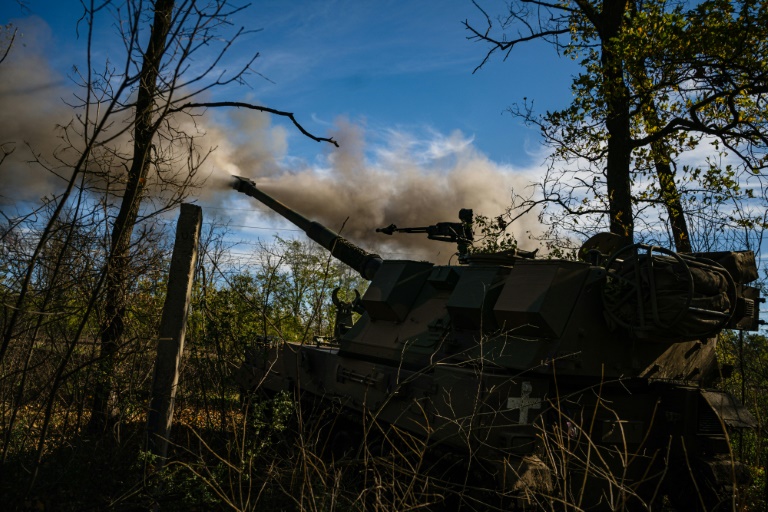
Russian President Vladimir Putin imposed martial law on Wednesday in four areas recently annexed by the Kremlin, with his forces raining down munitions across Ukraine, including on Kyiv and the country’s west, which had previously been spared the brunt of the onslaught.

In an evening address, Zelensky warned that “Russian terror will be directed at energy facilities”, and urged the country to conserve electricity starting at 7 am (0400 GMT) on Thursday.

He added that the government was “working on the creation of mobile power supply points for critical infrastructure in cities and villages”.

Kyiv mayor Vitaliy Klitschko asked residents of the capital not to turn on major electrical appliances, saying “even a small saving and reduction of electricity consumption in each residence will help to stabilise the national energy system’s operation”.

Ukraine said it had downed “several Russian rockets” over Kyiv in the third consecutive day of attacks on the capital, with Zelensky saying 10 Iranian-made drones aimed at the city had also been destroyed Wednesday.

– Creating ‘panic’ –

A Ukrainian representative called the push by Russia to evacuate Kherson the “equivalent of deportation”. The city has been in Moscow’s hands since the earliest days of the invasion.

Putin’s “aim is to create a kind of panic in Kherson and an image (to fuel) propaganda”, Sergiy Khlan said, adding that Ukrainian forces were still pushing their counter-offensive southward. 

He said the Russians were using the evacuations as a pretext to justify “their withdrawal from Kherson and more generally from the right bank” of the Dnieper River.

Oleksiy Danilov, secretary of Ukraine’s National Security and Defense Council, criticised Moscow’s move as criminal.

“Putin’s martial law in the annexed regions of Ukraine is preparation for the mass deportation of the Ukrainian population to depressed areas of Russia in order to change the ethnic composition of the occupied territory,” Danilov said.

Pro-Russian officials in the town of Oleshky across the Dnieper said residents from Kherson city were already arriving.

Russia’s Rossiya 24 TV showed images of people waiting to board ferries, unable to use bridges damaged by Ukraine.

Vladimir Saldo, the Kherson region’s Moscow-installed head, told Russian state television that the city’s administration would relocate east of the Dnieper.

– Sakharov Prize –

With developments on the ground gathering pace, Putin’s introduction of military rule in the Moscow-controlled territories also gives additional power to authorities in southern Russian regions bordering Ukraine to quash dissent.

“We are working on solving very complex large-scale tasks to ensure security and protect the future of Russia,” Putin said.

Local officials said they were planning to move up to 60,000 civilians from Kherson over roughly six days.

Separately, the secretary of Russia’s National Security Council Nikolay Patrushev said around five million people from Russian-held parts of Ukraine had “found shelter” in Russia.

Ukraine’s resilience has won plaudits internationally and the European Parliament on Wednesday awarded the annual Sakharov Prize for human rights to “brave” Ukrainians.

Zelensky tweeted in response: “Ukrainians prove dedication to the values of freedom, democracy every day on the battlefield.”

Meanwhile, in parts of Ukraine recently recaptured from Russian forces, repairs were under way before the onset of winter, with many residents still depending on humanitarian aid.

“Apart from this, nothing is working,” said Ivan Zakharchenko, a 70-year-old resident of Izyum queueing for aid in the square where Zelensky celebrated the town’s liberation just over a month ago.

– Nuclear plant staff detained –

Ukraine has recaptured occupied eastern territory in recent weeks. Its advance in the south, while far slower, has been gaining momentum.

There have been some advances on the Russian side too, with Moscow reporting Tuesday its troops had retaken territory in eastern Kharkiv region. 

Russia’s Wagner mercenary group said it was working on building a “multi-level and layered defence” in the Lugansk region.

Russian forces, meanwhile, continue to occupy the Zaporizhzhia nuclear power plant.

Petro Kotin, head of Ukraine’s nuclear energy agency Energoatom, told AFP Wednesday that Russian forces were currently holding about 50 plant employees.

– EU to sanction Iran –

Russia’s strikes following Ukrainian battlefield gains have demolished large parts of Ukraine’s power grid ahead of winter.

The government has warned of the risk of blackouts, saying about 30 percent of Ukraine’s power stations have been destroyed. 

After strikes Monday and Tuesday, multiple explosions were heard in central Kyiv on Wednesday.

Kyiv and Western allies have accused Moscow of using Iranian-made drones, with Ukraine saying it has successfully shot down 233 of them since mid-September.

The Kremlin and Iran have denied this, but EU foreign policy spokeswoman Nabila Massrali said the EU had “sufficient evidence” and would prepare fresh sanctions on Iran.

Cuban missile crisis: 13 days when nuclear war threatened

Sixty years ago the Cuban missile crisis brought the world to the brink of nuclear war.

Here is a look at how the standoff between the United States and the Soviet Union unfolded:

– Missiles deployed –

On May 21, 1962, Soviet leader Nikita Khrushchev decides to place medium- and intermediate-range nuclear missiles on the island of Cuba, Moscow’s communist ally in the Caribbean.

He justifies the decision by the fact that Cold War rival the United States could deploy nuclear weapons from NATO member Turkey, which bordered the then Soviet Union.

On September 4, US President John F. Kennedy warns that the “gravest consequences” will follow if significant Soviet offensive weapons are introduced into Cuba.

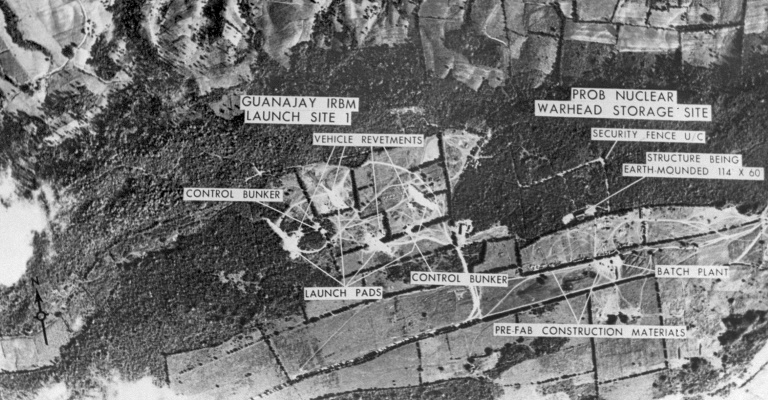
On October 14, a US U2 spy plane confirms that Soviet missiles were being deployed on Cuba, a mere 145 kilometres (90 miles) from the coast of Florida, and therefore within striking range of northeastern cities.

– 13-day crisis –

For 13 days a terrifying game of geo-political poker pits the young Kennedy against the fiery Khrushchev.

On October 16, Kennedy is briefed on a spy plane’s high-resolution photos. He weighs whether to order a naval blockade or an invasion.

The next day US military units begin moving to bases in the southeastern United States as intelligence photos from another U-2 flight show additional sites, and 16 to 32 missiles.

– Cuba under ‘quarantine’ –

On October 22 Kennedy writes to Khrushchev.

“I have not assumed that you or any other sane man would in this nuclear age, deliberately plunge the world into war which it is crystal clear no country could win and which could only result in catastrophic consequences to the whole world, including the aggressor,” he writes.

That evening he speaks on television and announces the establishment of a naval “quarantine” or blockade around Cuba and orders preparations for a landing on the island.

The Organization of American States backs Washington.

The next day ships of the naval quarantine fleet move into place around Cuba. 

Four nuclear-armed Soviet submarines move into the Caribbean. 

Soviet freighters bound for Cuba with military supplies freeze their positions.

Khrushchev protests in a letter to Kennedy “You are no longer appealing to reason, but wish to intimidate us.”

The military of the Soviet Union and its eastern bloc allies are put on alert.

On October 26, Cuban leader Fidel Castro urges Khrushchev to initiate a nuclear first strike against the United States in the event of a US invasion of Cuba.

In a letter to Kennedy, Khrushchev proposes removing Soviet missiles and personnel if the United States guarantees not to invade Cuba.

– Spy plane shot down –  

The next day a US U-2 spy plane is shot down over Cuba, killing its pilot, Rudolph Anderson, who becomes the sole fatality of the crisis.

Kennedy receives a new letter from Khrushchev demanding the removal of US missiles in Turkey in exchange for the removal of the Soviet missiles. Kennedy promises not to invade Cuba and to lift the blockade if the missiles are removed.

On October 28, Khrushchev backs down, agreeing to dismantle the installations and return the missiles to the Soviet Union, ending the crisis.

In an additional secret agreement, the United States agrees to eventually remove its Jupiter missiles from Turkey.

On November 20 Kennedy lifts the Cuba blockade.

– The aftermath –

The next year a “hotline” is set to link the US and Soviet leaders by telex. Up to then they had only communicated via their respective ambassadors.

Sixteen months earlier, in February 1962, following Cuba’s expropriations of US companies, Kennedy had imposed a strict economic and financial embargo on the island.

It would take another half a century for US President Barack Obama and Cuban leader Raul Castro in December 2014 to announce the re-establishment of diplomatic relations between the two countries.

Sources: John F. Kennedy Presidential Library and Museum, AFP archives

Close Bitnami banner
Bitnami