AFP

Musk says he's 'excited' about buying Twitter, but overpaying

Elon Musk on Wednesday said he is “excited” about taking over Twitter, expressing enthusiasm even though he’s spent months trying to break free of the $44 billion buyout contract.

A US judge early this month suspended litigation in the saga over Musk’s proposed takeover of Twitter, giving the parties until October 28 to finalize the on-again, off-again megadeal.

Twitter had filed a lawsuit to hold Musk to the terms of the deal he inked in April after the Tesla chief sent word he was terminating the contract.

“I’m excited about the Twitter situation,” Musk said while fielding questions on a Tesla quarterly earnings call.

“I think it’s an asset that has just sort of languished for a long time but has incredible potential, although obviously myself and the other investors are overpaying for Twitter right now.”

Musk added that he believes Twitter has potential to be worth “an order of magnitude” more than it is now.

Delaware Judge Kathaleen McCormick granted a request by Musk to freeze the case despite bitter opposition from Twitter, and said that a trial originally set for this week could be rescheduled for next month if a deal is not finalized.

With trial on Twitter’s breach-of-contract suit against Musk looming, the unpredictable billionaire had done an about-face, reviving his takeover plan on condition the court halt the lawsuit against him.

Musk began to step back from the Twitter deal soon after it was agreed, and said in July he was canceling the purchase because he was misled by Twitter concerning the number of fake “bot” accounts, allegations rejected by the company.

Twitter, meanwhile, has sought to prove Musk was contriving excuses to walk away — simply because he changed his mind.

Musk’s potential stewardship of the influential social media site has sparked worry from activists who fear he could open the gates to more abusive and misinformative posts.

Director Paul Haggis's civil trial for rape opens in New York

The New York civil trial against Oscar-winning Canadian filmmaker Paul Haggis, who is accused of raping a publicist in 2013, opened on Wednesday.

Haggis, who wrote and directed “Crash,” and penned the screenplay for “Million Dollar Baby,” arrived in court in the morning, an AFP photographer observed. 

The 69-year-old was accused in December 2017 by film publicist Haleigh Breest of abusing and raping her in January 2013 when she was 26 years old.

With the #MeToo movement gaining ground, three more women subsequently accused Haggis of sexual assault.

More recently, Haggis was arrested in June in southern Italy on suspicion of aggravated sexual assault in a different case. He denied any wrongdoing and was soon released.

The filmmaker’s lawyers suggested on Wednesday that Breest’s suit was guided by the Church of Scientology, which Haggis left and has since criticized, according to US media. 

The plaintiff’s lawyers denied the accusation.

In her suit, Breest said that on the evening of January 31, 2013, after a film screening in Manhattan, the director insisted she have a drink at his home, even though she preferred to go to a bar. 

Once in his apartment, Haggis made multiple advances before making her perform oral sex and then raping her, she says.

Known for being one of the creators of the “Walker Texas Ranger” television series, Haggis received an Oscar for best picture and best original screenplay in 2006 for “Crash.”

He was additionally the screenwriter for Clint Eastwood’s “Million Dollar Baby,” “Flags of Our Fathers” and “Letters from Iwo Jima,” as well as James Bond films “Casino Royale” and “Quantum of Solace.”

Trump testifies in case filed by rape accuser

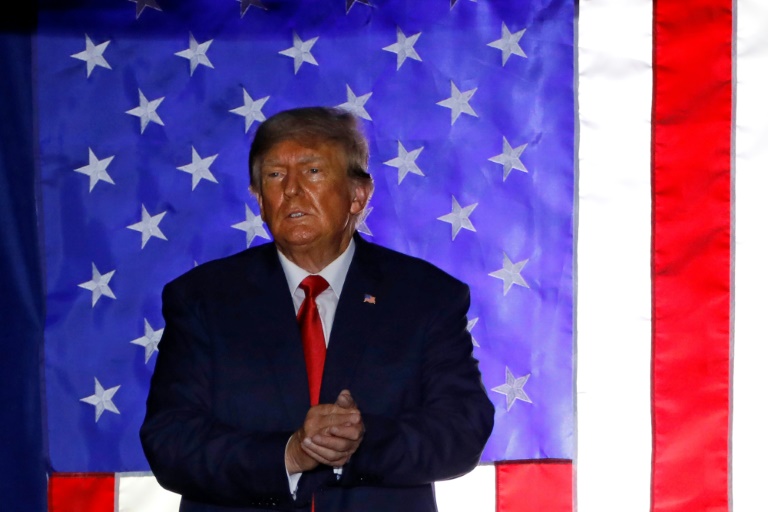
Former US president Donald Trump testified Wednesday in a defamation case pitting him against a prominent former American columnist who says he raped her in the 1990s.

E. Jean Carroll, 78, alleges that Trump sexually assaulted her in a New York department store.

Last week, a New York federal court judge rejected a motion by Trump, who has denied the accusation, to further delay his deposition. 

The New York law firm representing Carroll said in a statement: “We’re pleased that on behalf of our client… we were able to take Donald Trump’s deposition today.”

The firm, Kaplan Hecker & Fink, said it was “not able to comment further.”

In ruling on the deposition last week, Judge Lewis Kaplan said that Carroll’s and Trump’s depositions should be held on October 14 and 19, respectively.

It is not known if Carroll testified last Friday.

It also was not immediately clear if Trump submitted the sworn deposition from his Mar-a-Lago residence in Florida.

Carroll on Tuesday shared a photo of her lawyer Roberta Kaplan on Twitter captioned “Carroll versus Trump,” and wished Kaplan “GOOD LUCK FOR TOMORROW.” She later deleted the tweet.

Kaplan, who is unrelated to the case’s judge, is a co-founder of the Time’s Up movement that provides legal aid to victims of sexual assault.

Carroll, a former columnist for Elle magazine, sued then-president Trump for defamation in a New York civil court in November 2019.

In an excerpt of her book published by New York Magazine that year, Carroll said she was raped by Trump in the changing room at the luxury Bergdorf Goodman department store on Fifth Avenue in New York in the mid-1990s.

Trump denied the accusation, saying Carroll was “not my type” and that she was “totally lying,” which prompted the defamation suit.

The case has been delayed by procedural battles, including whether Trump should be represented by the US government, since he was president at the time he made the statements. 

According to several media outlets on Tuesday, Trump’s lawyers have always claimed their client was protected by his executive immunity, particularly for allegedly defamatory statements he made during his term.

Last week, Trump made new comments about the case on his right-wing Truth Social platform, mocking Carroll’s rape allegations. 

According to legal experts cited in a Vice News report, Carroll could argue that Trump defamed her again — this time as a private citizen. 

Judge Kaplan said last week that Carroll could claim damages from Trump for the alleged rape starting from November 24, after a New York state law comes into effect that allows survivors of sexual assault to file a civil suit regardless of the statute of limitations.

US hits network that smuggled chips to Russian arms makers

US authorities indicted five Russians Wednesday who allegedly shipped American electronic components to Russia arms makers, some of which have been found on the battlefield in Ukraine.

Separately, three Latvians and a Ukrainian were charged for attempting to send a US-made high-precision industrial grinder to Russia that the Justice Department said could be used by arms makers or in a nuclear weapons program.

The Justice Department said the two schemes involved front companies in multiple countries including Dubai and Germany and were designed to evade US and global sanctions on Russia.

The first scheme involved buying sensitive technologies from US manufacturers like advanced semiconductors and microprocessors that are used in fighter aircraft, missile systems, smart munitions, radar and satellites.

The Justice Department said Dubai-based Russian Yury Orekhov, Artem Uss, the son of a regional Russian governor, and the three others used a Hamburg, Germany-based firm for the operation, shipping some of the technology to Russian defense companies that are under US sanctions.

It said, for example, that Orekhov had travelled to the United States in 2019 to source parts that were used in the Russian-made Sukhoi fighter aircraft.

“Some of the types of electronic components obtained through the criminal scheme have been found in Russian weapons platforms seized on the battlefield in Ukraine,” the Justice Department said.

At the same time, it said, Orekhov, his Russian parters and two Venezuelan oil brokers who were also indicted, used the German company as a front to ship “hundreds of millions of barrels of oil” from Venezuela to Russia and China, violating global sanctions.

Payments meanwhile were routed through shell companies, a bank in the Untied Arab Emirates, and via cash drops and cryptocurrency trades, the department said.

The five Russians and two traders are charged with conspiracy to defraud the Untied States, sanctions violations, fraud and money laundering.

Orekhov and Uss were arrested Monday in Germany and Italy, respectively, and the United States will seek their extradition, the department said.

In the second scheme, the four arranged the purchase of a jig grinder made in the US state of Connecticut ostensibly for the European market, but sought to ship it to Russia. The grinder was intercepted by Latvian authorities.

“These defendants attempted to smuggle a high-precision export-controlled item to Russia where it could have been used in nuclear proliferation and Russian defense programs,” said US Attorney Vanessa Roberts Avery.

The three Latvians were arrested on Tuesday while the Ukrainian national was arrested in June in Estonia.

They are all charged with conspiracy to defraud the Untied States, smuggling, and money laundering. The Justice Department is also seeking their extradition.

Meanwhile the US Treasury placed sanctions on Orekhov, the German company and a Dubai company he controls.

“Russia has increasingly struggled to secure critical inputs and technologies needed for its brutal war against Ukraine,” said Deputy Treasury Secretary of Wally Adeyemo in a statement.

“We know these efforts are having a direct effect on the battlefield, as Russia’s desperation has led them to turn to inferior suppliers and outdated equipment,” Adeyemo said.

Stocks waver as inflation concerns offset positive earnings

US stocks stumbled Wednesday, snapping a two-day rally, as investors tracked soaring inflation, while oil prices rose despite the latest US petroleum release announcement by President Joe Biden.

The yield on the 10-year US Treasury note, a proxy for Federal Reserve interest rates, jumped above four percent following UK data that showed inflation soaring back above 10 percent last month.

“There’s nothing to suggest that inflation is going to move in the right direction,” said Tom Cahill of Ventura Wealth Management. 

A downcast Federal Reserve “Beige Book” report observed rising recession fears as households grapple with soaring costs and earlier Fed interest rate hikes slowing demand.

After climbing the last two days, major US indices retreated, with the S&P 500 losing 0.7 percent.

Bourses in Paris, London and Frankfurt also pulled back.

Market movements have been dominated in recent months by interest rate hikes by the US Federal Reserve and other central banks as they try to rein in surging inflation.

Foreign exchange traders were keeping tabs also on whether the dollar would reach 150 yen, which would be a fresh high for 32 years.

Japan’s currency is being hit hard as the country’s central bank holds off from hiking interest rates, in sharp contrast to its peers.

Traders were given an extra boost by news that Netflix gained more than two million subscribers in July-September. Shares of Netflix surged more than 13 percent.

In Europe, Nestle’s nominal sales surged in the first nine months of the year as the maker of Nespresso capsules, Purina pet food and Haagen-Dazs ice cream raised its prices in response to soaring inflation.

Nestle’s shares ended the day down 1.3 percent, however, amid concerns about the impact of higher prices on sales volumes.

On commodity markets, crude oil prices rose after US inventory data showed a surprise decline in petroleum reserves. 

The gains also came as Biden announced the release of a final 15 million barrels of an earlier promise to release 180 million barrels from the Strategic Petroleum Reserve.

However, he also urged the US oil industry to get more oil out of the ground, insisting this did not counter his presidency’s priority of pushing the United States into a clean energy future.

“We need to responsibly increase American oil production without delaying or deferring our transition to clean energy,” he said.

– Key figures around 2100 GMT –

New York – Dow: DOWN 0.3 percent at 30,423.81 (close)

New York – S&P 500: DOWN 0.7 percent at 3,695.16 (close)

New York – Nasdaq: DOWN 0.9 percent at 10,680.51 (close)

London – FTSE 100: DOWN 0.2 percent at 6,924.99 (close)

Frankfurt – DAX: DOWN 0.2 percent at 12,741.41 (close)

Paris – CAC 40: DOWN 0.4 percent at 6,040.72 (close)

EURO STOXX 50: UP 0.2 percent at 3,471.24 (close)

Tokyo – Nikkei 225: UP 0.4 percent at 27,257.38 (close)

Hong Kong – Hang Seng Index: DOWN 2.4 percent at 16,511.28 (close)

Shanghai – Composite: DOWN 1.2 percent at 3,044.38 (close)

Pound/dollar: DOWN at $1.1219 from $1.1320 on Tuesday

Dollar/yen: UP at 149.88 yen from 149.26 yen

Euro/dollar: DOWN at $0.9778 from $0.9858 

Euro/pound: UP at 87.10 pence from 87.09 pence

Brent North Sea crude: UP 2.6 percent at $92.41 per barrel

West Texas Intermediate: UP 3.3 percent at $85.55 per barrel

burs-jmb/bfm

Stocks waver as inflation concerns offset positive earnings

US stocks stumbled Wednesday, snapping a two-day rally, as investors tracked soaring inflation, while oil prices rose despite the latest US petroleum release announcement by President Joe Biden.

The yield on the 10-year US Treasury note, a proxy for Federal Reserve interest rates, jumped above four percent following UK data that showed inflation soaring back above 10 percent last month.

“There’s nothing to suggest that inflation is going to move in the right direction,” said Tom Cahill of Ventura Wealth Management. 

A downcast Federal Reserve “Beige Book” report observed rising recession fears as households grapple with soaring costs and earlier Fed interest rate hikes slowing demand.

After climbing the last two days, major US indices retreated, with the S&P 500 losing 0.7 percent.

Bourses in Paris, London and Frankfurt also pulled back.

Market movements have been dominated in recent months by interest rate hikes by the US Federal Reserve and other central banks as they try to rein in surging inflation.

Foreign exchange traders were keeping tabs also on whether the dollar would reach 150 yen, which would be a fresh high for 32 years.

Japan’s currency is being hit hard as the country’s central bank holds off from hiking interest rates, in sharp contrast to its peers.

Traders were given an extra boost by news that Netflix gained more than two million subscribers in July-September. Shares of Netflix surged more than 13 percent.

In Europe, Nestle’s nominal sales surged in the first nine months of the year as the maker of Nespresso capsules, Purina pet food and Haagen-Dazs ice cream raised its prices in response to soaring inflation.

Nestle’s shares ended the day down 1.3 percent, however, amid concerns about the impact of higher prices on sales volumes.

On commodity markets, crude oil prices rose after US inventory data showed a surprise decline in petroleum reserves. 

The gains also came as Biden announced the release of a final 15 million barrels of an earlier promise to release 180 million barrels from the Strategic Petroleum Reserve.

However, he also urged the US oil industry to get more oil out of the ground, insisting this did not counter his presidency’s priority of pushing the United States into a clean energy future.

“We need to responsibly increase American oil production without delaying or deferring our transition to clean energy,” he said.

– Key figures around 2100 GMT –

New York – Dow: DOWN 0.3 percent at 30,423.81 (close)

New York – S&P 500: DOWN 0.7 percent at 3,695.16 (close)

New York – Nasdaq: DOWN 0.9 percent at 10,680.51 (close)

London – FTSE 100: DOWN 0.2 percent at 6,924.99 (close)

Frankfurt – DAX: DOWN 0.2 percent at 12,741.41 (close)

Paris – CAC 40: DOWN 0.4 percent at 6,040.72 (close)

EURO STOXX 50: UP 0.2 percent at 3,471.24 (close)

Tokyo – Nikkei 225: UP 0.4 percent at 27,257.38 (close)

Hong Kong – Hang Seng Index: DOWN 2.4 percent at 16,511.28 (close)

Shanghai – Composite: DOWN 1.2 percent at 3,044.38 (close)

Pound/dollar: DOWN at $1.1219 from $1.1320 on Tuesday

Dollar/yen: UP at 149.88 yen from 149.26 yen

Euro/dollar: DOWN at $0.9778 from $0.9858 

Euro/pound: UP at 87.10 pence from 87.09 pence

Brent North Sea crude: UP 2.6 percent at $92.41 per barrel

West Texas Intermediate: UP 3.3 percent at $85.55 per barrel

burs-jmb/bfm

French oil refinery strikes begin to ease

After three weeks of blockades, strikes at sites owned by French oil giant TotalEnergies were starting to ease on Wednesday, although uncertainty remains over fuel supply as the country heads into the autumn holiday break.

In recent weeks several of France’s seven refineries and one fuel depot were out of action as striking members of the hard-left CGT union rejected a pay offer from the hydrocarbon industry leader that other unions accepted.

But on Wednesday the CGT said the strike at the Donges refinery in the west of the country was suspended, as well as at two other oil sites in France, one in the north and one in the south.

Prime Minister Elisabeth Borne said the situation “continues to improve markedly”.

The blockades will continue at the Normandy and the Rhone sites.

Strike action at two Esso-ExxonMobil refineries ended last week, after a pay deal between management and moderate unions which represent a majority of workers.

“We hope that management will heed the demands of the strikers in order to bring this conflict to an end,” Benjamin Tange of the CGT union told AFP.

The CGT had announced on Wednesday morning that it had proposed a “protocol for ending the conflict” to the management of TotalEnergies.  

According to the union, the proposal was rejected by management, a statement not confirmed by the company when questioned by AFP.

The union proposal called for “negotiations on employment and investment” as well as guarantees that those who went out on strike would not be punished.

The CGT — which launched the industrial action three weeks ago — has been pushing for a 10-percent pay rise for staff at TotalEnergies, retroactive to the start of this year.

It says the French group can more than afford it, citing TotalEnergies’ net profit of $5.7 billion in the April-June period as energy prices soared with the war in Ukraine, and its payout of billions of euros in dividends to shareholders.

But the strike action has forced many filling stations to close and had a knock-on effect across all sectors of the economy.

Faced with the fuel shortages, many people have started to cancel holidays ahead of the upcoming school break, which has been impacting on an anticipated boost for the country’s tourism sector.

Energy Transition Minister Agnes Pannier-Runacher said the government is “doing everything so that people can go on a peaceful vacation”.

Some 20 percent of service stations were still short of petrol or diesel on Wednesday, according to the health ministry.

To try and ease the shortage, the government has used requisitioning powers to force some strikers back to open fuel depots — a move that has infuriated unions but been upheld in the courts.

burs-rox/pvh

French oil refinery strikes begin to ease

After three weeks of blockades, strikes at sites owned by French oil giant TotalEnergies were starting to ease on Wednesday, although uncertainty remains over fuel supply as the country heads into the autumn holiday break.

In recent weeks several of France’s seven refineries and one fuel depot were out of action as striking members of the hard-left CGT union rejected a pay offer from the hydrocarbon industry leader that other unions accepted.

But on Wednesday the CGT said the strike at the Donges refinery in the west of the country was suspended, as well as at two other oil sites in France, one in the north and one in the south.

Prime Minister Elisabeth Borne said the situation “continues to improve markedly”.

The blockades will continue at the Normandy and the Rhone sites.

Strike action at two Esso-ExxonMobil refineries ended last week, after a pay deal between management and moderate unions which represent a majority of workers.

“We hope that management will heed the demands of the strikers in order to bring this conflict to an end,” Benjamin Tange of the CGT union told AFP.

The CGT had announced on Wednesday morning that it had proposed a “protocol for ending the conflict” to the management of TotalEnergies.  

According to the union, the proposal was rejected by management, a statement not confirmed by the company when questioned by AFP.

The union proposal called for “negotiations on employment and investment” as well as guarantees that those who went out on strike would not be punished.

The CGT — which launched the industrial action three weeks ago — has been pushing for a 10-percent pay rise for staff at TotalEnergies, retroactive to the start of this year.

It says the French group can more than afford it, citing TotalEnergies’ net profit of $5.7 billion in the April-June period as energy prices soared with the war in Ukraine, and its payout of billions of euros in dividends to shareholders.

But the strike action has forced many filling stations to close and had a knock-on effect across all sectors of the economy.

Faced with the fuel shortages, many people have started to cancel holidays ahead of the upcoming school break, which has been impacting on an anticipated boost for the country’s tourism sector.

Energy Transition Minister Agnes Pannier-Runacher said the government is “doing everything so that people can go on a peaceful vacation”.

Some 20 percent of service stations were still short of petrol or diesel on Wednesday, according to the health ministry.

To try and ease the shortage, the government has used requisitioning powers to force some strikers back to open fuel depots — a move that has infuriated unions but been upheld in the courts.

burs-rox/pvh

Russia's population transfers are 'deportations', says Ukraine

Russia began evacuating civilians from Kherson in southern Ukraine on Wednesday in the face of advances by Kyiv, which said the population transfers amounted to “deportations”.

As battlefield developments continued to stretch Russia, President Vladimir Putin on Wednesday imposed sweeping new security measures in a swathe of Russian regions and declared martial law in four areas of Ukraine recently annexed by Moscow.

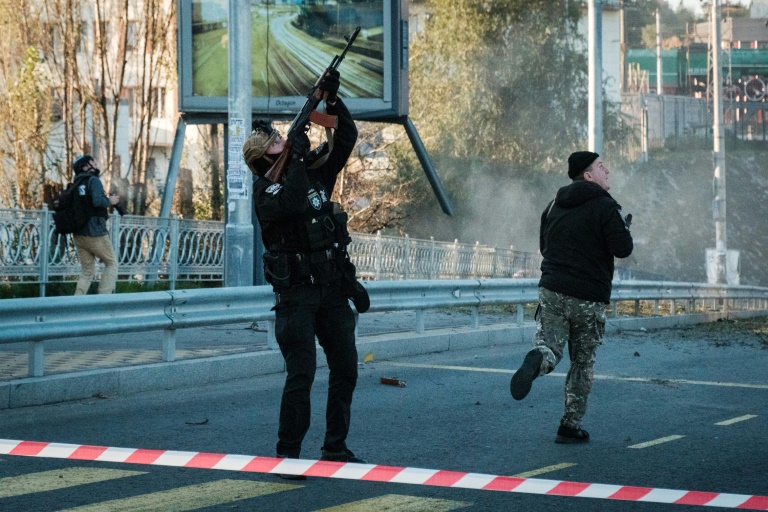
Moscow continued to rain down missiles and munitions on all corners of Ukraine, including Kyiv and the country’s west, which was spared the brunt of the Russian onslaught earlier in the conflict.

Ukraine said it had downed “several Russian rockets” over Kyiv in the third consecutive day of attacks on the capital.

– Creating ‘panic’ –

A Ukrainian representative in the Kherson region called the push by Russia to evacuate the city of the same name the “equivalent of deportation”. The city has been in Moscow’s hands since the earliest days of the invasion. 

“(Putin’s) aim is to create a kind of panic in Kherson and an image (to fuel) propaganda,” Sergiy Khlan said Ukrainian forces were still pushing their counter-offensive southward. 

He said the Russians were using the evacuations as a “pretext” to justify “their withdrawal from Kherson and more generally from the right bank” of the Dnieper river.

Pro-Russian officials in the Ukraine town of Oleshky on the other side of the river said residents from Kherson city were already arriving.

Russia’s Rossiya 24 TV showed images of people waiting to board ferries to cross the river, unable to use bridges put out of action by Ukraine.

Vladimir Saldo, the Kherson region’s Moscow-installed head, told Russian state television that the city’s administration would relocate to the eastern bank of the Dnieper.

But Khlan, the Ukrainian lawmaker, said evacuees were destined for Russia’s southern Krasnodar region.

“Russia is carrying out deportations as in Soviet times,” he said.

– Sakharov Prize –

As developments on the ground gathered pace, Putin’s introduction of military rule in the Moscow-controlled territories also gives additional power to authorities in southern Russian regions bordering Ukraine to quash dissent.

“We are working on solving very complex large-scale tasks to ensure security and protect the future of Russia,” Putin said.

Local officials said they were planning to move up to 60,000 civilians from Kherson over a period of around six days.

Separately, the secretary of Russia’s National Security Council Nikolay Patrushev said Wednesday that around five million people from Russian-held parts of Ukraine had “found shelter” in Russia.

Ukraine’s resilience has won plaudits around the world and the European Parliament on Wednesday awarded the annual Sakharov Prize for human rights to “brave” Ukrainians.

President Volodymyr Zelensky tweeted in response: “Ukrainians prove dedication to the values of freedom, democracy every day on the battlefield.”

In parts of Ukraine recently re-captured from Russian forces meanwhile, repairs were underway before the start of winter, many residents still depending on humanitarian aid.

“Apart from this, nothing is working,” said Ivan Zakharchenko, a 70-year-old resident of Izyum queueing for aid in the square where President Volodymyr Zelensky celebrated the town’s liberation just over a month ago.

– Nuclear plant staff detained –

Ukraine has re-captured occupied territory in the east of the country in recent weeks. Its advance in the south, while far slower, has been gaining momentum in recent days.

There have been some advances on the Russian side too.

Moscow reported on Tuesday its troops had retaken territory in the eastern Kharkiv region. Moscow has also been building up its defences in the territory it still holds.

Russia’s Wagner mercenary group said it was working on building a fortified line of defence in Ukraine’s eastern Lugansk region.

“It is a multi-level and layered defence,” the group’s founder Yevgeny Prigozhin said on the social media of his company Concord.

Russian forces meanwhile continue to occupy the Zaporizhzhia nuclear power plant — Europe’s largest.

Petro Kotin, head of Ukraine’s nuclear energy agency Energoatom, told AFP on Wednesday that Russian forces were currently holding about 50 plant employees.

– EU to sanction Iran –

Russia’s missile and drone strikes in the wake of Ukrainian battlefield have demolished large parts of Ukraine’s power grid ahead of winter.

The government has warned of the risk of blackouts, saying about 30 percent of Ukraine’s power stations have been destroyed. And the presidency said there would be electricity restrictions from Thursday.

Drones bombarded Kyiv on Monday, leaving five dead.

An energy facility in the city was then hit by strikes on Tuesday, killing at least two people.

On Wednesday, several explosions were heard in the centre before Kyiv mayor Vitali Klitschko said “several Russian rockets” had been successfully shot down.

Kyiv and its Western allies have accused Moscow of using Iranian-made drones, with Ukraine saying it has successfully shot down 223 of them since mid-September.

The Kremlin and Iran have denied this, but EU foreign policy spokeswoman Nabila Massrali said the EU had “sufficient evidence” and would prepare fresh sanctions on Iran.


Macron rams budget through divided French parliament

President Emmanuel Macron’s government on Wednesday sought to ram its 2023 budget through parliament without a vote after battling in vain to get it approved by the fractured lower house of parliament.

The administration is trying to lift the country out of an economic squeeze that has sparked industrial action and street protests.

But following weeks of disruption from strikes at oil refineries and fuel depots that have caused shortages at petrol pumps, the government waited until after Tuesday’s broader strike action and demonstrations before unveiling the controversial measure.

The walkouts have been just one of the challenges facing Macron in his second term in office.

The loss of his overall majority in June legislative polls meant he could not get enough deputies to approve the package.

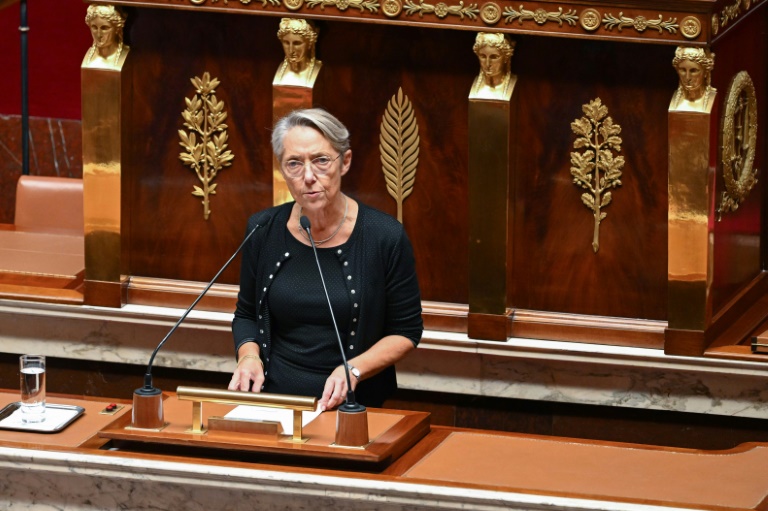
“We need to give our country a budget,” Prime Minister Elisabeth Borne told lawmakers as she announced the use of clause 49.3 of the French constitution.

Under the clause, a law can be passed automatically unless the opposition passes its own vote of no confidence in the government.

“Every opposition party has confirmed their intention to reject the text,” but “the French are expecting… action and results from us,” she said, to boos from the opposition and applause from supporters.

Deputies from the left-wing NUPES alliance began leaving the chamber before Borne had finished speaking.

After promising an open debate, Macron’s camp in recent days suffered a series of defeats over the first of thousands of proposed amendments to its fiscal plans for next year.

– ‘Anti-democratic brutality’ –

Opposition lawmakers on Wednesday accused the government of wasting their time.

“Macronism has become a form of authoritarianism,” leading France Unbowed (LFI) deputy Mathilde Panot told reporters following Borne’s announcement.

“Parliament’s work has been swept away in a few hours,” said Greens representative Cyrielle Chatelain.

Both of them were among 151 NUPES lawmakers to sign a no-confidence motion against the government.

Such an “act of anti-democratic brutality… leads us to demand the censure of the government,” it read.

On the far right, the National Rally (RN) plans to file a no-confidence motion of its own on Thursday.

But with both the hard left and far-right unwilling to back each other’s motions, neither is likely to reach the required 289 votes.

Macron has already increased the pressure on deputies by vowing to dissolve parliament and call fresh elections if a no-confidence vote succeeds.

The leader of the conservative Republicans group Olivier Marleix, asked if he could back either of the motions, said it would be “useless to pile chaos on top of chaos”.

– ‘Live with it’ –

After the election setback this summer that cost Macron’s party his parliamentary majority, he and his ministers have promised to be more open to dialogue with the opposition and civil society than during his first five years as president.

But they have rejected allegations from lawmakers that the use of article 49.3 means abandoning those efforts.

The article means “the government has the ability to force the adoption of a bill when in fact the opposition can live with it”, Francois Bayrou, leader of the Democratic Movement party allied to Macron, told broadcaster France Inter.

With the passage of the budget all but assured, lawmakers had been left wondering which of their hard-fought amendments might be left in, with the choice entirely up to ministers.

Borne said that “around 100” modifications, including some from the opposition, would be left in.

The budget “has been fed, complemented, amended, even corrected following the debates of recent days,” she told MPs.

One senior lawmaker told AFP that the changes, including tax breaks for childcare and for very small businesses, would cost up to 800 million euros ($782 million).

Finance Minister Bruno Le Maire has nevertheless warned Borne that he would not back changes that would blow holes in the budget, another person present at their Monday meeting said.

Close Bitnami banner
Bitnami