AFP

Iconic 'Pillars of Creation' captured in new Webb image

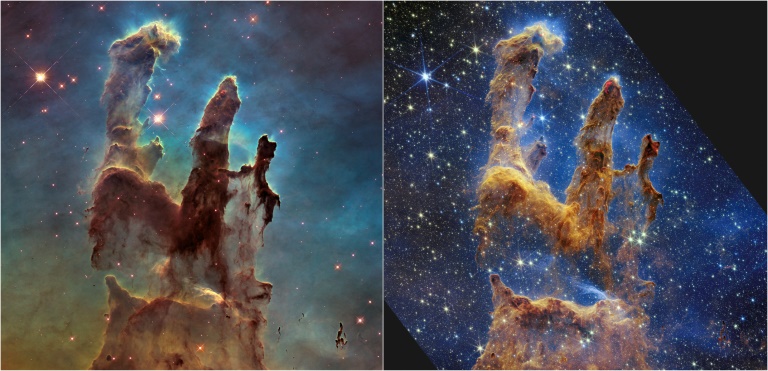
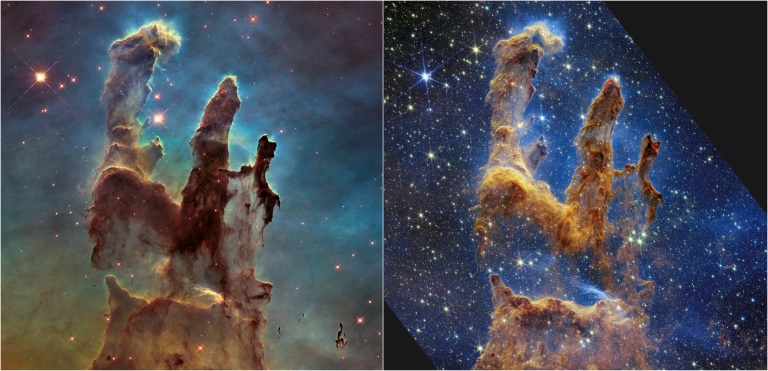
The James Webb Space Telescope captured the iconic “Pillars of Creation,” huge structures of gas and dust teeming with stars, NASA said Wednesday, and the image is as majestic as one could hope.

The twinkling of thousands of stars illuminates the telescope’s first shot of the gigantic gold, copper and brown columns standing in the midst of the cosmos.

At the ends of several pillars are bright red, lava-like spots. “These are ejections from stars that are still forming,” only a few hundred thousand years old, NASA said in a statement.

These “young stars periodically shoot out supersonic jets that collide with clouds of material, like these thick pillars,” the US space agency added.

The “Pillars of Creation” are located 6,500 light years from Earth, in the Eagle Nebula of our Milky Way galaxy.

The pillars were made famous by the Hubble Space Telescope, which first captured them in 1995 and then again in 2014.

But thanks to Webb’s infrared capabilities, the newer telescope — launched into space less than a year ago — can peer through the opacity of the pillars, revealing many new stars forming.

“By popular demand, we had to do the Pillars of Creation” with Webb, Klaus Pontoppidan, the science program manager at the Space Telescope Science Institute, said Wednesday on Twitter.

STScI operates Webb from Baltimore, Maryland.

“There are just so many stars!” Pontoppidan added.

NASA astrophysicist Amber Straughn summed it up: “The universe is beautiful!” she wrote on Twitter.

The image, covering an area of about eight light years, was taken by Webb’s primary imager NIRCam, which captures near-infrared wavelengths — invisible to the human eye.

The colors of the image have been “translated” into visible light.

According to NASA, the new image “will help researchers revamp their models of star formation by identifying far more precise counts of newly formed stars, along with the quantities of gas and dust in the region.”

Operational since July, Webb is the most powerful space telescope ever built, and has already unleashed a raft of unprecedented data. Scientists are hopeful it will herald a new era of discovery.

One of the main goals for the $10-billion telescope is to study the life cycle of stars. Another main research focus is on exoplanets, planets outside Earth’s solar system.

Iconic 'Pillars of Creation' captured in new Webb image

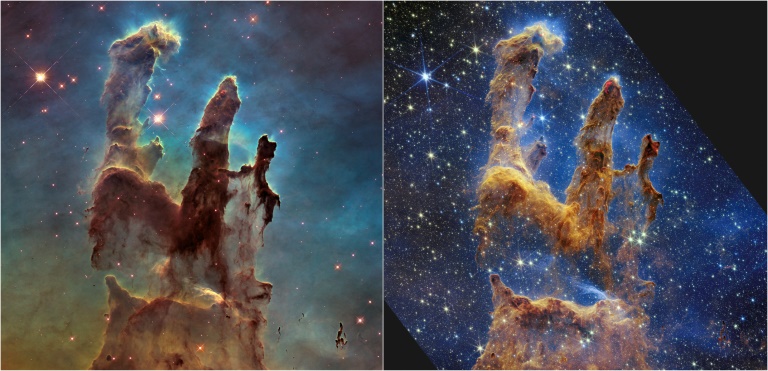
The James Webb Space Telescope captured the iconic “Pillars of Creation,” huge structures of gas and dust teeming with stars, NASA said Wednesday, and the image is as majestic as one could hope.

The twinkling of thousands of stars illuminates the telescope’s first shot of the gigantic gold, copper and brown columns standing in the midst of the cosmos.

At the ends of several pillars are bright red, lava-like spots. “These are ejections from stars that are still forming,” only a few hundred thousand years old, NASA said in a statement.

These “young stars periodically shoot out supersonic jets that collide with clouds of material, like these thick pillars,” the US space agency added.

The “Pillars of Creation” are located 6,500 light years from Earth, in the Eagle Nebula of our Milky Way galaxy.

The pillars were made famous by the Hubble Space Telescope, which first captured them in 1995 and then again in 2014.

But thanks to Webb’s infrared capabilities, the newer telescope — launched into space less than a year ago — can peer through the opacity of the pillars, revealing many new stars forming.

“By popular demand, we had to do the Pillars of Creation” with Webb, Klaus Pontoppidan, the science program manager at the Space Telescope Science Institute, said Wednesday on Twitter.

STScI operates Webb from Baltimore, Maryland.

“There are just so many stars!” Pontoppidan added.

NASA astrophysicist Amber Straughn summed it up: “The universe is beautiful!” she wrote on Twitter.

The image, covering an area of about eight light years, was taken by Webb’s primary imager NIRCam, which captures near-infrared wavelengths — invisible to the human eye.

The colors of the image have been “translated” into visible light.

According to NASA, the new image “will help researchers revamp their models of star formation by identifying far more precise counts of newly formed stars, along with the quantities of gas and dust in the region.”

Operational since July, Webb is the most powerful space telescope ever built, and has already unleashed a raft of unprecedented data. Scientists are hopeful it will herald a new era of discovery.

One of the main goals for the $10-billion telescope is to study the life cycle of stars. Another main research focus is on exoplanets, planets outside Earth’s solar system.

Iconic 'Pillars of Creation' captured in new Webb image

The James Webb Space Telescope captured the iconic “Pillars of Creation,” huge structures of gas and dust teeming with stars, NASA said Wednesday, and the image is as majestic as one could hope.

The twinkling of thousands of stars illuminates the telescope’s first shot of the gigantic gold, copper and brown columns standing in the midst of the cosmos.

At the ends of several pillars are bright red, lava-like spots. “These are ejections from stars that are still forming,” only a few hundred thousand years old, NASA said in a statement.

These “young stars periodically shoot out supersonic jets that collide with clouds of material, like these thick pillars,” the US space agency added.

The “Pillars of Creation” are located 6,500 light years from Earth, in the Eagle Nebula of our Milky Way galaxy.

The pillars were made famous by the Hubble Space Telescope, which first captured them in 1995 and then again in 2014.

But thanks to Webb’s infrared capabilities, the newer telescope — launched into space less than a year ago — can peer through the opacity of the pillars, revealing many new stars forming.

“By popular demand, we had to do the Pillars of Creation” with Webb, Klaus Pontoppidan, the science program manager at the Space Telescope Science Institute, said Wednesday on Twitter.

STScI operates Webb from Baltimore, Maryland.

“There are just so many stars!” Pontoppidan added.

NASA astrophysicist Amber Straughn summed it up: “The universe is beautiful!” she wrote on Twitter.

The image, covering an area of about eight light years, was taken by Webb’s primary imager NIRCam, which captures near-infrared wavelengths — invisible to the human eye.

The colors of the image have been “translated” into visible light.

According to NASA, the new image “will help researchers revamp their models of star formation by identifying far more precise counts of newly formed stars, along with the quantities of gas and dust in the region.”

Operational since July, Webb is the most powerful space telescope ever built, and has already unleashed a raft of unprecedented data. Scientists are hopeful it will herald a new era of discovery.

One of the main goals for the $10-billion telescope is to study the life cycle of stars. Another main research focus is on exoplanets, planets outside Earth’s solar system.

First 'concrete picture' of Neanderthal family revealed by DNA

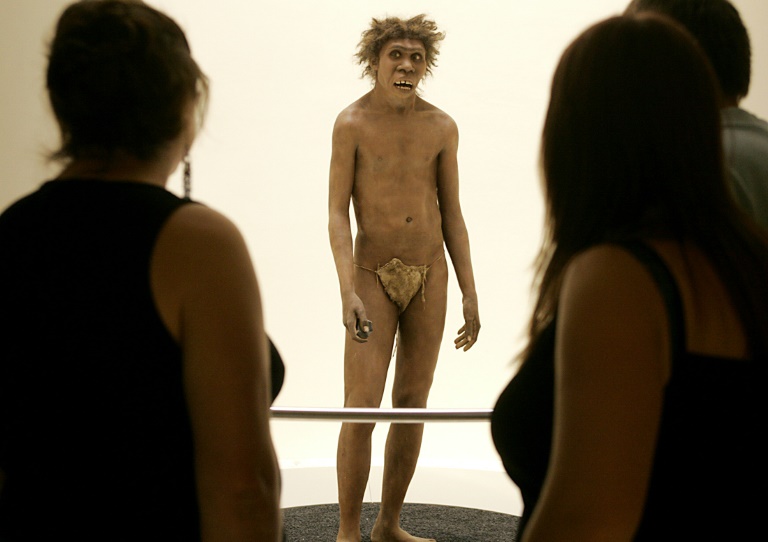
The original Flintstones? The largest genetic study of Neanderthals ever conducted has offered an unprecedented snapshot of a family, including a father and his teenage daughter, who lived in a Siberian cave around 54,000 years ago.

The new research, published in the journal Nature on Wednesday, used DNA sequencing to look at the social life of a Neanderthal community, finding that women were more likely to stray from the cave than men.

Previous archaeological excavations have shown that Neanderthals were more sophisticated than once thought, burying their dead and making elaborate tools and ornaments. 

However little is known about their family structure or how their society was organised.

The sequencing of the first Neanderthal genome in 2010, which won Swedish paleogeneticist Svante Paabo the medicine Nobel prize earlier this month, offered a new way to discover more about our long extinct forerunners.

An international team of researchers focused on multiple Neanderthal remains found in the Chagyrskaya and Okladnikov caves in southern Siberia. 

The scattered fragments of bones were mostly in a single layer in the earth, suggesting the Neanderthals lived around the same time.

“First we had to identify how many individuals we had,” Stephane Peyregne, an evolutionary geneticist at Germany’s Max Planck Institute and one of the study’s co-authors, told AFP.

– ‘Seem much more human’ –

The team used new techniques to extract and isolate the ancient DNA from the remains.

By sequencing the DNA, they established there were 13 Neanderthals, seven males and six females. Five of the group were children or early adolescents.

Eleven were from the Chagyrskaya cave, many of them from the same family including the father and his teenage daughter, as well as a young boy and a woman who were second-degree relatives, such as a cousin, aunt or grandmother.

The researchers also worked out that one man was a maternal relative of the father because he had a genetic phenomenon called heteroplasmy, which only passes down a couple of generations.

“Our study provides a concrete picture of what a Neandertal community may have looked like,” Max Planck’s Benjamin Peter, who supervised the research along with Paabo, said in a statement.

“It makes Neandertals seem much more human to me,” he added.

Genetic analysis showed that the group did not interbreed with its nearby relatives such as humans and Denisovans, hominins discovered by Paabo in caves just a few hundred kilometres away.

However we know that Neanderthals did breed with homo sapiens at some point — Paabo’s research also revealed that almost all modern humans have a little Neanderthal DNA.

– Rampant inbreeding –

The community of around 10 to 20 Neanderthals seems to have instead bred largely among themselves, displaying very little genetic diversity, the study found.

Neanderthals existed between 430,000 to 40,000 years ago, so this group was living in the twilight of its species.

The study compared the community’s level of inbreeding to endangered mountain gorillas. Another explanation for the inbreeding could be that the Neanderthals lived in an isolated region.

“We are probably dealing with a very subdivided population,” Peyregne said.

The researchers found that the group’s Y-chromosomes, which are inherited from father to son, were far less diverse than its mitochondrial DNA, which is inherited from mothers.

This suggests that the women travelled more frequently to interact and breed with different groups of Neanderthals, while the men largely stayed home.

Antoine Balzeau, a palaeoanthropologist at France’s National Museum of Natural History, said that fossils found in the Sidron Cave in Spain prompted suggestions of a similar Neanderthal community there, but far less complete genetic material is available.

Balzeau, who was not involved in the latest study, said it was “a very interesting technical feat”.

But “it will have to be compared with other groups” of Neanderthals, he added.

US Supreme Court denies appeal from Oklahoma Death Row inmate

The US Supreme Court on Wednesday rejected an appeal by a Death Row inmate in Oklahoma who is to be executed despite claims by his lawyers that he is severely mentally ill.

Benjamin Cole, 57, is to be put to death by lethal injection at 10:00 am (1500 GMT) on Thursday at the Oklahoma State Penitentiary in McAlester.

Cole was sentenced to death in 2004 for the murder of his daughter, Brianna.

He was accused of killing the crying infant to silence her so he could continue playing a video game.

According to his lawyers, Cole suffers from “debilitating mental illness” and the US Constitution prohibits the execution of someone who is not mentally competent.

Cole has been diagnosed with paranoid schizophrenia and brain damage, his lawyers said, and “his condition has deteriorated to the point that he is largely catatonic.”

“(Cole) cannot manage his own basic hygiene, and crawls on the cell floor if without a wheelchair,” they said in a statement.

“He barely communicates with prison staff or his own attorneys, going days at a time without speaking to anyone.”

Lower courts have rejected the claims that Cole is not mentally competent and the Supreme Court denied his last-minute appeal for a stay of execution without comment.

According to the Oklahoma authorities, Cole identifies as a “Messianic Jew” and “his refusal to speak to certain individuals appeared to be a choice on his part” motivated by his “extreme religiosity.”

“Cole’s claim of incompetency rests on experts who have not had actual conversations with him concerning his execution,” they said.

“In contrast, Cole willingly engaged with a neutral expert at a state-run hospital and very clearly expressed his rational understanding of his punishment,” they said.

There have been 11 executions in the United States this year, including three in Oklahoma.

Putin declares martial law in annexed Ukraine regions

Russian President Vladimir Putin on Wednesday declared martial law in four regions of Ukraine recently annexed by Moscow as his proxy officials in a southern city pulled out with Ukraine troops advancing.

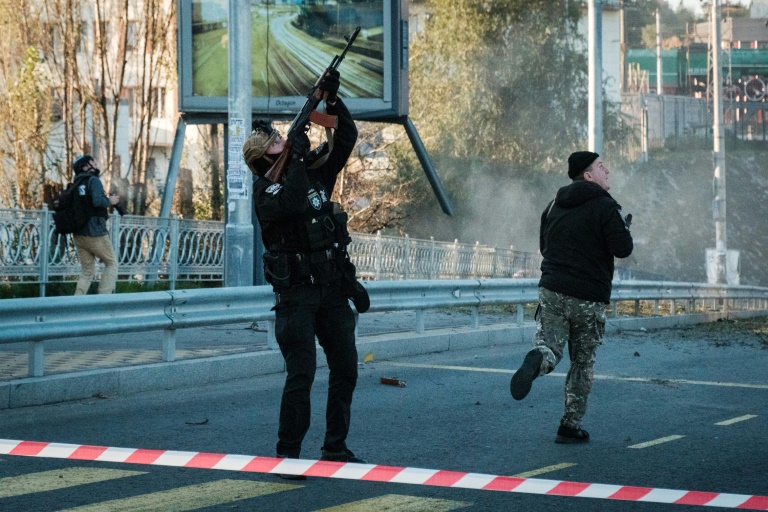
The decree came as Ukraine said it had downed “several Russian rockets” over Kyiv in a third consecutive day of missile and drone attacks on the capital after a string of battlefield defeats for Moscow. 

The introduction of military rule in the Moscow-controlled territories also gives additional power to authorities in southern Russian regions bordering Ukraine.

“We are working on solving very complex large-scale tasks to ensure security and protect the future of Russia,” Putin said.

Pro-Kremlin officials meanwhile said they were pulling out of the key southern Ukraine city of Kherson on Wednesday, as Kyiv’s forces advanced on territory in Russian hands since the war’s earliest days.

In parts of Ukraine recently re-captured from Russian forces, meanwhile, repairs are underway before winter begins, but many residents still depend on humanitarian aid.

“Apart from this, nothing is working,” said Ivan Zakharchenko, a 70-year-old resident of Izyum queueing for aid in the square where President Volodymyr Zelensky celebrated the town’s liberation just over a month ago.

– Ukrainians ‘will not give up’ –

Kherson was the first and only major city to fall to Moscow’s troops since the February invasion began and retaking it would be a crucial prize in Ukraine’s counter-offensive.

“The entire administration is already moving today,” to the eastern bank of the Dnieper River, the Kherson region’s Moscow-installed head, Vladimir Saldo, told Russian state television.

But Andriy Yermak, the Ukrainian presidency’s chief of staff, called the moves a “propaganda show” and accused Russia of “trying to scare the people of Kherson”.

Ukrainian forces “do not fire at Ukrainian cities,” Yermak wrote on Telegram.

Ukraine’s resilience has won plaudits around the world and the European Parliament on Wednesday awarded the annual Sakharov Prize for human rights to “brave” Ukrainians.

After the award Zelensky tweeted that “Ukrainians prove dedication to the values of freedom, democracy every day on the battlefield”.

– Evacuations by ferry –

Kherson is located on the western bank of the Dnieper, the same side where Ukrainian troops have been moving forward in a counter-offensive that began in August.

Saldo said the pull-out, along with the organised movement of civilians from the city, was a precaution and vowed that Russian forces would continue to fight Ukraine.

Local officials said they were planning to move up to 60,000 civilians from the city of Kherson over a period of around six days.

Ukrainian forces have targeted bridges across the river to disrupt supply lines, with Russian-installed officials saying that evacuations were being undertaken with ferries.

Russia’s Rossiya 24 state TV showed images of people waiting to board ferries to cross the river.

Pro-Russian officials have said civilians would only be allowed to leave towards Russia or Russian-held parts of Ukraine.

Sergiy Khlan, the Ukrainian deputy head of the Kherson region, said the evacuation “is equal to deportation”.

Separately, the secretary of Russia’s National Security Council Nikolay Patrushev said on Wednesday that around five million people from Russian-held parts of Ukraine have “found shelter” in Russia.

– Nuclear plant staff detained –

Ukraine has re-captured occupied territory in the east of the country in recent weeks.

Its advance in the south has been far slower but has been gaining momentum in recent days.

There have been some Russian advances too.

Russian forces on Tuesday claimed to have retaken territory from Ukrainian troops in the eastern Kharkiv region.

Moscow has also been building up its defences in the territory it still holds.

Russia’s Wagner mercenary group said it was working on building a fortified line of defence in Ukraine’s eastern Lugansk region.

“It is a multi-level and layered defence,” the group’s founder Yevgeny Prigozhin said on the social media of his company Concord.

Russian forces meanwhile continue to occupy the Zaporizhzhia nuclear power plant — Europe’s largest.

Petro Kotin, head of Ukraine’s nuclear energy agency Energoatom, told AFP on Wednesday that Russian forces were currently holding “about 50” plant employees.

– EU to sanction Iran –

Kyiv’s recapturing of swathes of its territory in the east and parts of the south has however been followed by missile and drone strikes that have demolished large parts of Ukraine’s power grid ahead of winter.

The government has warned of the risk of blackouts, saying about 30 percent of Ukraine’s power stations have been destroyed.

Drones bombarded Kyiv on Monday, leaving five dead.

An energy facility in the city was then hit by strikes on Tuesday, killing at least two people.

On Wednesday, several explosions were heard in the centre before Kyiv mayor Vitali Klitschko said “several Russian rockets” had been successfully shot down.

Kyiv and its Western allies have accused Moscow of using Iranian-made drones, with Ukraine saying it had successfully shot down 223 of them since mid-September.

The Kremlin and Iran have denied this, but EU foreign policy spokeswoman Nabila Massrali said the EU has “sufficient evidence” and would prepare fresh sanctions on Iran.

Spain minister says EU energy crisis measures too 'timid'

The EU’s proposals to rein in soaring energy prices are too “timid” and could lead to a “breakdown in confidence” in European institutions, Spain’s Energy Minister Teresa Ribera said Wednesday during an interview with AFP on the eve of an EU leaders summit.

Energy prices and inflation have surged across the 27-nation European Union as Moscow slashed gas supplies apparently in response to EU sanctions over Russia’s invasion of Ukraine in February.

As winter approaches, the European Commission, the EU’s executive arm, has been under intense pressure to tackle soaring heating bills for household and businesses.

On Tuesday it unveiled its latest proposals which put the emphasis on joint purchasing among EU countries in order to better command lower prices to refill gas reserves.

“The proposals are, in my view, still too timid: we are still missing concrete measures regarding the vast majority of subjects,” Ribera said.

While there has been a “real effort” to tackle the energy crisis over the past year, it is “frustrating to see” that “Europe’s reaction in the face of this challenge is slow and laboured,” she added.

Spain, the fourth largest eurozone economy, has been one of the loudest voices within the bloc calling for a vigorous reform of the EU’s energy market.

The commission’s latest plan — which will be taken up at a two-day summit of EU leaders which begins Thursday in Brussels — does not include an immediate gas price cap.

A large group of EU countries, led by Italy, have pushed hard for some form of price cap, which is opposed by Germany which fears scaring off alternative suppliers that have stepped in to replace Russia as the bloc’s main source of gas.

“I think it is important to go a bit faster on this issue,” Ribera said.

“We shouldn’t have to ask the Commission four times the same thing to have a proposal. But I trust that the Commission will speed up and make the proposals. It would be risky not to take the decisions in time.”

– ‘Tough situation’ –

The skyrocketing energy prices have fuelled large protests in several European nations against rising inflation and to demand higher wages.

“The energy crisis causes a tough situation for families and for the productive fabric. If we do not respond quickly enough, there may be a breakdown of confidence in the European institutions,” Ribera said.

“The current situation is a very important stress test for Europe,” she added.

Ribera said she was “moderately””optimistic that Spain will be able to convince France to lift its opposition to the construction of a new gas pipeline across the Pyrenees mountains.

With Russia withholding gas deliveries to most of Europe in reaction to sanctions over its invasion of Ukraine, there has been a resurgence of interest — especially from Germany — in a link to bring in much-needed supplies from Spain to the rest of the continent.

Plans for such a pipeline, known as MidCat, emerged a decade ago but were dropped in 2019 over regulatory and funding issues. 

“We respect and understand some of France’s arguments but not all,” Ribera said.

“It is important to find a European solution to the problem, and that the demand for help from Germany and other member states be heard.”

Stocks waver as inflation concerns offset positive earnings

Major stock markets fluctuated Wednesday as investors tracked soaring inflation and positive earnings results.

In a sign of the uphill struggle in the battle against soaring prices, UK inflation jumped back above 10 percent last month.

London’s FTSE 100 shares index dipped 0.2 percent and the pound fell following the data — and as Britain’s under-fire Prime Minister Liz Truss faced a grilling in parliament.

Sentiment was also dampened “by a sharp rise in US yields, as well as the US dollar, after Minneapolis Fed President Neel Kashkari said that the Federal Reserve would be in no position to pause on rate rises if inflation was still rising, even with the Fed Funds rate at 4.5 percent,” said market analyst Michael Hewson.

Market movements have been dominated in recent months by interest rate hikes by the US Federal Reserve and other central banks as they try to rein in surging inflation.

Foreign exchange traders were keeping tabs also on whether the dollar would reach 150 yen, which would be a fresh high for 32 years.

Japan’s currency is being hit hard as the country’s central bank holds off from hiking interest rates, in sharp contrast to its peers.

Frankfurt and Paris stocks ended the day modestly lower.

While the Dow was up marginally in late morning trading, both the S&P 500 and tech-heavy Nasdaq Composite were lower. 

“Fortunately, some strength is also being seen in the stocks of several widely-held companies that reported earnings,” said Briefing.com analyst Patrick O’Hare.

Traders were given an extra boost by news that Netflix gained more than two million subscribers in July-September.

In Europe, Nestle’s nominal sales surged in the first nine months of the year as the maker of Nespresso capsules, Purina pet food and Haagen-Dazs ice cream raised its prices in response to soaring inflation.

Nestle’s shares ended the day down 1.3 percent, however, amid concerns about the impact of higher prices on sales volumes.

On commodity markets, crude oil prices rose on renewed supply worries.

They had slumped Tuesday on bets that US President Joe Biden would order the release of more barrels from the country’s emergency reserves in order to keep fuel prices subdued heading into mid-term elections.

– Key figures around 1530 GMT –

New York – Dow: UP less than 0.1 percent at 30,529.07 points

EURO STOXX 50: UP 0.2 percent at 3,471.24

London – FTSE 100: DOWN 0.2 percent at 6,924.99 (close)

Frankfurt – DAX: DOWN 0.2 percent at 12,741.41 (close)

Paris – CAC 40: DOWN 0.4 percent at 6,040.72 (close)

Tokyo – Nikkei 225: UP 0.4 percent at 27,257.38 (close)

Hong Kong – Hang Seng Index: DOWN 2.4 percent at 16,511.28 (close)

Shanghai – Composite: DOWN 1.2 percent at 3,044.38 (close)

Pound/dollar: DOWN at $1.1246 from $1.1332 on Tuesday

Dollar/yen: UP at 149.75 yen from 149.21 yen

Euro/dollar: DOWN at $0.9785 from $0.9862 

Euro/pound: DOWN at 86.98 pence from 87.01 pence

Brent North Sea crude: UP 0.9 percent at $90.83 per barrel

West Texas Intermediate: UP 0.8 percent at $83.46 per barrel

burs-rl/lcm

Stocks waver as inflation concerns offset positive earnings

Major stock markets fluctuated Wednesday as investors tracked soaring inflation and positive earnings results.

In a sign of the uphill struggle in the battle against soaring prices, UK inflation jumped back above 10 percent last month.

London’s FTSE 100 shares index dipped 0.2 percent and the pound fell following the data — and as Britain’s under-fire Prime Minister Liz Truss faced a grilling in parliament.

Sentiment was also dampened “by a sharp rise in US yields, as well as the US dollar, after Minneapolis Fed President Neel Kashkari said that the Federal Reserve would be in no position to pause on rate rises if inflation was still rising, even with the Fed Funds rate at 4.5 percent,” said market analyst Michael Hewson.

Market movements have been dominated in recent months by interest rate hikes by the US Federal Reserve and other central banks as they try to rein in surging inflation.

Foreign exchange traders were keeping tabs also on whether the dollar would reach 150 yen, which would be a fresh high for 32 years.

Japan’s currency is being hit hard as the country’s central bank holds off from hiking interest rates, in sharp contrast to its peers.

Frankfurt and Paris stocks ended the day modestly lower.

While the Dow was up marginally in late morning trading, both the S&P 500 and tech-heavy Nasdaq Composite were lower. 

“Fortunately, some strength is also being seen in the stocks of several widely-held companies that reported earnings,” said Briefing.com analyst Patrick O’Hare.

Traders were given an extra boost by news that Netflix gained more than two million subscribers in July-September.

In Europe, Nestle’s nominal sales surged in the first nine months of the year as the maker of Nespresso capsules, Purina pet food and Haagen-Dazs ice cream raised its prices in response to soaring inflation.

Nestle’s shares ended the day down 1.3 percent, however, amid concerns about the impact of higher prices on sales volumes.

On commodity markets, crude oil prices rose on renewed supply worries.

They had slumped Tuesday on bets that US President Joe Biden would order the release of more barrels from the country’s emergency reserves in order to keep fuel prices subdued heading into mid-term elections.

– Key figures around 1530 GMT –

New York – Dow: UP less than 0.1 percent at 30,529.07 points

EURO STOXX 50: UP 0.2 percent at 3,471.24

London – FTSE 100: DOWN 0.2 percent at 6,924.99 (close)

Frankfurt – DAX: DOWN 0.2 percent at 12,741.41 (close)

Paris – CAC 40: DOWN 0.4 percent at 6,040.72 (close)

Tokyo – Nikkei 225: UP 0.4 percent at 27,257.38 (close)

Hong Kong – Hang Seng Index: DOWN 2.4 percent at 16,511.28 (close)

Shanghai – Composite: DOWN 1.2 percent at 3,044.38 (close)

Pound/dollar: DOWN at $1.1246 from $1.1332 on Tuesday

Dollar/yen: UP at 149.75 yen from 149.21 yen

Euro/dollar: DOWN at $0.9785 from $0.9862 

Euro/pound: DOWN at 86.98 pence from 87.01 pence

Brent North Sea crude: UP 0.9 percent at $90.83 per barrel

West Texas Intermediate: UP 0.8 percent at $83.46 per barrel

burs-rl/lcm

BMW to invest $1.7 bn in electric car production in US

German carmaker BMW said Wednesday it will invest $1.7 billion in the production of electric vehicles in the United States. 

The plan includes $1 billion towards expanding the company’s Spartanburg US manufacturing plant and $700 million for a new battery assembly facility, BMW said in a statement.

“The BMW group continues the roll-out of its electromobility plan with a new investment in the US,” the company said.

The Spartanburg plant in South Carolina is already BMW’s biggest factory, producing 1,500 BMW X vehicles a day.

The new high-voltage battery assembly facility will be located in Woodruff, South Carolina, BMW said.

The German group has also signed an agreement with Chinese battery manufacturer Envision AESC, which will “build a new battery cell factory in South Carolina” with an annual capacity of up to 30 GWh.

The group plans to produce at least six fully electric BMW X models at the Spartanburg plant by 2030.

The aim is for the factory to become “a major driver for our electrification strategy”, said Oliver Zipse, chair of BMW’s management board.

The move is part of a shift towards electrification at BMW and in the German car industry as a whole.

BMW already sells the i3 model but it has nonetheless lost market share to Tesla.

The German luxury brand is aiming to have two million electric vehicles on the road by 2025, promising 13 new electric models and a revamp of its Mini series.

However, the new investment comes amid tensions over President Joe Biden’s landmark “Inflation Reduction Act”, which includes tax breaks for US-made electric cars and batteries.

European Union officials have said the policy could put e-cars made elsewhere at an unfair disadvantage. 

German Economy Minister Robert Habeck on Wednesday warned that the US plans “must not destroy the level playing field between our two economies” and called for “a strong answer from the European side”. 

Speaking after talks with his French counterpart Bruno Le Maire, Habeck said companies were being “drawn away from Europe to the United States because of the strong subsidies paid”.

The US is also an attractive potential production base for German manufacturers struggling with soaring energy costs in the fallout from Russia’s invasion of Ukraine.

Gas prices remain low in the United States thanks to abundant domestic production.

Close Bitnami banner
Bitnami