AFP

US confirms Saudi sentencing of American over tweets

The United States said Tuesday it was raising with Saudi Arabia a prison sentence handed to a US citizen over tweets critical of the kingdom, another source of tension between the historic allies. 

The State Department confirmed the detention of Saad Ibrahim Almadi, a US citizen of Saudi origin, and said the United States brought up his case starting in December and as recently as Monday.

Almadi was sentenced to 16 years in prison for the tweets, his son Ibrahim confirmed to AFP.

“We have consistently and intensively raised our concerns regarding the case at senior levels of the Saudi government, both through channels in Riyadh and Washington,” State Department spokesman Vedant Patel told reporters.

“Exercising freedom of expression should never be criminalized,” he said.

The Washington Post reported that Almadi, who lives in Florida and had gone to visit family, was detained in November at the airport regarding 14 tweets he wrote over the previous seven years.

The newspaper, quoting the son Ibrahim, said that Almadi, who is 72, was sentenced on October 3 to 16 years in prison with a travel ban of another 16 years after that.

The son told the newspaper that his father had expressed only “mild” opinions with tweets mentioning corruption in Saudi Arabia and the killing of Jamal Khashoggi, the US-based columnist who was dismembered in 2018 after being lured into the kingdom’s Istanbul consulate.

Almadi was charged in part with supporting and funding terrorism and trying to destabilize the kingdom, said his son, who confirmed the Post’s reporting to AFP.

The State Department said no US representative was present at the sentencing as Saudi Arabia originally gave a later date for the hearing before moving it up.

“We did not hear back from the Saudi government until after the October 3 date” of the sentencing, Patel said, without confirming the details of the decision.

The death of Khashoggi, who wrote for The Washington Post, triggered outrage in Washington although then president Donald Trump boasted of saving the powerful crown prince, Mohammed Bin Salman, from major repercussions.

President Joe Biden declassified intelligence that showed that the crown prince ordered the killing and vowed to get tougher, including over Saudi Arabia’s deadly offensive in Yemen.

Biden in July nonetheless traveled to Saudi Arabia and was photographed in a fist-bump with the crown prince on a trip seen as seeking the kingdom’s help to lower gas prices by pumping more oil.

But OPEC+, led by Saudi Arabia, on October 5 announced a major cut in production just ahead of US congressional elections, outraging Biden who vowed consequences.

Saudi Arabia has long faced criticism over human rights. Blogger and rights activist Raif Badawi served 10 years in prison through March and was publicly lashed 50 times for charges over content on his website.
US confirms Saudi sentencing of American over tweets

The United States said Tuesday it was raising with Saudi Arabia a prison sentence handed to a US citizen over tweets critical of the kingdom, another source of tension between the historic allies. 

The State Department confirmed the detention of Saad Ibrahim Almadi, a US citizen of Saudi origin, and said the United States brought up his case starting in December and as recently as Monday.

Almadi was sentenced to 16 years in prison for the tweets, his son Ibrahim confirmed to AFP.

“We have consistently and intensively raised our concerns regarding the case at senior levels of the Saudi government, both through channels in Riyadh and Washington,” State Department spokesman Vedant Patel told reporters.

“Exercising freedom of expression should never be criminalized,” he said.

The Washington Post reported that Almadi, who lives in Florida and had gone to visit family, was detained in November at the airport regarding 14 tweets he wrote over the previous seven years.

The newspaper, quoting the son Ibrahim, said that Almadi, who is 72, was sentenced on October 3 to 16 years in prison with a travel ban of another 16 years after that.

The son told the newspaper that his father had expressed only “mild” opinions with tweets mentioning corruption in Saudi Arabia and the killing of Jamal Khashoggi, the US-based columnist who was dismembered in 2018 after being lured into the kingdom’s Istanbul consulate.

Almadi was charged in part with supporting and funding terrorism and trying to destabilize the kingdom, said his son, who confirmed the Post’s reporting to AFP.

The State Department said no US representative was present at the sentencing as Saudi Arabia originally gave a later date for the hearing before moving it up.

“We did not hear back from the Saudi government until after the October 3 date” of the sentencing, Patel said, without confirming the details of the decision.

The death of Khashoggi, who wrote for The Washington Post, triggered outrage in Washington although then president Donald Trump boasted of saving the powerful crown prince, Mohammed Bin Salman, from major repercussions.

President Joe Biden declassified intelligence that showed that the crown prince ordered the killing and vowed to get tougher, including over Saudi Arabia’s deadly offensive in Yemen.

Biden in July nonetheless traveled to Saudi Arabia and was photographed in a fist-bump with the crown prince on a trip seen as seeking the kingdom’s help to lower gas prices by pumping more oil.

But OPEC+, led by Saudi Arabia, on October 5 announced a major cut in production just ahead of US congressional elections, outraging Biden who vowed consequences.

Saudi Arabia has long faced criticism over human rights. Blogger and rights activist Raif Badawi served 10 years in prison through March and was publicly lashed 50 times for charges over content on his website.
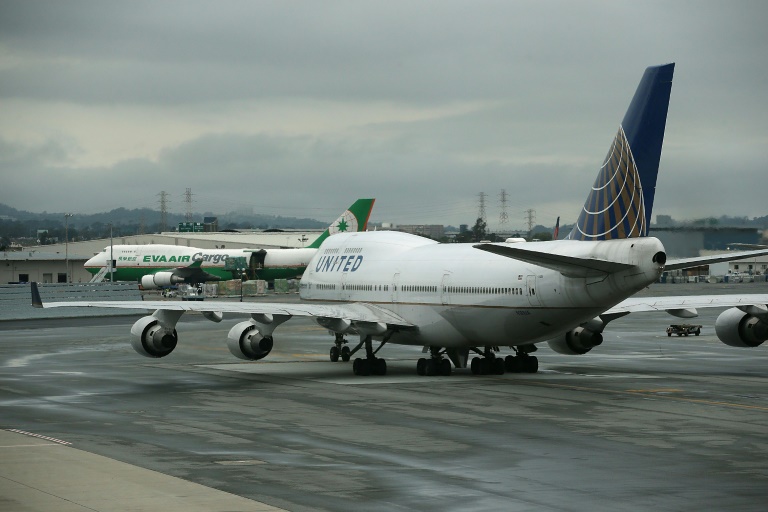
United Airlines bullish on air travel despite inflation

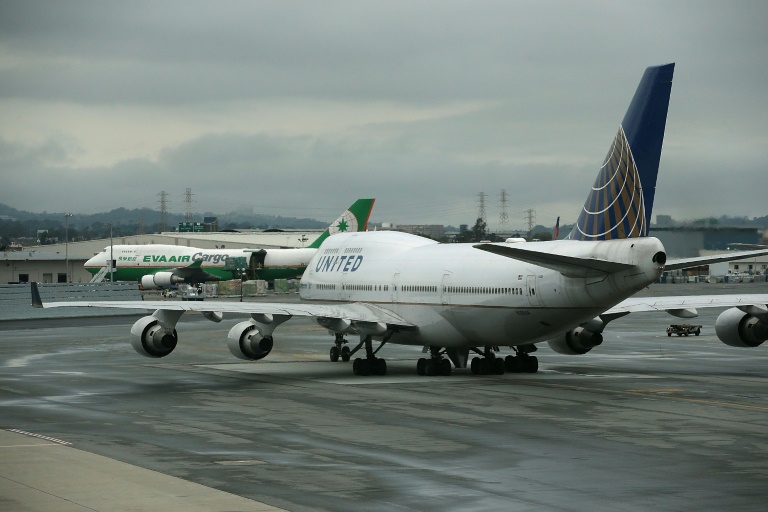
United Airlines reported strong third-quarter results Tuesday and said it does not expect inflation and other macroeconomic headwinds to derail the travel industry’s comeback.

The major US carrier improved in key revenue benchmarks compared with the comparable pre-pandemic 2019 stretch, making the period “by most metrics, the best operational quarter in our history,” as Chief Executive Officer Scott Kirby put it.

Compared with the 2019 quarter, United had about 10 percent fewer passengers and also about 10 percent lower seat capacity in the just-finished quarter.

But revenues were about 13 percent higher, thanks to lofty ticket prices in the wake of torrid consumer demand.

“Despite growing concerns about an economic slowdown, the ongoing COVID recovery trends at United continue to prevail and we remain optimistic that we’ll continue to deliver strong financial results in the fourth quarter, 2023 and beyond,” Kirby said.

Profits for the quarter ending September 30 were $942 million, about double the year-ago level, with revenues jumping 66 percent to $12.9 billion.

United pointed to three “durable” industry-wide trends that it expects to override economic headwinds: continuing pent-up travel demand after the coronavirus pandemic; the beneficial impact of hybrid work on travel demand; and “external supply challenges” that will limit industry supply.

Shares of United jumped 7.1 percent to $39.88 in after-hours trading.

United Airlines bullish on air travel despite inflation

United Airlines reported strong third-quarter results Tuesday and said it does not expect inflation and other macroeconomic headwinds to derail the travel industry’s comeback.

The major US carrier improved in key revenue benchmarks compared with the comparable pre-pandemic 2019 stretch, making the period “by most metrics, the best operational quarter in our history,” as Chief Executive Officer Scott Kirby put it.

Compared with the 2019 quarter, United had about 10 percent fewer passengers and also about 10 percent lower seat capacity in the just-finished quarter.

But revenues were about 13 percent higher, thanks to lofty ticket prices in the wake of torrid consumer demand.

“Despite growing concerns about an economic slowdown, the ongoing COVID recovery trends at United continue to prevail and we remain optimistic that we’ll continue to deliver strong financial results in the fourth quarter, 2023 and beyond,” Kirby said.

Profits for the quarter ending September 30 were $942 million, about double the year-ago level, with revenues jumping 66 percent to $12.9 billion.

United pointed to three “durable” industry-wide trends that it expects to override economic headwinds: continuing pent-up travel demand after the coronavirus pandemic; the beneficial impact of hybrid work on travel demand; and “external supply challenges” that will limit industry supply.

Shares of United jumped 7.1 percent to $39.88 in after-hours trading.

Stock markets climb on bright US earnings and UK policy U-turns

Major global equities rose Tuesday, with sentiment boosted by upbeat US earnings and relief over the demise of the new British government’s controversial fiscal plan.

Analysts pointed to better-than-expected reports from Goldman Sachs and Johnson & Johnson as a positive driver for stocks, along with shifting investor sentiment.

On Wall Street, both the Dow and S&P 500 climbed more than one percent following a day of strong trading in Asia and Europe.

“Better-than-expected US earnings reports sparked a rally on Wall Street with positive momentum reverberating across European equities,” Interactive Investor analyst Victoria Scholar told AFP.

US industrial production also picked up more than anticipated in September, according to official data Tuesday, bouncing back after a dip in August.

But Craig Erlam, senior market analyst at OANDA, warned the upbeat investor sentiment might not last, saying there was a “strong feeling of a bear market rally about trading over the course of the last week.”

“From the post-US-inflation rebound to what has now been a strong start to the week — in part driven by the UK’s decision to no longer shoot itself in the foot — nothing about this screams sustainable.”

Companies in the S&P 500 are expected to see earnings growth of just 1.6 percent, the lowest rate in two years, according to Factset.

– UK turbulence –

Frankfurt stocks closed up one percent on Tuesday as a key survey showed German investor confidence climbed slightly in October, but remained at a low level.

London gains were muted after the Bank of England poured cold water on a newspaper report that it could delay the sale of government bonds again to help maintain market stability.

A BoE spokesperson described the Financial Times story as “inaccurate”.

The British pound retreated slightly after jumping Monday above $1.14 as the UK government sensationally ripped up its controversial debt-fuelled budget.

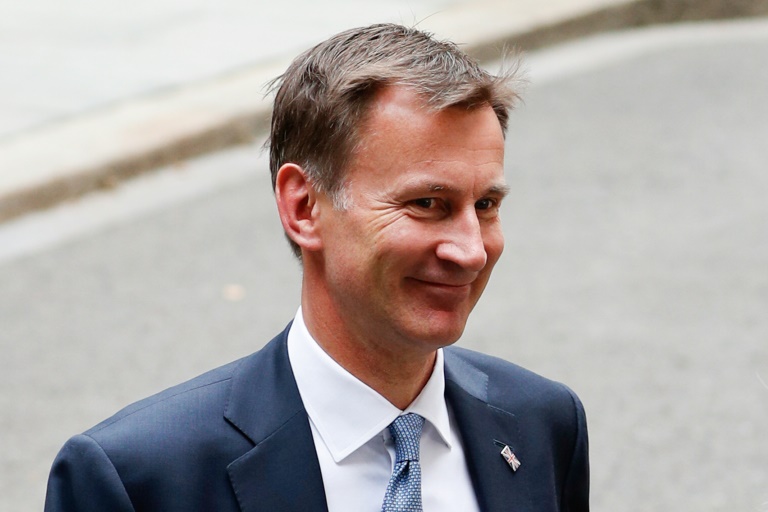
After a volatile few weeks during which the pound hit a record low, new finance minister Jeremy Hunt sought Monday to reassure investors as he scrapped tax cuts and warned of tough spending cuts.

Monday’s move, which dealt a blow to Prime Minister Liz Truss’s authority, sent sterling up as much as two percent at one point and the cost of government borrowing tumbled, while the FTSE 100 jumped.

“Investors continue to monitor the political and economic turbulence surrounding the UK,” noted XTB analyst Walid Koudmani.

Markets in China fluctuated a day after authorities delayed the release of third-quarter economic figures, which analysts said were likely to show the weakest growth since the pandemic owing to Covid-19 lockdowns.

The decision comes as the Communist Party holds a key gathering at which President Xi Jinping is expected to be handed a third term.

Oil prices slumped Tuesday in response on the expectation that the United States will draw more barrels than expected from its strategic reserves heading into the winter season.

– Key figures around 2030 GMT –

New York – Dow: UP 1.1 percent at 30,523.80 (close)

New York – S&P 500: UP 1.1 percent at 3,719.98 (close)

New York – Nasdaq: UP 0.9 percent at 10,772.40 (close)

London – FTSE 100: UP 0.2 percent at 6,936.74 (close)

Frankfurt – DAX: UP 0.9 percent at 12,765.61 (close)

Paris – CAC 40: UP 0.4 percent at 6,067.00 (close)

EURO STOXX 50: UP 0.6 percent at 3,463.83  (close)

Tokyo – Nikkei 225: UP 1.4 percent at 27,156.14 (close)

Hong Kong – Hang Seng Index: UP 1.8 percent at 16,914.58 (close)

Shanghai – Composite: DOWN 0.1 percent at 3,080.96 (close)

Pound/dollar: DOWN at $1.1332 from $1.1358 on Monday

Dollar/yen: UP at  149.21 yen from 149.04 yen

Euro/dollar: UP at $0.9862 from $0.9841 

Euro/pound: UP at 87.01 pence from 86.64 pence

Brent North Sea crude: DOWN 1.7 percent at $90.03 per barrel

West Texas Intermediate: DOWN 3.1 percent at $82.82 per barrel

burs-jmb/bgs

Stock markets climb on bright US earnings and UK policy U-turns

Major global equities rose Tuesday, with sentiment boosted by upbeat US earnings and relief over the demise of the new British government’s controversial fiscal plan.

Analysts pointed to better-than-expected reports from Goldman Sachs and Johnson & Johnson as a positive driver for stocks, along with shifting investor sentiment.

On Wall Street, both the Dow and S&P 500 climbed more than one percent following a day of strong trading in Asia and Europe.

“Better-than-expected US earnings reports sparked a rally on Wall Street with positive momentum reverberating across European equities,” Interactive Investor analyst Victoria Scholar told AFP.

US industrial production also picked up more than anticipated in September, according to official data Tuesday, bouncing back after a dip in August.

But Craig Erlam, senior market analyst at OANDA, warned the upbeat investor sentiment might not last, saying there was a “strong feeling of a bear market rally about trading over the course of the last week.”

“From the post-US-inflation rebound to what has now been a strong start to the week — in part driven by the UK’s decision to no longer shoot itself in the foot — nothing about this screams sustainable.”

Companies in the S&P 500 are expected to see earnings growth of just 1.6 percent, the lowest rate in two years, according to Factset.

– UK turbulence –

Frankfurt stocks closed up one percent on Tuesday as a key survey showed German investor confidence climbed slightly in October, but remained at a low level.

London gains were muted after the Bank of England poured cold water on a newspaper report that it could delay the sale of government bonds again to help maintain market stability.

A BoE spokesperson described the Financial Times story as “inaccurate”.

The British pound retreated slightly after jumping Monday above $1.14 as the UK government sensationally ripped up its controversial debt-fuelled budget.

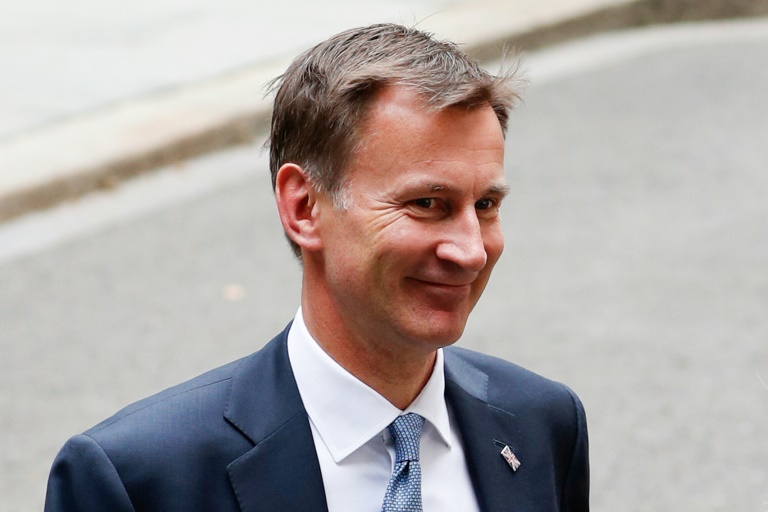
After a volatile few weeks during which the pound hit a record low, new finance minister Jeremy Hunt sought Monday to reassure investors as he scrapped tax cuts and warned of tough spending cuts.

Monday’s move, which dealt a blow to Prime Minister Liz Truss’s authority, sent sterling up as much as two percent at one point and the cost of government borrowing tumbled, while the FTSE 100 jumped.

“Investors continue to monitor the political and economic turbulence surrounding the UK,” noted XTB analyst Walid Koudmani.

Markets in China fluctuated a day after authorities delayed the release of third-quarter economic figures, which analysts said were likely to show the weakest growth since the pandemic owing to Covid-19 lockdowns.

The decision comes as the Communist Party holds a key gathering at which President Xi Jinping is expected to be handed a third term.

Oil prices slumped Tuesday in response on the expectation that the United States will draw more barrels than expected from its strategic reserves heading into the winter season.

– Key figures around 2030 GMT –

New York – Dow: UP 1.1 percent at 30,523.80 (close)

New York – S&P 500: UP 1.1 percent at 3,719.98 (close)

New York – Nasdaq: UP 0.9 percent at 10,772.40 (close)

London – FTSE 100: UP 0.2 percent at 6,936.74 (close)

Frankfurt – DAX: UP 0.9 percent at 12,765.61 (close)

Paris – CAC 40: UP 0.4 percent at 6,067.00 (close)

EURO STOXX 50: UP 0.6 percent at 3,463.83  (close)

Tokyo – Nikkei 225: UP 1.4 percent at 27,156.14 (close)

Hong Kong – Hang Seng Index: UP 1.8 percent at 16,914.58 (close)

Shanghai – Composite: DOWN 0.1 percent at 3,080.96 (close)

Pound/dollar: DOWN at $1.1332 from $1.1358 on Monday

Dollar/yen: UP at  149.21 yen from 149.04 yen

Euro/dollar: UP at $0.9862 from $0.9841 

Euro/pound: UP at 87.01 pence from 86.64 pence

Brent North Sea crude: DOWN 1.7 percent at $90.03 per barrel

West Texas Intermediate: DOWN 3.1 percent at $82.82 per barrel

burs-jmb/bgs

Cement giant Lafarge fined $778 mn for working with Islamic State in Syria

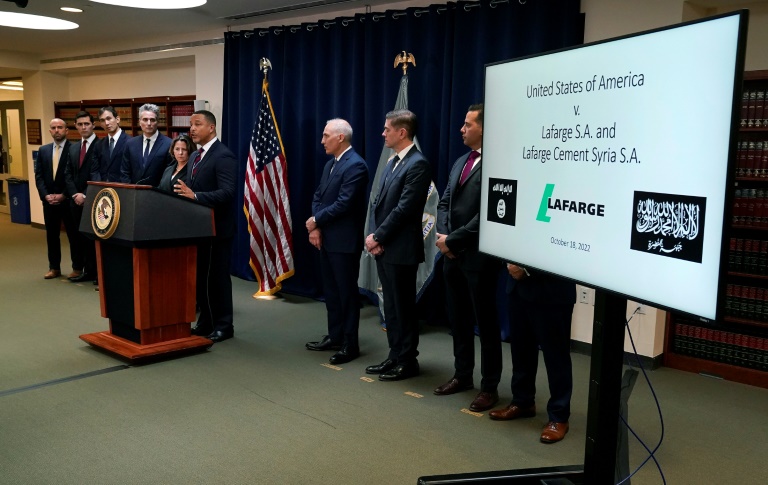
French cement giant Lafarge SA was slapped with a $778 million fine Tuesday for making millions in payments to the Islamic State and another jihadist group to build its business in Syria.

The US Justice Department said the company and its Syrian subsidiary actively sought the Islamic State (IS) group’s help to squeeze out competitors when the radical Islamists controlled large parts of Syria and Iraq in 2013-2014, operating an effective “revenue sharing agreement” with them.

It also paid access and protection money to associates of IS and the similarly radical Al-Nusrah Front, ultimately earning some $70 million in revenues during the period, with a Lafarge executive saying the cooperation was “to share the cake.”

Lafarge agreed to the fine and to plead guilty to one count of conspiring to provide material support to US-designated foreign terrorist organizations, the first time a corporation has faced the charge.

– ‘Unthinkable choice’ –

US officials said Lafarge, now owned by Swiss giant Holcim Group, made itself a handmaiden to terror for profits.

“In the midst of a civil war, Lafarge made the unthinkable choice to put money into the hands of ISIS, one of the world’s most barbaric terrorist organizations, so that it could continue selling cement,” US prosecutor Breon Peace said, using another acronym for IS.

“This unprecedented charge and resolution reflect the extraordinary crimes committed and demonstrates that corporations that take actions in contravention of our national security interests in violation of the law will be held to account,” Peace said.

In a statement, Lafarge said the company and its defunct subsidiary Lafarge Cement Syria “have accepted responsibility for the actions of the individual executives involved.”

“We deeply regret that this conduct occurred and have worked with the US Department of Justice to resolve this matter.”

Holcim, which took over Lafarge in 2015 without knowledge of the Syria business dealings, said it had been cleared of any wrongdoing by US authorities.

“None of the conduct involved Holcim, which has never operated in Syria, or any Lafarge operations or employees in the United States,” it said.

Holcim shares traded in Switzerland were suspended temporarily when the announcement was made but ended the day up 2.8 percent at 42.82 Swiss francs ($43.07). 

– Millions in payments –

Lafarge began operating a 680 million euro ($670 million) cement plant in  northern Syria in 2010, the year IS swept the region with a brutal campaign to establish its extremist “caliphate.”

That sparked a counter-offensive by the Iraq military and Syrian Kurdish forces backed by the US-led international coalition in the region.

The US designated IS and Al-Nusrah terror organizations, threatening tough penalties against anyone working with them.

Rather than withdraw like other companies, Lafarge kept working to market its cement, the Justice Department said.

From 2013 to 2104, it paid IS and Al-Nusrah around $5.9 million, some for raw materials, some as payments based on the volume of cement sold and some simply as monthly “donations.”

Lafarge paid another $1.1 million to intermediaries between the two groups.

It also worked out a deal with IS to make it harder for cheaper Turkish cement suppliers to sell their goods in the same area, allowing Lafarge to keep its prices higher.

– Sharing ‘the cake’ –

Company executives knew of the arrangement, the Justice Department said.

In 2014, a senior supervisory official who reported directly to Lafarge’s chief executive wrote to officials in the Syria subsidiary about negotiations with IS.

“We have to maintain the principle that we are ready to share the ‘cake,’ if there is a ‘cake,'” he wrote, defining cake as “profit.” 

Lafarge “negotiated and made unlawful payments at a time when these groups were gaining territory and brutalizing innocent civilians in Syria and elsewhere and were actively plotting against Americans,” said US Assistant Attorney General Matthew Olsen.

Lafarge still faces charges in France for complicity in crimes against humanity.

In May, a French appeals court approved the charge, opening the door for a trial of the company and eight executives, including former CEO Bruno Lafont.

Lafarge continues to fight that case, but now faces the possibility of the introduction of evidence from the US prosecution.

Unlike in the United States, it does not have the option of negotiating a settlement, which is disallowed under French anti-terrorism statutes.

Cement giant Lafarge fined $778 mn for working with Islamic State in Syria

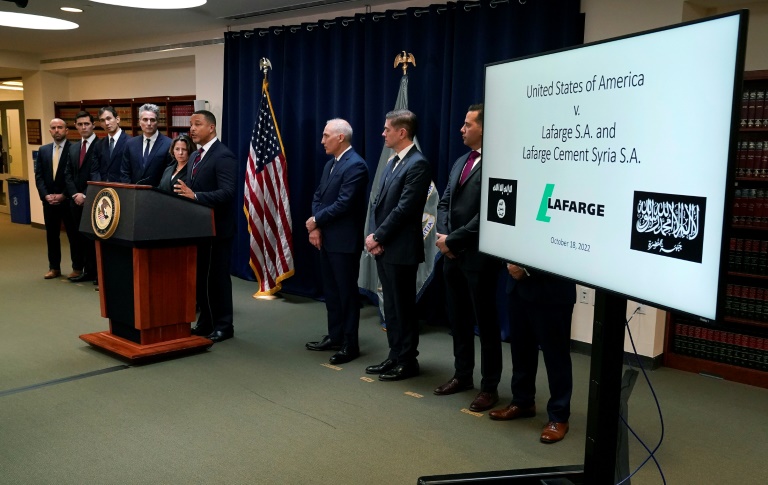
French cement giant Lafarge SA was slapped with a $778 million fine Tuesday for making millions in payments to the Islamic State and another jihadist group to build its business in Syria.

The US Justice Department said the company and its Syrian subsidiary actively sought the Islamic State (IS) group’s help to squeeze out competitors when the radical Islamists controlled large parts of Syria and Iraq in 2013-2014, operating an effective “revenue sharing agreement” with them.

It also paid access and protection money to associates of IS and the similarly radical Al-Nusrah Front, ultimately earning some $70 million in revenues during the period, with a Lafarge executive saying the cooperation was “to share the cake.”

Lafarge agreed to the fine and to plead guilty to one count of conspiring to provide material support to US-designated foreign terrorist organizations, the first time a corporation has faced the charge.

– ‘Unthinkable choice’ –

US officials said Lafarge, now owned by Swiss giant Holcim Group, made itself a handmaiden to terror for profits.

“In the midst of a civil war, Lafarge made the unthinkable choice to put money into the hands of ISIS, one of the world’s most barbaric terrorist organizations, so that it could continue selling cement,” US prosecutor Breon Peace said, using another acronym for IS.

“This unprecedented charge and resolution reflect the extraordinary crimes committed and demonstrates that corporations that take actions in contravention of our national security interests in violation of the law will be held to account,” Peace said.

In a statement, Lafarge said the company and its defunct subsidiary Lafarge Cement Syria “have accepted responsibility for the actions of the individual executives involved.”

“We deeply regret that this conduct occurred and have worked with the US Department of Justice to resolve this matter.”

Holcim, which took over Lafarge in 2015 without knowledge of the Syria business dealings, said it had been cleared of any wrongdoing by US authorities.

“None of the conduct involved Holcim, which has never operated in Syria, or any Lafarge operations or employees in the United States,” it said.

Holcim shares traded in Switzerland were suspended temporarily when the announcement was made but ended the day up 2.8 percent at 42.82 Swiss francs ($43.07). 

– Millions in payments –

Lafarge began operating a 680 million euro ($670 million) cement plant in  northern Syria in 2010, the year IS swept the region with a brutal campaign to establish its extremist “caliphate.”

That sparked a counter-offensive by the Iraq military and Syrian Kurdish forces backed by the US-led international coalition in the region.

The US designated IS and Al-Nusrah terror organizations, threatening tough penalties against anyone working with them.

Rather than withdraw like other companies, Lafarge kept working to market its cement, the Justice Department said.

From 2013 to 2104, it paid IS and Al-Nusrah around $5.9 million, some for raw materials, some as payments based on the volume of cement sold and some simply as monthly “donations.”

Lafarge paid another $1.1 million to intermediaries between the two groups.

It also worked out a deal with IS to make it harder for cheaper Turkish cement suppliers to sell their goods in the same area, allowing Lafarge to keep its prices higher.

– Sharing ‘the cake’ –

Company executives knew of the arrangement, the Justice Department said.

In 2014, a senior supervisory official who reported directly to Lafarge’s chief executive wrote to officials in the Syria subsidiary about negotiations with IS.

“We have to maintain the principle that we are ready to share the ‘cake,’ if there is a ‘cake,'” he wrote, defining cake as “profit.” 

Lafarge “negotiated and made unlawful payments at a time when these groups were gaining territory and brutalizing innocent civilians in Syria and elsewhere and were actively plotting against Americans,” said US Assistant Attorney General Matthew Olsen.

Lafarge still faces charges in France for complicity in crimes against humanity.

In May, a French appeals court approved the charge, opening the door for a trial of the company and eight executives, including former CEO Bruno Lafont.

Lafarge continues to fight that case, but now faces the possibility of the introduction of evidence from the US prosecution.

Unlike in the United States, it does not have the option of negotiating a settlement, which is disallowed under French anti-terrorism statutes.

Gold mining threatens 'forest giraffe' in DR Congo

Gold mining in a Democratic Republic of Congo national park is threatening the okapi, a stripy-legged relative of the giraffe, civil society groups warned on Tuesday.

They called for a halt to the “rapidly expanding” mining operation in the Okapi Wildlife Reserve, a UNESCO World Heritage Site in the northeast of the country.

The endangered okapi, also called the forest giraffe, is only found in this region of the DRC.

NGOs, lawyers and scientists urged the government to revoke a mining concession and protect the “unique forest ecosystem and the local communities that depend on it”.

“If the DRC government acts now, this unique World Heritage Site can still be saved”, they said in a statement from the Congolese Alert Network for the Environment and Human Rights (ACEDH) organisation.

“These miners are literally eating the reserve out of its wildlife by hunting these animals for food,” said Gabriel Nenungo, a coordinator of geologists in Ituri province.

“There is almost no wildlife left around the mine itself, and wildlife numbers are massively reduced around mining towns. There have even been cases of armed actors trafficking okapi skins and elephant ivory in and around the mines.”

The wildlife reserve is spread over nearly 14,000 square kilometres (5,400 square miles) and houses several endangered species.

US midterm election: Republicans put Ukraine on the ballot

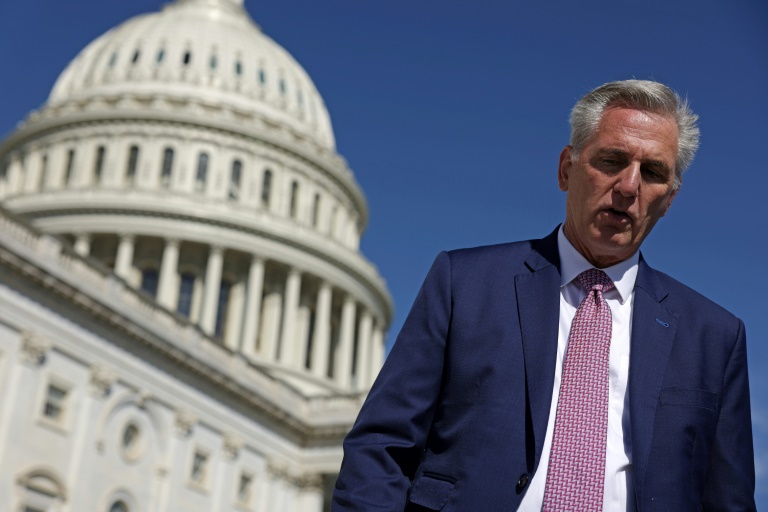
US Republicans said Tuesday they will not write “a blank check” to war-torn Ukraine if they make the widely expected gains needed to take control of the House of Representatives in the midterm elections.

The warning from House minority leader Kevin McCarthy is the first official signal that Kyiv could be facing a tougher fight for funding as it fends off Russia’s invasion, with bipartisan support beginning to wane in the United States.

“I think people are going to be sitting in a recession and they’re not going to write a blank check to Ukraine. They just won’t do it,” McCarthy told online politics outlet Punchbowl News. 

McCarthy hopes to become House speaker — the third-most senior position in US politics behind the president and vice president — if Republicans take over the House next year.

He said he expected voters to punish the Democrats in November’s elections for neglecting domestic priorities such as a growing immigration crisis at the southern border. 

“Ukraine is important, but at the same time it can’t be the only thing they do and it can’t be a blank check,” McCarthy said.

The 57-year-old from California spoke out as Kyiv announced almost 1,200 towns and villages had been left without power after 10 days of Russian strikes that have destroyed one-third of the country’s power stations, with winter approaching.

– ‘Spending spree’ –

Since the start of Russia’s expanded invasion in February, President Joe Biden’s administration has allocated $17.6 billion in military aid to Ukraine — although this is a fraction of the total bill including humanitarian assistance. 

There has been cross-party support in Congress for the handouts, although a significant section of the Republicans’ “America First” hard-right has objected. 

Some analysts suggested that McCarthy’s announcement was a concession to the party’s right wing as he looks for votes to become speaker. 

Others said his remarks may be aimed at juicing turnout among the traditionally isolationist support base of former president Donald Trump, with Republican strategists fearing many plan to stay home on Election Day. 

“The Democrat spending spree never, ever ends. Biden needs to understand that we are the USA not the US-ATM,” far right congresswoman Lauren Boebert tweeted last month.

All but a handful of House members voted against a $12.3 billion spending bill in September that included $3 billion for arms, supplies and salaries for Ukraine’s military.

Democrats said McCarthy’s interview demonstrated that Republicans could not be trusted with US foreign policy. 

“Cutting off Ukraine in the middle of the biggest war in Europe since WWII indicates just how over his head McCarthy would be as Speaker,” tweeted Ben Rhodes, a deputy national security advisor in Barack Obama’s administration.

Close Bitnami banner
Bitnami