AFP

US stocks rebound after disappointing inflation data

Wall Street stocks finished a topsy-turvy session with strong gains Thursday following disappointing inflation data, while the pound rallied and the yen hit a new multi-decade low.

US consumer prices rose 0.4 percent in September compared to August, twice the 0.2 percent projected by analysts, even as the annual increase in the consumer price index slowed slightly to 8.2 percent from 8.3 percent.

The data are the latest sign inflation is becoming more ingrained in the US economy, despite numerous Federal Reserve actions to counter the trend.

US stocks initially plummeted on the report, which exacerbated recession worries on the increased odds of more aggressive Fed interest rate increases.

But equities soon reversed course, working their way back into positive territory by late morning and rising from there.

The broad-based S&P 500 ended 2.6 percent higher, joined in positive territory by bourses in Paris and Frankfurt that had earlier closed up at least one percent.

The early action after the inflation report was “knee-jerk” selling, said Briefing.com analyst Patrick O’Hare, adding that the inflation data — while disappointing — was not shocking given other recent economic reports.

The initial reversal was due to technical trading factors. When stocks refused to drop below a key trading level, they did a 180-degree turn and pushed higher.

“Maybe now there’s a bottom in place for the time being,” O’Hare said.

Also on Thursday, the British pound soared against the dollar and other currencies amid media speculation the government may cut back on its fiscal stimulus plans and increase corporate taxes in its latest policy U-turn.

The IMF reiterated its criticism of the new British government’s policies, with Chief Kristalina Georgieva calling for “coherent and consistent” measures.

Throughout this week’s meetings of finance chiefs in Washington, the IMF has stressed that the priority was for central banks to control inflation with monetary policy tightening and for governments to keep their budgets tight.

“Our message to everybody, not just to the UK, to everybody at this time: fiscal policy should not undermine monetary policy,” Georgieva said.

The Japanese yen on Thursday also hit its lowest level against the dollar since 1990 after the US inflation data, a reflection of the gulf between the US and Japanese central banks in monetary policy.

“The Bank of Japan continues to keep monetary policy easy because inflation and wages remain relatively low” in Japan, said Carol Kong, an economist and currency strategist at Commonwealth Bank of Australia.

– Key figures around 2100 GMT –

New York – Dow: UP 2.8 percent at 30,038.72 (close)

New York – S&P 500: UP 2.6 percent at 3,669.91 (close)

New York – Nasdaq: UP 2.2 percent at 10.649.15 (close)

London – FTSE 100: UP 0.4 percent at 6,850.27 (close) 

Frankfurt – DAX: UP 1.5 percent at 12,355.58 (close)

Paris – CAC 40: UP 1.0 percent at 5,879.19 (close)

EURO STOXX 50: UP 0.9 percent at 3,362.40 (close)

Tokyo – Nikkei 225: DOWN 0.6 percent at 26,237.42 (close)

Hong Kong – Hang Seng Index: DOWN 1.9 percent at 16,389.11 (close)

Shanghai – Composite: DOWN 0.3 percent at 3,016.36 (close)

Pound/dollar: UP at $1.1333 from $1.1100 Wednesday

Dollar/yen: UP at 147.22 yen from 146.91 yen

Euro/dollar: UP at $0.9780 from $0.9703

Euro/pound: DOWN at 86.28 pence from 87.41 pence

Brent North Sea crude: UP 2.3 percent at $94.57 per barrel

West Texas Intermediate: UP 2.1 percent at $89.11 per barrel

burs-jmb/des
US Capitol riot probe votes to subpoena Trump to testify

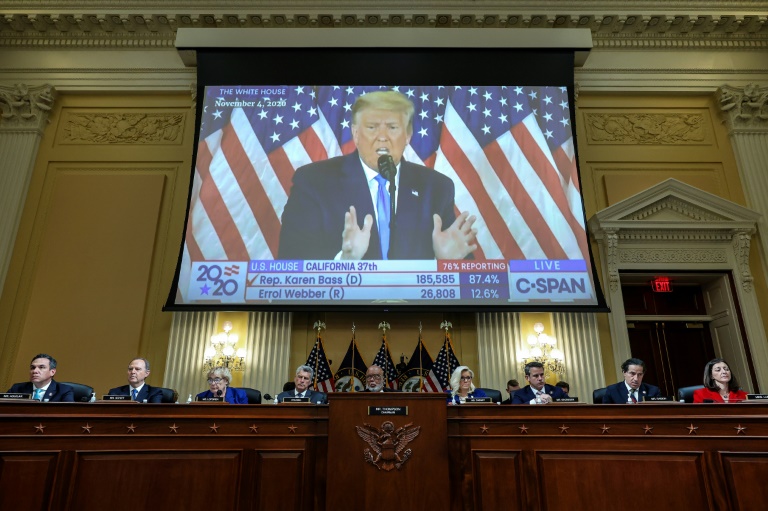
Lawmakers probing the 2021 attack on the US Capitol voted Thursday to subpoena former president Donald Trump to testify on his role in the violence, in a major escalation of the sprawling inquiry weeks before it is due to wind up.

During what was expected to be its final hearing before the midterm elections, the House panel of seven Democrats and two Republicans agreed unanimously to compel Trump’s appearance before investigators.

“We need to be fair and thorough and gain a full context for the evidence we’ve obtained. But the need for this committee to hear from Donald Trump goes beyond our fact-finding,” said Bennie Thompson, the chairman of the committee.

“This is a question about accountability to the American people. He must be accountable. He is required to answer for his actions.”

Subpoenas from the panel have proved difficult to enforce, with former White House aide Steve Bannon the only target yet convicted of contempt of Congress for refusing to comply.

Trump is notorious for his ability to run down the clock on congressional investigations and legal action, and it remains highly unlikely that he would agree to give evidence.

“Why didn’t the Unselect Committee ask me to testify months ago? Why did they wait until the very end, the final moments of their last meeting?” thundered Trump, who has had a standing invitation to appear before the committee.

Reacting on his right-wing Truth Social platform, Trump said the committee was a “total ‘BUST’ that has only served to further divide our Country.”

Any subpoena would expire in any case with the new congressional term in January. Control of the House of Representatives is expected to flip after November elections to the Republicans, who plan to immediately end the investigation.

But the move marks an aggressive escalation of the probe, which has issued more than 100 subpoenas and interviewed more than 1,000 people since its inception in 2021.

While no sitting president has ever been forced to testify before Congress, lawmakers have summoned former presidents to discuss their conduct in office.

– ‘Clear and present’ threat –

Trump didn’t say whether he would testify, but if he refuses to comply, the full House can hold him in criminal contempt in a vote recommending him for prosecution.

The vote came as a spectacular coda to an already stunning hearing in which the committee offered fresh evidence that Trump had planned to declare victory in the 2020 election — regardless of the outcome.

Trump had a “premeditated plan” formulated months before the vote to claim he had won on election night, whatever the vote tally showed, panel member Zoe Lofgren told the hearing, citing evidence gathered by the committee. 

Across eight hearings in the summer the panel unveiled reams of evidence on the former president’s involvement in a labyrinthine series of connected schemes to overturn the election.

The committee pressed its position on Thursday that Trump — who continues to be a wellspring of disinformation about the 2020 presidential election — remains a “clear and present” threat to democracy.

Blockbuster witness testimony in June and July provided stunning examples of Trump and his allies pressuring election officials and trying to get lawfully-cast votes nullified in swing states, and of Trump’s inertia amid the mob uprising.

Lawmakers plan to release a final report by the end of the year, although preliminary findings could be announced before November’s midterm elections.

The committee has not announced formally whether it will make direct criminal referrals over January 6, although several members see the issue as moot, since the Justice Department is already investigating.

– ‘Right to the violence’ –

Thursday’s hearing featured new video footage from a Danish film crew shot for a documentary about longtime Trump ally Roger Stone.

In one clip from the day before the 2020 election played to the packed hearing room, the notorious self-styled “dirty trickster” was seen telling the filmmakers he has no interest in waiting to contest the vote tally.

“Let’s get right to the violence,” says the 70-year-old Republican operative, who has not been charged in connection with the riot.

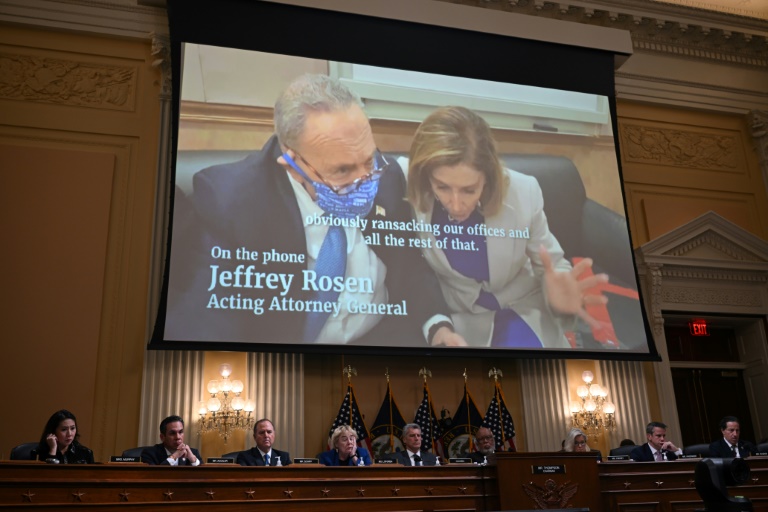
One of the most chilling moments came when the hearing room was shown footage of congressional leaders including House Speaker Nancy Pelosi desperately phoning officials to call for help as the Capitol was being ransacked around them.

“They’re just breaking windows… they said somebody was shot. It’s just horrendous, and all at the instigation of the president of the United States,” Pelosi is pictured saying. 

The panel also unveiled evidence developed from nearly one million pages of documents surrendered by the Secret Service, as lawmakers seek to understand why certain agents’ text messages from the eve of the insurrection and the day itself went missing.

Secret Service emails obtained by investigators confirm testimony from previous hearings that Trump wanted to join the mob at the Capitol — a move that would have escalated a riot into an attack by one branch of the government on another, potentially upending the republic.

Trump, who urged his supporters in a fiery speech near the White House to “fight like hell,” was impeached for inciting the mob to storm Congress to halt the peaceful transfer of power to Joe Biden.

New video shows leaders' alarm as US Congress attacked

Disturbing video of party leaders desperately calling for help as the US Capitol was ransacked provided a chilling twist in Thursday’s session of the probe into the 2021 insurrection.

Previously unreleased footage underlined how vulnerable lawmakers were as a mob sent by former president Donald Trump ransacked offices and hallways.

“There has to be some way we can maintain th sense that people have that there is some security or some confidence that government can function,” Democratic House Speaker Nancy Pelosi was shown saying as she sheltered in a secure location with leaders from both parties.

At one point during the frantic calls, Pelosi is told that lawmakers are donning gas masks to prepare for a breach, and she asks her top lieutenant Jim Clyburn: “Do you believe this?”

Chuck Schumer, who now leads the Senate although his Democrats were in the minority at the time, appeared equally perturbed.

“I’m going to call up the effing (Defense) Secretary,” the clearly upset New Yorker tells Pelosi.

Minutes later he calls Justice Department acting chief Jeffrey Rosen and demands: “Why don’t you get the president to tell them to leave the Capitol, Mr. Attorney General, in your law enforcement responsibility?”

Pelosi is also pictured on a phone call with Virginia’s then-governor Ralph Northam as she watches footage of the chaos on television.

“They’re just breaking windows… they said somebody was shot. It’s just horrendous, and all at the instigation of the president of the United States,” she says.

Pelosi and Schumer are pictured at one point with Republican leadership figures, all discussing how to send for help.

The footage, captured by Pelosi’s daughter, Alexandra, was interspersed with video of the violent pro-Trump mob invading the Capitol.

“Congressional leadership recognized on a bipartisan basis that President Trump was the only person who could get the mob to end its violent siege of the Congress, leave the Capitol and go home,” panel member Jamie Raskin told the hearing.

The committee was appearing in public for the last time before November’s midterm elections.

Trump is accused of leading a plot to overturn the 2020 presidential election, and of doing nothing to stop the violence in Washington that resulted from his plans.

G20 struggles for harmony again, as US-Saudi spat emerges

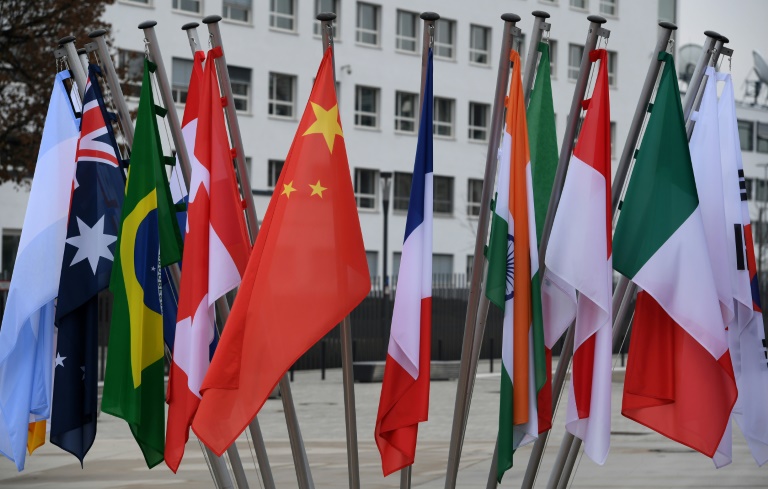
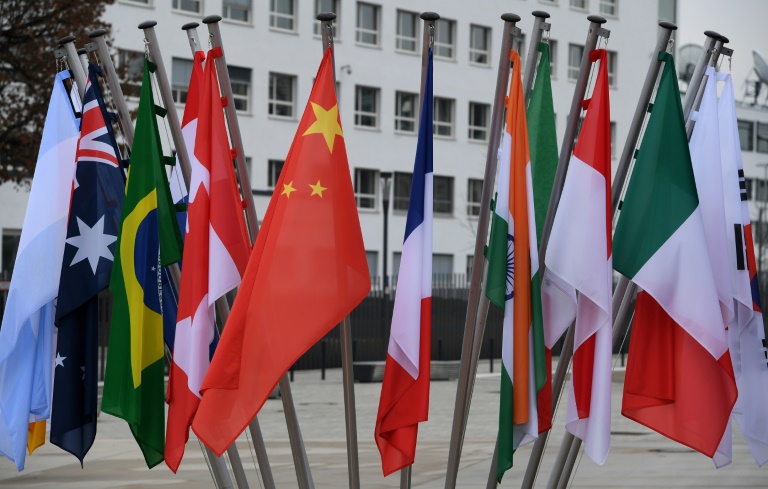
The G20 closed talks in Washington on Thursday without issuing a joint communique, as a growing US-Saudi feud created new tensions in a group already divided over Russia’s invasion of Ukraine.

Finance ministers and central bankers from the Group of 20 major economies met during the IMF and World Bank annual meetings that have focused on the war, soaring inflation and the climate crisis.

But the G20 failed to issue a joint communique at the end of its meeting, as in its last two gatherings. Russian officials participated via video link, according to a source familiar with the talks.

Despite the lack of consensus, officials said the G20 remains a useful forum, with heads of state and government due to meet next month in Bali, Indonesia.

“All member countries underlined that it is very important to continue to preserve this G20 as the premier economic forum for cooperation,” Indonesian Finance Minister Sri Mulyani Indrawati, whose country chairs the G20 this year, said at a news conference.

She acknowledged that the group faces “many challenges” and “differences in view”, with “escalating geopolitical conflicts, a war in Ukraine which exacerbated and worsened the economic situation.”

German Finance Minister Christian Lindner said before the meeting that it was “better to have a forum to speak in than none.”

“Even if there are different opinions — including those that you don’t share, some even that you don’t understand — it’s still a good forum for a conversation,” Lindner told reporters.

“We could do a communique that doesn’t mention the war in Ukraine, but we don’t want a communique that sweeps things under the rug,” the source familiar with the discussions told AFP.

– Saudi-US spat –

Washington and Riyadh have locked horns over a decision by the OPEC+ group of oil exporters, led by Saudi Arabia and Russia, to sharply cut production — a move that could send energy prices soaring higher.

The source close to the G20 discussions said Western nations explained at the meeting that they were “disappointed” and that the cuts went against Saudi interests “because the risk for them is that they cause a recession.”

“It’s hard to understand,” the source said.

President Joe Biden threatened “consequences” for Saudi Arabia in a CNN interview on Wednesday.

In a rare statement on Thursday, the Saudi foreign ministry denied that the decision was “politically motivated against the United States” and expressed its “total rejection of these statements that are not based on facts.”

But US National Security Council spokesman John Kirby responded that Riyadh knew the cut “would increase Russian revenues and blunt the effectiveness of sanctions. That is the wrong direction.”

– Oil price cap –

The OPEC+ cut comes as the Group of Seven wealth democracies is seeking to impose a price cap on Russia’s crude exports, a move aimed at stripping the country of a major source of funding for its war machine.

But gaining broad global approval for a price cap may prove to be a major challenge.

While Western nations have imposed unprecedented sanctions on Russia, other countries have maintained economic ties with Moscow, with India and China stepping up their purchases of Russian oil.

Despite the lack of a joint communique, Indrawati said the G20 made progress on a number of issues, including sustainable finance and efforts to impose a global minimum tax on major corporations.

Tensions within the G20 come as leaders are due to meet in Bali next month — a summit that could see Biden share the same venue as Russian President Vladimir Putin and another rival, Chinese leader Xi Jinping.

The lack of consensus within the group also comes ahead of the United Nations’ COP27 climate summit in Egypt in November.

G20 struggles for harmony again, as US-Saudi spat emerges

The G20 closed talks in Washington on Thursday without issuing a joint communique, as a growing US-Saudi feud created new tensions in a group already divided over Russia’s invasion of Ukraine.

Finance ministers and central bankers from the Group of 20 major economies met during the IMF and World Bank annual meetings that have focused on the war, soaring inflation and the climate crisis.

But the G20 failed to issue a joint communique at the end of its meeting, as in its last two gatherings. Russian officials participated via video link, according to a source familiar with the talks.

Despite the lack of consensus, officials said the G20 remains a useful forum, with heads of state and government due to meet next month in Bali, Indonesia.

“All member countries underlined that it is very important to continue to preserve this G20 as the premier economic forum for cooperation,” Indonesian Finance Minister Sri Mulyani Indrawati, whose country chairs the G20 this year, said at a news conference.

She acknowledged that the group faces “many challenges” and “differences in view”, with “escalating geopolitical conflicts, a war in Ukraine which exacerbated and worsened the economic situation.”

German Finance Minister Christian Lindner said before the meeting that it was “better to have a forum to speak in than none.”

“Even if there are different opinions — including those that you don’t share, some even that you don’t understand — it’s still a good forum for a conversation,” Lindner told reporters.

“We could do a communique that doesn’t mention the war in Ukraine, but we don’t want a communique that sweeps things under the rug,” the source familiar with the discussions told AFP.

– Saudi-US spat –

Washington and Riyadh have locked horns over a decision by the OPEC+ group of oil exporters, led by Saudi Arabia and Russia, to sharply cut production — a move that could send energy prices soaring higher.

The source close to the G20 discussions said Western nations explained at the meeting that they were “disappointed” and that the cuts went against Saudi interests “because the risk for them is that they cause a recession.”

“It’s hard to understand,” the source said.

President Joe Biden threatened “consequences” for Saudi Arabia in a CNN interview on Wednesday.

In a rare statement on Thursday, the Saudi foreign ministry denied that the decision was “politically motivated against the United States” and expressed its “total rejection of these statements that are not based on facts.”

But US National Security Council spokesman John Kirby responded that Riyadh knew the cut “would increase Russian revenues and blunt the effectiveness of sanctions. That is the wrong direction.”

– Oil price cap –

The OPEC+ cut comes as the Group of Seven wealth democracies is seeking to impose a price cap on Russia’s crude exports, a move aimed at stripping the country of a major source of funding for its war machine.

But gaining broad global approval for a price cap may prove to be a major challenge.

While Western nations have imposed unprecedented sanctions on Russia, other countries have maintained economic ties with Moscow, with India and China stepping up their purchases of Russian oil.

Despite the lack of a joint communique, Indrawati said the G20 made progress on a number of issues, including sustainable finance and efforts to impose a global minimum tax on major corporations.

Tensions within the G20 come as leaders are due to meet in Bali next month — a summit that could see Biden share the same venue as Russian President Vladimir Putin and another rival, Chinese leader Xi Jinping.

The lack of consensus within the group also comes ahead of the United Nations’ COP27 climate summit in Egypt in November.

Russia to help people leave annexed region as Kyiv advances

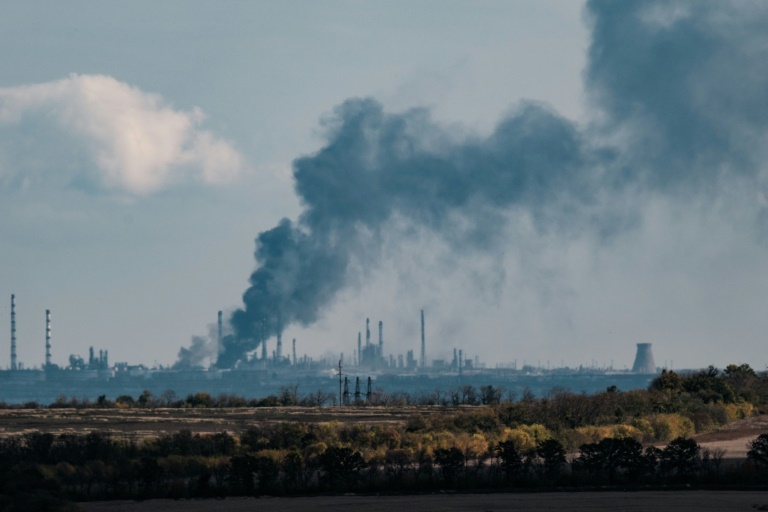
Russia agreed Thursday to help residents leave a region it “annexed” in a sign of success for Ukraine’s counter-offensive, as the EU warned Moscow’s army would be “annihilated” if the Kremlin uses nuclear weapons.

Moscow’s decision to assist people in leaving Kherson came a day after Kyiv said it had retaken five settlements in the southern region.

“The government took the decision to organise assistance for the departure of residents of the (Kherson) region,” Russian Deputy Prime Minister Marat Khusnullin said.

The Moscow-appointed head of the area had appealed for intervention.

Vladimir Saldo suggested residents “leave to other regions to protect themselves from missile strikes”.

Those departing would go to Crimea, a Ukrainian peninsula Moscow annexed in 2014, and southern Russian regions.

Kyiv, which announced its counter-offensive in the south in August, said it has already recaptured over 400 square kilometres (155 miles) in the Kherson region in under a week.

Kherson, which lies near Crimea, was the first major Ukrainian city to fall to Russian forces after the February 24 invasion.

– Nuclear threat –

In Brussels, European Union foreign policy chief Josep Borrell sent a strong message to the Kremlin after President Vladimir Putin’s veiled threats of resorting to nuclear weapons to stem growing battlefield losses.

“Putin is saying he is not bluffing. Well, he cannot afford bluffing,” Borrell said.

“Any nuclear attack against Ukraine will create an answer, not a nuclear answer, but such a powerful answer from the military side that the Russian Army will be annihilated.”

The NATO alliance has stopped short of threatening to use its nuclear arsenal to respond as non-member Ukraine is not covered by its mutual self-defence clause.

In Kazakhstan, President Recep Tayyip Erdogan defended Turkey’s booming trade ties with Moscow during an in-person meeting with Putin on the sidelines of a regional summit.

But Erdogan did not deliver an offer to mediate negotiations between Moscow and Kyiv — expected by the Kremlin — and comments between the leaders made no mention of Ukraine, focusing instead on economic ties.

Putin proposed to create a “gas hub” in Turkey as Russia’s supplies to Europe have been disrupted by Ukraine-related sanctions — an idea that France’s presidency said made “no sense”.

NATO member Turkey has sought to retain dialogue with its Western allies as well as Moscow, and has not joined sanctions on Russia over its invasion of Ukraine.

Ukrainian President Volodymyr Zelensky meanwhile told the Parliamentary Assembly of the Council of Europe on Thursday that “legal mechanisms” are needed to punish Russian war crimes.

“We must continue our dialogue in order to hold Russia as the aggressor state and each of the Russian murderers and torturers to account for all crimes in this war,” he said via video link.

– Rebels push to Bakhmut –

On the battlefield, Russian-backed separatist forces in the eastern Donetsk region of Ukraine said they had captured two villages near the industrial city of Bakhmut, posting small gains against Kyiv’s counter-offensive.

The villages lie just south of Bakhmut, a wine-making and salt-mining city that used to be populated by some 70,000 people and which Russian forces have been pummelling for weeks.

The reported gains came after Ukrainian troops had for weeks been clawing back large swathes of territory in the south and east of Ukraine — including Donetsk — controlled by Russian forces for months.

The Ukrainian military in an update said that it had repelled attacks near several frontline villages.

The governor of the Belgorod region also said that Ukrainian shelling hit housing in the southern Russian city and blew up a munitions depot in the border area.

– Boy pulled from rubble –

AFP reporters in Yampil just outside the recently recaptured Ukrainian town of Lyman on Thursday heard heavy exchanges of artillery fire to the southeast.

A Ukrainian soldier returning from the frontline said positions in Torske village were under fire from Russian guns guided by spotter drones.

Also in the south, the town of Mykolaiv was again rocked by Russian bombardments.

The head of the city Oleksandr Sienkevych said on social media a five-storey residential building was hit, with two upper floors destroyed.

“An 11-year-old boy was recovered from under the rubble and another seven people may still be there,” he said, adding a security guard was killed at a sea rescue station.

US and Saudi Arabia clash in public over oil cut, Russia

The United States and Saudi Arabia traded bitter barbs Thursday over last week’s OPEC+ oil output cut, with Washington accusing Riyadh of knowingly boosting Russian interests.

The Saudi-led OPEC+ cartel — which includes Russia — angered Washington by cutting production by two million barrels a day from November, adding further pressure on soaring crude prices.

Saudi Arabia issued a rare press release on Thursday expressing “total rejection” of accusations it was “taking sides” as President Vladimir Putin’s war in Ukraine rages on.

But White House spokesman John Kirby quickly fired back, saying that Riyadh knew the cut “would increase Russian revenues and blunt the effectiveness of sanctions.”

The United States has vowed to re-evaluate ties with the oil-rich kingdom since the cut, which was seen as a diplomatic slap in the face for President Joe Biden.

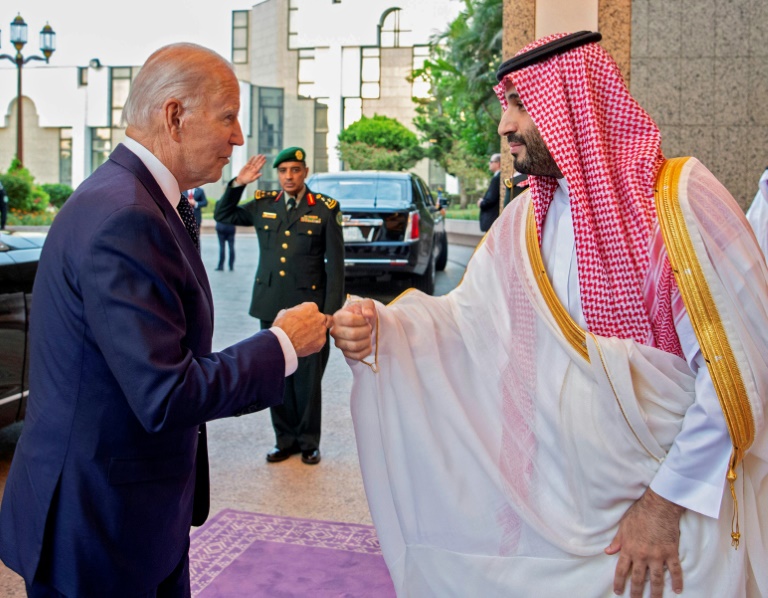
Despite vowing to make the kingdom an international “pariah” following the murder of journalist Jamal Khashoggi, Biden traveled to Saudi Arabia in July and met with Crown Prince Mohammed bin Salman — with the two greeting each other with a high-profile fist bump.

The OPEC supply cut decision was “moral and military support because it allows (Putin) to continue to fund his war-making machine,” Kirby said, in unusually strong remarks.

It “certainly gave… Mr. Putin a sense of comfort.”

Other OPEC+ nations “felt coerced to support Riyadh’s direction,” Kirby added, accusing Saudi Arabia of “twisting arms to get what they wanted.”

The oil cut comes at a sensitive moment for Biden as the Democratic Party faces tricky midterm elections in November with rising consumer prices, especially at the gas pump, a key concern for voters.

Asked about Riyadh’s move, Biden told reporters in Los Angeles: “We’re about to talk to them.”

– Oil funds Russian war –

In its press release, Saudi Arabia insisted that decisions by OPEC+ were taken “purely on economic considerations.”

And it suggested that Biden’s administration had asked the cartel to delay any cuts until after Americans go to the polls on November 8.

Biden has promised “consequences” for Saudi Arabia, but given no further details.

Russia relies on high oil prices to fund its floundering invasion of Ukraine, and some US lawmakers have called for Washington to halt all cooperation with Riyadh.

“We wanted to know that when the chips were down, when there was a global crisis, that the Saudis would choose us,” said Senator Bob Menendez this week. “Well, they didn’t. They chose Russia.”

Kirby said Thursday that “the Saudi foreign ministry can try to spin or deflect, but the facts are simple. The world is rallying behind Ukraine in combatting Russian aggression.”

The partnership between the United States and Saudi Arabia was sealed after World War II, providing the kingdom with military protection in exchange for American access to oil.

Fraught with crises, the relationship was revived by Biden’s predecessor Donald Trump, whose single term saw Riyadh accounting for a quarter of US arms exports, according to the Stockholm International Peace Research Institute.

Continuing the rapprochement, the United States announced in August that Saudi Arabia would buy 300 Patriot MIM-104E missile systems, which can be used to bring down long-range incoming ballistic and cruise missiles, as well as attacking aircraft.

Saudi Arabia, which backs the Yemeni government, has faced rocket threats from Yemen’s Huthi rebels, who have been supplied with Iranian equipment and technology.

French strikes spread as Macron's opponents push for 'confrontation'

French railway workers and civil servants voted Thursday to join striking oil refinery staff with a walkout next week, raising fears that anger over the rising cost of living could spiral into a series of blockages.

Railway staff and civil servants represented by the hard-left CGT union, the biggest in the public sector, will stop work next Tuesday, with several labour groups calling for a national day of stoppages.

The famously militant CGT said it was pushing for higher wages for railway workers but also wanted to protest government efforts to break a strike by refinery workers that has caused nationwide fuel shortages.

“Railway workers want to press again for salary improvements and denounce the repression and attack against the right to strike,” said a union statement.

The government has resorted to emergency powers to compel some striking refinery workers to return to their jobs to release fuel stocks stuck inside blockaded facilities.

Six out of seven refineries have been affected by strikes that are now in their third week, causing huge tailbacks outside petrol stations and growing frustration among motorists.

“The time for a confrontation (with the government) has arrived,” left-wing opposition parliamentarian Clementine Autain from the France Unbowed party told France 2 television on Thursday.

A leading Greens lawmaker, Sandrine Rousseau, said Wednesday she hoped the refinery standoff would be “the spark that begins a general strike”.

Not all unions have joined the call for strikes next Tuesday, however, with the country’s biggest, the CFDT, opting out.  

Left-wing political parties are to hold a protest rally against the policies of President Emmanuel Macron and the rising cost of living on Sunday.

– Sympathy and anger –

Until Tuesday, the government had been reluctant to inflame the pay dispute at French energy group TotalEnergies and US giant Esso-ExxonMobil whose refineries are affected.

TotalEnergies made a net profit of $5.7 billion in the April-June period and is distributing billions to shareholders, sparking some sympathy for employees pushing for higher wages. 

But with 30 percent of French service stations with little or no fuel, particularly those in the Paris region and the north, the government has begun requisitioning some fuel depot workers, forcing them to return to work or risk prosecution.

After an ExxonMobil depot Wednesday, a TotalEnergies site in northern France was requisitioned Thursday, with the first laden fuel tankers protected by police seen leaving during the afternoon.

Prime Minister Elisabeth Borne’s office said the emergency measures were justified because of a “real economic threat” for northern France, which relies heavily on agriculture, fishing and industry.

But the unions have reacted furiously to the government intervention.

“What we are seeing here is the Macronian dictatorship,” CGT official Benjamin Tange told AFP. The current industrial action, he said, arose out of “the anger of several months, several years and a rupture of social dialogue”.

Striking workers at an Esso-ExxonMobil refinery in Fos-sur-Mer, outside Marseille in the south, voted Thursday to lift their blockade after reaching a pay deal with management.

That leaves five out of seven of France’s refineries still affected by industrial action.

TotalEnergies announced it would hold talks with trade union representatives for the first time since the start of the strikes, raising hopes of a breakthrough.

The group has proposed a six percent raise for next year, below the CGT’s demand for an immediate 10 percent hike, retroactive to January 1.

The company has come under increasing pressure from the government to reach an agreement.

Finance Minister Bruno Le Maire told RTL radio that given its huge profits this year, it had “the capacity… and therefore an obligation” to raise workers’ pay.

Netflix to debut subscription with ads

Netflix on Thursday said a subscription option subsidized by ads will debut in November across a dozen countries as the streaming service strives to jumpstart stalled growth.

Netflix reported a loss of 970,000 subscribers in the second quarter along with stagnant profits, and its share price is down 63 percent from this time last year despite rising slightly on the ad-tier news.

The new “Basic with Ads” subscriptions will be priced at $6.99 in the United States — three dollars less than a no-ads basic option, Netflix chief operating officer Greg Peters said in a briefing.

“The timing is great because we really are at this pivotal moment in the entertainment industry and evolution of that industry,” Peters said.

“Now streaming has surpassed both broadcast and cable for total TV time in the United States.”

The ad-discounted tier, a first for Netflix, will roll out in Australia, Brazil, Britain, Canada, France, Germany, Italy, Japan, South Korea, Mexico, Spain and the United States.

Video ads will be from 15 seconds to 30 seconds long.

“We are looking at a very light ad load with no more than four to five minutes of ads per hour, and including some very tight frequency caps so that members don’t see the same ad repeatedly,” Peters said.

After having shunned advertising since it started its streaming service, Netflix acquiesced as competition in the market intensifies and as consumers recoil from soaring inflation.

With the launch of cheaper, ad-supported subscriptions, Netflix and Disney+ are expected to bite into the revenue of traditional television channels.

Netflix rival Disney+ is expected to launch its own ad-subsidized subscription soon.

“These launches are going to create the biggest premium advertising space in more than a generation,” said analytics company Samba TV senior vice president Dallas Lawrence.

“It’s going to be a major moment for advertisers.”

– Avoiding politics –

Netflix has sold nearly all the ad space for the new tier launch, president of worldwide advertising Jeremi Gorman said during the briefing.

Advertisers will be able to target audiences based on factors such as the country they live in as well as show genres or hit shows to be part of “zeitgeist moments” on the platform, executives said.

Netflix will not take political ads, nor will it accept marketing promoting smoking, guns, fireworks “or anything that feels like a get-rich-quick scheme,” Gorman added.

Advertisers will have options to avoid shows with sex, nudity or graphic violence, and Netflix is partnering with Neilson and ad-traffic verification companies to provide data regarding how well messages are reaching audiences, executives said.

“The new Netflix ad-supported tier will help the streamer to staunch the bleeding of its subscriber totals, but it will pull most users from the company’s existing user base instead of expanding the pool of Netflix viewers,” said Insider Intelligence forecasting analyst Peter Newman.

Peters acknowledged the potential for Netflix subscribers to switch to the lower-priced offering, but said the company expects that to be offset by ad revenue plus an overall increase in the number of subscribers.

“We’re not trying to steer people to one plan or the other. We really want to take a pro-consumer approach and let them land on the right plan for them,” Peters said.

“We think that the revenue model will be fine as a result.”

Netflix is continuing to invest in shows it believes will attract, and keep, subscribers.

Peters noted hits such as “Stranger Things” and “Extraordinary Attorney Woo” and pending releases of keenly anticipated films such as “Glass Onion: A Knives Out Mystery.”

Florida school shooter spared death penalty, gets life in prison

A US jury on Thursday rejected the death penalty and backed life imprisonment for Nikolas Cruz, who shot and killed 17 people at a Florida high school, in a sentence that shocked and angered some relatives of the victims.

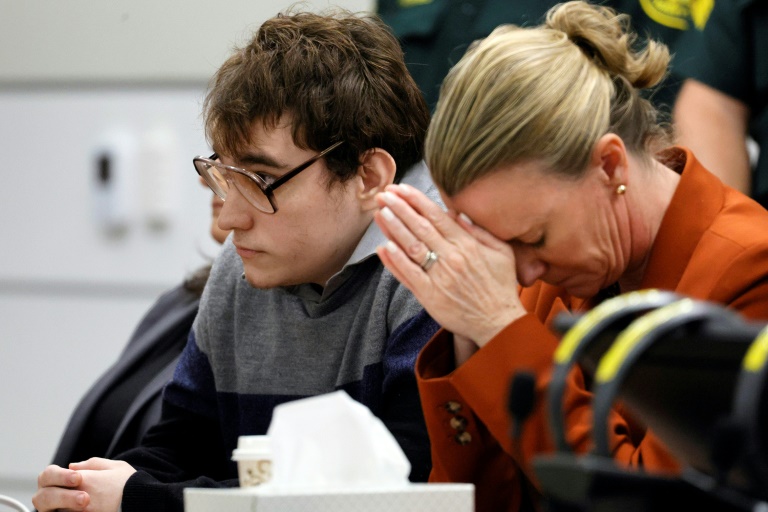
Cruz, 24, wearing a striped sweater and large glasses, stared down expressionless at the defense table as the verdict was read while the parents of several slain children shook their heads in disbelief.

The jury deliberated for a full day on Wednesday and briefly on Thursday before deciding that Cruz should receive life in prison with no chance of parole for the February 2018 murders of 14 students and three staff members at Marjory Stoneman Douglas High School in Parkland, Florida.

A death penalty recommendation needed to be unanimous and one or more of the 12 jurors found it was not justified because of mitigating circumstances.

“I could not be more disappointed in what happened today,” said Fred Guttenberg, whose 14-year-old daughter Jaime died in the Valentine’s Day attack.

“I’m stunned. I’m devastated,” Guttenberg said. “There are 17 victims that did not receive justice today. This jury failed our families.”

Prosecutors and Cruz’s defense team gave their closing arguments on Tuesday after a three-month trial, during which the jury saw graphic footage of the attack and listened to harrowing testimony from survivors.

Lead prosecutor Michael Satz said Cruz, who pleaded guilty to the murders last year, carried out a “systematic massacre” and the appropriate penalty was death.

The 80-year-old Satz, who came out of retirement to try the case, ended his closing arguments by solemnly reciting the names of the 17 people who died.

– ‘Brain-damaged, mentally-ill’ –

Melisa McNeill, a lawyer for Cruz, urged the jurors to show compassion.

McNeill said Cruz was a troubled young man born with fetal alcohol stress disorder to a mother who struggled with homelessness, alcoholism and drug addiction before putting him up for adoption.

“He was doomed from the womb and in a civilized, humane society, do we kill brain-damaged, mentally ill, broken people?” McNeill asked in her closing statement. “Do we? I hope not.”

Tony Montalto, whose 14-year-old daughter Gina was killed, said Cruz should not have been spared the death penalty just because he “had a tough time growing up.”

“This shooter did not deserve compassion,” Montalto said. “Did he show compassion to Gina when he put the weapon against her chest and chose to pull that trigger?”

Anne Ramsay, the mother of 17-year-old Helena Ramsay, said “the wrong verdict was given.”

“Even if this murderer had mental problems he still managed to get a gun,” Ramsay said. “He still managed to get an AR-15 and mow down our kids.”

Florida Governor Ron DeSantis expressed disappointment with the sentence.

“This stings,” DeSantis said. “It was not what I believe we were hoping for.”

On February 14, 2018, then-19-year-old Cruz walked into school carrying a semiautomatic rifle. He had been expelled a year earlier for disciplinary reasons.

In nine minutes, he killed 17 people and wounded another 17.

Cruz fled by mixing in with people frantically escaping the gory scene, but was arrested by police shortly after as he walked along the street.

– Gun control debate –

The Parkland shooting stunned the nation and reignited debate on gun control since Cruz had legally purchased the gun he used despite his mental health issues.

On March 24, 2018, nationwide marches inspired by school shooting survivors and parents of victims brought together 1.5 million people — the largest public turnout ever in defense of stricter gun control laws in America.

But the Parkland attack prompted no significant reform by Congress and gun sales have continued to rise.

Thousands turned out following two other recent mass shootings: one at a Texas elementary school that killed 19 young children and two teachers, and another at a New York supermarket that left 10 Black people dead.

Those shootings helped galvanize support for the first significant bill on gun safety in decades, which President Joe Biden signed into law in June.

It included enhanced background checks for younger buyers and federal cash for states introducing “red flag” laws that allow courts to temporarily remove weapons from people who are considered a threat.

But the measure fell far short of an assault weapons ban sought by Biden.

In March, the Justice Department reached a $127.5 million settlement with survivors and relatives of Parkland victims who had accused the FBI of negligence for failing to act on tips received prior to the attack that Cruz was dangerous.

Close Bitnami banner
Bitnami