AFP

Germany agrees to replace cheap national transport ticket

Germany on Thursday moved closer to approving a successor to a popular ultra-cheap, country-wide public transport ticket rolled out over the summer to curb inflation and cut carbon emissions.

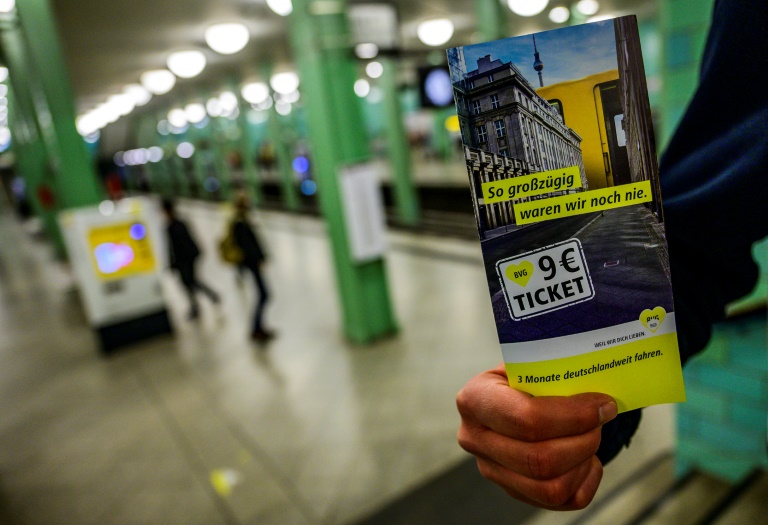
State and federal transport ministers agreed on a 49-euro ($47) monthly pass allowing users to travel on subways, buses and regional trains anywhere in Germany.

It would replace a nine-euro monthly pass in June, July and August that proved a roaring success, selling a total of 52 million tickets in addition to benefitting 10 million who already had monthly tickets.    

“We can get to work on the modalities but the main issues have been resolved — it will be a Germany-wide ticket offering everything that the nine-euro ticket did,” Federal Transport Minister Volker Wissing told reporters, pending approval by Berlin and regional governments.

Wissing said it would be likely be rolled out from January 1 and offered only as an annual subscription, renewing automatically each month, but can be cancelled at any time.

However at more than five times the special price offered in the summertime, consumer advocates have raised doubts about how attractive the new ticket will be.

The financing has also yet to be hammered out, with the federal government offering 1.5 billion euros per year from 2023 and asking states to match that amount.

Chancellor Olaf Scholz himself had said the summer tickets were “one of the best ideas” his centre-left-led coalition government had introduced, and pledged to come up with a longer-term measure.

The VDV public transport association touted the passes’ pollution savings of 1.8 million tonnes — the equivalent of the annual C02 output from almost 388,000 vehicles.

However Finance Minister Christian Lindner from the pro-business Free Democrats had baulked at the price tag of an extension, delaying the roll-out of a successor ticket.

Several cities and towns stepped into the breach with their own regional offers until a national policy can be implemented.

Germany, Europe’s top economy, is struggling with soaring inflation driven by surging energy costs.    

Stocks slump after key US inflation data

Equities fell sharply on Thursday after data showed US inflation jumped more than expected in September.

The data solidified expectations of further interest rate hikes, helping push the dollar higher, including striking its highest level against the Japanese yen since 1990.

US consumer prices rose 0.4 percent in September compared to August, twice the 0.2 percent projected by analysts even as the annual increase in the consumer price index slowed slightly to 8.2 percent from 8.3 percent.

But core inflation, excluding volatile energy and food prices, climbed to 6.6 percent from 6.3 percent in August.

The US Federal Reserve has  raised interest rates at an aggressive clip of 0.75 percentage points at its last three meetings, and signalled plans to continue doing so until rampant inflation is brought under control.

That has led to a slump in stock prices in recent months, as higher interest rates will reduce consumer spending power.

Last month saw a brief rally in stocks after data suggesting that the US economy was slowing, as investors hoped that it would allow a “pivot” by the Fed to a slower rate of interest rate hikes.

“The strong CPI only reinforces the view that there is no way the Federal Reserve can contemplate a ‘pivot’ this year,” said Stephen Innes at SPI Asset Management. 

Wall Street stocks plunged at the open, with the Dow falling 1.1 percent. The S&P 500 slumped 2.1 percent and the tech-heavy Nasdaq Composite 2.8 percent. 

European stocks, which had drifted higher before the US inflation data, turned lower. Frankfurt shed 1.1 percent and Paris 1.6 percent.

The FTSE 100 in London was down 1.3 percent, with media speculating the government may cut back on its fiscal stimulus plans and and increase corporate taxes in its latest policy U-turn.

But the speculation sent the pound soaring 1.4 percent against the dollar. Meanwhile the UK government’s 30-year bond yield eased to 4.63 percent and the 10-year fell to 4.31 percent.

The ten-year yield on Wednesday struck 4.64 percent, the highest since the 2008 global financial crisis and higher than the level that prompted the BoE’s recent bond market intervention.

Oil prices fell after the US inflation data, which reinforced recession concerns and about sliding demand prospects.

The dollar rose as high as 147.67 yen, its highest level since 1990, as US and Japanese monetary policy increasingly diverge. The Bank of Japan has so far refused to raise interest rates, making yen investments less attractive than dollar investments.

“The Bank of Japan continues to keep monetary policy easy because inflation and wages remain relatively low” in Japan, said Carol Kong, and economist and currency strategist at Commonwealth Bank of Australia.

– Key figures around 1530 GMT –

London – FTSE 100: DOWN 1.3 percent at 6,740.61 points

Frankfurt – DAX: DOWN 1.1 percent at 12,037.08

Paris – CAC 40: DOWN 1.6 percent at 5,727.54

EURO STOXX 50: DOWN 1.9 percent at 3,269.59

New York – Dow: DOWN 1.6 percent at 28,749.43

Tokyo – Nikkei 225: DOWN 0.6 percent at 26,237.42 (close)

Hong Kong – Hang Seng Index: DOWN 1.9 percent at 16,389.11 (close)

Shanghai – Composite: DOWN 0.3 percent at 3,016.36 (close)

Pound/dollar: UP at $1.1193 from $1.1100 Wednesday

Dollar/yen: UP at 147.19 yen from 146.91 yen

Euro/dollar: DOWN at $0.9666 from $0.9703

Euro/pound: DOWN at 86.38 pence from 87.41 pence

Brent North Sea crude: DOWN 0.4 percent at $92.09 per barrel

West Texas Intermediate: DOWN 1.0 percent at $86.41 per barrel

burs-rl/bp

Stocks slump after key US inflation data

Equities fell sharply on Thursday after data showed US inflation jumped more than expected in September.

The data solidified expectations of further interest rate hikes, helping push the dollar higher, including striking its highest level against the Japanese yen since 1990.

US consumer prices rose 0.4 percent in September compared to August, twice the 0.2 percent projected by analysts even as the annual increase in the consumer price index slowed slightly to 8.2 percent from 8.3 percent.

But core inflation, excluding volatile energy and food prices, climbed to 6.6 percent from 6.3 percent in August.

The US Federal Reserve has  raised interest rates at an aggressive clip of 0.75 percentage points at its last three meetings, and signalled plans to continue doing so until rampant inflation is brought under control.

That has led to a slump in stock prices in recent months, as higher interest rates will reduce consumer spending power.

Last month saw a brief rally in stocks after data suggesting that the US economy was slowing, as investors hoped that it would allow a “pivot” by the Fed to a slower rate of interest rate hikes.

“The strong CPI only reinforces the view that there is no way the Federal Reserve can contemplate a ‘pivot’ this year,” said Stephen Innes at SPI Asset Management. 

Wall Street stocks plunged at the open, with the Dow falling 1.1 percent. The S&P 500 slumped 2.1 percent and the tech-heavy Nasdaq Composite 2.8 percent. 

European stocks, which had drifted higher before the US inflation data, turned lower. Frankfurt shed 1.1 percent and Paris 1.6 percent.

The FTSE 100 in London was down 1.3 percent, with media speculating the government may cut back on its fiscal stimulus plans and and increase corporate taxes in its latest policy U-turn.

But the speculation sent the pound soaring 1.4 percent against the dollar. Meanwhile the UK government’s 30-year bond yield eased to 4.63 percent and the 10-year fell to 4.31 percent.

The ten-year yield on Wednesday struck 4.64 percent, the highest since the 2008 global financial crisis and higher than the level that prompted the BoE’s recent bond market intervention.

Oil prices fell after the US inflation data, which reinforced recession concerns and about sliding demand prospects.

The dollar rose as high as 147.67 yen, its highest level since 1990, as US and Japanese monetary policy increasingly diverge. The Bank of Japan has so far refused to raise interest rates, making yen investments less attractive than dollar investments.

“The Bank of Japan continues to keep monetary policy easy because inflation and wages remain relatively low” in Japan, said Carol Kong, and economist and currency strategist at Commonwealth Bank of Australia.

– Key figures around 1530 GMT –

London – FTSE 100: DOWN 1.3 percent at 6,740.61 points

Frankfurt – DAX: DOWN 1.1 percent at 12,037.08

Paris – CAC 40: DOWN 1.6 percent at 5,727.54

EURO STOXX 50: DOWN 1.9 percent at 3,269.59

New York – Dow: DOWN 1.6 percent at 28,749.43

Tokyo – Nikkei 225: DOWN 0.6 percent at 26,237.42 (close)

Hong Kong – Hang Seng Index: DOWN 1.9 percent at 16,389.11 (close)

Shanghai – Composite: DOWN 0.3 percent at 3,016.36 (close)

Pound/dollar: UP at $1.1193 from $1.1100 Wednesday

Dollar/yen: UP at 147.19 yen from 146.91 yen

Euro/dollar: DOWN at $0.9666 from $0.9703

Euro/pound: DOWN at 86.38 pence from 87.41 pence

Brent North Sea crude: DOWN 0.4 percent at $92.09 per barrel

West Texas Intermediate: DOWN 1.0 percent at $86.41 per barrel

burs-rl/bp

Ukraine restores power supplies after Russian missile salvos

Ukraine said Thursday it had reset its power grid after mass Russian strikes on energy facilities as Turkey held back on an expected offer to mediate talks between Moscow and Kyiv.

And in a sign that Ukraine’s counter-offensive was advancing in the south, the Moscow-installed head of the Kherson region under Russia’s control asked Moscow for help to evacuate civilians from the area. 

Turkish leader Recep Tayyip Erdogan defended Ankara’s booming trade ties with Moscow during an in-person meeting with Russian counterpart Vladimir Putin on the sidelines of a summit of regional leaders in Kazakhstan.

But Erdogan did not deliver an offer to mediate negotiations between Moscow and Kyiv — expected by the Kremlin — and comments between the leaders made no mention of Ukraine and focussed instead on economic ties.

Putin during the meeting proposed to create a “gas hub” in Turkey as Russia’s supplies to Europe have been disrupted by Ukraine-related sanctions.

NATO member Turkey has sought to retain dialogue with its Western allies as well as Moscow, and has not joined sanctions on Russia over its invasion of Ukraine.

Erdogan also refrained from commenting on mass Russian strikes on Ukraine earlier this week that mostly targeted energy infrastructure and left at least 20 dead. 

The attacks caused power and hot water cuts across the country, but the head of Ukraine’s energy operator Ukrenergo said Thursday that the power grid had “stabilised”, reassuring users emergency power cuts would be unneccessary.

– Rebels push to Bakhmut –

On the battlefield, Russian-backed separatist forces in the eastern Donetsk region of Ukraine said they had captured two villages near the industrial city of Bakhmut, posting small gains against Kyiv’s counteroffensive.

“A group of DNR and LNR troops — with fire support from the Russian Armed Forces — liberated Opytne and Ivangrad,” a statement released by separatist authorities said on Telegram, using acronyms for the so-called Donetsk and Lugansk people’s republics. 

The villages are located just south of Bakhmut, a wine-making and salt-mining city that used to be populated by some 70,000 people and which Russian forces have been pummelling for weeks to capture.

The reported gains after Ukrainian troops had for weeks been clawing back large swathes of territory in the south and east of Ukraine — including Donetsk — controlled by Russian forces for months.

The Ukrainian military countered in an update that it had repelled attacks near several frontline villages.

– Boy pulled from rubble –

Ukraine troops told AFP this week near the frontline south of Bakhmut that they were still outgunned by Russian artillery on their section of the frontline. Russian supply lines from the part of Donetsk occupied since 2014 are still intact. 

AFP reporters in Yampil just outside the recently liberated town of Lyman on Thursday heard heavy exchanges of artillery fire to the southeast. 

A Ukrainian soldier returning from the frontline said that positions in the village of Torske were under fire from Russian guns guided by spotter drones.

In the southern Kherson region, that Russia has claimed to have annexed, Ukraine forces have been clawing back territory for weeks.

The Moscow-appointed leader Vladimir Saldo suggested to residents that they “leave to other regions to protect themselves from missile strikes”.

Saldo said the region was being hit by an increasing number of rocket attacks that were causing “serious damage” and asked Russia to help organise the evacuations.

Also in the south, where Ukrainian forces have also announced sweeping gains over recent weeks, the town of Mykolaiv was again rocked by Russian bombardments.

The head of the city Oleksandr Sienkevych said on social media that a five-story residential building was hit, with two upper floors destroyed completely.

“An 11-year-old boy was recovered from under the rubble and another seven people may still be there,” he said, adding a security guard was killed at a sea rescue station.

France orders more strikers back to work as fuel shortages bite

The French government on Thursday ordered workers back to a second fuel depot in a bid to ease petrol shortages from a three-week strike, a move that infuriated unions hoping to amplify the conflict into a broader protest against President Emmanuel Macron.

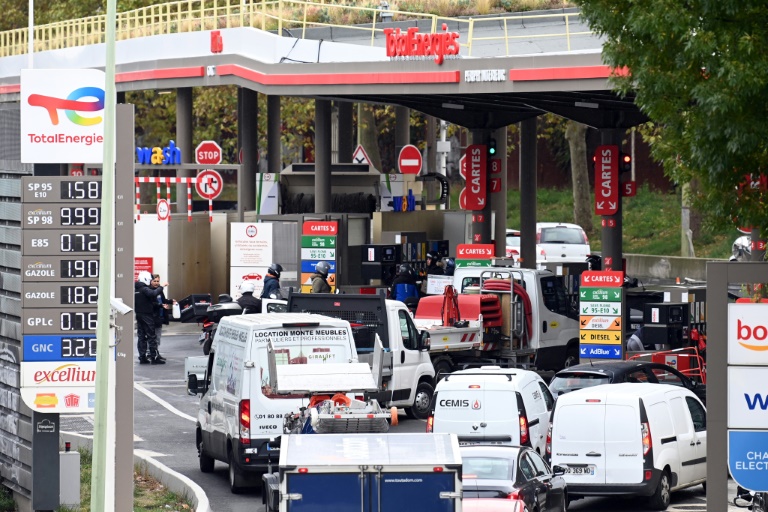
Motorists across the country have faced long queues to fill tanks at stations that often run dry in a day, as six of France’s seven refineries have been shut down.

“I have to honour my contracts for cleaning homes. And when there’s no petrol and I have a lot of rounds to make, things get complicated,” said Elisabeth Mailhes, waiting at a station in the capital.

Macron acknowledged the mounting anger in a televised address Wednesday, promising that relief was in sight for next week.

The office of Prime Minister Elisabeth Borne said Thursday the government was “counting on talks resuming in the coming hours between management and labour representatives”. 

But in the meantime, essential workers were told to return to work Thursday at the huge TotalEnergies fuel depot near Dunkirk, northern France, where around a dozen police were stationed outside, an AFP journalist saw.

Borne’s office cited a “real economic threat” for much of northern France, which relies heavily on agriculture, fishing and industry.

The strike has left 30 percent of service stations nationwide with little or no fuel, though nearly half of stations are impacted in northern France and the greater Paris region, the energy transition ministry said.

The CGT and FO unions leading the refineries strike have said they will fight the requisition orders in court, calling them an illegal manoeuvre against the right to labour action.

“This is the Macron dictatorship,” said Benjamin Tange, a CGT official at the Dunkirk site.

“What we’re seeing is the anger built up over several months and years, and a breakdown of any social dialogue,” he said. 

– Escalation of tensions feared –

The government had already requisitioned depot workers to return to the Esso-ExxonMobil refinery at Gravenchon-Port-Jerome in northern France on Wednesday.

In response, CGT and FO leaders planned to meet with other unions Thursday to discuss broadening the strike to other sectors, potentially with a mass walk-out next Tuesday.

The CGT is already pushing to extend the strike throughout the energy sector, potentially disrupting operations in the country’s all-important nuclear sector.

The refinery unions are seeking pay hikes in response to steep inflation, pointing to the massive profits of energy companies as gas and oil prices have soared during Russia’s invasion of Ukraine.

On Thursday, TotalEnergies told AFP it would propose a six percent raise for next year, below the CGT’s demand for an immediate 10 percent hike, retroactive to January 1.

“We’re not going to negotiate through the media,” responded Eric Sellini, the CGT coordinator at the company.

Government officials are pressing the companies to negotiate, fearing an escalation of tensions ahead of a nationwide march Sunday against inflation, organised by Macron’s left-wing opponents.

Finance Minister Bruno Le Maire told RTL radio that given TotalEnergies’ huge profits this year, it had “the capacity… and therefore an obligation” to raise workers’ pay.

In a sign that talks are making headway, striking workers at the Esso-ExxonMobil refinery in Fos-sur-Mer, outside Marseille in the southeast, voted Thursday to lift the blockade after reaching a pay deal, unions and management told AFP.

'Challenging' year for Ikea, 10,000 layoffs in Russia

Swedish furniture giant Ikea posted a six percent rise in full-year sales on Thursday, in what it described as a “challenging” year due to inflation and scaling back in Russia.

Following Russia’s invasion of Ukraine, Ikea closed its 17 shops and halted production in the country, where it was one of the largest Western employers before the war with 15,000 employees.

According to Dutch holding company Inter Ikea’s CEO Jon Abrahamsson Ring, a “substantial reduction” of employees had already been carried out.

The 2022 fiscal year “was a challenging year for the world, of course with all the things going on around us with pandemics but also very steep increasing inflation,” Abrahamsson Ring told AFP.

Jesper Brodin, the CEO of Ingka, a holding company that manages most of Ikea’s stores, told AFP that they “had to say goodbye” to around 10,000 staff out of the 12,000 retail employees in Ikea’s Russian stores.

Before the war, the Russian market represented about four to five percent of the group’s sales.

Total sales from the international furniture behemoth’s hundreds of shops came in at 44.6 billion euros ($43.4 billion) for the period September 2021-August 2022, Inter Ikea said in a statement.

However it meanwhile noted that “sales have grown in money, but sales quantities have not kept up. In addition, supply chain shortages made it difficult to keep Ikea shelves full.”

Excluding currency effects, revenue growth was lower at 3.5 percent.

“We had to increase our prices across the whole of Ikea,” Abrahamsson Ring said.

– Price rises –

The chief executive explained that the operations had been hurt by supply constraints — especially in Asia — plus increased prices for raw materials and the situation in Russia.

In December 2021, as the current wave of inflation began rearing its head, Ikea announced an average increase of  nine percent in its prices.

Raising prices was “against our mission, but we were forced,” Abrahamsson Ring said, adding that while they did not want to raise prices more they “can’t exclude it.”

The furniture giant — which in recent years has started launching new smaller stores close to the city centre — had a total of 474 stores at the end of August, compared to 458 a year earlier, despite the closures in Russia, the company said.

During the year, Ikea also opened its first store in South America, in the Chilean capital Santiago.

Brodin meanwhile said that on the supply front “there was a much improved situation” in recent months, “even if we’re not back to normal.”

“By the end of the (fiscal year) we actually had double digit growth, we hadn’t seen that in a long time,” Brodin told AFP.

Founded in 1943 in southern Sweden by the late Ingvar Kamprad, Ikea is not listed on any stock exchange and is therefore not obliged to communicate its financial results. 

Following accusations of a lack of financial transparency and tax optimisation schemes, the group started publishing partial results in 2010.

Weak pound is major draw at London's Frieze art fair

As the global art world descends on London’s Frieze fair this week, the current low value of the UK pound makes buying art in Britain particularly attractive for overseas collectors and dealers.

The prestigious fair opened Wednesday at full power after a difficult couple of years, experts on the sector said.

The bustling showcase goes ahead after the 2020 event was cancelled due to the pandemic and last year’s fair was hit by related travel restrictions that barred many buyers.

“This year I feel it’s 100 percent geared up”, said Daniela Duppen, an art dealer and adviser who has worked in London since 2008. 

Thousands of visitors poured into the fair, which runs till Sunday with 160 galleries running stalls in tents in Regent’s Park, central London.

For aficionados, Frieze offers a chance to buy a painting, a sculpture or other work of art that has been previously shown in some of the world’s top galleries.

It also draws international buyers.

“At the moment if you’re coming from America it’s very affordable to buy here because of the pound weakness,” added Duppen.

While Britons are clobbered with a severe cost of living crisis and near double-digit inflation, the new government last month caused panic in markets by announcing massive tax cuts without a clear way to fund them. 

As a result, the pound sterling hit a historic low and has struggled to recover, while the US dollar has benefited from being seen as a safe haven during the war in Ukraine.

– ‘Good timing’ –

“Of course this year it’s more affordable for us to buy in London”, said Robert, an American collector walking the fair’s aisles Wednesday.

“I think many Americans are thinking ‘let’s buy now’ when they may not have done the same in another context. It’s good timing for business,” said the former banker from Chicago, who asked not to use his full name.

“I’ve actually seen a lot of galleries switch the artwork prices to USD,” said Olivia Davis, an art consultant based in Los Angeles who had travelled for the London fair.

“Perhaps they can raise prices in US dollar terms and still have the same demand from American buyers,” she added.

After two years of pandemic, the galleries are feeling the pinch and counting on a big event like Frieze to bounce back.

“For galleries it’s the week of the year. They have no option but to sell,” said Louisa, an art student who works part-time at a small London gallery. 

She said galleries have to pay enormous sums for a stand, and there is “a lot of pressure to make it profitable.”

Davis predicted that at art sales this week — which accompany the fair at top London auction houses Sotheby’s, Christie’s and Phillips — there will be “a lot of American buyers taking advantage of the weakness in the GB pound.” 

Frieze “is a very big part of the art world”, stressed Davis, calling it “a great meeting point for collectors, gallerists and artists from all over the world”.

It comes a week before Art Basel holds a major new art fair in the French capital called Paris+, but she said less experienced collectors see Frieze as a safer bet.

“Paris+ is smaller and better for more seasoned collectors. Frieze is better for new collectors as it’s big and established”, Davis said.

London has recently lost its spot as the second largest art market in the world to China, behind the United States. 

But it still retains cachet for collectors.

“London is the place to be when you love art,” said the US collector Robert. 

“During Frieze you have dinners all over the city, parties everywhere. It’s exhausting, but there is nothing like Frieze.”

India's Infosys plans $1 bn buyback on strong profits

Indian outsourcing behemoth Infosys approved a $1 billion share buyback on Thursday after strong quarterly profits that reflected sustained demand for digital services.

Tech companies have benefited from higher digital services demand since the pandemic, and India’s second-largest IT company has kept a robust balance sheet despite labour competition driving up sector salaries. 

Net profit rose 11 percent year-on-year to 60.21 billion rupees ($731.4 million) in the September quarter.

Revenues were up 23.4 percent for the same period, helped by strong demand in North America and Europe.

“While concerns around the economic outlook persist, our demand pipeline is strong as clients remain confident in our ability to deliver the value they seek,” chief executive Salil Parekh said in a statement.

The Bangalore-headquartered company reported large deals of $2.7 billion for the quarter, its best result in nearly two years and up $1 billion from the June quarter.

Its board approved plans to buy back shares worth 93 billion rupees ($1.13 billion) at 1,850 rupees per share, a 30 percent premium to Thursday’s closing price.

Chief financial officer Nilanjan Roy said the board had approved an open market share buyback of 93 billion rupees ($1.14 billion) in its meeting before the results announcement.

Infosys also reported a marginally lower employee attrition rate — a key metric for IT companies — compared to the previous quarter.

Competition for employees has increasingly driven up salaries and weighed on operating margins of Indian technology companies.

“While supply side challenges are gradually abating as reflected in the reducing attrition rates, they continue to exert pressure on our cost structure,” Roy said.

Infosys is India’s second-largest information technology company and earns more than 60 percent of its revenues from North American markets.

It was at the forefront of an outsourcing boom that saw India become a back office to the world as Western firms subcontracted work to a skilled English-speaking workforce.

Shares in Infosys closed 0.64 percent lower in Mumbai ahead of the earnings announcement.

India's Infosys plans $1 bn buyback on strong profits

Indian outsourcing behemoth Infosys approved a $1 billion share buyback on Thursday after strong quarterly profits that reflected sustained demand for digital services.

Tech companies have benefited from higher digital services demand since the pandemic, and India’s second-largest IT company has kept a robust balance sheet despite labour competition driving up sector salaries. 

Net profit rose 11 percent year-on-year to 60.21 billion rupees ($731.4 million) in the September quarter.

Revenues were up 23.4 percent for the same period, helped by strong demand in North America and Europe.

“While concerns around the economic outlook persist, our demand pipeline is strong as clients remain confident in our ability to deliver the value they seek,” chief executive Salil Parekh said in a statement.

The Bangalore-headquartered company reported large deals of $2.7 billion for the quarter, its best result in nearly two years and up $1 billion from the June quarter.

Its board approved plans to buy back shares worth 93 billion rupees ($1.13 billion) at 1,850 rupees per share, a 30 percent premium to Thursday’s closing price.

Chief financial officer Nilanjan Roy said the board had approved an open market share buyback of 93 billion rupees ($1.14 billion) in its meeting before the results announcement.

Infosys also reported a marginally lower employee attrition rate — a key metric for IT companies — compared to the previous quarter.

Competition for employees has increasingly driven up salaries and weighed on operating margins of Indian technology companies.

“While supply side challenges are gradually abating as reflected in the reducing attrition rates, they continue to exert pressure on our cost structure,” Roy said.

Infosys is India’s second-largest information technology company and earns more than 60 percent of its revenues from North American markets.

It was at the forefront of an outsourcing boom that saw India become a back office to the world as Western firms subcontracted work to a skilled English-speaking workforce.

Shares in Infosys closed 0.64 percent lower in Mumbai ahead of the earnings announcement.

Europe heading for warmer-than-average winter: forecaster

Europe faces a higher-than-usual chance of a cold blast of weather before the end of the year, but the winter overall is likely to be warmer than average, the continent’s long-range weather forecaster said Thursday.

Temperatures this winter will be crucial for homeowners worried about the record cost of heating their homes, and for European policymakers seeking to avoid energy rationing due to cuts in Russian gas supplies. 

“We see the winter as being warmer than usual,” said Carlo Buontempo, director of the Copernicus Climate Change Service that produces seasonal forecasts for the European Centre for Medium-Range Weather Forecasts (ECMWF).

“Nevertheless there is a still a significant chance of a block situation, which can lead to cold temperatures and low wind over Europe,” he told AFP as the service issued a monthly update to its forecasts.

A so-called block or blocking pattern in the winter can bring stable, often wind-free weather accompanied by freezing temperatures.

“This was looking more likely in November, but there now looks like a pronounced probability of a cold outbreak in December,” Buontempo added.

The ECMWF produces weather modelling with data from a range of national weather services around Europe.

Its forecasts are based on indicators such as ocean and atmospheric temperatures, as well as wind speeds in the stratosphere, but do not have the accuracy of short-range reports.

The models provide the “best information possible, to give a hint, to guide our decisions”, Buontempo said. 

The European winter was expected to be warmer than usual because of the “La Nina” global weather phenomenon, which is related to cooling surface temperatures in the central and eastern equatorial Pacific Ocean.

“We know that in a La Nina year, the latter part of the European winter tends to favour westerly winds, so warm and wet,” Buontempo said.

The agency will update its winter season forecast next month when it will have greater confidence because “all the drivers for the winter will be more active”, he said.

Independent energy experts expect Europe to be able to withstand Russia’s gas cuts this winter, providing temperatures stay in line with or above the long-term average.

Governments have almost filled their strategic gas reserves and consumers are being urged to reduce their consumption.

The International Energy Agency, a Paris-based energy consultancy, believes temperatures over winter around 10 percent below the average would put strain on the European gas system.

It has also said a late cold spell, when gas stocks are expected to be low, could be the “Achilles heel of European gas supply security”.

Close Bitnami banner
Bitnami