AFP

Biden says he 'can beat' former US president Donald Trump again

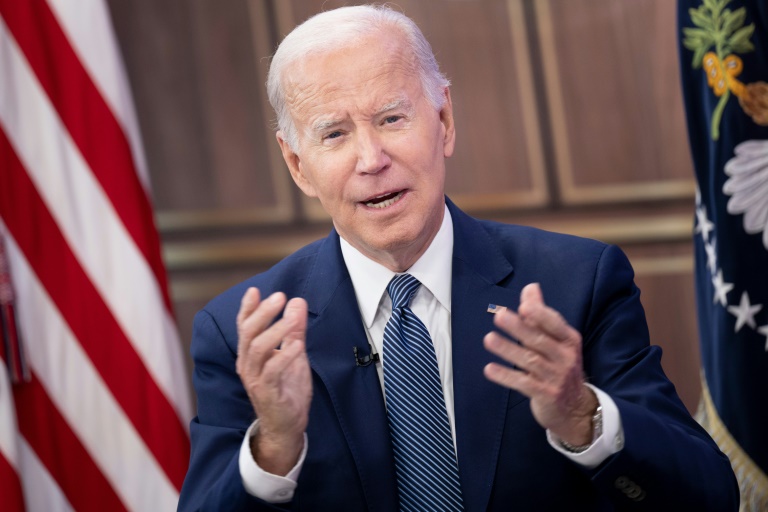
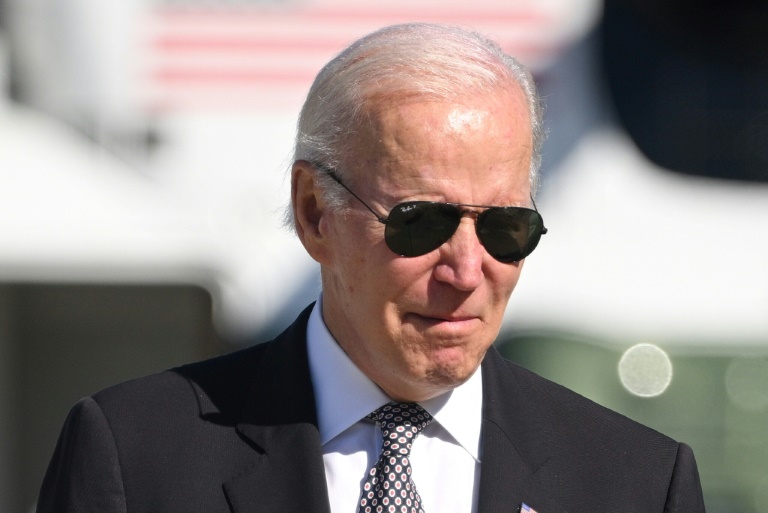
US President Joe Biden on Tuesday voiced confidence that he could beat his predecessor Donald Trump in a 2024 rematch — even as he acknowledged the country could sink back into recession under his leadership.

The 79-year-old Democrat was asked if he’d be announcing a run for a second term after November’s midterm elections — and if Trump would be a factor in his decision.

“I believe I can beat Donald Trump again,” Biden responded, although he stopped short of confirming another tilt at the Oval Office in 2024.

Biden defeated Trump in both the state-by-state “electoral college” and the popular vote in 2020 — leading to relentless false claims of widespread voter fraud from the defeated president.

Biden indicated to reporters at a NATO summit in March that he would be happy for Trump to be his opponent again.

Biden’s popularity has taken a hit in the last year amid soaring inflation, rising violent crime in cities and a seemingly intractable migrant crisis at the southern border.

But his approval ratings still outrank the numbers seen in polling for Trump, who regularly mocks Biden — three years his senior — for his age.

CNN asked Biden what he would tell voters who consider him too old for reelection. 

“Name me a president in recent history that’s gotten as much done as I have in the first two years. Not a joke. You may not like what I got done, but the vast majority of the American people do like what I got done,” Biden replied.

“And so… it’s a matter of, can you do the job? And I believe I can do the job.”

In a wide-ranging interview that took in the war in Ukraine and Saudi-led oil production cuts that are expected to send gas prices soaring again, Biden was asked about fears for the economy amid gloomy growth projections.

Biden downplayed the likelihood of a recession but conceded a “slight” downturn is possible.

“I don’t think there will be a recession. If it is, it’ll be a very slight recession. That is, we’ll move down slightly,” he said.

Trump, 76, came to power during the longest economic expansion in US history, although the economy tumbled into recession in 2020 as the world was gripped by the Covid-19 outbreak.

Biden frequently takes questions from the media, but he has held few press conferences or one-to-one televised interviews.

He has been more visible recently as he takes to the road to talk up Democratic legislative achievements and slam “MAGA Republicans” — followers of former president Donald Trump’s “Make America Great Again” agenda — in the final weeks of the midterm election campaign. 

He also sat down with CBS in September, making headlines for declaring the pandemic over and confirming US commitment to defending Taiwan from a Chinese assault.
Stocks dive, dollar rallies as dazed traders gird for inflation data

Asian stocks sank again Wednesday while the dollar held gains against the yen and sterling as the volatility that has characterised markets for most of the year showed no sign of letting up.

Angst-ridden investors are struggling to find some solace as they navigate a range of crises that threaten the global economy, from soaring prices and bumper interest rate hikes to the Ukraine war and China’s Covid-induced growth slowdown.

The gloom was summed up by the International Monetary Fund, which on Tuesday highlighted the risks of inflation and the conflict in Europe as it slashed its global growth forecast and warned: “For many people 2023 will feel like a recession”.

Later, US President Joe Biden admitted there was a chance the country could suffer a “slight” recession.

The latest blow came Tuesday when the Bank of England announced it would stop its emergency bond-buying efforts on Friday, ignoring calls to extend the programme to allow markets to stabilise.

Officials were forced last month to step into financial markets to prevent a collapse in pension funds caused by a spike in bond prices after a debt-fuelled, tax-cutting mini budget by new finance minister Kwasi Kwarteng sparked fears of a surge in borrowing.

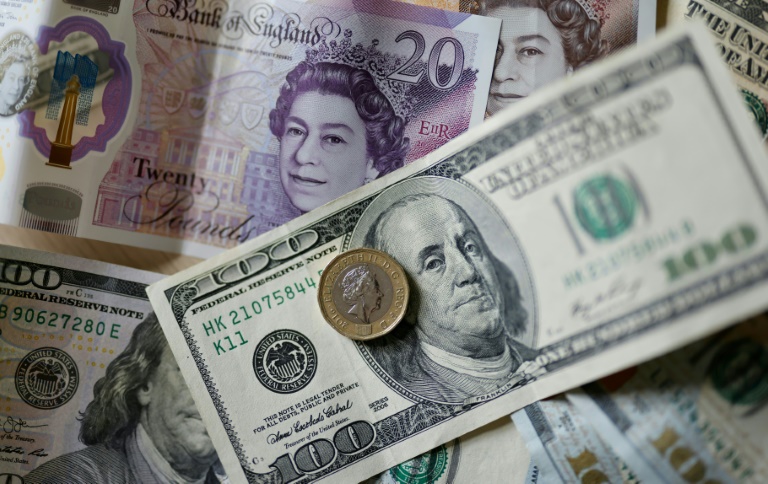
The move quelled the crisis — after the pound hit a record-low $1.0350 — but traders were spooked by the prospect of more selling when the BoE removes its support.

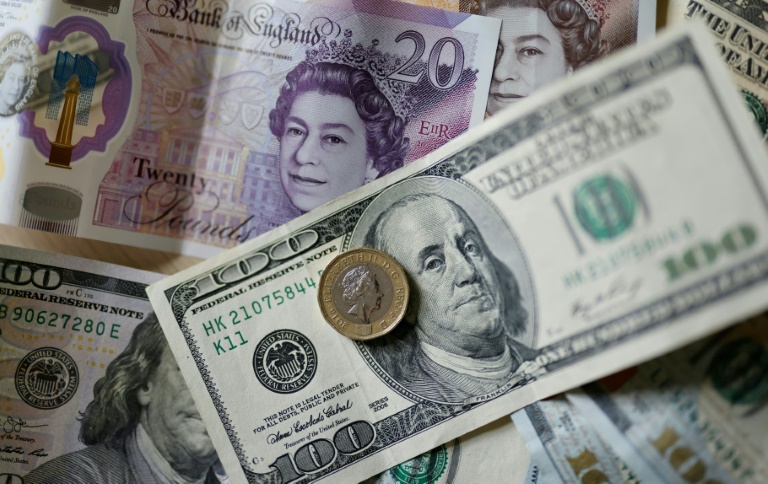
Sterling, which had recovered to as high as $1.15 last week, came back under pressure to drop back below $1.10 Tuesday where it remained the next day in Asian business.

Risk assets buckled after the announcement, with all three main indexes on Wall Street turning lower Tuesday, having been in positive territory earlier.

– Fresh volatility warning –

Most of Asia followed suit.

Hong Kong led losses, shedding more than two percent, while Tokyo, Sydney, Shanghai, Singapore, Seoul, Wellington, Jakarta and Taipei were also down. 

“And at least they did not allow the rug to get ripped from under pension funds,” said SPI Asset Management’s Stephen Innes. “But stepping away as the buyer of last resort is not great for risk or sterling.

“At the end of the day, UK economic issues, fiscal irresponsibility, and a hawkish Fed will linger. So do not be surprised by a pickup in pound volatility and for a continued move lower as well.”

Investors are now nervously looking ahead to Thursday’s US inflation report, with observers warning that a strong reading could spark another rout.

The desire to find a safe place to invest also pushed the greenback to a new 24-year high against the yen, breaking the level touched last week when Tokyo stepped into the market to support the Japanese unit.

Investors will be keeping a close eye on developments in Japan, to see if there is another cash injection, though analysts said the yen could strengthen naturally.

“There is so much tension that duration time (above 146 yen) will be short,” said Yoshio Iguchi, of Traders Securities. “The chicken race will continue with people wanting to test the upside but at the same time scared of being countered by intervention.”

And City Index’s Matt Simpson added: “Traders are confident that the yen will weaken, despite comments from government officials that they are watching forex markets very closely.

“But the reality is that the (Bank of Japan) wants a weaker currency, and (is) happy to let it slide so long as its demise is not too volatile.

“As of yet we’re yet to hear any comments from BoJ or (finance ministry) officials, but we suspect comments will surely follow — not that they seem to care.”

Recession fears and China’s Covid-linked economic woes also dragged oil prices back down, having surged last week on an outsized OPEC output cut, with many warning that demand will plunge as people refrain from spending.

– Key figures around 0230 GMT –

Tokyo – Nikkei 225: DOWN 0.1 percent at 26,364.25 (break)

Hong Kong – Hang Seng Index: DOWN 2.3 percent at 16,451.44

Shanghai – Composite: DOWN 0.9 percent at 2,952.74

Pound/dollar: DOWN at $1.0938 from $1.0972 Tuesday

Dollar/yen: UP at 146.34 yen from 145.83 yen

Euro/dollar: DOWN at $0.9688 from $0.9709

Euro/pound: UP at 88.57 pence from 88.46 pence

West Texas Intermediate: DOWN 1.1 percent at $88.40 per barrel

Brent North Sea crude: DOWN 0.9 percent at $93.43 per barrel

New York – Dow: UP 0.1 percent at 29,239.19 (close)

London – FTSE 100: DOWN 1.1 percent at 6,885.23 (close)

Stocks dive, dollar rallies as dazed traders gird for inflation data

Asian stocks sank again Wednesday while the dollar held gains against the yen and sterling as the volatility that has characterised markets for most of the year showed no sign of letting up.

Angst-ridden investors are struggling to find some solace as they navigate a range of crises that threaten the global economy, from soaring prices and bumper interest rate hikes to the Ukraine war and China’s Covid-induced growth slowdown.

The gloom was summed up by the International Monetary Fund, which on Tuesday highlighted the risks of inflation and the conflict in Europe as it slashed its global growth forecast and warned: “For many people 2023 will feel like a recession”.

Later, US President Joe Biden admitted there was a chance the country could suffer a “slight” recession.

The latest blow came Tuesday when the Bank of England announced it would stop its emergency bond-buying efforts on Friday, ignoring calls to extend the programme to allow markets to stabilise.

Officials were forced last month to step into financial markets to prevent a collapse in pension funds caused by a spike in bond prices after a debt-fuelled, tax-cutting mini budget by new finance minister Kwasi Kwarteng sparked fears of a surge in borrowing.

The move quelled the crisis — after the pound hit a record-low $1.0350 — but traders were spooked by the prospect of more selling when the BoE removes its support.

Sterling, which had recovered to as high as $1.15 last week, came back under pressure to drop back below $1.10 Tuesday where it remained the next day in Asian business.

Risk assets buckled after the announcement, with all three main indexes on Wall Street turning lower Tuesday, having been in positive territory earlier.

– Fresh volatility warning –

Most of Asia followed suit.

Hong Kong led losses, shedding more than two percent, while Tokyo, Sydney, Shanghai, Singapore, Seoul, Wellington, Jakarta and Taipei were also down. 

“And at least they did not allow the rug to get ripped from under pension funds,” said SPI Asset Management’s Stephen Innes. “But stepping away as the buyer of last resort is not great for risk or sterling.

“At the end of the day, UK economic issues, fiscal irresponsibility, and a hawkish Fed will linger. So do not be surprised by a pickup in pound volatility and for a continued move lower as well.”

Investors are now nervously looking ahead to Thursday’s US inflation report, with observers warning that a strong reading could spark another rout.

The desire to find a safe place to invest also pushed the greenback to a new 24-year high against the yen, breaking the level touched last week when Tokyo stepped into the market to support the Japanese unit.

Investors will be keeping a close eye on developments in Japan, to see if there is another cash injection, though analysts said the yen could strengthen naturally.

“There is so much tension that duration time (above 146 yen) will be short,” said Yoshio Iguchi, of Traders Securities. “The chicken race will continue with people wanting to test the upside but at the same time scared of being countered by intervention.”

And City Index’s Matt Simpson added: “Traders are confident that the yen will weaken, despite comments from government officials that they are watching forex markets very closely.

“But the reality is that the (Bank of Japan) wants a weaker currency, and (is) happy to let it slide so long as its demise is not too volatile.

“As of yet we’re yet to hear any comments from BoJ or (finance ministry) officials, but we suspect comments will surely follow — not that they seem to care.”

Recession fears and China’s Covid-linked economic woes also dragged oil prices back down, having surged last week on an outsized OPEC output cut, with many warning that demand will plunge as people refrain from spending.

– Key figures around 0230 GMT –

Tokyo – Nikkei 225: DOWN 0.1 percent at 26,364.25 (break)

Hong Kong – Hang Seng Index: DOWN 2.3 percent at 16,451.44

Shanghai – Composite: DOWN 0.9 percent at 2,952.74

Pound/dollar: DOWN at $1.0938 from $1.0972 Tuesday

Dollar/yen: UP at 146.34 yen from 145.83 yen

Euro/dollar: DOWN at $0.9688 from $0.9709

Euro/pound: UP at 88.57 pence from 88.46 pence

West Texas Intermediate: DOWN 1.1 percent at $88.40 per barrel

Brent North Sea crude: DOWN 0.9 percent at $93.43 per barrel

New York – Dow: UP 0.1 percent at 29,239.19 (close)

London – FTSE 100: DOWN 1.1 percent at 6,885.23 (close)

English winemakers toast summer heatwaves

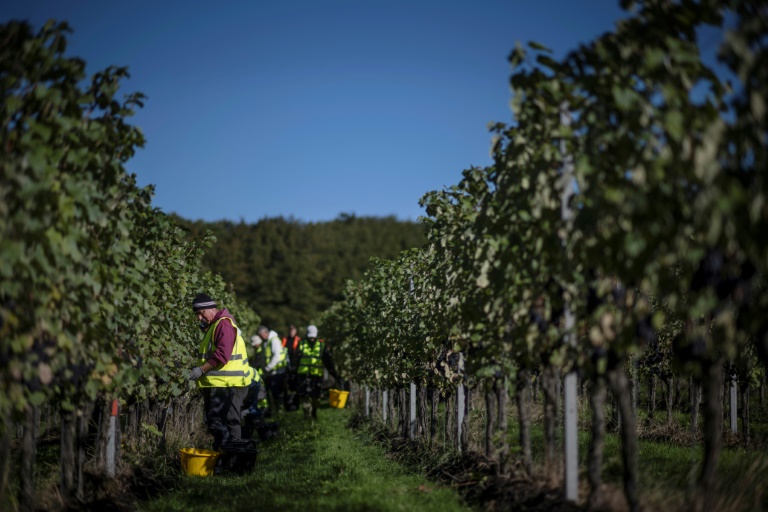
Under a blue sky, seasonal workers ran their secateurs along long rows of grapevines, harvesting a variety of pinot noir grown during the summer heatwave.

This was not a village in France, however, but Appledore in Kent in southern England, where high temperatures needed to grow the grape variety are no longer rare.

“At the moment, I think we have similar growing conditions to Champagne in the (19)70s and 80s,” said Charlie Holland, head winemaker and chief executive at Gusbourne Estate. 

“We’re seeing the same sort of growth conditions, the same ripening period” in England as back then in France, he added.

That is good news for Britain’s embryonic viticulture which is now able to produce a wide variety of still and sparkling wines from grape varieties including pinot noir, chardonnay and riesling that are traditionally more accustomed to France and Germany.

“It’s not so often that you see a new wine region appearing on the map,” said Holland.

“In England, now we can make an exceptional sparkling wine, we have a perfect climate, we have a very long growing season.”

– ‘Quite frightening’ –

At Gusbourne Estate, tractors were transporting baskets full of grapes to the winery. The fruit was immediately destemmed and pressed to begin the fermentation process.

During the harvest period, the estate is a beehive of 200 workers, more than half of them seasonal.

Holland was everywhere, darting between presses, vats and oak barrels as he inspected and tasted the produce.

Climate change may be helping England’s vineyards for now but the fast pace of transition risks major planning difficulties, warned Alistair Nesbitt, co-author of an outlook study on the country’s winemaking industry.

“That’s a really quite frighteningly short period of time to have such a transition of varietals suitability, and that really shows the pace of change that certain areas of the UK are starting to see as a result of climate change,” he noted.

“Hopefully the world will get (its) act together and we won’t see that continuing increase for too much longer, because that’s threatening to everyone, including producers in the UK,” added Nesbitt, who is chief executive of consultancy Vinescapes.

Nesbitt forecasts that beyond 2040, England’s vineyards could be working with grape varieties found further south in France, such as merlot and cabernet sauvignon. 

This assumes that climate change continues on its expected path amid global reductions in carbon emissions.

– ‘Niche producer’ –

Britain’s wine growers are planting grapes in droves to meet booming demand at home and abroad.

The surface area of vineyards in the country has doubled in eight years, according to industry organisation WineGB.

UK vineyards are however dwarfed on the international stage, covering a total of 3,800 hectares — or about one tenth of France’s champagne-producing region.

Britain “will likely remain a niche wine producer”, said Daniel Mettyear, research director at consultancy IWSR Drinks Market Analysis.

Despite the relatively high price — £45 ($50) for one of Gusbourne’s sparkling wines — demand is growing both in Britain and abroad for the drink.

“Quality has improved significantly in recent years,” added Mettyear, noting strong interest from North American and Nordic countries, as well as from Australia.

Gusbourne exports about one third of its wine to 28 nations worldwide, mostly to Norway but also to France.

English winemakers toast summer heatwaves

Under a blue sky, seasonal workers ran their secateurs along long rows of grapevines, harvesting a variety of pinot noir grown during the summer heatwave.

This was not a village in France, however, but Appledore in Kent in southern England, where high temperatures needed to grow the grape variety are no longer rare.

“At the moment, I think we have similar growing conditions to Champagne in the (19)70s and 80s,” said Charlie Holland, head winemaker and chief executive at Gusbourne Estate. 

“We’re seeing the same sort of growth conditions, the same ripening period” in England as back then in France, he added.

That is good news for Britain’s embryonic viticulture which is now able to produce a wide variety of still and sparkling wines from grape varieties including pinot noir, chardonnay and riesling that are traditionally more accustomed to France and Germany.

“It’s not so often that you see a new wine region appearing on the map,” said Holland.

“In England, now we can make an exceptional sparkling wine, we have a perfect climate, we have a very long growing season.”

– ‘Quite frightening’ –

At Gusbourne Estate, tractors were transporting baskets full of grapes to the winery. The fruit was immediately destemmed and pressed to begin the fermentation process.

During the harvest period, the estate is a beehive of 200 workers, more than half of them seasonal.

Holland was everywhere, darting between presses, vats and oak barrels as he inspected and tasted the produce.

Climate change may be helping England’s vineyards for now but the fast pace of transition risks major planning difficulties, warned Alistair Nesbitt, co-author of an outlook study on the country’s winemaking industry.

“That’s a really quite frighteningly short period of time to have such a transition of varietals suitability, and that really shows the pace of change that certain areas of the UK are starting to see as a result of climate change,” he noted.

“Hopefully the world will get (its) act together and we won’t see that continuing increase for too much longer, because that’s threatening to everyone, including producers in the UK,” added Nesbitt, who is chief executive of consultancy Vinescapes.

Nesbitt forecasts that beyond 2040, England’s vineyards could be working with grape varieties found further south in France, such as merlot and cabernet sauvignon. 

This assumes that climate change continues on its expected path amid global reductions in carbon emissions.

– ‘Niche producer’ –

Britain’s wine growers are planting grapes in droves to meet booming demand at home and abroad.

The surface area of vineyards in the country has doubled in eight years, according to industry organisation WineGB.

UK vineyards are however dwarfed on the international stage, covering a total of 3,800 hectares — or about one tenth of France’s champagne-producing region.

Britain “will likely remain a niche wine producer”, said Daniel Mettyear, research director at consultancy IWSR Drinks Market Analysis.

Despite the relatively high price — £45 ($50) for one of Gusbourne’s sparkling wines — demand is growing both in Britain and abroad for the drink.

“Quality has improved significantly in recent years,” added Mettyear, noting strong interest from North American and Nordic countries, as well as from Australia.

Gusbourne exports about one third of its wine to 28 nations worldwide, mostly to Norway but also to France.

Putin 'miscalculated' Russia's ability to occupy Ukraine: Biden

US President Joe Biden said Tuesday he believes his Russian counterpart Vladimir Putin is a normally rational actor who badly misjudged his prospects of occupying Ukraine.

The president spoke out in a rare televised interview as his administration looks for what he has described as an “off-ramp” for Putin to deescalate his invasion of Ukraine before he resorts to weapons of mass destruction.

“I think he is a rational actor who has miscalculated significantly,” Biden told CNN after Moscow’s shelling of civilian targets across its neighbor marked an escalation in the seven-month conflict.

Biden warned last week that the world risks “Armageddon” in unusually direct remarks about the dangers from Putin’s thinly veiled threats to use nuclear weapons to assist Russia’s faltering attempt to take over swaths of Ukraine.

Putin’s state of mind has been the subject of much debate after the Russian president suffered a series of recent military set-backs in the invasion, which he launched in February.

Biden told CNN that while he believed Putin was rational, he had underestimated the ferocity of Ukrainian defiance.

“I think… he thought he was going to be welcomed with open arms, that this was the home of Mother Russia in Kyiv, and that where he was going to be welcomed, and I think he just totally miscalculated,” Biden said.

The president even left open the possibility of talks with his Russian counterpart on the sidelines of the meeting of G20 nations in Bali scheduled for November — although he was clear there are no plans for talks on Ukraine. 

“Look, I have no intention of meeting with him,” Biden told CNN, adding that he would however see Putin if the Russian leader wanted negotiations over releasing detained US basketball star Brittney Griner. 

“If he came to me at the G20 and said ‘I want to talk about the release of Griner,’ I’d meet with him. I mean, it would depend,” he said.

– ‘Further escalation’ –

Kyiv’s forces have in recent weeks been pushing back against Russian soldiers across the front lines in the south and in the east.

Ukrainian President Volodymyr Zelensky said Friday his troops had recaptured nearly 965 square miles (2,500 square kilometers) in the counter-offensive that began late last month.

But the Ukrainian defense ministry said Monday that Russia had retaliated with a massive bombardment of its neighbor, hitting the Ukrainian capital Kyiv for the first time in months, as well as other cities across the country. 

Biden spoke to CNN hours after meeting virtually with members of the Group of 7 industrialized nations, who heard from Zelensky on the need for intensified efforts to “create an air shield for Ukraine” amid the barrage of Russian cruise missile and drone attacks.

Zelensky told the G7 “millions of people would be grateful” for help fending off attacks from the sky, and he warned Russia “still has room for further escalation.”

Washington pledged after Monday’s bloody salvos that it would up shipments of air defenses to Ukraine, while Germany promised delivery “in the coming days” of the first Iris-T missile shield reportedly capable of protecting a city.

– No neutrality –

Meanwhile, the United States was leading an all-out offensive to rally as many countries as possible to adopt a resolution at the UN condemning Moscow’s annexation of Ukrainian regions. 

“We believe the time has long passed for neutrality. There is no such thing as neutrality in a situation like this,” said State Department spokesman Ned Price. 

UN countries are debating a resolution introduced to the General Assembly by Ukraine, which the West hopes will demonstrate the isolation of Putin’s Russia on the international stage, with a vote likely on Wednesday or Thursday.

Biden frequently takes questions from the media, but he has held few press conferences or one-to-one televised interviews.

IMF cuts 2023 global growth, warns major economies to stall

Global growth is expected to slow further next year, the IMF said Tuesday, downgrading its forecasts as countries grapple with the fallout from Russia’s invasion of Ukraine, spiraling cost-of-living and economic downturns.

The world economy has been dealt multiple blows, with the war in Ukraine driving up food and energy prices following the coronavirus outbreak, while soaring costs and rising interest rates threaten to reverberate around the globe.

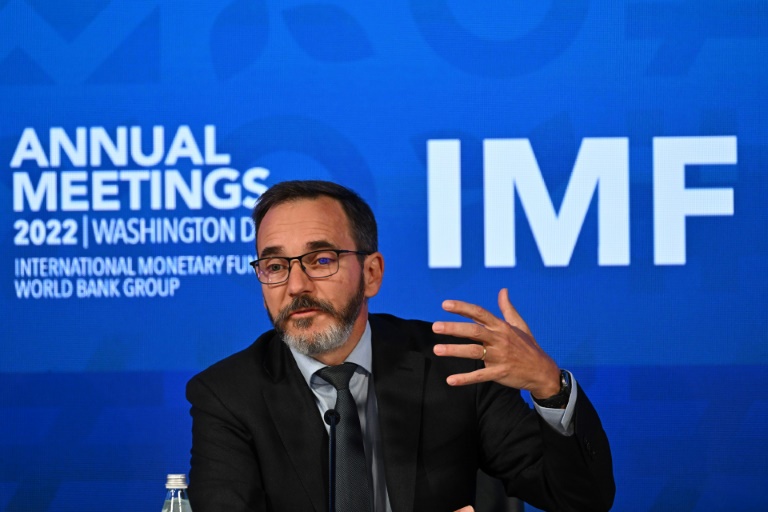
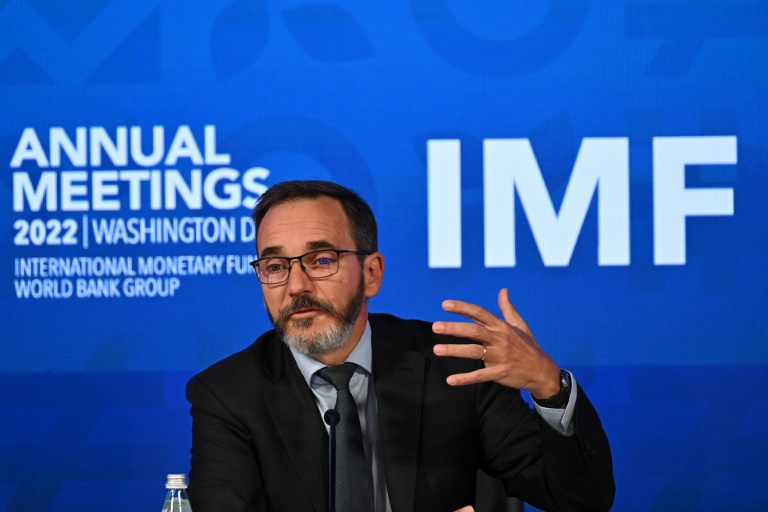
“This year’s shocks will re-open economic wounds that were only partially healed post-pandemic,” said International Monetary Fund economic counsellor Pierre-Olivier Gourinchas in a blog post accompanying the fund’s latest World Economic Outlook.

More than a third of the global economy is headed for contraction this year or next, and the three biggest economies –- the United States, European Union and China –- will continue to stall, he warned.

“The worst is yet to come and, for many people, 2023 will feel like a recession,” said Gourinchas.

In its report, the IMF trimmed its 2023 global GDP growth forecast to 2.7 percent, 0.2 point down from July expectations.

Its world growth forecast for this year remains unchanged at 3.2 percent.

The global growth profile is its weakest since 2001, apart from during the global financial crisis and the worst of the pandemic, the IMF said.

This reflects slowdowns for the biggest economies, including a US GDP contraction in the first half of 2022 and continued lockdowns in China as it faces a property crisis.

The world economy is expected to avert recession, but there is about a one-in-four chance that growth could slow to 2 percent or below, Gourinchas warned Tuesday.

“We’ve only had that five times since 1970…this is the oil price shock of 1973, the disinflation of 1981, the 2008 financial crisis…these are all big things that have impacted the global economy,” he told AFP.

– Laser focus –

A key factor behind the slowdown is a policy shift as central banks try to bring down soaring inflation, with higher interest rates starting to take the heat out of domestic demand.

Growing price pressures are the most immediate threat to prosperity, said the IMF’s report, adding that central banks are now “laser-focused on restoring price stability”.

Global inflation is expected to peak at 9.5 percent this year before dropping to 4.1 percent by 2024.

Misjudging the persistence of inflation could prove detrimental to future macroeconomic stability, Gourinchas warned, “by gravely undermining the hard-won credibility of central banks.”

Asked about the Federal Reserve’s rate hikes, he told a press briefing on Tuesday that the IMF is not calling for an acceleration, but this “doesn’t mean that they should pause on (their) path” either. 

This is because banks were starting from a point of historically-low rates as countries emerged from the pandemic.

Current challenges do not mean a large downturn is inevitable, but the fund warned many low-income countries are either in or close to debt distress.

While the G20 has agreed on a “common framework” for debt restructuring for the poorest countries, only three have qualified and “more progress is needed,” Gourinchas told reporters.

“Time may soon be running out,” he said.

– Slowdown in major economies –

The IMF has also cut forecasts for the world’s two biggest economies, the United States and China.

US economic growth for this year is now pegged at 1.6 percent, 0.7 point below the fund’s July forecast, due to an “unexpected real GDP contraction in the second quarter,” the IMF said.

“Declining real disposable income continues to eat into consumer demand, and higher interest rates are taking an important toll on spending,” the report added.

The Fed has been raising interest rates aggressively to tamp down surging inflation, which is slowing economic activity. And the central bank has said more increases are likely to come.

President Joe Biden conceded that a “slight” recession was a possibility.

“I don’t think there will be a recession,” he told CNN. “If it is, it’ll be a very slight recession. That is, we’ll move down slightly.” 

China’s economy is expected to grow at 3.2 percent this year — its lowest rate in decades, apart from the initial coronavirus outbreak.

The fund cautioned that a worsening of China’s property sector slump could spill over to the domestic banking sector and weigh on growth.

A slowdown in the Euro area is also expected to deepen next year, the IMF projected, with the German and Italian economies tumbling into recession due to their exposure to Russian gas cuts.

The energy crisis provoked by Russia’s invasion “is not a transitory shock,” the IMF said, describing the global shift in energy trade as “broad and permanent.”

With the large shock, “there is no recovery in sight in the Russian economy” either, Gourinchas told AFP.

IMF cuts 2023 global growth, warns major economies to stall

Global growth is expected to slow further next year, the IMF said Tuesday, downgrading its forecasts as countries grapple with the fallout from Russia’s invasion of Ukraine, spiraling cost-of-living and economic downturns.

The world economy has been dealt multiple blows, with the war in Ukraine driving up food and energy prices following the coronavirus outbreak, while soaring costs and rising interest rates threaten to reverberate around the globe.

“This year’s shocks will re-open economic wounds that were only partially healed post-pandemic,” said International Monetary Fund economic counsellor Pierre-Olivier Gourinchas in a blog post accompanying the fund’s latest World Economic Outlook.

More than a third of the global economy is headed for contraction this year or next, and the three biggest economies –- the United States, European Union and China –- will continue to stall, he warned.

“The worst is yet to come and, for many people, 2023 will feel like a recession,” said Gourinchas.

In its report, the IMF trimmed its 2023 global GDP growth forecast to 2.7 percent, 0.2 point down from July expectations.

Its world growth forecast for this year remains unchanged at 3.2 percent.

The global growth profile is its weakest since 2001, apart from during the global financial crisis and the worst of the pandemic, the IMF said.

This reflects slowdowns for the biggest economies, including a US GDP contraction in the first half of 2022 and continued lockdowns in China as it faces a property crisis.

The world economy is expected to avert recession, but there is about a one-in-four chance that growth could slow to 2 percent or below, Gourinchas warned Tuesday.

“We’ve only had that five times since 1970…this is the oil price shock of 1973, the disinflation of 1981, the 2008 financial crisis…these are all big things that have impacted the global economy,” he told AFP.

– Laser focus –

A key factor behind the slowdown is a policy shift as central banks try to bring down soaring inflation, with higher interest rates starting to take the heat out of domestic demand.

Growing price pressures are the most immediate threat to prosperity, said the IMF’s report, adding that central banks are now “laser-focused on restoring price stability”.

Global inflation is expected to peak at 9.5 percent this year before dropping to 4.1 percent by 2024.

Misjudging the persistence of inflation could prove detrimental to future macroeconomic stability, Gourinchas warned, “by gravely undermining the hard-won credibility of central banks.”

Asked about the Federal Reserve’s rate hikes, he told a press briefing on Tuesday that the IMF is not calling for an acceleration, but this “doesn’t mean that they should pause on (their) path” either. 

This is because banks were starting from a point of historically-low rates as countries emerged from the pandemic.

Current challenges do not mean a large downturn is inevitable, but the fund warned many low-income countries are either in or close to debt distress.

While the G20 has agreed on a “common framework” for debt restructuring for the poorest countries, only three have qualified and “more progress is needed,” Gourinchas told reporters.

“Time may soon be running out,” he said.

– Slowdown in major economies –

The IMF has also cut forecasts for the world’s two biggest economies, the United States and China.

US economic growth for this year is now pegged at 1.6 percent, 0.7 point below the fund’s July forecast, due to an “unexpected real GDP contraction in the second quarter,” the IMF said.

“Declining real disposable income continues to eat into consumer demand, and higher interest rates are taking an important toll on spending,” the report added.

The Fed has been raising interest rates aggressively to tamp down surging inflation, which is slowing economic activity. And the central bank has said more increases are likely to come.

President Joe Biden conceded that a “slight” recession was a possibility.

“I don’t think there will be a recession,” he told CNN. “If it is, it’ll be a very slight recession. That is, we’ll move down slightly.” 

China’s economy is expected to grow at 3.2 percent this year — its lowest rate in decades, apart from the initial coronavirus outbreak.

The fund cautioned that a worsening of China’s property sector slump could spill over to the domestic banking sector and weigh on growth.

A slowdown in the Euro area is also expected to deepen next year, the IMF projected, with the German and Italian economies tumbling into recession due to their exposure to Russian gas cuts.

The energy crisis provoked by Russia’s invasion “is not a transitory shock,” the IMF said, describing the global shift in energy trade as “broad and permanent.”

With the large shock, “there is no recovery in sight in the Russian economy” either, Gourinchas told AFP.

Biden to 're-evaluate' Saudi ties after OPEC snub

US President Joe Biden promised “consequences” for Saudi Arabia after a Riyadh-led coalition of oil-producing nations sided with Russia to slash output.

The 13-nation OPEC cartel and its 10 allies headed by Moscow angered the White House last week with its decision to cut production by two million barrels a day from November, raising fears that oil prices could soar.

“I’m not going to get into what I’d consider and what I have in mind. But there will be — there will be consequences,” Biden told CNN when pressed on possible responses in a rare televised interview.

The Democratic leader didn’t reveal what options were being considered, but the White House had made clear earlier that Biden was reassessing ties between the allies.

“I think the president’s been very clear that this is a relationship that we need to continue to re-evaluate, that we need to be willing to revisit,” National Security Council spokesman John Kirby told CNN.

“Certainly in light of the OPEC decision, I think that’s where he is.”

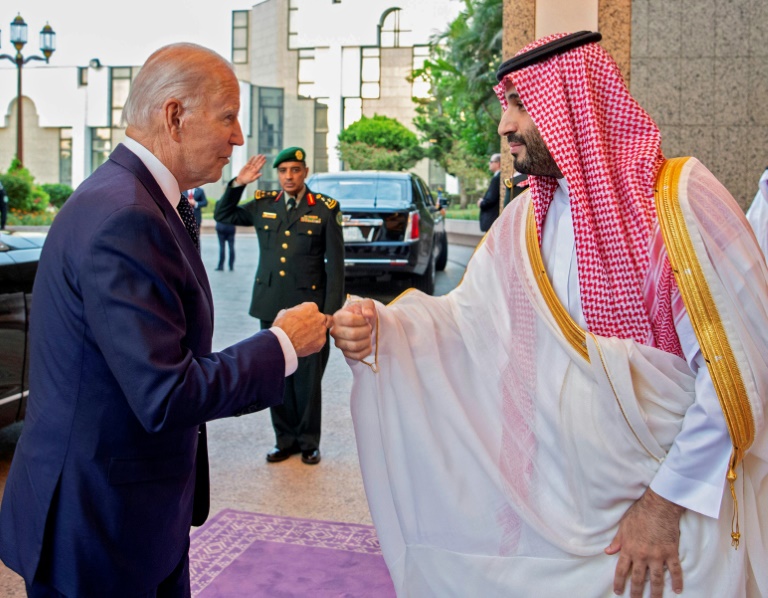
The OPEC move was widely seen as a diplomatic slap in the face, since Biden traveled to Saudi Arabia in July and met with Crown Prince Mohammed bin Salman, despite vowing to make the kingdom an international “pariah” following the murder of journalist Jamal Khashoggi.

It also comes at a sensitive moment for Biden’s Democratic party, as it faces November midterm elections with rising consumer prices a key Republican talking point.

Saudi Arabia has defended the planned production cuts, saying the priority of OPEC+ was “to maintain a sustainable oil market”.

On Tuesday, Saudi foreign minister Prince Faisal bin Farhan told the Al-Arabiya channel that the move “was purely economic and was taken unanimously by the (organization’s) member states.”

“OPEC+ members acted responsibly and took the appropriate decision,” he said.

Kirby added that Biden was “willing to work with Congress to think through what that relationship (with Saudi Arabia) ought to look like going forward,” although he clarified that no formal discussions had yet begun. 

His remarks came a day after Bob Menendez, the Democratic chairman of the influential Senate Foreign Relations Committee, called for Washington to halt all cooperation with Riyadh.

Menendez said the kingdom had decided to “underwrite” Russia’s war in Ukraine with a move he denounced as a concession to Moscow that would hurt the global economy.

– ‘They chose Russia’ –

“The United States must immediately freeze all aspects of our cooperation with Saudi Arabia, including any arms sales and security cooperation beyond what is absolutely necessary to defend US personnel and interests,” Menendez said.

“As chairman of the Senate Foreign Relations Committee, I will not greenlight any cooperation with Riyadh until the kingdom reassesses its position with respect to the war in Ukraine.”

The partnership between the United States and Saudi Arabia was sealed after World War II, providing the kingdom with military protection in exchange for American access to oil. 

Fraught with crises, the relationship was revived by Biden’s predecessor Donald Trump, whose single term saw Riyadh accounting for a quarter of US arms exports, according to the Stockholm International Peace Research Institute. 

Continuing the rapprochement, Biden’s State Department announced in August that Saudi Arabia would buy 300 Patriot MIM-104E missile systems, which can be used to bring down at long-range incoming ballistic and cruise missiles, as well as attacking aircraft.

The relationship is “strategic” and has “advanced the security and stability of the Middle East,” the Saudi embassy in Washington said in a statement on Tuesday.

Bilateral military cooperation “serves the interests of both countries,” it said, paraphrasing Prince Faisal’s comments to Al-Arabiya.

Saudi Arabia has faced recent rocket threats from Yemen’s Huthi rebels, who have been supplied with Iranian equipment and technology.

Biden said last week that he would look at alternatives to prevent gas price hikes.

These could include further releases from the US Strategic Petroleum Reserve, potentially increased domestic drilling, as well as more drastic measures, including limits on exports.

Menendez’s call for a freeze in arms sales has the support of several fellow Democratic lawmakers, including Connecticut’s Senator Chris Murphy, who told CNN that Washington had for too long given Riyadh a pass on transgressive conduct.  

“For years we have looked the other way as Saudi Arabia has chopped up journalists, has engaged in massive political repression, for one reason: we wanted to know that when the chips were down, when there was a global crisis, that the Saudis would choose us instead of Russia,” he said.

“Well, they didn’t. They chose Russia.”

NASA kicked asteroid off course in test to save Earth

NASA on Tuesday celebrated exceeding expectations during a mission to deflect a distant asteroid, in a sci-fi like test of humanity’s ability to stop an incoming cosmic object from devastating life on Earth.

The fridge-sized Double Asteroid Redirection Test (DART) impactor deliberately smashed into the moonlet asteroid Dimorphos on September 26, pushing it into a smaller, faster orbit around its big brother Didymos, NASA chief Bill Nelson announced.

That changed its orbital period by four percent, or 32 minutes — from 11 hour 55 minutes to 11 hours 23 minutes, bettering an expectation of 10 minutes.

“At some point in the future, if we find an asteroid that is threatening to hit Earth, and would be large enough to really do some damage, thank goodness that we will have had this successful test,” Nelson told AFP.

The asteroid pair loop together around our Sun every 2.1 years, and pose no threat to our planet.

But they are ideal for studying the “kinetic impact” method of planetary defense.

DART’s success as a proof-of-concept has made a reality what was once science fiction — notably films such as “Armageddon,” “Deep Impact,” and “Don’t Look Up.”

Never actually photographed before, Dimorphos, which is 530 feet (160 meters) in diameter or roughly the size of a big Egyptian pyramid, appeared as a speck of light around an hour before impact.

Its egg-like shape and craggy, boulder-dotted surface finally came into clear view in the last few moments, as DART raced toward it at roughly 14,500 miles (23,500 kilometers) per hour.

– Pseudo-comet –

In the days that followed, astronomers rejoiced in stunning images of matter spreading out thousands of miles — pictures collected by Earth and space telescopes, as well as a tiny companion satellite that traveled to the zone with DART.

Thanks to its temporary new tail, Dimorphos has turned into a man-made comet.

But quantifying just how well the test worked required an analysis of light patterns from ground telescopes, which took a few weeks to become apparent.

The binary asteroid system, which was around 6.8 million miles (11 million kilometers) from Earth at impact, is visible only as a single dot from the ground.

The dot’s brightness changes as Dimorphos passes in front of Didymos, which is significantly bigger at half-a-mile wide.

Four optical telescopes were involved in measuring the orbital period — all in Chile and South Africa — while two US based radar telescopes helped confirm the finding, said NASA planetary scientist Nancy Chabot.

The test also showed scientists that the asteroid is less like a solid rock, and more like a “rubbish pile” of boulders bound by mutual gravity.

If an asteroid is more solid, the momentum imparted by a spaceship will be limited. But if significant mass is pushed at high velocity in the opposite direction to impact, there will be an additional boost.

“It looks like the recoil from the ejecta blast off the surface was a substantial contributor to the overall push given to the asteroid,” said NASA scientist Tom Statler at a briefing.

The test will serve as an “anchor point” for simulations and calculations about the outcome of future impacts, he added.

– Mass extinction –

No known asteroid larger than 140 meters (460 feet) in size — big enough to devastate a city — has a significant chance to hit Earth for the next 100 years, according to NASA.

But wait long enough, and it will happen.

The geological record shows, for example, that a six-mile wide asteroid struck Earth 66 million years ago, plunging the world into a long winter that led to the mass extinction of the dinosaurs along with 75 percent of all species.

The agency plans to launch in 2026 a telescope called the Near-Earth Object (NEO) Surveyor to better characterize potentially hazardous 140-meter asteroids and comets that come within 30 million miles. 

So far, less than half of the estimated 25,000 NEOs of 140 meters have been discovered.

Kinetic impact with a spaceship is just one way to defend the planet, albeit the only method possible with current technology.

Should an approaching object be detected early, a spaceship could be sent to fly alongside it for long enough to divert its path via using the ship’s gravitational pull, creating a so-called gravity tractor.

Another option would be launching nuclear explosives to redirect or destroy an asteroid.

NASA believes the best way to deploy such weapons would be at a distance, to impart force without blowing the asteroid to smithereens, which could further imperil Earth.

Close Bitnami banner
Bitnami