AFP

As oceans rise, are some nations doomed to vanish?

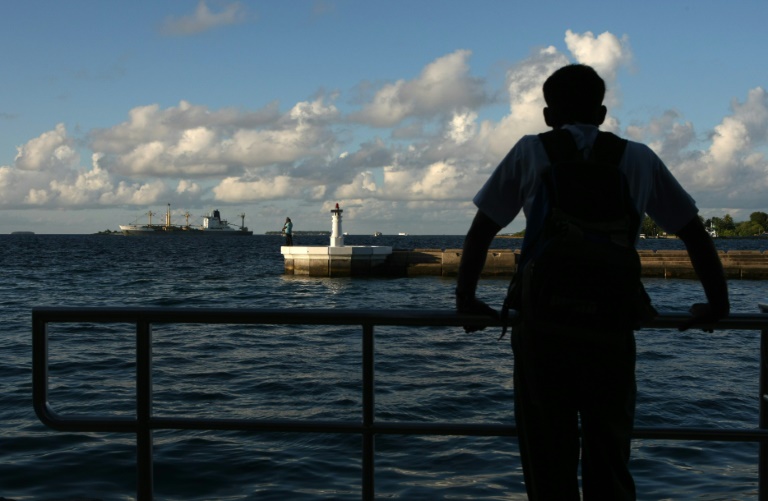
If rising seas engulf the Maldives and Tuvalu, will those countries be wiped off the map? And what happens to their citizens?

The prospect is no longer science fiction as global warming gathers pace, posing an unprecedented challenge to the international community, and threatening entire peoples with the loss of their land and identity.

“This is the biggest tragedy that a people, a country, a nation can face,” Mohamed Nasheed, former president of the Maldives, told AFP.

According to UN climate experts, sea levels have already risen 15 to 25 cm (six to 10 inches) since 1900, and the pace of rise is accelerating, especially in some tropical areas.

If warming trends continue, the oceans could rise by nearly one additional meter (39 inches) around the Pacific and Indian Ocean islands by the end of the century.

This is still below the highest point of the smallest, flattest island states, but rising seas will be accompanied by an increase in storms and tidal surges: Salt contamination to water and land will make many atolls uninhabitable long before they are covered over by the sea.

According to a study cited by the UN’s Intergovernmental Panel on Climate Change, five nations (the Maldives, Tuvalu, the Marshall Islands, Nauru and Kiribati) may become uninhabitable by 2100, creating 600,000 stateless climate refugees.

– ‘Legal fiction’ –

It is an unprecedented situation. States have, of course, been wiped off the map by wars. But “we haven’t had a situation where existing states have completely lost territory due to a physical event, or events, like sea-level rise, or severe weather events,” noted Sumudu Atapattu, of the University of Wisconsin in Madison.

But the 1933 Montevideo Convention on the Rights and Duties of States, a reference on the subject, is clear: A state consists of a defined territory, a permanent population, a government and the capacity to interact with other states. So if the territory is swallowed up, or no one can live on what is left of it, at least one of the criteria falls.

“The other thing that I argue is that statehood is a fiction, legal fiction we created for purposes of international law. So we should be able to come up with another fiction to encompass these deterritorialized states,” Atapattu added.

That is the idea behind the “Rising Nations” initiative launched in September by several Pacific governments: “convince members of the UN to recognize our nation, even if we are submerged under water, because that is our identity,” the prime minister of Tuvalu, Kausea Natano, explained to AFP.

Some people are already thinking about how these Nation-States 2.0 might work.

“You could have land somewhere, people somewhere else, and government in the third place,” Kamal Amakrane, managing director of the Global Centre for Climate Mobility at Columbia University, told AFP.

This would first require a “political declaration” by the UN, then a “treaty” between the threatened state and a “host state,” ready to receive the government in exile in a kind of permanent embassy. The population, which might be in that state or even a different one, would then have dual nationality.

Amakrane, a former UN official, also draws attention to an ambiguity in the Montevideo Convention: “When you speak about territory, is it dry or wet territory?”

– Humans ‘are so ingenious’ –

With 33 islands scattered over 3.5 million square kilometers (1.3 million square miles) in the Pacific, Kiribati, tiny in terms of land area, has one of the largest exclusive economic zones (EEZs) in the world.

If this maritime sovereignty were preserved, then a state would not disappear, some experts say.

While some islets are already being engulfed as shorelines recede, freezing the EEZs would preserve access to vital resources.

In an August 2021 declaration, the members of the Pacific Islands Forum, including Australia and New Zealand, proclaimed that their maritime zones “shall continue to apply, without reduction, notwithstanding any physical changes connected to climate change-related sea level rise.” 

But even with rising ocean levels, some would simply not consider leaving their threatened country.

“Human beings are so ingenious, they will find floating ways… to live exactly in this location,” says Nasheed, the Maldives’ former leader, suggesting people could resort to floating cities.

How these states would find resources for such projects is unclear. The question of financing the “loss and damage” caused by the impacts of global warming will be a burning issue at COP27 in Egypt in November.

Even as experts like Amakrane defend “the right to remain” for people who don’t want to leave their heritage, he adds: “You always need to have a plan B.”

In this vein, he has called for launching “as soon as possible” a “political” process to preserve the future of uninhabitable states, “because it gives hope to people.”

Otherwise, he warns, the current state of uncertainty “creates bitterness and disarray, and with that, you kill a nation, a people.”
To save California coasts, scientists turn to the humble oyster

There are no pearls growing on the oyster reefs in San Diego Bay, but scientists hope they will yield an even more valuable treasure: protection against coastal erosion wrought by rising sea levels.

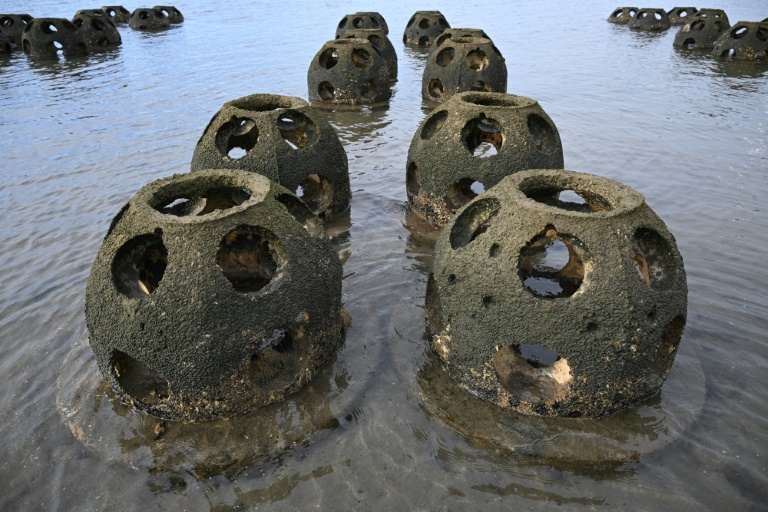
Thousands of the tiny mollusks have begun growing on the artificial reefs dropped in the bay as part of a plan to mitigate damage in California’s far south.

“We look at numerous different ways to help combat sea-level rise, and these reef balls are one of the tools in our toolbox to do that,” Eileen Maher, director of environmental conservation at the Port of San Diego, told AFP. 

The port implanted 360 structures last December, along a peninsula wedged between the salt marshes of Southern California and the Coronado peninsula — home to the naval air base that inspired “Top Gun.”

These hemispheres weigh 300 pounds (135 kilograms) and look like huge thimbles.

They are made from a mixture of cement, sand and crushed oyster shells — a crucial ingredient that attracts living oysters to make their home there.

After 10 months in the water, the reefs are covered with a greenish silt, which hides thousands of still-microscopic oysters, says Maher.  

Eventually, the dozen scientists working on this pilot project hope to see the formation of real oyster reefs, which they believe will have a genuine impact on their local environment.

– Miniature filters –

The reefs are much more than a natural bulwark against tidal erosion; their bivalve occupants are all miniature filtration plants that are essential to the marine ecosystem.  

That’s because to capture the nutrients an oyster needs to survive, each one filters around 50 gallons (190 liters) of water every day, said Maher. 

“They help remove that turbidity out of the water and help clean the water, which will provide additional benefits to eelgrass, the submerged aquatic vegetation,” she said.

“The more eelgrass sits in the bay, the less chance there is of the shoreline eroding, because it helps — any plant will help prevent shorelines from eroding.”

And like the oysters, these long-filament seagrass beds will also provide a crucial food source for the 80 species of fish and 300 varieties of birds that make their home in the area.

– Flooding and erosion –

By 2050, sea levels around California are expected to have risen 20 centimeters (eight inches), according to a National Oceanic and Atmospheric Administration (NOAA) study released early this year.  

This would drastically increase the frequency of flooding on the West Coast, which will also occur more often due to storms and heavy rainfall events exacerbated by human-caused climate change. 

And rising seas will worsen the erosion that threatens California’s coastline. 

Around San Diego, this future is already apparent.

To the south, the streets of Imperial Beach are regularly flooded during high tides. An hour’s drive to the north, the rail line that carries the “Pacific Surfliner” has just been closed at San Clemente, where the rocks that support it are sinking because of erosion. 

In this context, “We have to make sure that we’re resilient,” said Jason Giffen, vice president of planning and environment for the Port of San Diego. 

The $1.3 million oyster reef project is being evaluated over five years. Similar schemes have been established in San Francisco and New York.

The oyster barriers work only in areas of shallow water, Giffen said.

Elsewhere, the port is exploring other solutions. 

In the northern part of the bay, small hollow reinforcements have been attached to the piers.

They not only offer stability but provide refuge to algae, fish and shellfish, helping to bolster biodiversity.

Currently, about 70 percent of the shoreline around San Diego Bay has some type of artificially contructed rock protection.

“We can look at replacing in the long run that infrastructure with something that’s more biologically and environmentally sensitive and actually would be a value-add in terms of environmental quality,” said Giffen.

To save California coasts, scientists turn to the humble oyster

There are no pearls growing on the oyster reefs in San Diego Bay, but scientists hope they will yield an even more valuable treasure: protection against coastal erosion wrought by rising sea levels.

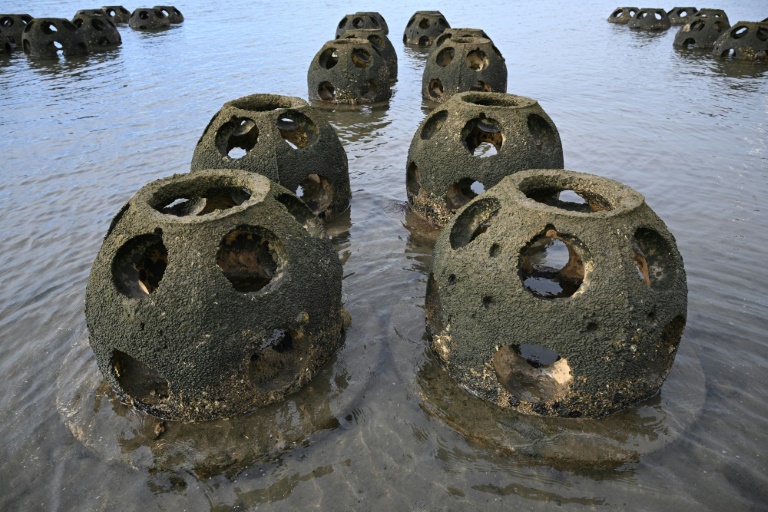
Thousands of the tiny mollusks have begun growing on the artificial reefs dropped in the bay as part of a plan to mitigate damage in California’s far south.

“We look at numerous different ways to help combat sea-level rise, and these reef balls are one of the tools in our toolbox to do that,” Eileen Maher, director of environmental conservation at the Port of San Diego, told AFP. 

The port implanted 360 structures last December, along a peninsula wedged between the salt marshes of Southern California and the Coronado peninsula — home to the naval air base that inspired “Top Gun.”

These hemispheres weigh 300 pounds (135 kilograms) and look like huge thimbles.

They are made from a mixture of cement, sand and crushed oyster shells — a crucial ingredient that attracts living oysters to make their home there.

After 10 months in the water, the reefs are covered with a greenish silt, which hides thousands of still-microscopic oysters, says Maher.  

Eventually, the dozen scientists working on this pilot project hope to see the formation of real oyster reefs, which they believe will have a genuine impact on their local environment.

– Miniature filters –

The reefs are much more than a natural bulwark against tidal erosion; their bivalve occupants are all miniature filtration plants that are essential to the marine ecosystem.  

That’s because to capture the nutrients an oyster needs to survive, each one filters around 50 gallons (190 liters) of water every day, said Maher. 

“They help remove that turbidity out of the water and help clean the water, which will provide additional benefits to eelgrass, the submerged aquatic vegetation,” she said.

“The more eelgrass sits in the bay, the less chance there is of the shoreline eroding, because it helps — any plant will help prevent shorelines from eroding.”

And like the oysters, these long-filament seagrass beds will also provide a crucial food source for the 80 species of fish and 300 varieties of birds that make their home in the area.

– Flooding and erosion –

By 2050, sea levels around California are expected to have risen 20 centimeters (eight inches), according to a National Oceanic and Atmospheric Administration (NOAA) study released early this year.  

This would drastically increase the frequency of flooding on the West Coast, which will also occur more often due to storms and heavy rainfall events exacerbated by human-caused climate change. 

And rising seas will worsen the erosion that threatens California’s coastline. 

Around San Diego, this future is already apparent.

To the south, the streets of Imperial Beach are regularly flooded during high tides. An hour’s drive to the north, the rail line that carries the “Pacific Surfliner” has just been closed at San Clemente, where the rocks that support it are sinking because of erosion. 

In this context, “We have to make sure that we’re resilient,” said Jason Giffen, vice president of planning and environment for the Port of San Diego. 

The $1.3 million oyster reef project is being evaluated over five years. Similar schemes have been established in San Francisco and New York.

The oyster barriers work only in areas of shallow water, Giffen said.

Elsewhere, the port is exploring other solutions. 

In the northern part of the bay, small hollow reinforcements have been attached to the piers.

They not only offer stability but provide refuge to algae, fish and shellfish, helping to bolster biodiversity.

Currently, about 70 percent of the shoreline around San Diego Bay has some type of artificially contructed rock protection.

“We can look at replacing in the long run that infrastructure with something that’s more biologically and environmentally sensitive and actually would be a value-add in terms of environmental quality,” said Giffen.

Hurricane Julia slams Nicaragua, menaces Central America

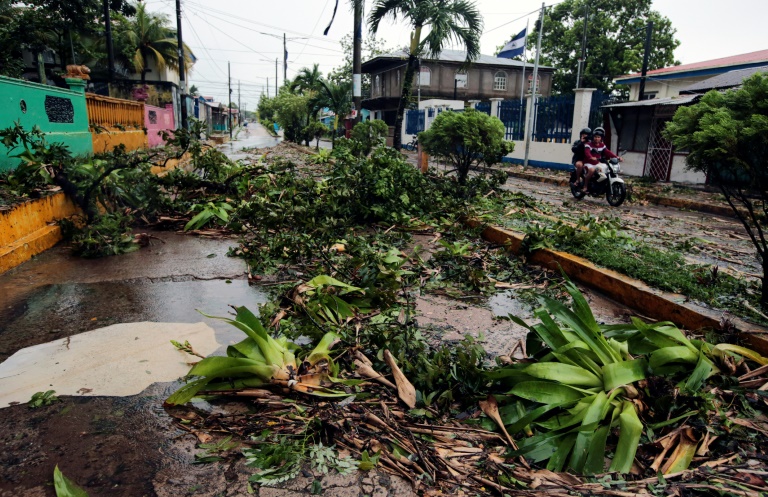
Hurricane Julia raked across Nicaragua Sunday, lashing the country with winds and heavy rain and bringing potentially life-threatening flash flooding and mudslides to much of Central America and southern Mexico.

Maximum sustained winds were estimated at 85 miles (140 kilometers) per hour when the storm made landfall near the Laguna de Perlas area at 0715 GMT, the country’s weather agency said.

By midday, the fifth Atlantic hurricane of the season had weakened to a tropical storm with top sustained winds of nearly 60 miles per hour as it churned westward across Nicaragua, unleashing a dangerous storm surge along the coast, damaging homes in the country’s interior and leaving some towns incommunicado.

“It’s still raining, water has surrounded us, we have been without power and water since early morning, several houses are without roofs and many trees are down on the road,” Julio Hernandez, a resident of Rio Blanco, in central Nicaragua, told AFP.

The country was on high alert, with civil defense brigades helping to clear fallen trees from roads and watch for flooding in coastal towns and mountain villages. No fatalities have been reported.

But the US National Hurricane Center warned that Julia, whose center passed over the Central American isthmus into the eastern Pacific ocean Sunday night, was still packing a punch, not just for Nicaragua but for neighboring countries.

“Heavy rainfall with a risk of life-threatening flash floods and mudslides to continue across Central America and southern Mexico through Tuesday,” the NHC said.

– ‘We have to prepare’ –

Maintaining its tropical storm strength, Julia is forecast to produce five to 10 inches (12.7 to 25.4 centimeters) of rain in Nicaragua and El Salvador, with isolated pockets receiving as much as 15 inches.

Hours earlier in Bluefields, Nicaragua, one of the main coastal towns buffeted by the storm, fishermen had been busy safeguarding their boats as people rushed to buy groceries and withdraw money from ATMs.

Hurricane-force winds and heavy rains began to be felt around midnight, according to AFP photographers in the city, while reports detailed detached roofs, fallen trees and power outages.

Before reaching Nicaragua, Julia passed over a trio of Colombian islands, an environment ministry official told AFP, causing rain and lightning in the country’s north.

Julia was a Category 1 hurricane, on the low side of the five-tier Saffir-Simpson wind scale, when it roared ashore in Nicaragua.

Authorities have evacuated some 6,000 people in Laguna de Perlas, in the Miskito keys located off the coast, and in other zones, and dozens of storm shelters were set up in schools.

“We have to prepare with food, plastic, a little bit of everything, because we don’t know what’s going to happen,” Javier Duarte, a cabinetmaker in Bluefields, told AFP.

The municipality of some 60,000 inhabitants has many flimsy structures. By mid-morning, telephone communications were knocked out.

Julia’s arrival in Central America comes less than two weeks after deadly Hurricane Ian crashed into the southeastern US state of Florida as one of the most powerful US hurricanes on record.

The Category 4 storm flattened entire neighborhoods on the Sunshine State’s southwest coast. More than 100 people were killed, according to US media.

Climate change is increasing the temperature of ocean surface layers, which generates more powerful and wetter storms, according to experts.

Asian markets sink as US jobs data fan rate hike bets

Asian markets sank Monday as forecast-beating US jobs data fanned expectations for another big Federal Reserve interest rate hike, while traders are now focusing on an upcoming inflation report.

A brief rally across trading floors last week gave way to gloom as investors grow increasingly worried that central bank efforts to tame runaway prices will plunge the global economy into recession.

Adding to the stress is the upcoming corporate earnings season, which many fear will show that companies are feeling the pain of tightening monetary policies.

All three main indexes tumbled Friday — with the Nasdaq off almost four percent — following news that a net 263,000 US jobs were created in September.

While that was down from August it was more than expected and showed that the labour market remained robust and highlighted the tough job Fed officials face in their battle against four-decade-high inflation. 

With the spotlight on a consumer price index reading later in the week, policymakers continue to take a hawkish tone, warning they will not ease up on their rate hikes even if that means causing a recession.

“The real question for the market is whether one step down in core CPI will be enough to change the tone around inflation,” said SPI Asset Management’s Stephen Innes.

“Given the sharp increase in cross-asset correlations and breakdown in risk assets, it seems like that would be too much to hope for.”

Asia tracked the US losses, with Hong Kong down more than two percent, while there was also hefty selling in Sydney, Singapore, Manila, Jakarta and Wellington. 

Shanghai dropped as traders returned from a weeklong holiday, with rising Covid numbers in the country leading to worries of more economically painful lockdowns ahead of a key Communist Party gathering.

Tokyo, Seoul and Taipei were closed.

Innes added that there was also nervousness about earnings.

“Unlike June, where earnings were poised to beat expectations, investors are biased towards hitting the sell button as concern around lagged effects of tightening hitting bottom lines now permeate expectations,” he said in a note.

The prospect of higher US borrowing costs sent the dollar rallying Friday and it held most of those gains in early Asian trade.

Investors are keeping an eye on the yen, which is edging back to the lows touched last month when the government stepped in with a massive cash injection to support the currency.

Oil prices edged down after seeing their biggest weekly gain since March in reaction to a decision by OPEC and other major producers led by Russia to cut output by two million barrels a day.

The drop Monday came on demand concerns caused by China’s Covid flare-ups and more weak data out of Beijing caused by recent lockdowns.

“A slew of weak macroeconomic data that China has released shows that there is very limited room for an economic rebound in the short term, which is hard to provide support for earnings and market confidence,” Shen Meng, at investment bank Chanson & Co in Beijing, said.

– Key figures around 0230 GMT –

Hong Kong – Hang Seng Index: DOWN 2.4 percent at 17,316.13 

Shanghai – Composite: DOWN 0.7 percent at 3,003.77

Tokyo – Nikkei 225: Closed for a holiday

Pound/dollar: UP at $1.1102 from $1.1082 on Friday

Euro/dollar: UP at $0.9747 from $0.9743

Euro/pound: DOWN at 87.79 pence from 87.97 pence

Dollar/yen: UP at 145.43 yen from 145.38 yen

West Texas Intermediate: DOWN 0.5 percent at $92.19 per barrel

Brent North Sea crude: DOWN 0.5 percent at $97.47 per barrel

New York – Dow: DOWN 2.1 percent at 29,296.79 (close)

London – FTSE 100: DOWN 0.1 percent at 6,991.09 (close)

— Bloomberg News contributed to this story —

Parkland school shooter in US to learn his fate: death or life in prison

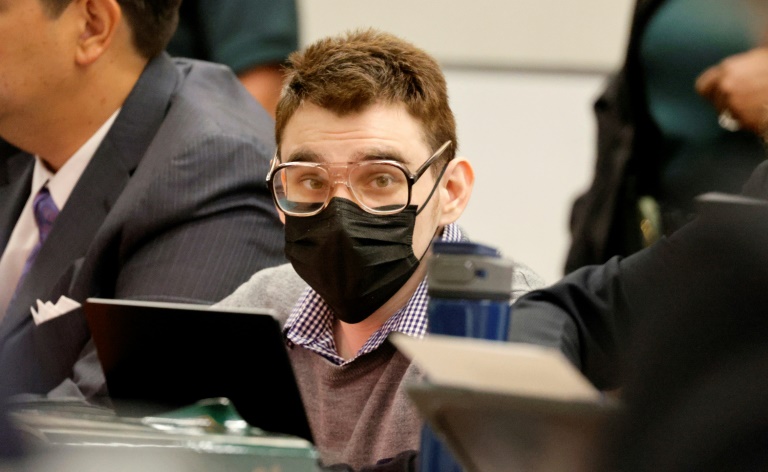
Nikolas Cruz, the man who shot and killed 17 people at a Florida high school in 2018, will learn his fate in the next few days, when a jury decides between life in prison and execution.

Cruz has pleaded guilty to the massacre, so all that remains after nearly three months of often disturbing testimony is for the jury to decide on his punishment.

It has been a gut-wrenching experience for relatives of those gunned down at Marjory Stoneman Douglas High School in Parkland, a town north of Miami. 

Lawyers defending Cruz, who is now 24, will present their final arguments on Tuesday. Jury deliberations begin the following day.

If the jury of seven men and five women does not vote unanimously for capital punishment, Cruz will be sentenced to life in prison with no possibility of parole.

On February 14, 2018, the then 19-year-old Cruz walked into the school carrying a high-powered AR-15 rifle. He had been expelled from the school a year earlier for disciplinary reasons.

In a matter of nine minutes, he killed 14 students and three school employees, then fled by mixing in with people frantically escaping the gory scene.

Police arrested Cruz shortly thereafter as he walked along the street.

– Cold-blooded killer or troubled kid? –

The next few days in the Fort Lauderdale courtroom will show whether the prosecution, led by Michael Satz, or the defense, under Melisa McNeill, has laid out a more persuasive case.

McNeill, a public defender, centered her strategy on Cruz’s traumatic childhood. She argued that he was born with fetal alcohol stress disorder because his mother, who was homeless, drank heavily while pregnant with him. She also used drugs.

“He was poisoned in the womb,” McNeill told the court back in August. “His brain was irretrievably broken, through no fault of his own.”

Cruz’s birth mother gave him up in a brokered private adoption, McNeill said, but his adoptive mother also became an alcoholic, and he grew up in a broken home.

Cruz told the court that a family friend abused him sexually at age nine, and McNeill said his developmental and behavioral problems were never properly addressed.

Given the challenges he faced, she said, life in prison was a more appropriate punishment than execution.

Prosecutors, however, argued that Cruz knew exactly what he was doing when he walked into the school with a semi-automatic rifle and several ammunition clips.

Satz has said Cruz carried out a “cold, calculated, manipulative and deadly” act — one he had announced in a video taped three days earlier.

Satz played a video of the shooting recorded by another student. Screams, cries and moans were punctuated by multiple shots as terrified students sought cover from bullets blasting through the classroom door.

Several anguished relatives of the victims fled the courtroom as the video was played, while others wept openly and hugged their loved ones.

Satz called former students who had witnessed the shooting to testify, and organized a trip for the jury to visit the school.

The prosecutor tried to discredit the idea that Cruz suffered from fetal alcohol syndrome. He elicited testimony from a neuropsychologist, Robert Denney, who accused Cruz of faking brain problems by intentionally doing poorly on psychological tests.

Denney argued that the very fact that Cruz acted with premeditation showed that he understands reality and can control his actions. 

– Gun control –

The shooting stunned the nation and reignited debate on gun control, since Cruz had legally purchased the gun he used, despite his history of mental issues.

On March 24, 2018, nationwide marches inspired by school shooting survivors and parents of victims brought together 1.5 million people — the largest public turnout ever in defense of stricter gun control laws in America.

But the Parkland shooting prompted no significant reform and gun sales have continued to rise.

There have been more mass shootings, including one in Uvalde, Texas, in May that left 19 young children and two adults dead at an elementary school.

After the latest shootings, Congress did pass legislation to increase funding for school security and mental health care.

England's Shadoff takes wire-to-wire LPGA Mediheal title

England’s Jodi Ewart Shadoff captured her first career LPGA title on Sunday, holding off a host of rivals for a wire-to-wire triumph at the LPGA Mediheal Championship.

Shadoff fired a one-under par 71 to finish 72 holes on 15-under 273 for a one-stroke victory at The Saticoy Club in Somis, west of Los Angeles.

The 34-year-old Briton made her victory breakthrough in her 246th career LPGA start.

“Surreal,” Shadoff said of the feeling. “I’ve waited a long time for this. There have been many times in my career I didn’t think this was ever going to happen so really grateful in this moment.”

Japan’s Yuka Saso made a late charge to shoot 66 and finish second on 274 with fast-closing Georgia Hall of England, late co-leader Paula Reto of South Africa and American Danielle Kang sharing third on 275.

World number 93 Shadoff had not won a title in 12 LPGA seasons but was third at June’s ShopRite Classic, her best result since a runner-up effort at the 2017 British Women’s Open.

After battling injuries and self-doubt, Shadoff can finally say she’s an LPGA champion.

“I’ve been through a lot in the past couple of years, injuries, and last year was really tough. I found it a pretty significant mental challenge to get through that,” Shadoff said.

“There were times during last year I didn’t think I would be playing this year so to be stood here today is really awesome. I didn’t give up on myself. I have a lot to be grateful for.”

Shadoff began the day after a restless night with a four-stroke lead but bogeys at the third and at the par-3 ninth after a birdie at the par-5 eighth left her in a fight for the crown.

“That four-shot lead quickly diminished,” she said. “I tried to stay in the moment and commit to every shot I was hitting.”

She responded with birdies at the 12th and par-5 14th and parred her way to the clubhouse, claiming the trophy with a tap-in par at 18.

“That last one-footer felt like 20 feet to me,” Shadoff said.

Reto, who won her first LPGA title in August at the Canadian Women’s Open, birdied four of the first eight holes and seized the lead and another birdie at 14 kept her level with Shadoff late but bogeys at 16 and 17 dropped her two adrift and that’s where she finished.

“Good start, which was nice,” Reto said. “When I got to the back nine I started slowing down and a couple shots got away from me.”

Saso, who began the day six off the pace, eagled the par-5 eighth, birdied 14 and birdied each of the last three holes but it was only good enough to grab second.

“I made some putts. I gave myself a chance,” Saso said. “I’ll just keep doing what I’m doing and have fun.”

Hall birdied five of the last seven holes and both par-5 holes on the front nine to shoot 65, but couldn’t deny her compatriot the crown.

“I was really pleased the way I finished,” Hall said. “I’ve always had good chances at birdies.”

Weinstein sex assault trial to open in Los Angeles

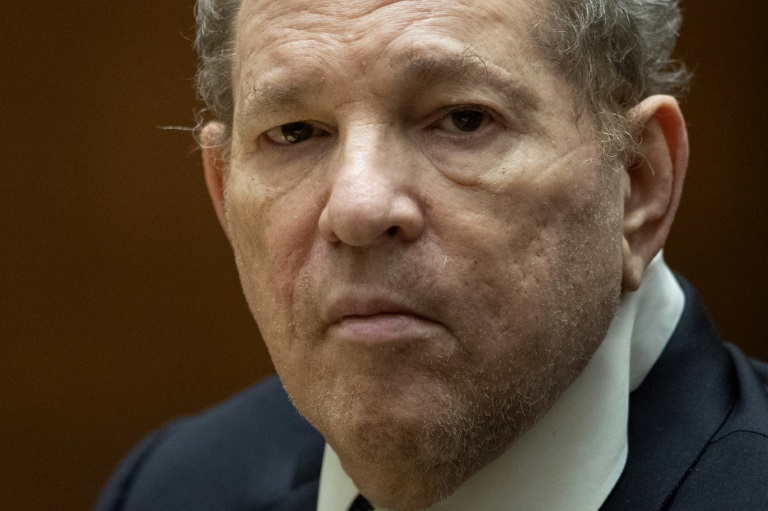
Disgraced Hollywood mogul Harvey Weinstein goes on trial in Los Angeles on Monday, where he faces charges in the city whose main industry he dominated for decades.

The 70-year-old “Pulp Fiction” producer is already serving 23 years in jail in New York after being convicted there of a series of sex crimes.

He now faces 11 more charges including sexual battery by restraint, forcible rape and forcible oral copulation against women in Beverly Hills and Los Angeles hotels between 2004 and 2013, in a trial expected to last two months.

If convicted, Weinstein — who has pleaded not guilty to all counts — could be sentenced to 140 additional years behind bars.

Jury selection was set to begin Monday in a downtown Los Angeles court.

Widespread sexual abuse and harassment allegations against Weinstein exploded in October 2017, and his conviction in New York in 2020 was a landmark in the #MeToo movement.

In June, he lost a bid to have that sex crimes conviction overturned. He has also been separately charged by British prosecutors with the 1996 indecent assault of a woman in London.

In total, nearly 90 women, including Angelina Jolie, Gwyneth Paltrow and Salma Hayek, have accused Weinstein of harassment or assault. 

He says that all his sexual encounters were consensual, and his lawyer told reporters that the Los Angeles accusations “stem from many years ago” and cannot “be substantiated or corroborated by any forensic evidence” or “credible witnesses.”

The New York Film Festival this week will premiere “She Said,” a film about the 2017 newspaper investigation into Weinstein that sparked the demise of his movie empire.

Before the allegations against him emerged, the producer and his brother Bob were Hollywood’s ultimate power players.

They co-founded Miramax Films, a distribution company named after their mother Miriam and father Max, in 1979. It was sold to Disney in 1993.

Their hits included 1998’s “Shakespeare in Love,” for which Weinstein shared a best picture Oscar. Over the years, Weinstein’s films received more than 300 Oscar nominations and 81 statuettes.

22 dead, more than 50 missing in Venezuela landslide

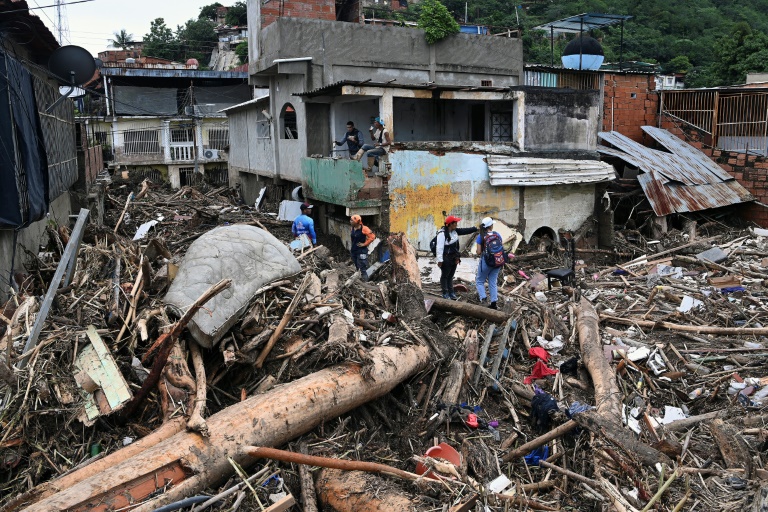
A landslide in central Venezuela left at least 22 people dead and more than 50 missing after a river overflowed, officials said Sunday, in the latest deadly disaster caused by heavy rains to hit the country. 

Dozens of people have died in recent months in the crisis-hit South American nation as a result of historically high precipitation.

“We are seeing very significant damage here, human losses: so far, we have already found 22 dead, there are more than 52 people missing,” Vice President Delcy Rodriguez told local media at the scene in the town of Las Tejerias. “We are working to find these people.”

Houses and businesses were destroyed and felled trees littered the town’s streets, which were covered with mud and debris, including splintered wood, household items and mangled cars.

“The village is lost. Las Tejerias is lost,” 55-year-old resident Carmen Melendez, who has lived her whole life in the town 50 kilometers (30 miles) from the capital, Caracas, in Aragua state, told AFP.

Around a thousand people had joined the rescue efforts, Interior and Justice Minister Remigio Ceballos told AFP, as he also worked at the site.

Local residents dug through the remains of battered homes looking for loved ones, while search teams arrived with dogs hoping to find survivors trapped in the rubble. 

A butcher shop that had closed due to the pandemic and which was due to reopen Monday was buried in muddy sediment that caked the refrigerators and everything else inside. 

“We were waiting for the meat to be shipped in — to start after two years closed,” said Ramon Arvelo, one of the workers who was helping remove mud. 

“I never thought that something of this magnitude could happen; it’s a really big deal,” said Loryis Verenzuela, 50, as she looked out at the devastation through tears.

– Record rain –

“We have a huge landslide as a result of the changing climate,” Ceballos said, referring to the effects of Hurricane Julia, which passed just north of Venezuela the night before. 

“There was a record rainfall,” he added as he surveyed the disaster site — as much rain in one day as is usually seen in one month. 

“These strong rains saturated the ground,” he said. 

Images taken by rescue teams’ drones showed huge amounts of earth piled up in the streets as residents had tried to shovel out the meters of mud that flowed into their houses. 

President Nicolas Maduro declared three days of national mourning for the victims, while Venezuelans took to social media to offer assistance to the town.

Caracas baseball team Los Leones said they would organize a collection for the victims, asking for “non-perishable foods, water and clothes.”

The landslide, caused by the biggest river flood in the area in 30 years, is the worst so far this year in Venezuela, which has seen historic rain levels in recent months. 

In August, at least 15 people died in the Venezuelan Andes after heavy rains triggered mud and rock slides.

And in September, at least eight people died when floods from intense rains flowed through a religious retreat in the western part of the country.

In 1999, huge landslides killed some 10,000 people in the state of Vargas, north of Caracas.

Instagram, Twitter restrict Kanye West accounts over posts deemed anti-Semitic

Instagram and Twitter said they have restricted the accounts of US rapper Kanye West over posts slammed as anti-Semitic.  

A spokeswoman for Twitter told AFP on Sunday that West’s account was locked due to a violation of the social media platform’s policies. 

And a spokesperson for Instagram parent Meta told AFP the group had deleted content — without specifying which posts — from West’s account for violating its rules.

Instagram also restricted his account, which may involve preventing him from posting, commenting or sending private messages, according to the same source.

In the tweet, which is no longer visible on West’s account, the rapper said, “I’m a bit sleepy tonight but when I wake up I’m going death con 3 On JEWISH PEOPLE,” in apparent reference to a US military readiness code known as DEFCON.

The restrictions come after West, a Black artist who now goes by Ye, stirred controversy by wearing a “White Lives Matter” T-shirt during the recent Paris Fashion Week, in a misappropriation of the slogan “Black Lives Matter.”

The phrase “Black Lives Matter” became a rallying cry for protests against racism and police brutality sparked by the 2020 murder of George Floyd.

On Friday, 45-year-old West posted screen shots on Instagram of a conversation with rapper Diddy, who called out West over the T-shirt and its message.

“Ima use you as an example to show the Jewish people that told you to call me that no one can threaten or influence me. I told you this was war. Now gone get you some business,” he wrote. The posts have since been deleted from the platform but images can still be found online. 

He then said on Twitter that he would target Jewish people in a post that has been blocked by the platform for violating its rules. 

The American Jewish Committee (AJC) hit out at West for having “fomented hatred of Jews.” 

“Kanye West should figure out how to make a point without using antisemitism,” the organization said.

No stranger to controversy, West, who has been open about his struggles with bipolar disorder, was previously banned from posting on Instagram for 24 hours in March, amid an acrimonious divorce from reality TV star Kim Kardashian.

Earlier this week, German sportswear giant Adidas said it was reconsidering its partnership with West after he reportedly became disgruntled with how the brand was marketing his products.

Last month, West and retail brand Gap also announced an end to a partnership.

Close Bitnami banner
Bitnami