
AFP

Deal reached for civil aviation to try for net-zero emissions by 2050

UN aviation agency members reached an agreement Friday to try to achieve by 2050 net-zero carbon emissions in air travel — often criticized for its outsized role in climate change.

The assembly, which brought together representatives from 193 nations at the International Civil Aviation Organization’s Montreal headquarters, reached a “historic agreement on a collective long-term aspirational goal (LTAG) of net-zero carbon emissions by 2050!” the UN agency said in a Twitter message.

It added that it “continues to advocate for much more ambition and investment by states to ensure aviation is fully decarbonized by 2050 or earlier.”

“It’s an excellent result,” a diplomatic source told AFP, revealing that that only four countries — including China, the main thrust of global growth in air travel — “had expressed reservations.”

The air transportation industry has faced growing pressure to deal with its outsized role in the climate crisis.

Currently responsible for 2.5 percent to three percent of global CO2 emissions, the sector’s switch to renewable fuels is proving difficult, even if the aeronautics industry and energy companies are seeking progress.

The International Air Transport Association (IATA) said airlines were “strongly encouraged” by the adoption of the climate goal, coming one year after the organization endorsed the same position at its own general meeting.

IATA director general Willie Walsh said now “we expect much stronger policy initiatives in key areas of decarbonization such as incentivizing the production capacity of sustainable aviation fuels.”

According to airlines, it will require investments of $1.5 billion between 2021 and 2050 to decarbonize aviation.

“The global aviation community welcomes this landmark agreement,” said Luis Felipe de Oliveira, the head of Airports Council International, which represents 1,950 airports in 185 countries.

“This is a watershed moment in the effort to decarbonize the aviation sector with both governments and industry now heading in the same direction, with a common policy framework,” he said in a statement.

– Deal is non-binding –

The agreement, however, was far from satisfying for some non-governmental groups expressing regret it didn’t go far enough and was not legally binding.

Planes attract particularly sharp criticism because only about 11 percent of the world’s population fly each year, according to a widely quoted 2018 study by Nordic researchers.

In addition, 50 percent of airline emissions come from the one percent of travelers who fly the most, it found.

“This is not the aviation’s Paris agreement moment. Let’s not pretend that a non-binding goal will get aviation down to zero,” said Jo Dardenne of NGO Transport & Environment.

She also expressed disappointment over tweaks considered by delegates to the sector’s carbon offsetting and reduction scheme, known as CORSIA.

During the 10-day meeting, Russia had also sought but failed to get enough votes to be re-elected to the UN organization’s governing council, which is responsible for ensuring compliance with aviation rules.

Russia was accused of breaking international rules by registering hundreds of leased planes at home rather than returning them, as required by sanctions imposed after its invasion of Ukraine in February.

The ICAO general meeting was the first since the start of the pandemic, which had brought the airline industry to its knees: in 2021 the number of airline passengers was only half the 4.5 billion in 2019, marking a small rebound from the 60 percent year-over-year drop in 2020.

The sector hopes in 2022 to see to 83 percent of its customer levels from three years ago and to become profitable again worldwide next year.
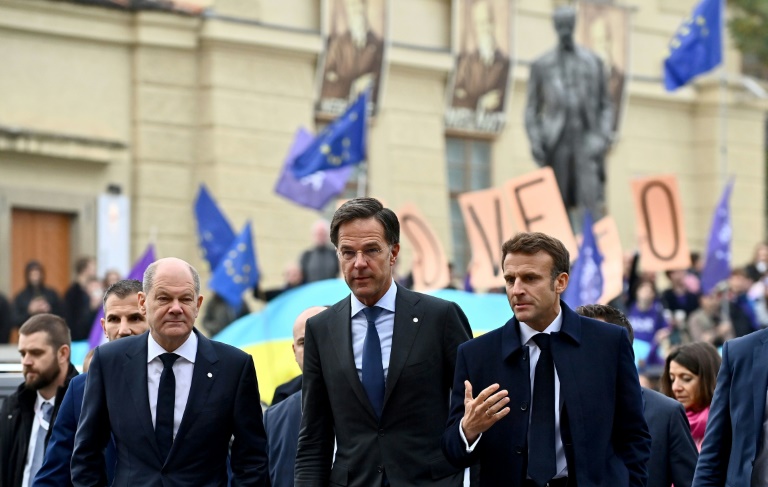

EU leaders struggle for answer to Putin's 'energy missile'

EU leaders wrestled on Friday to come up with a plan to tackle soaring energy costs as they struggled with the fallout from Russia’s war on Ukraine at a summit in Prague. 

President Volodymyr Zelensky urged further sanctions on Moscow’s energy sector and more arms as the bloc looks to maintain its backing for Ukraine and hold a tough line against the Kremlin.

“We must be strong – until our common victory, to preserve all that we value so much,” Zelensky told the leaders by videolink. 

“We must invest now in our defence, in our security, in our cooperation as much as possible.”

The leaders also discussed ways to better protect their critical infrastructure in the wake of leaks from the Russia-Europe Nord Stream gas pipelines that have been blamed on “sabotage”.

But it was the sharp disagreements over how to tackle the energy crisis that were the major focus of attention as the 27 nations wrangled over the best plan to try to bring down prices.

Europe is facing an energy crunch as the cost of electricity generation skyrockets because of a massive surge in gas prices caused by Russia turning off the taps.

“Russia has fired an energy missile at the European continent and the world,” European Council head Charles Michel said. 

Governments across the bloc are scrambling to lower bills for their consumers, but they rely on different sources for their energy and are split over the solutions.

EU executive head Ursula von der Leyen is proposing a “roadmap” of measures to help ease the burden — including potential moves to cap the price of gas. 

However, there is no consensus on how any caps could work and leaders are not set to take a firm decision until a summit in Brussels later this month.  

“We will have a lot of work this autumn and winter and it will not be easy,” German Chancellor Olaf Scholz said.  

– Not ‘intimidated’ –

More than half of the bloc have pushed for the EU to impose a price ceiling on how much it would pay for gas piped or shipped in, as the northern hemisphere winter sets in.

But Germany has so far stood in the way over fears that the move could divert precious supplies away from Europe.

“A price cap on gas if that could be achieved would be grand, with the caveat that we cannot endanger security of supplies,” said Latvian Prime Minister Krisjanis Karins.

“We cannot set the price so that no one would sell gas into Europe.”

Berlin has come under fire from other EU members for dragging its feet on the issue while announcing a 200-billion-euro ($199-billion) fund to subsidise gas purchases at home.

“My message to Germany is be united with all the others because during difficult times everybody has to agree on a common denominator,” Polish Prime Minister Mateusz Morawiecki said.

Despite some discontent from Hungary, the bloc has managed to remain largely united in its opposition to the Kremlin as Putin has escalated the conflict by claiming four occupied regions of Ukraine.

– ‘Ukraine needs support now’ –

A broader summit of 44 nations from across Europe held in Prague on Thursday highlighted Moscow’s isolation.

Michel insisted the EU does not “intend to be intimidated” after US President Joe Biden warned of the risk of nuclear “Armageddon” as Putin ratcheted up his threats. 

The bloc is looking to maintain its backing for Kyiv as Zelensky’s troops push Russian forces back on several fronts over seven months into the war. 

Ukraine is urging the EU to speed up much-needed economic support, after Brussels on Monday signed a memorandum of understanding to provide five billion euros.

On the military front, the bloc is planning to launch a training mission for Ukrainian forces later this month.

It is also eyeing a possible fresh tranche of funding for arms for Ukraine that would take its overall spending on weaponry to three billion euros.

French President Emmanuel Macron for his part announced Paris was setting up a special 100-million-euro fund to allow Kyiv to buy arms directly. 

“Ukraine needs our support not tomorrow, Ukraine needs support today, right now,” said Lithuanian President Gitanas Nauseda. 

Stocks slump, dollar boosted by US jobs data

Stocks slid and the dollar surged Friday after US jobs data showed only a timid slowdown in the labour market, setting the stage for further aggressive interest rate hikes. 

Equity markets have taken a battering in the past couple of months as the US Federal Reserve has made it clear it intends to continue aggressively raising interest rates until soaring inflation is tamed, even if that means sending the economy into a recession.

There was a brief rebound at the start of the week as investors hoped data pointing to an economic slowdown would allow the Fed to “pivot”, or slow down rate hikes.

However, the jobs report shows the US labour market is still robust, with hiring in the US economy slowing slightly in September, to a net gain of 263,000 jobs, from 315,000 in August. 

That was more than the consensus forecast for a net gain of 250,000, sending equities lower and the dollar higher. 

“Those hoping for a Fed pivot have been sorely disappointed with today’s job numbers, which have confirmed that US economy continues to rumble along quite well,” said Chris Beauchamp, chief market analyst at online trading platform IG.

“The latest bear market bounce has now begun to wilt as investors wearily return to expectations” of a couple more considerable rate hikes this year, followed by more in 2023. 

Wall Street was sharply lower in late morning trading, with the Dow sliding 1.5 percent. The broader S&P 500 index fell 2.0 percent and the tech-heavy Nasdaq Composite tumbled 2.8 percent.

In Europe, Frankfurt fell 1.6 percent and Paris shed 1.2 percent. London ended the day less than 0.1 percent lower. 

“Investors are simultaneously fretting that the fall in the pace of hirings indicates a slowing economy, but also that the better-than-expected data shows that the jobs markets hasn’t slowed enough to stop the Fed from hiking rates aggressively,” said markets analyst Susannah Streeter at Hargreaves Lansdown brokerage.  

– ‘Pivot party gang’ –

Rising interest rates boost the dollar as foreign investors seek to buy dollar-denominated debt. But high interest rates raise borrowing costs and dampen consumption, which are bad for companies and thus their share prices.

Stephen Innes at SPI Asset Management said it is “unsurprising to see solid dollar buying with stocks and gold tanking as the labour market strength should quieten any Fed pivot talk for now, if not deal a severe knockout blow to the pivot party gang.”

The next data point that the Fed, and investors, will be scrutinising is the consumer price index report next week.

Adding to unease on markets was a warning from US President Joe Biden that the world faced nuclear “Armageddon” for the first time since the 1962 Cuban missile crisis.

He told a Democratic Party fundraiser in New York that Russian President Vladimir Putin was “not joking” when he threatened to use nuclear weapons over the Ukraine war.

Elsewhere, oil prices jumped and were set for their biggest weekly gain since March after OPEC and other major producers led by Russia agreed to slash daily output by two million barrels.

– Key figures around 1530 GMT –

New York – Dow: DOWN 1.5 percent at 29,480.26 points

EURO STOXX 50: DOWN 1.7 percent at 3,375.46

London – FTSE 100: DOWN less than 0.1 percent at 6,991.09 (close)

Frankfurt – DAX: DOWN 1.6 percent at 12,273.00 (close)

Paris – CAC 40: DOWN 1.2 percent at 5,866.94 (close)

Tokyo – Nikkei 225: DOWN 0.7 percent at 27,116.11 (close)

Hong Kong – Hang Seng Index: DOWN 1.5 percent at 17,740.05 (close)

Shanghai – Composite: Closed for a holiday

Pound/dollar: DOWN at $1.1119 from $1.1161 on Thursday

Euro/dollar: DOWN at $0.9787 from $0.9794

Euro/pound: UP at 87.95 pence from 87.74 pence

Dollar/yen: UP at 145.20 yen from 145.11 yen

Brent North Sea crude: UP 3.0 percent at $97.28 per barrel

West Texas Intermediate: UP 3.4 percent at $91.49 per barrel

burs-rl/kjm

Stocks slump, dollar boosted by US jobs data

Stocks slid and the dollar surged Friday after US jobs data showed only a timid slowdown in the labour market, setting the stage for further aggressive interest rate hikes. 

Equity markets have taken a battering in the past couple of months as the US Federal Reserve has made it clear it intends to continue aggressively raising interest rates until soaring inflation is tamed, even if that means sending the economy into a recession.

There was a brief rebound at the start of the week as investors hoped data pointing to an economic slowdown would allow the Fed to “pivot”, or slow down rate hikes.

However, the jobs report shows the US labour market is still robust, with hiring in the US economy slowing slightly in September, to a net gain of 263,000 jobs, from 315,000 in August. 

That was more than the consensus forecast for a net gain of 250,000, sending equities lower and the dollar higher. 

“Those hoping for a Fed pivot have been sorely disappointed with today’s job numbers, which have confirmed that US economy continues to rumble along quite well,” said Chris Beauchamp, chief market analyst at online trading platform IG.

“The latest bear market bounce has now begun to wilt as investors wearily return to expectations” of a couple more considerable rate hikes this year, followed by more in 2023. 

Wall Street was sharply lower in late morning trading, with the Dow sliding 1.5 percent. The broader S&P 500 index fell 2.0 percent and the tech-heavy Nasdaq Composite tumbled 2.8 percent.

In Europe, Frankfurt fell 1.6 percent and Paris shed 1.2 percent. London ended the day less than 0.1 percent lower. 

“Investors are simultaneously fretting that the fall in the pace of hirings indicates a slowing economy, but also that the better-than-expected data shows that the jobs markets hasn’t slowed enough to stop the Fed from hiking rates aggressively,” said markets analyst Susannah Streeter at Hargreaves Lansdown brokerage.  

– ‘Pivot party gang’ –

Rising interest rates boost the dollar as foreign investors seek to buy dollar-denominated debt. But high interest rates raise borrowing costs and dampen consumption, which are bad for companies and thus their share prices.

Stephen Innes at SPI Asset Management said it is “unsurprising to see solid dollar buying with stocks and gold tanking as the labour market strength should quieten any Fed pivot talk for now, if not deal a severe knockout blow to the pivot party gang.”

The next data point that the Fed, and investors, will be scrutinising is the consumer price index report next week.

Adding to unease on markets was a warning from US President Joe Biden that the world faced nuclear “Armageddon” for the first time since the 1962 Cuban missile crisis.

He told a Democratic Party fundraiser in New York that Russian President Vladimir Putin was “not joking” when he threatened to use nuclear weapons over the Ukraine war.

Elsewhere, oil prices jumped and were set for their biggest weekly gain since March after OPEC and other major producers led by Russia agreed to slash daily output by two million barrels.

– Key figures around 1530 GMT –

New York – Dow: DOWN 1.5 percent at 29,480.26 points

EURO STOXX 50: DOWN 1.7 percent at 3,375.46

London – FTSE 100: DOWN less than 0.1 percent at 6,991.09 (close)

Frankfurt – DAX: DOWN 1.6 percent at 12,273.00 (close)

Paris – CAC 40: DOWN 1.2 percent at 5,866.94 (close)

Tokyo – Nikkei 225: DOWN 0.7 percent at 27,116.11 (close)

Hong Kong – Hang Seng Index: DOWN 1.5 percent at 17,740.05 (close)

Shanghai – Composite: Closed for a holiday

Pound/dollar: DOWN at $1.1119 from $1.1161 on Thursday

Euro/dollar: DOWN at $0.9787 from $0.9794

Euro/pound: UP at 87.95 pence from 87.74 pence

Dollar/yen: UP at 145.20 yen from 145.11 yen

Brent North Sea crude: UP 3.0 percent at $97.28 per barrel

West Texas Intermediate: UP 3.4 percent at $91.49 per barrel

burs-rl/kjm

Biden moves to end legal limbo for US Big Tech in Europe

US President Joe Biden signed an executive order on Friday designed to protect the privacy of personal data transfers between the EU and the United States and address European concerns about US spying activity.

The executive order provides a new legal framework for transatlantic data flows that are critical to the digital economy, the White House said.

The move by Biden is the latest attempt to end years of court battles in which activists in Europe have questioned the legality of the data transfers and thrown the EU operations of US Big Tech into jeopardy. 

“This is a culmination of our joint efforts to restore trust and stability to transatlantic data flows,” Commerce Secretary Gina Raimondo told reporters. 

“It will enable a continued flow of data that underpins more than a trillion dollars in cross-border trade and investment every year.”

The EU’s Justice Commissioner Didier Reynders hailed the executive order as a “significant step”, though officials in Brussels warned that it was only the start of a process that could take months to reach a new data deal.

US tech giants have faced a barrage of lawsuits from EU privacy activists concerned about the ability of US intelligence services to access the personal data of Europeans that use Facebook or Google for their internet needs.

Europe’s top court has invalidated previous arrangements, known as equivalency deals, after hearing complaints that US laws violate the fundamental rights of EU citizens.

The White House said the executive order addresses concerns raised by the Court of Justice of the European Union when it ruled that the previous framework known as Privacy Shield did not provide adequate protection.

– Court battle ‘likely’ –

Austrian privacy activist Max Schrems, whose legal campaigns brought down the previous pacts, said he would likely challenge the new arrangement. 

“We will likely attack (the deal) in court,” he told AFP, putting the chances at “90 percent”. 

“We need to first analyse it in detail, which will take several days,” he said, adding that at first glance it seems the central privacy issues “haven’t been resolved”.

Privacy Shield, struck down in July 2020, was the successor to another EU-US deal, Safe Harbor, which was itself torpedoed by a court ruling in 2015.

Businesses have since resorted to legally uncertain workarounds to keep the data flow moving, with hope that the two sides could come up with something stronger in the long term.

Striking a new agreement “is of great importance,” said Christian Borggreen, senior vice predident in Europe for the Big Tech lobby, the Computer & Communications Industry Association.

“It will support continued transatlantic commerce, strengthen data protection, and provide legal clarity for data transfers between the EU and US,” he said.

– ‘Robust commitments’ –

Raimondo expressed confidence that the new arrangement, which builds upon an agreement in principle announced in March, will survive the intense legal scrutiny that began after revelations by former National Security Agency contractor Edward Snowden of mass digital spying by US agencies.

“The EU-US data privacy framework includes robust commitments to strengthen the privacy and civil liberties safeguards for signals intelligence which will ensure the privacy of EU personal data,” she said.

The executive order requires that US signals intelligence activities be conducted “only in pursuit of defined national security objectives”.

US agencies must also “take into consideration the privacy and civil liberties of all persons” regardless of nationality or country of residence.”

It also creates an independent court for EU individuals “to seek redress if they believe they are unlawfully targeted by US intelligence activities.”

Judges on the newly created court will be appointed from outside the US Government and “review cases independently,” the White House said.

Their decisions will be binding.

Biden moves to end legal limbo for US Big Tech in Europe

US President Joe Biden signed an executive order on Friday designed to protect the privacy of personal data transfers between the EU and the United States and address European concerns about US spying activity.

The executive order provides a new legal framework for transatlantic data flows that are critical to the digital economy, the White House said.

The move by Biden is the latest attempt to end years of court battles in which activists in Europe have questioned the legality of the data transfers and thrown the EU operations of US Big Tech into jeopardy. 

“This is a culmination of our joint efforts to restore trust and stability to transatlantic data flows,” Commerce Secretary Gina Raimondo told reporters. 

“It will enable a continued flow of data that underpins more than a trillion dollars in cross-border trade and investment every year.”

The EU’s Justice Commissioner Didier Reynders hailed the executive order as a “significant step”, though officials in Brussels warned that it was only the start of a process that could take months to reach a new data deal.

US tech giants have faced a barrage of lawsuits from EU privacy activists concerned about the ability of US intelligence services to access the personal data of Europeans that use Facebook or Google for their internet needs.

Europe’s top court has invalidated previous arrangements, known as equivalency deals, after hearing complaints that US laws violate the fundamental rights of EU citizens.

The White House said the executive order addresses concerns raised by the Court of Justice of the European Union when it ruled that the previous framework known as Privacy Shield did not provide adequate protection.

– Court battle ‘likely’ –

Austrian privacy activist Max Schrems, whose legal campaigns brought down the previous pacts, said he would likely challenge the new arrangement. 

“We will likely attack (the deal) in court,” he told AFP, putting the chances at “90 percent”. 

“We need to first analyse it in detail, which will take several days,” he said, adding that at first glance it seems the central privacy issues “haven’t been resolved”.

Privacy Shield, struck down in July 2020, was the successor to another EU-US deal, Safe Harbor, which was itself torpedoed by a court ruling in 2015.

Businesses have since resorted to legally uncertain workarounds to keep the data flow moving, with hope that the two sides could come up with something stronger in the long term.

Striking a new agreement “is of great importance,” said Christian Borggreen, senior vice predident in Europe for the Big Tech lobby, the Computer & Communications Industry Association.

“It will support continued transatlantic commerce, strengthen data protection, and provide legal clarity for data transfers between the EU and US,” he said.

– ‘Robust commitments’ –

Raimondo expressed confidence that the new arrangement, which builds upon an agreement in principle announced in March, will survive the intense legal scrutiny that began after revelations by former National Security Agency contractor Edward Snowden of mass digital spying by US agencies.

“The EU-US data privacy framework includes robust commitments to strengthen the privacy and civil liberties safeguards for signals intelligence which will ensure the privacy of EU personal data,” she said.

The executive order requires that US signals intelligence activities be conducted “only in pursuit of defined national security objectives”.

US agencies must also “take into consideration the privacy and civil liberties of all persons” regardless of nationality or country of residence.”

It also creates an independent court for EU individuals “to seek redress if they believe they are unlawfully targeted by US intelligence activities.”

Judges on the newly created court will be appointed from outside the US Government and “review cases independently,” the White House said.

Their decisions will be binding.

US job gains slow, but not enough to ease inflation worries

US job gains slowed slightly in September, offering some good news for the Federal Reserve as it works to cool the economy, but official data Friday also showed wages continued to rise which underlined the challenge to tamping down rampant inflation.

President Joe Biden, who has seen his approval erode in the face of surging prices, cheered the data as an “encouraging sign” on the economy’s path, even while he said there is more work to do to help American families.

But the central bank likely will want to see more progress on slowing price gains, which have been the fastest in 40 years, before pulling back on its aggressive interest rate increases, and economists say another big hike remains likely next month.

The economy added 263,000 jobs last month, showing a steady slowdown from the blistering pace in 2020 and 2021, the Labor Department said in the closely-watched report. The unemployment rate slipped two-tenths of a percentage point to 3.5 percent.

“Today’s jobs numbers are an encouraging sign that we are transitioning to stable, steady growth. And more Americans are working than ever before,” Biden said on Twitter. “There’s more to do to grow our economy from the bottom up and middle out, but we’re making progress.”

But of more concern for policymakers, the report showed a 10-cent increase in average hourly earnings in the month to $32.46. 

Over the past 12 months, average hourly earnings have increased by 5.0 percent, still high but a slowing from the pace seen over the past year.

The central bankers are watching closely to see if wages continue to accelerate, which would fuel further inflation pressures.

The Fed has raised the benchmark lending rate five times this year and said more tightening will be needed to get inflation down, but acknowledge that the process could cause a painful economic slowdown.

“A moderation in job and wage growth will be welcome developments for Fed officials. However, these data do not change the near-term course of monetary policy,” Rubeela Farooqi of High Frequency Economics said in an analysis.

Fed officials in recent comments have made it clear that no single data report will change their trajectory since it will take time for inflation to get back down to the two percent goal, which will require more rate hikes.

– Worker shortage? –

Fed board member Christopher Waller warned that given ongoing price pressures, including from the US housing market, inflation is “not likely to fall quickly.”

“We haven’t yet made meaningful progress on inflation, and until that progress is both meaningful and persistent, I support continued rate increases,” Waller said in a speech Thursday.

Still, Robert Frick, corporate economist with Navy Federal Credit Union, called the September data “a Goldilocks jobs report.”

He said it was “cool enough to make the Fed happy that the ‘tight’ labor market is loosening, and warm enough to satisfy most Americans looking for work, or looking to switch jobs for higher pay.”

Jason Furman, a former White House economist, said only two “surprisingly low” inflation reports before the November 1-2 policy meeting could cause the Fed to pivot its stance.

“And while economic forecasting can be difficult, I’m reasonably confident the chances of that happening are precisely 0%,” Furman tweeted.

US employers continue to complain that they have difficulty filling open positions, and the Fed wants to see signs of an easing in the tight labor market.

The data showed notable gains in the leisure and hospitality sector and in health care, and a decline in government jobs.

The unemployment rate, which edged up in August as more workers came off the sidelines to join the labor force, slipped back last month, and the participation rate was barely changed at 62.3 percent as the pool of available workers was about steady.

Hurricane Ian, which caused massive devastation, especially in Florida, “had no discernible effect” on the data, which was collected before the storm made landfall.

US job gains slow, but not enough to ease inflation worries

US job gains slowed slightly in September, offering some good news for the Federal Reserve as it works to cool the economy, but official data Friday also showed wages continued to rise which underlined the challenge to tamping down rampant inflation.

President Joe Biden, who has seen his approval erode in the face of surging prices, cheered the data as an “encouraging sign” on the economy’s path, even while he said there is more work to do to help American families.

But the central bank likely will want to see more progress on slowing price gains, which have been the fastest in 40 years, before pulling back on its aggressive interest rate increases, and economists say another big hike remains likely next month.

The economy added 263,000 jobs last month, showing a steady slowdown from the blistering pace in 2020 and 2021, the Labor Department said in the closely-watched report. The unemployment rate slipped two-tenths of a percentage point to 3.5 percent.

“Today’s jobs numbers are an encouraging sign that we are transitioning to stable, steady growth. And more Americans are working than ever before,” Biden said on Twitter. “There’s more to do to grow our economy from the bottom up and middle out, but we’re making progress.”

But of more concern for policymakers, the report showed a 10-cent increase in average hourly earnings in the month to $32.46. 

Over the past 12 months, average hourly earnings have increased by 5.0 percent, still high but a slowing from the pace seen over the past year.

The central bankers are watching closely to see if wages continue to accelerate, which would fuel further inflation pressures.

The Fed has raised the benchmark lending rate five times this year and said more tightening will be needed to get inflation down, but acknowledge that the process could cause a painful economic slowdown.

“A moderation in job and wage growth will be welcome developments for Fed officials. However, these data do not change the near-term course of monetary policy,” Rubeela Farooqi of High Frequency Economics said in an analysis.

Fed officials in recent comments have made it clear that no single data report will change their trajectory since it will take time for inflation to get back down to the two percent goal, which will require more rate hikes.

– Worker shortage? –

Fed board member Christopher Waller warned that given ongoing price pressures, including from the US housing market, inflation is “not likely to fall quickly.”

“We haven’t yet made meaningful progress on inflation, and until that progress is both meaningful and persistent, I support continued rate increases,” Waller said in a speech Thursday.

Still, Robert Frick, corporate economist with Navy Federal Credit Union, called the September data “a Goldilocks jobs report.”

He said it was “cool enough to make the Fed happy that the ‘tight’ labor market is loosening, and warm enough to satisfy most Americans looking for work, or looking to switch jobs for higher pay.”

Jason Furman, a former White House economist, said only two “surprisingly low” inflation reports before the November 1-2 policy meeting could cause the Fed to pivot its stance.

“And while economic forecasting can be difficult, I’m reasonably confident the chances of that happening are precisely 0%,” Furman tweeted.

US employers continue to complain that they have difficulty filling open positions, and the Fed wants to see signs of an easing in the tight labor market.

The data showed notable gains in the leisure and hospitality sector and in health care, and a decline in government jobs.

The unemployment rate, which edged up in August as more workers came off the sidelines to join the labor force, slipped back last month, and the participation rate was barely changed at 62.3 percent as the pool of available workers was about steady.

Hurricane Ian, which caused massive devastation, especially in Florida, “had no discernible effect” on the data, which was collected before the storm made landfall.

Crypto scammers make off with $100 mn from Binance

Scammers stole cryptocurrency worth roughly $100 million from Binance, the world’s biggest exchange for cryptoassets, the firm said on Friday.

The total stolen was $580 million, but company chief Changpeng Zhao said roughly 80 percent had been frozen immediately, and the damage had been limited to less than $100 million.

He tweeted that “an exploit” in the system led to extra production of the exchange’s dedicated currency, BNB, but insisted the issue had been “contained” and told his seven million followers: “Your funds are safe.”

It is among the biggest thefts in cryptocurrency history and comes in a year where scammers preying on the sector have got away with billions of dollars.

In the most damaging incident, the Axie Infinity blockchain game was hacked for more than $500 million in late March.

Both scams exploited weaknesses in “cross-chain bridges” — the means used by investors to move assets from one blockchain to another.

Blockchains are digital ledgers that store details of transactions — the biggest is bitcoin but there are thousands of others.

Binance, which boasted of handling transactions worth $32 trillion last year, said in a statement that “a total of 2 million BNB was withdrawn”, which valued the heist at around $580 million.

Zhao later clarified in an interview with MSNBC that most of those coins had been frozen.

A Binance spokesman told AFP that rapid reaction and coordination meant “the majority of the funds remained in the exploiter’s address, while partners helped secure funds on other chains as well”.

– ‘Complete chaos’ –

Prominent crypto figures had taken to social media late on Thursday talking of a $600 million theft hours before the firm sent its first statement.

“Somebody on BNB just got hacked for (roughly) 2 million BNB,” wrote a developer who uses the name foobar on Twitter.

“The attacker is spewing funds across liquidity pools and utilising every bridge they can to get to safer chains. Complete chaos on the chain.”

Experts have been warning of security lapses on cross-chain bridges all year.

Chainalysis, a crypto analysis firm, said in August that bridge exploits had accounted for around $2 billion in thefts so far this year.

Elliptic, another analysis firm, said on Twitter it was helping to track down the Binance funds.

In a report this week, Elliptic said bridges “tend to accumulate large amounts of locked assets on numerous blockchains, many of which may not have advanced security or auditing cultures due to their relative obscurity”. 

“This has made bridges an attractive target for cybercriminals in the past,” it added.

Governments are concerned that cryptocurrencies are being used to fund terrorism, circumvent sanctions and prop up repressive regimes.

Experts believe groups linked to North Korea have been behind some of the most high-profile heists, including the Axie Infinity breach.  

US releases new Arctic strategy as climate threat grows

US President Joe Biden’s administration released a new Arctic strategy on Friday as the strategically and environmentally important region suffers worsening effects from climate change and sees increased international competition.

Global warming is melting Arctic ice, opening previously closed areas to navigation and creating new opportunities for countries such as the United States, Russia and China to vie for resources and influence.

The situation is further complicated by the invasion of Ukraine by Russia — a major Arctic power — which has increased tensions between Moscow and Washington to a level not seen since the height of the Cold War.

“The Arctic — home to more than four million people, extensive natural resources, and unique ecosystems — is undergoing a dramatic transformation,” the strategy says.

“Driven by climate change, this transformation will challenge livelihoods in the Arctic, will create new economic opportunities, and could intensify strategic competition among countries.”

The strategy features four main pillars: security, climate change and environmental protection, sustainable economic development, and international cooperation.

“Our highest priority is to protect the American people and our sovereign territory and rights. We are committed to the security of our treaty allies and to supporting our partners in the region,” the strategy says.

To do this, Washington will “enhance and exercise both our military and civilian capabilities in the Arctic as required to deter threats and to anticipate, prevent, and respond to both natural and human-made incidents.”

As the impact of global warming grows, Washington wants to help Alaska — its northernmost state — to build resilience and adapt, and also aims to pursue international initiatives to mitigate emissions in the Arctic.

“Climate change generates greater impacts in the Arctic than in many more temperate regions, yielding unstable terrain, vulnerable coasts, changing ecosystems, and a worsening biodiversity crisis,” the strategy says.

– Russia cooperation ‘virtually impossible’ –

“We will support efforts to build Alaskan communities’ resilience in the face of dramatic changes on the Arctic’s horizon,” it says, noting that more than 60 percent of the state’s Native communities are considered “environmentally threatened.”

On the economic front, the strategy notes that melting Arctic ice — while a “stark indicator of accelerating climate change” — also presents opportunities.

“The US government will help create the conditions to catalyze responsible, inclusive, and transparent economic development in Alaska and across the Arctic,” it says, including via infrastructure development and supporting industries that increase opportunities for local communities.

The strategy says the United States values Arctic cooperation, but that Russia’s invasion of Ukraine has dealt the prospects of working with Moscow a significant blow.

“Russia’s brutal war in Ukraine has made this cooperation in the Arctic virtually impossible… at present. However, maintaining cooperation with our allies and partners in the near-term remains essential to advancing our objectives for the region,” it says.

It has been nearly 10 years since the last US Arctic policy document was released, and the new strategy acknowledges both the changing natural and geopolitical environment.

“This strategy addresses the climate crisis with greater urgency, given the developments that we’ve seen over the last eight to nine years,” a senior US administration official said ahead of its release.

It also “recognizes the increased strategic competition that we’ve seen in the Arctic in terms of Russia and (China) over the last decade, and… seeks to position the US to effectively compete and also manage those tensions.”

Close Bitnami banner
Bitnami