AFP

Oil prices climb as OPEC+ cuts output

Oil prices climbed Wednesday as OPEC and Russia-led allies announced a major cut in output, while a stocks rally ran out of gas.

The pound, meanwhile, continued to suffer against the dollar over fears for Britain’s recession-threatened economy, falling around two percent to slide under $1.13.

In Vienna, ministers from the 13-nation OPEC cartel and its 10 Russian-led allies agreed to reduce two million barrels per day from November.

It is the biggest cut since the height of the Covid pandemic in 2020, and came despite concerns it could fuel inflation further and push central banks to further hike interest rates and therefore increase the chances of a global recession.

Oil prices had slid back to their levels before the war in Ukraine in recent weeks on concerns of a global slowdown, but have surged in recent days on expectations of the production cut.

The main international crude contract, Brent, jumped two percent following the decision.

“Oil futures are expected to continue their rally in the short and medium term, but continued concerns over a global recession and rising inflation are likely to limit the long-term upside,” said Srijan Katyal, Global Head of Strategy and Trading Services at the international brokerage ADSS.

Swissquote analyst Ipek Ozkardeskaya warned that the big cut could “backfire” on OPEC+ if investors fear that it will push inflation higher and force central banks to hike interest rates so much that it will trigger a recession.

“The higher the energy prices, the sharper the central banks must kill demand to pull the prices lower,” she said before the decision was announced.

“Therefore, a big cut in OPEC production could well backfire, and trigger profit taking and fall in oil prices today,” she added.

– Rally loses steam –

Meanwhile, a stocks rally triggered by disappointing US data on Monday that fuelled hopes the US Federal Reserve could let up in its campaign of aggressive interest rate hikes to tame inflation has petered out.

European stocks finished lower across the board, and Wall Street’s main indices were down sharply in late morning trading.

“Market participants are being forced to contend with the possibility that the Fed won’t acquiesce to the stock market’s hopeful wishes,” said analyst Patrick O’Hare at Briefing.com.

In currency trading, the pound took another beating as a speech by British Prime Minister Liz Truss failed to reassure investors about her controversial fiscal plans. 

“As Prime Minister Liz Truss took to the stage to try and shore up her support among her party and the country, the pound fell further back and government borrowing costs rose slightly,” said market analyst Susannah Streeter at Hargreaves Lansdown brokerage. 

“The speech will do little to quell dissent over worries that public services will bear the brunt of the tax cuts plans” she added.

– Key figures around 1530 GMT –

Brent North Sea crude:  UP 1.8 percent at $93.46 per barrel

West Texas Intermediate: UP 1.6 percent at $87.93 per barrel

New York – Dow: DOWN 1.1 percent at 29,994.41 points

EURO STOXX 50: DOWN 1.1 percent at 3,445.42

London – FTSE 100: DOWN 0.5 percent at 7,051.60 (close) 

Frankfurt – DAX: DOWN 1.2 percent at 12,516.22 (close)

Paris – CAC 40: DOWN 1.0 percent at 5,981.06 (close)

Tokyo – Nikkei 225: UP 0.5 percent at 27,120.53 (close)

Hong Kong – Hang Seng Index: UP 5.9 percent at 18,087.97 (close)

Shanghai – Composite: Closed for a holiday

Pound/dollar: DOWN at $1.1249 from $1.1477 on Tuesday

Euro/dollar: DOWN at $0.9858 from $0.9992

Euro/pound: UP at 87.61 pence from 87.03 pence

Dollar/yen: UP at 144.79 yen from 144.09 yen

burs-rl/lcm

Oil prices climb as OPEC+ cuts output

Oil prices climbed Wednesday as OPEC and Russia-led allies announced a major cut in output, while a stocks rally ran out of gas.

The pound, meanwhile, continued to suffer against the dollar over fears for Britain’s recession-threatened economy, falling around two percent to slide under $1.13.

In Vienna, ministers from the 13-nation OPEC cartel and its 10 Russian-led allies agreed to reduce two million barrels per day from November.

It is the biggest cut since the height of the Covid pandemic in 2020, and came despite concerns it could fuel inflation further and push central banks to further hike interest rates and therefore increase the chances of a global recession.

Oil prices had slid back to their levels before the war in Ukraine in recent weeks on concerns of a global slowdown, but have surged in recent days on expectations of the production cut.

The main international crude contract, Brent, jumped two percent following the decision.

“Oil futures are expected to continue their rally in the short and medium term, but continued concerns over a global recession and rising inflation are likely to limit the long-term upside,” said Srijan Katyal, Global Head of Strategy and Trading Services at the international brokerage ADSS.

Swissquote analyst Ipek Ozkardeskaya warned that the big cut could “backfire” on OPEC+ if investors fear that it will push inflation higher and force central banks to hike interest rates so much that it will trigger a recession.

“The higher the energy prices, the sharper the central banks must kill demand to pull the prices lower,” she said before the decision was announced.

“Therefore, a big cut in OPEC production could well backfire, and trigger profit taking and fall in oil prices today,” she added.

– Rally loses steam –

Meanwhile, a stocks rally triggered by disappointing US data on Monday that fuelled hopes the US Federal Reserve could let up in its campaign of aggressive interest rate hikes to tame inflation has petered out.

European stocks finished lower across the board, and Wall Street’s main indices were down sharply in late morning trading.

“Market participants are being forced to contend with the possibility that the Fed won’t acquiesce to the stock market’s hopeful wishes,” said analyst Patrick O’Hare at Briefing.com.

In currency trading, the pound took another beating as a speech by British Prime Minister Liz Truss failed to reassure investors about her controversial fiscal plans. 

“As Prime Minister Liz Truss took to the stage to try and shore up her support among her party and the country, the pound fell further back and government borrowing costs rose slightly,” said market analyst Susannah Streeter at Hargreaves Lansdown brokerage. 

“The speech will do little to quell dissent over worries that public services will bear the brunt of the tax cuts plans” she added.

– Key figures around 1530 GMT –

Brent North Sea crude:  UP 1.8 percent at $93.46 per barrel

West Texas Intermediate: UP 1.6 percent at $87.93 per barrel

New York – Dow: DOWN 1.1 percent at 29,994.41 points

EURO STOXX 50: DOWN 1.1 percent at 3,445.42

London – FTSE 100: DOWN 0.5 percent at 7,051.60 (close) 

Frankfurt – DAX: DOWN 1.2 percent at 12,516.22 (close)

Paris – CAC 40: DOWN 1.0 percent at 5,981.06 (close)

Tokyo – Nikkei 225: UP 0.5 percent at 27,120.53 (close)

Hong Kong – Hang Seng Index: UP 5.9 percent at 18,087.97 (close)

Shanghai – Composite: Closed for a holiday

Pound/dollar: DOWN at $1.1249 from $1.1477 on Tuesday

Euro/dollar: DOWN at $0.9858 from $0.9992

Euro/pound: UP at 87.61 pence from 87.03 pence

Dollar/yen: UP at 144.79 yen from 144.09 yen

burs-rl/lcm
US duo and Dane win Nobel for 'click chemistry'

A trio of scientists from the United States and Denmark won the Nobel Chemistry Prize on Wednesday for laying the foundation for a more functional form of chemistry where molecules are linked together.

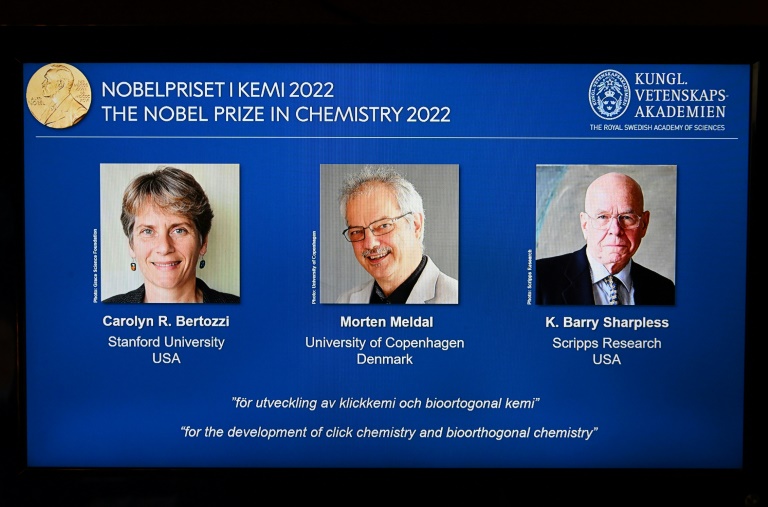
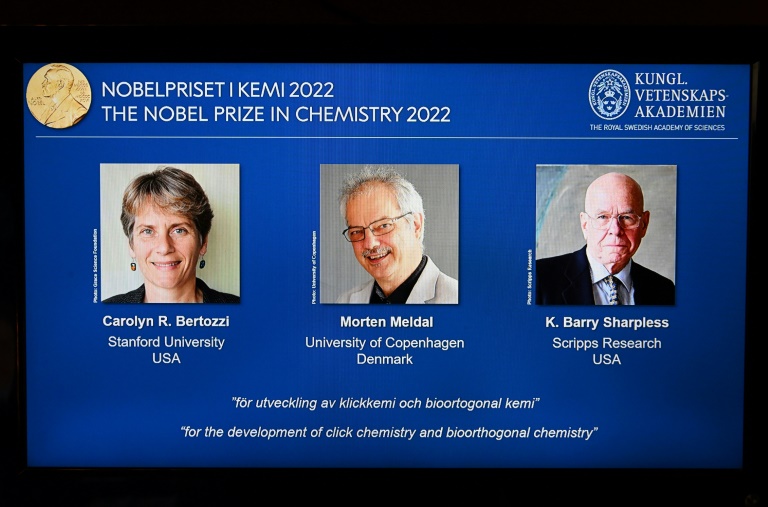
Americans Carolyn Bertozzi and Barry Sharpless, together with Denmark’s Morten Meldal, were honoured “for the development of click chemistry and bioorthogonal chemistry”, the jury said.

Bertozzi is the only woman among the seven Nobel laureates honoured so far this year, with women vastly under-represented in the history of the prizes, especially in the science disciplines.

The chemist — who as an undergraduate at Harvard played keyboards in a band called Bored of Education with future Rage Against the Machine guitarist Tom Morello — is only the eighth woman to win a Nobel Chemistry Prize, out of 189 recipients.

Speaking to AFP, Bertozzi conceded she didn’t have the musical talent of her former bandmate.

“So I think I chose the right path. Especially today,” she said.

Benjamin Schumann, a chemist as London’s Imperial College and former student in Bertozzi’s lab, however said she was still known as “the rock star of sciences”.

The award marks the second Nobel for 81-year-old Sharpless, who won in chemistry in 2001. 

Only four other individuals have achieved the feat of winning two Nobel Prizes, including Polish-born Frenchwoman Marie Curie, who won the chemistry prize in 1911 after first winning the physics prize in 1903.

– Like Lego –

Click chemistry “is an elegant and efficient chemical reaction that is now in widespread use,” the jury said in a statement.

“Among many other uses, it is utilised in the development of pharmaceuticals,for mapping DNA and creating materials that are more fit for purpose,” it added.

Sharpless, a professor at Scripps Research in California, “started the ball rolling” and “coined the concept of click chemistry” around 2000, the jury said.

Afterwards, Sharpless and Meldal, a professor at the University of Copenhagen, independently of each other, presented “what is now the crown jewel of click chemistry: the copper catalysed azide-alkyne cycloaddition”.

The process allows chemists to “snap” molecules together “with the help of some copper ions”, which among other things allow for the production of new materials.

It is possible to click in substances that conduct electricity, capture sunlight, are antibacterial, protect from ultraviolet radiation or have other desirable properties, it said.

“The discovery that we did was more or less by serendipity” Meldal told AFP, calling his win a “big surprise”.

Speaking to reporters, the Danish professor said the application of click chemistry could be likened to Lego — the iconic plastic blocks that also hail from Denmark.

“You can make a house or bike or car or whatever functionality you want. By combining differently these building blocks… in chemistry, we do the same thing,” Meldal explained.

– ‘A new level’ –

Bertozzi, 55, a professor at Stanford in the United States, was highlighted for then taking “click chemistry to a new level”.

“She developed click reactions that work inside living organisms. Her bioorthogonal reactions take place without disrupting the normal chemistry of the cell,” the jury said.

Her research is now being used to investigate how these reactions can be used to diagnose and treat cancer.

“I’m absolutely stunned, I’m sitting here and I can hardly breathe,” Bertozzi told reporters via telephone, minutes after the announcement.

Silvia Diez-Gonzalez, a chemist who works on click chemistry at Imperial College, London, welcomed the win.

“Thank goodness” that the days of women not being allowed in chemistry labs are over, she told AFP, though “there is a lot of bias still out there”.

“I want to believe that it’s just a matter of time that as women and non-white people get more opportunities to achieve their potential, then eventually the recognition they get will be spread more widely.”

The Royal Swedish Academy of Sciences, which awards the Nobels in the science disciplines, has refused to introduce quotas despite the dearth of women laureates.

Goran Hansson, then-secretary general of the academy, told AFP last year after all of the science nods went to men, that it wanted every laureate to be accepted “because they made the most important discovery, and not because of gender or ethnicity”. 

The lack of women laureates “reflects the unfair conditions in society, particularly in years past but still existing”, he acknowledged.

burs-jll/po/jmm

US duo and Dane win Nobel for 'click chemistry'

A trio of scientists from the United States and Denmark won the Nobel Chemistry Prize on Wednesday for laying the foundation for a more functional form of chemistry where molecules are linked together.

Americans Carolyn Bertozzi and Barry Sharpless, together with Denmark’s Morten Meldal, were honoured “for the development of click chemistry and bioorthogonal chemistry”, the jury said.

Bertozzi is the only woman among the seven Nobel laureates honoured so far this year, with women vastly under-represented in the history of the prizes, especially in the science disciplines.

The chemist — who as an undergraduate at Harvard played keyboards in a band called Bored of Education with future Rage Against the Machine guitarist Tom Morello — is only the eighth woman to win a Nobel Chemistry Prize, out of 189 recipients.

Speaking to AFP, Bertozzi conceded she didn’t have the musical talent of her former bandmate.

“So I think I chose the right path. Especially today,” she said.

Benjamin Schumann, a chemist as London’s Imperial College and former student in Bertozzi’s lab, however said she was still known as “the rock star of sciences”.

The award marks the second Nobel for 81-year-old Sharpless, who won in chemistry in 2001. 

Only four other individuals have achieved the feat of winning two Nobel Prizes, including Polish-born Frenchwoman Marie Curie, who won the chemistry prize in 1911 after first winning the physics prize in 1903.

– Like Lego –

Click chemistry “is an elegant and efficient chemical reaction that is now in widespread use,” the jury said in a statement.

“Among many other uses, it is utilised in the development of pharmaceuticals,for mapping DNA and creating materials that are more fit for purpose,” it added.

Sharpless, a professor at Scripps Research in California, “started the ball rolling” and “coined the concept of click chemistry” around 2000, the jury said.

Afterwards, Sharpless and Meldal, a professor at the University of Copenhagen, independently of each other, presented “what is now the crown jewel of click chemistry: the copper catalysed azide-alkyne cycloaddition”.

The process allows chemists to “snap” molecules together “with the help of some copper ions”, which among other things allow for the production of new materials.

It is possible to click in substances that conduct electricity, capture sunlight, are antibacterial, protect from ultraviolet radiation or have other desirable properties, it said.

“The discovery that we did was more or less by serendipity” Meldal told AFP, calling his win a “big surprise”.

Speaking to reporters, the Danish professor said the application of click chemistry could be likened to Lego — the iconic plastic blocks that also hail from Denmark.

“You can make a house or bike or car or whatever functionality you want. By combining differently these building blocks… in chemistry, we do the same thing,” Meldal explained.

– ‘A new level’ –

Bertozzi, 55, a professor at Stanford in the United States, was highlighted for then taking “click chemistry to a new level”.

“She developed click reactions that work inside living organisms. Her bioorthogonal reactions take place without disrupting the normal chemistry of the cell,” the jury said.

Her research is now being used to investigate how these reactions can be used to diagnose and treat cancer.

“I’m absolutely stunned, I’m sitting here and I can hardly breathe,” Bertozzi told reporters via telephone, minutes after the announcement.

Silvia Diez-Gonzalez, a chemist who works on click chemistry at Imperial College, London, welcomed the win.

“Thank goodness” that the days of women not being allowed in chemistry labs are over, she told AFP, though “there is a lot of bias still out there”.

“I want to believe that it’s just a matter of time that as women and non-white people get more opportunities to achieve their potential, then eventually the recognition they get will be spread more widely.”

The Royal Swedish Academy of Sciences, which awards the Nobels in the science disciplines, has refused to introduce quotas despite the dearth of women laureates.

Goran Hansson, then-secretary general of the academy, told AFP last year after all of the science nods went to men, that it wanted every laureate to be accepted “because they made the most important discovery, and not because of gender or ethnicity”. 

The lack of women laureates “reflects the unfair conditions in society, particularly in years past but still existing”, he acknowledged.

burs-jll/po/jmm

US duo and Dane win Nobel for 'click chemistry'

A trio of chemists from the United States and Denmark who laid the foundation for a more functional form of chemistry where molecules are snapped together on Wednesday won the Nobel Chemistry Prize.

Americans Carolyn Bertozzi and Barry Sharpless, together with Denmark’s Morten Meldal, were honoured “for the development of click chemistry and bioorthogonal chemistry”, the jury said.

Bertozzi is the only woman among the seven Nobel laureates honoured so far this year, with women vastly under-represented in the history of the prizes, especially in the science disciplines.

The chemist — who as an undergraduate at Harvard played keyboards in a band called Bored of Education with future Rage Against the Machine guitarist Tom Morello — is only the eighth woman to win a Nobel Chemistry Prize, out of 189 recipients.

The award marks the second Nobel for 81-year-old Sharpless, who won the chemistry Nobel in 2001. 

Only four other individuals have achieved the feat of winning two Nobel Prizes, including Polish-born Frenchwoman Marie Curie, who won the chemistry prize in 1911 after first winning the physics prize in 1903.

She was followed by American Linus Pauling who won for chemistry in 1954 and peace in 1962. American John Bardeen won the physics prize in 1956 and 1972, and Britain’s Frederick Sanger won the chemistry prize in 1958 and 1980.

– To make drugs, map DNA –

Click chemistry “is an elegant and efficient chemical reaction that is now in widespread use,” the jury said in a statement.

“Among many other uses, it is utilised in the development of pharmaceuticals, for mapping DNA and creating materials that are more fit for purpose,” it added.

Sharpless, a professor at Scripps Research in California, “started the ball rolling” and “coined the concept of click chemistry” around 2000, the jury said.

Afterwards, Sharpless and Meldal, a professor at the University of Copenhagen, “independently of each other, presented what is now the crown jewel of click chemistry: the copper catalysed azide-alkyne cycloaddition”.

The process allows chemists to “snap” molecules together like Lego bricks “with the help of some copper ions”, which among other things allow for the production of new materials.

“If a manufacturer adds a clickable azide to a plastic or fibre, changing the material at a later stage is straightforward,” the Nobel committee explained.

It is possible to click in substances that conduct electricity, capture sunlight, are antibacterial, protect from ultraviolet radiation or have other desirable properties, it said.

While there is widespread application of his research, Meldal said he was “very surprised and very proud” to receive the honour.

“There are so many good discoveries and developments in the world, it’s incredible to be in this situation,” Meldal told Swedish public radio.

– ‘A new level’ –

Bertozzi, 55, a professor at Stanford in the United States, was highlighted for then taking “click chemistry to a new level”.

“She developed click reactions that work inside living organisms. Her bioorthogonal reactions take place without disrupting the normal chemistry of the cell,” the jury said.

Her research is now being used to investigate how these reactions can be used to diagnose and treat cancer.

“I’m absolutely stunned, I’m sitting here and I can hardly breathe,” Bertozzi told reporters via telephone, minutes after the announcement.

Silvia Diez-Gonzalez, a chemist who works on click chemistry at Imperial College, London, welcomed the win.

“Thank goodness” that the days of women not being allowed in chemistry labs are over, she told AFP, though “there is a lot of bias still out there”.

“I want to believe that it’s just a matter of time that as women and non-white people get more opportunities to achieve their potential, then eventually the recognition they get will be spread more widely.”

The Royal Swedish Academy of Sciences, which awards the Nobels in the science disciplines, has refused to introduce quotas despite the dearth of women laureates.

Goran Hansson, then-secretary general of the academy, told AFP last year after all of the science nods went to men, that it wanted every laureate to be accepted “because they made the most important discovery, and not because of gender or ethnicity”. 

The lack of women laureates “reflects the unfair conditions in society, particularly in years past but still existing”, he acknowledged.

This year’s laureates will share the Nobel award sum of 10 million Swedish kronor (more than $910,000), and will receive the prize from King Carl XVI Gustaf at a ceremony in Stockholm on December 10, the anniversary of the 1896 death of scientist Alfred Nobel who created the prizes in his last will and testament.

US duo and Dane win Nobel for 'click chemistry'

A trio of chemists from the United States and Denmark who laid the foundation for a more functional form of chemistry where molecules are snapped together on Wednesday won the Nobel Chemistry Prize.

Americans Carolyn Bertozzi and Barry Sharpless, together with Denmark’s Morten Meldal, were honoured “for the development of click chemistry and bioorthogonal chemistry”, the jury said.

Bertozzi is the only woman among the seven Nobel laureates honoured so far this year, with women vastly under-represented in the history of the prizes, especially in the science disciplines.

The chemist — who as an undergraduate at Harvard played keyboards in a band called Bored of Education with future Rage Against the Machine guitarist Tom Morello — is only the eighth woman to win a Nobel Chemistry Prize, out of 189 recipients.

The award marks the second Nobel for 81-year-old Sharpless, who won the chemistry Nobel in 2001. 

Only four other individuals have achieved the feat of winning two Nobel Prizes, including Polish-born Frenchwoman Marie Curie, who won the chemistry prize in 1911 after first winning the physics prize in 1903.

She was followed by American Linus Pauling who won for chemistry in 1954 and peace in 1962. American John Bardeen won the physics prize in 1956 and 1972, and Britain’s Frederick Sanger won the chemistry prize in 1958 and 1980.

– To make drugs, map DNA –

Click chemistry “is an elegant and efficient chemical reaction that is now in widespread use,” the jury said in a statement.

“Among many other uses, it is utilised in the development of pharmaceuticals, for mapping DNA and creating materials that are more fit for purpose,” it added.

Sharpless, a professor at Scripps Research in California, “started the ball rolling” and “coined the concept of click chemistry” around 2000, the jury said.

Afterwards, Sharpless and Meldal, a professor at the University of Copenhagen, “independently of each other, presented what is now the crown jewel of click chemistry: the copper catalysed azide-alkyne cycloaddition”.

The process allows chemists to “snap” molecules together like Lego bricks “with the help of some copper ions”, which among other things allow for the production of new materials.

“If a manufacturer adds a clickable azide to a plastic or fibre, changing the material at a later stage is straightforward,” the Nobel committee explained.

It is possible to click in substances that conduct electricity, capture sunlight, are antibacterial, protect from ultraviolet radiation or have other desirable properties, it said.

While there is widespread application of his research, Meldal said he was “very surprised and very proud” to receive the honour.

“There are so many good discoveries and developments in the world, it’s incredible to be in this situation,” Meldal told Swedish public radio.

– ‘A new level’ –

Bertozzi, 55, a professor at Stanford in the United States, was highlighted for then taking “click chemistry to a new level”.

“She developed click reactions that work inside living organisms. Her bioorthogonal reactions take place without disrupting the normal chemistry of the cell,” the jury said.

Her research is now being used to investigate how these reactions can be used to diagnose and treat cancer.

“I’m absolutely stunned, I’m sitting here and I can hardly breathe,” Bertozzi told reporters via telephone, minutes after the announcement.

Silvia Diez-Gonzalez, a chemist who works on click chemistry at Imperial College, London, welcomed the win.

“Thank goodness” that the days of women not being allowed in chemistry labs are over, she told AFP, though “there is a lot of bias still out there”.

“I want to believe that it’s just a matter of time that as women and non-white people get more opportunities to achieve their potential, then eventually the recognition they get will be spread more widely.”

The Royal Swedish Academy of Sciences, which awards the Nobels in the science disciplines, has refused to introduce quotas despite the dearth of women laureates.

Goran Hansson, then-secretary general of the academy, told AFP last year after all of the science nods went to men, that it wanted every laureate to be accepted “because they made the most important discovery, and not because of gender or ethnicity”. 

The lack of women laureates “reflects the unfair conditions in society, particularly in years past but still existing”, he acknowledged.

This year’s laureates will share the Nobel award sum of 10 million Swedish kronor (more than $910,000), and will receive the prize from King Carl XVI Gustaf at a ceremony in Stockholm on December 10, the anniversary of the 1896 death of scientist Alfred Nobel who created the prizes in his last will and testament.

Uganda Ebola outbreak death toll 29, says WHO

Sixty-three confirmed and probable cases have been reported in the Ebola outbreak in Uganda, including 29 deaths, the World Health Organization said Wednesday.

WHO chief Tedros Adhanom Ghebreyesus said the vaccines used to curb recent outbreaks in the neighbouring Democratic Republic of Congo (DRC) were not effective against the type of Ebola virus circulating in Uganda.

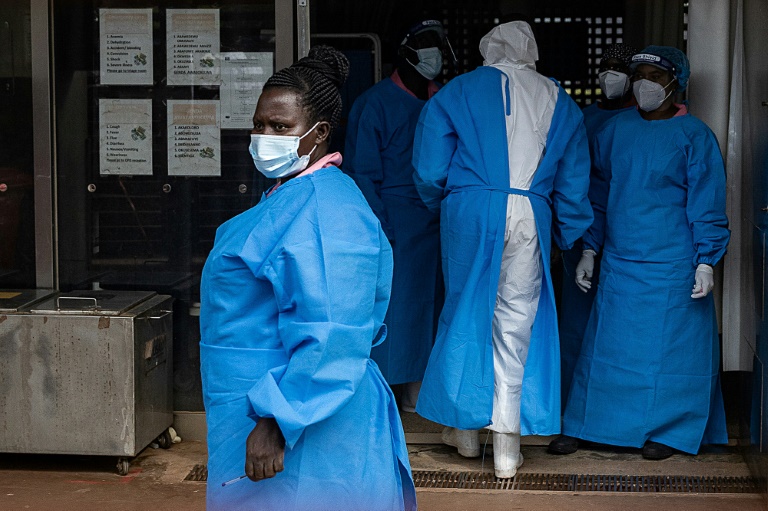
And he lamented that the Uganda outbreak, declared by the government two weeks ago, was taking a deadly toll on health workers.

“So far, 63 confirmed and probable cases have been reported, including 29 deaths,” Tedros told a press conference in Geneva.

“Ten health workers have been infected and four have died. Four people have recovered and are receiving follow-up care.”

The east African nation’s Health Minister Jane Ruth Aceng Ocero said that a 58-year-old anaesthetist had died of Ebola early Wednesday.

“The late Margaret (Nabisubi) is the fourth health worker we have lost in the current Ebola outbreak,” the minister said on Twitter, following the deaths of a Tanzanian doctor, a health assistant and a midwife.

– Candidate vaccines –

Tedros said: “When there is a delay in detecting an Ebola outbreak, it’s normal for cases to increase steadily at the beginning and then decrease as life-saving interventions and outbreak control measures are implemented.”

But he added: “The vaccines used successfully to curb recent Ebola outbreaks in the DRC are not effective against the type of Ebola virus that’s responsible for this outbreak in Uganda.

“However, several vaccines are in various stages of development against this virus, two of which could begin clinical trials in Uganda in the coming weeks, pending regulatory and ethics approvals from the Ugandan government.”

Tedros said the WHO was supporting the Ugandan government in its response to the outbreak, which has been reported in four districts.

Since the initial outbreak was discovered in the central district of Mubende, infections have been found in Kassanda, Kyegegwa and Kagadi.

The UN’s health agency has released $2 million from its contingency fund for emergencies and is working with partners to support the health ministry by sending additional specialists, supplies and resources, Tedros said.

Ugandan President Yoweri Museveni has vowed not to impose any lockdowns to tackle the disease, saying last week that there was “no need for anxiety”.

Uganda had confirmed 10 deaths, with Museveni specifying that 19 other probable Ebola cases had also died, but said they were buried before they could be tested for infection.

– Haemorrhagic fever –

Ebola is an often-fatal viral haemorrhagic fever named after a river in the DRC where it was discovered in 1976.

Human transmission is through bodily fluids, with the main symptoms being fever, vomiting, bleeding and diarrhoea.

Outbreaks are difficult to contain, especially in urban environments.

People who are infected do not become contagious until symptoms appear, which is after an incubation period of between two and 21 days.

There is currently no licensed medication to prevent or treat Ebola, although a range of experimental drugs are in development. 

Uganda, which shares a porous border with the DRC, has experienced several Ebola outbreaks, most recently in 2019 when at least five people died.

The DRC last week declared an end to an Ebola virus outbreak that emerged in eastern North Kivu province six weeks ago.

The worst epidemic, in West Africa between 2013 and 2016, killed more than 11,300 people. The DRC has had more than a dozen epidemics, the deadliest killing 2,280 people in 2020.

What's next for the Musk-Twitter deal?

With Twitter and Elon Musk edging towards finalizing a deal, here’s what may come next in the billionaire’s on-again, off-again bid to buy the influential social media platform.

– Where it stands –

After seeking for months to back out of the purchase, Musk did an about-face and informed Twitter that he would proceed with the $44 billion deal at the original $54.20 share price.

Twitter simply confirmed receipt of Musk’s proposal, but if the company does manage to reach an agreement it would avert a bitterly contested trial that had been slated to begin in Delaware on October 17.

Some experts believe the level of mistrust between the parties is so high that Twitter will likely seek further legal assurances that Musk will really follow through this time before it agrees to call off the trial.

“They thought they had a deal before,” said Adam Badawi, a law professor at the University of California, Berkeley. “So to actually accept something from him, it’s going to have to be as ironclad as it possibly can.

“But if details (can be) worked out, litigation will be off.”

“I imagine Twitter will want to put the $44 billion in escrow, or a very large amount of money, to show his good faith and commitment to actually getting this done,” Badawi said.

– Why the U-turn? –

Expert consensus is that Musk realized he was unlikely to prevail in court and his claim that Twitter had not revealed enough about the number of bots on the platform would have been hard to prove.

“We continue to believe Musk saw the writing on the wall and knew his chances of a victory in Delaware were slim to none with the best path accepting the current deal and move forward,” said Daniel Ives, a technology analyst at Wedbush Securities. 

Carl Tobias, a law professor at the University of Richmond, said “the standard Musk faced in court was proving a material adverse effect — it now looks like the bots were not enough to meet the standard.”

“I think this deal will stick, mostly because walking away a second time could be very damaging,” Tobias said. “What was to be gained in a trial that was an uphill fight?”

– The state of Twitter –

Twitter’s share price surged 22 percent on news of Musk’s U-turn.

But the takeover saga has reportedly created a lot of uncertainty within the San Francisco-based company and damaged staff morale.

Twitter’s brand has also recently been damaged by whistleblower testimony from a former security chief who delivered scathing criticism of privacy and security failures at the company.

Musk’s original offer also coincided with a plunge in online advertising revenue.

“For Musk, the irony is the easy part of this deal was buying Twitter,” said Wedbush’s Ives. “The hard part will be fixing it with monetization and subscriber engagement.”

– Concern over a Musk-owned Twitter –

The likelihood that a deal will be reached has reignited strong concerns about what a Musk-owned Twitter would look like.

The initial deal announced in April sparked fears the platform would see a surge in abuse and disinformation after Musk — a self-proclaimed free speech absolutist — said he would largely let anyone say anything allowed by law on Twitter.

Progressive groups were particularly concerned that Musk may permit a return to the platform by former US president Donald Trump, who was banned from Twitter after last year’s assault on the US Capitol by his supporters seeking to overturn the 2020 presidential election result.

What's next for the Musk-Twitter deal?

With Twitter and Elon Musk edging towards finalizing a deal, here’s what may come next in the billionaire’s on-again, off-again bid to buy the influential social media platform.

– Where it stands –

After seeking for months to back out of the purchase, Musk did an about-face and informed Twitter that he would proceed with the $44 billion deal at the original $54.20 share price.

Twitter simply confirmed receipt of Musk’s proposal, but if the company does manage to reach an agreement it would avert a bitterly contested trial that had been slated to begin in Delaware on October 17.

Some experts believe the level of mistrust between the parties is so high that Twitter will likely seek further legal assurances that Musk will really follow through this time before it agrees to call off the trial.

“They thought they had a deal before,” said Adam Badawi, a law professor at the University of California, Berkeley. “So to actually accept something from him, it’s going to have to be as ironclad as it possibly can.

“But if details (can be) worked out, litigation will be off.”

“I imagine Twitter will want to put the $44 billion in escrow, or a very large amount of money, to show his good faith and commitment to actually getting this done,” Badawi said.

– Why the U-turn? –

Expert consensus is that Musk realized he was unlikely to prevail in court and his claim that Twitter had not revealed enough about the number of bots on the platform would have been hard to prove.

“We continue to believe Musk saw the writing on the wall and knew his chances of a victory in Delaware were slim to none with the best path accepting the current deal and move forward,” said Daniel Ives, a technology analyst at Wedbush Securities. 

Carl Tobias, a law professor at the University of Richmond, said “the standard Musk faced in court was proving a material adverse effect — it now looks like the bots were not enough to meet the standard.”

“I think this deal will stick, mostly because walking away a second time could be very damaging,” Tobias said. “What was to be gained in a trial that was an uphill fight?”

– The state of Twitter –

Twitter’s share price surged 22 percent on news of Musk’s U-turn.

But the takeover saga has reportedly created a lot of uncertainty within the San Francisco-based company and damaged staff morale.

Twitter’s brand has also recently been damaged by whistleblower testimony from a former security chief who delivered scathing criticism of privacy and security failures at the company.

Musk’s original offer also coincided with a plunge in online advertising revenue.

“For Musk, the irony is the easy part of this deal was buying Twitter,” said Wedbush’s Ives. “The hard part will be fixing it with monetization and subscriber engagement.”

– Concern over a Musk-owned Twitter –

The likelihood that a deal will be reached has reignited strong concerns about what a Musk-owned Twitter would look like.

The initial deal announced in April sparked fears the platform would see a surge in abuse and disinformation after Musk — a self-proclaimed free speech absolutist — said he would largely let anyone say anything allowed by law on Twitter.

Progressive groups were particularly concerned that Musk may permit a return to the platform by former US president Donald Trump, who was banned from Twitter after last year’s assault on the US Capitol by his supporters seeking to overturn the 2020 presidential election result.

Alec Baldwin reaches settlement with family over 'Rust' death

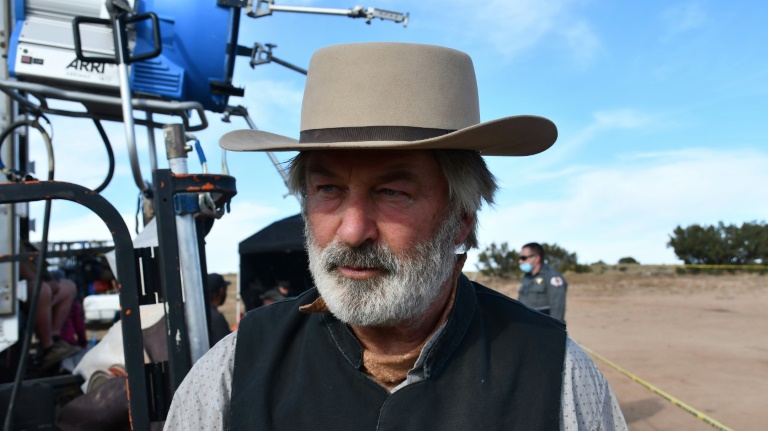
Actor Alec Baldwin has reached a civil settlement with the family of the woman he shot dead on a film set last year, he said Wednesday, as it was announced production on the movie would restart in January.

The US actor was holding a Colt gun during a rehearsal for “Rust,” a low-budget Western being filmed in New Mexico last October when it discharged a live round, killing 42-year-old Halyna Hutchins.

“We are pleased to announce today the settlement of the civil case filed on behalf of the family of cinematographer Halyna Hutchins,” Baldwin said in an Instagram post.

“Throughout this difficult process, everyone has maintained the specific desire to do what is best for Halyna’s son,” he said.

Details of the settlement, which also includes Rust Movie Productions, the limited liability company formed to make the movie, were not disclosed.

Baldwin, who was a producer as well as the star of “Rust,” had been told the gun was safe and has previously said he did not pull the trigger, though an FBI report determined the gun could not have gone off otherwise.

Production on the movie will resume in January, filmmakers said in a statement Wednesday, with Hutchins’ husband Matthew Hutchins taking on the role of executive producer.

“I have no interest in engaging in recriminations or attribution of blame (to the producers or Mr. Baldwin),” Matthew Hutchins said in the statement. “All of us believe Halyna’s death was a terrible accident.”

According to Matthew Hutchins, “all the original principal players” will return to the set. 

“Rust” director Joel Souza, who was also injured in the shooting, said he would devote his work on the film “to honoring Halyna’s legacy and making her proud.”

“Though certainly bittersweet, I am pleased that together, we will now complete what Halyna and I started,” he said.

The family’s lawsuit was one of a series of civil proceedings over the fatal shooting, which sent shockwaves through Hollywood, and led to calls for guns to be permanently banned from sets.

Almost a year on from the tragedy, investigators in New Mexico have filed no criminal charges, but have not ruled them out against anybody, including Baldwin.

In August, Baldwin said he did not believe he would be charged, telling CNN he had hired a private investigator to assess possible culpability.

While there has never been any doubt that the gun was in Baldwin’s hands when it went off, the central question that remains unresolved is how it came to be loaded with a live round.

Film sets are supposed to have stringent rules around prop weapons.

That has brought a focus on Hannah Gutierrez-Reed, the movie’s young armorer and props assistant, and on assistant director Dave Halls, who handed Baldwin the gun, apparently declaring it “cold” — industry speak for inert.

Gutierrez-Reed has sued the film’s ammunition supplier, accusing him of leaving real bullets among the dummy cartridges.

Close Bitnami banner
Bitnami