AFP

UK's Truss says 'no shame' in climbdown amid Tory tensions

Britain’s Prime Minister Liz Truss insisted Tuesday she felt “no shame” and vowed to press on with unpopular economic reforms despite lurching into a self-inflicted crisis just a month into her term.

Despite Truss’s attempts to move on, cabinet splits emerged as the ruling Conservatives endured another stormy day at their annual conference in Birmingham, central England.

Truss and Chancellor of the Exchequer Kwasi Kwarteng have been forced to climb down on their plan to cut income tax for the richest, as ordinary Britons suffer the worst cost-of-living crisis in generations.

The plan met with uproar from Tory critics, deep disapproval in opinion polls, and destabilised financial markets given its reliance on billions extra in government borrowing.

“I think there’s absolutely no shame in a leader listening to people and responding, and that’s the kind of person I am,” Truss told Sky News.

Reiterating that the tax cut had proved a “distraction”, she added on the BBC: “I want to take people with me. Yes, we are going to have to make tough decisions.”

“I’m determined to carry on with this growth package,” she told LBC radio, stressing another component of the plan to cap soaring energy bills.

– Budget confusion –

Truss and Kwarteng were widely reported as bringing forward a major debt reduction plan to later this month, having insisted previously that it would only come on November 23.

Its unveiling will be accompanied by independent forecasts from the Office for Budget Responsibility (OBR), in a bid to calm febrile financial markets.

But the two politicians both insisted November 23 remained the date, with Kwarteng telling GB News that the media had been “reading the runes” incorrectly.

Mel Stride, the Tory chairman of the powerful Treasury committee in the House of Commons, had welcomed the reporting of an earlier date to show how the government intends to fix its finances.

Acting in advance of the Bank of England’s next rate-setting meeting on November 3 could “reduce the upward pressure on interest rates to the benefit of millions of people up and down the country”, he added.

Potential cuts to the welfare budget are shaping up as the next battle with dissident Tory MPs after the aborted tax cut.

“We have to look at these issues in the round. We have to be fiscally responsible,” Truss told BBC radio.

– ‘Coup’ –

But senior minister Penny Mordaunt, one of the candidates Truss beat in the Tory leadership race, stepped out of the cabinet line.

It “makes sense” that welfare should still rise in line with soaring rates of inflation, she told Times Radio.

“That’s what I voted for before, and so have a lot of my colleagues.”

Truss said she did not intend to fire Mordaunt, and denied that she had lost control of her cabinet after putting on a show of unity with Kwarteng on a visit to a construction site in Birmingham.

There was little team spirit on display from Home Secretary Suella Braverman, however, as she accused party critics of seeking to stage a “coup” against Truss.

Braverman herself later set up the government for further strife by promising to deport all asylum seekers who do not enter Britain via a safe and legal route, which unions pointed out would be in breach of international conventions. 

Many commentators argue that Truss’s credibility was already in tatters not long after she succeeded Boris Johnson on September 6.

The Daily Mail newspaper, normally a trenchant voice in support of the new leader’s right-wing agenda, headlined its main story: “Get a grip!”

– Honouring Boris –

Dissident ringleader Michael Gove kept up criticism of Truss, stressing all Conservative MPs had been elected on Johnson’s manifesto of 2019. 

It included a pledge to end arbitrary evictions of tenants by private landlords, he noted at a conference fringe event held by the housing charity Shelter. 

“We’ve got to keep faith with what Boris wanted, we’ve got to make sure that manifesto commitment is honoured,” Gove said, after Truss reneged on a Johnson commitment to ban fracking. 

But asked by reporters if Truss would survive past the end of the year, the former minister said: “Yes.”

Shelter presented poll findings that suggested private renters who voted Tory in 2019 are deserting the party in droves for Labour and other opposition parties. 

Wider opinion polls in recent days have shown Labour breaching 50 percent as the Tories slump under Truss, fraying nerves in Birmingham as she prepares to close the conference on Wednesday.

Alain Aspect, Nobel-winning father of quantum entanglement

Alain Aspect, who won a long-expected Nobel Physics Prize on Tuesday, not only helped prove the strange theory of quantum entanglement but also inspired a generation of physicists in his native France, according to former students and colleagues.

Quantum entanglement is the theory — famously dismissed by Albert Einstein — that when a particle is split into two, the properties of the two new particles remain connected, as if by an invisible piece of string, regardless of how far apart they are.

It remained a theory until Aspect and his team proved the phenomenon in a laboratory experiment for the first time in 1981, entangling two photons — units of light — at a distance of 12 metres (40 feet).

The experiment helped pave the way for what Aspect has called the “second quantum revolution”, which has led to a range of new technologies including quantum computing, encryption and more.

“Quantum strangeness has dominated my whole life as a physicist,” Aspect told AFP in a 2010 interview.

His experiment finally settled a debate from more than 60 years earlier between Einstein and one of the fathers of quantum physics, Denmark’s Niels Bohr. 

Bohr believed in quantum entanglement but Einstein — whose work helped predict the phenomenon — famously argued against it, calling it “spooky action at a distance”.

“Bohr wins from a certain point of view,” Aspect said in an interview published by the Nobel Foundation after his win on Tuesday.

“But Einstein wins because he spotted something extraordinary,” he added.

Aspect said he was proud to be on the same list of Nobel-winners who have “totally changed physics”.

Awarded along with Austrian physicist Anton Zeilinger and John Clauser from the United States, Aspect emphasised the importance of international scientific collaboration “at a time when the world is not so nice, and where nationalism is taking over in many countries”.

– ‘Tireless teacher’ –

Aspect, the son of a teacher, was born in Agen in southwest France in 1947.

He came second in the French education physics exam, and is currently professor at Paris-Saclay University and at Ecole Polytechnique. Now 74, he is married and has two children.

Aspect has already racked up many awards, including the gold medal from France’s CNRS research institute, as well as sharing the 2010 Wolf Prize in physics with Zeilinger and Clauser.

Aspect had been expected to win the Nobel for years, with Chris Phillips, a physicist at Imperial College London, saying “the prize was long overdue”.

“It’s one of the most deserved prizes we’ve had for a while,” he added.

“We have all been waiting for this for a long time! We are very proud,” said France’s minister for higher education and research, Sylvie Retailleau, who knew Aspect from her time as a physicist.

“He is one of those mentors in physics. A whole community today works under his leadership,” said Retailleau, a former president of Paris-Saclay University.

Aspect is also a “tireless teacher” who gives acclaimed lectures, she added.

Former student Georges-Olivier Reymond, who is now the head of French start-up Pasqal which is working on developing a quantum processor, said it was “fantastic” that Aspect had won the Nobel.

“Everything I have done in my career is thanks to him,” Reymond said. 

With his experiment, “Aspect pulled off a feat that surprised us all,” Reymond said. “It was so different from what we learned at school… it inspired generations of students.”

As well as passing his passion for physics on to his students, Aspect is also a “bon vivant who will tell you all about his foie gras recipes”, Reymond said.

“I can still hear him saying, when I was just 20 years old… ‘you have to create quantum start-ups — it’s the future’,” Reymond said.

“He was right.”

Stocks surge on interest rate hopes

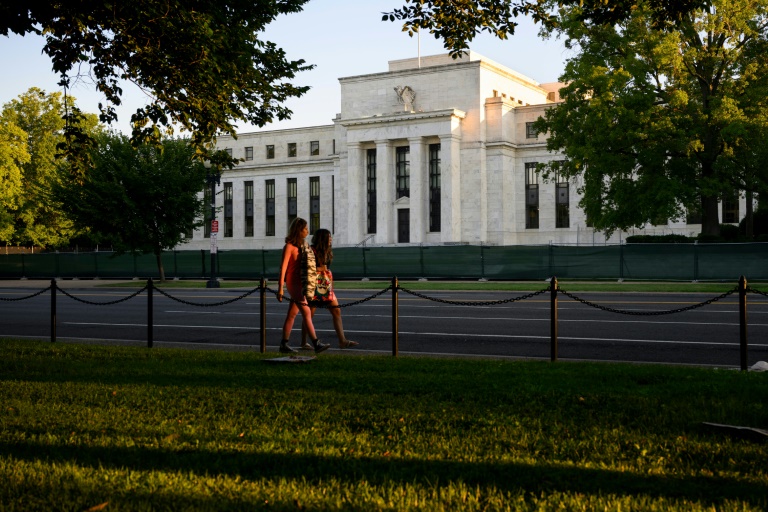
Global stocks rallied Tuesday and the dollar mostly slid as weak US data sparked hopes the Federal Reserve could ease its interest-rate hiking plans.

Frankfurt and Paris equities both soared around four percent in value after Tokyo gained 3.0 percent, while London won 2.6 percent.

Wall Street’s surged higher for the second straight day, with the Dow rising 2.7 percent. The S&P 500 jumped 2.9 percent and the Nasdaq Composite 3.4 percent.

“Weaker-than-expected manufacturing data from the US was taken as a signal that rising interest rates may be having some effect on cooling demand for goods,” said Interactive Investor analyst Richard Hunter.

“This in turn led to hopes of a Federal Reserve pivot, even though the spectre of inflation remains firmly at the top of their stated to-do list.”

The Fed and other central banks across the world have raised interest rates in efforts to tame runaway inflation, but the monetary tightening has raised fears that it could plunge countries into recession.

Those concerns have fed into sharp drops in stocks in recent weeks, as have expectations that the Fed will have to raise interest rates by a couple more percentage points through much of next year to get on top of inflation.

But Wall Street had enjoyed a bumper start to the fourth quarter on Monday after data showed US manufacturing growth slowed more than expected in September to its weakest in more than two years.

The Institute for Supply Management said its manufacturing index dropped 1.9 points to 50.9 percent, just barely above the 50-percent threshold indicating expansion, as the prices index fell to the lowest in more than two years.

Eurozone manufacturing survey data out Monday showed a contraction on the back of the region’s ongoing energy crisis.

“The turnaround in risk appetite appears to have been driven by another deterioration in PMI surveys as traders speculate that such weakness could be a precursor to slower monetary tightening,” noted OANDA market analyst Craig Erlam.

Asian markets built on the Monday Wall Street surge. Tokyo and Seoul were among the leaders, despite news that North Korea had fired a missile over Japan for the first time since 2017.

Sydney soared 3.8 percent after the Reserve Bank of Australia lifted interest rates by less than expected.

Hong Kong and Shanghai were closed for holidays.

Investors will focus later this week on Friday’s all-important US jobs figures for the latest reading on the health of the world’s biggest economy.

“The specter of the September employment report on Friday, however, is still hanging out there as a potential spoiler,” said Briefing.com analyst Patrick O’Hare.

“By the same token, it could also provide more interest rate relief if it is on the weaker side of things,” he added.

– Sterling extends gains –

Oil also continued to push higher on expectations OPEC and other major producers will slash output this week, having become spooked by a plunge in the price of the commodity on recession fears.

The 13 members of the Organization of the Petroleum Exporting Countries (OPEC), led by Riyadh, and their 10 allies headed by Moscow will hold Wednesday their first in-person meeting at the group’s headquarters in Vienna since March 2020.

The rally in equities came as the dollar weakened owing to lower expectations for US monetary tightening, with the pound also supported by the UK government’s decision to scrap a planned cut in the top rate of income tax.

The pound extended gains after breaking back above $1.14, having last Monday tanked to a record low $1.0350. The euro rose around 1.5 percent against the greenback.

– Key figures around 1530 GMT –

New York – Dow: UP 2.7 percent at 30,273.78 points

EURO STOXX 50: UP 4.3 percent at 3,484.48

Paris – CAC 40: UP 4.2 percent at 6,039.69 (close)

Frankfurt – DAX: UP 3.8 percent at 12,670.48 (close)

London – FTSE 100: UP 2.6 percent at 7,086.46 (close)

Tokyo – Nikkei 225: UP 3.0 percent at 26,992.21 (close)

Hong Kong – Hang Seng Index: Closed for a holiday

Shanghai – Composite: Closed for a holiday

Pound/dollar: UP at $1.1440 from $1.1323 on Monday

Euro/dollar: UP at $0.9976 from $0.9826

Euro/pound: UP at 87.16 pence from 86.77 pence

Dollar/yen: DOWN at 144.39 yen from 144.55 yen

Brent North Sea crude: UP 3.5 percent at $91.94 per barrel

West Texas Intermediate: UP 3.4 percent at $86.48 per barrel

burs-rl/cdw

Stocks surge on interest rate hopes

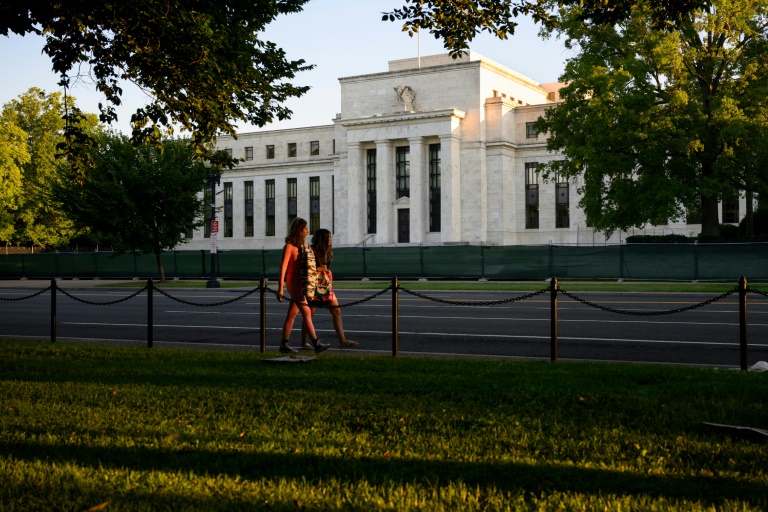
Global stocks rallied Tuesday and the dollar mostly slid as weak US data sparked hopes the Federal Reserve could ease its interest-rate hiking plans.

Frankfurt and Paris equities both soared around four percent in value after Tokyo gained 3.0 percent, while London won 2.6 percent.

Wall Street’s surged higher for the second straight day, with the Dow rising 2.7 percent. The S&P 500 jumped 2.9 percent and the Nasdaq Composite 3.4 percent.

“Weaker-than-expected manufacturing data from the US was taken as a signal that rising interest rates may be having some effect on cooling demand for goods,” said Interactive Investor analyst Richard Hunter.

“This in turn led to hopes of a Federal Reserve pivot, even though the spectre of inflation remains firmly at the top of their stated to-do list.”

The Fed and other central banks across the world have raised interest rates in efforts to tame runaway inflation, but the monetary tightening has raised fears that it could plunge countries into recession.

Those concerns have fed into sharp drops in stocks in recent weeks, as have expectations that the Fed will have to raise interest rates by a couple more percentage points through much of next year to get on top of inflation.

But Wall Street had enjoyed a bumper start to the fourth quarter on Monday after data showed US manufacturing growth slowed more than expected in September to its weakest in more than two years.

The Institute for Supply Management said its manufacturing index dropped 1.9 points to 50.9 percent, just barely above the 50-percent threshold indicating expansion, as the prices index fell to the lowest in more than two years.

Eurozone manufacturing survey data out Monday showed a contraction on the back of the region’s ongoing energy crisis.

“The turnaround in risk appetite appears to have been driven by another deterioration in PMI surveys as traders speculate that such weakness could be a precursor to slower monetary tightening,” noted OANDA market analyst Craig Erlam.

Asian markets built on the Monday Wall Street surge. Tokyo and Seoul were among the leaders, despite news that North Korea had fired a missile over Japan for the first time since 2017.

Sydney soared 3.8 percent after the Reserve Bank of Australia lifted interest rates by less than expected.

Hong Kong and Shanghai were closed for holidays.

Investors will focus later this week on Friday’s all-important US jobs figures for the latest reading on the health of the world’s biggest economy.

“The specter of the September employment report on Friday, however, is still hanging out there as a potential spoiler,” said Briefing.com analyst Patrick O’Hare.

“By the same token, it could also provide more interest rate relief if it is on the weaker side of things,” he added.

– Sterling extends gains –

Oil also continued to push higher on expectations OPEC and other major producers will slash output this week, having become spooked by a plunge in the price of the commodity on recession fears.

The 13 members of the Organization of the Petroleum Exporting Countries (OPEC), led by Riyadh, and their 10 allies headed by Moscow will hold Wednesday their first in-person meeting at the group’s headquarters in Vienna since March 2020.

The rally in equities came as the dollar weakened owing to lower expectations for US monetary tightening, with the pound also supported by the UK government’s decision to scrap a planned cut in the top rate of income tax.

The pound extended gains after breaking back above $1.14, having last Monday tanked to a record low $1.0350. The euro rose around 1.5 percent against the greenback.

– Key figures around 1530 GMT –

New York – Dow: UP 2.7 percent at 30,273.78 points

EURO STOXX 50: UP 4.3 percent at 3,484.48

Paris – CAC 40: UP 4.2 percent at 6,039.69 (close)

Frankfurt – DAX: UP 3.8 percent at 12,670.48 (close)

London – FTSE 100: UP 2.6 percent at 7,086.46 (close)

Tokyo – Nikkei 225: UP 3.0 percent at 26,992.21 (close)

Hong Kong – Hang Seng Index: Closed for a holiday

Shanghai – Composite: Closed for a holiday

Pound/dollar: UP at $1.1440 from $1.1323 on Monday

Euro/dollar: UP at $0.9976 from $0.9826

Euro/pound: UP at 87.16 pence from 86.77 pence

Dollar/yen: DOWN at 144.39 yen from 144.55 yen

Brent North Sea crude: UP 3.5 percent at $91.94 per barrel

West Texas Intermediate: UP 3.4 percent at $86.48 per barrel

burs-rl/cdw

EU lawmakers impose single charger for all smartphones

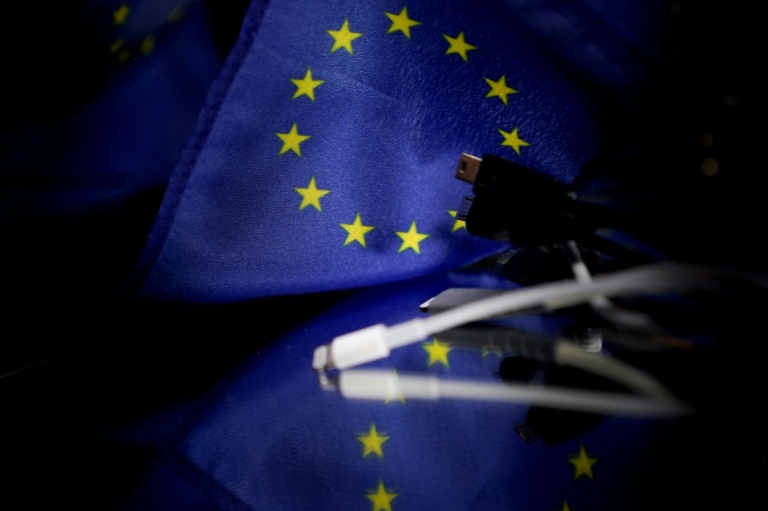
The EU parliament on Tuesday passed a new law requiring USB-C to be the single charger standard for all new smartphones, tablets and cameras from late 2024.

The measure, which EU lawmakers adopted with a vote 602 in favour, 13 against, will — in Europe at least — push Apple to drop its outdated Lightning port on its iPhones for the USB-C one already used by many of its competitors.

Makers of laptops will have extra time, from early 2026, to also follow suit.

EU policymakers say the single charger rule will simplify the life of Europeans, reduce the mountain of obsolete chargers and reduce costs for consumers. 

It is expected to save at least 200 million euros ($195 million) per year and cut more than a thousand tonnes of EU electronic waste every year, the bloc’s competition chief Margrethe Vestager said.

The EU move is expected to ripple around the world.

The European Union’s 27 countries are home to 450 million people who count among the world’s wealthiest consumers. Regulatory changes in the bloc often set global industry norms in what is known as the Brussels Effect.

“Today is a great day for consumers, a great day  for our environment,” Maltese MEP Alex Agius Saliba, the European Parliament’s pointman on the issue, said.

“After more than a decade; the single charger for multiple electronic devices will finally become a reality for Europe and hopefully we can also inspire the rest of the world,” he said.

– Faster data speed –

Apple, the world’s second-biggest seller of smartphones after Samsung, already uses USB-C charging ports on its iPads and laptops. 

But it resisted EU legislation to force a change away from its Lightning ports on its iPhones, saying that was disproportionate and would stifle innovation.

However some users of its latest flagship iPhone models — which can capture extremely high-resolution photos and videos in massive data files — complain that the Lightning cable transfers data at only a bare fraction of the speed USB-C does.

The EU law will in two years’ time apply to all handheld mobile phones, tablets, digital cameras, headphones, headsets, portable speakers, handheld videogame consoles, e-readers, earbuds, keyboards, mice and portable navigation systems.

People buying a device will have the choice of getting one with or without a USB-C charger, to take advantage of the fact they might already have at least one cable at home.

Makers of electronic consumer items in Europe agreed a single charging norm from dozens on the market a decade ago under a voluntary agreement with the European Commission.

But Apple refused to abide by it, and other manufacturers kept their alternative cables going, meaning there are still some six types knocking around.

They include old-style USB-A, mini-USB and USB-micro, creating a jumble of cables for consumers.

USB-C ports can charge at up to 100 Watts, transfer data up to 40 gigabits per second, and can serve to hook up to external displays.

Apple also offers wireless charging for its latest iPhones — and there is speculation it might do away with charging ports for cables entirely in future models. But currently the wireless charging option offers lower power and data transfer speeds than USB-C.

US to require extra hour of rest for flight attendants

US authorities will require flight attendants be given an additional hour to rest between trips, according to new rule announced Tuesday.

The Federal Aviation Administration will lift the minimum rest time to 10 consecutive hours from nine, implementing a rule change as required by a 2018 law.

“Flight attendants, like all essential transportation workers, work hard every day to keep the traveling public safe, and we owe them our full support,” US Transportation Secretary Pete Buttigieg said. 

“This new rule will make it easier for flight attendants to do their jobs, which in turn will keep all of us safe in the air.”

The Association of Flight Attendants, which had long fought for the longer rest times, praised the FAA announcement, which takes effect in 30 days and gives airlines 90 days to be implemented.

“As aviation’s first responders and last line of defense, it is critical that we are well rested and ready to perform our duties,” said AFA President Sara Nelson

“Covid has only exacerbated the safety gap with long duty days, short nights, and combative conditions on planes.”

Nelson praised President Joe Biden for enacting the measure, adding that while the 2018 congressional mandate “could not have been more clear,” officials in Donald Trump’s administration “put our rest on a regulatory road to kill it.”

US to require extra hour of rest for flight attendants

US authorities will require flight attendants be given an additional hour to rest between trips, according to new rule announced Tuesday.

The Federal Aviation Administration will lift the minimum rest time to 10 consecutive hours from nine, implementing a rule change as required by a 2018 law.

“Flight attendants, like all essential transportation workers, work hard every day to keep the traveling public safe, and we owe them our full support,” US Transportation Secretary Pete Buttigieg said. 

“This new rule will make it easier for flight attendants to do their jobs, which in turn will keep all of us safe in the air.”

The Association of Flight Attendants, which had long fought for the longer rest times, praised the FAA announcement, which takes effect in 30 days and gives airlines 90 days to be implemented.

“As aviation’s first responders and last line of defense, it is critical that we are well rested and ready to perform our duties,” said AFA President Sara Nelson

“Covid has only exacerbated the safety gap with long duty days, short nights, and combative conditions on planes.”

Nelson praised President Joe Biden for enacting the measure, adding that while the 2018 congressional mandate “could not have been more clear,” officials in Donald Trump’s administration “put our rest on a regulatory road to kill it.”

Shell CEO hints energy firms should pay more tax

Shell’s departing chief executive indicated Tuesday that governments should “probably” tax energy firms more to help protect the poorest from rocketing electricity and gas bills and ease the cost-of-living crisis.

Ben van Beurden, who leaves Shell at the end of this year, was addressing the Energy Intelligence Forum industry gathering.

“You cannot have a market that behaves in such a way… that it’s going to damage a significant part of society. You simply cannot have that,” he told delegates.

“One way or another, there needs to be government intervention … that somehow results in protecting the poorest.

“And that probably means governments need to tax people in this room to pay for it — I think we just have to accept as a societal reality.”

Energy bills have sky-rocketed in the wake of key gas producer Russia’s invasion of Ukraine, sparking accusations from some quarters that the sector has reaped profits as a result of the war.

New British Prime Minister Liz Truss last month launched an energy price freeze that seeks to cushion the blow of runaway bills for households and businesses.

However the costly price freeze, contained also in the government’s recent controversial mini-budget, has sparked turmoil over its impact on government debt.

Van Beurden did not comment on the most appropriate way to tax the energy sector.

Truss, a former Shell employee, has already ruled out extending a windfall tax on energy companies’ profits, which was unveiled by her predecessor Boris Johnson.

Environmental campaigners Greenpeace welcomed van Beurden’s comments but criticised the government for doing nothing.

Susannah Streeter, an investment and market analyst, said van Beurden had “flung open a door on a windfall tax which the UK government had been trying to close”.

“This will reignite the debate over how profits of energy giants should be taxed just as a row rages about whether welfare spending will be hit to pay for the Truss administration’s slash and spend policies.”

Meanwhile, the outgoing Shell chief executive expressed scepticism on Tuesday over a possible price cap for Russian oil.

The European Union had last week proposed a new round of sanctions on Moscow, including the oil price cap.

As part of the new round of sanctions — which has to be signed off by the bloc’s 27 nations — the EU is laying out a “legal basis” for a price cap on Russian oil, in line with a G7 agreement.

“I struggle with understanding how effective an oil price cap on Russian oil will be,” van Beurden told the Energy Intelligence Forum, according to comments relayed on Twitter.

“Intervening in complex energy markets is going to be very difficult. 

“Governments need to consult with market experts on what they can and cannot do in terms of interventions.”

The Onion defends parody in US Supreme Court brief

It’s not often that the justices of the US Supreme Court receive a legal brief that is laugh-out-loud funny.

But they haven’t received one from The Onion before.

The popular satirical website filed an amicus brief on Monday in support of an Ohio man who was arrested for creating a parody page on Facebook of his hometown police department.

“Americans can be put in jail for poking fun at the government?” the Onion asked in the filing in support of Anthony Novak of Parma, Ohio.

“This was a surprise to America’s Finest News Source and an uncomfortable learning experience for its editorial team.”

The 18-page filing is a mix of serious legal argument, jokes, hyperbole and a defense of the art of parody.

Claiming a daily readership of “4.3 trillion,” the Onion described itself as the “single most powerful and influential organization in human history.”

It said the facts of Novak’s case “managed to eclipse what The Onion’s staff could make up.”

Novak was arrested after creating a spoof Facebook page in 2016 mocking the police department in Parma.

Accused of disrupting public services and interfering with police functions, Novak was acquitted in a jury trial.

He went on to sue the police department charging that his free speech rights had been violated.

An appeals court backed the police, however, and Novak is now seeking to have the Supreme Court hear his case.

That’s where the Onion entered the fray, filing what is known as a friend-of-the-court brief in support of Novak.

“As the globe’s premier parodists, The Onion’s writers also have a self-serving interest in preventing political authorities from imprisoning humorists,” it said.

“The Onion cannot stand idly by in the face of a ruling that threatens to disembowel a form of rhetoric that has existed for millennia, that is particularly potent in the realm of political debate, and that, purely incidentally, forms the basis of The Onion’s writers’ paychecks.”

Plastic gobbling enzymes in worm spit may help ease pollution

Enzymes found in the saliva of wax worms can degrade one of the most common forms of plastic waste, according to research published Tuesday that could open up new ways of dealing with plastic pollution.

Humans produce some 400 million tonnes of plastic waste each year despite international drives to reduce single-use plastics and to increase recycling. 

Around a third is polyethylene, a tough plastic thanks to its structure, which traditionally requires heating or radiation before it starts to break down. 

There have been several studies showing that microorganisms can release enzymes that start the degradation process on polyethylene, but the process has until now taken months each time. 

But those contained in the saliva the wax worm moth (Galleria mellonella) can act in only a few hours, Tuesday’s research showed. 

Researcher Federica Bertocchini, an avid beekeeper, said she originally stumbled on the idea that this small caterpillar had unusual powers when storing honeycombs a few years ago.

“At the end of the season, usually beekeepers put some empty beehives in a storage room, to put them back in the field in the spring,” she told AFP. 

“One year I did that, and I found my stored honeycombs plagued with wax worms. In fact, that is their habitat.” 

Bertocchini cleaned the honeycombs and put the worms in a plastic bag.

When she returned a short time later she found the bag “riddled with holes”.

– Poured over plastics –

“That raised the question: is it the result of munching or there is a chemical modification? We checked that, doing proper lab experiments, and we found that the polyethylene had been oxidised,” she told AFP.

In her latest research Bertocchini, from Madrid’s Margarita Salas Centre for Biological Studies (CIB) and her colleagues analysed proteins in the wax worm saliva and identified two enzymes that could break polyethylene down into small polymers in only a few hours at room temperature.

Writing in the journal Nature Communications they explained how they used another worm’s saliva as a control experiment, which produced no degradation compared with the wax worm.

Bertocchini said her team were still trying to figure out precisely how the worms degraded the plastic.

While the study authors stressed that much more research was needed before Tuesday’s findings could be implemented at any meaningful scale, there were a number of possible applications.

“We can imagine a scenario where these enzymes are used in an aqueous solution, and litres of this solution is poured over piles of collected plastic in a waste management facility,” said Bertocchini, who said her team were still trying to figure out precisely how the worms degraded the plastic.

“We can also imagine small amounts that can reach more remote locations, like villages or small islands, where waste facilities are not available.” 

She said that further down the line the solution could be used in individual houses, where each family could degrade their own plastic waste.

Close Bitnami banner
Bitnami