AFP

Deadly hurricane heads for Carolinas after devastation in Florida

US forecasters expect Hurricane Ian to unleash life-threatening conditions on the Carolina states on Friday after causing devastation in Florida, where it killed at least 12 people with the toll expected to rise.

After weakening across land, Ian regained its Category 1 status in the Atlantic Ocean, the US National Hurricane Center said, predicting up to seven feet (two meters) of storm surge as it slams into the South Carolina coast by afternoon.

The storm, one of the most powerful ever to hit the United States, left hundreds of people in need of rescue in Florida.

State Governor Ron DeSantis on Friday described the coastal Fort Myers area as “ground zero,” adding “but this was such a big storm that there are effects far inland.”

Many people evacuated, but thousands chose to shelter in place. DeSantis said Florida officials had so far contacted 20,000 people who chose to stay.

At least 12 people have been confirmed dead, according to local officials, the majority of them in Charlotte county.

DeSantis has warned that it was too early to give a death toll, and that concrete information about casualty numbers could be expected over several days. 

The NHC has issued a hurricane warning for South Carolina’s entire coast, as well as portions of Georgia and North Carolina.

– ‘Horrifying sounds’ –

Ian then is set to weaken fast and “dissipate near the North Carolina/Virginia border by Saturday night,” the NHC said.

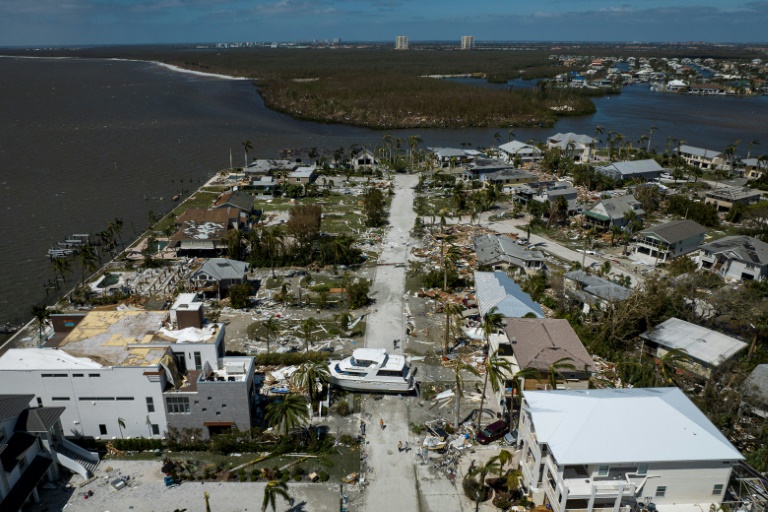
Fort Myers, where Ian came ashore as a powerful Category 4 hurricane on Wednesday, took much of the brunt, as streets became rivers and seawater poured into houses.

Dozens of boats moored in the marina were sunk while others were tossed onto downtown streets.

DeSantis described the destruction as a “500-year flood event.”

Tom Johnson of Fort Myers had a front row seat for the chaos from his apartment on the second floor of a two-story harbourside building.

“I was scared because I’ve never been through that,” the 54-year-old told AFP. “It was just the most horrifying sounds with debris flying everywhere, doors flying off.”

His home was undamaged but one of his neighbors, Janelle Thil, was not so lucky and had to ask other residents for help after her ground floor apartment began to flood.

“They got my dogs and then I jumped out of the window and swam,” the 42-year-old said.

When Thil returned to her apartment after the storm passed, she said she opened the door and “had to wait about five minutes for all the floodwaters to come out.”

“I loved my home,” she said. “But I’m alive and that’s what matters.”

A US Coast Guard official said helicopter crews were plucking people from the rooftops of homes inundated by floodwaters.

– Millions without power –

Seventeen migrants were missing from a boat that sank during the hurricane on Wednesday, with one person found dead and nine others rescued, the Coast Guard said. Among them were four Cubans who swam to shore in the Florida Keys.

Much of Florida’s southwest coast was plunged into darkness after the storm wiped out power.

Tracking website PowerOutage.us said two million homes and businesses remained without electricity in the Sunshine State on Friday.

Two barrier islands near Fort Myers, Pine Island and Sanibel Island, popular with vacationers, were essentially cut off when the storm damaged causeways to the mainland.

Before pummeling Florida, Ian plunged all of Cuba into darkness after downing the island’s power network.

Electricity was gradually returning, but many homes remain without power.

Laura Mujica joined dozens of Cuban women gathered in the capital Havana on Thursday to demand electricity be restored in the city.

“We took to the street, because we haven’t had electricity for several days and we are tired of it. 

“We women decided to take to the streets to empower ourselves and protest so that the electricity will be fixed,” said the 20-year-old.

Human-induced climate change is resulting in more severe weather events across the globe, scientists say — including with Ian.

According to a rapid and preliminary analysis, human-caused climate change increased the extreme rain that Ian unleashed by over 10 percent, US scientists said.
Key US inflation index shows signs of slowing in August

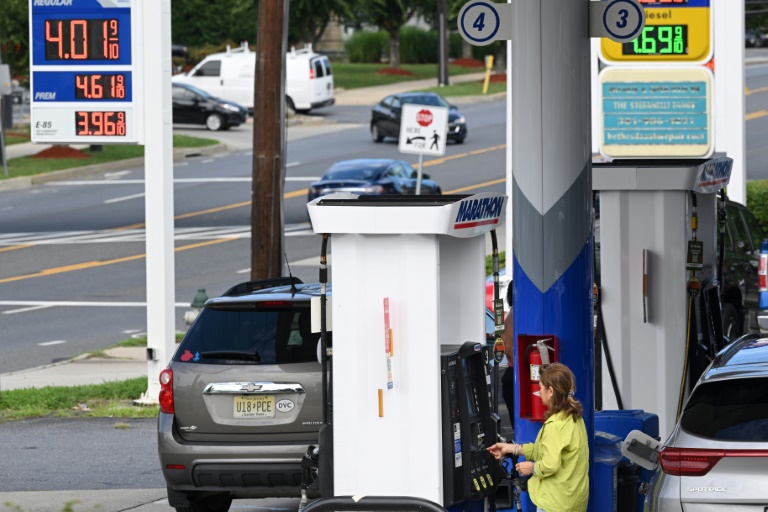
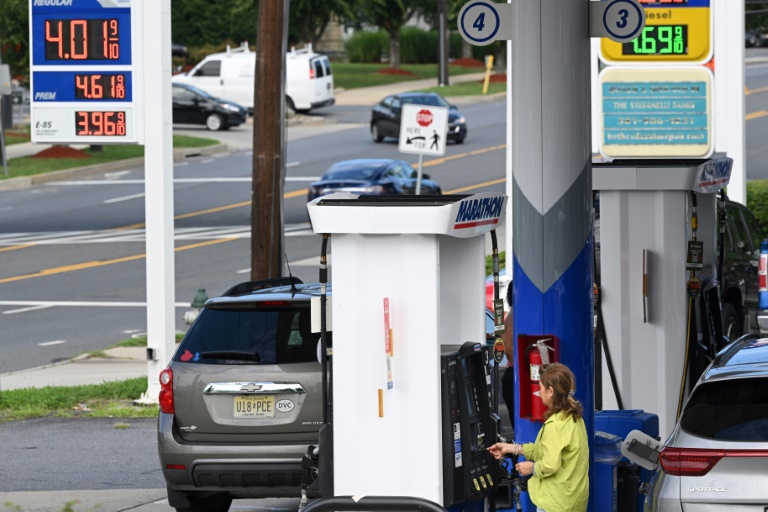
A closely-watched measure of US inflation showed the annual pace of price increases slowed slightly in August as energy costs fell and increases in food costs eased, according to government data released Friday.

But while the data moved in the right direction, it may not provide much comfort to President Joe Biden or the Federal Reserve since inflation remains at the highest level since the early 1980s.

The Fed’s preferred inflation measure, the personal consumption expenditures (PCE) price index, increased 6.2 percent from August 2021, down slightly from the pace in July and from the 7.0 percent peak in June, the Commerce Department reported.

Inflation picked up speed last year and has accelerated this year as global supply chain snarls and worker shortages pushed prices higher — factors worsened by Russia’s war on Ukraine, which sent food and energy prices soaring worldwide.

Energy prices increased 24.7 percent over the past year while food prices are up 12.4 percent, the report showed. 

The Fed focuses on the PCE price index as it reflects consumers’ actual spending, including shifts to lower cost items, unlike the more well-known consumer price index (CPI), which also slowed in August from the blistering 9.1 percent rate in June — the highest in 40 years.

The Fed has raised interest rates aggressively this year to try to cool demand and tamp down inflation pressures, and officials have said more increases are coming before the year is out.

However, the report may not provide much comfort to central bankers as it showed widespread increases in goods and services prices, beyond the volatile food and energy components.

Excluding food and energy, the “core” PCE price index for August increased 4.9 percent from one year ago, accelerating faster than in July.

“The big and unwelcome surprise here is the overshoot in the core PCE,” said Ian Shepherdson of Pantheon Macroeconomics. 

While “it’s not as bad as it looks … appearances count, and this does not look good,” he said, predicting a fourth straight three-quarter point Fed interest rate hike in November.

Compared to the prior month, the index rose 0.3 percent, rebounding after a slight dip in July, while the core PCE jumped 0.6 percent, the report said.

The data also showed household spending increased 0.4 percent in the month, after falling in July, although economists say the trend is slowing.

Key US inflation index shows signs of slowing in August

A closely-watched measure of US inflation showed the annual pace of price increases slowed slightly in August as energy costs fell and increases in food costs eased, according to government data released Friday.

But while the data moved in the right direction, it may not provide much comfort to President Joe Biden or the Federal Reserve since inflation remains at the highest level since the early 1980s.

The Fed’s preferred inflation measure, the personal consumption expenditures (PCE) price index, increased 6.2 percent from August 2021, down slightly from the pace in July and from the 7.0 percent peak in June, the Commerce Department reported.

Inflation picked up speed last year and has accelerated this year as global supply chain snarls and worker shortages pushed prices higher — factors worsened by Russia’s war on Ukraine, which sent food and energy prices soaring worldwide.

Energy prices increased 24.7 percent over the past year while food prices are up 12.4 percent, the report showed. 

The Fed focuses on the PCE price index as it reflects consumers’ actual spending, including shifts to lower cost items, unlike the more well-known consumer price index (CPI), which also slowed in August from the blistering 9.1 percent rate in June — the highest in 40 years.

The Fed has raised interest rates aggressively this year to try to cool demand and tamp down inflation pressures, and officials have said more increases are coming before the year is out.

However, the report may not provide much comfort to central bankers as it showed widespread increases in goods and services prices, beyond the volatile food and energy components.

Excluding food and energy, the “core” PCE price index for August increased 4.9 percent from one year ago, accelerating faster than in July.

“The big and unwelcome surprise here is the overshoot in the core PCE,” said Ian Shepherdson of Pantheon Macroeconomics. 

While “it’s not as bad as it looks … appearances count, and this does not look good,” he said, predicting a fourth straight three-quarter point Fed interest rate hike in November.

Compared to the prior month, the index rose 0.3 percent, rebounding after a slight dip in July, while the core PCE jumped 0.6 percent, the report said.

The data also showed household spending increased 0.4 percent in the month, after falling in July, although economists say the trend is slowing.

UK teen died after 'negative effects of online content': coroner

A 14-year-old British girl died from an act of self-harm while suffering from the “negative effects of online content”, a coroner said Friday, in a case that has shone a spotlight on social media companies.

Molly Russell was “exposed to material that may have influenced her in a negative way and, in addition, what had started as a depression had become a more serious depressive illness,” Andrew Walker ruled at North London Coroner’s Court.

The teenager “died from an act of self-harm while suffering depression”, he said, but added it would not be “safe” to conclude it was suicide.

Some of the content she viewed was “particularly graphic” and “normalised her condition,” said Walker.

Of the 16,300 posts Russell saved, shared or liked on Instagram in the six-month period before her death, 2,100 related to depression, self-harm or suicide, the inquest was told.

Russell, from Harrow in northwest London, died in November 2017, leading her family to set up a campaign highlighting the dangers of social media.

“Molly was a thoughtful, sweet-natured, caring, inquisitive, selfless, beautiful individual — although a few words cannot possibly encapsulate our wonderful girl,” her father Ian said in a statement.

“We have heard a senior Meta (Instagram parent company) executive describe this deadly stream of content the platform’s algorithms pushed to Molly as ‘safe’ and not contravening the platform’s policies.

“If this demented trail of life-sucking content was safe, my daughter Molly would probably still be alive and instead of being a bereaved family of four, there would be five of us looking forward to a life full of purpose and promise that lay ahead for our adorable Molly.

“It’s time the toxic corporate culture at the heart of the world’s biggest social media platform changed,” he urged.

– Silicon Valley ‘shockwaves’ –

The week-long hearing became heated when the family’s lawyer, Oliver Sanders, took a Meta executive to task.

A visibly angry Sanders asked Elizabeth Lagone, the head of health and wellbeing at Meta, why the platform allowed children to use it when it was “allowing people to put potentially harmful content on it”.

“You are not a parent, you are just a business in America. You have no right to do that. The children who are opening these accounts don’t have the capacity to consent to this,” he said.

Lagone apologised after being shown footage, viewed by Russell, that “violated our policies”.

In a statement issued following the ruling, a spokeswoman for Meta said: “Our thoughts are with the Russell family and everyone who has been affected by this tragic death.

“We’ll continue our work with the world’s leading independent experts to help ensure that the changes we make offer the best possible protection and support for teens,” she added.

Children’s charity NSPCC said the ruling “must be a turning point”, stressing that any delay to a government bill dealing with online safety “would be inconceivable to parents”.

“Tech companies must be held accountable when they don’t make children’s safety a priority,” tweeted the charity. 

NSPCC chief executive Peter Wanless said the ruling should “send shockwaves through Silicon Valley”.

“The magnitude of this moment for children everywhere cannot be understated,” he added.

Eurozone inflation jumps to record 10% as energy prices soar

Eurozone consumer prices skyrocketed by a record 10 percent in September, official data showed on Friday, as inflation reached double digits on the back of soaring energy prices caused by Russia’s war on Ukraine.

Stoked by a staggering 40.8 percent rise in energy prices, the yearly inflation rate in the 19-country single currency area hit its highest level since records began, according to Eurostat.

The historic level of inflation will encourage the European Central Bank to stay on its current path of rate hikes, in an effort to cool prices despite the risk of triggering economic recession in Europe.

The ECB is desperate to prevent inflation from taking root in the economy and is taking measures that will reduce demand and could therefore slow growth.

The ECB argues that the hikes are also necessary to put monetary policy on a more “neutral” footing after many years of negative rates and stimulus programmes that pumped tens of billions of euros into the eurozone economy.

The leap to 10 percent followed a 9.1 percent rise in August and doused hopes that inflation would begin to ease as energy markets stabilise seven months after Russia launched its invasion of Ukraine.

Making matters more complicated for policymakers, the eurozone’s powerhouse economies showed widely divergent inflation rates, with Germany seeing price hikes of 10.8 percent and France at 6.2 percent.

In the Netherlands inflation prices rose by 17.1 percent, the highest since World War II, in a major leap from an already sky-high 12 percent a month earlier.

Also muddying the waters, some eurozone countries are pushing through major national spending to ease the energy price burden on consumers, creating further fragmentation in the European economy.

In an urgent effort to tame prices, European Union energy ministers on Friday agreed to cut peak-hour power consumption and impose windfall levies on energy companies.

– ECB rate hike looms –

In the face of a tough balancing act, ECB chief Christine Lagarde indicated this week she would go ahead with another hefty rate hike of 0.75 percentage points at the bank’s next meeting on October 27.

“We expect to raise interest rates further over the next several meetings to dampen demand and guard against the risk of a persistent upward shift in inflation expectations,” she told EU lawmakers. 

Energy prices in Europe remain under intense pressure with Russia starving the continent of gas supply as winter approaches.

The ECB’s target for inflation is two percent and efforts to get closer to that level have raised fears that the central bank may lead the bloc into a recession in its effort to reduce prices.

“The jump in the eurozone’s headline inflation rate in September into double digits will be of grave concern to the ECB,” said Jessica Hinds of Capital Economics.

“Despite the weak economic outlook we expect the banks to prioritise inflation and deliver another bumper rate hike next month,” she added.

Eurostat data also published on Friday showed the eurozone unemployment rate remaining at a record low of 6.6 percent in July.

This will further encourage the ECB to stay the course and choose fighting inflation over concerns about economic growth and its consequences on employment.

UK teen died after 'negative effects of online content': coroner

A 14-year-old British girl died from an act of self harm while suffering from the “negative effects of online content”, a coroner said Friday in a case that shone a spotlight on social media companies.

Molly Russell was “exposed to material that may have influenced her in a negative way and, in addition, what had started as a depression had become a more serious depressive illness,” Andrew Walker ruled at North London Coroner’s Court.

The teenager “died from an act of self-harm while suffering depression”, he said, but added it would not be “safe” to conclude it was suicide.

Some of the content she viewed was “particularly graphic” and “normalised her condition,” said Walker.

Russell, from Harrow in northwest London, died in November 2017, leading her family to set up a campaign highlighting the dangers of social media.

“There are too many others similarly affected right now,” her father Ian Russell said after the ruling.

“At this point, I just want to say however dark it seems, there is always hope. 

“I hope that this will be an important step in bringing about much needed change,” he added.

The week-long hearing became heated when the family’s lawyer, Oliver Sanders, took an Instagram executive to task.

A visibly angry Sanders asked Elizabeth Lagone, the head of health and wellbeing at Meta, Instagram’s parent company, why the platform allowed children to use it when it was “allowing people to put potentially harmful content on it”.

“You are not a parent, you are just a business in America. You have no right to do that. The children who are opening these accounts don’t have the capacity to consent to this,” he said.

Lagone apologised after being shown footage, viewed by Russell, that “violated our policies”.

Of the 16,300 posts Russell saved, shared or liked on Instagram in the six-month period before her death, 2,100 related to depression, self-harm or suicide, the inquest heard.

Children’s charity NSPCC said the ruling “must be a turning point”.

“Tech companies must be held accountable when they don’t make children’s safety a priority,” tweeted the charity. 

“This must be a turning point,” it added, stressing that any delay to a government bill dealing with online safety “would be inconceivable to parents”.

UK avoids recession in boost for under-fire Truss

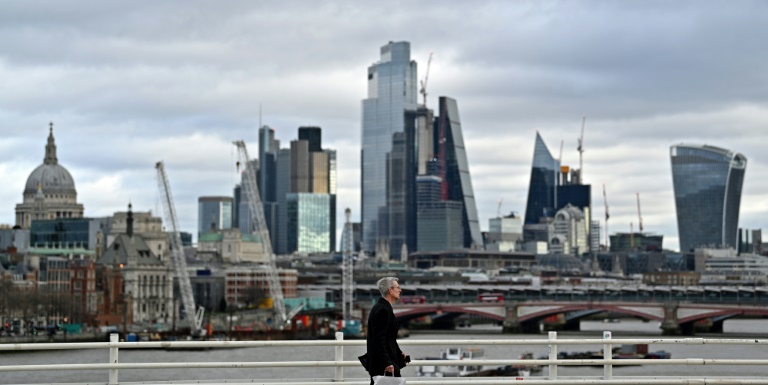
Britain is not yet in recession, revised data showed Friday in a boost for under-fire Prime Minister Liz Truss, but its economy may still face a downturn on soaring interest rates.

Gross domestic product expanded 0.2 percent in the second quarter, said the Office for National Statistics in an upgrade from its previous estimate of a 0.1-percent contraction.

Even if the economy has shrunk in the current third quarter that ends Friday, as the Bank of England forecasts, it would mean the UK had avoided two successive quarters of contraction — the technical definition of a recession.

The turnaround follows a rough week for new PM Truss as the country’s borrowing costs soared and the pound hit a record dollar-low after her government announced a controversial budget plan on September 23 that included a cap on soaring energy bills.

Truss and finance minister Kwasi Kwarteng met Friday with Britain’s fiscal watchdog to discuss the economic and fiscal outlook in the wake of last week’s announcement of also debt-fuelled tax cuts.

“We will deliver the first iteration of that forecast” next week, the Office for Budget Responsibility said in a statement after the meeting.

The country’s economy output remains fragile, with Friday’s ONS data also revised to show that it was still below pre-Covid levels.

– ‘Calamitous week’ –

“In what has been a calamitous week for the UK economy, there was a rare glimmer of hope… (with it) defying expectations of a recession — for now,” said Interactive Investor analyst Richard Hunter.

“Sterling has also found some cautious support… although the jitters will remain as the government continues to justify and explain the implications of its fiscal largesse.”

Investors were spooked this week by the huge amount of borrowing likely needed for a UK budget seen as benefitting the rich more than the poorest during the cost-of-living crisis.

Less than a month into the job, Truss is already deep in a financial crisis.

The pound on Monday collapsed to an all-time low at $1.0350 on fears the budget would make sky-high inflation worse and cause the Bank of England (BoE) to hike its main interest rate even more aggressively.

Sterling has since recovered slightly.

The upbeat GDP figure came two days after the BoE carried out emergency action to snap up government bonds, whose yields had soared following the budget.

And the central bank is forecast to hike its interest rate far beyond the current 2.25 percent, which compares with a record-low 0.1 percent less than a year ago, as markets fear ever-higher inflation.

This in turn could see businesses closing and home-owners defaulting on their mortgages.

– ‘Good news, bad news’ –

Despite growth in the latest quarter, the UK economy is 0.2 percent smaller than its pre-pandemic size, the ONS added Friday. 

The statistics office previously had the UK economy at 0.6 percent larger than in 2019.

“The good news is that the economy is not already in recession,” said Capital Economics analyst Paul Dales.

“The bad news is that contrary to previous thinking, it still hasn’t returned to pre-pandemic levels.”

The ONS also said the UK economy slumped 11 percent in 2020 on fallout from the Covid pandemic.

It then rebounded with 7.5-percent growth in 2021.

Attack kills 25 in Ukraine ahead of Kremlin annexation

An attack on a frontline civilian convoy killed at least 25 people in southern Ukraine on Friday, just hours before Moscow was due to annex four occupied Ukrainian regions.

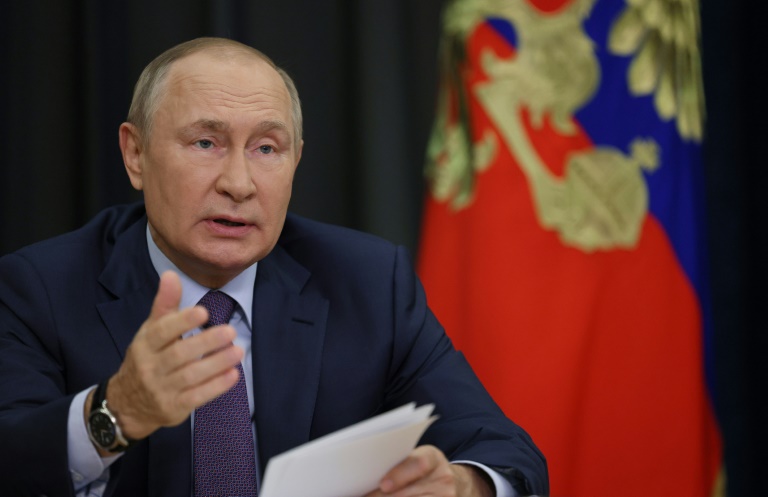
Russian President Vladimir Putin is poised to formally annex Kherson, Zaporizhzhia, Donetsk and Lugansk, which his forces mostly control, at a grand Kremlin ceremony later on Friday.

He has warned he could use nuclear weapons to retain control of the territory as the United States leads Western allies in vowing “never” to recognise the regions as anything other than part of Ukraine.

Kremlin spokesman Dmitry Peskov told reporters that the annexations would be formalised at an event at (1200 GMT) during which Putin would deliver a “major” speech.

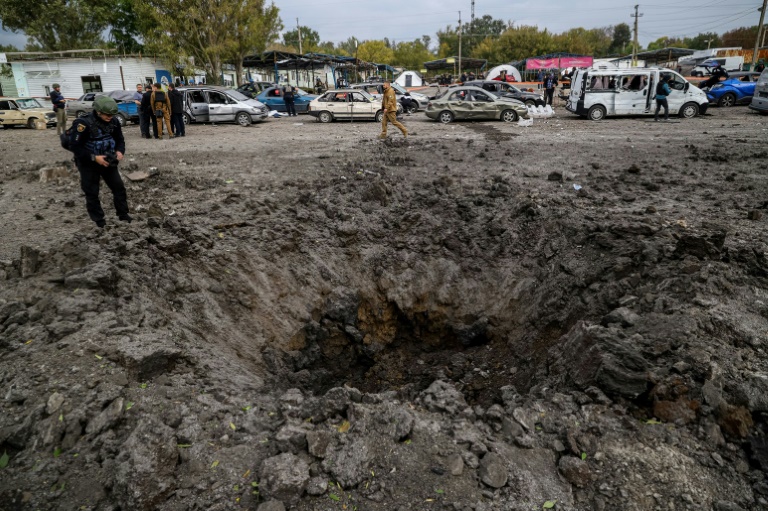
But early on Friday, an attack in Zaporizhzhia in the south, killed at least 25 people as civilians were preparing to leave to pick up relatives, Ukrainian officials said.

“Twenty-five killed and about 50 wounded in an attack by the Russian military on a humanitarian convoy in Zaporizhzhia. Investigation launched,” said the prosecutor general’s office on Telegram.

Bodies of people wearing civilian clothes were left on the ground after the attack and windows of cars blown out, an AFP photographer said. 

“Only complete terrorists could do this,” said Ukrainian President Volodymyr Zelensky. “Bloodthirsty scum! You will definitely answer,” he added. 

– Some 20 percent of Ukraine –

“The enemy launched rockets on a civilian convoy leaving the city centre,” said Zaporizhzhia governor Oleksandr Starukh.

But pro-Kremlin regional chief Vladimir Rogov accused Ukrainian troops of carrying out a “terrorist act”.

“The regime in Kyiv is trying to portray what happened as shelling by Russian troops, resorting to a heinous provocation,” he said on social media.

Preparations were underway in Moscow’s Red Square for state-organised celebrations to announce the annexation of Zaporizhzhia and the three other regions.

Municipal workers were climbing scaffolding in advance to install huge banners emblazoned with: “Donetsk. Lugansk. Zaporizhzhia. Kherson. Russia!”

“I’m happy if they want to join Russia,” Natalya Bodner, a 37-year-old lawyer told AFP in central Moscow. “They have more hope than we do”.

“It should have been done a long time ago,” a Russian serviceman Ildar Babaev from the southern region of Dagestan said.

“This is the right decision”.

The four territories create a crucial land corridor between Russia and the Crimean peninsula, annexed by Moscow in 2014.

– ‘Nobody believes it’ –

But the Kremlin said Friday it “needed to clarify” the exact borders of Kherson and Zaporizhzhia — neither fully controlled by Moscow’s forces — that it intends to annex.

Together, all five regions including Crimea, make up around 20 percent of Ukraine, whose forces in recent weeks have been clawing back wins as part of a counter-offensive.

In Sloviansk, a city in Donetsk, a military medic who goes by the name of Coconut said the annexations were nonsense.

“If my neighbour comes to my house and announces that it’s his, nobody believes it actually belongs to him,” he told AFP.

In Kherson, Russian officials announced that Ukrainian strikes with US-supplied precision artillery systems had killed a senior security chief of the Russian-controlled region.

A “pinpoint” strike by Himars hit his house, Kirill Stremousov, the deputy head of the Russian proxy administration said.

It was the latest of several targeted attacks on Russian-appointed officials in the region.

– Security Council vote –

Ukrainian forces are also on the doorstep of Lyman in Donetsk, which Moscow’s forces pummelled for weeks to capture this summer. 

“Lyman is partially surrounded,” said Denis Pushilin, the pro-Moscow leader in the breakaway region of Donetsk, on social media. Two nearby villages were “not fully under our control,” he added.

On Thursday, President Joe Biden said the United States would “never, never, never” recognise Russian sovereignty over the territories set for annexation.

The four regions’ Kremlin-installed leaders this week assembled in the Russian capital ahead of the ceremony.

They formally requested annexation after claiming residents backed the move in hastily organised referendums that were dismissed by Kyiv and the West as fraudulent.

Ukraine has said the West’s only appropriate response is to hit Russia with more sanctions and to supply Ukrainian forces with more weapons to keep reclaiming territory.

The UN Security Council will vote Friday on a resolution condemning the referendums, according to France, the council’s current president, but it has no chance of passing due to Moscow’s veto power.

Zelensky is calling an “urgent” meeting of his national security council for Friday, his spokesman said.

burs/jm

Court upholds Tanzania move to cordon off land to protect wildlife

A regional court on Friday ruled that Tanzania’s decision to cordon off land for wildlife protection was legal, dealing a blow to Maasai pastoralists who had protested the move, two lawyers for the community said.

The nomadic community in Loliondo in the northern district of Ngorongoro has accused the government of trying to force them off their ancestral land in order to organise safaris and hunting expeditions.

But the government has rejected the accusations, claiming it wants to “protect” 1,500 square kilometres (580 square miles) of the area from human activity.

After several postponements, the Arusha-based East African Court of Justice upheld the government’s decision, a lawyer for the Maasai told AFP.

“Unfortunately, the court ruled against us,” Esther Mnaro said.

“They have delivered a very impugned judgement,” another lawyer, Yonas Masiaya, told AFP.

The Maasai had asked the court to “stop the evictions, the arrest, detention or persecution” of their members and demanded a billion Tanzanian shillings ($430,000) as damages.

The three-judge bench said no compensation was due, Mnaro said.

They “decided that there… was no loss of property and none of these people were injured during the evictions, but our evidence and our witnesses had said totally different things.”

Mnaro said the community would decide whether to appeal.

There was no immediate reaction to the ruling from the government, which had previously argued that the Arusha court did not have jurisdiction to hear the matter.

Tensions have soared in recent months with violent clashes breaking out in June in Loliondo between police and Maasai demonstrators.

More than two dozen Maasai protesters were charged with murder over the death of a policeman in the clashes.

– Population growth –

Tanzania has historically allowed indigenous communities such as the Maasai to live within some national parks, including the Ngorongoro conservation area, a UNESCO World Heritage site. 

But the authorities say their growing population is encroaching on wildlife habitat and began moving the pastoralists out of Ngorongoro in June, calling it a voluntary relocation.

The relocation has sparked concern, with a team of UN-appointed independent rights experts warning in June that “it could jeopardise the Maasai’s physical and cultural survival.”

Since 1959, the number of humans living in Ngorongoro has shot up from 8,000 to more than 100,000.

The livestock population has grown even more quickly, from around 260,000 in 2017 to over one million today.

As climate change leads to prolonged droughts and low crop yields, pressure on the pastoralists has increased, forcing them into conflict with wildlife over access to food and water.

In 2009, thousands of Maasai families were moved out of Loliondo to allow an Emirati safari company, Ortelo Business Corporation, to organise hunting expeditions there. 

The government cancelled that deal in 2017, following allegations of corruption.

The East Africa Court of Justice came into force in 2001 to ensure adherence to the laws establishing the seven-nation East African Community bloc, made up of Burundi, Kenya, Rwanda, South Sudan, Tanzania, the Democratic Republic of Congo and Uganda.

European stocks climb, pound stalls on mixed data

European stock markets climbed Friday but the pound and euro fell as traders assessed mixed growth and inflation data.

The pound jumped on revised figures showing the UK economy had avoided recession — but it swiftly fell back on expectations of an eventual downturn owing to sky-high inflation.

In the eurozone, consumer prices rocketed a record 10 percent in September on soaring energy prices caused by Russia’s war on Ukraine, separate official data showed.

“Stock markets are bouncing back… although I don’t think anyone is getting excited by the moves which pale in comparison to the losses that preceded them,” noted OANDA senior market analyst Craig Erlam.

“This looks like nothing more than a dead cat bounce after a steep decline over the last couple of weeks as investors have been forced to once again accept that interest rates are going to rise further and faster than hoped.”

In the United States, Federal Reserve officials have again reiterated their intention to ramp up rates until they have tamed inflation, even if that means plunging the world’s top economy into recession.

The case for a fourth successive 0.75-percentage point lift was strengthened by news Thursday that first-time unemployment benefit claims fell below 200,000 for the first time since May.

All three main indices on Wall Street finished deep in the red Thursday, with the S&P 500 ending at its lowest level since November 2020.

In Asia on Friday, Shanghai dropped as data showed China’s manufacturing and services sectors struggled again in September from Covid lockdowns in parts of the country that have battered the world’s number-two economy.

There was also little reaction to news that Beijing would allow some cities to reduce mortgage rates for first-home purchases as it tries to support the property market.

Market sentiment was being eroded also by rising fears about developments in the Ukraine war, as Russia prepares to annex four occupied regions of its neighbour Friday, with President Vladimir Putin threatening to use nuclear weapons to defend the territories.

– Key figures around 1100 GMT –

London – FTSE 100: UP 0.4 percent at 6,909.18 points 

Frankfurt – DAX: UP 0.4 percent at 12,017.95

Paris – CAC 40: UP 0.8 percent at 5,723.46

EURO STOXX 50: UP 0.6 percent at 3,297.15

Tokyo – Nikkei 225: DOWN 1.8 percent at 25,937.21 (close)

Hong Kong – Hang Seng Index: UP 0.3 percent at 17,222.83 (close)

Shanghai – Composite: DOWN 0.6 percent at 3,024.39 (close)

New York – Dow: DOWN 1.5 percent at 29,225.61 (close)

Pound/dollar: DOWN at $1.1067 from $1.1116 on Thursday

Euro/dollar: DOWN at $0.9764 from $0.9818

Euro/pound: DOWN at 88.20 pence from 88.28 pence

Dollar/yen: UP at 144.47 yen from 144.42 yen

Brent North Sea crude: UP 0.7 percent at $89.12 per barrel

West Texas Intermediate: UP 0.3 percent at $81.41 per barrel

Close Bitnami banner
Bitnami