AFP

Gas flares vastly underperform, causing greater climate impact: study

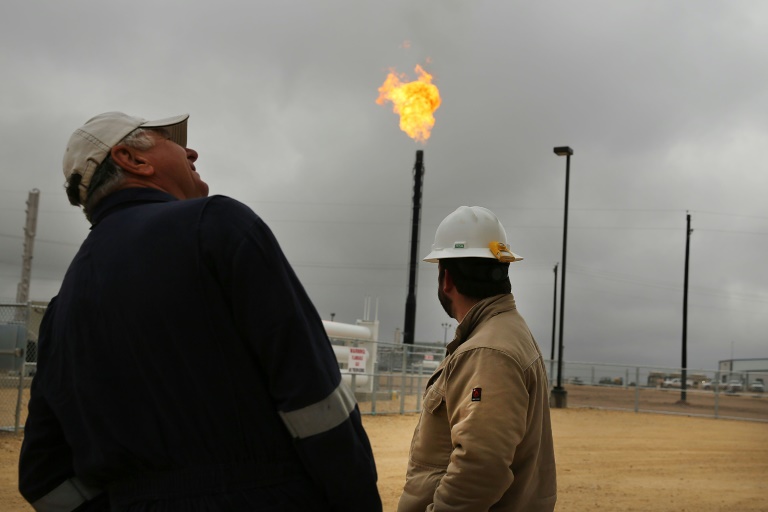
Flaring — burning off unwanted natural gas from oil and gas wells — releases five times more of the potent greenhouse gas methane into the atmosphere over the United States than previously assumed, according to a study published Thursday.

The result is a far greater impact on climate change, with the warming potential between the stated and actual effectiveness of flaring across the United States equivalent to putting 2.9 million more cars onto the road each year, the paper in Science said.

A team led by Genevieve Plant at the University of Michigan carried out airborne sampling over the Permian Basin and Eagle Ford Shale in Texas, as well as the Bakken Formation that straddles North Dakota and Montana. These together account for 80 percent of US flaring.

“We employed a small airplane equipped with highly sensitive sensors to measure the concentrations of methane and carbon dioxide directly downwind of flare stacks,” Plant told AFP.

“Over the course of our airborne survey, we sample around 300 distinct flare stacks throughout the highest-flaring regions in the US.”

The fossil fuel industry and US government work on the assumption that flares remain lit and destroy methane, the predominant component of natural gas, with 98 percent efficiency.

But according to the study, a combination of unlit flares and some flares that were burning highly inefficiently meant that on average, flares destroyed just 91.1 percent of methane.

That implies methane emissions from flaring in the United States, which ranks among the top five nations for flaring activity, are five times as high as currently officially reported. 

– Health impacts –

Digging deeper into the numbers, the team found that most flares actually operate at 98 percent efficiency.

But a modest number of malfunctioning flares operate at efficiency as low as 60 percent, and 3-5 percent of flares are unlit — directly venting unburned gas into the atmosphere.

Flaring is an inherently wasteful activity — as the natural gas associated with oil extraction could be used for productive purposes. 

The amount of gas that is currently flared each year – about 144 billion cubic meters – could power the whole of sub-Saharan Africa, according to the World Bank.

Gas is flared for various reasons. Sometimes it is done for safety, since the extraction process deals with high pressures that can cause explosions. 

At other times it can be economic — when, for example, the target is oil and the associated gas isn’t considered worth bringing to market.

“From anecdotal conversations with industry experts, one potential reason flares may be unlit is due to high wind events and then the flares remain unlit until noticed by the operator if re-igniting systems are either not installed or not working,” said Plant.

The team suggested a number of solutions, key among them: reduce the total volume of flaring activity, increasing flare efficiency, and reducing the number of unlit flares.

Technology solutions can also be deployed, such as re-injecting gas back into oil reservoirs, which is common practice in Alaska.

“Other proposed alternatives to flaring include using the gas to power equipment on-site, as well as storing it, either compressed or liquefied form, for later energy use,” said Plant.

In a related commentary, authors Riley Duren and Deborah Gordon said the findings had important health implications for the half million people who live within five kilometers (three miles) of the three basins studied.

“Unlit and partially combusted flares have the potential to expose front-line communities to a cocktail of co-pollutants that present risks of acute and/or chronic health impacts,” they said.

Methane is a potent greenhouse gas, with more than 80 times the warming power of carbon dioxide over the first 20 years it enters the atmosphere — though carbon dioxide has greater staying power. 

Because of this, more than 120 countries have signed a Global Methane Pledge to cut emissions by 30 percent by 2030.

EU grapples with runaway energy prices

The EU on Friday will seek urgent ways to bring down skyrocketing energy prices as winter looms, with “sabotage” of gas pipelines from Russia this week injecting drama into the effort.

Energy ministers will gather in Brussels to consider an emergency European Commission proposal that includes cutting power use in the bloc, imposing windfall levies on energy companies and discussing a price cap on wholesale gas supplies.

Europe has found itself over a barrel as fossil fuel deliveries from Russia dry up. 

EU sanctions on Moscow for its invasion of Ukraine, which include shunning Russian oil starting in December, have prompted the Kremlin to retaliate by severely reducing supplies of natural gas.

Unexplained leaks on the undersea Nord Stream 1 and 2 gas pipelines from Russia to Germany — seen as “sabotage” by EU leaders, with suspicion falling on Moscow — have aggravated the situation.

– Sky-high bills –

Alarm is rising sharply among Europeans faced with climbing energy bills.

“It’s utterly impossible to pay,” Pascale Dumont, a baker in a Belgian town called Gedinne, told AFP after her business’s monthly electricity bill jumped tenfold, to 11,836 euros ($11,500).

“If you work it out over a year, it’s how much a house costs!” she exclaimed.

Business Europe, an EU lobby, warned that “the current state of high gas and electricity prices bears the imminent risk of production losses and shutdowns of thousands of European companies”.

The EU country on the frontline of the energy crunch is Germany, the bloc’s export powerhouse which had long been dependent on Russian gas.

After recording a jump to 10 percent inflation, its government said it will borrow 200 billion euros to shield German households and businesses from “an energy war”.

That adds to various national initiatives across the European Union totalling many hundreds of billions of euros — a hefty bill added to the one run-up during the worst of the Covid pandemic.

The European Commission is trying to leverage the Covid-era cooperation to forge a common EU approach on energy.

“Europe is facing energy blackmail by Russia, and global demand for gas is higher than supply,” EU energy commissioner Kadri Simson said.

“We need to work along the whole chain to tackle the challenge,” she said, adding that a price cap on the wholesale price of gas entering the EU “is possible” if other measures fail to bring results.

– Price cap mooted –

One core proposal with strong backing is a “cap” on non-gas electricity producers’ profits and a “contribution” from other energy majors. 

The levies — the commission refuses to call them a “windfall tax” — are calculated to raise 140 billion euros which can be spent to cushion consumers.

Another is to encourage reduced energy consumption, for instance by turning off public lighting earlier, lowering thermostats to a maximum of 19 degrees Celsius (66 degrees Fahrenheit) and lower peak-hour power use.

The Bruegel think tank in Brussels, however, said those steps are “not sufficient”.

“A more comprehensive plan needs to ensure that all countries bring forward every available supply-side flexibility, make real efforts to reduce gas and electricity demand, keep their energy markets open and pool demand to get a better deal from external gas suppliers,” it said.

Fifteen EU countries, among them France, Italy and Poland, have written a joint letter calling for a price cap on all gas imports into the bloc — covering pipeline gas from Russia but also liquified natural gas (LNG) shipments from the US and elsewhere.

An EU official briefing journalists on condition of anonymity called that idea “radical”.

The “significant risks” it carried included a sudden shortfall in gas supplies to Europe, especially from LNG suppliers diverting ships to more lucrative buyers elsewhere in the world.

One possible solution would be a centralised EU buying for gas “but the complexity of such a mechanism is such that I think in a short timeframe it is difficult to address,” the official said.

French Finance Minister Bruno Le Maire and his German counterpart Robert Habeck called Thursday in a joint newspaper column on the European Commission “to explore all other options which may lower prices while maintaining a secure energy supply and avoiding excessive consumption of gas.”

Latin America bears brunt of land activist murders: NGO

More than three-quarters of the world’s murders of environmental activists took place in Latin America last year, an annual review by watchdog Global Witness showed on Thursday.

The group said a total of 200 land and environmental defenders — whom it named individually — were killed in 2021, down from a record 227 in 2020.

These killings came “in the context of a wider range of threats against defenders who are being targeted by government, business and other non-state actors with violence, intimidation, smear campaigns and criminalization,” the London-based group said.

“Over three-quarters of the attacks recorded took place in Latin America,” said Global Witness, which has issued such reports since 2012.

It maintains a database of the killings based on reviews of “reliable sources of publicly available online information,” the report said.

Mexico had the highest recorded number of killings at 54 in 2021, Global Witness found. That figure was up from 30 the previous year, and more than 40 percent of the victims were Indigenous people, it said.

Global Witness reported that heavy Latin American tolls also occurred in Colombia, with 33 killings, Brazil where there were 26 and Nicaragua, which had 15.

While in most cases the killings could not be connected to a specific industry, the report identified 27 tied to mining and extractive industries.

– ‘We feel abandoned’ –

Among the Mexican victims identified by Global Witness was Jose Santos Isaac Chavez , an Indigenous leader and lawyer in Ayotitlan in Jalisco state who opposed the local Pena Colorada mine.

Chavez was murdered in April last year.

“He was found dead in his car, which had been driven off a cliff. His body showed evidence of torture,” Global Witness said.

No one has been brought to justice for this and other killings linked to opponents of the mine, it added.

“The mines destroy and pollute the environment,” said Ayotitlan community activist Jose Santos Rosales, whose 17-year-old son Rogelio Rosales Ramos was murdered in 2020.

“I ask the authorities for justice and to punish those responsible,” Rosales, whose brother also disappeared in 1993, told AFP by telephone.

“We feel abandoned to our fate” because criminals, when faced with any criticism about the mine, “send someone to murder,” he added.

Global Witness said that “impunity remains rife” in Mexico, with more than 94 percent of such crimes not reported and only 0.9 percent resolved.

It called for urgent actions to hold companies and governments accountable for actions against land and environmental defenders, “who are often standing on the front line of the climate crisis.”

Among the measures, it said governments should require companies to carry out due diligence on human rights and environmental risks, and must ensure an enforceable legal environment that protects land defenders. 

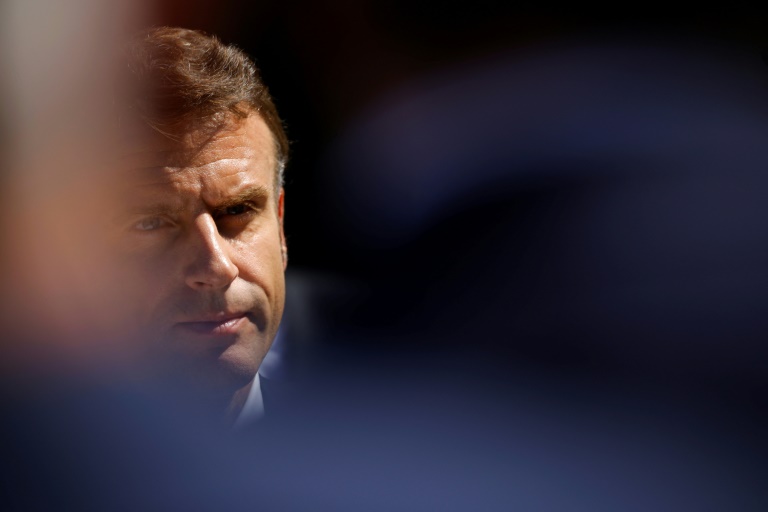
Macron agrees pension reform timeline as protests start

The French government vowed on Thursday to push through pension reform by the end of the winter despite opposition from unions which launched a first major day of strikes.

A call for nationwide stoppages by the CGT union on Thursday — the first since President Emmanuel Macron was re-elected in April — caused some disruption, but was not widely followed.

Several unions, including the country’s biggest, did not take part, although all of them and left-wing political parties are gearing up for a months-long fight over efforts to raise the pension age.

“It’s the start of a social battle,” leading left-wing MP Alexis Corbiere from the France Unbowed (LFI) party told AFP as he took part in a protest march of tens of thousands in Paris. “My hope is that this is the starting point.” 

Macron made raising the retirement age from its current level of 62 one of the key planks of his re-election campaign, arguing that the current system was unsustainable and too expensive.

“All the unions in France are against working up to 64 or 65 years. Because it’s stupid,” the head of the CGT union, Philippe Martinez, told France 2 on Thursday. 

Left-wing political parties have called their own separate rallies on October 16 to demand pay rises and an end to the planned pension changes.

Though Macron is known to be in a hurry to push through legislation, Prime Minister Elisabeth Borne announced Thursday that the government would spend another few months in consultations with unions and other political parties.

“There are important questions we want to open talks about,” she told AFP after talks at the presidential palace on Wednesday evening.

A bill would be voted on “before the end of the winter”, she promised.

– Fresh elections? –

With deficits spiralling and public debt at historic highs, Macron views pushing back the pension age as one of the only ways the state can raise revenues without increasing taxes.

But his centrist party lost its majority in parliament in June, severely undermining his ability to make changes that are broadly unpopular.

Labour Minister Olivier Dussopt said that the 44-year-old head of state would not hesitate to call fresh elections if opposition parties voted down the government over the reform.

“If all of the opposition comes together to adopt a vote of no-confidence and brings down the government, he (Macron) will let French people decide and say what sort of a majority they want,” Dussopt told the LCI channel. 

No opposition party has pledged to support the centrist minority government so far, but the conservative Republicans might still be persuaded, observers say.

“I’m not sure that there’s a majority in the country for working longer, lowering unemployment benefits and freezing salaries,” Corbiere said in a swipe at Macron’s economic policies.

The government has raised salaries for public sector workers — but below inflation of nearly 6.0 percent.

“We’re ready,” added Corbiere.

– Stoppages – 

The strike on Thursday was followed by about one in ten teachers, according to the education ministry, leading to school closures in some areas.

One in three railway workers also stopped work, according to the CGT, leading to major cancellations on key routes including Paris-Bordeaux. 

The biggest of around 200 protests nationwide drew up to 40,000 people in Paris, according to organisers, while around 4,000 people marched in the southern city of Marseille.

“It’s a bit disappointing,” said Nathalie Bourget, a teacher at the Paris march. “We were hoping for more.”

The strikes and demonstrations were much smaller than in 2019 — Macron’s last attempt to reform pensions — when hundreds of thousands marched and a four-week strike hit the Paris transport system.

Macron called off the reform several months later amid the Covid-19 pandemic.

“It’s up to us to show our determination, to show that street protests still have some power,” said Xavier Signac, a 48-year-old member of the UNSA union from southwest France, as he walked along with a flag in Paris.

burs-adp/lcm

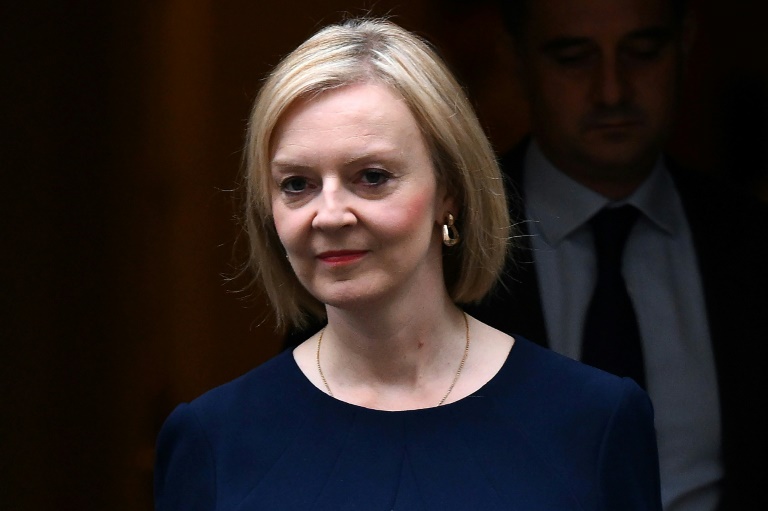
UK PM vows to get borrowing 'back on track' after market turmoil over tax cuts

UK Prime Minister Liz Truss defended her tax-slashing plans Thursday but vowed to “get borrowing back on track”, after nearly a week of silence when markets tanked and the Bank of England was forced into an emergency intervention.

“We had to take urgent action to get our economy growing, get Britain moving, and also deal with inflation,” she said in an initial round of local BBC radio interviews.

“And of course, that means taking controversial and difficult decisions, but I’m prepared to do that as prime minister,” she added, in her first comments to UK media since the crisis sparked by Friday’s “mini-budget”.

“It’s important the United Kingdom’s on the front foot, that we are pulling all the levers we can to drive economic growth. That is what we are pushing ahead with.” 

In a series of further BBC regional television interviews, Truss — in power for less than a month — said some aspects of her growth plan “will take time” while insisting “we will get borrowing back on track”.

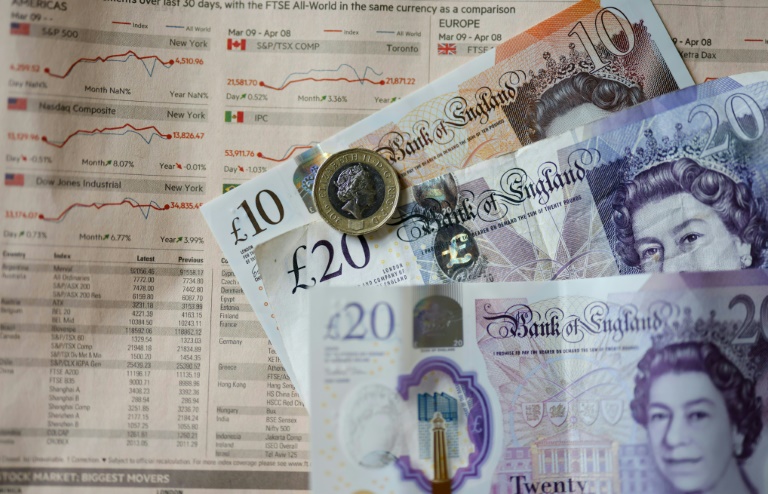
The under-fire leader is facing severe pressure after the markets reacted to her government’s contentious plans for extra borrowing to fund uncosted tax cuts by sending the pound to an all-time low against the dollar.

UK markets remain highly volatile, with the central bank intervening on Wednesday to buy government bonds in order to prevent a “material risk” to stability.

The Bank of England announced a two-week programme to buy long-term UK bonds, capped initially at £65 billion ($71 billion), as UK pension funds scrambled to sell investments in order to remain solvent.

After sterling hit its dollar low early Monday, the bank said it would “not hesitate to change interest rates by as much as needed” to curb high inflation.

But it also signalled that it would wait until its next policy meeting on November 3 before fully assessing the impact of the government’s contentious plans.

Parliament’s Treasury Committee on Thursday called on Chancellor Kwasi Kwarteng directly to publish a fully costed economic forecast by the end of October to help the bank rather than on November 23 as planned.

Opposition leaders have demanded that Truss cancel her Conservative party’s annual conference starting on Sunday and recall parliament over the crisis.

– Truss v IMF –

Markets are concerned that Britain cannot fund its huge spending commitments, having announced a massive fuel subsidy package alongside the tax cuts.

Truss defended her fiscal policy, which includes a cut to the top rate of income tax, arguing the UK currently had its highest tax burden in 70 years. 

“We’ve reduced those taxes across the board. And of course people who are better off tend to pay more taxes,” she said.

The pound rebounded somewhat during Thursday, rising one percent against the dollar and reaching $1.09, reversing losses the previous day following the BoE’s emergency move.

But former BoE chief Mark Carney said the government had “undercut” financial institutions with its actions. 

“Unfortunately having a partial budget, in these circumstances — tough global economy, tough financial market position, working at cross-purposes with the bank — has led to quite dramatic moves in financial markets,” he told the BBC. 

But Truss insisted she was working “very closely” with the central bank.

In a highly unusual intervention on Wednesday, the International Monetary Fund said it was “closely monitoring” developments and urged the UK government to change tack.

It noted that Truss and Kwarteng, were trying to deal with the energy shock and boost growth.

“However, given elevated inflation pressures in many countries… we do not recommend large and untargeted fiscal packages at this juncture.” 

The IMF stressed the importance of fiscal policy not working “at cross purposes to monetary policy”.

Many central banks, including the Bank of England, are aggressively hiking interest rates in a bid to cool decades-high inflation. 

“There are many people with many different opinions, but what I think nobody is arguing with is that we had to take action to deal with what is a very, very difficult economic situation,” Truss retorted.

“My priority was making sure that we were supporting the British people in what is going to be a very difficult winter.”

Poland blames toxic algae for Oder river fish kill

Polish authorities on Thursday said toxic algae was to blame for mass fish deaths in the Oder river, ruling out industrial pollution as the cause.

The conclusions presented at a press conference by scientists and government officials come from a preliminary report to be released Friday, weeks after the environmental disaster unfolded. 

The authors of the report said nearly 250 tonnes of dead fish were recovered from the Oder river that runs through Poland and Germany. 

Various factors “led us to conclude that the fish deaths were probably caused by the toxic effects of an algal bloom”, said Agnieszka Kolada from the Polish Institute of Environmental Protection.

The micro-algae at issue — known as Prymnesium parvum, or golden alga — are prevalent in estuaries and normally grow in brackish water, mainly near the sea, and “had until now never been detected in Poland”, she told reporters.

She added that the water quality of the Oder has been poor “for years” and was only made worse this summer by high temperatures and very low water levels, which may have fostered the algal bloom.

Some observers, including media outlets and environmental organisations, suspected that a chemical spill was at fault for the disaster, but the Polish side rejected that theory.

“The fish deaths were neither caused by heavy metals, nor pesticides, nor petroleum substances,” according to a presentation on the report. 

According to the analyses to date, “none of the inspected business entities had discharged pollutants above the regulatory limits” into the river, said Andrzej Szweda-Lewandowski, the government’s head of environmental protection.

The amount of industrial discharge had been “the same as in previous years”, he told reporters.

Fishermen in Poland first started reporting dead fish in the Oder in late July and they began washing up in Germany a few days later.

Poland’s government only reacted on August 12, sparking widespread criticism from both local Polish authorities and Germany. 

Kremlin to annex more Ukraine territories at ceremony Friday

Russia will annex four regions of Ukraine that its troops occupy at a grand ceremony in the Kremlin on Friday, Moscow said, after President Vladimir Putin threatened he could use nuclear weapons to defend the territories.

The threats have not deterred a sweeping Ukrainian counter-offensive, which has been pushing back Russian troops in the east and is on the doorstep of the Donetsk region town of Lyman that Moscow’s forces pummelled for weeks before capturing this summer.

Kremlin spokesman Dmitry Peskov told reporters that the annexation of these four areas would be formalised at a ceremony in the Kremlin and that Putin would deliver a “major” speech.

The Russian leader himself then blamed the conflict in Ukraine on the West and said simmering conflicts in the ex-USSR were the result of the Soviet collapse.

The rhetoric built on his now famous phrase that the collapse of the USSR was a tragedy and he has recently suggested Moscow should extend again its influence over the former Soviet region.

“It’s enough to look at what’s happening now between Russia and Ukraine and what is happening on the borders of some other CIS countries,” Putin told security chiefs from former Soviet countries.

– ‘Soviet collapse’ –

“All this, of course, is the result of the collapse of the Soviet Union,” he said.

The Kremlin-installed leaders of the four regions that pleaded to Putin for annexation this week were gathered in the Russian capital Thursday ahead of the ceremony.

Their nearly simultaneous requests came after they claimed residents had unanimously backed the move in hastily organised referendums that were dismissed by Kyiv and the West as illegal, fraudulent and void.

Ukraine after the so-called referendums said the only appropriate response from the West was to hit Russia with more sanctions and to supply Ukrainian forces with more weapons to keep reclaiming territory.

“Ukraine cannot and will not tolerate any attempts by Russia to seize any part of our land,” President Volodymyr Zelensky said.

The Ukrainian leader on Thursday called an “urgent” meeting of his national security council on Friday, his spokesman said, after the Kremlin announced the timing of the annexation ceremony.

The four territories — Kherson and Zaporizhzhia in the south; Donetsk and Lugansk in the east — create a crucial land corridor between Russia and the Crimean peninsula, annexed by Moscow in 2014.

Together, all five make up around 20 percent of Ukraine, whose forces in recent weeks have been clawing back ground.

In the south, Ukrainian forces have been wresting back territory near Kherson and residents of recently recaptured villages described to AFP journalists this week months of terror under Russian occupation.

“They robbed and humiliated us,” 72-year-old Maria Syzhuk said in the village of Vysokopillya, echoing with the dull thuds of artillery from both sides — mostly in the distance, but sometimes a little too close.

Kyiv’s army in particular has been progressing in the eastern Kharkiv region and recapturing territory in Donetsk. Military observers say Kyiv’s forces are close to capturing Lyman. 

“At the moment, our units are managing to repel all attacks,” a Russian-backed official in the Donetsk region, Alexei Nikonorov, told state TV on Thursday.

–  ‘I don’t want to kill people’ – 

Moscow’s forces are striking back along the entire frontline and officials in Kyiv said Thursday that Russian bombardment had killed three in the Dnipropetrovsk region, five in Donetsk and wounded seven in the Kharkiv region.

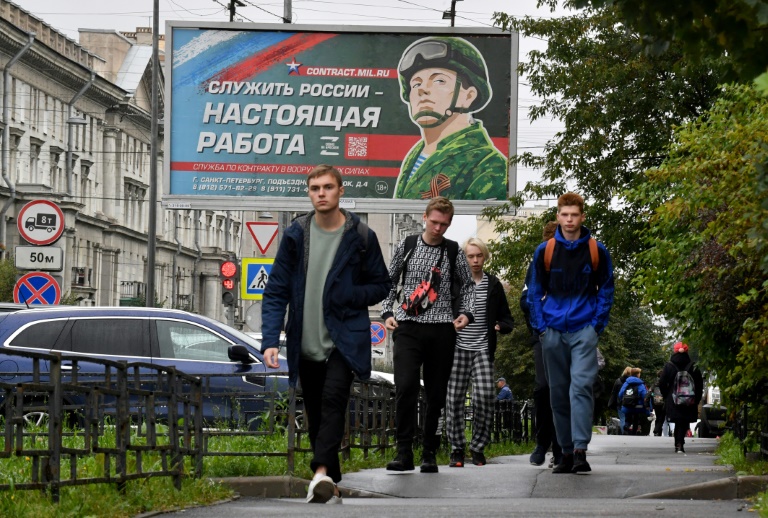
Along with threats to use nuclear weapons, Putin announced a mobilisation of hundreds of thousands of Russian men to bolster Moscow’s army in Ukraine, sparking demonstrations and an exodus of men abroad.

Finland’s Vaalimaa crossing has been flooded with new arrivals recently and has grown more precarious after Helsinki announced it would close its border from midnight to Russians holding European tourism visas for the Schengen zone.

“I just made it through, I don’t know how the others will get through. It’s sad, sad,” Andrei Stepanov, a 49-year-old Russian, told AFP of Finland’s new restrictions.

On a bright morning in Mongolia’s capital Ulaanbaatar, a young Russian fleeing Moscow’s first military call-up since World War II had a stark answer for why he had left: “I don’t want to kill people.”

“It was very difficult to leave everything behind — home, motherland, my relatives — but it’s better than killing people,” the man in his 20s told AFP, speaking on condition of anonymity.

Russia’s move to annex the Ukrainian territories was met with the announcement from the United States of a new package of weapons and supplies worth $1.1 billion, including precision rocket systems, ammunition, armoured vehicles and radars.

And the European Commission proposed fresh sanctions targeting Russian exports worth seven billion euros, an oil price cap, an expanded travel blacklist and asset freezes.

New asteroid strike images show impact 'a lot bigger than expected'

The James Webb and Hubble telescopes on Thursday revealed their first images of a spacecraft deliberately smashing into an asteroid, as astronomers indicated that the impact looks to have been much greater than expected.

The world’s telescopes turned their gaze towards the space rock Dimorphos earlier this week for a historic test of Earth’s ability to defend itself against a potential life-threatening asteroid in the future.

Astronomers rejoiced as NASA’s Double Asteroid Redirection Test (DART) impactor slammed into its pyramid-sized, rugby ball-shaped target 11 million kilometres (6.8 million miles) from Earth on Monday night.

Images taken by Earth-bound telescopes showed a vast cloud of dust expanding out of Dimorphos — and its big brother Didymos which it orbits — after the spaceship hit.

While those images showed matter spraying out over thousands of kilometres, the James Webb and Hubble images “zoom in much closer”, said Alan Fitzsimmons, an astronomer at Queen’s University Belfast involved in observations with the ATLAS project.

James Webb and Hubble can offer a view “within just a few kilometres of the asteroids and you can really clearly see how the material is flying out from that explosive impact by DART”, Fitzsimmons told AFP.

“It really is quite spectacular,” he said.

An image taken by James Webb’s Near-Infrared Camera (NIRCam) four hours after impact shows “plumes of material appearing as wisps streaming away from the centre of where the impact took place”, according to a joint statement from the European Space Agency, James Webb and Hubble.

Hubble images from 22 minutes, five hours and eight hours after impact show the expanding spray of matter from where DART hit.

– ‘Worried there was nothing left’ –

Ian Carnelli of the European Space Agency said that the “really impressive” Webb and Hubble images were remarkably similar to those taken by the toaster-sized satellite LICIACube, which was just 50 kilometres from the asteroid after separating from the DART spacecraft a few weeks ago.

The images depict an impact that looks “a lot bigger than we expected,” said Carnelli, the manager of the ESA’s Hera mission which intends to inspect the damage in four years.

“I was really worried there was nothing left of Dimorphos” at first, Carnelli told AFP.

The Hera mission, which is scheduled to launch in October 2024 and arrive at the asteroid in 2026, had expected to survey a crater around 10 metres (33 feet) in diameter. 

It now looks like it will be far bigger, Carnelli said, “if there is a crater at all, maybe a piece of Dimorphos was just chunked off.”

The true measure of DART’s success will be exactly how much it diverted the asteroid’s trajectory, so the world can start preparing to defend itself against bigger asteroids that could head our way in the future.

It will likely take Earth-bound telescopes and radars at least a week for a first estimate of how much the asteroid’s orbit has been altered, and three or four weeks before there is a precise measurement, Carnelli said.

– ‘Huge implications’ – 

“I am expecting a much bigger deflection than we had planned,” he said.

That would have “huge implications in planetary defence because it means that this technique could be used for much larger asteroids”, Carnelli added.

“Until today, we thought that the only deflection technique would be to send a nuclear device.”

Fitzsimmons said that even if no material had been “flung off” Dimorphos, DART still would still have slightly affected its orbit. 

“But the more material and the faster it’s moving, the more of a deflection there will have been,” he said.

The observations from James Webb and Hubble will help reveal how much — and how quickly — matter sprayed from the asteroid, as well as the nature of its surface.

The asteroid impact marked the first time the two space telescopes observed the same celestial body.

Since launching in December and releasing its first images in July, James Webb has taken the title of most powerful space telescope from Hubble.

Fitzsimmons said the images were “a beautiful demonstration of the extra science you can get by using more than one telescope simultaneously”.

European and US stocks tumble, pound rebounds

European and US equities sank Thursday on fears that rising interest rates will spark a global recession, while the pound clawed back ground one day after emergency bond-market intervention from the Bank of England.

“Higher US treasury yields, inflation and rising recession fears are back in the driving seat,” said market analyst Fiona Cincotta at City Index.

German inflation accelerated sharply in September, official data showed Thursday in the latest indication that Europe’s biggest economy is buckling under the pressure from soaring energy prices.

Consumer prices spiked 10.0 percent compared to the same month a year earlier.

German Chancellor Olaf Scholz announced that the nation would plough 200 billion euros into shielding households and businesses from skyrocketing energy costs in the wake of Russia’s invasion of Ukraine.

However, Frankfurt stocks slumped 1.7 percent, while Paris fell 1.5 percent.

London equities dropped 1.8 percent as the pound rebounded somewhat from earlier falls, one day after the BoE snapped up UK bonds to avert a risk to UK financial stability.

“The BoE rode to the rescue of the markets for one day, and the overall impact has been limited,” said Cincotta, although the pound bounced more than one percent higher to climb above $1.10.

The BoE, the European Central Bank, the US Federal Reserve and many other counterparts are ratcheting up interest rates to fight decades-high inflation.

Wall Street’s main stock indices slumped as US treasury yields continued to rise, and with the latest data showing a drop in first-time unemployment benefit claims falling under 200,000 for the first time since May.

The reading will be used by the Fed “as a basis to maintain an aggressive line with its rate hikes” because the bank sees a softening of the labour market as necessary to bring inflation back down to its two-percent target, said Patrick O’Hare, analyst at Briefing.com.

The Dow was down 1.6 percent in late morning trading, while the broader S&P 500 fell 2.1 percent, and the tech-heavy Nasdaq Composite tumbled 2.9 percent.

– ‘Pessimistic’ investors –

“There’s a growing list of reasons why investors are pessimistic right now, with the prospect of an interest-rate recession being right up there,” Craig Erlam, analyst at trading platform OANDA, told AFP.

“But we are increasingly seeing pressures mounting and forcing responses from policymakers that are not normal. That started out as super-sized rate hikes, and now includes Japanese foreign-exchange interventions and the BoE intervening in bond markets.”

Stocks had also rallied Wednesday partly after the BoE’s surprise purchase, which came after Britain’s recent tax-cutting budget sparked soaring bond yields and sent the pound to a record dollar low on Monday. 

The BoE launched a two-week programme to buy long-term UK bonds, capped initially at £65 billion ($71 billion), as UK pension funds scrambled to sell investments to remain solvent.

While the UK government’s 30-year sovereign bond yield retreated further to 3.97 percent, having briefly surged Wednesday to a 1998 peak at 5.14 percent, the yield on 10-year bonds began to march higher.

Meanwhile, sentiment was also dented this week by leaks from the undersea Nord Stream pipelines running from Russia to Europe.

That sparked accusations of sabotage amid strained relations between the West and sanctions-hit Russia over the latter’s war on Ukraine.

– Key figures around 1530 GMT –

New York – Dow: DOWN 1.6 percent at 29,217.11 points

EURO STOXX 50: DOWN 1.7 percent at 3,279.04

London – FTSE 100: DOWN 1.8 percent at 6,881.59 (close) 

Frankfurt – DAX: DOWN 1.7 percent at 11,975.55 (close) 

Paris – CAC 40: DOWN 1.5 percent at 5,676.87 (close)

Tokyo – Nikkei 225: UP 1.0 percent at 26,422.05 (close)

Hong Kong – Hang Seng Index: DOWN 0.5 percent at 17,165.87

Shanghai – Composite: DOWN 0.1 percent at 3,041.20 (close)

Pound/dollar: UP at $1.1024 from $1.0689 on Wednesday

Euro/dollar: DOWN at $0.9777 from $0.9735

Euro/pound: UP at 88.65 pence from 89.40 pence

Dollar/yen: UP at 144.51 yen from 144.16 yen

Brent North Sea crude: DOWN 0.2 percent at $89.13 per barrel

West Texas Intermediate: UP 0.1 percent at $82.24 per barrel

burs-rl/jmm

European and US stocks tumble, pound rebounds

European and US equities sank Thursday on fears that rising interest rates will spark a global recession, while the pound clawed back ground one day after emergency bond-market intervention from the Bank of England.

“Higher US treasury yields, inflation and rising recession fears are back in the driving seat,” said market analyst Fiona Cincotta at City Index.

German inflation accelerated sharply in September, official data showed Thursday in the latest indication that Europe’s biggest economy is buckling under the pressure from soaring energy prices.

Consumer prices spiked 10.0 percent compared to the same month a year earlier.

German Chancellor Olaf Scholz announced that the nation would plough 200 billion euros into shielding households and businesses from skyrocketing energy costs in the wake of Russia’s invasion of Ukraine.

However, Frankfurt stocks slumped 1.7 percent, while Paris fell 1.5 percent.

London equities dropped 1.8 percent as the pound rebounded somewhat from earlier falls, one day after the BoE snapped up UK bonds to avert a risk to UK financial stability.

“The BoE rode to the rescue of the markets for one day, and the overall impact has been limited,” said Cincotta, although the pound bounced more than one percent higher to climb above $1.10.

The BoE, the European Central Bank, the US Federal Reserve and many other counterparts are ratcheting up interest rates to fight decades-high inflation.

Wall Street’s main stock indices slumped as US treasury yields continued to rise, and with the latest data showing a drop in first-time unemployment benefit claims falling under 200,000 for the first time since May.

The reading will be used by the Fed “as a basis to maintain an aggressive line with its rate hikes” because the bank sees a softening of the labour market as necessary to bring inflation back down to its two-percent target, said Patrick O’Hare, analyst at Briefing.com.

The Dow was down 1.6 percent in late morning trading, while the broader S&P 500 fell 2.1 percent, and the tech-heavy Nasdaq Composite tumbled 2.9 percent.

– ‘Pessimistic’ investors –

“There’s a growing list of reasons why investors are pessimistic right now, with the prospect of an interest-rate recession being right up there,” Craig Erlam, analyst at trading platform OANDA, told AFP.

“But we are increasingly seeing pressures mounting and forcing responses from policymakers that are not normal. That started out as super-sized rate hikes, and now includes Japanese foreign-exchange interventions and the BoE intervening in bond markets.”

Stocks had also rallied Wednesday partly after the BoE’s surprise purchase, which came after Britain’s recent tax-cutting budget sparked soaring bond yields and sent the pound to a record dollar low on Monday. 

The BoE launched a two-week programme to buy long-term UK bonds, capped initially at £65 billion ($71 billion), as UK pension funds scrambled to sell investments to remain solvent.

While the UK government’s 30-year sovereign bond yield retreated further to 3.97 percent, having briefly surged Wednesday to a 1998 peak at 5.14 percent, the yield on 10-year bonds began to march higher.

Meanwhile, sentiment was also dented this week by leaks from the undersea Nord Stream pipelines running from Russia to Europe.

That sparked accusations of sabotage amid strained relations between the West and sanctions-hit Russia over the latter’s war on Ukraine.

– Key figures around 1530 GMT –

New York – Dow: DOWN 1.6 percent at 29,217.11 points

EURO STOXX 50: DOWN 1.7 percent at 3,279.04

London – FTSE 100: DOWN 1.8 percent at 6,881.59 (close) 

Frankfurt – DAX: DOWN 1.7 percent at 11,975.55 (close) 

Paris – CAC 40: DOWN 1.5 percent at 5,676.87 (close)

Tokyo – Nikkei 225: UP 1.0 percent at 26,422.05 (close)

Hong Kong – Hang Seng Index: DOWN 0.5 percent at 17,165.87

Shanghai – Composite: DOWN 0.1 percent at 3,041.20 (close)

Pound/dollar: UP at $1.1024 from $1.0689 on Wednesday

Euro/dollar: DOWN at $0.9777 from $0.9735

Euro/pound: UP at 88.65 pence from 89.40 pence

Dollar/yen: UP at 144.51 yen from 144.16 yen

Brent North Sea crude: DOWN 0.2 percent at $89.13 per barrel

West Texas Intermediate: UP 0.1 percent at $82.24 per barrel

burs-rl/jmm

Close Bitnami banner
Bitnami