AFP

Hong Kong confirms November banking summit after ending quarantine

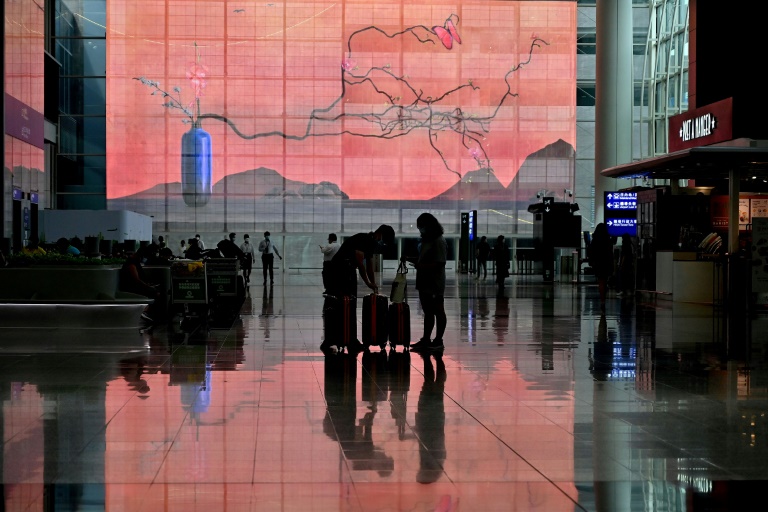
Hong Kong confirmed Thursday it will host an international banking summit in early November, days after it lifted mandatory quarantine rules for arrivals that have battered the city’s reputation as a business hub.

The city has had a difficult three years, with a sweeping crackdown on political freedoms and the imposition of some of the world’s strictest coronavirus pandemic controls, which have kept the city isolated even as competitors reopen.

The banking summit on November 2 is expected to draw 200 participants, including the group chairmen or Chief Executive Officers of 30 major financial institutions, according to the Hong Kong Monetary Authority (HKMA).

HKMA Chief Executive Eddie Yue wrote in a blog post that the event would allow guests to “meet their staff and clients in person, and establish new relationships”, now that travel to Hong Kong has become easier.

“For most of them this will only be a short visit and we need to make sure they can meet people, do business and build relationships in the kind of business-as-usual way they expect from a vibrant international city,” Yue added.

The gathering will include panel talks featuring Goldman Sachs CEO David Solomon, Morgan Stanley CEO James Gorman, Citigroup CEO Jane Fraser, as well as top executives from JPMorgan Chase, BlackRock, UBS and KKR, according to the HKMA.

Hong Kong last week scrapped mandatory hotel quarantine for travellers after two-and-a-half years, amid concerns of brain drain and losing business to rivals like Singapore and London, which reopened to the world once their populations were adequately vaccinated.

But the city still adheres to a version of China’s zero-Covid strategy and has kept some pandemic restrictions in place, including social distancing, business hours limitations and compulsory masking.

Arrivals in the city no longer have to quarantine in hotels, but they cannot enter restaurants or bars for three days after landing and must undergo regular testing. 

Those who test positive face being isolated in hotel rooms at their own expense.

It is unclear if summit participants will be exempt from the pandemic restrictions, and the HKMA said Thursday that it was working to “finalise an appropriate set of arrangements”.

HSBC Chief Executive Noel Quinn and Standard Chartered CEO Bill Winters were among the banking industry leaders who previously committed to attending the Hong Kong summit in person.

Hong Kong confirms November banking summit after ending quarantine

Hong Kong confirmed Thursday it will host an international banking summit in early November, days after it lifted mandatory quarantine rules for arrivals that have battered the city’s reputation as a business hub.

The city has had a difficult three years, with a sweeping crackdown on political freedoms and the imposition of some of the world’s strictest coronavirus pandemic controls, which have kept the city isolated even as competitors reopen.

The banking summit on November 2 is expected to draw 200 participants, including the group chairmen or Chief Executive Officers of 30 major financial institutions, according to the Hong Kong Monetary Authority (HKMA).

HKMA Chief Executive Eddie Yue wrote in a blog post that the event would allow guests to “meet their staff and clients in person, and establish new relationships”, now that travel to Hong Kong has become easier.

“For most of them this will only be a short visit and we need to make sure they can meet people, do business and build relationships in the kind of business-as-usual way they expect from a vibrant international city,” Yue added.

The gathering will include panel talks featuring Goldman Sachs CEO David Solomon, Morgan Stanley CEO James Gorman, Citigroup CEO Jane Fraser, as well as top executives from JPMorgan Chase, BlackRock, UBS and KKR, according to the HKMA.

Hong Kong last week scrapped mandatory hotel quarantine for travellers after two-and-a-half years, amid concerns of brain drain and losing business to rivals like Singapore and London, which reopened to the world once their populations were adequately vaccinated.

But the city still adheres to a version of China’s zero-Covid strategy and has kept some pandemic restrictions in place, including social distancing, business hours limitations and compulsory masking.

Arrivals in the city no longer have to quarantine in hotels, but they cannot enter restaurants or bars for three days after landing and must undergo regular testing. 

Those who test positive face being isolated in hotel rooms at their own expense.

It is unclear if summit participants will be exempt from the pandemic restrictions, and the HKMA said Thursday that it was working to “finalise an appropriate set of arrangements”.

HSBC Chief Executive Noel Quinn and Standard Chartered CEO Bill Winters were among the banking industry leaders who previously committed to attending the Hong Kong summit in person.

Asian stocks pick up after BoE steps in, but pound rally wanes

Asian stocks rallied Thursday as UK and US government yields fell after the Bank of England jumped into bond markets to prevent a fresh financial catastrophe.

However, the pound — which earlier this week hit a record low against the dollar — struggled to hold its advance against the greenback, with commentators warning it could face further pain.

Financial markets are being hammered as central banks around the world ramp up interest rates to tackle runaway inflation, fuelling worries about a recession and a possible hit to company profits.

And the selling picked up this week after new UK finance minister Kwasi Kwarteng unveiled a tax-cutting mini-budget Friday, which many experts including the International Monetary Fund warned would fan borrowing and deal a further blow to the already fragile economy.

The spending plan sent yields on UK government bonds, as well as those of other countries, soaring and raised the prospect of even bigger interest rate hikes.

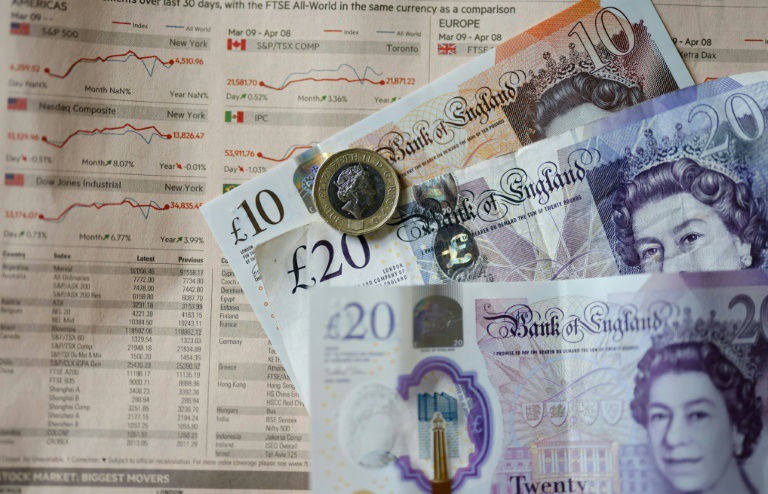
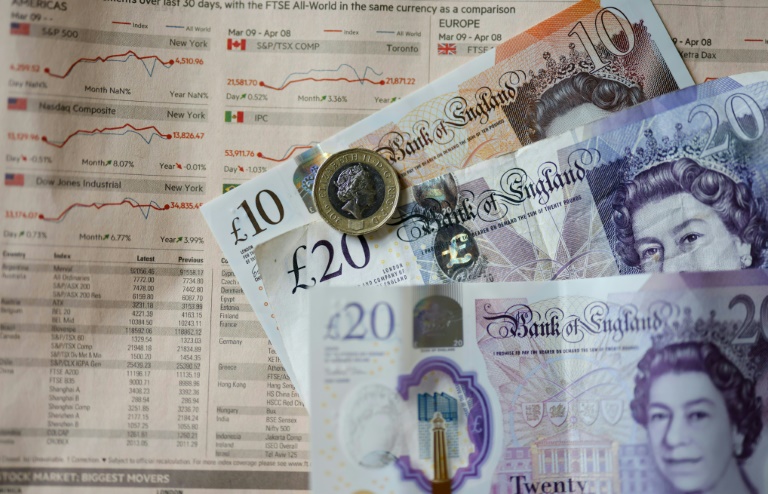
That led the Bank of England on Wednesday to announce a two-week programme to spend £65 billion ($71 billion) buying long-dated UK bonds “to restore orderly market conditions”.

The move meant the BoE had to suspend a programme to sell “gilts” as part of its drive to fight inflation, though analysts speculated that it could give traders some hope that similar support could be provided elsewhere.

National Australia Bank’s Ray Attrill said traders had grown accustomed to the fact that central banks were not ready to simply help asset markets when they drop in response to inflation-fighting measures.

But now there was an understanding that “when markets become dysfunctional with potential real world economic consequences, central banks’ financial stability obligations can still kick in”.

All three main indexes on Wall Street surged around two percent Wednesday, while European markets were also up.

And Asia extended the gains, though the initial surge was beginning to wane as the day wore on.

Hong Kong, Sydney, Seoul, Singapore, Wellington and Manila were all up more than one percent, while Tokyo, Shanghai, Taipei and Jakarta were also in positive territory.

However, the pound was weakening again sitting just below $1.0800, having spiked at $1.0900 earlier, as the dollar remained the go-to unit owing to Fed plans to lift rates further this year.

OANDA’s Edward Moya warned of more rough seas for sterling.

“The British pound went on a little roller coaster ride following the BoE action to buy unlimited long-dated gilts, but will still probably remain heavy over the country’s fiscal situation, current account deficit, financial stability risks, and energy poverty likelihood for parts of the population,” he said in a note.

The uptick across markets, however, was rare and the general mood on trading floors remains dark as the Fed and other central banks zero in on hiking borrowing costs to fight decades-high inflation.

“All eyes are on inflation and interest rates,” said Josh Emanuel at Wilshire. “Equities are really going to take their cues from bond markets. So if you see bond yields move lower, that is a good sign for equities.”

And Julia Raiskin, at Citigroup, added that “markets are very pessimistic… Other than the dollar, there are not many assets that are trading constructively.”

– Key figures at around 0230 GMT –

Tokyo – Nikkei 225: UP 0.3 percent at 26,238.32 (break)

Hong Kong – Hang Seng Index: UP 1.3 percent at 17,477.77

Shanghai – Composite: UP 0.5 percent at 3,060.83

Pound/dollar: DOWN at $1.0789 from $1.0889 on Wednesday

Euro/dollar: UP at $0.9638 from $0.9735

Euro/pound: UP at 89.68 from 89.39 pence 

Dollar/yen: UP at 144.30 yen from 144.11 yen

West Texas Intermediate: DOWN 0.4 percent at $81.84 per barrel

Brent North Sea crude: DOWN 0.4 percent at $89.00 per barrel

New York – Dow: UP 1.9 percent at 29,683.74 (close)

London – FTSE 100: UP 0.3 percent at 7,005.39 (close)

Asian stocks pick up after BoE steps in, but pound rally wanes

Asian stocks rallied Thursday as UK and US government yields fell after the Bank of England jumped into bond markets to prevent a fresh financial catastrophe.

However, the pound — which earlier this week hit a record low against the dollar — struggled to hold its advance against the greenback, with commentators warning it could face further pain.

Financial markets are being hammered as central banks around the world ramp up interest rates to tackle runaway inflation, fuelling worries about a recession and a possible hit to company profits.

And the selling picked up this week after new UK finance minister Kwasi Kwarteng unveiled a tax-cutting mini-budget Friday, which many experts including the International Monetary Fund warned would fan borrowing and deal a further blow to the already fragile economy.

The spending plan sent yields on UK government bonds, as well as those of other countries, soaring and raised the prospect of even bigger interest rate hikes.

That led the Bank of England on Wednesday to announce a two-week programme to spend £65 billion ($71 billion) buying long-dated UK bonds “to restore orderly market conditions”.

The move meant the BoE had to suspend a programme to sell “gilts” as part of its drive to fight inflation, though analysts speculated that it could give traders some hope that similar support could be provided elsewhere.

National Australia Bank’s Ray Attrill said traders had grown accustomed to the fact that central banks were not ready to simply help asset markets when they drop in response to inflation-fighting measures.

But now there was an understanding that “when markets become dysfunctional with potential real world economic consequences, central banks’ financial stability obligations can still kick in”.

All three main indexes on Wall Street surged around two percent Wednesday, while European markets were also up.

And Asia extended the gains, though the initial surge was beginning to wane as the day wore on.

Hong Kong, Sydney, Seoul, Singapore, Wellington and Manila were all up more than one percent, while Tokyo, Shanghai, Taipei and Jakarta were also in positive territory.

However, the pound was weakening again sitting just below $1.0800, having spiked at $1.0900 earlier, as the dollar remained the go-to unit owing to Fed plans to lift rates further this year.

OANDA’s Edward Moya warned of more rough seas for sterling.

“The British pound went on a little roller coaster ride following the BoE action to buy unlimited long-dated gilts, but will still probably remain heavy over the country’s fiscal situation, current account deficit, financial stability risks, and energy poverty likelihood for parts of the population,” he said in a note.

The uptick across markets, however, was rare and the general mood on trading floors remains dark as the Fed and other central banks zero in on hiking borrowing costs to fight decades-high inflation.

“All eyes are on inflation and interest rates,” said Josh Emanuel at Wilshire. “Equities are really going to take their cues from bond markets. So if you see bond yields move lower, that is a good sign for equities.”

And Julia Raiskin, at Citigroup, added that “markets are very pessimistic… Other than the dollar, there are not many assets that are trading constructively.”

– Key figures at around 0230 GMT –

Tokyo – Nikkei 225: UP 0.3 percent at 26,238.32 (break)

Hong Kong – Hang Seng Index: UP 1.3 percent at 17,477.77

Shanghai – Composite: UP 0.5 percent at 3,060.83

Pound/dollar: DOWN at $1.0789 from $1.0889 on Wednesday

Euro/dollar: UP at $0.9638 from $0.9735

Euro/pound: UP at 89.68 from 89.39 pence 

Dollar/yen: UP at 144.30 yen from 144.11 yen

West Texas Intermediate: DOWN 0.4 percent at $81.84 per barrel

Brent North Sea crude: DOWN 0.4 percent at $89.00 per barrel

New York – Dow: UP 1.9 percent at 29,683.74 (close)

London – FTSE 100: UP 0.3 percent at 7,005.39 (close)

Defying turmoil, Porsche to go 'full throttle' with blockbuster IPO

Luxury sports carmaker Porsche will debut on the Frankfurt stock exchange Thursday in one of Europe’s biggest listings in years, hoping its brand power can attract investors despite market turbulence.

Even as stocks worldwide suffer from surging inflation and mounting recession fears, the maker of the 911 sports car is pushing ahead with the blockbuster flotation.

The initial public offering (IPO) has generated buzz in Porsche’s home market of Germany, where top tabloid Bild described it as “crazy, cool, fast-paced”.

“On Thursday, sports car icon Porsche goes full throttle and races onto the stock market,” read a column in the paper.

“It will be the largest IPO in Germany for decades!”

Parent company Volkswagen is set to raise 9.4 billion euros ($9.2 billion) from the listing. Porsche’s shares will each be issued at 82.50 euros — the top end of an initial range — which gives the carmaker a valuation of 75 billion euros.

Some of the cash raised will be ploughed into Volkswagen’s high-speed drive towards electric vehicles, which has brought the legacy carmaker into more direct competition with US rival Tesla.

In terms of value of shares issued, Porsche’s is set to be the biggest stock market debut in Germany since Deutsche Telekom’s in 1996, and the largest in Europe since the 2011 flotation of Switzerland-based commodities giant Glencore.

– ‘Car market catalyst’ –

Analysts are looking to the carmaker’s market entry for some cheer against a morose economic backdrop, with investment bank Berenberg saying it could “offer a catalyst in an industry sorely lacking positive surprises”. 

It has generated interest from major investors, including Qatar and Abu Dhabi’s public investment funds, Norway’s sovereign wealth fund and US asset management firm T. Rowe Price. 

But German automotive expert Ferdinand Dudenhoeffer cautioned “it is not the best time for an IPO”, noting the Frankfurt stock market had fallen heavily since the start of the year.

But he said the conditions did exist for Porsche’s listing to be a success, and it would be “exciting to see how it develops in a difficult economic environment”.

The IPO will see 113.9 million shares of “Porsche AG” issued.

The carmaker’s valuation will be below some earlier estimates — but should still catapult it above rivals such as BMW, with a valuation of 47 billion euros, and Mercedes-Benz, with a 56-billion-euro capitalisation.

– Electric drive –

Porsche has joined the electric drive of the Volkswagen group, whose brands also include Audi and Skoda, in earnest. 

The electric “Taycan” has been the brand’s best-selling model since January, an electric version of the “Macan” is due in 2024, as well as the launch of a new SUV in the middle of the decade.

The electric strategy includes building battery factories across Europe and the US. Volkswagen announced this week it will work with Belgian group Umicore to produce battery materials. 

The IPO will see preferential shares sold to investors, which have no voting rights, while Volkswagen will also sell 25 percent of the carmaker to Porsche SE. 

The eponymous company is a listed holding controlled by the Porsche-Piech family, who in turn are the main shareholders in Volkswagen.

This means that Porsche SE will have a blocking minority that will allow it to steer the future of the company.

Volkswagen hopes that listing a minority stake in Porsche will push up its own stock market value, which is 85 billion euros — just a fraction of Tesla’s, at just over $900 billion.

Receding ice leaves Canada's polar bears at rising risk

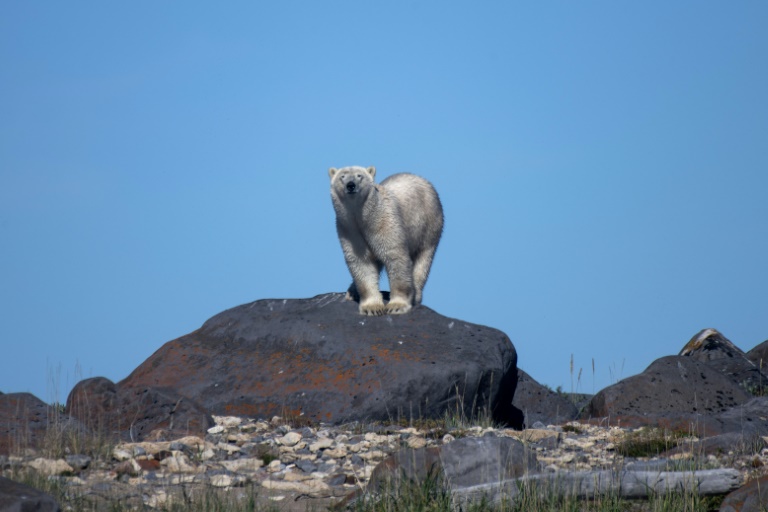
Sprawled on rocky ground far from sea ice, a lone Canadian polar bear sits under a dazzling sun, his white fur utterly useless as camouflage. 

It’s mid-summer on the shores of Hudson Bay and life for the enormous male has been moving in slow motion, far from the prey that keeps him alive: seals.

This is a critical time for the region’s polar bears.

Every year from late June when the bay ice disappears — shrinking until it dots the blue vastness like scattered confetti — they must move onto shore to begin a period of forced fasting.

But that period is lasting longer and longer as temperatures rise — putting them in danger’s way. 

Once on solid ground, the bears “typically have very few options for food,” explains Geoff York, a biologist with Polar Bear International (PBI).

York, an American, spends several weeks each year in Churchill, a small town on the edge of the Arctic in the northern Canadian province of Manitoba. There he follows the fortunes of the endangered animals.

This is one of the best spots from which to study life on Hudson Bay, though transportation generally requires either an all-terrain vehicle adapted to the rugged tundra, or an inflatable boat for navigating the bay’s waters. 

York invited an AFP team to join him on an expedition in early August.

Near the impressively large male bear lazing in the sun is a pile of fishbones — nowhere near enough to sustain this 11-foot (3.5-meter), 1,300-pound (600-kilo) beast.

“There could be a beluga whale carcass they might be able to find, (or a) naive seal near shore, but generally they’re just fasting,” York says.

“They lose nearly a kilogram of body weight every day that they’re on land.”

Climate warming is affecting the Arctic three times as fast as other parts of the world — even four times, according to some recent studies. So sea ice, the habitat of the polar bear, is gradually disappearing.

A report published two years ago in the journal Nature Climate Change suggested that this trend could lead to the near-extinction of these majestic animals: 1,200 of them were counted on the western shores of Hudson Bay in the 1980s. Today the best estimate is 800.

– Summer scarcity –

Each summer, sea ice begins melting earlier and earlier, while the first hard freeze of winter comes later and later. Climate change thus threatens the polar bears’ very cycle of life.

They have fewer opportunities to build up their reserves of fat and calories before the period of summer scarcity.

The polar bear — technically known as the Ursus maritimus — is a meticulous carnivore that feeds principally on the white fat that envelops and insulates a seal’s body.

But these days this superpredator of the Arctic sometimes has to feed on seaweed — as a mother and her baby were seen doing not far from the port of Churchill, the self-declared “Polar Bear Capital.”

If female bears go more than 117 days without adequate food, they struggle to nurse their young, said Steve Amstrup, an American who is PBI’s lead scientist. Males, he adds, can go 180 days.

As a result, births have declined, and it has become much rarer for a female to give birth to three cubs, once a common occurrence.

It is a whole ecosystem in decline, and one that 54-year-old York — with his short hair and rectangular glasses — knows by heart after spending more than 20 years roaming the Arctic, first for the ecology organization WWF and now for PBI.

During a capture in Alaska, a bear sunk its fangs into his leg. 

Another time, while entering what he thought was an abandoned den, he came nose-to-snout with a female. York, normally a quiet man, says he “yelled as loud as I ever have in my life.”

Today, these enormous beasts live a precarious existence.

“Here in Hudson Bay, in the western and southern parts, polar bears are spending up to a month longer on shore than their parents or grandparents did,” York says.

As their physical condition declines, he says, their tolerance for risk rises, and “that might bring them into interaction with people (which) can lead to conflict instead of co-existence.”

– Patrolling the town – 

Binoculars in hand, Ian Van Nest, a provincial conservation officer, keeps an eye out through the day on the rocks surrounding Churchill, where the bears like to hide.

In this town of 800 inhabitants, which is only accessible by air and train but not by any roads, the bears have begun frequenting the local dump, a source of easy — but potentially harmful — food for them.

They could be seen ripping open trash bags, eating plastic or getting their snouts trapped in food tins amid piles of burning waste.

Since then, the town has taken precautions: The dump is now guarded by cameras, fences and patrols.

Across Churchill, people leave cars and houses unlocked in case someone needs to find urgent shelter after an unpleasant encounter with this large land-based carnivore. 

Posted on walls around town are the emergency phone numbers to reach Van Nest or his colleagues. 

When they get an urgent call, they hop in their pickup truck armed with a rifle and a spray can of repellent, wearing protective flak jackets. 

Van Nest, who is bearded and in his 30s, takes the job seriously, given the rising number of polar bears in the area.

Sometimes they can be scared off with just “the horn on your vehicle,” he tells AFP. 

But other times “we might have to get on foot and grab our shotguns and cracker shells,” which issue an explosive sound designed to frighten the animal, “and head onto the rocks and pursue that bear.”

Some areas are watched more closely than others — notably around schools as children are arriving in the morning “to ensure that the kids are going to be safe.”

There have been some close calls, like the time in 2013 when a woman was grievously injured by a bear in front of her house, before a neighbor — clad in pajamas and slippers — ran out wielding only his snow shovel to scare the animal away.

Sometimes the animals have to be sedated, then winched up by a helicopter to be transported to the north, or kept in a cage until winter, when they can again feed on the bay.

Churchill’s only “prison” is inhabited entirely by bears, a hangar whose 28 cells can fill up in the autumn as the creatures maraud in mass around town while waiting for the ice to re-form in November. 

– Planet’s air conditioning –

The fate of the polar bear should alarm everyone, says Flavio Lehner, a climate scientist at Cornell University who was part of the expedition, because the Arctic is a good “barometer” of the planet’s health.

Since the 1980s, the ice pack in the bay has decreased by nearly 50 percent in summer, according to the US National Snow and Ice Data Center.

“We see the more — the faster — changes here, because it is warming particularly fast,” says Lehner, who is Swiss.

The region is essential to the health of the global climate because the Arctic, he says, effectively provides the planet’s “air conditioning.”

“There’s this important feedback mechanism of sea ice and snow in general,” he says, with frozen areas reflecting 80 percent of the sun’s rays, providing a cooling effect.

When the Arctic loses its capacity to reflect those rays, he said, there will be consequences for temperatures around the globe.

Thus, when sea ice melts, the much darker ocean’s surface absorbs 80 percent of the sun’s rays, accelerating the warming trend.

A few years ago, scientists feared that the Arctic’s summer ice pack was rapidly reaching a climatic “tipping point” and, above a certain temperature, would disappear for good.

But more recent studies show the phenomenon could be reversible, Lehner says.

“Should we ever be able to bring temperatures down again, sea ice will come back,” he says.

That said, the impact for now is pervasive. 

“In the Arctic, climate change is impacting all species,” says Jane Waterman, a biologist at the University of Manitoba. “Every single thing is being affected by climate change.”

Permafrost — defined as land that is permanently frozen for two successive years — has begun to melt, and in Churchill the very contours of the land have shifted, damaging rail lines and the habitat of wild species. 

The entire food chain is under threat, with some non-native species, like certain foxes and wolves, appearing for the first time, endangering Arctic species. 

Nothing is safe, says Waterman, from the tiniest bacteria to enormous whales. 

– A summer refuge –

That includes the beluga whales that migrate each summer — by the tens of thousands — from Arctic waters to the refuge of the Hudson Bay. 

These small white whales are often spotted in the bay’s vast blue waters.  

Swimming in small groups, they like to follow the boats of scientists who have come to study them, seemingly taking pleasure in showing off their large round heads and spouting just feet from captivated observers.

The smallest ones, gray in color, cling to their mothers’ backs in this estuary, with its relatively warm waters, where they find protection from killer whales and plentiful nourishment.

But there has been “a shift in prey availability for beluga whales in some areas of the Arctic,” explains Valeria Vergara, an Argentine researcher who has spent her life studying the beluga.

As the ice cover shrinks, “there’s less under the surface of the ice for the phytoplankton that in turn will feed the zooplankton that in turn will feed big fish,” says Vergara, who is with the Raincoast Conservation Foundation.

The beluga has to dive deeper to find food, and that uses up precious energy.

And another danger lurks: Some climate models suggest that as early as 2030, with the ice fast melting, boats will be able to navigate the Hudson Bay year-round.

Sound pollution is a major problem for the species — known as the “canary of the seas” — whose communication depends on the clicking and whistling sounds it makes. 

The beluga depends on sound-based communication to determine its location, find its way and to locate food, Vergara says. 

Thanks to a hydrophone on the “Beluga Boat” that Vergara uses, humans can monitor the “conversations” of whales far below the surface. 

Vergara, 53, describes their communications as “very complex,” and she can distinguish between the cries made by mother whales keeping in contact with their youngsters.

To the untrained ear, the sound is a cacophony, but clearly that of an animated community. Scientists wonder, however, how much longer such communities will last?

Far from the Arctic ice one lonely beluga became lost in the waters of France’s Seine river before dying in August. And in May a polar bear meandered its way deep into Canada’s south, shocking those who discovered it along the Saint Lawrence River.

Canada's Hudson Bay a summer refuge for thousands of belugas

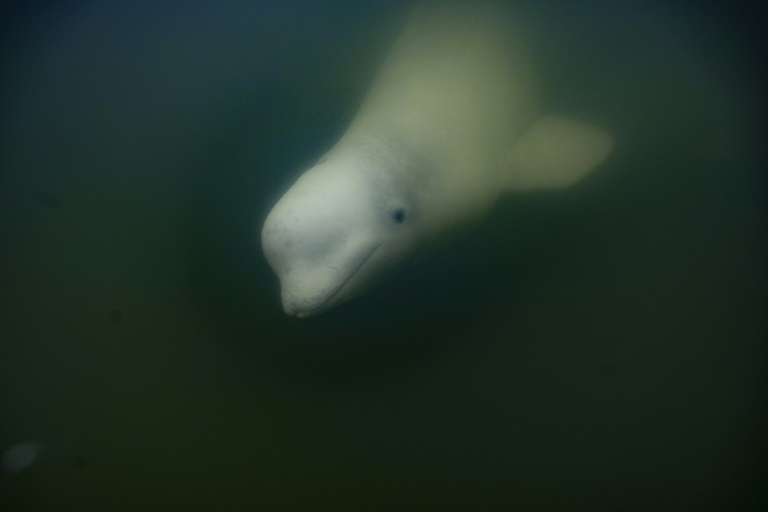
Half a dozen beluga whales dive and reemerge around tourist paddle boards in Canada’s Hudson Bay, a handful of about 55,000 of the creatures that migrate from the Arctic to the bay’s more temperate waters each summer. 

Far from the Seine river where a beluga strayed in early August north of Paris, the estuaries that flow into the bay in northern Canada offer a sanctuary for the small white whales to give birth in relative warm and shelter. 

In the murky bay, the belugas, with small dark eyes and what look like wide smiles, seem to enjoy the presence of a cluster of tourists who travelled to the remote town of Churchill — home to some 800 people and only accessible by train or plane — to observe the cetaceans.

For more than seven months of the year, between November and June, the bay is frozen.

The thaw marks the return of the belugas to the haven, where they are protected from orcas and feed on the rich food found in the estuaries.

The gray color of the young whales stands out against the bright white adults as they glide through the water in packs, all the while communicating in their own array of sounds.

– Hydrophone –

Nicknamed “canaries of the sea” due to the 50 or so different vocalizations — whistles, clicks, chirps and squeals — they emit, belugas are “social butterflies” and “sound is the glue of that society,” said Valeria Vergara, who has been studying them for years.

“Belugas are sound-centered species, and sound to them is really like vision to us,” the researcher with the Raincoast Conservation Foundation told AFP.

Listening at the speaker of a hydrophone, the 53-year-old scientist tries to distinguish the multitude of sounds from the depths — a cacophony to the untrained ear. 

“They need to rely on sound to communicate and they also rely on sound to echolocate, to find their way… to find food,” said Vergara, who has identified “contact calls” used between members of a pod. 

Newborn belugas, which measure around 1.8 meters (six feet) long and weigh some 80 kilos (175 pounds), remain dependent on their mother for two years. 

As an adult, the mammal — which generally matures in the icy waters around Greenland and in the north of Canada, Norway and Russia — can grow to six meters long and live between 40 and 60 years.

The Hudson Bay beluga population is the largest in the world. 

But the decrease in ice due to climate change, in an area that is warming three to four times faster than the rest of the planet, is a cause for concern for researchers.

Tracing uncertainty: Google harnesses quantum mechanics at California lab

Outside, balmy September sunshine warms an idyllic coast, as California basks in yet another perfect day.

Inside, it’s minus 460 Fahrenheit (-273 Celsius) in some spots, pockets of cold that bristle with the impossible physics of quantum mechanics — a science in which things can simultaneously exist, not exist and also be something in between.

This is Google’s Quantum AI laboratory, where dozens of super-smart people labor in an office kitted out with climbing walls and electric bikes to shape the next generation of computers — a generation that will be unlike anything users currently have in their pockets or offices.

“It is a new type of computer that uses quantum mechanics to do computations and allows us… to solve problems that would otherwise be impossible,” explains Erik Lucero, lead engineer at the campus near Santa Barbara.

“It’s not going to replace your mobile phone, your desktop; it’s going to be working in parallel with those things.”

Quantum mechanics is a field of research that scientists say could be used one day to help limit global warming, design city traffic systems or develop powerful new drugs.

The promises are so great that governments, tech giants and start-ups around the world are investing billions of dollars in it, employing some of the biggest brains around.

– Schrodinger’s cat –

Old fashioned computing is built on the idea of binary certainty: tens of thousands of “bits” of data that are each definitely either “on” or “off,” represented by either a one or a zero.

Quantum computing uses uncertainty: its “qubits” can exist in a state of both one-ness and zero-ness in what is called a superposition.

The most famous illustration of a quantum superposition is Schrodinger’s cat — a hypothetical animal locked in a box with a flask of poison which may or may not shatter.

While the box is shut, the cat is simultaneously alive and dead. But once you interfere with the quantum state and open the box, the question of the cat’s life or death is resolved.

Quantum computers use this uncertainty to perform lots of seemingly contradictory calculations at the same time — a bit like being able to go down every possible route in a maze all at once, instead of trying each one in series until you find the right path.

The difficulty for quantum computer designers is getting these qubits to maintain their superposition long enough to make a calculation. 

As soon as something interferes with them — noise, muck, the wrong temperature — the superposition collapses, and you’re left with a random and likely nonsensical answer. 

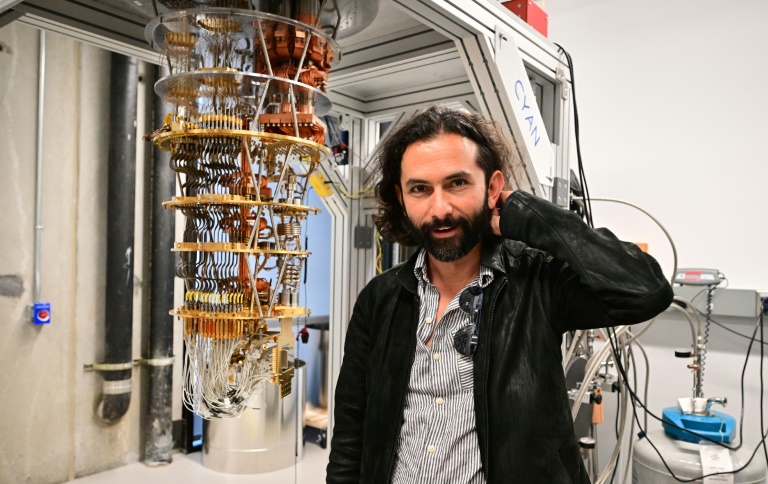
The quantum computer Google showed off to journalists resembles a steampunk wedding cake hung upside-down from a support structure.

Each layer of metal and curved wires gets progressively colder, down to the final stage, where the palm-sized processor is cooled to just 10 Millikelvin, or about -460 Fahrenheit (-273 Celsius).

That temperature — only a shade above absolute zero, the lowest temperature possible in the universe — is vital for the superconductivity Google’s design relies on.

While the layer-cake computer is not huge — about half a person high — a decent amount of lab space is taken up with the equipment to cool it — pipes whoosh overhead with helium dilutions compressing and expanding, using the same process that keeps your refrigerator cold.

– Future –

But… what does it all actually do?

Well, says Daniel Lidar, an expert in quantum systems at the University of Southern California, it’s a field that promises much when it matures, but which is still a toddler.

“We’ve learned how to crawl but we’ve certainly not yet learned how to how to walk or jump or run,” he told AFP.

The key to its growth will be solving the problem of the superpositional collapses — the opening of the cat’s box — to allow for meaningful calculations.

As this process of error correction improves, problems such as city traffic optimization, which is fiendishly hard on a classical computer because of the number of independent variables involved — the cars themselves — could come within reach, said Lidar.

“On (an error-corrected) quantum computer, you could solve that problem,” he said.

For Lucero and his colleagues, these future possibilities are worth the brain ache.

“Quantum mechanics is one of the best theories that we have today to experience nature. This is a computer that speaks the language of nature.

“And if we want to go out and figure out these really challenging problems, to help save our planet, and things like climate change, than having a computer that can do exactly that, I’d want that.”

Tracing uncertainty: Google harnesses quantum mechanics at California lab

Outside, balmy September sunshine warms an idyllic coast, as California basks in yet another perfect day.

Inside, it’s minus 460 Fahrenheit (-273 Celsius) in some spots, pockets of cold that bristle with the impossible physics of quantum mechanics — a science in which things can simultaneously exist, not exist and also be something in between.

This is Google’s Quantum AI laboratory, where dozens of super-smart people labor in an office kitted out with climbing walls and electric bikes to shape the next generation of computers — a generation that will be unlike anything users currently have in their pockets or offices.

“It is a new type of computer that uses quantum mechanics to do computations and allows us… to solve problems that would otherwise be impossible,” explains Erik Lucero, lead engineer at the campus near Santa Barbara.

“It’s not going to replace your mobile phone, your desktop; it’s going to be working in parallel with those things.”

Quantum mechanics is a field of research that scientists say could be used one day to help limit global warming, design city traffic systems or develop powerful new drugs.

The promises are so great that governments, tech giants and start-ups around the world are investing billions of dollars in it, employing some of the biggest brains around.

– Schrodinger’s cat –

Old fashioned computing is built on the idea of binary certainty: tens of thousands of “bits” of data that are each definitely either “on” or “off,” represented by either a one or a zero.

Quantum computing uses uncertainty: its “qubits” can exist in a state of both one-ness and zero-ness in what is called a superposition.

The most famous illustration of a quantum superposition is Schrodinger’s cat — a hypothetical animal locked in a box with a flask of poison which may or may not shatter.

While the box is shut, the cat is simultaneously alive and dead. But once you interfere with the quantum state and open the box, the question of the cat’s life or death is resolved.

Quantum computers use this uncertainty to perform lots of seemingly contradictory calculations at the same time — a bit like being able to go down every possible route in a maze all at once, instead of trying each one in series until you find the right path.

The difficulty for quantum computer designers is getting these qubits to maintain their superposition long enough to make a calculation. 

As soon as something interferes with them — noise, muck, the wrong temperature — the superposition collapses, and you’re left with a random and likely nonsensical answer. 

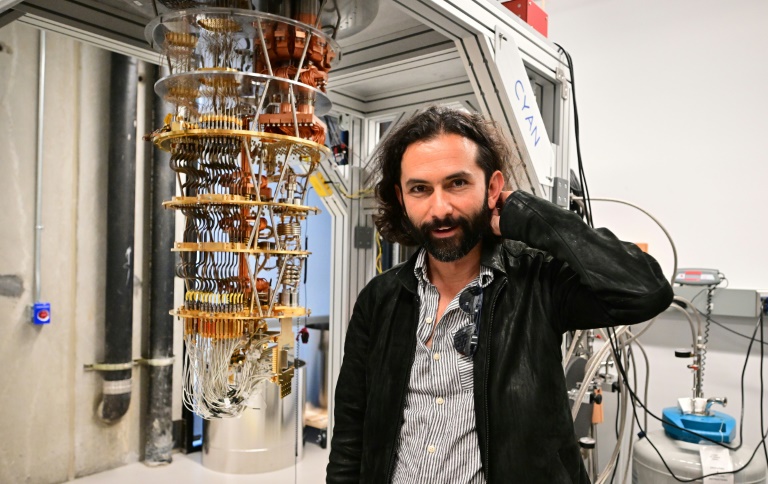
The quantum computer Google showed off to journalists resembles a steampunk wedding cake hung upside-down from a support structure.

Each layer of metal and curved wires gets progressively colder, down to the final stage, where the palm-sized processor is cooled to just 10 Millikelvin, or about -460 Fahrenheit (-273 Celsius).

That temperature — only a shade above absolute zero, the lowest temperature possible in the universe — is vital for the superconductivity Google’s design relies on.

While the layer-cake computer is not huge — about half a person high — a decent amount of lab space is taken up with the equipment to cool it — pipes whoosh overhead with helium dilutions compressing and expanding, using the same process that keeps your refrigerator cold.

– Future –

But… what does it all actually do?

Well, says Daniel Lidar, an expert in quantum systems at the University of Southern California, it’s a field that promises much when it matures, but which is still a toddler.

“We’ve learned how to crawl but we’ve certainly not yet learned how to how to walk or jump or run,” he told AFP.

The key to its growth will be solving the problem of the superpositional collapses — the opening of the cat’s box — to allow for meaningful calculations.

As this process of error correction improves, problems such as city traffic optimization, which is fiendishly hard on a classical computer because of the number of independent variables involved — the cars themselves — could come within reach, said Lidar.

“On (an error-corrected) quantum computer, you could solve that problem,” he said.

For Lucero and his colleagues, these future possibilities are worth the brain ache.

“Quantum mechanics is one of the best theories that we have today to experience nature. This is a computer that speaks the language of nature.

“And if we want to go out and figure out these really challenging problems, to help save our planet, and things like climate change, than having a computer that can do exactly that, I’d want that.”

High stakes for climate-change race in Brazil vote

The image would indelibly mark President Jair Bolsonaro’s term: the sky over Sao Paulo turning dark at 3:00 pm as smoke from fires in the Amazon rainforest engulfed Brazil’s biggest city.

The black haze that traveled thousands of kilometers to the economic capital that day — August 19, 2019, just under nine months into Bolsonaro’s term — drew global attention to the accelerating destruction of the Amazon under the far-right president, whose environmental record is under new scrutiny as Brazil holds elections Sunday.

Climate scientists and environmentalists say the stakes for the planet are potentially huge in the divisive race, which pits Bolsonaro against leftist ex-president Luiz Inacio Lula da Silva (2003-2010).

Three years after the fires that sparked worldwide outcry, Bolsonaro’s record on protecting the Amazon and its Indigenous inhabitants has only gone from bad to worse, activists say.

Under the former army captain, average annual deforestation in the Brazilian Amazon has risen by 75 percent compared to the previous decade, as the government has slashed environmental funding by 71 percent from its high in 2014.

Along the way, Bolsonaro has fired or sidelined government officials who pushed back against his environmental policies, attacked foreign critics with nationalist rhetoric about Brazilian sovereignty over “our Amazon,” and played to his hardline base and backers in the powerful agribusiness industry with calls to make the rainforest an engine of economic development.

While Lula’s own environmental record is hardly spotless, activists say there is no comparison between the two.

“We’re facing a radical choice: decide whether the Amazon lives or gets a death sentence with Bolsonaro’s reelection,” said Marcio Astrini, head of the Climate Observatory, a coalition of environmental groups.

“This is the most important election in Brazilian history.”

– ‘Not a good thing’ –

Environmental issues have taken a back seat to economic and social ones in the campaign.

But with the world scrambling to hold global warming to a livable limit, the issue matters beyond Brazil. 

The Amazon basin, 60 percent of which is in Brazil, is looking fragile.

Research shows the world’s biggest rainforest, which until recently helped soak up humanity’s soaring carbon emissions, is now strained to the point it has started releasing more carbon than it absorbs.

A hemisphere away, US climate scientist Scott Denning says he doesn’t follow Brazilian politics, but is closely watching what happens in the Amazon, whose CO2 emissions doubled in Bolsonaro’s first two years — reaching the equivalent of five percent of global fossil-fuel emissions.

“Four more years like that, and that’s quite a lot of CO2. That’s not a good thing,” said Denning, an atmospheric scientist at Colorado State University.

“The Amazon is this humongous living carbon sponge. But now we’re cutting and burning the trees faster than they can regrow.”

The timing is terrible, he noted.

“The rest of the world is scrambling to cut our fossil-fuel emissions… and Bolsonaro is pulling in the opposite direction.”

– Lula’s imperfect record –

In a statement, Bolsonaro’s campaign defended his record on the Amazon as “balancing environmental protection with economic growth.”

Lula, who leads in the polls, has himself faced criticism for his environmental record, which notably included the controversial decision to build the massive Belo Monte hydroelectric dam in the Amazon.

In Lula’s first year in office, deforestation reached 27,772 square kilometers (10,723 square miles) in the Brazilian Amazon — the second-worst year on record, and far higher than the 13,038 square kilometers under Bolsonaro last year.

However, by the end of his term, Lula’s government had slashed deforestation by 75 percent, to historic lows.

Under Bolsonaro, it has sharply increased.

Lula got a key endorsement two weeks ago when respected former environment minister Marina Silva — who quit his government in disgust in 2008 over the leftist’s Amazon policies — announced she was backing him.

The environment “isn’t exactly close to Lula’s heart,” says veteran activist Claudio Angelo, who worked on Silva’s unsuccessful 2018 presidential campaign.

But Lula’s camp knows it has the upper hand on the issue.

The ex-metal worker has vowed to go “even further” than Brazil’s emission-cutting targets under the 2015 Paris Accord, revive the internationally backed, $1.3-billion Amazon Fund to protect the rainforest — suspended under Bolsonaro — and work to achieve net-zero deforestation.

Close Bitnami banner
Bitnami