AFP

Dollar softens after rally, stocks stable but uncertainty reigns

The dollar lost a little of its strength Tuesday after starting the week by surging against major peers, including a record high versus the pound, but while equity markets stabilised, sentiment remained dampened by recession fears.

While central banks around the world are ramping up interest rates to fight inflation, the main focus is on the US Federal Reserve’s increasingly hawkish tone that has seen it unveil three successive bumper hikes with a warning of more to come.

That has seen investors pile into the dollar, sending it to record or multi-decade peaks, which has rattled governments from Tokyo to Beijing and London.

On Monday, it hit its highest-ever level against the pound — touching $1.0350 after traders were spooked by a massive tax giveaway mini-budget by new UK finance minister Kwasi Kwarteng.

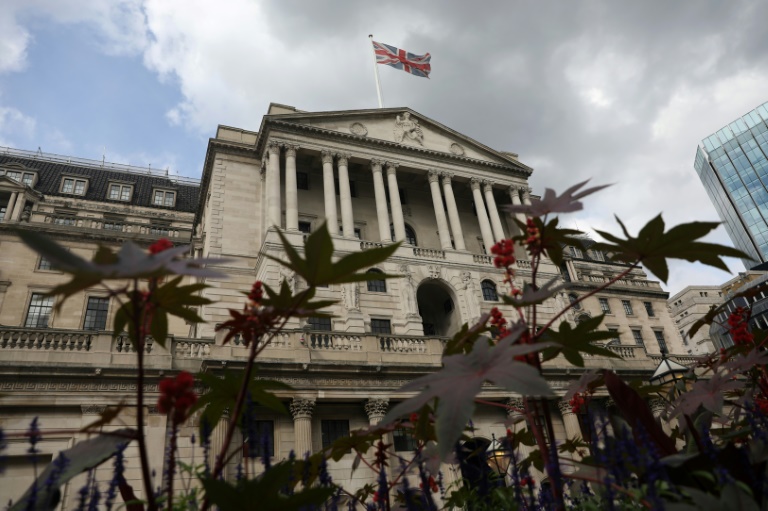
Sterling staged a small recovery but fell back again after traders were left disappointed by a lack of solid action from the Bank of England, with Governor Andrew Bailey saying only it would not hesitate to increase rates by as much as needed.

However, speculation is rife that officials will announce a huge 1.5 percentage point hike at their next meeting in November.

The dollar’s rally against the pound was matched by advances across forex markets, with the euro hitting a new 20-year low and the yen pushing back to the level it hit when the government intervened to support the currency last week.

But the greenback surge ran out of steam Tuesday as a little stability returned to markets, though analysts warned that volatility would remain high as more global rate hikes were in the pipeline and geopolitical crises remained unresolved.

Added to that were concerns that inflation remained stubbornly high.

“The market is pricing in some Fed increases, but we’re a bit worried that it might not be pricing in everything,” Laila Pence, of Pence Wealth Management, told Bloomberg Television.

“We got whipsawed in August when inflation was up not down — everyone is nervous.”

– ‘Wrecking ball’ –

Another selloff in Wall Street stocks saw the S&P 500 suffer its lowest close since December 2020, though Asia was mixed.

Tokyo, Shanghai, Sydney, Seoul, Taipei and Mumbai all rose while Hong Kong eked out marginal gains but Singapore, Wellington, Bangkok, Manila and Jakarta were in the red.

London, Paris and Frankfurt were in positive territory in early business.

“Dollar strength remains the driving force — or wrecking ball — in financial markets at the moment,” said Markets.com analyst Neil Wilson. “It’s not only wrecking relative currency stability but is a major factor in the weakness for equities.”

And OANDA’s Edward Moya added: “Right now, financial markets are a mess.

“Wall Street is realising that we won’t be seeing a significant sign that inflation is easing fast enough in the next couple of months and that should make it tough to buy the dip just yet.”

Oil prices rallied around two percent as news filtered through that the two leaks have been identified on the Nord Stream 1 Russia-Europe gas pipeline in the Baltic Sea, hours after a similar incident on its twin pipeline.

However, both contracts remain wedged around their lowest levels since January owing to the stronger dollar and worries about demand caused by the expected recession.

And Moya added there appeared little chance the commodity will stage a near-term recovery, despite speculation that major producers could announce a fresh output cut.

“Chaos in the forex markets could keep crude prices heavy no matter what OPEC+ does over the short-term,” he wrote. “Forex volatility won’t let up anytime soon and that will send oil on a very long roller-coaster ride.”

– Key figures at around 0810 GMT –

Tokyo – Nikkei 225: UP 0.5 percent at 26,571.87 (close)

Hong Kong – Hang Seng Index: FLAT at 17,860.31 (close)

Shanghai – Composite: UP 1.4 percent at 3,093.86 (close)

London – FTSE 100: UP 0.7 percent at 7,069.40

Pound/dollar: UP at $1.0809 from $1.0689 on Monday

Euro/dollar: UP at $0.9647 from $0.9611

Euro/pound: DOWN at 89.26 pence from 89.87 pence 

Dollar/yen: DOWN at 144.30 yen from 144.72 yen

West Texas Intermediate: UP 2.0 percent at $78.23 per barrel

Brent North Sea crude: UP 1.9 percent at $85.67 per barrel

New York – Dow: DOWN 1.1 percent at 29,260.81 (close)
Japan honours assassinated Abe at controversial funeral

Japanese and foreign dignitaries paid tribute to assassinated former prime minister Shinzo Abe at a controversial state funeral on Tuesday, as long lines of people gathered to offer flowers and prayers.

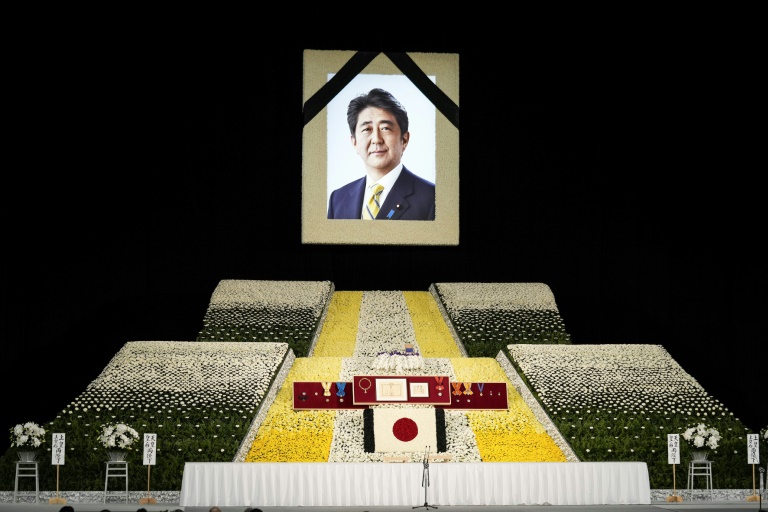
Abe’s ashes, carried by his widow Akie, arrived at the storied Budokan venue in Tokyo, where a 19-gun salute sounded in honour of the slain former leader.

In a eulogy, Prime Minister Fumio Kishida described the politician as a “person of courage”, listing his achievements, including efforts to strengthen Japan’s diplomatic ties.

“I feel heart-breaking grief,” Kishida said as he faced a photograph of Abe that was hung above a grand floral structure used to display his ashes, medals and the Japanese flag.

Abe was Japan’s longest-serving prime minister and one of the country’s most recognisable political figures, known for cultivating international alliances and his “Abenomics” economic strategy.

He resigned in 2020 over recurring health problems, but remained a key political voice and was campaigning for his ruling party when a lone gunman killed him with a homemade weapon on July 8.

The shooting sent shock waves through a country with famously low gun crime and prompted international condemnation.

But the decision to give him a state funeral — only the second for a former premier in the post-war period — has provoked opposition, with around 60 percent of Japanese against the event in recent polls.

– ‘So much opposition’ –

US Vice-President Kamala Harris and world leaders including Indian Prime Minister Narendra Modi and Australian premier Anthony Albanese were among those in attendance at the Budokan.

Outside, thousands of people stood in line as the ashes arrived, waiting to deliver flowers and say a prayer in two mourning tents.

Koji Takamori came all the way from northern Hokkaido with his nine-year-old son. “I wanted to thank him. He has done so much for Japan,” the 46-year-old told AFP.

“The way he died was so shocking. To be honest, I also came because there has been so much opposition. It’s almost like I’m here to oppose those who are opposing this (funeral),” he added.

Those opponents were also out, marching near the tents before a demonstration in front of the parliament.

– Discontent over state funeral –

Abe’s accused killer targeted the former leader believing he had ties to the Unification Church, which the attacker resented over massive donations his mother had made to the sect.

The assassination prompted fresh scrutiny of the church and its fundraising, and uncomfortable questions for Japan’s political establishment, with the ruling party admitting around half its lawmakers had links to the religious organisation.

Kishida has pledged the party will sever all ties with the church, but the scandal helped fuel discontent over the state funeral.

Thousands have protested the ceremony and a man set himself on fire last week near the prime minister’s office, leaving notes reportedly expressing his objection to the event.

Some lawmakers from opposition parties are also boycotting the funeral.

The controversy has several causes, with some accusing Kishida of unilaterally approving the funeral instead of consulting parliament, and others resentful of a nearly $12 million price tag.

It is also the legacy of Abe’s divisive tenure, marked by persistent allegations of cronyism, and opposition to his nationalism and plans to reform the pacifist constitution.

Kishida’s government may be hoping the solemnity of the event, attended by an estimated 4,300 people including 700 foreign invitees, will drown out the controversy.

Abe worked to cultivate close ties with Washington to bolster the key US-Japan alliance, and also courted a stronger “Quad” grouping of Japan, the United States, India and Australia.

Japan’s emperor and empress are not attending, as neutral national figures, but Crown Prince Akishino and his wife led mourners in offering flowers at the end of the 90-minute service.

Cuba, Florida brace for Hurricane Ian

Cuba declared an emergency alert in multiple provinces Monday as fast-approaching Hurricane Ian strengthened rapidly, with Florida also ramping up preparations ahead of a likely hit.

About 50,000 people in Cuba’s western Pinar del Rio province moved to safer locations, 6,000 of them to state-run shelters and the rest to the homes of relatives and friends, local authorities said.

The US National Hurricane Center (NHC) warned Ian was intensifying and could pass over western Cuba late Monday and early Tuesday.

“Maximum sustained winds have increased to near 110 miles (177 kilometers) per hour with higher gusts,” it said, making Ian a Category 2 storm on the Saffir-Simpson scale.

“Rapid strengthening is expected during the next day or so,” the NHC added. 

– ‘Huge storm surge’ expected –

In Florida, the city of Tampa was under a hurricane watch, and Governor Ron DeSantis declared a state of emergency in all 67 counties as officials scrambled to prepare for the storm’s forecast landing on Wednesday or Thursday.

Ian “will bring heavy rains, strong winds, flash flooding, storm surge, along with isolated tornado activity along Florida’s Gulf Coast,” DeSantis said at a press conference in Tallahassee on Monday.

He warned people to prepare for power cuts.

“Even if the eye of the storm doesn’t hit your region, you’re going to have really significant winds, it’s going to knock over trees, it’s going to cause interruptions,” DeSantis said, warning of likely flooding.

The governor urged residents to stock up on food, water, medicine and fuel, and he called up 7,000 National Guard members to help with the effort.

Authorities in several Florida municipalities, including Miami, Fort Lauderdale and Tampa, started distributing free sandbags to residents to help protect their homes from the risk of flooding.

Tampa International Airport said it would suspend operations on Tuesday at 5:00 pm local time (2100 GMT).

President Joe Biden approved emergency aid to 24 counties in Florida through the Federal Emergency Management Agency (FEMA).

NASA said it was rolling back its massive Moon rocket into its storage hangar at the Kennedy Space Center in Florida due to the hurricane.

– Fiona’s wake –

The Caribbean and parts of eastern Canada are still counting the cost of powerful storm Fiona, which tore through last week, claiming several lives.

When it arrived in eastern Canada, the storm packed intense winds of 80 miles per hour, bringing torrential rain and waves of up to 40 feet (12 meters).

Three people are believed to have died when Fiona barreled into Canada’s Atlantic provinces as a post-tropical cyclone early Saturday.

Prince Edward Island authorities confirmed the death of one person, while officials in Newfoundland said they found the body of a 73-year-old woman believed to have been swept from her home. She was apparently sheltering in her basement when waves broke through.

A third person has been reported missing in Nova Scotia — one of the hardest-hit provinces — and is presumed dead.

“The devastation is immense,” Nova Scotia Premier Tim Houston told reporters. “The magnitude of the storm is incredible.”

Storm surges swept at least 20 homes into the sea in the town of Channel-Port aux Basques, on the southwestern tip of Newfoundland.

Around 200 residents had been evacuated before the storm hit.

“Some people have lost everything, and I mean everything,” Mayor Brian Button told CBC News.

Cuba, Florida brace for Hurricane Ian

Cuba declared an emergency alert in multiple provinces Monday as fast-approaching Hurricane Ian strengthened rapidly, with Florida also ramping up preparations ahead of a likely hit.

About 50,000 people in Cuba’s western Pinar del Rio province moved to safer locations, 6,000 of them to state-run shelters and the rest to the homes of relatives and friends, local authorities said.

The US National Hurricane Center (NHC) warned Ian was intensifying and could pass over western Cuba late Monday and early Tuesday.

“Maximum sustained winds have increased to near 110 miles (177 kilometers) per hour with higher gusts,” it said, making Ian a Category 2 storm on the Saffir-Simpson scale.

“Rapid strengthening is expected during the next day or so,” the NHC added. 

– ‘Huge storm surge’ expected –

In Florida, the city of Tampa was under a hurricane watch, and Governor Ron DeSantis declared a state of emergency in all 67 counties as officials scrambled to prepare for the storm’s forecast landing on Wednesday or Thursday.

Ian “will bring heavy rains, strong winds, flash flooding, storm surge, along with isolated tornado activity along Florida’s Gulf Coast,” DeSantis said at a press conference in Tallahassee on Monday.

He warned people to prepare for power cuts.

“Even if the eye of the storm doesn’t hit your region, you’re going to have really significant winds, it’s going to knock over trees, it’s going to cause interruptions,” DeSantis said, warning of likely flooding.

The governor urged residents to stock up on food, water, medicine and fuel, and he called up 7,000 National Guard members to help with the effort.

Authorities in several Florida municipalities, including Miami, Fort Lauderdale and Tampa, started distributing free sandbags to residents to help protect their homes from the risk of flooding.

Tampa International Airport said it would suspend operations on Tuesday at 5:00 pm local time (2100 GMT).

President Joe Biden approved emergency aid to 24 counties in Florida through the Federal Emergency Management Agency (FEMA).

NASA said it was rolling back its massive Moon rocket into its storage hangar at the Kennedy Space Center in Florida due to the hurricane.

– Fiona’s wake –

The Caribbean and parts of eastern Canada are still counting the cost of powerful storm Fiona, which tore through last week, claiming several lives.

When it arrived in eastern Canada, the storm packed intense winds of 80 miles per hour, bringing torrential rain and waves of up to 40 feet (12 meters).

Three people are believed to have died when Fiona barreled into Canada’s Atlantic provinces as a post-tropical cyclone early Saturday.

Prince Edward Island authorities confirmed the death of one person, while officials in Newfoundland said they found the body of a 73-year-old woman believed to have been swept from her home. She was apparently sheltering in her basement when waves broke through.

A third person has been reported missing in Nova Scotia — one of the hardest-hit provinces — and is presumed dead.

“The devastation is immense,” Nova Scotia Premier Tim Houston told reporters. “The magnitude of the storm is incredible.”

Storm surges swept at least 20 homes into the sea in the town of Channel-Port aux Basques, on the southwestern tip of Newfoundland.

Around 200 residents had been evacuated before the storm hit.

“Some people have lost everything, and I mean everything,” Mayor Brian Button told CBC News.

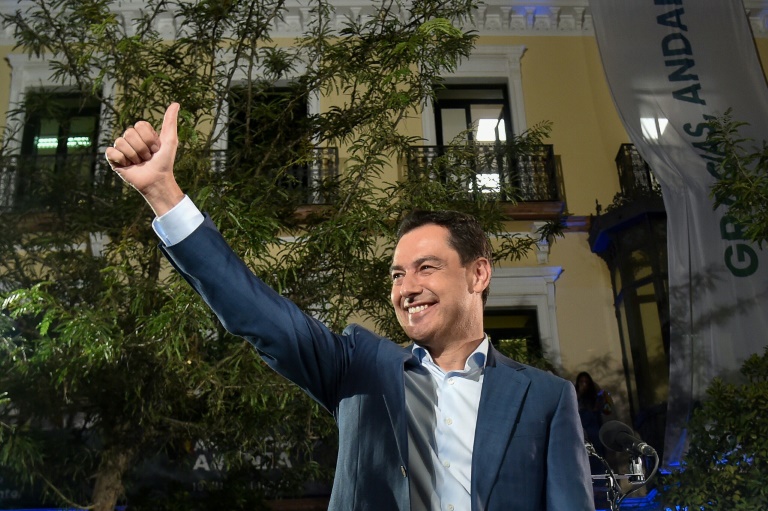
In Spain, politicians wage tax war ahead of elections

With elections a year away, the battle lines have been drawn between Spain’s left-wing government and its right-wing regions who are tripping over themselves to unveil lower tax policies.

On the back burner for months, the tax issue hit the headlines last week after the leader of the southern Andalusia region decided to axe wealth tax and lower income tax in a bid to attract wealthy taxpayers.

“We were a tax hellhole but now we’re the region with the second lowest taxes in Spain,” boasted Juanma Moreno of the right-wing opposition Popular Party (PP) — his region trailing only Madrid, which is also held by the PP.

As one of the Western world’s most decentralised nations, Spain is divided into 17 regions, whose governments have considerable autonomy and are responsible for budget management. 

Moreno’s remarks opened the floodgates, with many other PP-run regions announcing cuts, including Murcia, which slashed income tax, and Galicia, which is rolling back its wealth tax.

– ‘Welcome to paradise’ –

This flurry of announcements was hailed by top figures within the PP, among them the party’s rising star, Madrid leader Isabel Diaz Ayuso.

“Welcome to paradise,” tweeted this champion of the tax war, who last year repealed some 15 local levies in her region. 

But the move has drummed up a storm of criticism within the government of Socialist Prime Minister Pedro Sanchez, which has denounced it as economic populism ahead of regional elections in May and a general election expected in late 2023.

And it has raised concerns about the impact of such measures on public service funding. 

Economy Minister Nadia Calvino didn’t mince her words, denouncing such moves as introducing an “irresponsible, incoherent and destructive dynamic that would affect the whole country” and demanding they be reversed. 

And Budget Minister Maria Jesus Montero warned it was “dangerous” to create “tax havens” within Spain. 

Even Sanchez weighed in, denouncing what he called “tax gifts to the minority” and pleading for “responsible tax policies”.

“There must be tax reforms that guarantee that those who have more contribute more to the public purse in order to have a much stronger welfare state,” he said. 

– Harmonisation –

On Thursday, the government said it would slap an “exceptional” tax on the country’s richest to help pay for measures aimed at easing the impact of spiralling inflation.

And it is in favour of a greater “tax harmonisation” between the regions. 

But it’s a sensitive subject in Spain where the Constitution requires a certain solidarity between the regions while also guaranteeing their robust fiscal and financial autonomy on top of extending them wide-ranging powers over issues such as health and education. 

“If some regions are lowering taxes, it’s because legally they can,” said Stella Raventos, head of AEDAF, the Spanish Association of Tax Advisors. 

“Not all regions have the same policies because they don’t have the same problems.”

But given the risks inherent in a wholesale policy of slashing duties, “a tax harmonisation policy could be a good idea”, as long as it was kept within “reasonable levels” and with upper limits, she said. 

For the PP, any such move would be crossing a red line. 

If there is any government “interference”, there will be “a robust legal response”, Andalusia’s Moreno vowed, warning against any move to “centralise” fiscal policy. 

For now, the government has no plans to encroach on the regions’ autonomy — although it is determined to fight any “fiscal dumping” within the framework of a huge reform package aimed at making Spain’s tax system more just and progressive. 

Details of the tax reform, which is required by Brussels in exchange for aid channelled through its post-pandemic recovery scheme, will be released early next year.

Ireland to unveil budget to tackle cost of living and energy crises

The Irish government will on Tuesday unveil its budget for the upcoming year and its plans to deal with widespread problems caused by the cost of living and energy crises.

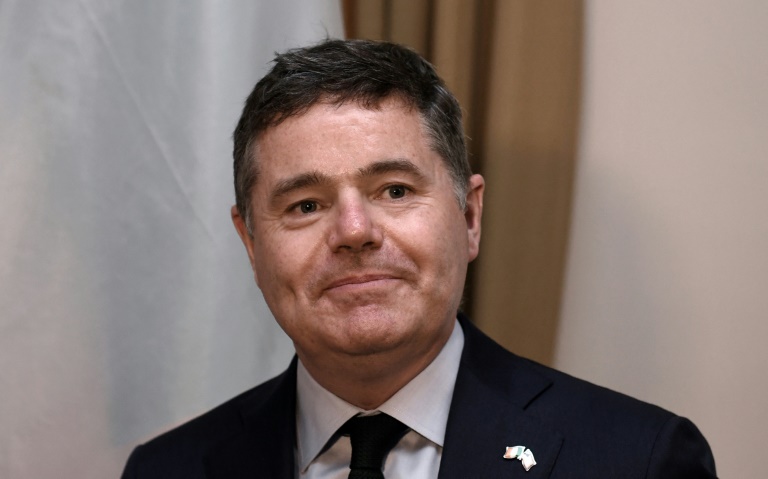
Finance minister for Ireland’s three-party governing coalition Paschal Donohoe will reveal the spending measures at about 1200 GMT in the Dail, the state’s lower house of parliament.

The date for the budget announcement was brought forward by two weeks because of the urgent need to deal with inflationary and supply chain pressures on households and businesses.

On top of a 6.7 billion-euro ($6.5 billion) package laid out in the government’s Summer Economic Statement, the Republic is set to introduce a one-off set of measures to alleviate the cost of living, reportedly of between 2-3 billion euros.

On Saturday, Donohoe reiterated the budget would “put money back in the pockets of people” but would stop short of raiding surplus funds.

“There will always be demands on us to do more and to spend more but we are in really uncertain times, we are dealing with a crisis caused by a huge war in Europe and we cannot be sure how long this will go on for,” he said.

The government has indicated surpluses in the state’s coffers would at least partially be held back to deal with uncertainties like the Covid-19 pandemic, Brexit and the war in Ukraine.

On the back of European Commission proposals for a windfall tax on energy firms, EU member Ireland has moved closer to implementing its own levy to offset rising energy costs on families and businesses.

Earlier this month, deputy premier Leo Varadkar, who will become prime minister in December as part of the coalition government’s rotation deal, told the Dail a backdated windfall tax had been agreed “in principle” and “will form part of the budget”.

But Donohoe has said he had ruled out an energy price cap.  

“Any measure that we bring in needs to be affordable and sustainable, and should not be a source of new risk, and we can see significant difficulties with a cap idea,” he said.

“You are in effect requiring the taxpayer to take on all of the cost regarding the price of something that is currently uncertain”.

Dollar softens after rally but Asian stocks struggle to recover

The dollar lost a little of its strength Tuesday after starting the week by surging against major peers, including a record high versus the pound, though equity traders struggled to claw back recent losses owing to recession fears.

While central banks around the world are ramping up interest rates to fight inflation, the main focus is on the US Federal Reserve’s increasingly hawkish tone that has seen it unveil three successive bumper hikes with a warning of more to come.

That has seen investors pile into the dollar, sending it to record or multi-decade peaks, which has rattled governments from Tokyo to Beijing and London.

On Monday it hit its highest-ever level against the pound — touching $1.0350 after traders were spooked by a massive tax giveaway mini-budget by new UK finance minister Kwasi Kwarteng.

Sterling staged a small recovery but fell back again after traders were left disappointed by a lack of solid action from the Bank of England, with governor Andrew Bailey saying only it would not hesitate to increase rates by as much as needed.

The dollar’s rally against the pound was matched by advances across forex markets, with the euro hitting a new 20-year low and the yen pushing back to the level it hit when the government intervened to support the currency last week.

But the greenback surge ran out of steam Tuesday as a little stability returned to markets, though analysts warned that volatility would remain high as more global rate hikes were in the pipeline and geopolitical crises remained unresolved.

Added to that were concerns that inflation remained stubbornly high.

“The market is pricing in some Fed increases, but we’re a bit worried that it might not be pricing in everything,” Laila Pence, of Pence Wealth Management, told Bloomberg Television.

“We got whipsawed in August when inflation was up not down — everyone is nervous.”

Another selloff in Wall Street stocks saw the S&P 500 suffer its lowest close since December 2020, and Asia also struggled.

Tokyo, Shanghai and Sydney all rose but red was flashing up on screens in Hong Kong, Singapore, Seoul, Wellington, Taipei, Manila and Jakarta.

“Right now financial markets are a mess,” said OANDA’s Edward Moya.

“Wall Street is realising that we won’t be seeing a significant sign that inflation is easing fast enough in the next couple of months and that should make it tough to buy the dip just yet.”

Oil prices edged slightly higher, though both contracts remain wedged at their lowest levels since January owing to the stronger dollar and worries about demand caused by the expected recession.

And Moya added there appeared little chance the commodity will stage a near-term recovery, despite speculation that major producers could announce a fresh output cut.

“Chaos in the forex markets could keep crude prices heavy no matter what OPEC+ does over the short-term,” he wrote. “Forex volatility won’t let up anytime soon and that will send oil on a very long roller-coaster ride.”

– Key figures at around 0230 GMT –

Tokyo – Nikkei 225: Up 0.8 percent at 26,651.60 (break)

Hong Kong – Hang Seng Index: DOWN 0.6 percent at 17,755.57

Shanghai – Composite: UP 0.1 percent at 3,053.60

Pound/dollar: UP at $1.0761 from $1.0689 on Monday

Euro/dollar: UP at $0.9629 from $0.9611

Euro/pound: DOWN at 89.49 pence from 89.87 pence 

Dollar/yen: DOWN at 144.52 yen from 144.72 yen

West Texas Intermediate: UP 0.4 percent at $77.02 per barrel

Brent North Sea crude: UP 0.4 percent at $84.38 per barrel

New York – Dow: DOWN 1.1 percent at 29,260.81 (close)

London – FTSE 100: FLAT at 7,020.95 (close)

Dollar softens after rally but Asian stocks struggle to recover

The dollar lost a little of its strength Tuesday after starting the week by surging against major peers, including a record high versus the pound, though equity traders struggled to claw back recent losses owing to recession fears.

While central banks around the world are ramping up interest rates to fight inflation, the main focus is on the US Federal Reserve’s increasingly hawkish tone that has seen it unveil three successive bumper hikes with a warning of more to come.

That has seen investors pile into the dollar, sending it to record or multi-decade peaks, which has rattled governments from Tokyo to Beijing and London.

On Monday it hit its highest-ever level against the pound — touching $1.0350 after traders were spooked by a massive tax giveaway mini-budget by new UK finance minister Kwasi Kwarteng.

Sterling staged a small recovery but fell back again after traders were left disappointed by a lack of solid action from the Bank of England, with governor Andrew Bailey saying only it would not hesitate to increase rates by as much as needed.

The dollar’s rally against the pound was matched by advances across forex markets, with the euro hitting a new 20-year low and the yen pushing back to the level it hit when the government intervened to support the currency last week.

But the greenback surge ran out of steam Tuesday as a little stability returned to markets, though analysts warned that volatility would remain high as more global rate hikes were in the pipeline and geopolitical crises remained unresolved.

Added to that were concerns that inflation remained stubbornly high.

“The market is pricing in some Fed increases, but we’re a bit worried that it might not be pricing in everything,” Laila Pence, of Pence Wealth Management, told Bloomberg Television.

“We got whipsawed in August when inflation was up not down — everyone is nervous.”

Another selloff in Wall Street stocks saw the S&P 500 suffer its lowest close since December 2020, and Asia also struggled.

Tokyo, Shanghai and Sydney all rose but red was flashing up on screens in Hong Kong, Singapore, Seoul, Wellington, Taipei, Manila and Jakarta.

“Right now financial markets are a mess,” said OANDA’s Edward Moya.

“Wall Street is realising that we won’t be seeing a significant sign that inflation is easing fast enough in the next couple of months and that should make it tough to buy the dip just yet.”

Oil prices edged slightly higher, though both contracts remain wedged at their lowest levels since January owing to the stronger dollar and worries about demand caused by the expected recession.

And Moya added there appeared little chance the commodity will stage a near-term recovery, despite speculation that major producers could announce a fresh output cut.

“Chaos in the forex markets could keep crude prices heavy no matter what OPEC+ does over the short-term,” he wrote. “Forex volatility won’t let up anytime soon and that will send oil on a very long roller-coaster ride.”

– Key figures at around 0230 GMT –

Tokyo – Nikkei 225: Up 0.8 percent at 26,651.60 (break)

Hong Kong – Hang Seng Index: DOWN 0.6 percent at 17,755.57

Shanghai – Composite: UP 0.1 percent at 3,053.60

Pound/dollar: UP at $1.0761 from $1.0689 on Monday

Euro/dollar: UP at $0.9629 from $0.9611

Euro/pound: DOWN at 89.49 pence from 89.87 pence 

Dollar/yen: DOWN at 144.52 yen from 144.72 yen

West Texas Intermediate: UP 0.4 percent at $77.02 per barrel

Brent North Sea crude: UP 0.4 percent at $84.38 per barrel

New York – Dow: DOWN 1.1 percent at 29,260.81 (close)

London – FTSE 100: FLAT at 7,020.95 (close)

Boost climate action or we'll see you in court, activists tell govts

Governments around the world must scale up climate action “or face further legal action”, an open letter from campaign groups warned Tuesday, as battles over policies to cut emissions and protect the environment are increasingly fought in the courts.

From legal efforts to steer governments to do more to curb fossil fuel pollution, to court action over companies’ misleading green claims, the number, scope and ambitions of climate litigation is expanding, say experts, with an increasing number of cases are being launched against governments. 

And that will continue if they do not use the upcoming United Nations COP meeting in Egypt to substantially enhance their climate action, according to an open letter signed by lawyers from more than 20 organisations around the world. 

“Governments of the world: your delay is costing lives. Strong action is needed now to protect people and the planet,” the letter said. 

“If you continue to fail us, we will continue to turn to the courts to demand accountability.”

The groups said they had already launched more than 80 legal cases around the world to “compel” governments from the Netherlands to Brazil, warning that the world was on the “precipice of the most serious intergenerational violation of human rights in history”.

Research from the Grantham Research Institute at the London School of Economics this year has found that of the 2,000 or so climate legal cases filed since 1986, almost a quarter were started since the beginning of 2020. 

Some 80 of these cases have been filed against national or subnational governments since 2005, the research found, with a record number of 30 new cases submitted in 2021. 

Perhaps the most successful of this kind of case was environmental group Urgenda’s landmark 2019 victory in Dutch courts, which saw the government ordered to reduce greenhouse gas emissions by at least 25 percent by the end of 2020. The target was largely met.

“Climate action is a legal duty. Yet governments are failing to comply with their own laws and commitments,” said Sarah Mead Co-Director of Climate Litigation Network, part of the Urgenda Foundation, which signed the letter. 

“We want to make sure that countries understand that the law is on our side.”

– Cases rise –

But legal rulings can go both ways. 

In June, the US Supreme Court ruled that the government’s key environmental agency cannot issue broad limits on greenhouse gases.

Campaigners say that energy companies are increasingly turning to international arbitration to recoup investments as governments accelerate the shift away from fossil fuels.

Earth has warmed nearly 1.2 degrees Celsius above pre-industrial levels so far, unleashing more intense weather extremes, including dangerous heatwaves and floods.  

The 2015 Paris Agreement saw governments agree to a cap on warming of well below 2C and preferably a safer 1.5C. 

But the UN’s Environment Programme has said that even taking into account updated global promises to cut emissions of heat-trapping gases, the world is currently on course to warm 2.8C. 

Dollar softens after rally but Asian stocks struggle to recover

The dollar lost a little of its strength Tuesday after starting the week by surging against major peers, including a record high versus the pound, though equity traders struggled to claw back recent losses owing to recession fears.

While central banks around the world are ramping up interest rates to fight inflation, the main focus is on the US Federal Reserve’s increasingly hawkish tone that has seen it unveil three successive bumper hikes with a warning of more to come.

That has seen investors pile into the dollar, sending it to record or multi-decade peaks, which has rattled governments from Tokyo to Beijing and London.

On Monday it hit its highest-ever level against the pound — touching $1.0350 after traders were spooked by a massive tax giveaway mini-budget by new UK finance minister Kwasi Kwarteng.

Sterling staged a small recovery but fell back again after traders were left disappointed by a lack of solid action from the Bank of England, with governor Andrew Bailey saying only it would not hesitate to increase rates by as much as needed.

The dollar’s rally against the pound was matched by advances across forex markets, with the euro hitting a new 20-year low and the yen pushing back to the level it hit when the government intervened to support the currency last week.

But the greenback surge ran out of steam Tuesday as a little stability returned to markets, though analysts warned that volatility would remain high as more global rate hikes were in the pipeline and geopolitical crises remained unresolved.

Added to that were concerns that inflation remained stubbornly high.

“The market is pricing in some Fed increases, but we’re a bit worried that it might not be pricing in everything,” Laila Pence, of Pence Wealth Management, told Bloomberg Television.

“We got whipsawed in August when inflation was up not down — everyone is nervous.”

Another selloff in Wall Street stocks saw the S&P 500 suffer its lowest close since December 2020, and Asia also struggled.

Tokyo, Shanghai and Sydney all rose but red was flashing up on screens in Hong Kong, Singapore, Seoul, Wellington, Taipei, Manila and Jakarta.

“Right now financial markets are a mess,” said OANDA’s Edward Moya.

“Wall Street is realising that we won’t be seeing a significant sign that inflation is easing fast enough in the next couple of months and that should make it tough to buy the dip just yet.”

Oil prices edged slightly higher, though both contracts remain wedged at their lowest levels since January owing to the stronger dollar and worries about demand caused by the expected recession.

And Moya added there appeared little chance the commodity will stage a near-term recovery, despite speculation that major producers could announce a fresh output cut.

“Chaos in the forex markets could keep crude prices heavy no matter what OPEC+ does over the short-term,” he wrote. “Forex volatility won’t let up anytime soon and that will send oil on a very long roller-coaster ride.”

– Key figures at around 0230 GMT –

Tokyo – Nikkei 225: Up 0.8 percent at 26,651.60 (break)

Hong Kong – Hang Seng Index: DOWN 0.6 percent at 17,755.57

Shanghai – Composite: UP 0.1 percent at 3,053.60

Pound/dollar: UP at $1.0761 from $1.0689 on Monday

Euro/dollar: UP at $0.9629 from $0.9611

Euro/pound: DOWN at 89.49 pence from 89.87 pence 

Dollar/yen: DOWN at 144.52 yen from 144.72 yen

West Texas Intermediate: UP 0.4 percent at $77.02 per barrel

Brent North Sea crude: UP 0.4 percent at $84.38 per barrel

New York – Dow: DOWN 1.1 percent at 29,260.81 (close)
London – FTSE 100: FLAT at 7,020.95 (close)

Close Bitnami banner
Bitnami