AFP

'You cannot survive': Inflation bites as Thai election looms

Sheltering from rain near Bangkok’s Grand Palace, scores of unemployed Thais queue alongside homeless people waiting for free meals as 14-year-high inflation sends living costs soaring — causing a headache for the government ahead of a looming general election.

The leadership came to power eight years ago under Prayut Chan-O-Cha, promising to provide stability after long-running protests started to hit the kingdom’s economy.

However, it struggled to live up to its pledges and the damage wrought by the pandemic on the travel industry has been compounded by a global inflationary crisis that has sent prices rising beyond many people’s reach.

And in a move seen as symbolic of the severity of the situation but likely to cause more pain for consumers, the government recently raised the price of instant noodles for the first time in more than a decade after manufacturers agitated for a rise.

For those waiting in the rain, the impact is already painfully clear.

“A few years ago, I was able to afford buying my own food but now food is too expensive,” said Somchai, who only gave one name, and who is unemployed.

“I couldn’t bear the prices so I have to come out and find food donation like this,” said the 42-year-old after he had collected his meal.

A general election must be called by March, giving the coalition government led by the military-friendly Palang Pracharat Party (PPRP) little time to turn things around.

– Unkept promises –

Adding to PPRP’s woes, Prayut was suspended from office last month while the Constitutional Court decides whether he has reached his term limit as prime minister.

In a bid to ease the pain for struggling Thais, the government has approved a proposal to raise the daily minimum wage to between 328 and 354 baht ($8.83 and $9.53) after earlier agreeing to extend a fuel tax break.

But political analyst Napisa Waitoolkiat at Naresuan University told AFP the measures were taken “for winning votes” but doubted they would turn many voters around.

“The damage is beyond repair,” she said.

The economy looks set to be a major factor in the election, and Napisa said voters would not forget the PPRP’s vows to improve it.

“Yet, once they are in power, they cannot keep the promise,” she said.

And while the minimum wage hike goes some way, Thammasat University international business professor Pavida Pananond suggested more was needed.

“What we now need to look at is more targeted policy measures that would help alleviate the difficulty from rising living costs among Thai lower-income households,” she said.

Growth remains sluggish — just 2.5 percent in the second quarter, dragged by high inflation despite the return of foreign visitors after the pandemic shutdowns.

“You will see that even the GDP growth rate of Thailand is the slowest in the region,” Pavida said.

– ‘You cannot survive’ –

Pavida also warned that price rises, like those of instant noodles, could be a precursor to further hikes in foodstuff.

“For lower-income people, whose majority of income is spent on food or energy, they would be even more impacted by this,” she said.

Veerayuth Sae-ung, queueing to buy a noodle lunch in central Bangkok, said his “way of eating has changed a lot”.

“I used to come down here and buy lunch like this daily, but lately I just couldn’t afford to buy from stalls every day anymore,” the 34-year-old said.

Greg Lange, co-founder of Bangkok Community Help Foundation which distributes 500 meals a day, warned they were helping more and more people.

“Even in spite of the rain, there are some times that the line goes two or three blocks,” he said.

“I think it was already very hard for the elderly to make ends meet,” his co-founder Friso Poldervaart added.

Poldervaart said many of the elderly people they helped had lost touch with their families and were unable to survive on the government support of between 600 and 1,000 baht a month.

“You cannot survive on that. That’s just the way it is,” he said.

“So it was already hard, but of course with increasing prices it just gets harder for everyone to make ends meet.”

'You cannot survive': Inflation bites as Thai election looms

Sheltering from rain near Bangkok’s Grand Palace, scores of unemployed Thais queue alongside homeless people waiting for free meals as 14-year-high inflation sends living costs soaring — causing a headache for the government ahead of a looming general election.

The leadership came to power eight years ago under Prayut Chan-O-Cha, promising to provide stability after long-running protests started to hit the kingdom’s economy.

However, it struggled to live up to its pledges and the damage wrought by the pandemic on the travel industry has been compounded by a global inflationary crisis that has sent prices rising beyond many people’s reach.

And in a move seen as symbolic of the severity of the situation but likely to cause more pain for consumers, the government recently raised the price of instant noodles for the first time in more than a decade after manufacturers agitated for a rise.

For those waiting in the rain, the impact is already painfully clear.

“A few years ago, I was able to afford buying my own food but now food is too expensive,” said Somchai, who only gave one name, and who is unemployed.

“I couldn’t bear the prices so I have to come out and find food donation like this,” said the 42-year-old after he had collected his meal.

A general election must be called by March, giving the coalition government led by the military-friendly Palang Pracharat Party (PPRP) little time to turn things around.

– Unkept promises –

Adding to PPRP’s woes, Prayut was suspended from office last month while the Constitutional Court decides whether he has reached his term limit as prime minister.

In a bid to ease the pain for struggling Thais, the government has approved a proposal to raise the daily minimum wage to between 328 and 354 baht ($8.83 and $9.53) after earlier agreeing to extend a fuel tax break.

But political analyst Napisa Waitoolkiat at Naresuan University told AFP the measures were taken “for winning votes” but doubted they would turn many voters around.

“The damage is beyond repair,” she said.

The economy looks set to be a major factor in the election, and Napisa said voters would not forget the PPRP’s vows to improve it.

“Yet, once they are in power, they cannot keep the promise,” she said.

And while the minimum wage hike goes some way, Thammasat University international business professor Pavida Pananond suggested more was needed.

“What we now need to look at is more targeted policy measures that would help alleviate the difficulty from rising living costs among Thai lower-income households,” she said.

Growth remains sluggish — just 2.5 percent in the second quarter, dragged by high inflation despite the return of foreign visitors after the pandemic shutdowns.

“You will see that even the GDP growth rate of Thailand is the slowest in the region,” Pavida said.

– ‘You cannot survive’ –

Pavida also warned that price rises, like those of instant noodles, could be a precursor to further hikes in foodstuff.

“For lower-income people, whose majority of income is spent on food or energy, they would be even more impacted by this,” she said.

Veerayuth Sae-ung, queueing to buy a noodle lunch in central Bangkok, said his “way of eating has changed a lot”.

“I used to come down here and buy lunch like this daily, but lately I just couldn’t afford to buy from stalls every day anymore,” the 34-year-old said.

Greg Lange, co-founder of Bangkok Community Help Foundation which distributes 500 meals a day, warned they were helping more and more people.

“Even in spite of the rain, there are some times that the line goes two or three blocks,” he said.

“I think it was already very hard for the elderly to make ends meet,” his co-founder Friso Poldervaart added.

Poldervaart said many of the elderly people they helped had lost touch with their families and were unable to survive on the government support of between 600 and 1,000 baht a month.

“You cannot survive on that. That’s just the way it is,” he said.

“So it was already hard, but of course with increasing prices it just gets harder for everyone to make ends meet.”
Storm Fiona slams eastern Canada, knocking out power and ripping off roofs

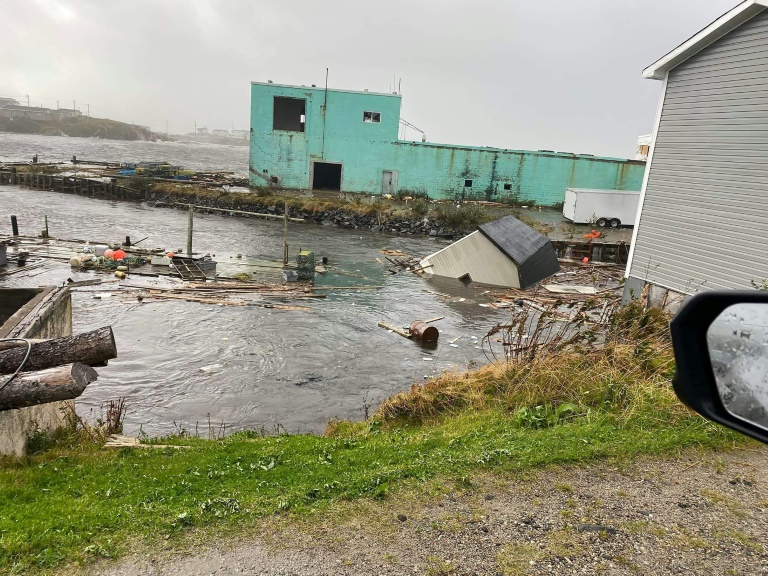
Powerful storm Fiona lashed into eastern Canada on Saturday, cutting power to thousands and washing houses into the sea as it pummeled the area with fierce winds and rains “like nothing we’ve ever seen,” police said.

Two women were swept into the ocean in Newfoundland, the Royal Canadian Mounted Police said. One was rescued, and investigators were looking into the second case.

Mayor Brian Button of Channel-Port aux Basques, on the southwestern tip of Newfoundland, said in a Facebook video Saturday night that at least 20 homes had been destroyed and the community looked like a “total warzone.”

“We’ve got destruction everywhere,” he said. 

A boil water order was in effect, Button said, and he encouraged residents in need to take shelter at a local elementary school. 

As of late afternoon, nearly 500,000 homes were left without power across the region as the storm hammered a wide area, felling countless trees and ripping roofs from buildings.

“The power lines are down everywhere,” Erica Fleck, assistant chief of Halifax Regional Fire and Emergency, told CBC. “It’s not safe to be on the roads.”

Although downgraded to a post-tropical cyclone, Fiona still packed hurricane-force winds of 80 miles (130 kilometers) per hour as it first barreled into Canada after earlier battering the Caribbean, according to meteorologists. 

By late Saturday, the storm’s maximum sustained winds had slowed to 68 mph, according to the Canadian Hurricane Centre (CHC), with the government reporting individual gusts seen at more than 100 mph in Newfoundland and Labrador, as well as Nova Scotia.

– Nova Scotia hard hit –

The storm first made landfall in Nova Scotia province around 3:00 am (0600 GMT), according to the CHC. 

By Saturday night, 294,000 households were still without electricity in the province, Nova Scotia Power reported, though repairs had started on some lines, with the utility’s president saying outages could last for days.

In New Brunswick, more than 25,000 were still without power while 82,000 customers were without electricity on Prince Edward Island. 

“Trees have come down on homes, trees have come down on cars, there’s buildings that have collapsed,” Fire Chief Lloyd MacIntosh in the Nova Scotia town of North Sydney told CBC. 

Police in Charlottetown, the capital of Prince Edward Island, posted images of tangles of downed power lines and roofs punctured by felled trees. 

“It’s incredible,” said Charlottetown mayor Philip Brown on Radio-Canada TV. “It’s stronger than Hurricane Juan in 2003.”

Nova Scotia Premier Tim Houston said in a statement that “it will take time for Nova Scotia to recover. I just ask everyone for their patience.”

Canadian Prime Minister Justin Trudeau, who canceled his trip to Japan for former prime minister Shinzo Abe’s funeral so that he can travel to the affected regions, told Canadians that the “government is standing ready to support provinces with any necessary resources.”

“We’re thinking first and foremost of the people who’ve had a terrifying past 12 hours,” Trudeau said during a press conference Saturday, adding that the country’s military would aid in the recovery effort.

Canada had issued severe weather warnings for swaths of its eastern coast, advising people to lay in supplies for at least 72 hours.

Rainfall of up to 7.5 inches (192 millimeters) was recorded in Nova Scotia, the CHC said, with waves of up to 40 feet (12 meters) hitting Nova Scotia and western Newfoundland. 

The CHC said conditions were improving in parts of Nova Scotia, New Brunswick, Prince Edward Island and areas of Quebec and Newfoundland late Saturday, but warned of ongoing “strong winds and large waves” in the eastern Gulf of the St. Lawrence region into the night. 

– Puerto Rico struggling –

Fiona had skirted Bermuda a day earlier, with residents battening down and authorities calling for people to remain inside as strong winds raked over the British territory. No fatalities or major damage were reported as the storm passed roughly 100 miles to the west of the island.

Fiona killed at least four people in Puerto Rico earlier this week, according to US media, while two deaths were reported in the Dominican Republic and one in the French overseas department of Guadeloupe. 

President Joe Biden declared a state of emergency in Puerto Rico, a US territory that is still struggling to recover from Hurricane Maria five years ago.

In the Dominican Republic, President Luis Abinader declared three eastern provinces to be disaster zones.

As the Caribbean licked its wounds, Cuba, Jamaica and Florida were bracing Saturday for the arrival of tropical storm Ian, which is expected to gain power in coming days to reach “at or near major hurricane strength,” the NHC said.

In anticipation of the storm, NASA called off the scheduled Tuesday launch of its historic uncrewed mission to the Moon, and Biden approved a state of emergency in Florida.  

burs/sw/bbk/caw/ssy

Ford's electric drive reinvents historic Michigan factory

Construction crews are back at Dearborn, remaking Ford’s century-old industrial complex once again, this time for a post-petroleum era that is finally beginning to feel possible.

The manufacturing operation’s prime mission in recent times has been to assemble the best-selling F-150, a gasoline-powered vehicle.

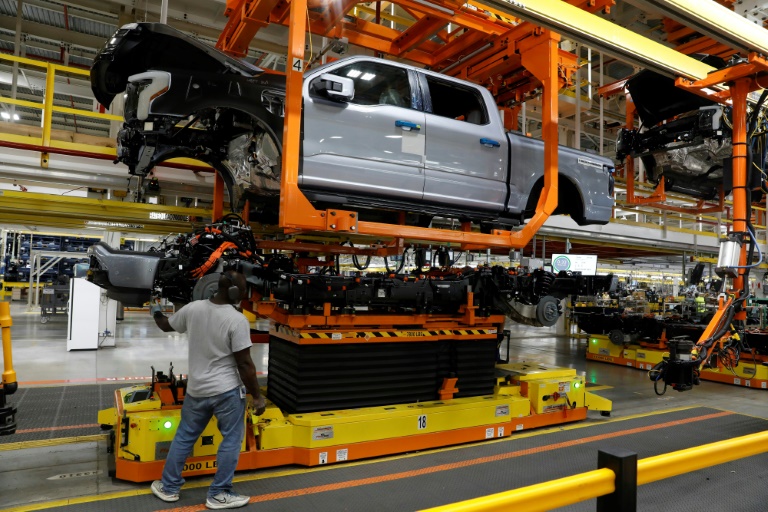
The truck plant churns out a new pickup truck every 53 seconds in a well-oiled process that will continue for the foreseeable future.  

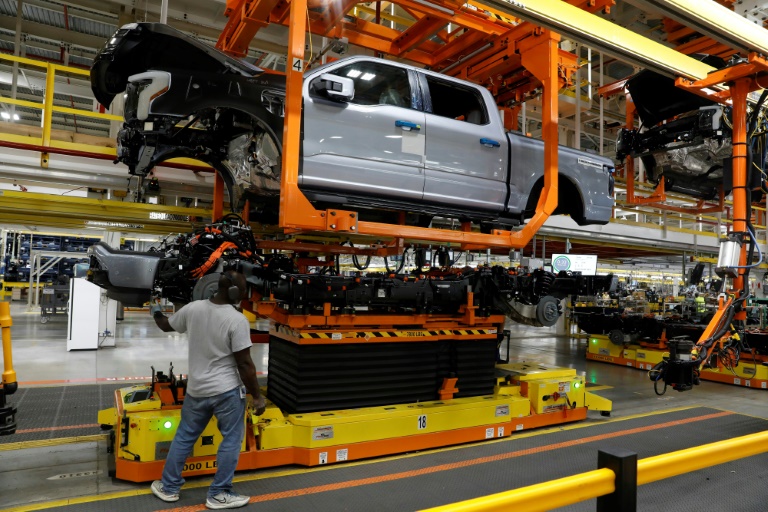
But in September 2020, Ford broke ground on a smaller facility on neighboring land, tasking the new operation with building a battery electric cousin to the internal combustion engine (ICE) F-150. 

The F-150 Lightning is part of a growing fleet of battery electric vehicles (BEVs) hitting the roadways from established automakers and upstarts.

At the Detroit Auto Show last week, President Joe Biden proclaimed that “the great American Road Trip is going to be fully electrified.”

After racking up some 200,000 reservations for the Lightning, Ford has announced expansions to quadruple output over the next year.

Will there be a tipping point where the Lightning could overtake the ICE model? That is a question on the minds of officials at Ford and rival Detroit automakers that are investing billions of dollars in BEVs while still producing millions of ICE vehicles.

“The industry is changing so quickly, I don’t think anybody has a good prediction of where it’s going to be,” Ford’s Chris Skaggs told AFP.  

“But we are reacting and getting the right resources to build batteries and scaling so that we can meet demand whatever that is,” said Skaggs, a veteran Ford operations manager who is leading the BEV plant expansion.  

“I’ve been doing this for 29 years, and I thought I would be retired before we even got to this point.”

– Storied history –

The Lightning marks the latest reinvention of the Dearborn Rouge industrial complex south of Detroit near the Rouge River.

The Rouge factory was built between 1917 and 1928 and originally planned to comprise all the components in car production, including tire-making, vehicle assembly, steelmaking and engine building. 

Peak employment topped 100,000 in the 1930s, a decade that also saw visits by artist Diego Rivera for his famed murals of auto workers.

The complex was enlisted to build fighter jet engines for the Allies’ World War II before assembling such iconic Ford vehicles as the Thunderbird and the Mustang, which was launched in the 1960s and is now assembled at a different Michigan factory.

The Rouge site — long emblematic of the moving assembly line that changed manufacturing history — began to look like a white elephant as Ford streamlined later in the twentieth century and pollution rendered it a brownfield site.

But William Clay Ford Jr., the great-grandson of Henry Ford, refused to shutter it, authorizing a $2 billion upgrade soon after becoming chairman in 1999.

Dearborn Truck plant opened in 2004 following extensive environmental cleanup and the installation of a “living roof” to make heating and cooling more efficient.

– ‘Flex’ capacity –

The younger Ford, who identified Rouge as “our heritage,” faced pushback internally on the Dearborn investment, which coincided with a trying period financially.

But it would be difficult to find fault with the staying power of the F-150, which has been the best-selling vehicle in the United States for four decades.

Three shifts populate the 4,500-employee Dearborn truck assembly plant, working around the clock.

The vehicle assembly process starts when the aluminum coils are stamped into panels on-site. The panels are assembled at the body shop and then painted before making their way to the assembly line.

The truck then proceeds through hundreds of work stations where the engine and other components are installed, and is then put through testing including wheels and headlamp alignment, camera-based inspections and electronic computer once-overs before shipping to the customer.

Ford does not release daily output figures, but each vehicle is assembled in hours once it arrives at the factory, Skaggs said.

In contrast to the ICE truck factory, which clanks with activity, the BEV plant operates at a modest hum, a quality partly due to the company’s focus on ergonomics. 

The BEV assembly process is also organized around production lines, but there are fewer work stations in an operation that is still gearing up for bigger things. The Rouge Electric Vehicle Center currently employs about 500.

The expansion will double the size of the BEV factory and add more workers and work stations, taking output to 150,000 annually by next fall, Skaggs said.

But the added productivity will be “flex,” Skaggs said, meaning it could be used for either ICE or BEV depending on demand.

“If we don’t call it right, we can build more ICE units… or if BEV really takes off like we all expect it to, we can scale this up.”

Ford's electric drive reinvents historic Michigan factory

Construction crews are back at Dearborn, remaking Ford’s century-old industrial complex once again, this time for a post-petroleum era that is finally beginning to feel possible.

The manufacturing operation’s prime mission in recent times has been to assemble the best-selling F-150, a gasoline-powered vehicle.

The truck plant churns out a new pickup truck every 53 seconds in a well-oiled process that will continue for the foreseeable future.  

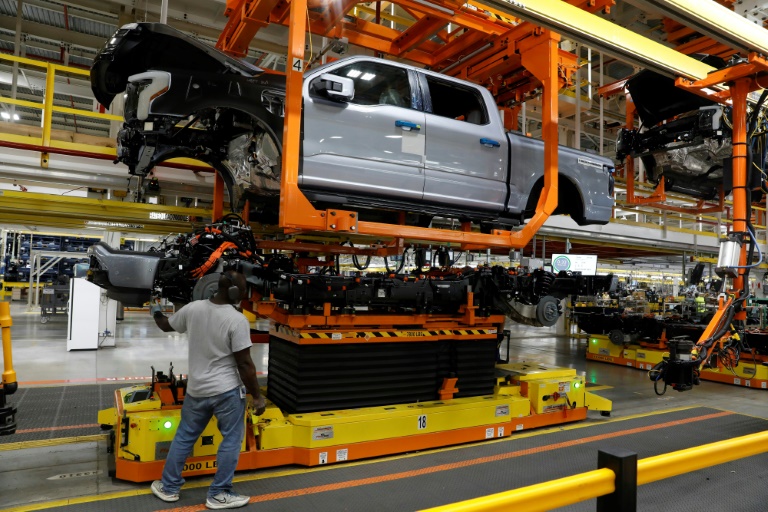
But in September 2020, Ford broke ground on a smaller facility on neighboring land, tasking the new operation with building a battery electric cousin to the internal combustion engine (ICE) F-150. 

The F-150 Lightning is part of a growing fleet of battery electric vehicles (BEVs) hitting the roadways from established automakers and upstarts.

At the Detroit Auto Show last week, President Joe Biden proclaimed that “the great American Road Trip is going to be fully electrified.”

After racking up some 200,000 reservations for the Lightning, Ford has announced expansions to quadruple output over the next year.

Will there be a tipping point where the Lightning could overtake the ICE model? That is a question on the minds of officials at Ford and rival Detroit automakers that are investing billions of dollars in BEVs while still producing millions of ICE vehicles.

“The industry is changing so quickly, I don’t think anybody has a good prediction of where it’s going to be,” Ford’s Chris Skaggs told AFP.  

“But we are reacting and getting the right resources to build batteries and scaling so that we can meet demand whatever that is,” said Skaggs, a veteran Ford operations manager who is leading the BEV plant expansion.  

“I’ve been doing this for 29 years, and I thought I would be retired before we even got to this point.”

– Storied history –

The Lightning marks the latest reinvention of the Dearborn Rouge industrial complex south of Detroit near the Rouge River.

The Rouge factory was built between 1917 and 1928 and originally planned to comprise all the components in car production, including tire-making, vehicle assembly, steelmaking and engine building. 

Peak employment topped 100,000 in the 1930s, a decade that also saw visits by artist Diego Rivera for his famed murals of auto workers.

The complex was enlisted to build fighter jet engines for the Allies’ World War II before assembling such iconic Ford vehicles as the Thunderbird and the Mustang, which was launched in the 1960s and is now assembled at a different Michigan factory.

The Rouge site — long emblematic of the moving assembly line that changed manufacturing history — began to look like a white elephant as Ford streamlined later in the twentieth century and pollution rendered it a brownfield site.

But William Clay Ford Jr., the great-grandson of Henry Ford, refused to shutter it, authorizing a $2 billion upgrade soon after becoming chairman in 1999.

Dearborn Truck plant opened in 2004 following extensive environmental cleanup and the installation of a “living roof” to make heating and cooling more efficient.

– ‘Flex’ capacity –

The younger Ford, who identified Rouge as “our heritage,” faced pushback internally on the Dearborn investment, which coincided with a trying period financially.

But it would be difficult to find fault with the staying power of the F-150, which has been the best-selling vehicle in the United States for four decades.

Three shifts populate the 4,500-employee Dearborn truck assembly plant, working around the clock.

The vehicle assembly process starts when the aluminum coils are stamped into panels on-site. The panels are assembled at the body shop and then painted before making their way to the assembly line.

The truck then proceeds through hundreds of work stations where the engine and other components are installed, and is then put through testing including wheels and headlamp alignment, camera-based inspections and electronic computer once-overs before shipping to the customer.

Ford does not release daily output figures, but each vehicle is assembled in hours once it arrives at the factory, Skaggs said.

In contrast to the ICE truck factory, which clanks with activity, the BEV plant operates at a modest hum, a quality partly due to the company’s focus on ergonomics. 

The BEV assembly process is also organized around production lines, but there are fewer work stations in an operation that is still gearing up for bigger things. The Rouge Electric Vehicle Center currently employs about 500.

The expansion will double the size of the BEV factory and add more workers and work stations, taking output to 150,000 annually by next fall, Skaggs said.

But the added productivity will be “flex,” Skaggs said, meaning it could be used for either ICE or BEV depending on demand.

“If we don’t call it right, we can build more ICE units… or if BEV really takes off like we all expect it to, we can scale this up.”

Ford's electric drive reinvents historic Michigan factory

Construction crews are back at Dearborn, remaking Ford’s century-old industrial complex once again, this time for a post-petroleum era that is finally beginning to feel possible.

The manufacturing operation’s prime mission in recent times has been to assemble the best-selling F-150, a gasoline-powered vehicle.

The truck plant churns out a new pickup truck every 53 seconds in a well-oiled process that will continue for the foreseeable future.  

But in September 2020, Ford broke ground on a smaller facility on neighboring land, tasking the new operation with building a battery electric cousin to the internal combustion engine (ICE) F-150. 

The F-150 Lightning is part of a growing fleet of battery electric vehicles (BEVs) hitting the roadways from established automakers and upstarts.

At the Detroit Auto Show last week, President Joe Biden proclaimed that “the great American Road Trip is going to be fully electrified.”

After racking up some 200,000 reservations for the Lightning, Ford has announced expansions to quadruple output over the next year.

Will there be a tipping point where the Lightning could overtake the ICE model? That is a question on the minds of officials at Ford and rival Detroit automakers that are investing billions of dollars in BEVs while still producing millions of ICE vehicles.

“The industry is changing so quickly, I don’t think anybody has a good prediction of where it’s going to be,” Ford’s Chris Skaggs told AFP.  

“But we are reacting and getting the right resources to build batteries and scaling so that we can meet demand whatever that is,” said Skaggs, a veteran Ford operations manager who is leading the BEV plant expansion.  

“I’ve been doing this for 29 years, and I thought I would be retired before we even got to this point.”

– Storied history –

The Lightning marks the latest reinvention of the Dearborn Rouge industrial complex south of Detroit near the Rouge River.

The Rouge factory was built between 1917 and 1928 and originally planned to comprise all the components in car production, including tire-making, vehicle assembly, steelmaking and engine building. 

Peak employment topped 100,000 in the 1930s, a decade that also saw visits by artist Diego Rivera for his famed murals of auto workers.

The complex was enlisted to build fighter jet engines for the Allies’ World War II before assembling such iconic Ford vehicles as the Thunderbird and the Mustang, which was launched in the 1960s and is now assembled at a different Michigan factory.

The Rouge site — long emblematic of the moving assembly line that changed manufacturing history — began to look like a white elephant as Ford streamlined later in the twentieth century and pollution rendered it a brownfield site.

But William Clay Ford Jr., the great-grandson of Henry Ford, refused to shutter it, authorizing a $2 billion upgrade soon after becoming chairman in 1999.

Dearborn Truck plant opened in 2004 following extensive environmental cleanup and the installation of a “living roof” to make heating and cooling more efficient.

– ‘Flex’ capacity –

The younger Ford, who identified Rouge as “our heritage,” faced pushback internally on the Dearborn investment, which coincided with a trying period financially.

But it would be difficult to find fault with the staying power of the F-150, which has been the best-selling vehicle in the United States for four decades.

Three shifts populate the 4,500-employee Dearborn truck assembly plant, working around the clock.

The vehicle assembly process starts when the aluminum coils are stamped into panels on-site. The panels are assembled at the body shop and then painted before making their way to the assembly line.

The truck then proceeds through hundreds of work stations where the engine and other components are installed, and is then put through testing including wheels and headlamp alignment, camera-based inspections and electronic computer once-overs before shipping to the customer.

Ford does not release daily output figures, but each vehicle is assembled in hours once it arrives at the factory, Skaggs said.

In contrast to the ICE truck factory, which clanks with activity, the BEV plant operates at a modest hum, a quality partly due to the company’s focus on ergonomics. 

The BEV assembly process is also organized around production lines, but there are fewer work stations in an operation that is still gearing up for bigger things. The Rouge Electric Vehicle Center currently employs about 500.

The expansion will double the size of the BEV factory and add more workers and work stations, taking output to 150,000 annually by next fall, Skaggs said.

But the added productivity will be “flex,” Skaggs said, meaning it could be used for either ICE or BEV depending on demand.

“If we don’t call it right, we can build more ICE units… or if BEV really takes off like we all expect it to, we can scale this up.”

Taiwan's pangolins suffer surge in feral dog attacks

In most of its habitats, the heavily trafficked pangolin’s biggest threat comes from humans. But in Taiwan, the scaly mammals brave a different danger: a surging feral dog population.

Veterinarian Tseng Shao-tung, 28, has seen firsthand what a dog can do to the gentle creatures during his shifts at a hospital in Hsinchu.

Last month he worked to save the life of a male juvenile pangolin who had been lying in the wild for days with half of its tail chewed off. 

“It has a big open wound on its tail and its body tissue has decayed,” Tseng said as he carefully turned the sedated pangolin to disinfect the gaping injury.

It was the fifth pangolin Tseng and his fellow veterinarians had saved this year, all from suspected dog attacks.

Chief veterinarian Chen Yi-ru said she had noticed a steady increase of pangolins with trauma injuries in the last five years — most of them with severed tails.

Pangolins are covered in hard, overlapping body scales and curl up into a ball when attacked. The tail is the animal’s most vulnerable part.

“That’s why when attacked, the tail is usually the first to be bitten,” Chen explained.

Wildlife researchers and officials said dog attacks, which account for more than half of all injuries since 2018, have become “the main threat to pangolins in Taiwan” in a report released last year.

– Most trafficked mammal –

Pangolins are described by conservationists as the world’s most trafficked mammal, with traditional Chinese medicine being the main driver. 

Although their scales are made of keratin — the substance that makes up our fingernails and hair — there is huge demand for them among Chinese consumers because of the unproven belief that they help lactation in breastfeeding mothers.

That demand has decimated pangolin populations across Asia and Africa despite a global ban and funded a lucrative international black market trade.

All eight species of pangolins on both continents are listed as endangered or critically endangered.

Taiwan has been a comparative conservation success story, transforming itself from a place where pangolins went from near-extinct to protected and thriving.

Chan Fang-tse, veterinarian and researcher at the official Taiwan Endemic Species Research Institute, said the 1950s to 1970s saw massive hunting. 

“Sixty thousand pangolins in Taiwan were killed for their scales and hides during that period,” he told AFP. 

A 1989 wildlife protection law ended the industry, while rising conservation awareness led the public to start embracing their scaly neighbours as something to be cherished, rather than a commodity.

The population of the Formosan or Taiwanese pangolin, a subspecies of the Chinese pangolin, has since bounced back with researchers estimating that there are now between 10,000 to 15,000 in the wild.

But the island’s growing feral dog population — itself a consequence of a 2017 government policy not to cull stray animals — is hitting pangolins hard, Chan warned. 

“Pangolins are most affected because they have a big overlap of roaming area and pangolins don’t move as fast as other animals,” Chan said.

– Picky eaters –

Pangolins are also vulnerable because of how few offspring they have.

The solitary Formosan pangolins mate once a year and only produce one offspring after 150 days of pregnancy. Captivity breeding programmes have had little success. 

“It may be more difficult to breed pangolins than pandas,” Chan said.

The rise in injured pangolins has created another challenge for animal doctors: finding enough ants and termites to feed the picky eaters who often reject substitute mixtures of larvae. 

Piling into a truck with three other vets, Tseng headed to a tree to retrieve an ant nest he had recently spotted.

“We have to be constantly on the lookout and go search for ants nests every couple of days now because we have more pangolins to feed,” Tseng said.

A pangolin can eat an ant nest the size of a football each day. 

The government has also called for residents to report nest locations to help feed the pangolins until they can be released back into the wild.

But the injured pangolin in Tseng’s care will likely have to be sent to a zoo or government facility for adoption after it recovers.

“It will have difficulty climbing up trees and won’t be able to roll itself into a ball shape,” Tseng said.

“It has lost the ability to protect itself in the wild.”

Why are climate activists calling for reparations?

Pakistan’s catastrophic floods have led to renewed calls for rich polluting nations, which grew their economies through heavy use of fossil fuels, to compensate developing countries for the devastating impacts caused by the climate crisis.

The currently favored term for this concept is “loss and damage” payments,  but some campaigners want to go further and frame the issue as “climate reparations,” just as racial justice activists call for compensation for the descendants of enslaved people. 

Beyond the tougher vocabulary, green groups also call for debt cancellation for cash-strapped nations that spend huge portions of their budgets servicing external loans, rather than devoting the funds to increasing resilience to a rapidly changing planet. 

“There’s a historical precedent of not just the industrial revolution that led to increased emissions and carbon pollution, but also the history of colonialism and the history of extraction of resources, wealth and labor,” Belgium-based climate activist Meera Ghani told AFP.

“The climate crisis is a manifestation of interlocking systems of oppression, and it’s a form of colonialism,” said Ghani, a former climate negotiator for Pakistan. 

Such ideas stretch back decades and were first pushed by small island nations susceptible to rising sea levels —  but momentum is once more building on the back of this summer’s catastrophic inundations in Pakistan, driven by unprecedented monsoon rains. 

Nearly 1,600 were killed, several million displaced, and the cash-strapped government estimates losses in the region of $30 billion. 

– Beyond mitigation and adaptation –

Campaigners point to the fact that the most climate-vulnerable countries in the Global South are least responsible — Pakistan, for instance, produces less than one percent of global greenhouse emissions, as opposed to the G20 countries which account for 80 percent.

The international climate response currently involves a two-pronged approach: “mitigation” — which means reducing heat-trapping greenhouse gases — and “adaptation,” which means steps to alter systems and improve infrastructure for changes that are already locked in.

Calls for “loss and damage” payments go further than adaptation financing, and seek compensation for multiplying severe weather impacts that countries cannot withstand.

At present, however, even the more modest goal of adaptation financing is languishing. 

Advanced economies agreed to channel $100 billion to less developed countries by the year 2020 — a promise that was broken — even as much of the funding that was mobilized came in the form of loans.

“Our starting point is that the global North is largely responsible for the state of our planet today,” said Maira Hayat, an assistant professor of environment and peace studies at the University of Notre Dame in Indiana. 

“Why should countries that have contributed little by way of GHG emissions be asking them for aid –- loans are the predominant form –- with onerous repayment conditions?”

“If the language is upsetting for some, the next step should be to probe why that might be -– do they dispute the history? Or the present-day implications of accepting certain historical pasts?”

– Point scoring? –

Not all in the climate arena are convinced. 

“Beyond a certain rhetorical point-scoring that’s not going to go anywhere,” said Daanish Mustafa, professor in critical geography at King’s College London. 

While he mostly blames the Global North for the world’s current predicament, he says he is wary of pushing a narrative that may excuse the actions of the Pakistani leadership and policy choices they have taken that exacerbate this and other disasters.

The World Weather Attribution group of climate scientists found that climate change likely contributed to the floods. 

But the devastating impacts were also driven “by the proximity of human settlements, infrastructure (homes, buildings, bridges) and agricultural land to flood plains,” among other locally driven factors, they said.

Pakistan’s own emissions, while low at the global scale, are fast rising — with the benefits flowing to a tiny elite, said Mustafa, and the country should pursue an alternative, low-carbon development path rather than “aping the West” and damaging itself in the process. 

The case for “loss and damage” payments received a recent boost with UN chief Antonio Guterres calling for “meaningful action” on it at the next global climate summit, COP27 in Egypt in November.

But the issue is sensitive for rich countries — especially the United States, the largest emitter of GHGs historically — which fear it could pave the way for legal action and kept language regarding “liability and compensation” out of the landmark Paris agreement.

EVs at Detroit Auto Show? Consumers have questions

The emerging fleet of electric vehicles (EV) provoked fascination at the Detroit Auto Show, but many consumers were not yet ready to take the plunge to own one themselves.

Some, like Justin Tata, wanted a first-hand look at new EV offerings, saying “it’s embracing the change that’s coming because I think the internal combustion engine (ICE) is on the way out.” 

But Tata, who works in the packaging industry, still has questions about EV battery disposal. He came to the Detroit show, which concludes Sunday, to survey the state of play, but doesn’t foresee buying an EV for another five to 10 years.

Among other attendees, the less-EV enthused included Tim Stokes.

“I think eventually that’s going to be the only option,” said Stokes as he admired a new gasoline-powered Ford Mustang, adding that he wants to “prolong (driving ICE vehicles) as long as possible.”

Friends in the auto industry have advised waiting three or four years for the industry to “work out the kinks” with EVs, said Stokes, who works in telecommunications.

– Mainstream options –

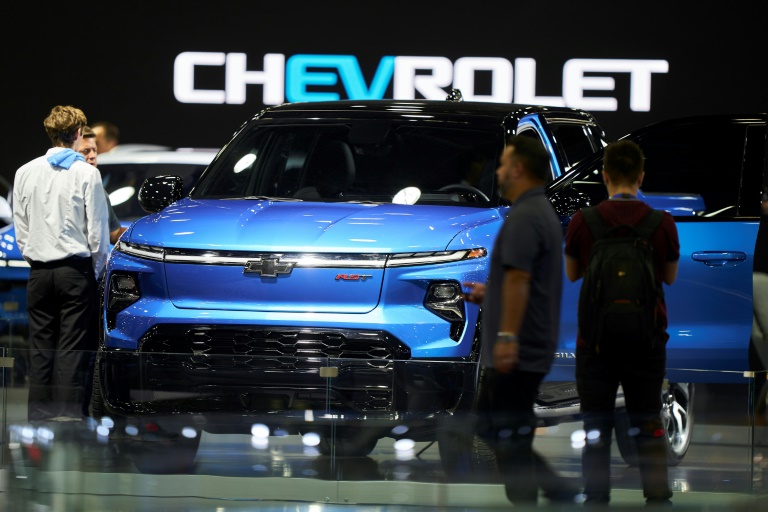
Long considered a niche sideshow in the auto world, the prominence of EVs at this year’s Detroit gathering underscored their new mainstream status as big automakers respond to rising concerns about climate change and government policies promoting EVs.

Chevrolet’s showcase highlighted EV versions of three of the GM brand’s top-selling products: the Silverado pickup, and the Blazer and Equinox, both SUVs. Chevy expects to begin deliveries on the vehicles in 2023.

Ford too has targeted its EV campaign towards its most popular vehicles, unveiling a battery-powered version of its best-selling F-150 pickup truck and launching the Mustang Mach-E, a new SUV that has also attracted strong interest from consumers.

A 2022 Consumer Reports survey showed 14 percent of Americans saying they would “definitely” buy or lease an EV if they were searching for a vehicle, up from four percent in 2020.

While the vehicle launches have brought unprecedented attention to EVs, auto experts say that a meaningful transformation of the ICE-dominated US fleet is still years away. 

Price remains a big problem, with the average price of an EV nearly $67,000, according to Cox Automotive.

Experts also cite the lack of EV charging stations as a concern. President Biden signed into law a bill to provide $7.5 billion to build more stations, as his administration announced the first tranche of funding in parallel with a presidential address at the Detroit show.

– Can the industry deliver? –

Auto insiders also point to doubts about the availability of critical materials such as lithium and cobalt needed for batteries. 

These issues have come to the fore during the Covid-19 pandemic, when shortages of semiconductors and other supply chain woes forced automakers to restrict vehicle production and store tens of thousands of partially-built autos.

Ford said on Monday that it expects to have some 40,000-45,000 mostly built vehicles in inventory at the end of the third quarter due to needed parts. On Friday, the Wall Street Journal reported that the company had delayed some vehicle deliveries due to a shortage of badges with the company’s blue oval logo.

Don Lamos, who works for auto supplier, had placed an order on a Ford Lightning, but is backing off after Ford raised the price on that version to above the $80,000 cap that would allow car buyers to qualify for a $7,500 tax credit under new US legislation.

Lamos and his wife, Janice, were drawn to the Chevy offerings, including the Equinox, which starts at $30,000. 

“If they can hold that at $30,000, then awesome,” he said. “I don’t know if they’ll really be able to meet production next year, so we’ll see.”

Don Lamos cited cost savings as the main impetus, while Janice Lamos described climate change as a priority. The couple are sold on EVs, but pondering how much to spend now when battery technologies will likely improve in the future.

Many of the vehicles being released are touted for being able to travel 300 miles without being recharged, but the capacity is much lower if the vehicle is towing cargo.

“You know when you need gas you can go to the corner and there’s a station. I don’t think there’s enough (charging) stations for one of these,” Carlos Rubante said when asked about the Lightning.

Consumers at the show described climate change as a worry, but were not necessarily convinced that EVs were the solution. 

Besides battery disposal, another concern is the unwanted consequences of the mining boom in critical materials, such as the use of child labor in the Democratic Republic of Congo to produce cobalt, said Cristian Damboiu, who works for an auto supplier.

“When you’re considering all these things, maybe they aren’t as clean as they seem,” said Damboiu.

“I understand (EVs) have some advantages, so we’ll see how it plays out.”

EVs at Detroit Auto Show? Consumers have questions

The emerging fleet of electric vehicles (EV) provoked fascination at the Detroit Auto Show, but many consumers were not yet ready to take the plunge to own one themselves.

Some, like Justin Tata, wanted a first-hand look at new EV offerings, saying “it’s embracing the change that’s coming because I think the internal combustion engine (ICE) is on the way out.” 

But Tata, who works in the packaging industry, still has questions about EV battery disposal. He came to the Detroit show, which concludes Sunday, to survey the state of play, but doesn’t foresee buying an EV for another five to 10 years.

Among other attendees, the less-EV enthused included Tim Stokes.

“I think eventually that’s going to be the only option,” said Stokes as he admired a new gasoline-powered Ford Mustang, adding that he wants to “prolong (driving ICE vehicles) as long as possible.”

Friends in the auto industry have advised waiting three or four years for the industry to “work out the kinks” with EVs, said Stokes, who works in telecommunications.

– Mainstream options –

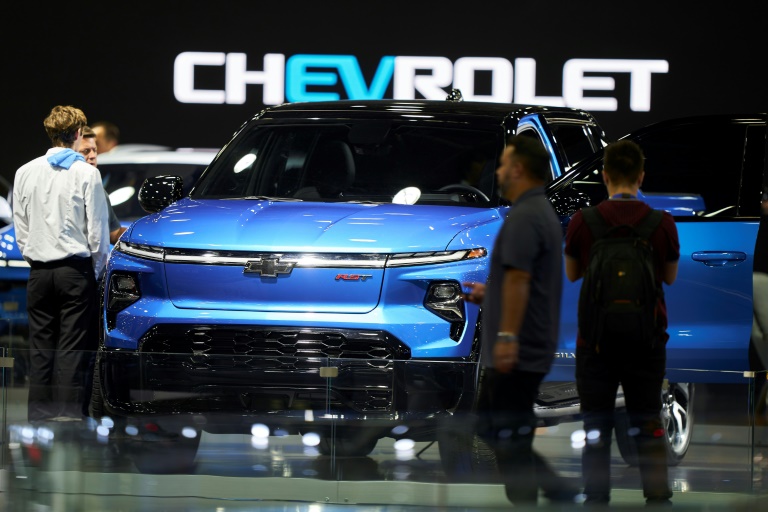
Long considered a niche sideshow in the auto world, the prominence of EVs at this year’s Detroit gathering underscored their new mainstream status as big automakers respond to rising concerns about climate change and government policies promoting EVs.

Chevrolet’s showcase highlighted EV versions of three of the GM brand’s top-selling products: the Silverado pickup, and the Blazer and Equinox, both SUVs. Chevy expects to begin deliveries on the vehicles in 2023.

Ford too has targeted its EV campaign towards its most popular vehicles, unveiling a battery-powered version of its best-selling F-150 pickup truck and launching the Mustang Mach-E, a new SUV that has also attracted strong interest from consumers.

A 2022 Consumer Reports survey showed 14 percent of Americans saying they would “definitely” buy or lease an EV if they were searching for a vehicle, up from four percent in 2020.

While the vehicle launches have brought unprecedented attention to EVs, auto experts say that a meaningful transformation of the ICE-dominated US fleet is still years away. 

Price remains a big problem, with the average price of an EV nearly $67,000, according to Cox Automotive.

Experts also cite the lack of EV charging stations as a concern. President Biden signed into law a bill to provide $7.5 billion to build more stations, as his administration announced the first tranche of funding in parallel with a presidential address at the Detroit show.

– Can the industry deliver? –

Auto insiders also point to doubts about the availability of critical materials such as lithium and cobalt needed for batteries. 

These issues have come to the fore during the Covid-19 pandemic, when shortages of semiconductors and other supply chain woes forced automakers to restrict vehicle production and store tens of thousands of partially-built autos.

Ford said on Monday that it expects to have some 40,000-45,000 mostly built vehicles in inventory at the end of the third quarter due to needed parts. On Friday, the Wall Street Journal reported that the company had delayed some vehicle deliveries due to a shortage of badges with the company’s blue oval logo.

Don Lamos, who works for auto supplier, had placed an order on a Ford Lightning, but is backing off after Ford raised the price on that version to above the $80,000 cap that would allow car buyers to qualify for a $7,500 tax credit under new US legislation.

Lamos and his wife, Janice, were drawn to the Chevy offerings, including the Equinox, which starts at $30,000. 

“If they can hold that at $30,000, then awesome,” he said. “I don’t know if they’ll really be able to meet production next year, so we’ll see.”

Don Lamos cited cost savings as the main impetus, while Janice Lamos described climate change as a priority. The couple are sold on EVs, but pondering how much to spend now when battery technologies will likely improve in the future.

Many of the vehicles being released are touted for being able to travel 300 miles without being recharged, but the capacity is much lower if the vehicle is towing cargo.

“You know when you need gas you can go to the corner and there’s a station. I don’t think there’s enough (charging) stations for one of these,” Carlos Rubante said when asked about the Lightning.

Consumers at the show described climate change as a worry, but were not necessarily convinced that EVs were the solution. 

Besides battery disposal, another concern is the unwanted consequences of the mining boom in critical materials, such as the use of child labor in the Democratic Republic of Congo to produce cobalt, said Cristian Damboiu, who works for an auto supplier.

“When you’re considering all these things, maybe they aren’t as clean as they seem,” said Damboiu.

“I understand (EVs) have some advantages, so we’ll see how it plays out.”

Close Bitnami banner
Bitnami