AFP

Markets drop as Fed hike looms, Putin move lifts dollar and oil

Stocks fell Wednesday ahead of what many expect to be a third successive jumbo rate hike by the Federal Reserve, while the dollar hit fresh multi-decade highs against the pound and euro after Russia stepped up its war in Ukraine.

Equities around the world have been clattered by fears of a recession in major economies as central banks ramp up borrowing costs to combat the highest inflation in decades, which has been compounded by the Ukraine war and supply chain snarls.

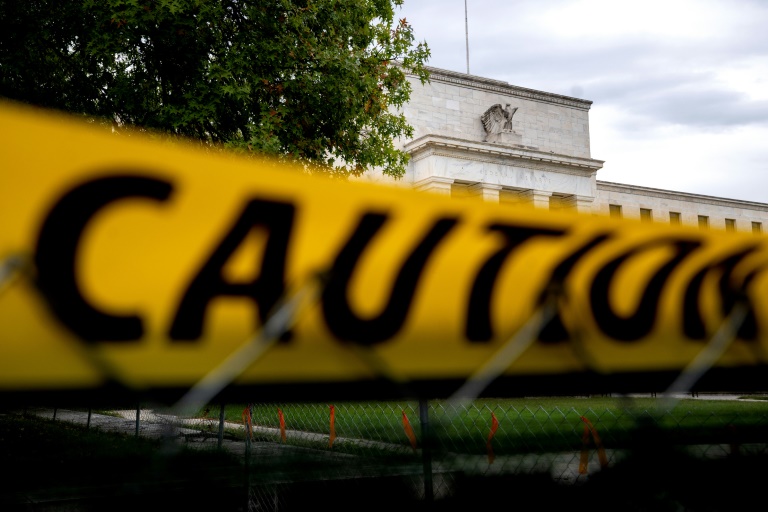
In Washington, the Fed is due to conclude its latest policy meeting, with most analysts predicting it will announce another 75 basis-point lift, though some have tipped a full percentage-point move.

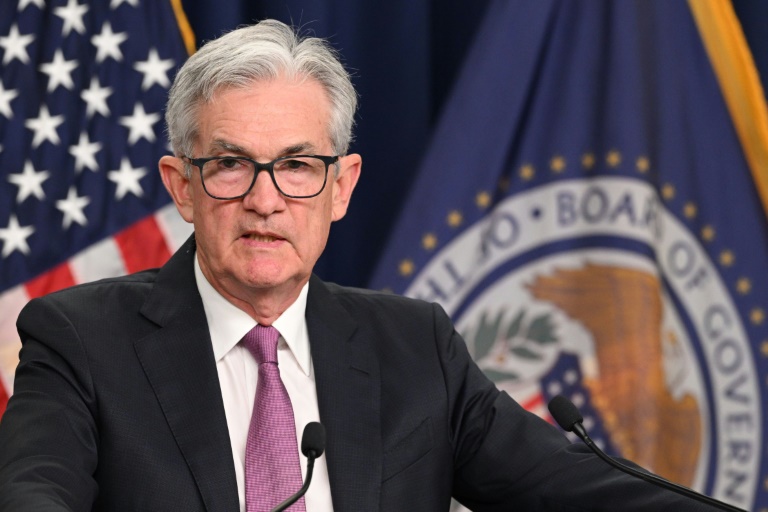
However, while the hike has largely been priced into the markets, the US central bank’s forecast and post-meeting comments from boss Jerome Powell are the main attraction for investors.

“Volumes remain light and the mood cautious, with few looking to take on large positions before hearing what the Fed says and where policy makers see rates going by the end of the hiking cycle,” Fiona Cincotta, at City Index, said.

“This is what will drive the markets, not the rate hike… but what the Fed plans to do next.”

Fed officials have for months stuck to the mantra that they will only ease up on their hawkish drive when inflation comes down and remains subdued.

This has led many to warn that rates are unlikely to come down anytime soon, possibly as late as 2024, with a recession more than likely in the United States as well as other major economies.

– Dollar extends rally –

Other central banks are also meeting this week. On Tuesday, officials in Sweden surprised markets by unveiling a one percentage-point hike, while the United Kingdom and Switzerland are expected to announce more increases.

Asian markets were back in the red, reversing Tuesday’s bounce.

Tokyo, Hong Kong, Sydney and Manila were all down more than one percent, while there were also losses in Shanghai, Seoul, Singapore, Wellington, Taipei, Mumbai and Jakarta.

London rose in early trade, but Paris and Frankfurt were down.

Adding to the dour mood was Vladimir Putin’s announcement of a “partial mobilisation” as he upped the ante in his battle against Ukraine after his forces were routed from several cities in recent weeks.

He added that he would annex the territories his forces have already occupied and backed weekend referendums in four regions in Russian-held parts of Ukraine.

“We will definitely use all means available” to protect Russian territory, he warned, adding: “That’s not a bluff.”

The moves mark an escalation of the seven-month war, which has roiled markets and sparked an energy crisis.

Oil prices, which have wilted in recent months owing to worries about demand caused by any recession, surged more than three percent.

And the dollar, a safe haven in times of uncertainty and turmoil and which was already elevated ahead of the rate decision, rallied further.

It hit a fresh 37-year high of $1.1305 against sterling and a new 20-year peak of $0.9885 per euro, with the eurozone already in economic trouble owing to sanctions on Russian oil and Putin’s decision to cut off gas supplies to the continent.

The announcement and possible escalation in the war “raises a whole new set of uncertainties”, Rabobank’s Jane Foley said.

“This is set to weigh on the euro and on the currencies of eastern Europe.”

– Key figures at around 0810 GMT –

Tokyo – Nikkei 225: DOWN 1.4 percent at 27,313.13 (close)

Hong Kong – Hang Seng Index: DOWN 1.8 percent at 18,444.62 (close)

Shanghai – Composite: DOWN 0.2 percent at 3,117.18 (close)

London – FTSE 100: DOWN 0.3 percent at 7,210.45

Euro/dollar: DOWN at $0.9909 from $0.9977 on Tuesday

Dollar/yen: DOWN at 143.71 yen from 143.72 yen

Pound/dollar: DOWN at $1.1345 from $1.1384

Euro/pound: DOWN at 87.35 pence from 87.63 pence 

West Texas Intermediate: UP 3.2 percent at $86.62 per barrel

Brent North Sea crude: UP 3.1 percent at $93.39 per barrel

New York – Dow: DOWN 1.0 percent at 30,706.23 (close)

— Bloomberg News contributed to this story —
UK's new PM veers away from Biden's economic script at UN

Britain’s new Prime Minister Liz Truss was Wednesday to outline an economic rescue programme focussed on tax cuts — even as US President Joe Biden rejected that approach as the two prepared to meet at the UN.

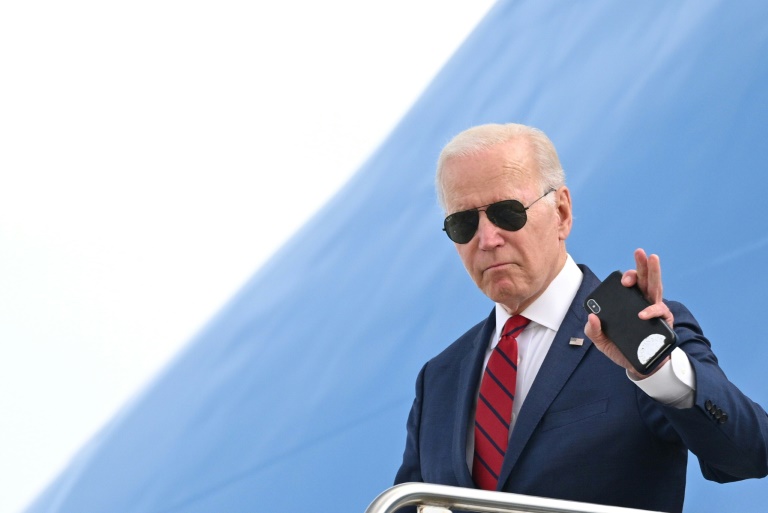
“I am sick and tired of trickle-down economics. It has never worked,” Biden tweeted ahead of his first meeting with Boris Johnson’s successor in New York. 

“We’re building an economy from the bottom up and middle out,” the president said, contrasting his approach to Republican opponents whose philosophy is more akin to the UK’s new Conservative leader.

Truss has underscored in New York her contentious belief that tax cuts for the better-off would benefit everyone, as her new government tries to get a grip on soaring energy prices.

An emergency budget on Friday is expected to roll out tax changes that would disproportionately benefit Britain’s rich. The Times newspaper said it could also come with a surprise cut to property purchase taxes.

“I don’t accept this argument that cutting taxes is somehow unfair,” Truss told Sky News in New York, ahead of her bilateral meeting with Biden and debut speech Wednesday at the UN General Assembly. 

“What we know is people on higher incomes generally pay more tax. So when you reduce taxes, there is often a disproportionate benefit because those people are paying more taxes in the first place,” she said.

The contrasting economic visions are only one point of dispute between Truss and Biden. 

The White House has made clear its unhappiness about the new prime minister’s hard line on Brexit and Northern Ireland. Truss conceded that a post-Brexit UK-US trade deal was unlikely for years.

But in her speech to the UN, she was set to defend her economic vision as a way to corral Western democracies against foes such as Russia.

“We want people to keep more of the money they earn, because we believe that freedom trumps instruction,” Truss was expected to say, according to excerpts released by Downing Street. 

“We are reforming our economy to get Britain moving forward once again.

“The free world needs this economic strength and resilience to push back against authoritarian aggression and win this new era of strategic competition.”

Truss was to say that Ukraine’s recent battlefield advances against Russian forces was “the story of freedom fighting back”.

“But this must not be a one-off,” she will say, urging Western unity. 

Putin calls up reservists, warns Russia will use 'all means' for defence

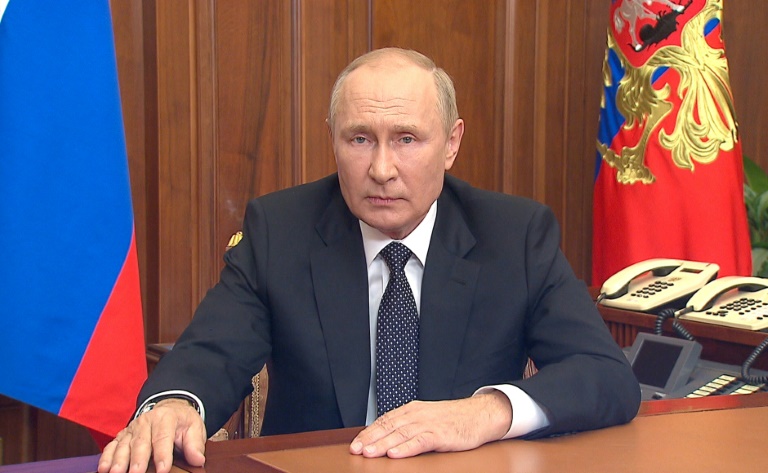
President Vladimir Putin ordered a partial military mobilisation and vowed on Wednesday to use “all available means” to protect Russian territory, after Moscow-held regions of Ukraine suddenly announced annexation referendums.

The votes, already denounced by Kyiv and the West as a “sham”, will dramatically up the stakes in the seven-month old conflict in Ukraine by giving Moscow the ability to accuse Ukrainian forces of attacking its own territory.

Four Russian-occupied regions of Ukraine — Donetsk and Lugansk in the east and Kherson and Zaporizhzhia in the south — said on Tuesday that they would hold the votes over five days beginning Friday.

In a pre-recorded address to the nation early on Wednesday, Putin accused the West of trying to “destroy” his country through its backing of Kyiv, and said Russia needed to support those in Ukraine who wanted to “determine their own future”.

The Russian leader announced a partial military mobilisation, with Defence Minister Sergei Shoigu telling state television that some 300,000 reservists would be called up.

– ‘Not a bluff’ –

“When the territorial integrity of our country is threatened, we will certainly use all the means at our disposal to protect Russia and our people. This is not a bluff,” Putin said.

“Those who are trying to blackmail us with nuclear weapons should know that the wind can also turn in their direction,” Putin added. 

Putin said that through its support for Ukraine the West was trying to “weaken, divide and ultimately destroy our country”, while Shoigu said Moscow was “fighting not so much Ukraine as the collective West” in Ukraine. 

The sudden flurry of moves by Moscow this week came with Russian forces in Ukraine facing their biggest challenge since the start of the conflict.

In a rare admission of military losses from Moscow, Shoigu said Wednesday 5,937 Russian soldiers had died in Ukraine since the launch of the military intervention in February.

A sweeping Ukrainian counter-offensive in recent weeks has seen Kyiv’s forces retake hundreds of towns and villages that had been controlled by Russia for months.

The referendums follow a pattern first established in 2014, when Russia annexed the Crimea peninsula from Ukraine after a similar vote.

Like in 2014, Washington, Berlin and Paris denounced the latest referendums and said the international community would never recognise the results.

German Chancellor Olaf Scholz said they were a “sham”, French President Emmanuel Macron called them a “travesty”, and White House National Security Advisor Jake Sullivan said they were “an affront to the principles of sovereignty and territorial integrity”.

“Sham referenda and mobilisation are signs of weakness, of Russian failure,” the US ambassador in Ukraine, Bridget Brink, said on Twitter.

“I thank all the friends and partners of Ukraine for their massive and firm condemnation of Russia’s intentions to organise yet more pseudo-referendums,” Ukrainian President Volodymyr Zelensky said in response.

– Strike at nuclear plant –

Kyiv said the referendums were meaningless and vowed to “eliminate” threats posed by Russia, saying its forces would keep retaking territory regardless of what Moscow or its proxies announced.

Political analyst Tatiana Stanovaya said the vote announcements were a direct result of the success of Ukraine’s eastern counter-offensive.

“Putin does not want to win this war on the battlefield. Putin wants to force Kyiv to surrender without a fight,” she said.

The Ukrainian nuclear operator Energoatom meanwhile on Wednesday accused Russia of again striking the Zaporizhzhia atomic power plant in southern Ukraine.

The strike damaged a power line causing the stoppage of several transformers of the number six reactor of the plant and forcing a brief start of emergency generators, Energoatom said.

“Even the presence of inspectors from the International Atomic Energy Agency (IAEA) does not stop” the Russians, it said, calling on the agency to “more resolute actions” against Moscow.

Europe’s largest nuclear facility, located in Russian-held territory, has become a hot spot for concerns after tit-for-tat claims of attacks there.

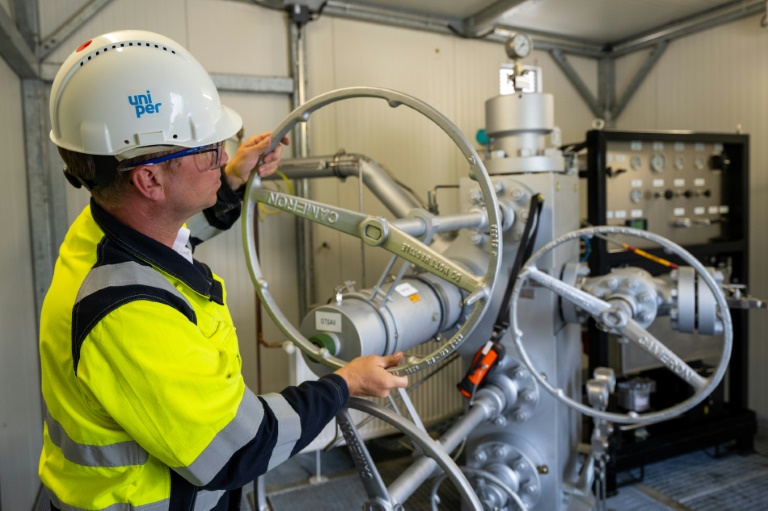
Germany reaches deal to nationalise troubled gas giant Uniper

Germany has reached a deal to nationalise troubled gas giant Uniper, the government said Wednesday, as the energy sector reels from the fallout of Russia’s war in Ukraine.

Berlin and Uniper’s Finnish owner, Fortum, announced a deal that will leave Germany with a 98.5 percent stake in the debt-laden gas company.

“Uniper is a central pillar of German energy supplies,” the economy ministry said in a statement.

Under the agreement, Berlin will inject eight billion euros ($8 billion) in cash in Uniper and buy Fortum’s shares for 500 million euros.

Fortum will also be repaid for an eight-billion-euro loan it gave Uniper.

“Under the current circumstances in the European energy markets and recognising the severity of Uniper’s situation, the divestment of Uniper is the right step to take, not only for Uniper but also for Fortum,” said Fortum chief executive Markus Rauramo.

“The role of gas in Europe has fundamentally changed since Russia attacked Ukraine, and so has the outlook for a gas-heavy portfolio. As a result, the business case for an integrated group is no longer viable,” Rauramo said in a statement.

One of the biggest importers of Russian gas, Uniper has been squeezed as Moscow has reduced supplies to the continent in the wake of its invasion of Ukraine in February.

Missing deliveries have had to be replaced with expensive supplies from the open market, where prices for gas have skyrocketed.

Fortum said Uniper has accumulated close to 8.5 billion euros in gas-related losses “and cannot continue to fulfil its role as a critical provider of security of supply as a privately-owned company”.

– Germany’s Russian gas dependence –

The German state had already agreed in July to take a 30 percent stake in Uniper as part of an initial bailout agreement.

But Uniper announced earlier this month that the two sides were exploring a possible nationalisation as the energy crisis showed no signs of abating.

Fortum provided an eight-billion-euro loan to Uniper in January as the price of gas had already begun to climb amid tensions with Moscow before the invasion of Ukraine.

The Finnish company held a near-80-percent stake in Uniper, which would have been cut to around 56 percent under the July bailout plan.

Earlier in September, the German government entered into discussions with another gas supplier, VNG, over a possible bailout package.

Russia’s war in Ukraine has triggered an earthquake on European energy markets, cranked up the pressure on suppliers and raised fears of possible shortages over the winter.

Germany has found itself particularly exposed due to its previous heavy reliance on Russian energy imports.

Since the outbreak of the war, Berlin has worked to wean itself off Russian gas and secure alternative supplies.

Officials have seized key pieces of energy infrastructure which were in the hands of Russian energy companies and mandated gas stores to be filled.

Plentiful water offers relief in Vienna

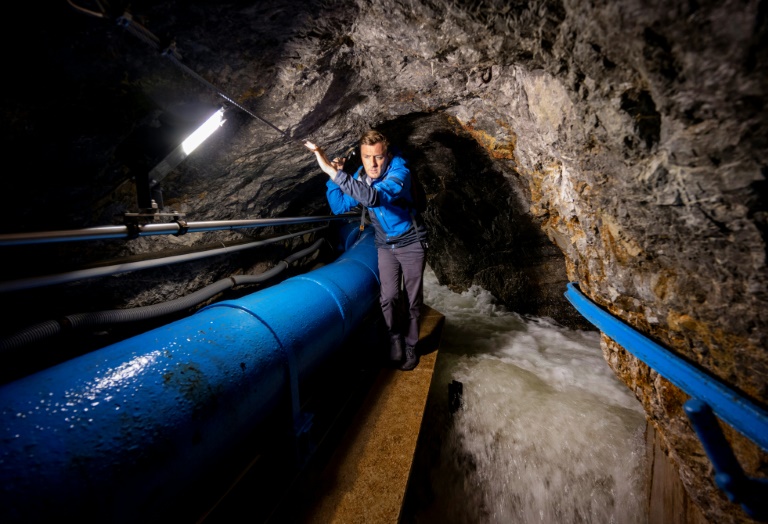
As Europe suffered its worst drought in centuries, residents in Austria’s capital were feeling fortunate for their plentiful water supply that courses from streams in the green forests of the Alps.

A rarety in the EU, the two million inhabitants of Vienna get their tap water from dozens of springs — the main one some 655 metres (2,150 feet) above sea level.

It’s a serious subject in Vienna, where access to clean drinking water has since 2001 even been guaranteed in the constitution — a world first, according to the city’s website.

“Vienna is in the fortunate position that, as a city of millions, firstly, we have enough water and secondly, that it’s water of the best quality,” Juergen Czernohorszky, Vienna councillor in charge of the environment, told AFP.

The summer of 2022 was the hottest in Europe’s recorded history, as climate change drives ever longer heat spells and the drought parching the continent was the worst in at least 500 years.

Yet at the main Klaeffer spring feeding Vienna, some 150 kilometres (90 miles) outside the capital, the underground source bears water that is less than six degrees Celsius (43 degrees Fahrenheit) in temperature.

Some 10,000 litres (2,600 gallons) per second flow out from the Klaeffer spring alone, feeding a river named Salza that coils down a steep uninhabited valley.

The water system was set up about a century and a half ago under the Austro-Hungarian Empire to provide the city with fresh water to overcome diseases such as cholera.

Today, the city’s sanctuary still encompasses 70 sources in untouched mountains south-west of the capital with a system of 130 aqueducts.

Thirty-one reservoirs in and around the city store the water, drawing officials from as far away as China to marvel at them, municipal water company Wiener Wasser spokeswoman Astrid Rompolt told AFP.

Each Viennese consumes around 130 litres of running water per day for some 30 euro cents ($0.30) — 15 cents cheaper than the same amount in Paris.

In Vienna, there is also enough to feed fountains, swimming pools, 1,300 drinking water fountains and even 175 mist showers that allow passers-by to cool off in the light spray.

The growing city plans to renovate 30 kilometres of pipeline per year to prepare for increasingly hot summers expected as the impacts of climate change intensify.

US Fed set to raise interest rates as recession fears mount

The Federal Reserve is poised to roll out another big increase in interest rates Wednesday as it tries to cool the economy to tamp down the highest inflation in 40 years, but recession fears are rising.

Soaring prices that are putting the squeeze on American families and businesses have already become a political liability for President Joe Biden, as he faces midterm congressional elections in early November.

But a contraction of the world’s largest economy would be a more damaging blow to Biden, to the Fed’s credibility and the world at large.

Federal Reserve Chair Jerome Powell has made it clear that officials will continue to act aggressively to cool the economy and avoid a repeat of the 1970s and early 1980s, the last time US inflation got out of control.

It took tough action — and a recession — to finally bring prices down in the 1980s, and the Fed is unwilling to give up its hard-won, inflation-fighting credibility.

Many economists are expecting a third straight three-quarter point rate hike when the meeting concludes Wednesday, which would be an unprecedented action since that era. But there is a chance the Fed could opt for a full point increase.

Powell and other central bankers have been sending the same message: a downturn is better than continued high inflation given the pain that would inflict, especially on those least able to withstand it.

“Since inflation began to accelerate in early 2021, Fed officials have been overly optimistic that it would quickly recede to the central bank’s 2% target,” economists Mickey Levy and Andrew Levin wrote in The Wall Street Journal.

“The economy now faces a serious risk of persistent high inflation.”

The Fed’s policy-setting Federal Open Market Committee (FOMC) is scheduled to announce its decision at 1600 GMT Wednesday.

Powell’s press conference after the meeting will be closely scrutinized for clues on how much more he thinks the Fed will have to do before it declares victory in the inflation fight.

– Avoiding a downturn –

Inflation is a global phenomenon amid the Russian war in Ukraine on top of global supply chain snarls and Covid lockdowns in China, and other major central banks are taking action as well.

European Central Bank President Christine Lagarde said Tuesday that more increases will be needed to stop inflation from taking hold. 

US policymakers have the luxury of a strong job market, and low unemployment, which gives it some leeway to tackle high prices.

Even so, many economists say at least a short period of negative GDP in the first half of 2023 will be needed before inflation starts coming down.

Despite the welcome drop in gasoline prices at the pump in recent weeks, the disappointing consumer price report for August showed widespread increases. 

But Ian Shepherdson of Pantheon Macroeconomics, who believes inflation has peaked, said incomes are growing amid rising wages, which bodes well for the outlook.

“The US economy is not in recession or headed there,” he said in an analysis.

The Fed has front-loaded its rate hikes, cranking up the benchmark lending rate four times this year, including two straight three-quarter-point hikes in June and July.

The aim is to raise the cost of borrowing and cool demand, and it is having an impact: the housing market has slowed as mortgage rates have surged.

Recent statements from Fed officials indicate more rate hikes are coming, and no cuts until inflation is under control — dousing hopes that had built up in markets following the July policy meeting.

“The irony here is that just as the Fed is ratcheting-up the anti-inflation rhetoric to fever-pitch, the forces needed to drive down inflation over the next year are now in place,” Shepherdson said.

The FOMC also will release the quarterly forecasts from members, which will show how they feel about the direction of the economy and the impact of the policy moves, and how soon inflation will come down.

US Fed set to raise interest rates as recession fears mount

The Federal Reserve is poised to roll out another big increase in interest rates Wednesday as it tries to cool the economy to tamp down the highest inflation in 40 years, but recession fears are rising.

Soaring prices that are putting the squeeze on American families and businesses have already become a political liability for President Joe Biden, as he faces midterm congressional elections in early November.

But a contraction of the world’s largest economy would be a more damaging blow to Biden, to the Fed’s credibility and the world at large.

Federal Reserve Chair Jerome Powell has made it clear that officials will continue to act aggressively to cool the economy and avoid a repeat of the 1970s and early 1980s, the last time US inflation got out of control.

It took tough action — and a recession — to finally bring prices down in the 1980s, and the Fed is unwilling to give up its hard-won, inflation-fighting credibility.

Many economists are expecting a third straight three-quarter point rate hike when the meeting concludes Wednesday, which would be an unprecedented action since that era. But there is a chance the Fed could opt for a full point increase.

Powell and other central bankers have been sending the same message: a downturn is better than continued high inflation given the pain that would inflict, especially on those least able to withstand it.

“Since inflation began to accelerate in early 2021, Fed officials have been overly optimistic that it would quickly recede to the central bank’s 2% target,” economists Mickey Levy and Andrew Levin wrote in The Wall Street Journal.

“The economy now faces a serious risk of persistent high inflation.”

The Fed’s policy-setting Federal Open Market Committee (FOMC) is scheduled to announce its decision at 1600 GMT Wednesday.

Powell’s press conference after the meeting will be closely scrutinized for clues on how much more he thinks the Fed will have to do before it declares victory in the inflation fight.

– Avoiding a downturn –

Inflation is a global phenomenon amid the Russian war in Ukraine on top of global supply chain snarls and Covid lockdowns in China, and other major central banks are taking action as well.

European Central Bank President Christine Lagarde said Tuesday that more increases will be needed to stop inflation from taking hold. 

US policymakers have the luxury of a strong job market, and low unemployment, which gives it some leeway to tackle high prices.

Even so, many economists say at least a short period of negative GDP in the first half of 2023 will be needed before inflation starts coming down.

Despite the welcome drop in gasoline prices at the pump in recent weeks, the disappointing consumer price report for August showed widespread increases. 

But Ian Shepherdson of Pantheon Macroeconomics, who believes inflation has peaked, said incomes are growing amid rising wages, which bodes well for the outlook.

“The US economy is not in recession or headed there,” he said in an analysis.

The Fed has front-loaded its rate hikes, cranking up the benchmark lending rate four times this year, including two straight three-quarter-point hikes in June and July.

The aim is to raise the cost of borrowing and cool demand, and it is having an impact: the housing market has slowed as mortgage rates have surged.

Recent statements from Fed officials indicate more rate hikes are coming, and no cuts until inflation is under control — dousing hopes that had built up in markets following the July policy meeting.

“The irony here is that just as the Fed is ratcheting-up the anti-inflation rhetoric to fever-pitch, the forces needed to drive down inflation over the next year are now in place,” Shepherdson said.

The FOMC also will release the quarterly forecasts from members, which will show how they feel about the direction of the economy and the impact of the policy moves, and how soon inflation will come down.

Global Fund seeks $18 billion to end HIV, TB and malaria

The Global Fund to Fight AIDS, Tuberculosis and Malaria will hold a donor conference Wednesday in New York, where it aims to raise at least $18 billion during an event hosted by US President Joe Biden.

It is the highest ever “replenishment” goal set by the organization, and comes amid rising economic pressures — both on donor countries and recipients — following the Covid-19 pandemic and the food and energy crises caused by the Ukraine conflict.

But spokeswoman Francoise Vanni told AFP she was buoyed by recent pledges — including most recently 1.3 billion euros from Germany, which followed $6 billion from the United States and $1.08 billion from Japan — that had brought the fund “about halfway” to its target.

“There’s a lot at stake, and the $18 billion target is very much based on getting back on track to end AIDS, TB and malaria by 2030, recovering ground lost during the Covid pandemic and saving no less than 20 million lives over the next three years,” she said.

“Everything is still at play and no decision has been made until it’s been made…But we have very strong pledges already in the bag.”

The amount is 30 percent more than that raised during the organization’s sixth and most recent replenishment, hosted by President Emmanuel Macron of France in 2019, which raised a then-record $14 billion.

The Global Fund was created in 2002 and brings together governments, multilateral agencies, bilateral partners, civil society groups, and the private sector to tackle the three deadly diseases, with new funding cycles usually every three years.

Vanni said she hoped donors would look at the fund’s track record of success — last week it announced it had helped save 50 million lives over the past 20 years.

What’s more, “countries around the world realize that no one is safe until everyone is safe. We’ve been saying that during Covid-19, and we cannot lose that momentum.”

– Signs of recovery – 

Last year, the Global Fund warned that the pandemic was having a “devastating” impact on its work, leading to declining results across the board for the first time in the fund’s history.

But it said last week that the massive resources it had pumped to counter the downturn had paid off and “recovery is underway” against all three diseases.

For example, the number of people dying from TB rose for the first time in a decade in 2020, when it caused an estimated 1.5 million deaths, making it the world’s second biggest infectious disease killer behind Covid.

But the Global Fund, which provides 76 percent of all international financing for fighting TB, said the programs had shown signs of recovery last year.

Similarly, the number of people reached with HIV prevention services rose again after dropping in 2020, reaching 12.5 million people worldwide, it said. The fund provides nearly a third of all international financing to battle HIV.

Per an act of Congress, the United States cannot provide more than one-third of funding for the Global Fund — a limit that serves as a matching challenge to other nations to double the American pledge.

Zero-Covid harming 75% of European firms in China: business group

China’s “inflexible” and “inconsistent” zero-Covid policy is crippling European business operations in the country, a major business lobby said Wednesday, warning that the presence of the companies “can no longer be taken for granted”.

The report by the European Union’s Chamber of Commerce in China marks the latest statement by the foreign business community that Beijing’s hardline virus curbs are harming the world’s second-largest economy and isolating it on the international stage.

China is the last major economy wedded to a strategy of stamping out emerging virus outbreaks as they arise, through a combination of snap lockdowns, mass testing and lengthy quarantines.

Despite sparking business closures and roiling global supply chains, President Xi Jinping has declared the approach China’s most “economic and effective” path forward, and officials have not indicated when the rules might be eased.

The European Chamber — a group of more than 1,800 European companies in China — said in a position paper that zero-Covid and its “massive uncertainty” had had a “negative impact” on 75 percent of its members’ operations.

“China’s business environment will remain unpredictable as long as the threat of lockdowns exists,” the organisation said, calling Xi’s flagship policy “inflexible and inconsistently implemented” and cautioning that ideology seemed to be “trumping the economy”.

It added that the situation had prompted nearly a quarter of firms to consider shifting current or planned investments out of China, the highest percentage in the past decade.

Despite China’s significant growth potential, “the extent of European firms’ engagement can no longer be taken for granted”, the report said.

China in June reduced the length of mandatory quarantine for inbound travellers from 21 to 10 days, but a lack of flights and sky-high ticket prices remain a major obstacle to travel.

The near-total shutdown of the country’s borders since 2020 has quickened an “exodus” of European nationals and left those who remain more isolated than before, according to the report.

If Beijing continues to persist with the policy, “the business environment will continue to become more challenging”, it said.

In a foreword to the report, European Chamber President Joerg Wuttke wrote that “the rest of the world has largely resumed pre-pandemic levels of ‘normality’, but China remains reluctant to open its doors”.

European companies “need China to fulfil its huge economic potential”, he added.

China’s economy expanded just 0.4 percent in the second quarter as virus restrictions across swathes of the country caused business shutdowns and roiled supply chains.

Analysts say the country is set to miss its annual growth target of around 5.5 percent by a wide margin.

Zero-Covid harming 75% of European firms in China: business group

China’s “inflexible” and “inconsistent” zero-Covid policy is crippling European business operations in the country, a major business lobby said Wednesday, warning that the presence of the companies “can no longer be taken for granted”.

The report by the European Union’s Chamber of Commerce in China marks the latest statement by the foreign business community that Beijing’s hardline virus curbs are harming the world’s second-largest economy and isolating it on the international stage.

China is the last major economy wedded to a strategy of stamping out emerging virus outbreaks as they arise, through a combination of snap lockdowns, mass testing and lengthy quarantines.

Despite sparking business closures and roiling global supply chains, President Xi Jinping has declared the approach China’s most “economic and effective” path forward, and officials have not indicated when the rules might be eased.

The European Chamber — a group of more than 1,800 European companies in China — said in a position paper that zero-Covid and its “massive uncertainty” had had a “negative impact” on 75 percent of its members’ operations.

“China’s business environment will remain unpredictable as long as the threat of lockdowns exists,” the organisation said, calling Xi’s flagship policy “inflexible and inconsistently implemented” and cautioning that ideology seemed to be “trumping the economy”.

It added that the situation had prompted nearly a quarter of firms to consider shifting current or planned investments out of China, the highest percentage in the past decade.

Despite China’s significant growth potential, “the extent of European firms’ engagement can no longer be taken for granted”, the report said.

China in June reduced the length of mandatory quarantine for inbound travellers from 21 to 10 days, but a lack of flights and sky-high ticket prices remain a major obstacle to travel.

The near-total shutdown of the country’s borders since 2020 has quickened an “exodus” of European nationals and left those who remain more isolated than before, according to the report.

If Beijing continues to persist with the policy, “the business environment will continue to become more challenging”, it said.

In a foreword to the report, European Chamber President Joerg Wuttke wrote that “the rest of the world has largely resumed pre-pandemic levels of ‘normality’, but China remains reluctant to open its doors”.

European companies “need China to fulfil its huge economic potential”, he added.

China’s economy expanded just 0.4 percent in the second quarter as virus restrictions across swathes of the country caused business shutdowns and roiled supply chains.

Analysts say the country is set to miss its annual growth target of around 5.5 percent by a wide margin.

Close Bitnami banner
Bitnami