AFP

EU plans 'comprehensive reform' of electricity market

The European Union presented plans on Wednesday to tap into the windfall profits of energy firms as part of measures to tame gas and electricity prices that have soared following Russia’s invasion of Ukraine.

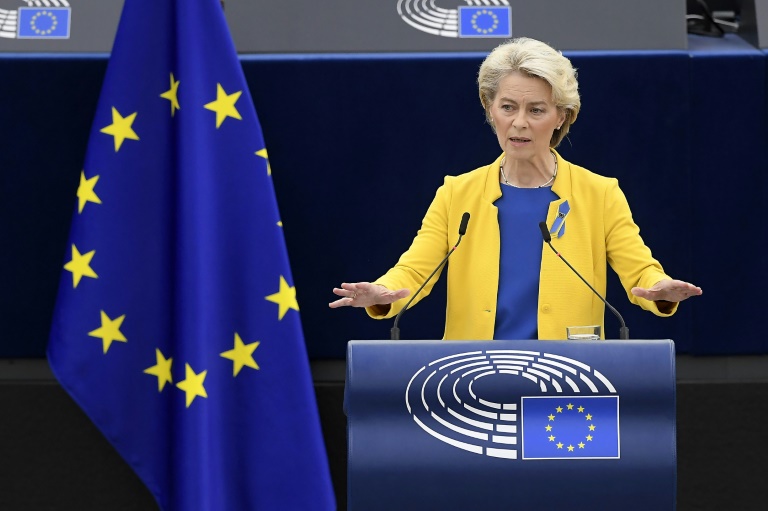
European Commission chief Ursula von der Leyen outlined a “deep and comprehensive” reform of the electricity market during her annual State of the European Union address in front of the bloc’s parliament in Strasbourg, France.

A cap on electricity producers’ profits would raise 140 billion euros ($140 billion) and “cushion” consumers from high prices, she said.

“These companies are making revenues they never accounted for, they never even dreamt of,” von der Leyen said, dressed in Ukraine’s blue and gold colours.

“In these times it is wrong to receive extraordinary record profits benefiting from war and on the back of consumers,” she said, adding that major oil, gas and coal companies would also “have to give a crisis contribution”.

The idea to tax profits by non-gas electricity providers is to divert the money to households and businesses to weather the situation.

Other steps laid out by von der Leyen include rationing energy, temporary state aid and decoupling the prices of gas and electricity.

She also announced the creation of a new bank designed to spur investment of up to three billion euros in hydrogen as a green alternative to fossil fuels.

The measures were in response to soaring energy costs as Europe painfully unhitches its decades-long dependency on Russian fossil fuels.

Sanctions on Russia and retaliation by Moscow by cutting off gas supplies have sent prices skyrocketing, leaving Europe to confront a difficult coming winter.

“Russia keeps on actively manipulating our energy market. They prefer to flare the gas than to deliver it,” von der Leyen said.

“This market is not functioning anymore.”

– Gas reserves –

EU countries have rushed to prepare for the winter, stocking up on gas while urging consumers and businesses to conserve energy in anticipation that Russia would cut off supplies.

The bloc’s gas reserves have hit 84 percent of capacity well ahead of an October deadline, von der Leyen said.

At the same time, she highlighted that the EU is pivoting to “reliable suppliers”, naming the United States, Norway and Algeria among them, and that in the longer term the EU wants greater reliance on renewable energies.

Countries have taken their own steps to cope with the crisis.

In a show of solidarity with Germany after Russia stopped deliveries to the country through the Nord Stream pipeline, French operator GRTgaz said Wednesday that new capacity for exports to France’s neighbour would be available from mid-October.

French Prime Minister Elisabeth Borne announced on Wednesday that her government would cap an expected increase in gas and electricity prices at 15 percent next year.

The new measures, however, are less far-reaching than caps introduced this year that limited domestic electricity price rises to four percent and fixed gas prices at October 2021 levels.

The Danish government unveiled its own 45-billion-kronor ($6-billion) plan to cap gas, electricity and heating bills to help households following a five-fold increase in energy prices.

– Kyiv trip –

Von der Leyen also announced plans for legislation to secure critical raw materials for the EU as it shifts towards greater use of electric vehicles and other more environmentally friendly technologies.

In her speech, she highlighted the stranglehold China has over resources such as lithium that are key to the energy transition.

“Today, China controls the global processing industry. Almost 90 percent of rare earths and 60 percent of lithium are processed in China,” she said in her address.

The proposed law would identify “strategic projects all along the supply chain” and “build up strategic reserves where supply is at risk”, she said.

As for Russia, the EU chief signalled that the bloc would maintain its sanctions pressure as long as Moscow waged its war in Ukraine.

“I want to make it very clear, the sanctions are here to stay. This is the time for us to show resolve, not appeasement,” she said.

Ukraine’s first lady Olena Zelenska attended the gathering in Strasbourg, receiving a standing ovation from lawmakers.

Von der Leyen told MEPs that she would travel to Kyiv to meet Ukrainian President Volodymyr Zelensky, her third trip to the Ukrainian capital since the war started, to discuss the continuation of European aid.

“For the first time in its history, this parliament is debating the state of our union while war is raging on European soil,” said von der Leyen.
All Shanghai passenger flights cancelled as typhoon hits

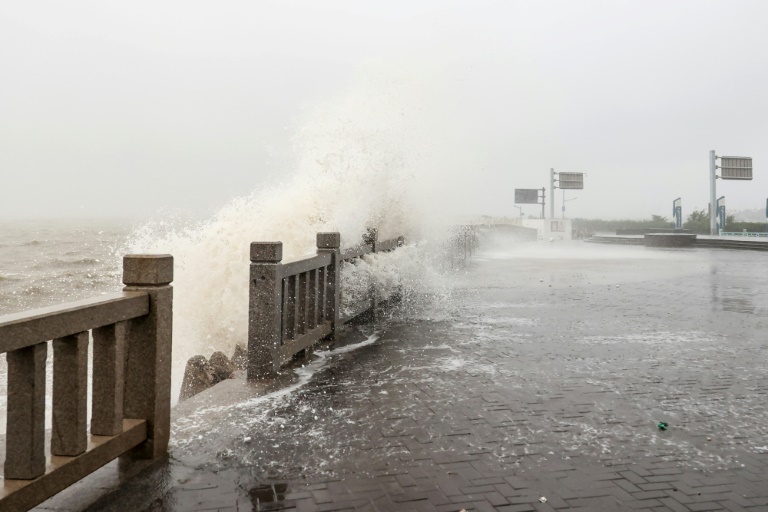
All passenger flights at Shanghai’s two international airports were cancelled Wednesday, the airport operator said, as Typhoon Muifa made landfall on China’s densely populated east coast.

The storm hit the city of Zhoushan in Zhejiang province at around 8:30 pm (1330 GMT), state news agency Xinhua said, bringing strong winds and threatening flooding along the coast around Shanghai — an area home to Asia’s largest commercial port.

The highest wind speed recorded on landfall was 42 metres per second, making it the strongest typhoon to make landfall in China this year, according to state broadcaster CCTV.

China’s Central Meteorological Administration issued its highest-level typhoon alert for the first time this year, saying Muifa would increase in intensity as it approaches the coast.

Gale force winds and heavy rains are forecast along China’s eastern seaboard until Thursday morning, the weather agency said. 

“Relevant areas should pay attention to the prevention of flash floods and geological disasters that may be caused by heavy rainfall,” it added.

The typhoon is expected to move from Zhoushan, home to the busiest port in the world in terms of cargo tonnage, through the coastal provinces of Jiangsu and Fujian carrying gusts of up to 172 kilometres (107 miles) per hour.

Shanghai Airport Group said in a social media statement that it “will announce flight adjustments at both airports to the public in a timely manner, in line with the typhoon’s impact”. 

The storm comes soon after Typhoon Hinnamnoor hit Shanghai and its neighbouring region last week, causing the suspension of Shanghai ferry services and school closures in parts of Zhejiang.

Zhejiang authorities ordered all fishing vessels to return to port by noon Wednesday, closed schools in three cities, suspended passenger ferry routes and shut tourist attractions as the province braced for Muifa’s landfall.

Temporary emergency shelters have been set up around Shanghai, CCTV reported, as well as an emergency evacuation zone spanning over 30 kilometres (18 miles) along the city’s coastal area. 

Muifa is the 12th typhoon to hit China this year, according to state media.

Its impact is expected to gradually decrease as it moves further north inland on Thursday, CCTV said.

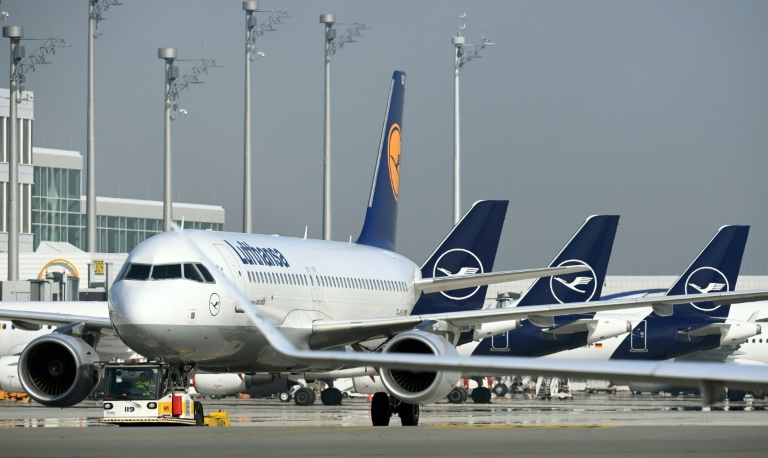
Lufthansa back in private hands as Germany sells rescue stake

Lufthansa said Wednesday the German state had sold the stake it took in the airline as part of a rescue package at the peak of the Covid pandemic, and booked a healthy profit in the process.

In the spring of 2020, borders were shutting worldwide, forcing airlines everywhere to ground planes and put staff put on forced leave.

To save Lufthansa from bankruptcy, the German government took a 20-percent stake in the group under a nine-billion-euro (dollar) state aid package.

Under the deal, the government agreed to sell the stake by October 2023.

But with the airline’s finances stabilising as travel resumed, Berlin was able to start selling its holdings as early as November last year.

Lufthansa said the remaining 6.2 percent of the share capital was sold on Tuesday.

“This brings the stabilisation of Lufthansa to a successful conclusion,” said Carsten Spohr, its CEO.

“The stabilisation of Lufthansa was successful, and is also paying off financially for the German government and thus for the taxpayer,” he added.

The state paid 306 million euros for the stake and sold it for 1.07 billion euros — a profit of 760 million.

“With this gratifying balance, the WSF’s (Economic Stabilisation Fund’s) participation comes to an end and the company is once again in private hands,” said Jutta Doenges, who ran the fund.

Among investors who snapped up the shares was German billionaire Klaus-Michael Kuehne, who owns the logistics giant Kuehne + Nagel.

With the purchase, he raised his stake to 17.5 percent from 15 percent previously, his office said in a statement. 

Lufthansa in August reported its first net profit since the pandemic, booking 259 million euros in earnings for the second quarter as it benefited from pent-up demand for travel.

The group — which includes Eurowings, Austrian, Swiss and Brussels Airlines — made huge net losses of 6.7 billion euros in 2020 and 2.2 billion euros in 2021 as the pandemic shut down large parts of the airline industry.

Zelensky vows 'victory' on frontline visit to liberated Kharkiv region

Ukrainian President Volodymyr Zelensky on Wednesday promised “victory” on a visit to the strategic city of Izyum that was recently recaptured from Russia by Kyiv’s army in a lightning counter-offensive.

The visit comes at a decisive moment in Russia’s six-month invasion, with Ukraine routing Moscow’s forces from swathes of the east and seriously undermining the Kremlin’s ambitions to capture the entire Donbas region of Ukraine.

“Our blue-yellow flag is already flying in deoccupied Izyum. And it will be so in every Ukrainian city and village,” Zelensky said in a statement on social media.

“We are moving in only one direction — forward and towards victory.” 

Pictures distributed by his office showed the Ukrainian leader wearing dark-green and flanked by guards as he took selfies with soldiers and thanked troops at a flag-rising ceremony.

Ukraine has claimed sweeping successes in the northeastern Kharkiv region that borders Russia in recent days and also says it has clawed back territory along a southern front near the Kherson region on the Black Sea.

Zelensky said Wednesday that Russia’s occupation of Crimea — annexed by Russia in 2014 — was a “tragedy” and promised that his forces would eventually recapture the peninsula.

Kyiv says that since the beginning of September its forces have retaken hundreds of villages, towns and cities that were captured by Russian forces that invaded Ukraine on February 24.

– ‘They killed my son’ –

In the recaptured eastern Ukrainian village of Bogorodychne, 58-year-old Mykola told AFP he had “barely survived” the Russian occupation during which his brother was killed.

“How can I describe it in words? It was difficult. I was afraid,” he said.  

Wiping tears from her eyes with a veil, Mykola’s mother Nina said: “I cry every day. They killed my son.” 

Moscow said its forces were hitting back on areas recaptured in Kharkiv with “massive strikes,” claiming — without providing evidence — to have inflicted losses on Ukrainian military hardware and servicemen.

In a battlefield update on Wednesday, Russia also claimed to have captured dozens of Ukrainian servicemen in the southern Kherson and Zaporizhzhia regions.

The Kremlin, which has made little mention of the setbacks in recent days vowed to continue fighting, claiming that the percieved threat Kyiv posed to Russia remains.

“The leadership of this country must take actions that eliminate threats to the Russian Federation” President Vladimir Putin’s spokesman, Dmitry Peskov told journalists.

The Ukrainian official in charge of the eastern Donetsk region, which has been partially controlled by pro-Moscow separatists since 2014, said Russian forces had attacked the entire front line region over the past 24 hours.

– ‘Life and death’ –

Pavlo Kyrylenko, the Donetsk governor, said one civilian had been killed and again urged all others to leave, describing the order as a “matter of life and death.”

Military observers have credited the success of Ukraine’s push back into the east on Western-supplied arms, particularly long-range precision artillery and also training of Ukrainian forces by Western allies.

The Ukrainian military announced on social media Wednesday that some 5,000 Ukrainian military had been trained as part of a joint program with the United Kingdom.

Western countries have also hit back against Russia with waves of economic penalties.

EU commission president Ursula von der Leyen on Wednesday said the successive waves of EU sanctions against Russia for its invasion of Ukraine would remain and that Europeans must keep their resolve against Moscow.

“I want to make it very clear, the sanctions are here to stay. This is the time for us to show resolve, not appeasement,” von der Leyen said in European Parliament during her annual State of the Union speech.

Ukraine’s first lady Olena Zelenska attended the gathering in Strasbourg, receiving a standing ovation from lawmakers.

She also told MEPs that she would travel Wednesday to Kyiv to meet Ukrainian President Volodymyr Zelensky. 

Shy male albatrosses prefer divorce to confrontation: study

Most albatrosses mate for life but shy males who avoid confrontation are more likely to get dumped, researchers said Wednesday, adding it was the first time personality had been shown to predict divorce in a wild animal.

Wandering albatrosses, which traverse the Southern Hemisphere and have the largest wingspan of any bird at more than three metres (10 feet), are among the most monogamous animals.

They can live for more than 50 years, and while they spend much of that time on the wing, they meet up every two years with the same partner to breed.

Divorce is a “super rare event”, occurring around 13 percent of the time, Ruijiao Sun, the lead author of a new study published in the journal Biology Letters, told AFP.

But “if they find that their breeding success is too low with a specific partner they may look for another one,” said the PhD student at Woods Hole Oceanographic Institution in the US.

To find out how an individual bird’s personality affects their likeliness of getting divorced, the researchers drew on a unique database.

Since 1959, scientists have been tracking a colony of wandering albatrosses on Possession Island, in the southern Indian Ocean’s Crozet archipelago.

“We put a stainless ring on the leg with a number,” marine biologist and study co-author Stephanie Jenouvrier told AFP.

“Because they’re not really scared we can approach very slowly and we can read the number,” she added, saying it allowed the team to “reconstruct the entire history of these birds”.

Sun said the birds “breed every two years because they take a whole year to rear their chick and it’s super energy-consuming, so they take a one-year sabbatical after to recover and they do not spend that time together”.

– Shy guys finish last –

Over more than a decade, the researchers measured the boldness of nearly 2,000 birds by observing how they respond to a human approaching their nest.

They found that shyer male albatrosses were up to twice as likely to get divorced than their bolder rivals — but no difference was found in females.

“We show for the first time the link between personality and divorce in a wild species, thanks to probably the best dataset in the world,” Sun said. 

Wandering albatrosses have “elaborate courtship processes”, the study said, as the birds raise up their wings, squawk and generally dance around.

Sometimes during the process, a pushy outsider male couple tries to cut in. That is when the shyer males avoid confrontation — and accept divorce.

However there are other factors affecting divorce rates, the researchers said.

There are more male than female albatrosses, because females tend to forage in areas where they are more likely to get caught up in fishing lines.

The surplus of males means that females quickly find a new mate, but it can take males more than four years, the study found.

Also, “individuals that are in a long-term relationship are less likely to divorce than the ones that are new to each other,” Jenouvrier said.

Last year research indicated that climate change could also be driving albatrosses to divorce, as the birds have to travel farther to find decreasing numbers of fish.

Stocks extend global selloff on US inflation gloom

Global equities sank further Wednesday as stronger-than-expected US inflation data sparked fears of a prolonged campaign of Federal Reserve interest rate hikes.

London was the heaviest faller in Europe after news that UK inflation slowed last month but held close to a 40-year high.

Asia tanked after Wall Street took its worst beating in weeks Tuesday on news of hot US inflation.

The dollar edged down in choppy trade, while oil prices were mixed Wednesday.

US inflation slowed slightly in August to 8.3 percent, but this trumped market expectations of about eight percent.

– ‘Caught up’ –

European markets are “caught up in the negative sentiment that has taken hold across global markets,” said Victoria Scholar, head of investment at Interactive Investor.

“Hotter-than-expected US inflation figures prompted heavy selling on Wall Street,” she added.

Global consumer prices have soared for months, exacerbated by Russia’s invasion of Ukraine — which has hiked energy and food costs — as well as owing to supply chain strains and Covid lockdowns in China.

The Fed has already instituted two consecutive 75-basis-point hikes, and a third such move is widely expected at its meeting next week.

After the latest US inflation data, some investors are even predicting the next Fed hike could be a full percentage point.

Aggressive rate tightening by central banks worldwide is denting economic activity as consumers and businesses face higher loan repayments.

In the UK, inflation slowed to 9.9 percent in August but remained almost in double digits.

The news boosted the pound on hopes of another interest rate hike next week from the Bank of England.

“There has been a fresh bout of anxiety on financial markets amid worries that inflation is still proving to be a formidable opponent to take down,” said Hargreaves Lansdown analyst Susannah Streeter.

In Asia, Tokyo led the region’s losses with the Nikkei plunging 2.8 percent.

Hong Kong stocks closed down more than two percent, with Chinese conglomerate Fosun hit hard by media reports that the group was under regulator scrutiny.

– Key figures at around 1115 GMT –

London – FTSE 100: DOWN 1.1 percent at 7,307.45 points

Frankfurt – DAX: DOWN 0.6 percent at 13,110.78

Paris – CAC 40: DOWN 0.3 percent at 6,225.22   

EURO STOXX 50: DOWN 0.4 percent at 3,573.69

Tokyo – Nikkei 225: DOWN 2.8 percent at 28,818.62 (close) 

Hong Kong – Hang Seng Index: DOWN 2.5 percent at 18,847.10 (close)

Shanghai – Composite: DOWN 0.8 percent at 3,237.54 (close)

New York – Dow: DOWN 3.9 percent at 31,104.97 (close)

Euro/dollar: UP at $1.0006 from $0.9970 late Tuesday

Pound/dollar: UP at $1.1559 from $1.1493 

Euro/pound: DOWN at 86.56 pence from 86.75 pence 

Dollar/yen: DOWN at 143.24 yen from 144.58 yen 

Brent North Sea crude: DOWN 0.1 percent at $93.07 per barrel

West Texas Intermediate: UP 0.4 percent at $87.68 per barrel

burs/rfj/bcp/lth

Stocks extend global selloff on US inflation gloom

Global equities sank further Wednesday as stronger-than-expected US inflation data sparked fears of a prolonged campaign of Federal Reserve interest rate hikes.

London was the heaviest faller in Europe after news that UK inflation slowed last month but held close to a 40-year high.

Asia tanked after Wall Street took its worst beating in weeks Tuesday on news of hot US inflation.

The dollar edged down in choppy trade, while oil prices were mixed Wednesday.

US inflation slowed slightly in August to 8.3 percent, but this trumped market expectations of about eight percent.

– ‘Caught up’ –

European markets are “caught up in the negative sentiment that has taken hold across global markets,” said Victoria Scholar, head of investment at Interactive Investor.

“Hotter-than-expected US inflation figures prompted heavy selling on Wall Street,” she added.

Global consumer prices have soared for months, exacerbated by Russia’s invasion of Ukraine — which has hiked energy and food costs — as well as owing to supply chain strains and Covid lockdowns in China.

The Fed has already instituted two consecutive 75-basis-point hikes, and a third such move is widely expected at its meeting next week.

After the latest US inflation data, some investors are even predicting the next Fed hike could be a full percentage point.

Aggressive rate tightening by central banks worldwide is denting economic activity as consumers and businesses face higher loan repayments.

In the UK, inflation slowed to 9.9 percent in August but remained almost in double digits.

The news boosted the pound on hopes of another interest rate hike next week from the Bank of England.

“There has been a fresh bout of anxiety on financial markets amid worries that inflation is still proving to be a formidable opponent to take down,” said Hargreaves Lansdown analyst Susannah Streeter.

In Asia, Tokyo led the region’s losses with the Nikkei plunging 2.8 percent.

Hong Kong stocks closed down more than two percent, with Chinese conglomerate Fosun hit hard by media reports that the group was under regulator scrutiny.

– Key figures at around 1115 GMT –

London – FTSE 100: DOWN 1.1 percent at 7,307.45 points

Frankfurt – DAX: DOWN 0.6 percent at 13,110.78

Paris – CAC 40: DOWN 0.3 percent at 6,225.22   

EURO STOXX 50: DOWN 0.4 percent at 3,573.69

Tokyo – Nikkei 225: DOWN 2.8 percent at 28,818.62 (close) 

Hong Kong – Hang Seng Index: DOWN 2.5 percent at 18,847.10 (close)

Shanghai – Composite: DOWN 0.8 percent at 3,237.54 (close)

New York – Dow: DOWN 3.9 percent at 31,104.97 (close)

Euro/dollar: UP at $1.0006 from $0.9970 late Tuesday

Pound/dollar: UP at $1.1559 from $1.1493 

Euro/pound: DOWN at 86.56 pence from 86.75 pence 

Dollar/yen: DOWN at 143.24 yen from 144.58 yen 

Brent North Sea crude: DOWN 0.1 percent at $93.07 per barrel

West Texas Intermediate: UP 0.4 percent at $87.68 per barrel

burs/rfj/bcp/lth

Japan central bank conducts 'rate check' as yen sinks: reports

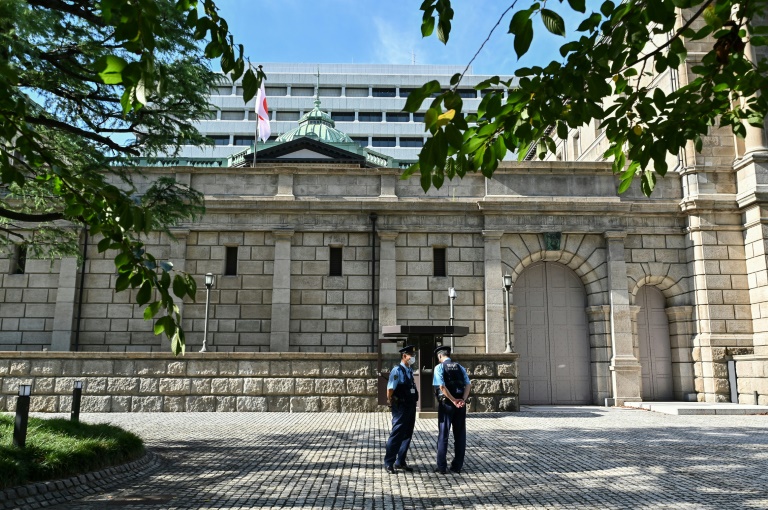
Japan’s central bank on Wednesday conducted an operation often seen as a precursor to currency intervention, local media said, as the yen continues to crater against a strengthening dollar.

The financial daily Nikkei and other local media said the Bank of Japan (BoJ) carried out a “rate check”. A Bank spokesman contacted by AFP declined to comment.

A rate check involves asking market participants about their foreign exchange trading, said Toshikazu Horiuchi of IwaiCosmo Securities.

“Basically it’s a warning, which is the next best thing to an intervention when the exchange rate is fluctuating,” he told AFP.

The yen has tumbled from around 115 per dollar in March to  below 140 in recent weeks, as the BoJ maintains its monetary easing policies despite sometimes sharp rate hikes elsewhere, including from the Federal Reserve, to tackle inflation.

In early Tokyo trade, a dollar fetched 144.94 yen, after worse-than-expected US inflation data raised the prospect of even steeper US rate hikes to tame prices.

The rate check reports saw the yen strengthen quickly, with the dollar touching a low of 143.53 within an hour.

Japanese government officials also sought to calm the waters by insisting they were monitoring the currency swings and would not rule out any option to prevent further falls.

Speaking to reporters Wednesday evening, Finance Minister Shunichi Suzuki declined to comment on the rate check reports. 

But he said that if falls continued, “necessary steps will be taken in the market with all options on the table”.  

He was tightlipped on whether intervention had been decided or implemented, adding only: “in cases where it is, it’s done swiftly, without missing a beat.”

Horiuchi said a rate check is often seen as a precursor of an intervention, “so that’s why the market reacts very sensitively.”

“But its actual impact hinges on whether an intervention is really possible.”

– ‘Many moving parts’ –

Japan’s government has few options though, particularly before the next Federal Reserve meeting, said Hideo Kumano, chief economist at Dai-ichi Life Research Institute.

“There are so many moving parts, like preparation for interventions and behind-the-scenes negotiations with the United States,” he told AFP.

“That leads me to believe that this series of verbal interventions is not directly linked with the work to put bullets in the gun (and carry out an intervention).”

A weaker yen can help Japanese companies sell products overseas, but the levels seen in recent weeks are starting to put pressure on households and businesses due to higher import prices.

Inflation more broadly has risen to seven-year highs in Japan, partly due to the impact of the war in Ukraine on energy prices, though it is still less severe than in many major economies.

Japan’s central bank has been in no hurry to shift course on its ultra-loose monetary policy, viewing the measures as necessary to achieve its long-standing goal of sustained two percent inflation.

The bank sees recent price increases as temporary and linked to exceptional factors like the Ukraine conflict and pandemic-related supply chain issues.

UK inflation eases from 40-year high

UK inflation has eased on lower motor fuel costs but remains close to 40-year peaks, official data showed Wednesday as the nation faces more strikes over a cost-of-living crisis.

The Consumer Prices Index slowed to 9.9 percent in August, the Office of National Statistics said.

CPI for July had stood at 10.1 percent, the highest level since 1982, fuelled by surging domestic energy bills and soaring food prices.

The Bank of England, which has delayed its next interest rate decision until after the funeral of Queen Elizabeth II, is still expected to again ramp up borrowing costs by sizeable amounts in the coming months with Britons set to a hike in energy bills.

The UK data follows Tuesday’s higher-than-expected US inflation print that has cemented expectations of a prolonged period of rate hikes by the Federal Reserve.

– Strike action –

Rampant inflation sparked a summer of strikes in Britain, spearheaded by tens of thousands of railway workers as pay offers fail to keep pace, although some walkouts have been postponed following the queen’s death.

Retail Prices Index inflation — which includes mortgage interest payments and is used by unions and employers when negotiating wage increases — remains unchanged at a 1981 peak of 12.3 percent, the ONS said Wednesday.

Although motor fuel prices dropped last month, they remain historically very high, while average food prices rocketed more than 13 percent in August. 

Inflation has soared around the globe this year also on supply constraints after economies reopened from pandemic lockdowns, and in the wake of Russia’s invasion of Ukraine.

The Bank of England last month ramped up its key interest rate by 0.5 points to 1.75 percent, the biggest hike since 1995, as it seeks to dampen red-hot inflation.

– Energy price freeze –

British Prime Minister Liz Truss last week announced a two-year freeze on domestic energy prices in an multi-billion-pound attempt to bring down the soaring cost of living.

However, household electricity and gas prices will still jump substantially next month ahead of the peak-demand winter.

“While energy prices have been capped, people will still be paying more for their gas and electricity come October and, as the nights draw in, they’ll also be using more power,” said AJ Bell analyst Danni Hewson.

The BoE has forecast an inflation-induced UK recession starting this year, and has predicted a CPI peak of 13 percent.

The August inflation rate is almost five times the BoE’s government-set target of 2.0 percent.

Shares in Chinese conglomerate Fosun dive on report of watchdog scrutiny

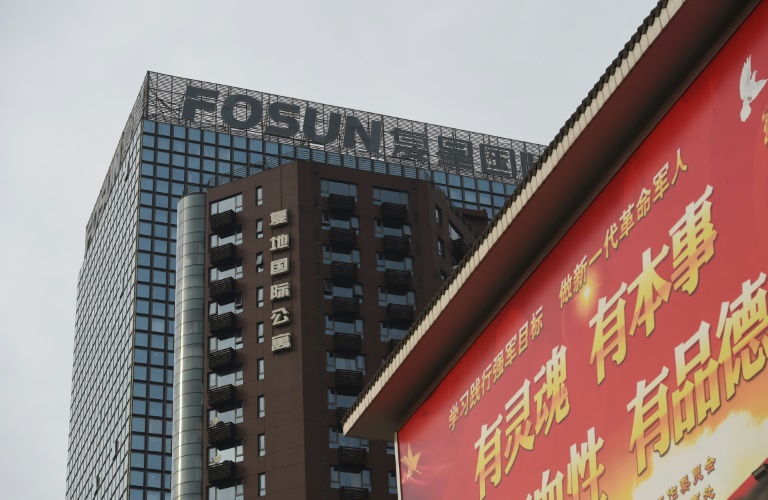
Club Med owner Fosun, one of China’s largest private-sector conglomerates, saw billions wiped off its value on Wednesday as jittery investors reacted to a media report that the group was under regulatory scrutiny.

There has been growing concern about the debts of Chinese companies, particularly after a run of high-profile defaults in the property sector last year that rippled through the wider economy.

Bloomberg News on Tuesday cited unnamed sources as saying that regulators, including China’s banking watchdog and the local commission overseeing state investments, have told large lenders and state-owned enterprises to closely examine their exposure to Fosun.

Shares in Fosun International Limited, the conglomerate’s flagship company, slid as much as 9.6 percent in Hong Kong on Wednesday. 

They later pared some of those losses, ending the day down 6.6 percent at HK$4.56, the lowest level since late 2012.

Fosun’s Chief Financial Officer Alex Gong rejected the Bloomberg report as “completely false”.

“Neither the China Banking and Insurance Regulatory Commission (CBIRC) nor the Shanghai Banking and Insurance Regulatory Commission have asked commercial banks to find out about Fosun’s financial exposure, and those institutions have not received any notice of this,” Gong told the South China Morning Post.

The public had a “one-sided interpretation” of Fosun’s recent reductions in shareholdings and divestments and failed to see that they were part of a long-term financial strategy, the Shanghai-based company added in a statement.

– Circus and football –

Co-founded by tycoon Guo Guangchang in 1992 during the heady days of China’s initial “reform and opening” period, Fosun started off in pharmaceuticals and real estate but has since built a sprawling business empire that includes tourism and finance. 

A prolific buyer of global assets, Fosun owns French brand Club Med and has a controlling stake in the fashion house Lanvin.

It owns English Premier League football club Wolverhampton Wanderers and has a major stake in Canadian circus producer Cirque du Soleil.

In 2020, Fosun struck a deal with Germany’s BioNTech to manufacture its coronavirus vaccine in China and later became its exclusive distributor to the Greater China region.

Chinese companies have faced growing scrutiny over their debt exposure, especially those in the property sector. 

Multiple construction giants, including Evergrande, have defaulted on debts and been forced into major restructuring.

Beijing has also launched regulatory investigations in multiple sectors, including education and technology businesses, clipping their growth.

In recent months China’s economy has been reeling from a debt crisis in its massive property sector, mortgage boycotts, as well as disruptions from coronavirus lockdowns in finance and manufacturing hubs.

Fosun faces as much as $8 billion in bond repayments through 2023, according to Bloomberg News.

Fosun’s dollar bonds also fell by as much as six cents on Wednesday, adding to declines a day earlier that were the biggest since a rout in June.

The CBIRC’s request to banks to check their exposure to Fosun debt does not mean it wants lenders to change their financing, and the regulator’s move may not result in any action, Bloomberg reported.

The Beijing branch of the State-owned Assets Supervision and Administration Commission was also among the regulators who asked institutions for closer scrutiny regarding Fosun, the report added.

Fosun’s debt stood at 261 billion yuan ($37.7 billion) as of June 30, up from 237 billion yuan at the end of last year, according to an earnings report last month.

Moody’s last month downgraded Fosun, citing weak liquidity and a weakening portfolio amid asset sales.

— Bloomberg News contributed to this story —

Close Bitnami banner
Bitnami