AFP

UN chief says world paying 'horrific price' for fossil fuels folly

United Nations Secretary-General Antonio Guterres said developing nations were paying a “horrific price” for the world’s reliance on fossil fuels, as he toured parts of Pakistan hit by floods blamed on climate change.

Nearly 1,400 people have died in flooding that covers a third of the country — an area the size of the United Kingdom — wiping out crops and destroying homes, businesses, roads and bridges.

Guterres hopes his visit will galvanise support for Pakistan, which needs at least $10 billion to repair damaged infrastructure.

“Pakistan and other developing countries are paying a horrific price for the intransigence of big emitters that continue to bet on fossil fuels,” Guterres said in a tweet, shortly before heading to see some of the most flood-affected areas.

“From Islamabad, I am issuing a global appeal: Stop the madness. Invest in renewable energy now. End the war with nature.”

Pakistan receives heavy — often destructive — rains during its annual monsoon season, which is crucial for agriculture and water supplies.

But downpours as intense as this year’s have not been seen for decades.

– ‘Insanity and suicide’ –

On Friday Guterres lamented the lack of attention the world gave to climate change — particularly the industrialised nations that scientists blame.

“This is insanity, this is collective suicide,” he said.

Pakistan is responsible for less than one percent of global greenhouse gas emissions, but is eighth on a list compiled by the NGO Germanwatch of countries most vulnerable to extreme weather caused by climate change.

Guterres is touring flood-hit parts of the south on Saturday, and will also visit Mohenjo-daro, a centuries-old UNESCO-designated world heritage site threatened by the deluge.

Some 33 million people have been affected by the floods, which have destroyed around two million homes and business premises, washed away 7,000 kilometres (4,500 miles) of roads and collapsed 500 bridges.

The effect of the torrential rain has been twofold — destructive flash floods in rivers in the mountainous north, and a slow accumulation of water in the southern plains.

“If he comes and sees us, Allah will bless him,” Rozina Solangi, a 30-year-old housewife from a flooded village near Sukkur, told AFP Friday.

“All the children, men and women are roasting in this scorching heat. We have nothing to eat, there is no roof on our heads. So he must do something for us poor.”

The meteorological office says Pakistan received five times more rain than normal in 2022. Padidan, a small town in Sindh province, has been drenched by more than 1.8 metres (71 inches) since the monsoon began in June.

Thousands of temporary campsites have mushroomed on slivers of dry land in the south and west — often roads and railway tracks are the only ground in a landscape of water.

With people and livestock cramped together, the camps are ripe for outbreaks of disease, with many cases of mosquito-borne dengue reported, as well as scabies.


Musk's latest reason to drop Twitter deal – whistleblower payment

Elon Musk on Friday added a severance payment made by Twitter to a whistleblower to the list of reasons he feels entitled to walk away from his $44 billion deal to buy the social media platform.

A termination letter sent to Twitter accused the firm of not informing him about a multi-million dollar severance payment it made in June to departing security chief Peiter Zatko, who went on to file a whistleblower complaint criticizing Twitter’s security practices, according to a copy of the letter filed with the Securities and Exchange Commission.

Musk’s lawyers argued that failing to seek his consent before paying Zatko provides another legal basis to break the merger deal with Twitter he inked in April.

Twitter disagreed.

“My friend seems to be arguing that Twitter should have gratuitously told Musk that there existed a disgruntled former employee who made various allegations that had been inquired upon and found to be without merit,” Twitter attorney William Savitt said earlier this week.

“That doesn’t make any sense.”

Twitter did not respond to a request for comment on Friday.

Musk, the world’s richest man, said in his original termination letter that he was canceling the deal because he was misled by Twitter concerning the number of bot accounts on its platform, allegations rejected by the company.

In a mixed ruling earlier this week, Kathaleen McCormick, the chancellor of the Delaware court that is overseeing the case, said Musk could add whistleblowing revelations from Zatko that surfaced in August.

But she denied his request to push back the litigation, saying prolonging the suit “would risk further harm to Twitter too great to justify.”

Musk has been locked in a bitter legal battle with Twitter since announcing in July that he was pulling the plug on the purchase of the company following a complex, volatile, months-long courtship.

The five-day trial is due to go ahead beginning October 17 in the Delaware court. 

Musk's latest reason to drop Twitter deal – whistleblower payment

Elon Musk on Friday added a severance payment made by Twitter to a whistleblower to the list of reasons he feels entitled to walk away from his $44 billion deal to buy the social media platform.

A termination letter sent to Twitter accused the firm of not informing him about a multi-million dollar severance payment it made in June to departing security chief Peiter Zatko, who went on to file a whistleblower complaint criticizing Twitter’s security practices, according to a copy of the letter filed with the Securities and Exchange Commission.

Musk’s lawyers argued that failing to seek his consent before paying Zatko provides another legal basis to break the merger deal with Twitter he inked in April.

Twitter disagreed.

“My friend seems to be arguing that Twitter should have gratuitously told Musk that there existed a disgruntled former employee who made various allegations that had been inquired upon and found to be without merit,” Twitter attorney William Savitt said earlier this week.

“That doesn’t make any sense.”

Twitter did not respond to a request for comment on Friday.

Musk, the world’s richest man, said in his original termination letter that he was canceling the deal because he was misled by Twitter concerning the number of bot accounts on its platform, allegations rejected by the company.

In a mixed ruling earlier this week, Kathaleen McCormick, the chancellor of the Delaware court that is overseeing the case, said Musk could add whistleblowing revelations from Zatko that surfaced in August.

But she denied his request to push back the litigation, saying prolonging the suit “would risk further harm to Twitter too great to justify.”

Musk has been locked in a bitter legal battle with Twitter since announcing in July that he was pulling the plug on the purchase of the company following a complex, volatile, months-long courtship.

The five-day trial is due to go ahead beginning October 17 in the Delaware court. 

Emmy nominees in key categories

Here is a list of the nominees in key categories for the 74th Emmy Awards, which will be handed out in Los Angeles on Monday.

HBO’s “Succession” topped the nominations list with 25, followed by “Ted Lasso” and “The White Lotus” at 20 each.

OUTSTANDING DRAMA SERIES

“Better Call Saul”

“Euphoria”

“Ozark”

“Severance”

“Squid Game”

“Stranger Things”

“Succession”

“Yellowjackets”

OUTSTANDING COMEDY SERIES

“Abbott Elementary”

“Barry”

“Curb Your Enthusiasm”

“Hacks”

“The Marvelous Mrs Maisel”

“Only Murders in the Building”

“Ted Lasso”

“What We Do in the Shadows”

LEAD ACTOR, DRAMA

Jason Bateman, “Ozark”

Brian Cox, “Succession”

Lee Jung-jae, “Squid Game”

Bob Odenkirk, “Better Call Saul”

Adam Scott, “Severance”

Jeremy Strong, “Succession”

LEAD ACTRESS, DRAMA

Jodie Comer, “Killing Eve”

Laura Linney, “Ozark”

Melanie Lynskey, “Yellowjackets”

Sandra Oh, “Killing Eve”

Reese Witherspoon, “The Morning Show”

Zendaya, “Euphoria”

LEAD ACTOR, COMEDY

Donald Glover, “Atlanta”

Bill Hader, “Barry”

Nicholas Hoult, “The Great”

Steve Martin, “Only Murders in the Building”

Martin Short, “Only Murders in the Building”

Jason Sudeikis, “Ted Lasso”

LEAD ACTRESS, COMEDY

Rachel Brosnahan, “The Marvelous Mrs Maisel”

Quinta Brunson, “Abbott Elementary”

Kaley Cuoco, “The Flight Attendant”

Elle Fanning, “The Great”

Issa Rae, “Insecure”

Jean Smart, “Hacks”

SUPPORTING ACTOR, DRAMA

Nicholas Braun, “Succession”

Billy Crudup, “The Morning Show”

Kieran Culkin, “Succession”

Park Hae-soo, “Squid Game”

Matthew Macfadyen, “Succession”

John Turturro, “Severance”

Christopher Walken, “Severance”

Oh Yeong-su, “Squid Game”

SUPPORTING ACTRESS, DRAMA

Patricia Arquette, “Severance”

Julia Garner, “Ozark”

Jung Ho-yeon, “Squid Game”

Christina Ricci, “Yellowjackets”

Rhea Seehorn, “Better Call Saul”

J. Smith-Cameron, “Succession”

Sarah Snook, “Succession”

Sydney Sweeney, “Euphoria”

SUPPORTING ACTOR, COMEDY

Anthony Carrigan, “Barry”

Brett Goldstein, “Ted Lasso”

Toheeb Jimoh, “Ted Lasso”

Nick Mohammed, “Ted Lasso”

Tony Shalhoub, “The Marvelous Mrs. Maisel”

Tyler James Williams, “Abbott Elementary”

Henry Winkler, “Barry”

Bowen Yang, “Saturday Night Live”

SUPPORTING ACTRESS, COMEDY

Alex Borstein, “The Marvelous Mrs Maisel”

Hannah Einbinder, “Hacks”

Janelle James, “Abbott Elementary”

Kate McKinnon, “Saturday Night Live”

Sarah Niles, “Ted Lasso”

Sheryl Lee Ralph, “Abbott Elementary”

Juno Temple, “Ted Lasso”

Hannah Waddingham, “Ted Lasso”

OUTSTANDING LIMITED OR ANTHOLOGY SERIES

“Dopesick”

“The Dropout”

“Inventing Anna”

“Pam and Tommy”

“The White Lotus”

LEAD ACTOR, LIMITED SERIES OR MOVIE

Colin Firth, “The Staircase”

Andrew Garfield, “Under the Banner of Heaven”

Oscar Isaac, “Scenes from a Marriage”

Michael Keaton, “Dopesick”

Himesh Patel, “Station Eleven”

Sebastian Stan, “Pam and Tommy”

LEAD ACTRESS, LIMITED SERIES OR MOVIE

Toni Collette, “The Staircase”

Julia Garner, “Inventing Anna”

Lily James, “Pam and Tommy”

Sarah Paulson, “Impeachment: American Crime Story”

Margaret Qualley, “Maid”

Amanda Seyfried, “The Dropout”

SUPPORTING ACTOR, LIMITED SERIES OR MOVIE

Murray Bartlett, “The White Lotus”

Jake Lacy, “The White Lotus”

Will Poulter, “Dopesick”

Seth Rogen, “Pam and Tommy”

Peter Sarsgaard, “Dopesick”

Michael Stuhlbarg, “Dopesick”

Steve Zahn, “The White Lotus”

SUPPORTING ACTRESS, LIMITED SERIES OR MOVIE

Connie Britton, “The White Lotus”

Jennifer Coolidge, “The White Lotus”

Alexandra Daddario, “The White Lotus”

Kaitlyn Dever, “Dopesick”

Natasha Rothwell, “The White Lotus”

Sydney Sweeney, “The White Lotus”

Mare Winningham, “Dopesick”

Top 10 programs with most overall nominations:

“Succession” – 25

“Ted Lasso” – 20

“The White Lotus” – 20

“Hacks” – 17

“Only Murders in the Building” – 17

“Euphoria” – 16

“Barry” – 14

“Dopesick” – 14

“Severance” – 14

“Squid Game” – 14

'Squid Game' to compete for Emmys history

Hundreds entered, but only one can triumph: South Korea’s “Squid Game” will make a play for Emmys history Monday as it aims to become the first foreign-language television show to win top honors for best drama.

The Netflix show — in which misfits and criminals compete for cash in barbaric and fatal versions of schoolyard games — is aiming to follow in the footsteps of Oscar-winning movie “Parasite” with success at TV’s top prize gala.

It is already the first non-English-language series to earn a best drama series nomination. To convert that into a trophy at the ceremony in Los Angeles, it will need to overcome a previous winner in HBO’s “Succession.”

“It’s pretty hard to go against that HBO juggernaut,” said Deadline awards columnist Pete Hammond, noting that the cutthroat drama about a powerful clan vying to inherit a media empire secured the most overall nominations with 25.

“I do think [‘Squid Game’] is going to win best actor,” said Hammond — an outcome that would make Lee Jung-jae the category’s first winner whose performance was not in English.

Other shows contending for the night’s top drama prizes include Apple TV+ dystopian workplace series “Severance,” starring Adam Scott, and the final season of Netflix’s much-lauded crime saga “Ozark.”

Zendaya, who became the youngest-ever best actress winner two years ago for hard-hitting teen drama “Euphoria,” is tipped to repeat with her work on the show’s sophomore season. 

– Keaton ‘lock’ –

Given the penchant of Television Academy voters for honoring previous winners, best comedy series looks like an open goal for season two of Apple TV+’s fish-out-of-water soccer coach “Ted Lasso.” 

But its star Jason Sudeikis will have to fend off another previous winner for best actor in Bill Hader, whose dark hitman comedy “Barry” returns from a three-year, pandemic-prolonged absence.

Jean Smart is also heavily tipped to repeat as best actress for “Hacks,” in which she plays an aging Las Vegas diva forced to reinvent her dated stand-up routine. 

By definition, offering some fresh blood are the nominees in the limited series section, which honors shows capped at a single season.

Four of the five contenders chronicle real-life scandals. 

“Dopesick” looks at the US opioid crisis, “The Dropout” recounts the Theranos fraud, “Pam and Tommy” recalls an infamous celebrity sex tape and “Inventing Anna” is inspired by a Russian con artist who scammed upper-crust New York.

But the pundits’ favorite in a tight race is “The White Lotus,” a satirical look at hypocrisy and wealth among the guests at a luxury Hawaii hotel.

The show — which is bending Emmy rules by returning for a second season, albeit with a largely new cast and location — has a whopping eight acting nominations, including for Jennifer Coolidge.

Actors make up the biggest voting branch in the Academy.

“I think Michael Keaton has got a lock on actor in a limited series” for ‘Dopesick’,” said Hammond, while Amanda Seyfried’s turn as disgraced Theranos boss Elizabeth Holmes in “The Dropout” is likely to prove popular.

– ‘The Slap’ –

The ceremony will be hosted by “Saturday Night Live” stalwart Kenan Thompson.

It is expected to mark a return to normality, after the Covid-19 crisis forced producers to get creative with recent remote and socially distanced editions.

The show takes place at a downtown Los Angeles theater, where A-listers will gather to walk the red carpet for the first major Hollywood awards ceremony since this year’s extraordinary Oscars.

Back in March, Will Smith stunned viewers around the world by slapping Chris Rock live on stage for cracking a joke about his wife.

Emmy organizers have rejected the suggestion that security will need to be beefed up to prevent a repeat.

“I can’t imagine that lightning will strike twice,” Academy CEO Frank Scherma told Deadline. 

“We have smart security. We have people around that make quick decisions… We’ll be on the lookout and we’ll be smart like we always are.”

In Wyoming, scene of infamous gay hate crime an unlikely LGBTQ haven

Nearly 25 years ago, the brutal murder of Matthew Shepard — a gay college student in Wyoming who was beaten, tied to a fence and left to die — shocked America. 

Today, the small city of Laramie — the scene of the infamous hate crime — has become an improbable refuge for sexual minorities in the ultra-conservative mountain state.

“It’s always funny to say that I didn’t come out until I came to Wyoming, because people just don’t think that’s possible,” says 27-year-old Ray Kasckow, a transgender person living in the city of 30,000, nestled between two mountains.

In Wyoming, a state known for being the least populous in the nation and for giving Donald Trump a thunderous victory in 2020, Kasckow’s story seems anomalous.

For many Americans, the city is forever known as the place where Shepard was killed.

On October 6, 1998, the 21-year-old University of Wyoming student was driven away from a bar to a secluded area by two young men.

They savagely pistol-whipped him before leaving him for dead. Shepard was found 18 hours later by a cyclist who initially mistook him for a scarecrow.

He never regained consciousness and died in hospital a few days later. 

– ‘Support system’ –

Shepard’s killing served as a wake-up call, shining a cold light on homophobic violence in America.

In 2009, a federal law named for Shepard went into effect, expanding existing hate crimes legislation to include crimes motivated by a victim’s gender or sexual orientation.

But in Laramie, people did not want to wait around for change. 

“Folks in Laramie left — professors left, students left, residents left out of fear,” recalls Judy Shepard, Matthew’s mother.

With husband Dennis at her side, Judy founded the Matthew Shepard Foundation “to try to make life better for Matt’s friends and peers in the community.”

A New York theater troupe came to town multiple times to develop “The Laramie Project,” a play that recounts how the sleepy city became a scene for murder, depicting a fatal brew of toxic masculinity, cowboy mentality and isolation.

In Laramie, where life is punctuated by the passage of long freight trains, the local LGBT activist network sprang up little by little.

Then in 2015, the city was the first in the state to adopt an ordinance banning workplace or housing discrimination based on gender or sexual orientation.

Two years later, Laramie held its first Pride parade.

Rainbow flags fly in front of most businesses in Laramie, and all around the bar where Shepard was kidnapped.

Young people walk in the streets with buttons reading “they/them” — pronouns used by those who do not identify as a man or woman.

“People come here to Laramie because they know that there are communities present, and they know that they have friends and they have a support system,” Kasckow says.

– ‘Lots of stigma’ –

The welcoming atmosphere in Laramie is in stark contrast to how LGBTQ people feel they are treated in the rest of the state, according to Tyler Wolfgang, member of the Laramie Pridefest group.

“Wyoming has a long way to go as a LGBTQ-friendly state,” Wolfgang says, explaining that local legislatures have attempted to push through so-called “anti-trans bills” affecting transgender people over school athletics and bathroom usage.

“We see lots of stigma and a lot of transphobic thoughts or comments,” the non-binary activist adds.

Beyond Wyoming, other conservative-leaning US states have seen what activists say are efforts to single out transgender people, with primarily Republican lawmakers redoubling their efforts as national midterm elections set for November draw near.

“We’re right back where we started, essentially, in the community,” Judy Shepard says, slamming what she calls the “terrible attitude of ignorance and hate directed at the gay community, as is being directed at all the marginalized communities ” across the country.

But since 1998 and Matthew’s death, Judy Shepard says the community is organized.

“So many more people are out and comfortable as who they are… I think that we’re making attempts to erase us more difficult,” she says.

Matthew Shepard’s ashes were interred at the National Cathedral in Washington to mark the 20th anniversary of his death.

In Laramie, a bench was erected in the middle of the University of Wyoming campus where he studied political science.

The plaque on it reads: “He continues to make a difference.”

Why go back to the Moon?

On September 12, 1962, then US president John F Kennedy informed the public of his plan to put a man on the Moon by the end of the decade.

It was the height of the Cold War and America needed a big victory to demonstrate its space superiority after the Soviet Union had launched the first satellite and put the first man in orbit.

“We choose to go to the Moon,” Kennedy told 40,000 people at Rice University, “because that challenge is one that we are willing to accept, one we are unwilling to postpone, and one which we intend to win.”

Sixty years on, the United States is about to launch the first mission of its return program to the Moon, Artemis. But why repeat what has already been done?

Criticism has risen in recent years, for example from Apollo 11 astronaut Michael Collins, and the Mars Society founder Robert Zubrin, who have long advocated for America to go directly to Mars.

But NASA argues re-conquering the Moon is a must before a trip to the Red Planet. Here’s why.

– Long space missions –

NASA wants to develop a sustainable human presence on the Moon, with missions lasting several weeks –- compared to just a few days for Apollo. 

The goal: to better understand how to prepare for a multi-year round trip to Mars. 

In deep space, radiation is much more intense and poses a real threat to health. 

Low Earth Orbit, where the International Space Station (ISS) operates, is partly shielded from radiation by the Earth’s magnetic field, which isn’t the case on the Moon. 

From the first Artemis mission, many experiments are planned to study the impact of this radiation on living organisms, and to assess the effectiveness of an anti-radiation vest. 

What’s more, while the ISS can often be resupplied, trips to the Moon — a thousand times further — are much more complex. 

To avoid having to take everything with them, and to save costs, NASA wants to learn how to use the resources present on the surface. 

In particular, water in the form of ice, which has been confirmed to exist on the lunar south pole, could be transformed into rocket fuel by cracking it into its separate hydrogen and oxygen atoms.

– Testing new gear –

NASA also wants to pilot on the Moon the technologies that will continue to evolve on Mars. First, new spacesuits for spacewalks.

Their design was entrusted to the company Axiom Space for the first mission which will land on the Moon, in 2025 at the earliest. 

Other needs: vehicles  — both pressurized and unpressurized — so that the astronauts can move around, as well as habitats.

Finally, for sustainable access to an energy source, NASA is working on the development of portable nuclear fission systems. 

Solving any problems that arise will be much easier on the Moon, only a few days away, than on Mars, which can only be reached in at least several months.

– Establishing a waypoint –

A major pillar of the Artemis program is the construction of a space station in orbit around the Moon, called Gateway, which will serve as a relay before the trip to Mars. 

All the necessary equipment can be sent there in “multiple launches,” before finally being joined by the crew to set off on the long voyage, Sean Fuller, responsible for the Gateway program, told AFP.

“Kind of like you’re stopping at your gas station to make sure you get all the stuff, and then you’re off on your way.”

– Maintaining leadership over China –

Apart from Mars, another reason put forward by the Americans for settling on the Moon is to do so before the Chinese, who plan to send taikonauts by the year 2030.

China is the United States’ main competition today as the once proud Russian space program has withered.

“We don’t want China suddenly getting there and saying, “This is our exclusive territory,'” NASA boss Bill Nelson said in a recent interview.

– For the sake of science –

While the Apollo missions brought back to Earth nearly 400 kilograms of lunar rock, new samples will make it possible to further deepen our knowledge of this celestial object and its formation. 

“The samples that we collected during the Apollo missions changed the way we view our solar system,” astronaut Jessica Meir told AFP. “I think we can expect that from the Artemis program as well.”

She expects further scientific and technological breakthroughs too, just like during the Apollo era.

Why go back to the Moon?

On September 12, 1962, then US president John F Kennedy informed the public of his plan to put a man on the Moon by the end of the decade.

It was the height of the Cold War and America needed a big victory to demonstrate its space superiority after the Soviet Union had launched the first satellite and put the first man in orbit.

“We choose to go to the Moon,” Kennedy told 40,000 people at Rice University, “because that challenge is one that we are willing to accept, one we are unwilling to postpone, and one which we intend to win.”

Sixty years on, the United States is about to launch the first mission of its return program to the Moon, Artemis. But why repeat what has already been done?

Criticism has risen in recent years, for example from Apollo 11 astronaut Michael Collins, and the Mars Society founder Robert Zubrin, who have long advocated for America to go directly to Mars.

But NASA argues re-conquering the Moon is a must before a trip to the Red Planet. Here’s why.

– Long space missions –

NASA wants to develop a sustainable human presence on the Moon, with missions lasting several weeks –- compared to just a few days for Apollo. 

The goal: to better understand how to prepare for a multi-year round trip to Mars. 

In deep space, radiation is much more intense and poses a real threat to health. 

Low Earth Orbit, where the International Space Station (ISS) operates, is partly shielded from radiation by the Earth’s magnetic field, which isn’t the case on the Moon. 

From the first Artemis mission, many experiments are planned to study the impact of this radiation on living organisms, and to assess the effectiveness of an anti-radiation vest. 

What’s more, while the ISS can often be resupplied, trips to the Moon — a thousand times further — are much more complex. 

To avoid having to take everything with them, and to save costs, NASA wants to learn how to use the resources present on the surface. 

In particular, water in the form of ice, which has been confirmed to exist on the lunar south pole, could be transformed into rocket fuel by cracking it into its separate hydrogen and oxygen atoms.

– Testing new gear –

NASA also wants to pilot on the Moon the technologies that will continue to evolve on Mars. First, new spacesuits for spacewalks.

Their design was entrusted to the company Axiom Space for the first mission which will land on the Moon, in 2025 at the earliest. 

Other needs: vehicles  — both pressurized and unpressurized — so that the astronauts can move around, as well as habitats.

Finally, for sustainable access to an energy source, NASA is working on the development of portable nuclear fission systems. 

Solving any problems that arise will be much easier on the Moon, only a few days away, than on Mars, which can only be reached in at least several months.

– Establishing a waypoint –

A major pillar of the Artemis program is the construction of a space station in orbit around the Moon, called Gateway, which will serve as a relay before the trip to Mars. 

All the necessary equipment can be sent there in “multiple launches,” before finally being joined by the crew to set off on the long voyage, Sean Fuller, responsible for the Gateway program, told AFP.

“Kind of like you’re stopping at your gas station to make sure you get all the stuff, and then you’re off on your way.”

– Maintaining leadership over China –

Apart from Mars, another reason put forward by the Americans for settling on the Moon is to do so before the Chinese, who plan to send taikonauts by the year 2030.

China is the United States’ main competition today as the once proud Russian space program has withered.

“We don’t want China suddenly getting there and saying, “This is our exclusive territory,'” NASA boss Bill Nelson said in a recent interview.

– For the sake of science –

While the Apollo missions brought back to Earth nearly 400 kilograms of lunar rock, new samples will make it possible to further deepen our knowledge of this celestial object and its formation. 

“The samples that we collected during the Apollo missions changed the way we view our solar system,” astronaut Jessica Meir told AFP. “I think we can expect that from the Artemis program as well.”

She expects further scientific and technological breakthroughs too, just like during the Apollo era.

Why go back to the Moon?

On September 12, 1962, then US president John F Kennedy informed the public of his plan to put a man on the Moon by the end of the decade.

It was the height of the Cold War and America needed a big victory to demonstrate its space superiority after the Soviet Union had launched the first satellite and put the first man in orbit.

“We choose to go to the Moon,” Kennedy told 40,000 people at Rice University, “because that challenge is one that we are willing to accept, one we are unwilling to postpone, and one which we intend to win.”

Sixty years on, the United States is about to launch the first mission of its return program to the Moon, Artemis. But why repeat what has already been done?

Criticism has risen in recent years, for example from Apollo 11 astronaut Michael Collins, and the Mars Society founder Robert Zubrin, who have long advocated for America to go directly to Mars.

But NASA argues re-conquering the Moon is a must before a trip to the Red Planet. Here’s why.

– Long space missions –

NASA wants to develop a sustainable human presence on the Moon, with missions lasting several weeks –- compared to just a few days for Apollo. 

The goal: to better understand how to prepare for a multi-year round trip to Mars. 

In deep space, radiation is much more intense and poses a real threat to health. 

Low Earth Orbit, where the International Space Station (ISS) operates, is partly shielded from radiation by the Earth’s magnetic field, which isn’t the case on the Moon. 

From the first Artemis mission, many experiments are planned to study the impact of this radiation on living organisms, and to assess the effectiveness of an anti-radiation vest. 

What’s more, while the ISS can often be resupplied, trips to the Moon — a thousand times further — are much more complex. 

To avoid having to take everything with them, and to save costs, NASA wants to learn how to use the resources present on the surface. 

In particular, water in the form of ice, which has been confirmed to exist on the lunar south pole, could be transformed into rocket fuel by cracking it into its separate hydrogen and oxygen atoms.

– Testing new gear –

NASA also wants to pilot on the Moon the technologies that will continue to evolve on Mars. First, new spacesuits for spacewalks.

Their design was entrusted to the company Axiom Space for the first mission which will land on the Moon, in 2025 at the earliest. 

Other needs: vehicles  — both pressurized and unpressurized — so that the astronauts can move around, as well as habitats.

Finally, for sustainable access to an energy source, NASA is working on the development of portable nuclear fission systems. 

Solving any problems that arise will be much easier on the Moon, only a few days away, than on Mars, which can only be reached in at least several months.

– Establishing a waypoint –

A major pillar of the Artemis program is the construction of a space station in orbit around the Moon, called Gateway, which will serve as a relay before the trip to Mars. 

All the necessary equipment can be sent there in “multiple launches,” before finally being joined by the crew to set off on the long voyage, Sean Fuller, responsible for the Gateway program, told AFP.

“Kind of like you’re stopping at your gas station to make sure you get all the stuff, and then you’re off on your way.”

– Maintaining leadership over China –

Apart from Mars, another reason put forward by the Americans for settling on the Moon is to do so before the Chinese, who plan to send taikonauts by the year 2030.

China is the United States’ main competition today as the once proud Russian space program has withered.

“We don’t want China suddenly getting there and saying, “This is our exclusive territory,'” NASA boss Bill Nelson said in a recent interview.

– For the sake of science –

While the Apollo missions brought back to Earth nearly 400 kilograms of lunar rock, new samples will make it possible to further deepen our knowledge of this celestial object and its formation. 

“The samples that we collected during the Apollo missions changed the way we view our solar system,” astronaut Jessica Meir told AFP. “I think we can expect that from the Artemis program as well.”

She expects further scientific and technological breakthroughs too, just like during the Apollo era.

Firefighters brace for mudslides as storm moves into California

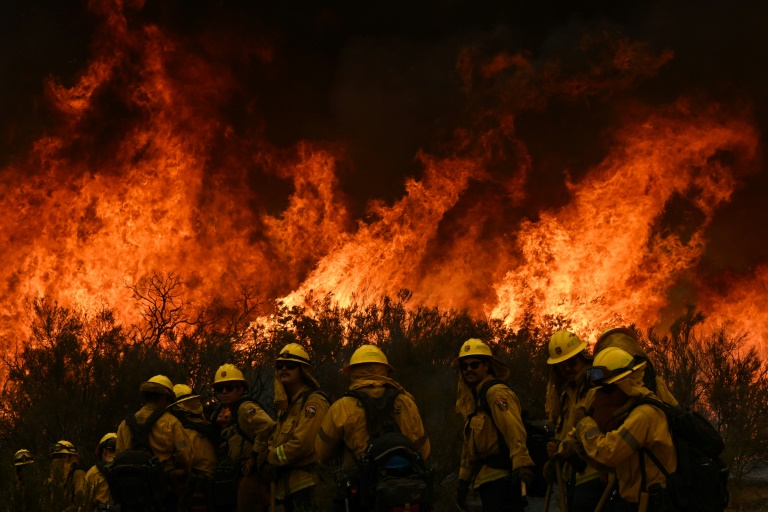
Firefighters battling a growing blaze outside Los Angeles were bracing Friday for mudslides and flooding as a storm barrels into burn areas.

The remnants of a hurricane that hit Mexico were bringing strong winds that are likely to fan the Fairview fire, prompting wider evacuation orders.

The 27,000-acre (10,000-hectare) fire, which erupted on Monday at the midpoint of a ferocious heat wave, is continuing to spread, buffeted by “extreme downslope winds” from nearby mountains, fire officials said.

“I have not seen a fire burn like this in Riverside County in my career,” said Cal Fire division chief John Crater.

“It’s a very stubborn fire. It’s doing things that we just haven’t seen.”

An already widespread evacuation zone was expanded to cover more than 20,000 people as emergency managers tried to out-flank the fire and get ahead of the winds.

“Winds will increase from the east… Ember cast will dramatically increase as the strong 40+ mph (65+ kph) winds enter the area,” Cal Fire warned. 

“Long range spotting over a mile will be possible with Probability of Ignition at 85 percent.”

“Ember cast” and “spotting” refer to burning materials jumping from the main fire and settling elsewhere, igniting and spreading the blaze.

Sheriff’s deputies were going door to door to urge residents to get out of harm’s way.

At least two people have already died in the blaze, apparently trapped by fast-moving flames as they tried to flee.

Further north, the Mosquito fire was raging out of control outside Sacramento, and had already torched 30,000 acres.

Firefighters said they did not have control of any of the perimeter of the blaze, which they believe has already damaged or destroyed a number of buildings.

“The fire is burning in extremely difficult terrain including steep canyons where directly attacking the fire can be difficult,” Cal Fire said in an operational update.

– Rain –

Meanwhile, Tropical Storm Kay, which made landfall in Mexico as a hurricane on Thursday was rolling north, and expected to bring heavy rain to parts of California and Arizona.

Forecasters at the National Weather Service said up to seven inches (18 centimeters) of rain could fall in the area around the Fairview fire, creating the risk of flash flooding and mudflows in areas where burned-out soil cannot absorb the sudden downpour.

“We could go from a fire suppression event into significant rain, water rescues, mudslides, debris (flows),” Jeff Veik of Cal Fire’s Riverside Unit told a community meeting.

“We have challenging days ahead.”

The storm, which by Friday afternoon was lashing southern California with gusts over 100 miles per hour, looked set gradually to bring an end to the punishing heat wave that has enveloped a large chunk of the western United States for more than a week.

But temperatures — some of which have exceeded 110 Fahrenheit (43 Celsius) in places for multiple days — remained high in central and northern California.

“Overnight lows will continue to rival records this weekend as the increased cloud cover traps warm air at the surface,” the National Weather Service said.

“Approximately 29 million Americans are currently under an Excessive Heat Warning.”

The warm and dry air was also increasing the chances of fires over the greater West, a risk that was being further elevated by winds that are whipped up as pressure systems move around.

The western United States is more than two decades into a historic drought that scientists say is being worsened by human-made climate change.

Much of the countryside is parched and overgrown, creating the conditions for hot, fast and destructive wildfires.

Climatologists predict that as the Earth continues to warm because of the unceasing burning of fossil fuels, these conditions will further worsen.

Close Bitnami banner
Bitnami