AFP

Firefighters brace for mudslides as storm moves into California

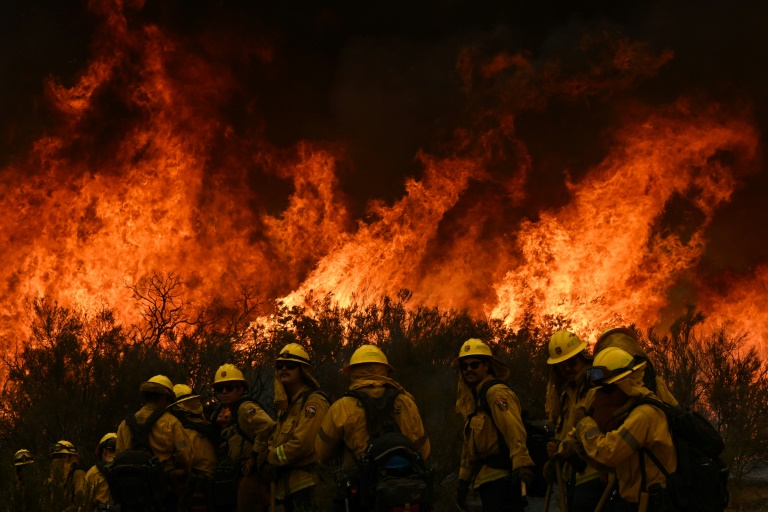
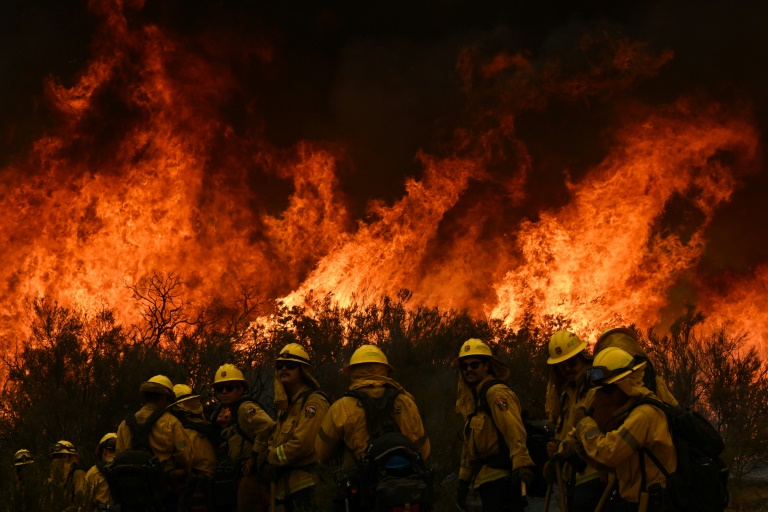
Firefighters battling a growing blaze outside Los Angeles were bracing Friday for mudslides and flooding as a storm barrels into burn areas.

The remnants of a hurricane that hit Mexico were bringing strong winds that are likely to fan the Fairview fire, prompting wider evacuation orders.

The 27,000-acre (10,000-hectare) fire, which erupted on Monday at the midpoint of a ferocious heat wave, is continuing to spread, buffeted by “extreme downslope winds” from nearby mountains, fire officials said.

“I have not seen a fire burn like this in Riverside County in my career,” said Cal Fire division chief John Crater.

“It’s a very stubborn fire. It’s doing things that we just haven’t seen.”

An already widespread evacuation zone was expanded to cover more than 20,000 people as emergency managers tried to out-flank the fire and get ahead of the winds.

“Winds will increase from the east… Ember cast will dramatically increase as the strong 40+ mph (65+ kph) winds enter the area,” Cal Fire warned. 

“Long range spotting over a mile will be possible with Probability of Ignition at 85 percent.”

“Ember cast” and “spotting” refer to burning materials jumping from the main fire and settling elsewhere, igniting and spreading the blaze.

Sheriff’s deputies were going door to door to urge residents to get out of harm’s way.

At least two people have already died in the blaze, apparently trapped by fast-moving flames as they tried to flee.

Further north, the Mosquito fire was raging out of control outside Sacramento, and had already torched 30,000 acres.

Firefighters said they did not have control of any of the perimeter of the blaze, which they believe has already damaged or destroyed a number of buildings.

“The fire is burning in extremely difficult terrain including steep canyons where directly attacking the fire can be difficult,” Cal Fire said in an operational update.

– Rain –

Meanwhile, Tropical Storm Kay, which made landfall in Mexico as a hurricane on Thursday was rolling north, and expected to bring heavy rain to parts of California and Arizona.

Forecasters at the National Weather Service said up to seven inches (18 centimeters) of rain could fall in the area around the Fairview fire, creating the risk of flash flooding and mudflows in areas where burned-out soil cannot absorb the sudden downpour.

“We could go from a fire suppression event into significant rain, water rescues, mudslides, debris (flows),” Jeff Veik of Cal Fire’s Riverside Unit told a community meeting.

“We have challenging days ahead.”

The storm, which by Friday afternoon was lashing southern California with gusts over 100 miles per hour, looked set gradually to bring an end to the punishing heat wave that has enveloped a large chunk of the western United States for more than a week.

But temperatures — some of which have exceeded 110 Fahrenheit (43 Celsius) in places for multiple days — remained high in central and northern California.

“Overnight lows will continue to rival records this weekend as the increased cloud cover traps warm air at the surface,” the National Weather Service said.

“Approximately 29 million Americans are currently under an Excessive Heat Warning.”

The warm and dry air was also increasing the chances of fires over the greater West, a risk that was being further elevated by winds that are whipped up as pressure systems move around.

The western United States is more than two decades into a historic drought that scientists say is being worsened by human-made climate change.

Much of the countryside is parched and overgrown, creating the conditions for hot, fast and destructive wildfires.

Climatologists predict that as the Earth continues to warm because of the unceasing burning of fossil fuels, these conditions will further worsen.
Stocks and oil rally as dollar drops

Stock markets and oil prices rallied Friday, with investors largely pricing in more central bank interest rate hikes aimed at taming surging inflation.

The dollar slid as much as one percent against the pound and euro after recent hefty gains.

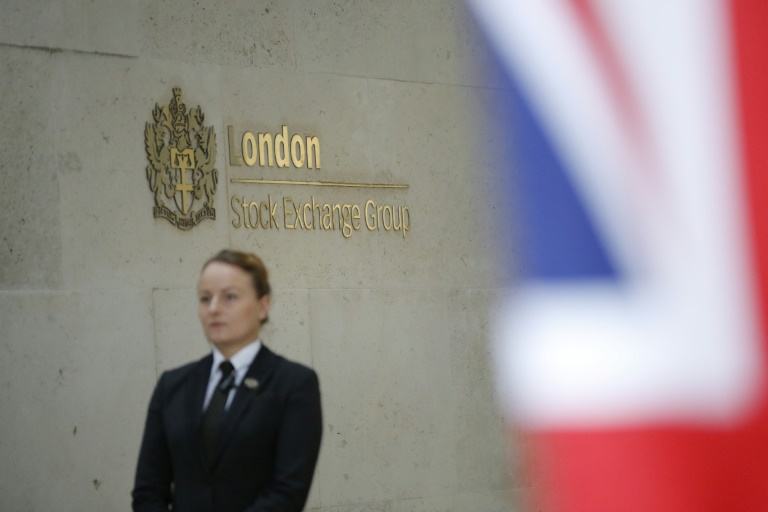
London’s stock market jumped 1.2 percent, mirroring advances in Paris and Frankfurt, while the British capital’s exchange mourned the death of Queen Elizabeth II.

“We are deeply saddened at the passing of Her Majesty Queen Elizabeth II,” the London Stock Exchange said in a message posted on its website following her death on Thursday.

The LSE is expected to shut on the day of the queen’s funeral.

“Markets are being very British about the whole thing, carrying on in a fashion that I suspect she would have approved of,” said IG analyst Chris Beauchamp.

Wall Street followed the upbeat European session with a third straight positive day.

The S&P 500 finished at 4,067.36, up 1.5 percent for the day and 3.6 percent for the week, snapping a three-week losing stream.

– Dollar off highs –

The more confident mood across equity and oil markets was reflected in a cooler dollar, which had surged to multi-decade highs against major peers in recent weeks owing to the US Federal Reserve’s hawkish tone promising even more interest rate hikes.

“There are hopes that the sharp rate increases from the Fed may already have dampened demand, causing US inflation to weaken,” said Fawad Razaqzada, City Index and FOREX.com analyst. 

The greenback’s softness came even after yet another strong statement from a leading US central banker. 

Fed Governor Christopher Waller on Friday was the latest to reaffirm the hawkish stance to combat rising prices.

He warned that lowering inflation will take time and higher rates, and said he supports another “significant increase” in the benchmark lending rate at the September 20-21 policy meeting.

In Asia, Hong Kong rose close to three percent heading into a long weekend.

There was also some cheer from news that inflation in China eased slightly in August, giving the government more room to introduce more economy-supporting measures, though the recovery remains hostage to leaders’ strict zero-Covid strategy of growth-sapping lockdowns.

The euro was holding well above parity with the dollar, one day after the European Central Bank announced its own 75 basis-point rate increase as it warned inflation was “far too high” and likely to stay above target for “an extended period”.

The yen strengthened as officials began speaking up after the unit approached a 32-year low against the greenback.

The pick-up came after Bank of Japan chief Haruhiko Kuroda met Prime Minister Fumio Kishida on Friday before saying “the rapid weakening of the yen is undesirable”. 

The talks were seen as a sign of intent to act in support of the currency if it continued to weaken. 

– Key figures at around 2050 GMT –

New York – Dow: UP 1.2 percent at 32,151.71 (close)

New York – S&P 500: UP 1.5 percent at 4,067.36 (close)

New York – Nasdaq: UP 2.1 percent at 12,112.31 (close)

London – FTSE 100: UP 1.2 percent at 7,351.07 (close)

Frankfurt – DAX: UP 1.4 percent at 13,088.21 (close)

Paris – CAC 40: UP 1.4 percent at 6,212.33 (close)

EURO STOXX 50: UP 1.6 percent at 3,570.04 (close)

Tokyo – Nikkei 225: UP 0.5 percent at 28,214.75 (close)

Hong Kong – Hang Seng Index: UP 2.7 percent at 19,362.25 (close)

Shanghai – Composite: UP 0.8 percent at 3,262.05 (close)

Euro/dollar: UP at $1.0046 from $0.9998 on Thursday

Pound/dollar: UP at $1.1587 from $1.1504

Euro/pound: DOWN at 86.84 pence from 86.90 pence

Dollar/yen: DOWN at 142.56 yen from 144.07 yen 

Brent North Sea crude: UP 4.1 percent at $92.84 per barrel

West Texas Intermediate: UP 3.9 percent at $86.79 per barrel

burs-jmb/hs

After pulling out of TPP, US forges Asia trade framework

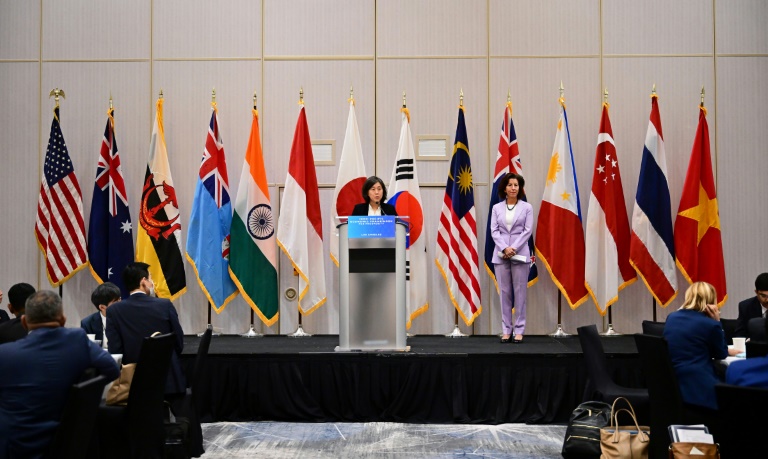
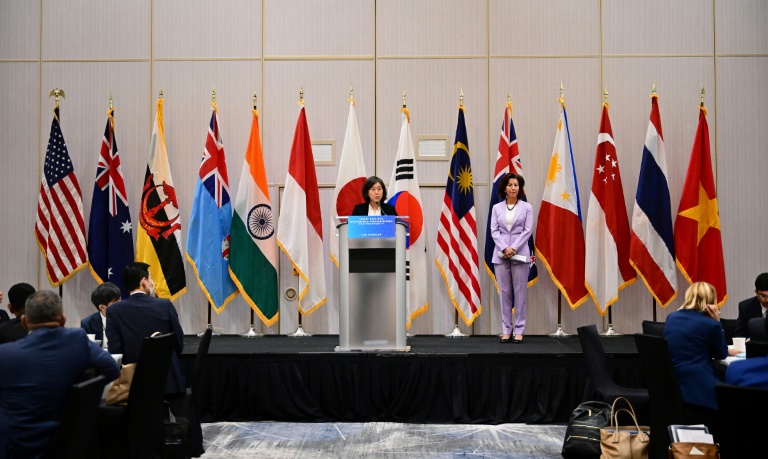
The United States and a group of Asian allies on Friday agreed on a set of negotiating targets, notably on trade and supply chains, as Washington looks to offer an alternative to the economic might of China in the region.

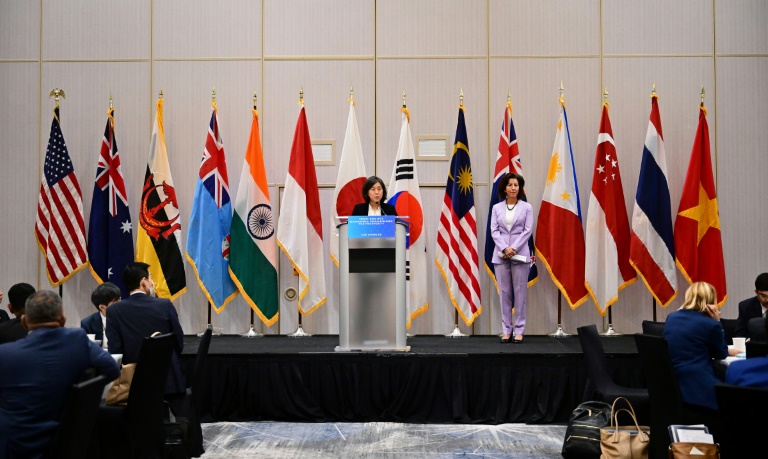
At the first ministerial for the Indo-Pacific Economic Prosperity Framework (IPEF), officials sketched the basis for common standards on key pillars, which also include green energy and the fight against corruption, in 14 countries accounting for 40 percent of the global economy.

“I feel very confident saying that IPEF will create jobs in the United States and will create jobs in other IPEF countries,” US Commerce Secretary Gina Raimondo said at the conclusion of the meeting.

“We were able to finalize all four of the ministerial statements, which lay out the full scope of the framework and provide a roadmap for future discussions.”

The initial meeting offered little flesh on the bones of the plans, which come several years after former president Donald Trump yanked the United States out of a much more comprehensive and hard-won regional trade block.

The Trans-Pacific Partnership (TPP), which has since gone ahead without Washington, was hailed as a “high quality” pact that offered a genuine bulwark to Chinese economic power.

But with US public opinion more wary of free trade agreements, which are seen as a threat to American jobs, President Joe Biden’s administration opted not to rejoin that pact.

The IPEF brings together the United States, Australia, Brunei, Fiji, India, Indonesia, Japan, South Korea, Malaysia, New Zealand, the Philippines, Singapore, Thailand and Vietnam.

Raimondo praised the “consensus and commitment among all” members, though she acknowledged that India had not signed onto agreements on trade and the digital economy.

Business leaders at the gathering said the frameworks agreed over two days of negotiations were worthwhile in the absence of a robust pact like the TPP.

“We were very supportive of the TPP but we’ve just moved on and we’re being realistic right now,” one business leader told AFP on condition of anonymity, adding that the focus is on “getting the best arrangement we can.”

“If the US remains absent from the region, that’s a risk,” the person said, noting how Beijing has frequently dangled sweeteners to regional players, in the form of infrastructure aid.

“Their help also comes with strings attached and in the long run, that can really hurt US companies in the region.”

The alliance is in theory an “open platform” that could eventually include other countries, but does not include Taiwan, a self-ruled island that Beijing claims as its own but that remains a US ally.

After pulling out of TPP, US forges Asia trade framework

The United States and a group of Asian allies on Friday agreed on a set of negotiating targets, notably on trade and supply chains, as Washington looks to offer an alternative to the economic might of China in the region.

At the first ministerial for the Indo-Pacific Economic Prosperity Framework (IPEF), officials sketched the basis for common standards on key pillars, which also include green energy and the fight against corruption, in 14 countries accounting for 40 percent of the global economy.

“I feel very confident saying that IPEF will create jobs in the United States and will create jobs in other IPEF countries,” US Commerce Secretary Gina Raimondo said at the conclusion of the meeting.

“We were able to finalize all four of the ministerial statements, which lay out the full scope of the framework and provide a roadmap for future discussions.”

The initial meeting offered little flesh on the bones of the plans, which come several years after former president Donald Trump yanked the United States out of a much more comprehensive and hard-won regional trade block.

The Trans-Pacific Partnership (TPP), which has since gone ahead without Washington, was hailed as a “high quality” pact that offered a genuine bulwark to Chinese economic power.

But with US public opinion more wary of free trade agreements, which are seen as a threat to American jobs, President Joe Biden’s administration opted not to rejoin that pact.

The IPEF brings together the United States, Australia, Brunei, Fiji, India, Indonesia, Japan, South Korea, Malaysia, New Zealand, the Philippines, Singapore, Thailand and Vietnam.

Raimondo praised the “consensus and commitment among all” members, though she acknowledged that India had not signed onto agreements on trade and the digital economy.

Business leaders at the gathering said the frameworks agreed over two days of negotiations were worthwhile in the absence of a robust pact like the TPP.

“We were very supportive of the TPP but we’ve just moved on and we’re being realistic right now,” one business leader told AFP on condition of anonymity, adding that the focus is on “getting the best arrangement we can.”

“If the US remains absent from the region, that’s a risk,” the person said, noting how Beijing has frequently dangled sweeteners to regional players, in the form of infrastructure aid.

“Their help also comes with strings attached and in the long run, that can really hurt US companies in the region.”

The alliance is in theory an “open platform” that could eventually include other countries, but does not include Taiwan, a self-ruled island that Beijing claims as its own but that remains a US ally.

After pulling out of TPP, US forges Asia trade framework

The United States and a group of Asian allies on Friday agreed on a set of negotiating targets, notably on trade and supply chains, as Washington looks to offer an alternative to the economic might of China in the region.

At the first ministerial for the Indo-Pacific Economic Prosperity Framework (IPEF), officials sketched the basis for common standards on key pillars, which also include green energy and the fight against corruption, in 14 countries accounting for 40 percent of the global economy.

“I feel very confident saying that IPEF will create jobs in the United States and will create jobs in other IPEF countries,” US Commerce Secretary Gina Raimondo said at the conclusion of the meeting.

“We were able to finalize all four of the ministerial statements, which lay out the full scope of the framework and provide a roadmap for future discussions.”

The initial meeting offered little flesh on the bones of the plans, which come several years after former president Donald Trump yanked the United States out of a much more comprehensive and hard-won regional trade block.

The Trans-Pacific Partnership (TPP), which has since gone ahead without Washington, was hailed as a “high quality” pact that offered a genuine bulwark to Chinese economic power.

But with US public opinion more wary of free trade agreements, which are seen as a threat to American jobs, President Joe Biden’s administration opted not to rejoin that pact.

The IPEF brings together the United States, Australia, Brunei, Fiji, India, Indonesia, Japan, South Korea, Malaysia, New Zealand, the Philippines, Singapore, Thailand and Vietnam.

Raimondo praised the “consensus and commitment among all” members, though she acknowledged that India had not signed onto agreements on trade and the digital economy.

Business leaders at the gathering said the frameworks agreed over two days of negotiations were worthwhile in the absence of a robust pact like the TPP.

“We were very supportive of the TPP but we’ve just moved on and we’re being realistic right now,” one business leader told AFP on condition of anonymity, adding that the focus is on “getting the best arrangement we can.”

“If the US remains absent from the region, that’s a risk,” the person said, noting how Beijing has frequently dangled sweeteners to regional players, in the form of infrastructure aid.

“Their help also comes with strings attached and in the long run, that can really hurt US companies in the region.”

The alliance is in theory an “open platform” that could eventually include other countries, but does not include Taiwan, a self-ruled island that Beijing claims as its own but that remains a US ally.

Biden says US must develop chips to keep up with China

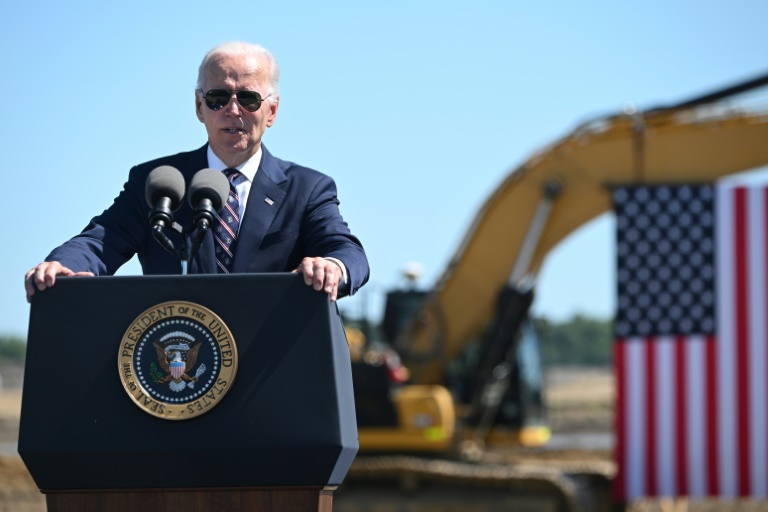
President Joe Biden said Friday at a ceremony to break ground on a semi-conductor plant that making sophisticated computer chips is an issue of US national security in the face of an assertive China.

“All of this is in our economic interest, and it’s in our national security interest as well,” Biden said at the site where Intel plans to build a $20 billion factory.

Biden made the trip to highlight recent legislation passed at his behest setting aside $52 billion to boost US semiconductor production. He said the initiative was part of the broader rivalry between the United States and China.

“It’s no wonder… that the Chinese Communist Party actively lobbied US business against this law,” Biden said, with heavy machinery looming in the background.

Biden said the US will need state-of-the-art engineering “for the weapon systems of the future that are only going to be more reliant on computer chips.”

“Unfortunately, we produce zero, zero of these advanced chips in America,” Biden said.

Biden’s visit here also had a political component as the US midterm elections of November approach.

Ohio is a Rust Belt state where blue collar factory workers historically tended to vote Democrat but turned to the Republican Party and Donald Trump as industries died out and workers felt left out by globalization.

Russia reinforces Kharkiv to counter Ukraine push

Russia said on Friday it was sending reinforcements to the Kharkiv region in eastern Ukraine, where Kyiv says it has re-taken dozens of settlements as part of a broader counter-offensive.

President Volodymyr Zelensky said in his evening address that Ukrainian troops had retaken 30 areas from Russian forces.  

“We are gradually taking control over new settlements. We are returning the Ukrainian flag and protection for our citizens everywhere,” he said, calling on Ukrainians to report any crimes committed by the occupying forces.

In the Kharkiv region, Ukrainian officials have exhumed two bodies in a village recently recaptured from Russia, part of an investigation into a possible war crime.

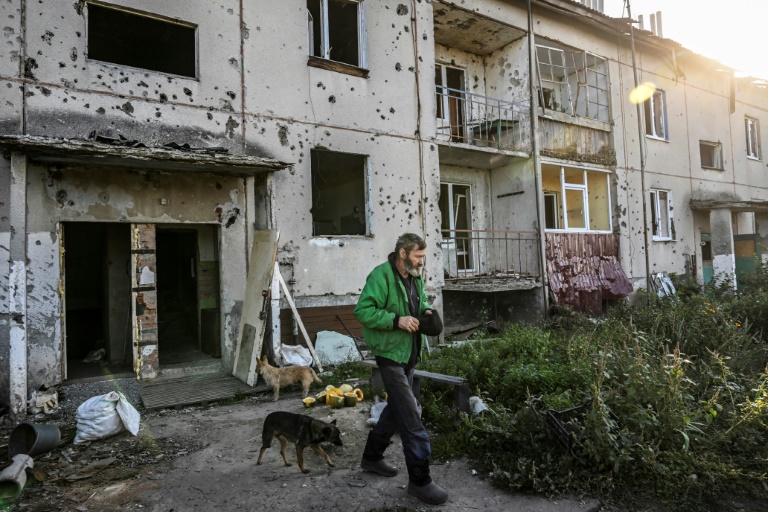
Grakove village was the scene of fierce fighting in the early weeks of Russia’s invasion.

Russian state media broadcast footage of military vehicles travelling along paved roads and dirt tracks in Kharkiv region, emblazoned with the letter “Z”, the symbol of Moscow’s invasion.

A Moscow-installed official, Vitaliy Ganchev, said in televised remarks that “fierce battles” were under way near the town of Balakliya, which Ukraine said it had recaptured on Thursday.

“We do not control Balakliya. Attempts are being made to dislodge the Ukrainian forces, but there are fierce battles, and our troops are being held back on the approaches,” Ganchev said.

“Now Russian reserves have been brought there, our troops are fighting back,” he added.

– Fresh shelling of nuclear plant –

The head of the International Atomic Energy Agency (IAEA) meanwhile warned of “dramatic” developments at the Russian-controlled Zaporizhzhia nuclear power plant in southern Ukraine where recent fighting had “compromised the safe operation” of the facility.

IAEA Secretary General Rafael Grossi warned that fresh shelling near the plant had caused a blackout in the nearby town of Energodar.

That jeopardised the safe running of the plant, he said.

“This is completely unacceptable. It cannot stand,” he said, insisting on “the immediate cessation of all shelling in the entire area”.

Petro Kotin, the head of Ukraine’s nuclear energy agency, told AFP that Russian forces had tortured staff at the nuclear power station, and that at least two people had been killed.

“Two people were beaten to death. We do not know where about ten people are now, they were taken (by the Russians) and after that we have no information about their whereabouts,” he said.

In the recently recaptured village of Grakove, where Ukrainian officials exhumed two bodies Friday, resident Sergiy Lutsay spoke to journalists about what he had seen.

Russian soldiers had forced him to bury the bodies at gunpoint soon after the war began, he said.

“They came to my house, I was with my father, aged 70,” he told journalists. “I was scared that they would threaten him.”

“They told me to come to dig a hole.”

He would not confirm a police statement that said that at least one of the two men killed had had his ears cut off.

– ‘Huge costs’ for Russia: Blinken –

US Secretary of State Antony Blinken said Russia’s push to reinforce Kharkiv showed Moscow was paying “huge costs” in its bid to capture and then hold Ukrainian territory.

“There are a huge number of Russian forces that are in Ukraine and unfortunately, tragically, horrifically President (Vladimir) Putin has demonstrated that he will throw a lot of people into this at huge cost to Russia,” he said.

He was speaking during a visit to Brussels on Friday for talks with NATO Secretary General Jens Stoltenberg.

A day earlier he paid a surprise visit to Kyiv during which he unveiled another $2.8 billion in military aid and hailed Ukraine’s “clear and real” frontline gains.

Late on Thursday, Zelensky shared footage showing camouflage-clad Ukrainian soldiers holding his country’s blue-and-yellow flag over Balakliya.

The town, which had been under Russian control for around six months and had a pre-war population of around 30,000 people, fell early on to Russian forces who invaded in February.

Now, Russian officials in the Kharkiv region say they are evacuating civilians towards Russia “until the situation stabilises”.

On the Ukrainian side however, Kharkiv regional governor Oleg Synegubov warned people not to return to newly recaptured areas while “cleaning and demining” took place.

In the area around Kharkiv city, Ukrainian forces penetrated 50 kilometres (30 miles) beyond Russian lines and took back more than 20 towns and villages, military officials said.

One queen, many presidents: Elizabeth II's ties with America

She had scones with Dwight Eisenhower, went riding with Ronald Reagan and took tea with Donald Trump: Queen Elizabeth II saw 14 US presidents serve during her reign, and she crafted her “special relationship” with America in her dealings with them.

From Harry Truman to Joe Biden, the late monarch met every man who inhabited the White House during her 70 years on the throne save one — Lyndon B Johnson, who moved into the Oval Office following the assassination of John F Kennedy.

Her first visit to the United States came in 1951 — the young princess waved to the crowd from the back seat of a convertible, with a visibly delighted Harry Truman at her side.

Even though she had not yet become queen, Elizabeth exhibited the oratory gravitas of a future head of state when she told the former British colony: “Free men everywhere look towards the United States with affection and with hope.”

After that trip, color brightened official photographs of her travels across the pond. 

Elizabeth, whose reign dovetailed with the rise of the United States as a global superpower, offered all US presidents the same treatment: the studied distance that protocol requires, and the carefully calibrated air of familiarity.

Those meetings came at everything from state dinners at the White House to the time-honored tradition of tea time at one of her many royal residences.

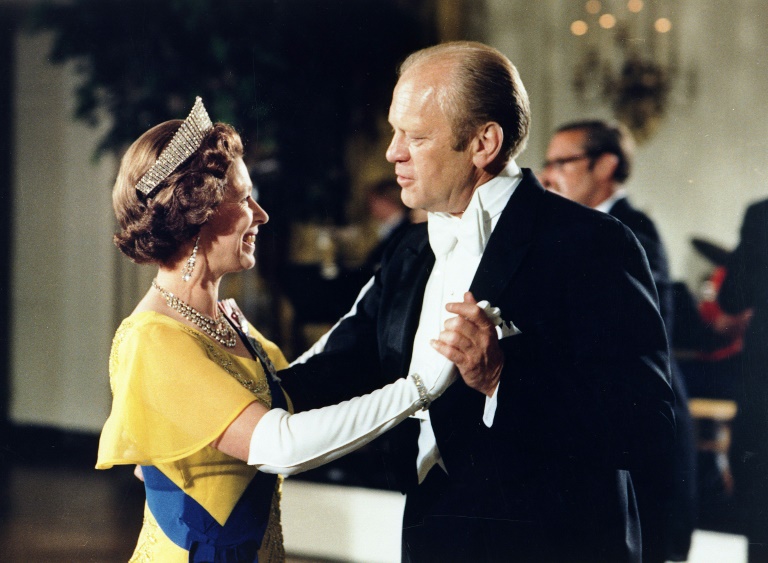
She welcomed the Kennedys to Buckingham Palace for a lavish dinner, and danced in a yellow dress and glittering tiara with Gerald Ford at a state dinner in July 1976 that coincided with the bicentennial of American independence.

While the queen slaked the media’s thirst for all things formal and splendid, she also understood the power of moments that were less scripted and more personal.

– Tacos and scones –

In 1982, she and Reagan, a onetime actor who appeared in Westerns, rode horses near Windsor Castle. He returned the favor the following year, treating the monarch to tacos and guacamole at his California ranch.

George H.W. Bush in 1991 took Elizabeth to a baseball game in Baltimore, where she shook hands with all the players. According to reports at the time, the queen passed on the chance to eat a hot dog at a pre-game reception, but did sip a martini.

In a handwritten 1960 letter to Eisenhower preserved at the National Archives, she gave the retired general her scone recipe, after he’d eaten the teatime favorite at Balmoral, the estate in Scotland where she died on Thursday at age 96.

“I think the mixture needs a great deal of beating,” the queen explains, adding that the baker should not let the dough sit too long before cooking. 

She also suggests using “golden syrup or treacle instead of only sugar,” noting “that can be very good, too.”

In more recent years, American leaders have expressed feeling like the aging queen was something akin to a mother figure.

“I don’t think she’d be insulted but she reminded me of my mother — the look of her and just the generosity,” Biden said after his June 2021 meeting with the queen.

The comment is particularly salient, given that when Biden was set to meet the queen for the first time, in 1982 in Britain when he was a young senator, his mother, a proud descendant of Irish immigrants, said: “Don’t you bow down to her.”

– Grandmother –

Trump told the Daily Mail that he thought of his own mother as he and wife Melania had tea with Elizabeth II at Windsor in 2018.

“My mother passed away a while ago, and she was a tremendous fan of the queen,” he said at the time. 

Obama, 15 years younger than Trump, said Elizabeth reminded him of his grandmother.

The 2009 meeting of the queen and the Obamas at Buckingham Palace has remained in the public’s imagination: Michelle briefly put her arm around the queen and, to everyone’s general surprise, Elizabeth did the same.

“She meant a great deal to us,” the Obamas said in a statement following her death.

All five living former US presidents — Jimmy Carter, Bill Clinton, George W. Bush, Obama and Trump — paid tribute to Elizabeth II in statements issued with their wives.

The same words cropped up in the remarks: elegance; dignity; duty; humor, kindness.

Biden ordered that US flags be flown at half-mast until the queen’s funeral, including over the White House, which was torched in 1814 by British soldiers.

In a lengthy homage, the Democratic leader summed up the mood felt across the nation, a country created less than 250 years ago, while the queen lived for nearly a century.

“Her Majesty Queen Elizabeth II was more than a monarch. She defined an era,” he said.

Russia reinforces Kharkiv to counter Ukraine push

Russia said on Friday it was sending reinforcements to the Kharkiv region in eastern Ukraine, where Kyiv’s forces have announced major gains as part of a broader counter-offensive.

The head of the International Atomic Energy Agency (IAEA) meanwhile warned of “dramatic” developments at the Russian-controlled Zaporizhzhia nuclear power plant in southern Ukraine where recent fighting had “compromised the safe operation” of the facility.

In the Kharkiv region, Ukrainian officials have exhumed two bodies in a village recently recaptured from Russia, part of an investigation into a possible war crime.

Grakove village was the scene of fierce fighting in the early weeks of Russia’s invasion.

Russian state media broadcast footage of columns of tanks, support vehicles and artillery travelling along paved roads and dirt tracks in Kharkiv region, emblazoned with the letter “Z”, the symbol of Moscow’s invasion.

A Moscow-installed official, Vitaliy Ganchev, said in televised remarks that “fierce battles” were under way near the town of Balakliya, which Ukraine said it had recaptured on Thursday.

“We do not control Balakliya. Attempts are being made to dislodge the Ukrainian forces, but there are fierce battles, and our troops are being held back on the approaches,” Ganchev said.

“Now Russian reserves have been brought there, our troops are fighting back,” he added.

– Fresh shelling of nuclear plant –

IAEA Secretary General Rafael Grossi warned Friday that fresh shelling near the Zaporizhzhia nuclear power plant in the south of the country had caused a blackout in the nearby town of Energodar.

That jeopardised the safe running of the plant, he said.

“This is completely unacceptable. It cannot stand,” he said, insisting on “the immediate cessation of all shelling in the entire area”.

Petro Kotin, the head of Ukraine’s nuclear energy agency, told AFP that Russian forces had tortured staff at the nuclear power station, and that at least two people had been killed.

“Two people were beaten to death. We do not know where about ten people are now, they were taken (by the Russians) and after that we have no information about their whereabouts,” he said.

In the recently recaptured village of Grakove, where Ukrainian officials exhumed two bodies Friday, resident Sergiy Lutsay spoke to journalists about what he had seen.

Russian soldiers had forced him to bury the bodies at gunpoint soon after the war began, he said.

“They came to my house, I was with my father, aged 70,” he told journalists. “I was scared that they would threaten him.”

“They told me to come to dig a hole.”

He would not confirm a police statement that said that at least one of the two men killed had had his ears cut off.

– ‘Huge costs’ for Russia: Blinken –

US Secretary of State Antony Blinken said Russia’s push to reinforce Kharkiv showed Moscow was paying “huge costs” in its bid to capture and then hold Ukrainian territory.

“There are a huge number of Russian forces that are in Ukraine and unfortunately, tragically, horrifically President (Vladimir) Putin has demonstrated that he will throw a lot of people into this at huge cost to Russia,” he said.

He was speaking during a visit to Brussels on Friday for talks with NATO Secretary General Jens Stoltenberg.

A day earlier he paid a surprise visit to Kyiv during which he unveiled another $2.8 billion in military aid and hailed Ukraine’s “clear and real” frontline gains.

Late on Thursday, President Volodymyr Zelensky shared footage showing camouflage-clad Ukrainian soldiers holding his country’s blue-and-yellow flag over Balakliya.

The town, which had been under Russian control for around six months and had a pre-war population of around 30,000 people, fell early on to Russian forces who invaded in February.

Now, Russian officials in the Kharkiv region say they are evacuating civilians towards Russia “until the situation stabilises”.

On the Ukrainian side however, Kharkiv regional governor Oleg Synegubov warned people not to return to newly recaptured areas while “cleaning and demining” took place.

– Donetsk shelling –

Zelensky said Thursday that in total Ukraine’s army had clawed back some 1,000 square kilometres (nearly 400 square miles) from Russian forces since the beginning of the month.

In the area around Kharkiv city, Ukrainian forces penetrated 50 kilometres (30 miles) beyond Russian lines and took back more than 20 towns and villages, military officials said.

The counter-offensive has shown progress in the south of the country too, particularly in the Kherson region, as well as in Kharkiv and in the industrial Donbas province in the east.

“It’s very tough, but we are moving forward,” commander-in-chief General Valeriy Zaluzhny said Friday.

Firefighters brace for mudslides as storm moves into California

Firefighters battling a growing blaze outside Los Angeles were bracing Friday for mudslides and flooding as a storm barrels into burn areas.

The remnants of a hurricane that hit Mexico could also bring strong winds that could further fan the Fairview fire, prompting wider evacuation orders.

The 24,000-acre (9,700-hectare) fire, which erupted on Monday at the midpoint of a ferocious heat wave, is continuing to spread, fanned by “extreme downslope winds” from nearby mountains, fire officials said.

“I have not seen a fire burn like this in Riverside County in my career,” said Cal Fire division chief John Crater.

“It’s a very stubborn fire. It’s doing things that we just haven’t seen.”

An already widespread evacuation zone was expanded to cover more than 20,000 people as emergency managers tried to out-flank the fire and get ahead of the winds.

Sheriff’s deputies were going door to door to urge residents to get out of harm’s way.

At least two people have already died in the blaze, apparently trapped by fast-moving flames as they tried to flee.

Meanwhile, Hurricane Kay made landfall in Mexico on Thursday and began moving northwards.

Even as it weakened into a tropical storm, it was expected to bring heavy rain to parts of California and Arizona.

Forecasters at the National Weather Service said up to seven inches (18 centimeters) of rain could fall in the area around the fire, creating the risk of flash flooding and mudflows in areas where burned-out soil cannot absorb the sudden downpour.

“We could go from a fire suppression event into significant rain, water rescues, mudslides, debris (flows),” Jeff Veik of Cal Fire’s Riverside Unit told a community meeting.

“We have challenging days ahead.”

The tropical storm moving up from Mexico looked set gradually to bring an end to the punishing heat wave that has enveloped a large chunk of the western United States for more than a week.

But temperatures — some of which have exceeded 110 Fahrenheit (43 Celsius) in places for multiple days — remained high in central and northern California.

“Overnight lows will continue to rival records this weekend as the increased cloud cover traps warm air at the surface,” the National Weather Service said.

“Approximately 29 million Americans are currently under an Excessive Heat Warning.”

The warm and dry air was also increasing the chances of fires over a vast area, a risk that was being further elevated by winds that are whipped up as pressure systems move around.

The western United States is more than two decades into a historic drought that scientists say is being worsened by human-made climate change.

Much of the countryside is parched and overgrown, creating the conditions for hot, fast and destructive wildfires.

Climatologists predict that as the Earth continues to warm because of the unceasing burning of fossil fuels, these conditions will further worsen.
Close Bitnami banner
Bitnami