AFP

Williams looks to extend US Open farewell, Wu eyes upset

Serena Williams aims to extend her emotional farewell tour at the US Open on Friday as China’s Wu Yibing targets a mammoth upset against men’s champion Daniil Medvedev.

After knocking out world number two Anett Kontaveit on Wednesday, Williams has fans daring to dream of a fairytale 24th Grand Slam title as she prepares to retire from the sport.

The 40-year-old tennis icon will crank up the hysteria further on Friday if she beats Australia’s Ajla Tomljanovic on the Arthur Ashe Stadium court to reach the last 16.

Williams, who didn’t play for a year before returning to singles tennis at Wimbledon in June, has been careful to dampen down expectations in what is likely to be her final tournament, dismissing her chances of victory as “fan fantasy.”

But the manner of her second round win over Kontaveit, when she reeled off a series of vintage winners to clinch the decisive third set, has left many wondering if the fantasy may yet become reality.

“There are a lot of very strong girls there in the draw but I think if she plays really good tennis, I think she always has a chance to win,” was Kontaveit’s verdict.

Certainly, Williams’ path to what would be a record-equalling 24th Grand Slam singles final has been blown open by the early demise of several higher-ranked rivals.

Three of the top four seeds have already fallen, as well as both of last year’s finalists, 2021 champion Emma Raducanu and Canada’s Leylah Fernandez.

Williams herself says she is playing without pressure, liberated from the customary expectation that accompanied her Grand Slam campaigns through the years.

“I don’t have anything to prove, I don’t have anything to win. I have absolutely nothing to lose,” Williams said.

Williams’ campaign will also be boosted by the fact that she is no longer expending energy in the doubles.

The veteran and elder sister Venus were eliminated in the first round on Thursday.

Elsewhere in the women’s draw on Friday, Tunisia’s fifth-seeded Ons Jabeur made it to the fourth round at the 10th attempt with a 4-6, 6-4, 6-3 victory over 31st seed Shelby Rogers.

“I know that I don’t play the best on hard court, but it’s always amazing to see how I’m improving, how I’m pushing my limits,” Jabeur said. 

“I just don’t want to stop here … I’m just gonna keep fighting and keep pushing and breaking records here.”

Jabeur will face 18th seed Veronika Kudermetova in the last 16. The Russian blew past Hungary’s Dalma Galfi 6-2, 6-0.

– David v Goliath –

In the men’s draw, Chinese youngster Wu would create one of the biggest shocks in Open history with an upset in his ‘David & Goliath’ meeting with world number one Medvedev.

The charismatic 22-year-old has been quietly accumulating milestones in New York, becoming the first man from China to win a Grand Slam singles match in 63 years in the opening round, before becoming the first Chinese man ever to reach the third round of the US Open with Wednesday’s win over Nuno Borges.

Wu, winner of the US Open junior crown in 2017, hardly played for three years prior to this season due to injury and the Covid-19 pandemic.

In March, his world ranking stood at 1,869, but he has rapidly ascended to 174th since then.

“I think there’s more to come,” Wu said after his second round defeat of Borges. 

“I feel like I have this level to play here in the Grand Slam. Hopefully I keep health, keep playing more Grand Slams.”

Wu has been part of a successful contingent of Chinese players at the US Open. 

Four Chinese women have reached the third round of the tournament, another Grand Slam first, and one of them, Zhang Shuai advanced to the fourth round on Friday with a 6-2, 6-4 win over Canada’s Rebecca Marino.


It's raining diamonds across the universe, research suggests

It could be raining diamonds on planets throughout the universe, scientists suggested Friday, after using common plastic to recreate the strange precipitation believed to form deep inside Uranus and Neptune.

Scientists had previously theorised that extremely high pressure and temperatures turn hydrogen and carbon into solid diamonds thousands of kilometres below the surface of the ice giants.

Now new research, published in Science Advances, inserted oxygen into the mix, finding that “diamond rain” could be more common than thought.

Ice giants like Neptune and Uranus are thought to be the most common form of planet outside our Solar System, which means diamond rain could be occurring across the universe.

Dominik Kraus, a physicist at Germany’s HZDR research lab and one of the study’s authors, said that diamond precipitation was quite different to rain on Earth.

Under the surface of the planets is believed to be a “hot, dense liquid”, where the diamonds form and slowly sink down to the rocky, potentially Earth-size cores more than 10,000 kilometres (6,200 miles) below, he said.

There fallen diamonds could form vast layers that span “hundreds of kilometres or even more”, Kraus told AFP.

While these diamonds might not be shiny and cut like a “a nice gem on a ring”, he said they were formed via similar forces as on Earth.

Aiming to replicate the process, the research team found the necessary mix of carbon, hydrogen and oxygen in a readily available source — PET plastic, which is used for everyday food packaging and bottles. 

Kraus said that while the researchers used very clean PET plastic, “in principle the experiment should work with Coca-Cola bottles”.

The team then turned a high-powered optical laser on the plastic at the SLAC National Accelerator Laboratory in California.

“Very, very short X-ray flashes of incredible brightness” allowed them to watch the process of nanodiamonds — tiny diamonds too small to see with the naked eye — as they formed, Kraus said.

“The oxygen that is present in large amounts on those planets really helps suck away the hydrogen atoms from the carbon, so it’s actually easier for those diamonds to form,” he added.

– New way to make nanodiamonds? – 

The experiment could point towards a new way to produce nanodiamonds, which have a wide and increasing range of applications including drug delivery, medical censors, non-invasive surgery and quantum electronics.

“The way nanodiamonds are currently made is by taking a bunch of carbon or diamond and blowing it up with explosives,” said SLAC scientist and study co-author Benjamin Ofori-Okai.

“Laser production could offer a cleaner and more easily controlled method to produce nanodiamonds,” he added.

The diamond rain research remains hypothetical because little is known about Uranus and Neptune, the most distant planets in our Solar System.

Only one spacecraft — NASA’s Voyager 2 in the 1980s — has flown past the two ice giants, and the data it sent back is still being used in research.

But a NASA group has outlined a potential new mission to the planets, possibly launching next decade.

“That would be fantastic,” Kraus said.

He said he is greatly looking forward to more data — even if it takes a decade or two.

Actress Jane Fonda says she has cancer

US actress and activist Jane Fonda announced Friday that she has cancer, and has begun chemotherapy in her battle against the disease.

The 84-year-old Oscar winner, a prominent supporter of the Democratic Party, vowed to fight the “very treatable” illness.

“I’ve been diagnosed with non-Hodgkin’s Lymphoma and have started chemo treatments,” she wrote on her verified Instagram account.

“This is a very treatable cancer. 80 percent of people survive, so I feel very lucky. 

“I’m also lucky because I have health insurance and access to the best doctors and treatments.”

Fonda, an avowed environmentalist and social campaigner, said her position was more fortunate than that of many others in her situation.

“Almost every family in America has had to deal with cancer at one time or another and far too many don’t have access to the quality health care I am receiving and this is not right,” she wrote.

Non-Hodgkin’s lymphoma is a kind of cancer that starts in the lymphatic system, a part of the body’s immune defenses, and can develop into widespread tumors.

According to the Mayo Clinic, symptoms can include: swollen lymph nodes, abdominal pain or swelling, chest pain, coughing or trouble breathing, as well as persistent fatigue and fever.

“In most instances, doctors don’t know what causes non-Hodgkin’s lymphoma,” the clinic says on its website.

“It begins when your body produces too many abnormal lymphocytes, which are a type of white blood cell.”

Usually those cells die, and the body creates new ones to replace them — but in non-Hodgkin’s lymphoma, they don’t, even as the body keeps making more.

“This oversupply of lymphocytes crowds into your lymph nodes, causing them to swell,” the clinic’s website states.

– Climate activism –

Fonda vowed that her treatment will not impede her environmental campaigning, and urged action on fossil fuel use, which she linked to cancer.

“I’m doing chemo for six months and am handling the treatments quite well and, believe me, I will not let any of this interfere with my climate activism.

“We’re living through the most consequential time in human history because what we do or don’t do right now will determine what kind of future there will be.

“I will not allow cancer to keep me from doing all I can, using every tool in my toolbox.”

She pointed to November midterm elections which could determine whether US President Joe Biden’s Democrats lose control of both houses of Congress, saying they were “beyond consequential.”

As a result, “you can count on me to be right there together with you as we grow our army of climate champions,” she wrote.

Fonda first appeared on screen in 1960, and scored Academy Awards for best actress for “Klute” (1971) and “Coming Home” (1978).

She has five other Oscar nominations in her career, four of them for best lead actress.

As well as anti-war activism during the US-Vietnam war that saw her dubbed “Hanoi Jane” and blacklisted in Hollywood, she was also a major figure in the home fitness video craze of the 1980s.

Fonda continues to work, and appears as the voice of an elegant dragon who is the CEO of a luck-making operation in the Apple TV+ animated movie “Luck.” 

She also stars in the popular, long-running Netflix hit “Grace and Frankie.”

Fonda comes from a family of famous stars; her father Henry was a legend of the big screen appearing as the hold-out juror in “12 Angry Men,” and winning best actor for “On Golden Pond” (1981).

Her brother Peter was a seminal figure in 1960s counterculture, whose turn in “Easy Rider” is a touchstone of Hollywood history.

NASA Moon launch to attract up to 400,000 visitors

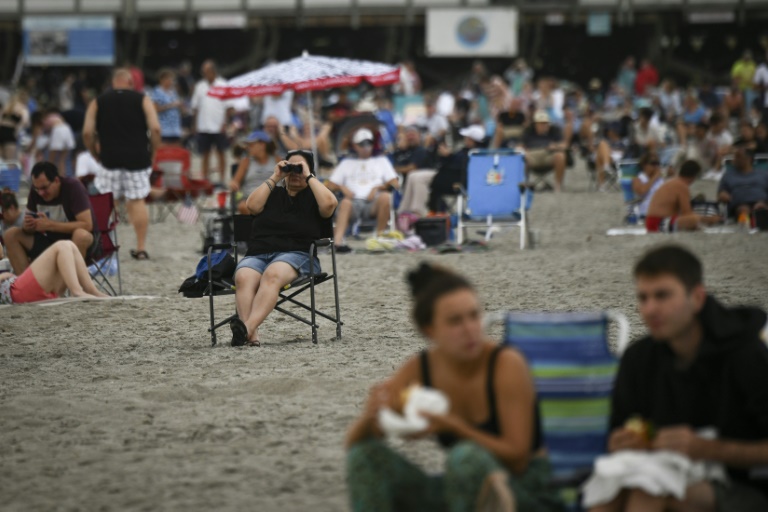
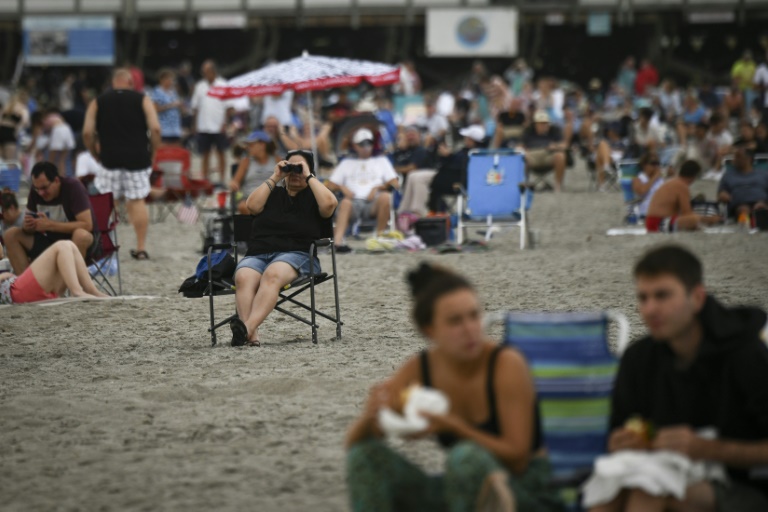
Up to 400,000 visitors are expected to flock to the Florida coast on Saturday, hoping to catch a glimpse — and hear the roar — of NASA’s rocket launch to the Moon.

If the uncrewed Space Launch System (SLS) lifts off successfully, it will be not only awe-inspiring but historic for NASA, marking the first of its Artemis missions plotting a return to the Moon.

The Kennedy Space Center will be closed to the public, but spectators on local beaches will be able to see the most powerful vehicle that NASA has ever launched climb into the sky.

“I remember being a little kid and some of the (Apollo) lunar landings,” Alberto Tirado told AFP on Cocoa Beach, the day before the rocket’s scheduled launch.

“So I want to feel that power and what they felt in the 1960s.”

On Monday, when a first launch attempt had to be scuttled at the last moment due to technical issues, local Brevard County authorities had expected between 100,000 and 200,000 visitors.

Don Walker, the county’s communications director, says that though Monday’s numbers have yet to be finalized, they estimate “double that amount on Saturday.”

“We are ‘guesstimating’ the launch viewing crowd to number between 200,000 to 400,000 people,” Walker told AFP.

For comparison, SpaceX’s first manned launch in 2020 — amid the pandemic — drew 220,000 people.

The fact that the launch is scheduled for a weekend, with Monday also a US holiday, means that the crowd is likely to be much larger, said Meagan Happel with the Space Coast Office of Tourism.

As on Monday, traffic is expected to get heavy “three to four hours” before the launch, Happel told AFP.

Liftoff is currently scheduled for 2:17 pm (18:17 GMT) on Saturday, with the potential for up to a two-hour delay if necessary.

Hotels along the coast have been fully booked for several weeks, and there are only a limited number of parking spaces near the best viewpoints.

Artemis 1 is a test flight without any astronauts on board.

The Orion capsule, after separating from the SLS rocket, will spend about six weeks in space and travel at one point nearly 40,000 miles (64,000 km) past the Moon — farther than any human-grade vehicle has ever gone.

It is the Orion that will then take future astronauts back to the Moon — including the first woman and the first person color to walk on its surface — in 2025 at the earliest.

NASA Moon launch to attract up to 400,000 visitors

Up to 400,000 visitors are expected to flock to the Florida coast on Saturday, hoping to catch a glimpse — and hear the roar — of NASA’s rocket launch to the Moon.

If the uncrewed Space Launch System (SLS) lifts off successfully, it will be not only awe-inspiring but historic for NASA, marking the first of its Artemis missions plotting a return to the Moon.

The Kennedy Space Center will be closed to the public, but spectators on local beaches will be able to see the most powerful vehicle that NASA has ever launched climb into the sky.

“I remember being a little kid and some of the (Apollo) lunar landings,” Alberto Tirado told AFP on Cocoa Beach, the day before the rocket’s scheduled launch.

“So I want to feel that power and what they felt in the 1960s.”

On Monday, when a first launch attempt had to be scuttled at the last moment due to technical issues, local Brevard County authorities had expected between 100,000 and 200,000 visitors.

Don Walker, the county’s communications director, says that though Monday’s numbers have yet to be finalized, they estimate “double that amount on Saturday.”

“We are ‘guesstimating’ the launch viewing crowd to number between 200,000 to 400,000 people,” Walker told AFP.

For comparison, SpaceX’s first manned launch in 2020 — amid the pandemic — drew 220,000 people.

The fact that the launch is scheduled for a weekend, with Monday also a US holiday, means that the crowd is likely to be much larger, said Meagan Happel with the Space Coast Office of Tourism.

As on Monday, traffic is expected to get heavy “three to four hours” before the launch, Happel told AFP.

Liftoff is currently scheduled for 2:17 pm (18:17 GMT) on Saturday, with the potential for up to a two-hour delay if necessary.

Hotels along the coast have been fully booked for several weeks, and there are only a limited number of parking spaces near the best viewpoints.

Artemis 1 is a test flight without any astronauts on board.

The Orion capsule, after separating from the SLS rocket, will spend about six weeks in space and travel at one point nearly 40,000 miles (64,000 km) past the Moon — farther than any human-grade vehicle has ever gone.

It is the Orion that will then take future astronauts back to the Moon — including the first woman and the first person color to walk on its surface — in 2025 at the earliest.

West, Russia trade pressure on energy as Ukraine goes on attack

Western powers and Moscow hit back at each other Friday with painful pressure measures on energy as Ukraine said it bombed a Russian base near a nuclear plant that has caused growing concern.

The Group of Seven major industrial democracies vowed to move urgently to set a price cap on Russian oil imports, a crucial source of revenue for Moscow and its war in Ukraine.

“Russia is benefitting economically from the uncertainty on energy markets caused by the war and is making big profits from the export of oil and we want to counter that decisively,” German Finance Minister Christian Lindner said in a press conference after the move was announced.

The aim of the price cap on oil exports was to “stop an important source of financing for the war of aggression and contain the rise in global energy prices”, he added.

Ahead of the decision, the Kremlin warned that the move would destabilise oil markets. It has shown it is willing to use gas supplies to Europe as leverage in what the United States has denounced as “weaponisation” of energy.

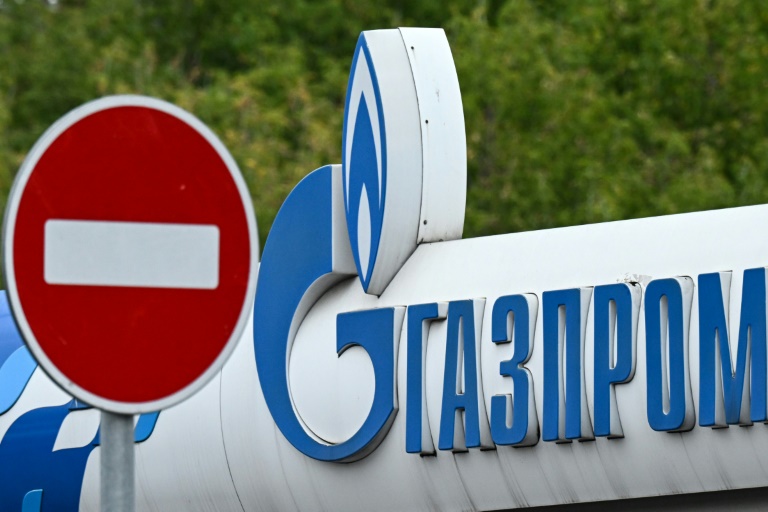
As if on cue, Russian gas giant Gazprom said it had halted gas deliveries to Germany for an indefinite period as there were leaks in a turbine.

Gazprom earlier said it expected a resumption on Saturday of gas shipments through Nord Stream, a pipeline — denounced at its inception by Russia’s critics — that links St Petersburg to Germany under the Baltic Sea.

“The reliability of the operation, of the whole system, is at risk,” Kremlin spokesman Dmitry Peskov said, blaming a lack of spare parts.

Siemens Energy, the German manufacturer of the turbine where Gazprom said it identified problems, said that the leaks identified by the Russians were not a reason to stop operation.

– Fighting near nuclear plant –

The showdown on energy comes amid growing alarm over Europe’s largest nuclear plant, Zaporizhzhia, which is under occupation of Russian troops.

Ukraine said it bombed a Russian base in the nearby town of Energodar, destroying three artillery systems as well as an ammunition depot.

Dmytro Orlov, the pro-Kyiv mayor of Energodar in southern Ukraine, told AFP from his location in exile that phone services in the town were badly disrupted.

A 14-strong team from the International Atomic Energy Agency (IAEA) is visiting Zaporizhzhia, with the UN nuclear watchdog’s chief, Rafael Grossi, saying that the site had been damaged in fighting.

The Ukrainian army charged the Russian forces had removed their equipment from the site before the UN team arrived on Thursday.

Russian troops seized control of the site in early March. There have been repeated attacks in the vicinity but both Moscow and Kyiv have denied responsibility and blamed each other.

UN inspectors spent their second day at Zaporizhzhia on Friday. Russia’s envoy to Vienna, Mikhail Ulyanov, said six IAEA inspectors would stay behind for several days and that two more would remain there “on a permanent basis”. 

“We welcome this because an international presence can dispel the many rumours about the state of affairs at the nuclear power plant,” he told Russian news agency RIA Novosti. 

– ‘Stop playing with fire’ –

Red Cross director general Robert Mardini on Thursday warned the consequences of hitting the plant could be “catastrophic”, saying “the slightest miscalculation could trigger devastation that we will regret for decades”.

“It is high time to stop playing with fire and instead take concrete measures to protect this facility … from any military operations,” he told reporters in Kyiv.

Ukraine has accused Russia of storing ammunition at Zaporizhzhia and deploying hundreds of soldiers there. 

It also suspects Moscow is intending to divert power from the plant to the nearby Crimean peninsula, annexed by Russia in 2014. 

Meanwhile, Ukrainian troops pressed ahead with a counter-offensive in the nearby region of Kherson to retake areas seized by Russia at the start of the invasion.

The president’s office said explosions had been heard across Kherson throughout Thursday night and that “heavy fighting” was taking place in two areas just up river from Kherson city, the regional capital. 

In the eastern Donetsk region, four people were killed and 10 wounded in various shelling incidents, while another died in the north east when a village was hit near Kharkhiv, Ukraine’s second city.

Despite the conflict, now in its seventh month, children started a new school year on September 1, although in several regions that meant lessons online due to the ongoing fighting.

“I’m happy to be back at school but I would be even happier if there was no war because I miss my teacher and my friends,” nine-year-old Antonina Sidorenko, told AFP, with the distant crackle of gunfire in the background. 

US stocks fall after Gazprom shutdown announcement

After following European equities higher Friday, Wall Street stocks reversed course, finishing sharply lower after Russia kept shut a key gas pipeline to Germany.

US stocks had initially gained following August jobs data that showed employment growth moderating and unemployment ticking higher in a report seen by investors as lessening pressure on the Federal Reserve to increase interest rates. 

But markets did a 180-degree turn midday as worries increased about the winter ahead after Russian gas giant Gazprom moved to keep natural gas deliveries to Germany off-line.

In a statement, Gazprom indicated it had discovered “oil leaks” in a turbine during a planned three-day maintenance operation, a statement that was seen skeptically in light of international condemnation of Russia’s invasion of Ukraine.

The announcement by Gazprom came the same day as the G7 nations said they would work to quickly implement a price cap on Russian oil exports, a move which would starve the Kremlin of critical revenue for its war effort. 

Fear of shortages of natural gas has driven futures contracts for electricity in France and Germany to record levels.

“You can draw a line to that Gazprom news,” said Briefing.com analyst Patrick O’Hare. “We’re going to continue to be stuck with this energy crisis hitting Europe and the prospect of a recession there.”

After opening higher, the broad-based S&P 500 finished at 3,924.35, down 1.1 percent for the day and 3.3 percent for the week.

The Gazprom announcement came after European bourses had already closed, with London, Paris and Frankfurt all posting solid gains following the US jobs data.

Labor Department data showed US employment increased by 315,000 jobs last month, which was in line with what economists were expecting but at a much slower pace than the 526,000 hires in July.

Markets have been expecting a third 0.75-percentage-point hike later this month. While the August jobs growth remained solid, unemployment rose to 3.7 percent from 3.5 percent.

“This is a goldilocks scenario for traders who now know that the Fed is unlikely to increase the rate aggressively,” said Naeem Aslam, chief market analyst at Avatrade.

“This factor has pushed the dollar index lower and gold prices moved higher on the back of this,” he added.

The dollar had rallied this week to highs not seen for decades including against the pound, euro and yen on expectations that the Fed would continue to raise interest rates aggressively.

The yen hit a new 24-year low against the dollar on Friday.

– Key figures at around 2020 GMT –

New York – Dow: DOWN 1.1 percent at 31,318.58 (close)

New York – S&P 500: DOWN 1.1 percent at 3,924.35 (close)

New York – Nasdaq: DOWN 1.3 percent at 11,630.86 (close)

London – FTSE 100: UP 1.9 percent at 7,281.19 (close)

Frankfurt – DAX: UP 3.3 percent at 13,050.27 (close)

Paris – CAC 40: UP 2.2 percent at 6,167.51 (close)

EURO STOXX 50: UP 2.5 percent at 3,544.38 (close)

Tokyo – Nikkei 225: FLAT at 27,650.84 (close)

Hong Kong – Hang Seng Index: DOWN 0.7 percent at 19,452.09 (close)

Shanghai – Composite: UP 0.1 percent at 3,186.48 (close)

Dollar/yen: UP at 140.16 yen from 139.44 yen on Thursday

Euro/dollar: UP at $.9957 from $0.9946

Pound/dollar: DOWN at $1.1515 from $1.1545

Euro/pound: UP at 86.45 pence from 86.14 pence

West Texas Intermediate: UP 0.3 percent at $86.87 per barrel

Brent North Sea crude: UP 0.7 percent at $93.02 per barrel

burs-jmb/bfm

US stocks fall after Gazprom shutdown announcement

After following European equities higher Friday, Wall Street stocks reversed course, finishing sharply lower after Russia kept shut a key gas pipeline to Germany.

US stocks had initially gained following August jobs data that showed employment growth moderating and unemployment ticking higher in a report seen by investors as lessening pressure on the Federal Reserve to increase interest rates. 

But markets did a 180-degree turn midday as worries increased about the winter ahead after Russian gas giant Gazprom moved to keep natural gas deliveries to Germany off-line.

In a statement, Gazprom indicated it had discovered “oil leaks” in a turbine during a planned three-day maintenance operation, a statement that was seen skeptically in light of international condemnation of Russia’s invasion of Ukraine.

The announcement by Gazprom came the same day as the G7 nations said they would work to quickly implement a price cap on Russian oil exports, a move which would starve the Kremlin of critical revenue for its war effort. 

Fear of shortages of natural gas has driven futures contracts for electricity in France and Germany to record levels.

“You can draw a line to that Gazprom news,” said Briefing.com analyst Patrick O’Hare. “We’re going to continue to be stuck with this energy crisis hitting Europe and the prospect of a recession there.”

After opening higher, the broad-based S&P 500 finished at 3,924.35, down 1.1 percent for the day and 3.3 percent for the week.

The Gazprom announcement came after European bourses had already closed, with London, Paris and Frankfurt all posting solid gains following the US jobs data.

Labor Department data showed US employment increased by 315,000 jobs last month, which was in line with what economists were expecting but at a much slower pace than the 526,000 hires in July.

Markets have been expecting a third 0.75-percentage-point hike later this month. While the August jobs growth remained solid, unemployment rose to 3.7 percent from 3.5 percent.

“This is a goldilocks scenario for traders who now know that the Fed is unlikely to increase the rate aggressively,” said Naeem Aslam, chief market analyst at Avatrade.

“This factor has pushed the dollar index lower and gold prices moved higher on the back of this,” he added.

The dollar had rallied this week to highs not seen for decades including against the pound, euro and yen on expectations that the Fed would continue to raise interest rates aggressively.

The yen hit a new 24-year low against the dollar on Friday.

– Key figures at around 2020 GMT –

New York – Dow: DOWN 1.1 percent at 31,318.58 (close)

New York – S&P 500: DOWN 1.1 percent at 3,924.35 (close)

New York – Nasdaq: DOWN 1.3 percent at 11,630.86 (close)

London – FTSE 100: UP 1.9 percent at 7,281.19 (close)

Frankfurt – DAX: UP 3.3 percent at 13,050.27 (close)

Paris – CAC 40: UP 2.2 percent at 6,167.51 (close)

EURO STOXX 50: UP 2.5 percent at 3,544.38 (close)

Tokyo – Nikkei 225: FLAT at 27,650.84 (close)

Hong Kong – Hang Seng Index: DOWN 0.7 percent at 19,452.09 (close)

Shanghai – Composite: UP 0.1 percent at 3,186.48 (close)

Dollar/yen: UP at 140.16 yen from 139.44 yen on Thursday

Euro/dollar: UP at $.9957 from $0.9946

Pound/dollar: DOWN at $1.1515 from $1.1545

Euro/pound: UP at 86.45 pence from 86.14 pence

West Texas Intermediate: UP 0.3 percent at $86.87 per barrel

Brent North Sea crude: UP 0.7 percent at $93.02 per barrel

burs-jmb/bfm

Russia halts gas supplies to Germany

Russia has halted gas deliveries to Germany via a key pipeline for an indefinite period, after saying Friday it had found problems in a key piece of equipment, a development that will worsen Europe’s energy crisis.

Russian gas giant Gazprom said Friday that the Nord Stream pipeline due to reopen at the weekend would remain shut until a turbine is repaired.

In a statement, Gazprom indicated it had discovered “oil leaks” in a turbine during a planned three-day maintenance operation.

Gazprom added that “until it is repaired… the transport of gas via Nord Stream is completely suspended”.

Resumption of deliveries via the pipeline which runs from near St Petersburg to Germany under the Baltic Sea, had been due to resume on Saturday. 

Gazprom said it had discovered the problems while carrying out maintenance with representatives of Siemens, which manufactured the turbine in a compressor station that pushes gas through the pipeline.

On its Telegram page it published a picture of cables covered in a brown liquid.

Earlier in the day, the Kremlin warned the future operation of the Nord Stream pipeline, one of Gazprom’s major supply routes, was at risk due to a lack of spare parts.

“There are no technical reserves, only one turbine is working,” Kremlin spokesman Dmitry Peskov told reporters.

“So the reliability of the operation, of the whole system, is at risk,” he said, adding that it was “not through the fault” of Russian energy giant Gazprom.

The turbine-maker Siemens Energy said in a statement that the oil leaks blamed by Gazprom was “not a technical reason for stopping operation”.

“Such leakages do not usually affect the operation of a turbine and can be sealed on site,” it said, adding that it was “not contracted for maintenance work”.

Following the imposition of economic sanctions over the Kremlin’s invasion of Ukraine, Russia has reduced or halted supplies to different European nations, causing energy prices to soar.

The Kremlin has blamed the reduction of supplies via Nord Stream on European sanctions which it says have blocked the return of a Siemens turbine that had been undergoing repairs in Canada.

Germany, which is where the turbine is located now, has said Moscow is blocking the return of the critical piece of equipment.

Berlin has previously accused Moscow of using energy as a weapon.

The announcement by Gazprom comes the same day as the G7 nations said they would work to quickly implement a price cap on Russian oil exports, a move which would starve the Kremlin of critical revenue for its war effort.

Gazprom also announced the suspension of gas supplies to France’s main provider Engie from Thursday after it failed to pay for all deliveries made in July.

– ‘Much better position’ –

As winter approaches, European nations have been seeking to completely fill their gas reserves, secure alternative supplies, and put into place plans to reduce consumption. 

A long-term halt to Russian gas supplies would complicate efforts by some nations to avoid shortages and rationing, however.

Germany said Friday its gas supplies were secure despite the halt to deliveries via Nord Stream.

“The situation on the gas market is tense, but security of supply is guaranteed,” a spokeswoman for the economy ministry said in a statement. 

The spokeswoman did not comment on the “substance” of Gazprom’s announcement earlier Friday but said Germany had “already seen Russia’s unreliability in the past few weeks”.

German officials have in recent times struck a more positive tone about the coming winter.

Before the latest shutdown, Chancellor Olaf Scholz said Germany was now “in a much better position” in terms of energy security, having achieved its gas storage targets far sooner than expected.

Europe as a whole has also been pushing ahead with filling its gas storage tanks, while fears over throttled supplies have driven companies to slash their energy usage.

Germany’s industry consumed 21.3 percent less gas in July than the average for the month from 2018 to 2021, said the Federal Network Agency.

Agency chief Klaus Mueller has said such pre-emptive action “could save Germany from a gas emergency this winter”.

Europe as a bloc meanwhile has been preparing to take emergency action to reform the electricity market in order to bring galloping prices under control. 

Fear of shortages of natural gas has driven futures contracts for electricity in France and Germany to record levels.

European consumers are also bracing for huge power bills as utilities pass on their higher energy costs.

burs-rl-sea/har

Biden seeks to make midterms a referendum on Trump

Midterm elections in America are traditionally all about the current president — whose party rarely comes out well. Joe Biden has another plan for this November: to turn the vote into a referendum on Donald Trump and his “extremist” politics.

The 79-year-old Democrat — still unpopular though his poll numbers have been creeping back up — has a catchphrase that says it all: “Don’t compare me to the Almighty. Compare me to the alternative.”

In other words — whatever his shortcomings may be, they pale in comparison to the dangers of electing Trump’s brand of Republican.

In a prime-time speech Thursday night in Philadelphia, Biden lashed out with rare virulence against Trump and those who embrace his “Make America Great Again” ideology, labeling them a threat to democracy.

“Donald Trump and the MAGA Republicans represent an extremism that threatens the very foundations of our republic,” he thundered, warning that the former president’s most ardent backers — those behind last year’s assault on the US Capitol — “thrive on chaos.”

“They live not in the light of truth but in the shadow of lies,” he said.

– 74 million people –

Following up Friday on his speech — intended to energize voters with two months to go until the midterms — Biden insisted he was not tarring all Trump voters, who numbered more than 74 million in 2020, with the same brush.

“I don’t consider any Trump supporter to be a threat to the country,” he told reporters at the White House. “When people voted for Donald Trump, and support him now, they weren’t voting for attacking the Capitol. They weren’t voting for overruling an election.”

With control of Congress in the balance come November, Biden appealed directly in his speech to mainstream Republicans to join forces with Democrats and repudiate Trump’s brand of politics — which holds sway over much of his party.

The New York Times summed up the strategy like this: “If Americans are asked whether they support Mr. Biden, they may say no.

“If they are asked whether they support him over Mr. Trump, they may say yes. At least, that is the theory in the White House.”

In that spirit, the White House laid the symbolism on thick in staging Biden’s speech — delivered near the spot where the US Constitution was adopted more than two centuries ago, with dramatic deep red lighting, and two Marines posted behind the commander-in-chief.

The military overtones for what was ostensibly a political speech ahead of the midterms raised eyebrows in conservative circles and beyond.

A White House spokesman, Andrew Bates, pushed back on Twitter, saying Biden’s “accurate warnings are the opposite of ‘political.'”

But the fact remains that by steering the conversation heavily towards themes such as the defense of democracy or abortion rights, Biden is undercutting the Republicans’ preferred talking points on crime and the economy.

– Polarization –

The Republican leadership has accused Biden of sharpening national divisions with his rhetoric — and is trying to make that an angle of attack.

But some of the party’s fierier members are upping the ante — like the pro-Trump lawmaker Marjorie Taylor Greene who shared a video doctored to make Biden look like Adolf Hitler.

For Wendy Schiller-Kalunian, a political scientist at Brown University, the Democratic strategy comes fraught with risks.

The November midterms will determine whether the president’s party loses control of both the Senate and House of Representatives, whether it manages to hold onto the upper house, or defies the odds by clinging onto both chambers of Congress.

“One of the key groups of voters in this year’s midterm election are suburban Republican women, and independent men,” who tend to lean right, Schiller-Kalunian explained.

“So if Biden makes this all about Trump and the danger of Republican control of Congress, that may backfire and inspire these suburban voters to support their own ‘team,'” she said.

Samuel Goldman, a political science professor at George Washington University, argues meanwhile that “undecided voters make decisions on the basis of concrete issues, particularly the economy.”

In that light, Goldman believes Biden’s main priority is to “fire up Democratic partisans.”

And he says Biden’s speech highlighted a dilemma common to all American presidents: to be both the head of state, rising above the fray to speak to all citizens, and the leader of a party seeking victory at the ballot box.

“Due to ideological polarization, media fragmentation, and declining trust in institutions, it’s getting harder and harder to play both roles at the same time,” Goldman said.

Close Bitnami banner
Bitnami