AFP

'Dangerous' heat wave hits southwestern US

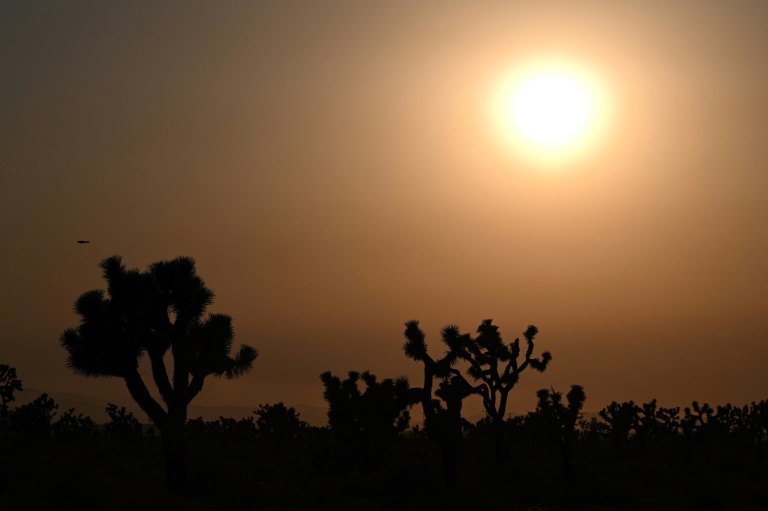
A “dangerous” heat wave was taking hold of the southwestern United States Tuesday, with punishing temperatures expected for the next week.

Forecasters said the mercury could reach as high as 112 Fahrenheit (44 Celsius) in the densely populated Los Angeles suburbs as a heat dome settles in over parts of California, Nevada and Arizona.

“Dangerously hot conditions expected through the week,” the National Weather Service warned.

“A prolonged period of excessive heat will significantly increase the potential for heat related illnesses, particularly for those working or participating in outdoor activities,” the NWS said.

“Those without access to adequate or reliable cooling or hydration will be at most risk, but much of the population could be susceptible to impacts as well.”

Nighttime temperatures are not expected to offer much relief, with lows struggling to get below 80 Fahrenheit in many places.

Things were heating up in and around Los Angeles on Tuesday, with inland areas already experiencing stifling temperatures.

But, said David Sweet, a meteorologist at the NWS in Oxnard, California, it is going to get worse.

“We’re looking at a heat wave starting on Wednesday and continuing through at least Monday of next week,” he told AFP.

“During that time, we’ll be looking at conditions hot enough to warrant an excessive heat warning,” he added.

It is not unusual for southern California to experience heat waves in September, but temperatures above 100 Fahrenheit are considered hot even for a place almost perpetually baked by sunshine.

The heat wave comes after swathes of the southwest were lashed with torrential rains over recent weeks.

Some areas, including the notoriously dusty Death Valley, suffered flooding, and one person died after being swept away in Zion National Park in Utah.

Scientists say global warming, which is being driven chiefly by humanity’s unending appetite for the power that fossil fuel provides, is making natural weather variations more extreme.

Heat waves are getting hotter and more intense, while storms are getting wetter and, in many cases, more dangerous.

Biden talks crime, guns in key election battleground

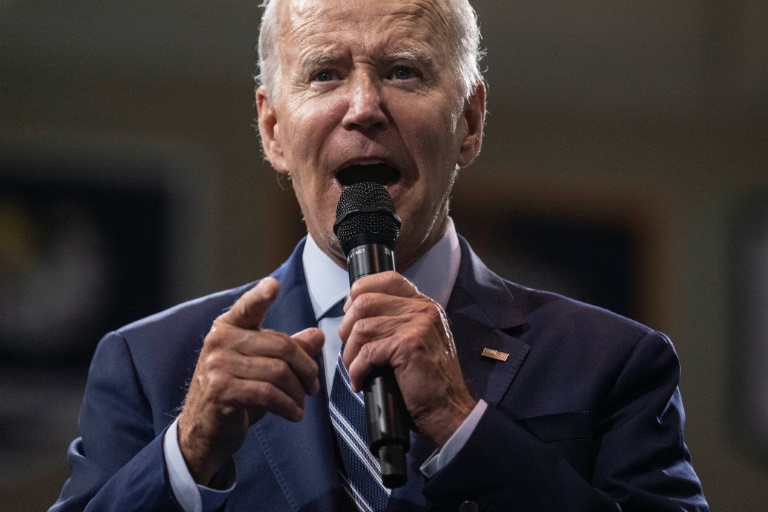
US President Joe Biden touted his plans to curb gun crime and framed Trumpist Republicans as a threat to the rule of law Tuesday on the first of multiple visits to the key swing state of Pennsylvania.

The Keystone State — which is hosting Biden three times over the coming days, including for a rare prime-time address to the nation on Thursday — is one of the most hotly contested battlegrounds as the president’s party seeks to hold on to Congress in the midterm elections.

The Democratic leader was in the city of Wilkes-Barre Tuesday — near his hometown of Scranton — where he promoted his Safer America Plan and called out Republicans for blocking gun reforms.

“I’m determined to ban assault weapons in this country. Determined. I did it once before and I’ll do it again,” Biden said, referring to his work as a senator in the 1990s to institute the last ban.

Biden’s proposals include substantial new funding for 100,000 extra police officers on the streets, investment in crime prevention, and “commonsense steps on guns to keep dangerous firearms out of dangerous hands.”

His visit came as former president Donald Trump, still the most influential Republican, is due to host his own rally in the same area on Saturday.

Republicans have presented themselves as the party of law-and-order amid a nationwide spike in murders — with some success, according to multiple polls — while accusing Democrats of wanting to defund the police.

– ‘Afraid of the NRA’ –

But Biden has attempted to turn the tables by pointing to the Republicans’ defense of US Capitol rioters and highlighting the various criminal investigations embroiling Trump.

The president set out his party’s actions on violent crime, highlighting the bipartisan gun safety package he signed into law in June, breaking a decades-long stalemate on firearms control.

Only 14 Republicans crossed the aisle and approve the package, which included enhanced background checks for younger buyers and federal cash for states introducing “red flag” laws that allow courts to temporarily remove weapons from those considered a threat.

Wayne LaPierre, the National Rifle Association’s executive vice president, said at the time that the legislation “undermines Second Amendment freedom.”

“The NRA was against it, which means the vast majority of Republicans in Congress couldn’t even stand up and vote for it because they’re afraid of the NRA,” Biden said Tuesday.

He also denounced attacks on the integrity of the FBI, three weeks after it raided Trump’s Florida residence to retrieve government secrets removed from the White House.

The federal law enforcement agency came under a barrage of criticism in right-wing circles after searching the Mar a Lago resort for government secrets — and was attacked by an armed man at its Cincinnati office in the following days.

– ‘Sickening’ –

“It’s sickening to see the new attacks on the FBI… There is no place in this country for endangering the lives of law enforcement. No place. None. Period,” Biden said.

“I’m opposed to defunding the police, I’m also opposed to defunding the FBI.”

And he berated “every single” Pennsylvania Republican lawmaker for voting against his American Rescue Plan, which provided hundreds of billions of dollars for states to help fund law enforcement and public safety programs.

The outcome of the upcoming US Senate election in Pennsylvania could decide whether the Democrats cede control of the evenly divided upper chamber of Congress to the Republicans for the next two years.

But Republican strategists worry that controversial Trump-backed candidates are muddying their path to victory.

The Cook Political Report moved the race to “lean Democrat” this month, however, citing widespread Republican concerns with Trump-backed celebrity physician Mehmet Oz’s campaign.

Initially preferring to present himself as a unifier in a deeply divided country, Biden has recently been concentrating his fire on Trumpist Republicans he has accused of embracing “semi-fascism.”

The 79-year-old Democrat, who narrowly beat Trump in Pennsylvania in 2020, will follow Tuesday’s address with two further visits to the state.

On Thursday he will echo his 2020 campaign theme about the battle for the “soul of nation” in historic Philadelphia, where the Declaration of Independence and US Constitution were written.

He will set out how an imperiled democracy threatens America’s standing on the international stage, according to White House officials, highlighting action to protect voting rights but warning that access to the ballot box is still at risk.

Stocks extend Fed-induced sell-off into third day

Global markets mostly tumbled again on Tuesday, extending losses sparked by last week’s Federal Reserve warning that more tough anti-inflation steps are on the way.

Wall Street indices tumbled around one percent, quickly dashing any hopes of a “turnaround Tuesday” after a small rebound in share prices prior to opening.

London’s FTSE 100 also closed lower after a public holiday the day before, while the Paris CAC 40 fell after staging a rally earlier in the day.

The Frankfurt DAX bucked the trend to end the day up 0.5 percent.

Elsewhere, Asian stocks indices diverged on Tuesday, winning limited support from bargain-buying.

Most markets have been slumping since Friday after Federal Reserve chief Jerome Powell warned of more interest rate hikes ahead — and no chance of a policy pivot — as it fights four-decade high inflation, even at the cost of economic pain.

A closely watched US survey found Americans consumers to be happier about the state of the economy than expected, and more willing to spend. And official figures showed job openings increased last month.

The strong data will boost the idea that the US economy does not need extra help from the Fed, said Ipek Ozkardeskaya, Swissquote Bank analyst.

“Cherry on top: the consumer sentiment regarding the future is improving,” she said. “Hence, there is no reason for the Fed to soften its stance.” 

– Energy woes –

Central banks are scrambling worldwide to tame consumer prices that have surged higher since Russia invaded Ukraine in late February.

German inflation data showed consumer prices rose by 7.9 percent in the year to August as the ongoing energy crisis further stoked price pressures.

In Spain, the inflation rate slowed to 10.4 percent in August as fuel prices eased, but it remained elevated due to rising electricity and food prices.

The European Central Bank — which raised interest rates for the first time in over a decade in July — is expected to hike them again when it meets next week.

Energy prices retreated on Tuesday, however, with oil contracts tanking on fears about a major hit to demand from any global economic slowdown — and more Covid restrictions in key consumer market China.

Brent North Sea crude fell below $100 per barrel.

Natural gas prices, which have soared this year over supply disruptions from key producer Russia, dipped in Europe as German Chancellor Olaf Scholz said government measures have left his country better prepared to cope with further delivery cuts in the winter.

Many European countries are facing severe supply problems as Moscow turns off the gas taps in response to EU military and diplomatic backing for Ukraine.

Russian energy giant Gazprom plans to suspend gas deliveries through the Nord Stream pipeline, which runs to Germany, for three days of “maintenance” work from Wednesday.

– Key figures at around 2030 GMT –

New York – Dow: DOWN 1.0 percent at 31,790.87 points (close)

New York – S&P 500: DOWN 1.1 percent at 3,986.16(close)

New York – Nasdaq: DOWN 1.1 percent at 11,883.14 (close)

London – FTSE 100: DOWN 0.9 percent at 7,361.63 points (close)

Frankfurt – DAX: UP 0.5 percent at 12,961.14 (close)

Paris – CAC 40: DOWN 0.2 percent at 6,210.22 (close)

EURO STOXX 50: DOWN 0.2 percent at 3,561.92 (close)

Tokyo – Nikkei 225: UP 1.1 percent at 28,195.58 (close)

Hong Kong – Hang Seng Index: DOWN 0.4 percent at 19,949.03 (close)

Shanghai – Composite: DOWN 0.4 percent at 3,227.22 (close)

Euro/dollar: UP at $1.0024 from $0.9972 on Monday

Pound/dollar: DOWN at $1.1661 from $1.1709

Euro/pound: UP at 85.95 pence from 85.38 pence

Dollar/yen: DOWN at 138.66 yen from 138.68 yen

West Texas Intermediate: DOWN 5.5 percent at $91.64 per barrel

Brent North Sea crude: DOWN 5.5 percent at $99.31 per barrel

burs-rox-bfm/hs

Webb telescope captures new detail of Phantom Galaxy

The James Webb space telescope has revealed dazzling new detail of a previously known slice of the cosmos 32 million light-years away, in a new picture released by NASA and the European Space Agency (ESA).

The infrared technology of the telescope, launched in December 2021, has allowed for an even clearer view of the so-called Phantom Galaxy than astronomers had ever seen before.  

“Webb’s sharp vision has revealed delicate filaments of gas and dust in the grandiose spiral arms which wind outwards from the center of this image,” NASA and the ESA said Monday. 

“A lack of gas in the nuclear region also provides an unobscured view of the nuclear star cluster at the galaxy’s center,” the agencies said in a statement.

The whirling celestial form, officially called M74, is located in the Pisces constellation 32 million light-years away from Earth. 

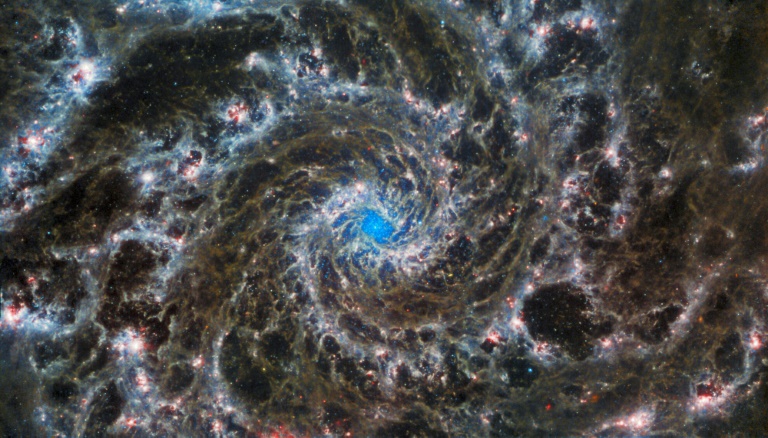
The Webb image shows the galaxy’s brilliant white, red, pink and light blue appendages of dust and stars swirling around a bright blue center, all set against the dark backdrop of deep space. 

M74 was previously photographed by the Hubble telescope, which captured the galaxy’s spiraling blue and pink arms, but instead showed its glowing center as a soft yellow. 

The Phantom Galaxy is a “favorite target for astronomers studying the origin and structure of galactic spirals,” NASA and the ESA said. The picture taken by Webb will help them “learn more about the earliest phases of star formation in the local Universe,” and record more information about 19 star-forming galaxies close to our own Milky Way. 

Astronomers will also use the picture to “pinpoint star-forming regions in the galaxies, accurately measure the masses and ages of star clusters, and gain insights into the nature of the small grains of dust drifting in interstellar space,” the statement said. 

Webb’s new pictures have thrilled the space community as the telescope orbits the Sun at a distance of a million miles (1.6 million kilometers) from Earth, in a region of space called the second Lagrange point.

The telescope, which has a primary mirror more than 21 feet (6.5 meters) wide, is an international collaboration between NASA, the ESA and the Canadian Space Agency. It is expected to operate for approximately 20 years.

Webb telescope captures new detail of Phantom Galaxy

The James Webb space telescope has revealed dazzling new detail of a previously known slice of the cosmos 32 million light-years away, in a new picture released by NASA and the European Space Agency (ESA).

The infrared technology of the telescope, launched in December 2021, has allowed for an even clearer view of the so-called Phantom Galaxy than astronomers had ever seen before.  

“Webb’s sharp vision has revealed delicate filaments of gas and dust in the grandiose spiral arms which wind outwards from the center of this image,” NASA and the ESA said Monday. 

“A lack of gas in the nuclear region also provides an unobscured view of the nuclear star cluster at the galaxy’s center,” the agencies said in a statement.

The whirling celestial form, officially called M74, is located in the Pisces constellation 32 million light-years away from Earth. 

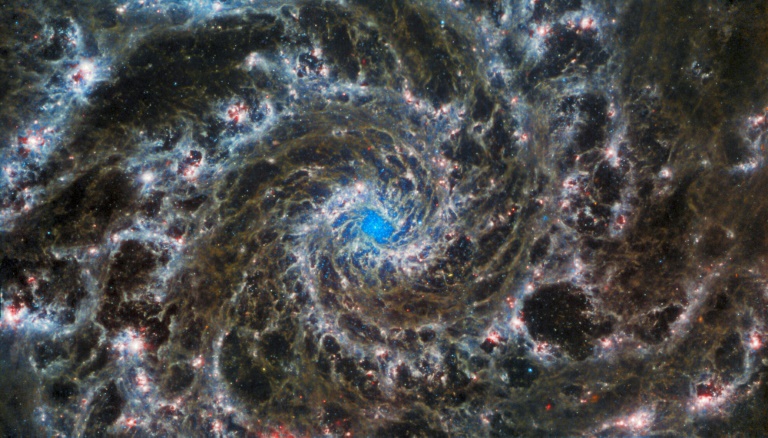
The Webb image shows the galaxy’s brilliant white, red, pink and light blue appendages of dust and stars swirling around a bright blue center, all set against the dark backdrop of deep space. 

M74 was previously photographed by the Hubble telescope, which captured the galaxy’s spiraling blue and pink arms, but instead showed its glowing center as a soft yellow. 

The Phantom Galaxy is a “favorite target for astronomers studying the origin and structure of galactic spirals,” NASA and the ESA said. The picture taken by Webb will help them “learn more about the earliest phases of star formation in the local Universe,” and record more information about 19 star-forming galaxies close to our own Milky Way. 

Astronomers will also use the picture to “pinpoint star-forming regions in the galaxies, accurately measure the masses and ages of star clusters, and gain insights into the nature of the small grains of dust drifting in interstellar space,” the statement said. 

Webb’s new pictures have thrilled the space community as the telescope orbits the Sun at a distance of a million miles (1.6 million kilometers) from Earth, in a region of space called the second Lagrange point.

The telescope, which has a primary mirror more than 21 feet (6.5 meters) wide, is an international collaboration between NASA, the ESA and the Canadian Space Agency. It is expected to operate for approximately 20 years.

Pakistan floods 'worst in country's history', aid efforts gather pace

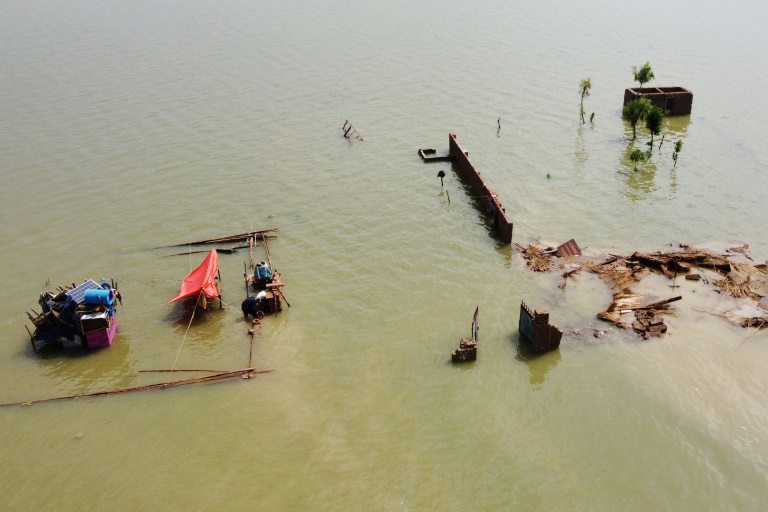
Aid efforts ramped up across flooded Pakistan on Tuesday to help tens of millions of people affected by relentless monsoon rains that have submerged a third of the country and claimed more than 1,100 lives.

Prime Minister Shehbaz Sharif called the flooding “the worst in the history of Pakistan”, adding it would cost at least $10 billion to repair damaged infrastructure spread across the country. 

The rains that began in June have unleashed powerful floods across the country that have washed away swathes of vital crops and damaged or destroyed more than a million homes.

Authorities and charities are struggling to accelerate aid delivery to more than 33 million people, a challenging task in areas cut off because many roads and bridges have been critically damaged.

Displaced people have been wandering what dry land remains, seeking shelter, food and drinking water.

“For God’s sake help us out,” said Qadir, 35, who was camped out with his extended family on a road near the southern city of Sukkur.

“We walked along the road for three days to reach here. There’s nothing left back at home, we only managed to save our lives.”

In the country’s south and west, many Pakistanis have crammed onto elevated highways and railroad tracks to escape the flooded plains.

“We don’t even have space to cook food. We need help,” Rimsha Bibi, a schoolgirl in Dera Ghazi Khan in central Pakistan, told AFP.

Pakistan receives heavy — often destructive — rains during its annual monsoon season, which are crucial for agriculture and water supplies.

But such intense downpours have not been seen for three decades.

Pakistani officials have blamed climate change, which is increasing the frequency and intensity of extreme weather around the world.

– ‘Mind-boggling devastation’ –

“To see the devastation on the ground is really mind-boggling,” Pakistan’s climate change minister Sherry Rehman told AFP.

“When we send in water pumps, they say, ‘Where do we pump the water?’ It’s all one big ocean, there’s no dry land to pump the water out.”

She said “literally a third” of the country was under water, comparing scenes from the disaster to a dystopian movie.

Tributaries of the Indus River, which runs the length of the South Asian nation, have sent torrents of water rushing downstream.

Pakistan as a whole has been deluged with twice the usual monsoon rainfall, the meteorological office said, but Balochistan and Sindh provinces have seen more than four times the average of the last three decades.

– ‘Monsoon on steroids’ –

The disaster could not have come at a worse time for Pakistan, where the economy is in free fall.

Appealing for international help, the government has declared an emergency.

Aid flights have arrived in recent days from China, Turkey and the United Arab Emirates, while other countries including Canada, Australia and Japan have also pledged assistance.

The United Nations launched a formal $160 million appeal on Tuesday to fund emergency aid.

“Pakistan is awash in suffering. The Pakistani people are facing a monsoon on steroids — the relentless impact of epochal levels of rain and flooding,” UN Secretary-General Antonio Guterres said in a video statement, calling it a “colossal crisis”.

His spokesman later said that Guterres would visit the country next week in “solidarity” with victims.

And the United States said Tuesday that it was sending $30 million in humanitarian assistance. 

Pakistan’s Sharif promised donors that any funding would be responsibly spent.

“I want to give my solemn pledge and solemn commitment… every penny will be spent in a very transparent fashion. Every penny will reach the needy,” he said.

Pakistan was already desperate for international support and the floods have compounded the challenge.

Prices of basic goods — particularly onions, tomatoes and chickpeas — are soaring as vendors bemoan a lack of supplies from the flooded breadbasket provinces of Sindh and Punjab.

There was some relief on Monday when the International Monetary Fund approved the revival of a loan programme for Pakistan, releasing a $1.1 billion tranche.

Makeshift relief camps have sprung up all over Pakistan — in schools, on motorways and in military bases.

In the northwestern town of Nowshera, a technical college was turned into a shelter for up to 2,500 flood victims.

They sweltered in the summer heat with sporadic food aid and little access to water.

“I never thought that one day we will have to live like this,” said 60-year-old Malang Jan.

“We have lost our heaven and are now forced to live a miserable life.”

Mississippi declares drinking water emergency for state capital

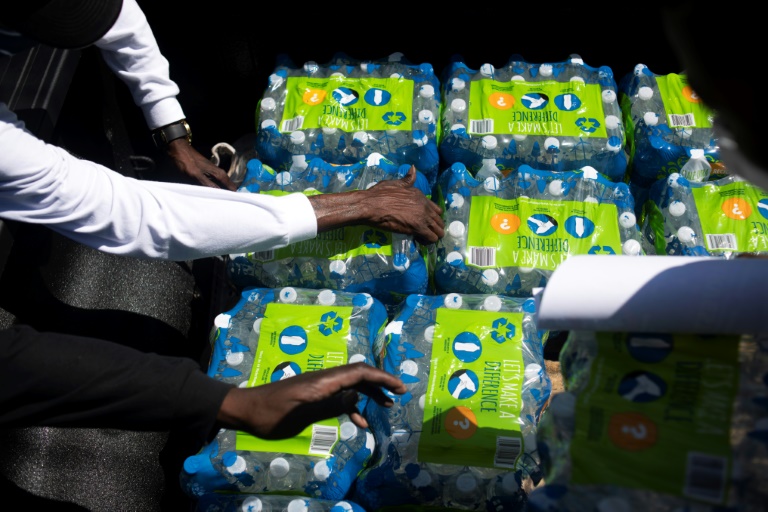
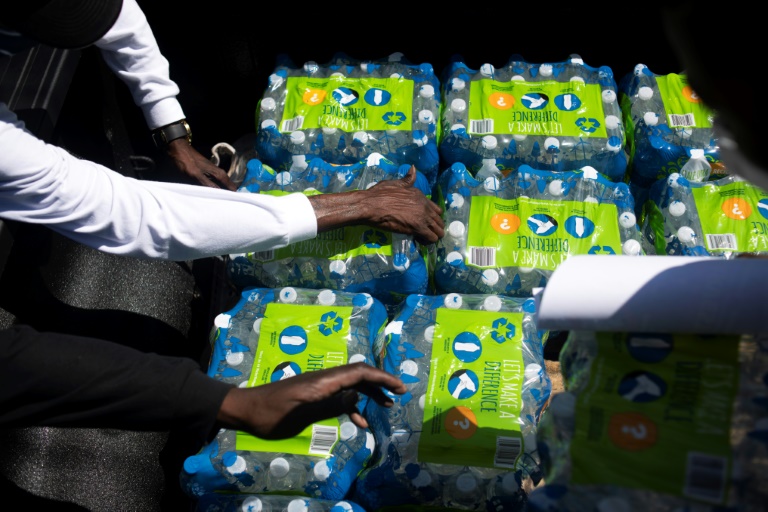
Mississippi officials declared a health emergency Tuesday after historic flooding damaged treatment systems and left 180,000 people in the state capital Jackson without safe drinking water.

Governor Tate Reeves warned residents about the crisis and on Tuesday deployed the National Guard to assist in water distribution throughout the city.

The Mississippi State Department of Health (MSDH) said water treatment pumps had failed and there were low levels of water in storage tanks serving Jackson.

Many city taps were dry, and water that was flowing was contaminated or untreated, officials cautioned.

“We do not have reliable running water at scale,” Reeves told a press conference late Monday. 

“The city cannot produce enough water to fight fires, to reliably flush toilets and to meet other critical needs,” he said, adding emergency services would distribute drinking water to residents in a “massively complicated logistical task.” 

Facing aging infrastructure, Jackson has been under a boil water order since late July.

Recent torrential rains intensified the crisis as the city’s Pearl River has faced historic flooding, which finally started to ease Monday, Jackson City Hall said in a statement. 

“It is no surprise that we have a very fragile water-treatment facility, and (the city’s treatment plant) OB Curtis receives its water from the reservoir, and because of the river water coming into the plant, we have to change how we treat the water,” Jackson Mayor Chokwe Antar Lumumba said at a press conference, according to the Mississippi Clarion Ledger newspaper.

According to the MSDH, water treatment plants in Jackson do not have sufficient maintenance staff or certified operators to safely run the system, leading to potential for contamination from dangerous organisms such as E.Coli and Giardia.

Reeves urged residents to avoid the water coming out of their faucets. 

“In too many cases, it is raw water from the reservoir being pushed through the pipes. Be smart, protect yourself, protect your family, preserve water, look out for your fellow man and look out for your neighbors.”

Without water, Jackson public schools were conducting virtual learning Tuesday, with no return to school yet scheduled.

White House spokeswoman Karine Jean-Pierre said President Joe Biden had been briefed on the situation.

“At his direction, we have been in regular contact with state and local officials, including Mayor Lumumba, and made clear that the Federal Government stands ready to offer assistance,” she tweeted. 

Jackson’s water system has suffered “significant deficiencies” since 2016, according to an MDSH report, with lead-contaminated pipes often more than a century old. 

The majority-Black city’s former public works director Charles Williams told AFP in April it could cost up to $5 billion to replace the necessary infrastructure.

Mississippi declares drinking water emergency for state capital

Mississippi officials declared a health emergency Tuesday after historic flooding damaged treatment systems and left 180,000 people in the state capital Jackson without safe drinking water.

Governor Tate Reeves warned residents about the crisis and on Tuesday deployed the National Guard to assist in water distribution throughout the city.

The Mississippi State Department of Health (MSDH) said water treatment pumps had failed and there were low levels of water in storage tanks serving Jackson.

Many city taps were dry, and water that was flowing was contaminated or untreated, officials cautioned.

“We do not have reliable running water at scale,” Reeves told a press conference late Monday. 

“The city cannot produce enough water to fight fires, to reliably flush toilets and to meet other critical needs,” he said, adding emergency services would distribute drinking water to residents in a “massively complicated logistical task.” 

Facing aging infrastructure, Jackson has been under a boil water order since late July.

Recent torrential rains intensified the crisis as the city’s Pearl River has faced historic flooding, which finally started to ease Monday, Jackson City Hall said in a statement. 

“It is no surprise that we have a very fragile water-treatment facility, and (the city’s treatment plant) OB Curtis receives its water from the reservoir, and because of the river water coming into the plant, we have to change how we treat the water,” Jackson Mayor Chokwe Antar Lumumba said at a press conference, according to the Mississippi Clarion Ledger newspaper.

According to the MSDH, water treatment plants in Jackson do not have sufficient maintenance staff or certified operators to safely run the system, leading to potential for contamination from dangerous organisms such as E.Coli and Giardia.

Reeves urged residents to avoid the water coming out of their faucets. 

“In too many cases, it is raw water from the reservoir being pushed through the pipes. Be smart, protect yourself, protect your family, preserve water, look out for your fellow man and look out for your neighbors.”

Without water, Jackson public schools were conducting virtual learning Tuesday, with no return to school yet scheduled.

White House spokeswoman Karine Jean-Pierre said President Joe Biden had been briefed on the situation.

“At his direction, we have been in regular contact with state and local officials, including Mayor Lumumba, and made clear that the Federal Government stands ready to offer assistance,” she tweeted. 

Jackson’s water system has suffered “significant deficiencies” since 2016, according to an MDSH report, with lead-contaminated pipes often more than a century old. 

The majority-Black city’s former public works director Charles Williams told AFP in April it could cost up to $5 billion to replace the necessary infrastructure.

London mayor warns of possible 'Tube' fare hikes

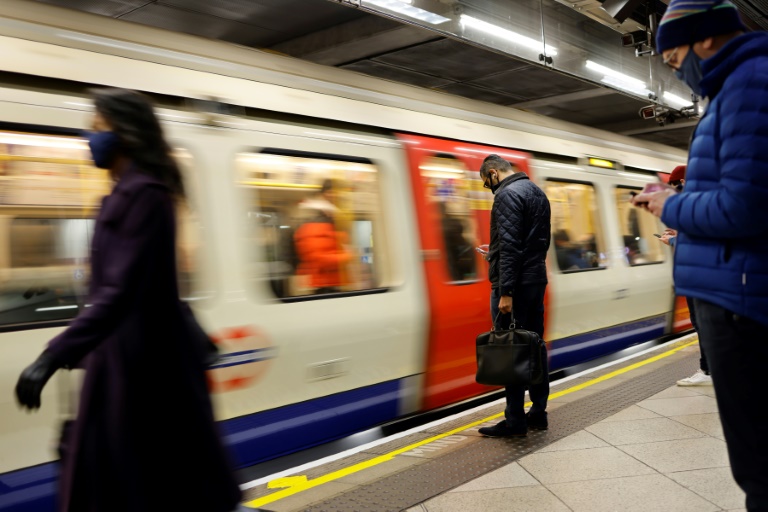
London’s mayor warned Tuesday of possible fare rises and service cuts after the capital’s transport operator struck a 20-month funding deal with the UK government that still leaves a budget “gap”.

Transport for London (TfL), which runs the underground “Tube” network, said the government had agreed to provide £1.2 billion ($1.4 bn) until the end of March 2024, as the system struggles to recover from the pandemic.

But Labour mayor Sadiq Khan said the settlement with the ruling Conservative government meant a £740 million funding shortfall remained, and that fare hikes and service reductions were under consideration.

“There could well be increases in fares coming during the midst of a cost-of-living crisis, which to me seems nonsensical, but also we could see some cuts in services to make sure our books balance,” he added.

The government has provided TfL, which also operates bus and overground railway services throughout the capital, with billions of pounds in emergency funding since March 2020, when the UK first went into lockdown due to coronavirus.

Although the country has been free from restrictions for nearly a year, the transport system has not fully recovered from the financial impact, as some employees continue to work from home part of the week.

Meanwhile, TfL has been hit by strikes this summer amid a dispute over jobs and pensions, one of many UK sectors suffering from industrial action as decades-high inflation impacts across the economy.

Transport Secretary Grant Shapps said the latest funding deal showed the government’s “unwavering commitment to London and the transport network it depends on”, but added that ministers “have to be fair to taxpayers across the entire country”.

“This deal more than delivers for Londoners,” he argued, while urging Khan “to get TfL back on a steady financial footing (and) stop relying on government bailouts”.

UN appeals for $160 mn to help worst hit in Pakistan floods

The United Nations and Pakistan launched an emergency appeal for $160 million on Tuesday as the country was submerged by floods, with the United States quickly offering $30 million.

The funds will provide 5.2 million of the worst-affected and most vulnerable people with aid including food, clean water, sanitation and emergency education, UN Secretary General Antonio Guterres said, calling the disaster a “colossal crisis”.

“Pakistan is awash in suffering. The Pakistani people are facing a monsoon on steroids — the relentless impact of epochal levels of rain and flooding,” he said in a video statement before announcing plans to visit Pakistan next week.

The United States, the largest donor to Pakistan, said it was providing a fresh $30 million for urgent needs including food, safe water and hygiene.

The US Agency for International Development in a statement announcing the aid said that one of its disaster specialists was working out of Islamabad to assess needs and coordinate with the Pakistani government and other local partners.

The United Nations said the aid would cover the initial six months of the crisis response and help to avoid outbreaks of diseases such as cholera, as well as providing nutrition to young children and their mothers.

It will also provide assistance to refugees and facilitate schemes to reunite families separated by the disaster.

“The people of Pakistan urgently need international solidarity and support,” Jens Laerke, spokesman for the UN humanitarian agency OCHA, told a press briefing in Geneva.

He said some 500,000 people displaced by the floods were sheltering in relief camps, with many more temporarily staying with host families.

Around 150 bridges have been washed away, he said, and 3,500 kilometres (2,175 miles) of roads damaged in flooding and landslides, hampering access.

“The heavy rains are forecast to continue and with many dams and rivers already at flood levels, the flooding is likely to get worse before it gets better,” Laerke said.

– Health facilities wrecked –

Tens of millions of people have been affected by relentless monsoon rains that have submerged a third of Pakistan and claimed more than 1,100 lives.

The rains that began in June have unleashed the worst flooding in more than a decade, washing away swathes of vital crops and damaging or destroying more than a million homes.

World Health Organization spokesman Christian Lindmeier said Pakistan’s health facilities had been severely affected by the flooding, with 180 “completely damaged”.

He said there was already a vast disparity between rural and urban healthcare provision, while treatment for non-communicable diseases such as diabetes would be “severely” impacted.

“It’s a vast problem which opens up here,” he said.

The UN refugee agency said there were 1.3 million Afghan refugees registered in Pakistan and it had already delivered $1.5 million worth of emergency relief and shelter items — but “much, much more” would be needed in the coming weeks.

– ‘Climate catastrophe’ –

Guterres branded the floods a “climate catastrophe”, saying South Asia was one of the world’s hotspots where people are “15 times more likely to die from climate impacts”.

“It is outrageous that climate action is being put on the back burner as global emissions of greenhouse gases are still rising, putting all of us — everywhere — in growing danger,” he said.

The UN’s World Meteorological Organization said that Pakistan and northwest India have been witnessing an intense 2022 monsoon season.

One site at Padidan in the southern Sindh province was reporting 1,288 millimetres of rain so far in August, compared to the monthly average of 46 millimetres, said WMO spokeswoman Clare Nullis.

Close Bitnami banner
Bitnami