AFP

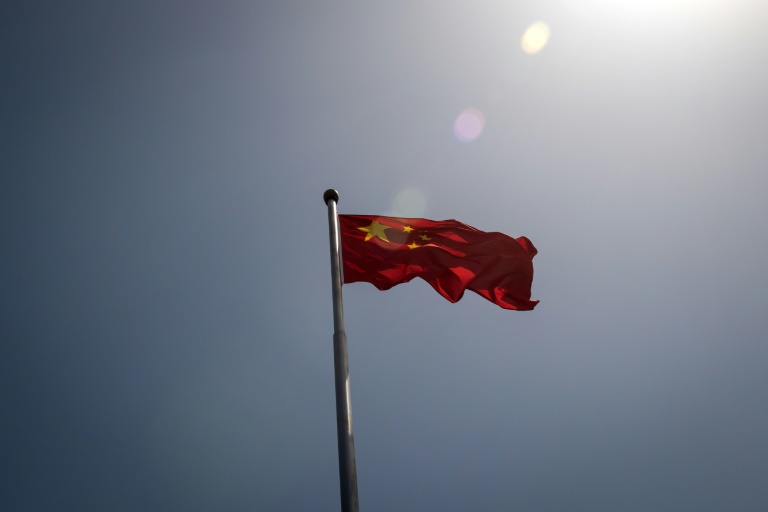
China probes state property firm execs for 'serious violations'

China has announced it is investigating several executives at state-owned property companies over allegations of “serious violations of discipline and law”.

The probes are another blow to a key sector, which is already struggling with slowing sales, angry customers and heavily indebted developers.

Authorities said in separate notices on Tuesday that they were investigating Zhuang Yuekai, chairman of C&D Real Estate, and Shi Zhen, chairman of C&D Urban Services.

They are also looking into Liu Hui, deputy general manager of Shenzhen Talents Housing Group, and Tang Yong, a former chairman at China Resources Land.

All four were “suspected of serious violations of discipline and law”, the notices said, providing few details.

The language used in the announcements, however, typically indicates impending graft charges.

These investigations may “deal a further blow to investor confidence and cause market worries about the internal governance of some state-owned enterprises”, ANZ’s Ting Meng told Bloomberg News.

The investigations come ahead of the ruling Communist Party’s 20th National Congress, at which President Xi Jinping is widely expected to be anointed for an unprecedented third term.

Xi has championed an anti-corruption drive since coming to power, taking down big-name detractors, and observers expect him to use the months leading up to the meeting to cement his grip on power.

The probes follow a regulatory crackdown on some of China’s biggest tech firms.

Authorities have also in recent months announced investigations into figures in the semiconductor industry, including minister for industry and information technology Xiao Yaqing.

Regulatory chiefs, insurance giants, security officials and financiers have faced censure or prosecution under the anti-corruption drive, but it is rare for a minister to be targeted while still in office.

The vast majority of people who have been investigated for corruption in China were eventually convicted.

China probes state property firm execs for 'serious violations'

China has announced it is investigating several executives at state-owned property companies over allegations of “serious violations of discipline and law”.

The probes are another blow to a key sector, which is already struggling with slowing sales, angry customers and heavily indebted developers.

Authorities said in separate notices on Tuesday that they were investigating Zhuang Yuekai, chairman of C&D Real Estate, and Shi Zhen, chairman of C&D Urban Services.

They are also looking into Liu Hui, deputy general manager of Shenzhen Talents Housing Group, and Tang Yong, a former chairman at China Resources Land.

All four were “suspected of serious violations of discipline and law”, the notices said, providing few details.

The language used in the announcements, however, typically indicates impending graft charges.

These investigations may “deal a further blow to investor confidence and cause market worries about the internal governance of some state-owned enterprises”, ANZ’s Ting Meng told Bloomberg News.

The investigations come ahead of the ruling Communist Party’s 20th National Congress, at which President Xi Jinping is widely expected to be anointed for an unprecedented third term.

Xi has championed an anti-corruption drive since coming to power, taking down big-name detractors, and observers expect him to use the months leading up to the meeting to cement his grip on power.

The probes follow a regulatory crackdown on some of China’s biggest tech firms.

Authorities have also in recent months announced investigations into figures in the semiconductor industry, including minister for industry and information technology Xiao Yaqing.

Regulatory chiefs, insurance giants, security officials and financiers have faced censure or prosecution under the anti-corruption drive, but it is rare for a minister to be targeted while still in office.

The vast majority of people who have been investigated for corruption in China were eventually convicted.

Whistle blows in Germany for world's first hydrogen train fleet

Germany on Wednesday will inaugurate a railway line powered entirely by hydrogen, a “world first” and a major step forward for green train transport despite nagging supply challenges.

A fleet of 14 trains provided by French industrial giant Alstom to the German state Lower Saxony will replace the diesel locomotives on the 100 kilometres (60 miles) of track connecting the cities of Cuxhaven, Bremerhaven, Bremervoerde and Buxtehude near Hamburg.

“Whatever the time of day, passengers will travel on this route thanks to hydrogen”, Stefan Schrank, project manager at Alstom, told AFP, hailing a “world first”. 

Hydrogen trains have become a promising way to decarbonise the rail sector and replace diesel, which still powers 20 percent of journeys in Germany.

Billed as a “zero emission” mode of transport, the trains mix hydrogen on board with oxygen present in the ambient air, thanks to a fuel cell installed in the roof. This produces the electricity needed to pull the train.

– Run for its money –

Designed in the southern French town of Tarbes and assembled in Salzgitter in central Germany, Alstom’s trains — called Coradia iLint — are trailblazers in the sector.

The project drew investment of “several tens of millions of euros” and created jobs for up to 80 employees in the two countries, according to Alstom. 

Commercial trials have been carried out since 2018 on the line with two hydrogen trains but now the entire fleet is adopting the ground-breaking technology.

The French group has inked four contracts for several dozen trains between Germany, France and Italy, with no sign of demand waning. 

In Germany alone “between 2,500 and 3,000 diesel trains could be replaced by hydrogen models”, Schrank estimates. 

“By 2035, around 15 to 20 percent of the regional European market could run on hydrogen,” Alexandre Charpentier, rail expert at consultancy Roland Berger, told AFP.

Hydrogen trains are particularly attractive on short regional lines where the cost of a transition to electric outstrips the profitability of the route. 

Currently, around one out of two regional trains in Europe runs on diesel.

But Alstom’s competitors are ready to give it a run for its money. German behemoth Siemens unveiled a prototype hydrogen train with national rail company Deutsche Bahn in May, with a view to a roll-out in 2024.

But, despite the attractive prospects, “there are real barriers” to a big expansion with hydrogen, Charpentier said.

For starters, trains are not the only means of transport hungry for the fuel.

The entire sector, whether it be road vehicles or aircraft, not to mention heavy industry such as steel and chemicals, are eyeing hydrogen to slash CO2 emissions.

– Colossal investment –

Although Germany announced in 2020 an ambitious seven-billion-euro (-dollar) plan to become a leader in hydrogen technologies within a decade, the infrastructure is still lacking in Europe’s top economy.

It is a problem seen across the continent, where colossal investment would be needed for a real shift to hydrogen.

“For this reason, we do not foresee a 100-percent replacement of diesel trains with hydrogen,” Charpentier said.

Furthermore, hydrogen is not necessarily carbon-free: only “green hydrogen”, produced using renewable energy, is considered sustainable by experts. 

Other, more common manufacturing methods exist, but they emit greenhouse gases because they are made from fossil fuels. 

The Lower Saxony line will in the beginning have to use a hydrogen by-product of certain industries such as the chemical sector.

The French research institute IFP specialising in energy issues says that hydrogen is currently “95 percent derived from the transformation of fossil fuels, almost half of which come from natural gas”. 

Europe’s enduring reliance on gas from Russia amid massive tensions over the Kremlin’s invasion of Ukraine poses major challenges for the development of hydrogen in rail transport.

“Political leaders will have to decide which sector to prioritise when determining what the production of hydrogen will or won’t go to,” Charpentier said. 

Germany will also have to import massively to meet its needs. 

Partnerships have recently been signed with India and Morocco, and an agreement to import hydrogen from Canada was on the agenda this week during a visit by Chancellor Olaf Scholz.

Whistle blows in Germany for world's first hydrogen train fleet

Germany on Wednesday will inaugurate a railway line powered entirely by hydrogen, a “world first” and a major step forward for green train transport despite nagging supply challenges.

A fleet of 14 trains provided by French industrial giant Alstom to the German state Lower Saxony will replace the diesel locomotives on the 100 kilometres (60 miles) of track connecting the cities of Cuxhaven, Bremerhaven, Bremervoerde and Buxtehude near Hamburg.

“Whatever the time of day, passengers will travel on this route thanks to hydrogen”, Stefan Schrank, project manager at Alstom, told AFP, hailing a “world first”. 

Hydrogen trains have become a promising way to decarbonise the rail sector and replace diesel, which still powers 20 percent of journeys in Germany.

Billed as a “zero emission” mode of transport, the trains mix hydrogen on board with oxygen present in the ambient air, thanks to a fuel cell installed in the roof. This produces the electricity needed to pull the train.

– Run for its money –

Designed in the southern French town of Tarbes and assembled in Salzgitter in central Germany, Alstom’s trains — called Coradia iLint — are trailblazers in the sector.

The project drew investment of “several tens of millions of euros” and created jobs for up to 80 employees in the two countries, according to Alstom. 

Commercial trials have been carried out since 2018 on the line with two hydrogen trains but now the entire fleet is adopting the ground-breaking technology.

The French group has inked four contracts for several dozen trains between Germany, France and Italy, with no sign of demand waning. 

In Germany alone “between 2,500 and 3,000 diesel trains could be replaced by hydrogen models”, Schrank estimates. 

“By 2035, around 15 to 20 percent of the regional European market could run on hydrogen,” Alexandre Charpentier, rail expert at consultancy Roland Berger, told AFP.

Hydrogen trains are particularly attractive on short regional lines where the cost of a transition to electric outstrips the profitability of the route. 

Currently, around one out of two regional trains in Europe runs on diesel.

But Alstom’s competitors are ready to give it a run for its money. German behemoth Siemens unveiled a prototype hydrogen train with national rail company Deutsche Bahn in May, with a view to a roll-out in 2024.

But, despite the attractive prospects, “there are real barriers” to a big expansion with hydrogen, Charpentier said.

For starters, trains are not the only means of transport hungry for the fuel.

The entire sector, whether it be road vehicles or aircraft, not to mention heavy industry such as steel and chemicals, are eyeing hydrogen to slash CO2 emissions.

– Colossal investment –

Although Germany announced in 2020 an ambitious seven-billion-euro (-dollar) plan to become a leader in hydrogen technologies within a decade, the infrastructure is still lacking in Europe’s top economy.

It is a problem seen across the continent, where colossal investment would be needed for a real shift to hydrogen.

“For this reason, we do not foresee a 100-percent replacement of diesel trains with hydrogen,” Charpentier said.

Furthermore, hydrogen is not necessarily carbon-free: only “green hydrogen”, produced using renewable energy, is considered sustainable by experts. 

Other, more common manufacturing methods exist, but they emit greenhouse gases because they are made from fossil fuels. 

The Lower Saxony line will in the beginning have to use a hydrogen by-product of certain industries such as the chemical sector.

The French research institute IFP specialising in energy issues says that hydrogen is currently “95 percent derived from the transformation of fossil fuels, almost half of which come from natural gas”. 

Europe’s enduring reliance on gas from Russia amid massive tensions over the Kremlin’s invasion of Ukraine poses major challenges for the development of hydrogen in rail transport.

“Political leaders will have to decide which sector to prioritise when determining what the production of hydrogen will or won’t go to,” Charpentier said. 

Germany will also have to import massively to meet its needs. 

Partnerships have recently been signed with India and Morocco, and an agreement to import hydrogen from Canada was on the agenda this week during a visit by Chancellor Olaf Scholz.

Boiling heat and no water: taps run dry in southern Iraq

Younes Ajil turns on the tap in his home but nothing comes out: dozens of villages are without running water in drought-hit Iraq, surviving on sporadic tanker-truck deliveries and salty wells.

For everything from drinking to bathing and washing dishes and clothes, Ajil and his eight children wait at their home in Al-Aghawat for trucked-in water from the Diwaniyah provincial authorities once or twice a week.

In burning summer temperatures that at times approach 50 degrees Celsius (122 Fahrenheit), he said he hasn’t bathed for four days.

“Even if there were daily deliveries, there would not be enough” water, the 42-year-old said.

Iraq is known in Arabic as the Land of the Two Rivers, but it has seen water levels on the once mighty Tigris and Euphrates plummet.

The Euphrates, which passes through Diwaniyah province, has visibly contracted in recent months, with some of the river’s weaker branches drying up.

Governor Zouheir al-Shaalan said “around a third” of his province has problems accessing water, with more than 75 villages affected.

Ajil has dug a well, but the water is salty.

“We mix that with the water from the trucks and make do,” he told AFP.

– Climate migration –

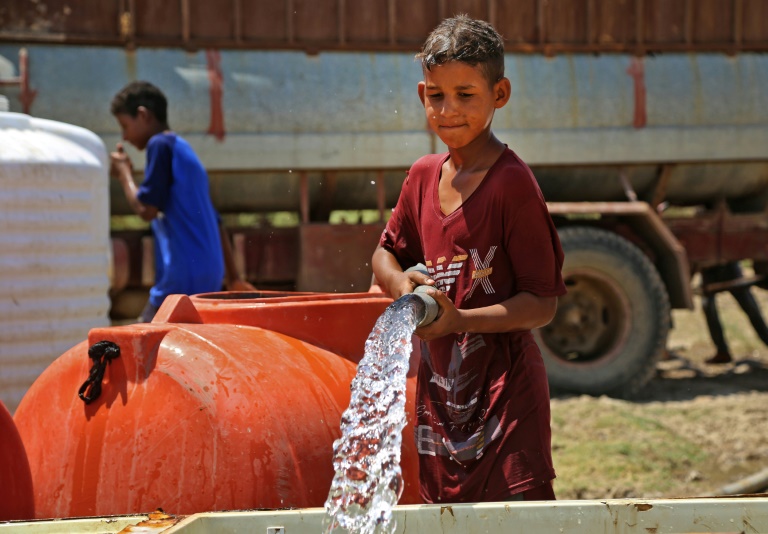
Local children cry out and run towards an orange water truck as it drives up the dirt road in their village. 

One person fills a tall white tank, climbing on top of it to hold the truck’s hose as water gushes out, while others wait to fill smaller tanks or even cooking pots.

Children splash gleefully in a rusting old fridge that has been laid on the ground as a cramped, makeshift tub. 

The UN classifies Iraq as the world’s fifth most vulnerable country to climate change.

Authorities blame drought for the current water shortages, but also dams built upstream on some rivers and tributaries in neighbouring Turkey and Iran.

Ajil shares his house with his brother, Mohammed.

Like most of their neighbours, they used to make a living from farming.

But over the past two years, the drought has brought local agriculture to its knees, so they have been selling their sheep to survive.

There are around 50 houses in the village, Ajil said, but only 10 families remain.

“The rest have left,” he said. “If there is no water, there is no more life.”

A report published this month by the International Organization for Migration in Iraq said that “climate migration is already a reality” in the country.

More than 3,300 families across 10 provinces in the country’s centre and south were displaced due to “climate factors” as of March this year, the report said, blaming water scarcity, high salinity and poor water quality. 

– ‘Farming is our lives’ –

Hassan Naim, who manages Diwaniyah’s water resources, said around 20 treatment plants were at a standstill.

Before, “some rivers ran dry, but only for a matter of days”, he said.

The present crisis has been going on for more than two months.

Naim acknowledged that authorities were distributing a “very low” amount of water compared to what was needed, but cautioned against using high-salinity well-water.

Diwaniyah Governor Shaalan said that to end the shortages, the province needed to receive double the current water flows of 85-90 cubic metres (3,000-3,200 cubic feet) per second along the Euphrates.

“Diwaniyah has no border crossings, oilfields, religious sanctuaries or tourism” to generate income, he said, urging authorities in Baghdad to exclude the province from the federal government’s water rationing plan.

“Farming is our lives,” he said.

Hundreds of angry Diwaniyah residents have twice taken to the streets to protest the situation.

Al-Aghawat resident Razzak Issa believes a deal with Turkey, the source of the Euphrates, is needed to increase water supplies.

“Yes, we can ration usage, but it’s hot. How am I supposed to ration? I don’t bathe? I don’t wash my clothes? I don’t bathe my children? It’s impossible,” he said.

He too mixes salty water from his well with the trucked-in water from the authorities.

“Where can we go?” he said. “Everywhere in Iraq is “torture”.

'We are divided': lake upends life for tiny Kenyan tribe

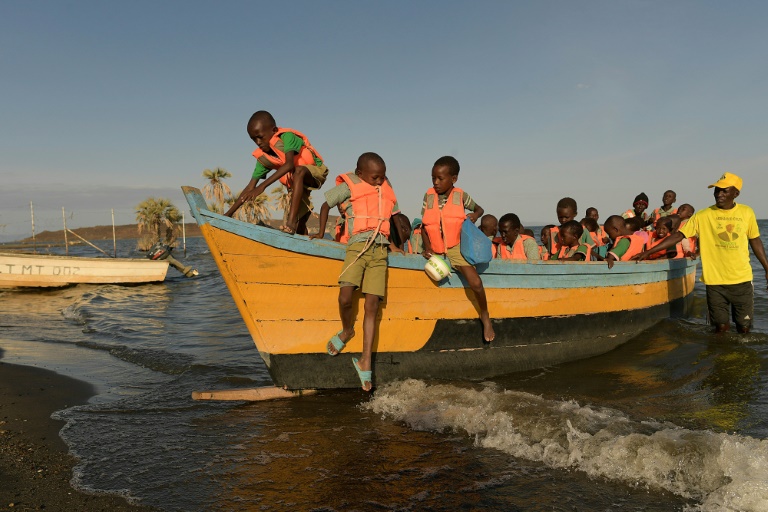
At first light, children from one of Kenya’s smallest and most isolated tribes put on life jackets and board a fishing boat for the journey across the lake to school.

Until recently, they could walk the distance. A road connected the El Molo with the world beyond their tiny village, a lifeline for a secluded community of fishers and craftspeople subsisting on the shores of Lake Turkana.

But three years ago the lake started rising dramatically, lapping at the El Molo’s dome-shaped huts draped in dry fish, then pushing inland, forcing villagers to higher ground.

As the tide reached levels not seen in living memory, the El Molo watched their only freshwater pipeline slip beneath the surface, as well as the burial mounds of their ancestors.

Eventually, the road to the mainland disappeared completely, marooning the El Molo on an island in a lake so large and imposing it is sometimes called the “Jade Sea”.

“There never used to be water here,” said El Molo fisherman Julius Akolong as he crossed the wide channel that today separates his community from the rest of far northern Kenya.

“You could drive a jeep across.”

Turkana, already the world’s largest desert lake, stretching 250 kilometres (155 miles) tip to tip, grew 10 percent in the decade to 2020, according to a government study published last year.

That expansion submerged nearly 800 additional square kilometres (about 300 square miles) of land including around El Molo Bay, where the tribespeople live on Turkana’s eastern shores.

Extreme rainfall over catchment areas -– a climatic event linked to global warming — greater soil runoff from deforestation and farming, and tectonic activity were all cited as contributing causes.

– Blessings and curses –

The phenomenon has profoundly impacted the El Molo, whose distinct Cushitic culture was already under serious threat.

Barely numbering 1,100 in the last census, the El Molo are dwarfed by Kenya’s larger and more prosperous ethnic groups that dominate a country of around 50 million people.

Known as “the people who eat fish” by the livestock-rearing tribes of northern Kenya, the El Molo are believed to have migrated from Ethiopia to Turkana around 1,000 BC.

But few today speak a word of their mother tongue, and ancient customs have evolved or vanished entirely through generations of intermarriage with neighbouring ethnic groups.

The lake’s unexpected rise fragmented the remaining El Molo still following the old ways of life.

Some displaced in the disaster made the wrenching decision to relocate to the mainland, erecting a squatter camp on the opposite shore.

The cluster of shanties on a barren and wind-swept clearing is nearer to the school and other facilities, but a world away from their tight-knit community and its traditions.

“It was very difficult… We had to go and discuss this with the elders so they could permit or bless us to go with no curses,” said Akolong, a 39-year-old father of two.

For those who stayed, life on the island has become a struggle.

The El Molo are skilled fishers, but as Turkana rose higher their people went hungry.

The fishing nets and baskets used for millennia, hand-woven with reeds and doum palm fibre, proved less effective in the deeper water, reducing catch. 

No longer able to access freshwater, the El Molo were forced to drink from Turkana, the most saline lake in Africa.

Children in the village suffer chalky teeth and bleached hair, a side effect of the lake’s high fluoride content.

“We often get diarrhoea… we have no other clean water. This is all we have. It is salty, and corrodes our teeth and hair,” said Anjela Lenapir, a 31-year-old mother of three who decided to stay.

– Disappearing culture – 

School attendance has fallen sharply because parents cannot afford the boat fare, said David Lesas, deputy head teacher at El Molo Bay Primary School.

“Most of them remain at home,” he lamented.

The local government and World Vision, an aid group, are assisting but resources are scarce and needs many in the region, which is experiencing a once-in-a-generation drought.

The school has suffered too: the perimeter fence and toilet block are underwater, and crocodiles have taken over part of the playground.

But the real damage to the El Molo is indelible.

Separated from his people, Akolong has missed initiation rites, naming ceremonies, and funerals — rituals that strengthen tribal identity and community.

“We are now divided,” he said bitterly.

Stone cairns marking the resting place of El Molo’s dead have been swept away, erasing memories of the past, while the lake threatens venerated shrines to tribal deities.

“It is a place that is deeply respected in our culture. With the water rising, we will lose that tradition too,” said Lenapir.

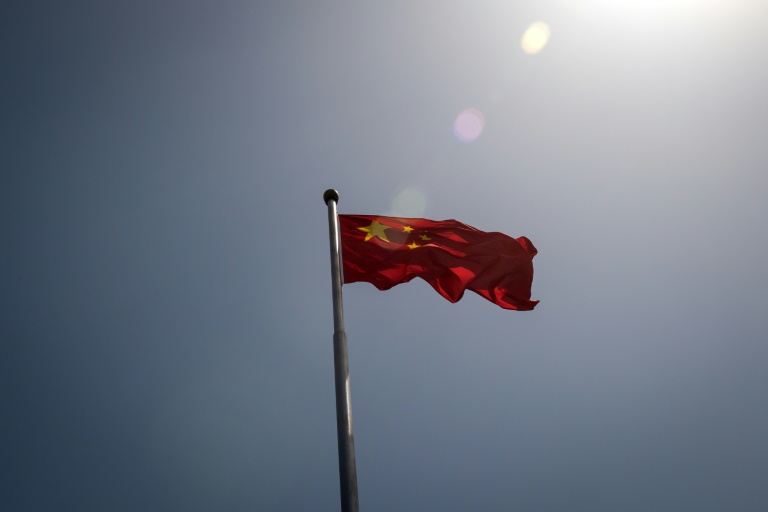
China warns of 'severe' threat to harvest from worst heatwave on record

China’s autumn harvest is under “severe threat” from high temperatures and drought, authorities have warned, urging action to protect crops in the face of the country’s hottest summer on record.

The world’s second-largest economy has been hit by record temperatures, flash floods and droughts this summer — phenomena that scientists have warned are becoming more frequent and intense due to climate change.

Southern China in particular has recorded its longest sustained period of high temperatures and sparse rain since records began more than 60 years ago, the agriculture ministry said.

Four government departments issued a notice on Tuesday urging the conservation of “every unit of water” to protect crops.

“The rapid development of drought superimposed with high temperatures and heat damage has caused a severe threat to autumn crop production,” the statement said.

Multiple Chinese provinces have announced power cuts to cope with a surge in demand driven partly by people cranking up the air conditioning to cope with temperatures as high as 45 degrees Celsius (113 degrees Fahrenheit).

The megacities of Shanghai and Chongqing have cut outdoor decorative lighting, while authorities in southwestern Sichuan province have imposed industrial power cuts as water levels drop at key hydroelectric plants.

More than 1,500 people in the area surrounding Chongqing were evacuated on Monday after hot and dry conditions sparked multiple wildfires, according to state news agency Xinhua.

The national meteorological service renewed its warnings for drought and high temperatures on Tuesday, calling for 11 provincial governments to “activate” emergency responses.

Authorities have already turned to cloud seeding — a method to induce rainfall — in parts of the country. 

State broadcaster CCTV published footage earlier this month showing meteorological staff shooting catalyst rockets into the sky and firefighters transporting water to farmers in need.

“This is the worst heat wave ever recorded,” climate and energy expert Liu Junyan of Greenpeace East Asia told AFP.

“Climate science shows extreme heat is becoming exponentially worse,” she said.

“So it’s more likely that next year will have record-breaking heat.”

China warns of 'severe' threat to harvest from worst heatwave on record

China’s autumn harvest is under “severe threat” from high temperatures and drought, authorities have warned, urging action to protect crops in the face of the country’s hottest summer on record.

The world’s second-largest economy has been hit by record temperatures, flash floods and droughts this summer — phenomena that scientists have warned are becoming more frequent and intense due to climate change.

Southern China in particular has recorded its longest sustained period of high temperatures and sparse rain since records began more than 60 years ago, the agriculture ministry said.

Four government departments issued a notice on Tuesday urging the conservation of “every unit of water” to protect crops.

“The rapid development of drought superimposed with high temperatures and heat damage has caused a severe threat to autumn crop production,” the statement said.

Multiple Chinese provinces have announced power cuts to cope with a surge in demand driven partly by people cranking up the air conditioning to cope with temperatures as high as 45 degrees Celsius (113 degrees Fahrenheit).

The megacities of Shanghai and Chongqing have cut outdoor decorative lighting, while authorities in southwestern Sichuan province have imposed industrial power cuts as water levels drop at key hydroelectric plants.

More than 1,500 people in the area surrounding Chongqing were evacuated on Monday after hot and dry conditions sparked multiple wildfires, according to state news agency Xinhua.

The national meteorological service renewed its warnings for drought and high temperatures on Tuesday, calling for 11 provincial governments to “activate” emergency responses.

Authorities have already turned to cloud seeding — a method to induce rainfall — in parts of the country. 

State broadcaster CCTV published footage earlier this month showing meteorological staff shooting catalyst rockets into the sky and firefighters transporting water to farmers in need.

“This is the worst heat wave ever recorded,” climate and energy expert Liu Junyan of Greenpeace East Asia told AFP.

“Climate science shows extreme heat is becoming exponentially worse,” she said.

“So it’s more likely that next year will have record-breaking heat.”

China warns of 'severe' threat to harvest from worst heatwave on record

China’s autumn harvest is under “severe threat” from high temperatures and drought, authorities have warned, urging action to protect crops in the face of the country’s hottest summer on record.

The world’s second-largest economy has been hit by record temperatures, flash floods and droughts this summer — phenomena that scientists have warned are becoming more frequent and intense due to climate change.

Southern China in particular has recorded its longest sustained period of high temperatures and sparse rain since records began more than 60 years ago, the agriculture ministry said.

Four government departments issued a notice on Tuesday urging the conservation of “every unit of water” to protect crops.

“The rapid development of drought superimposed with high temperatures and heat damage has caused a severe threat to autumn crop production,” the statement said.

Multiple Chinese provinces have announced power cuts to cope with a surge in demand driven partly by people cranking up the air conditioning to cope with temperatures as high as 45 degrees Celsius (113 degrees Fahrenheit).

The megacities of Shanghai and Chongqing have cut outdoor decorative lighting, while authorities in southwestern Sichuan province have imposed industrial power cuts as water levels drop at key hydroelectric plants.

More than 1,500 people in the area surrounding Chongqing were evacuated on Monday after hot and dry conditions sparked multiple wildfires, according to state news agency Xinhua.

The national meteorological service renewed its warnings for drought and high temperatures on Tuesday, calling for 11 provincial governments to “activate” emergency responses.

Authorities have already turned to cloud seeding — a method to induce rainfall — in parts of the country. 

State broadcaster CCTV published footage earlier this month showing meteorological staff shooting catalyst rockets into the sky and firefighters transporting water to farmers in need.

“This is the worst heat wave ever recorded,” climate and energy expert Liu Junyan of Greenpeace East Asia told AFP.

“Climate science shows extreme heat is becoming exponentially worse,” she said.

“So it’s more likely that next year will have record-breaking heat.”

Asian markets drop as investors eye US Fed outlook

Asian markets were down on Wednesday after falls in global stocks as the euro plunged against the dollar and traders await news on the next US interest rate hikes.

The single currency tumbled to $0.9901 — a new 20-year low — but later clawed back losses as the greenback was hit by poor US economic data.

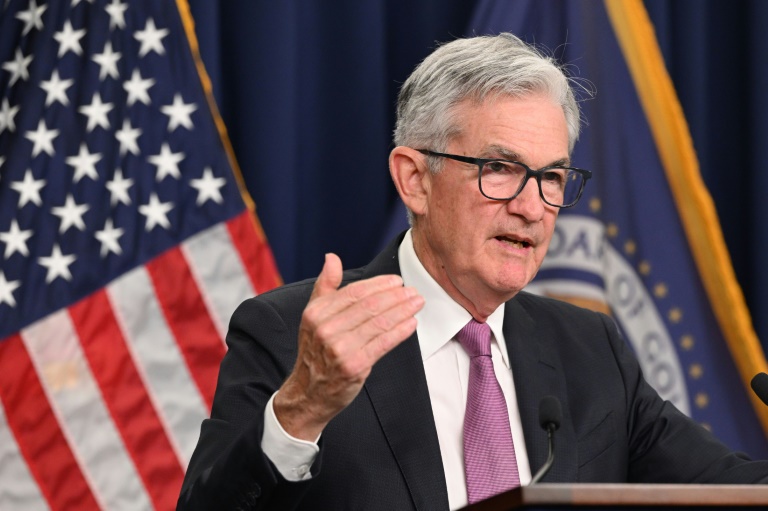
The dollar had strengthened this week ahead of a speech Friday by US Federal Reserve chief Jerome Powell, as markets speculate that the central bank will continue to tighten its monetary policy.

Higher interest rates boost the American currency as they make dollar-denominated debt more attractive to investors.

But the euro also has been weighed down by a gloomy outlook for the eurozone economy as Russia’s war in Ukraine has sent energy prices soaring.

The unit plunged below parity with the dollar Monday on recession fears to plumb the lowest levels since 2002, when it first came into physical circulation.

In the latest blow, S&P Global’s closely watched monthly composite purchasing managers’ index (PMI) showed that eurozone economic activity fell for the second month in a row in August.

With the Jackson Hole central banking symposium this week, the focus is on what Fed chief Powell says about plans to tackle high prices, with many fearing officials could send the economy into recession.

“I think that investors are bracing for some hawkish commentary from Fed chair Powell this coming week,” said Jack Ablin of Cresset Capital.

Wall Street indices ended mostly lower, and key markets in Asia followed suit.

Tokyo, Hong Kong and Shanghai fell — though Sydney, Seoul, Taipei, Wellington and Manila rose at the open.

US natural gas prices, meanwhile, hit a fresh 14-year high on Tuesday at $10.028.

But across the Atlantic, European natural gas prices fell, although they remain elevated on fears of a halt to Russia’s gas deliveries. 

Gas had spiked to record peaks in March after key producer Russia launched its invasion of neighbouring Ukraine.

That has sparked surging domestic energy bills, fueling decades-high inflation that has prompted tighter monetary policy around the world.

Moscow’s manoeuvres have hit the single currency hard because the bloc relies heavily on imported Russian gas, said Societe Generale analyst Kit Juckes. 

“The euro’s problem is… the threat from continued squeezing of gas supplies and the cost of replacing Russian gas,” Juckes said.

– Key figures at around 0250 GMT –

Tokyo – Nikkei 225: DOWN 0.34 percent at 28,359.10 

Hong Kong – Hang Seng Index: DOWN 0.9 percent at 19,318.04 

Shanghai – Composite: DOWN 0.68 percent at 3,253.97 

London – FTSE 100: DOWN 0.6 percent at 7,488.11 (close)

Euro/dollar: DOWN at 0.9949 from $0.9973 

Pound/dollar: DOWN at 1.1804 from $1.1835

Euro/pound: UP at 84.29 pence from 84.25 pence

Dollar/yen: UP at 136.92 yen from 136.77 yen

West Texas Intermediate: DOWN 0.31 percent at $93.46 per barrel

Brent North Sea crude: DOWN 0.4 percent at $99.82

New York – Dow: DOWN 0.5 percent at 32,909.59 points (close)

Close Bitnami banner
Bitnami