AFP

South Korea pardons Samsung boss 'to help the economy'

The heir and de facto leader of the Samsung group received a presidential pardon Friday, continuing South Korea’s long tradition of freeing business leaders convicted of corruption on economic grounds.

Billionaire Lee Jae-yong, convicted of bribery and embezzlement in January last year, will be “reinstated” to give him a chance to “contribute to overcoming the economic crisis” of the country, justice minister Han Dong-hoon said.

Lee — who has a net worth of $7.9 billion, according to Forbes — was released on parole in August 2021, after serving 18 months in jail, just over half of his original sentence.

Friday’s pardon will allow him to fully return to work by lifting a post-prison employment restriction that had been set for five years. 

“Due to the global economic crisis, the dynamism and vitality of the national economy have deteriorated, and the economic slump is feared to be prolonged,” the Justice Ministry said in a statement.

The pardon was given so that Lee — as well as other high-level executives receiving pardons Friday — could “lead the country’s continuous growth engine through active investment in technology and job creation”, it added.

Three other high-profile businessmen were also pardoned, including Lotte Group chairman Shin Dong-bin, who was sentenced to a suspended two-and-half-year prison term in a bribery case in 2018.

A total of 1,693 people — including prisoners with terminal illnesses and those near the end of their terms — were on the pardon list, the ministry said, ahead of the annual Liberation Day anniversary Monday.

The anniversary marks Japan’s 1945 World War II surrender, which liberated Korea from decades of colonial rule and is typically celebrated each year with the pardon of hundreds of prisoners.

Lee, 54, issued a statement after the pardon was announced saying he aimed to “contribute to the economy through continuous investment and job creation for young people”.

– Above the law? –

Lee is the vice-chairman of Samsung Electronics, the world’s biggest smartphone maker. The conglomerate’s overall turnover is equivalent to about one-fifth of South Korea’s gross domestic product.

He was jailed for offences connected to a massive corruption scandal that brought down former president Park Geun-hye.

There is a long history of South Korean tycoons being charged with bribery, embezzlement, tax evasion or other offences.

But many of those convicted have subsequently had their sentences cut or suspended on appeal, with some — including late Samsung chairman Lee Kun-hee, who was convicted twice — receiving presidential pardons in recognition of their “contribution to the national economy”.

The giant Samsung group is by far the largest of the family-controlled empires known as chaebol that dominate business in South Korea.

President Yoon Suk-yeol said Friday that the pardons were aimed at improving the lot of “ordinary people who have been affected by the prolonged Covid-19 pandemic”.

But analysts said they simply allowed major businessmen to feel they were not “constrained by any legal norms”, Vladimir Tikhonov, professor of Korean studies at the University of Oslo, told AFP.

Former conservative president Lee Myung-bak, who is currently serving a prison sentence over corruption and had initially been expected to benefit from the pardons, was not included on the list.

Justice minister Han said all politicians were excluded this time as the economy is the most “urgent and important” issue.

Local reports have speculated that pardoning Lee Myung-bak would have been too risky for President Yoon, who is already struggling with record-low approval ratings.

– More legal woes –

Lee Jae-yong still faces a separate trial over accusations of accounting fraud regarding a merger of two Samsung firms in 2015.

In May, he was excused from a hearing in that trial to host US President Joe Biden when he kicked off a tour of South Korea by visiting Samsung’s chip plant, alongside President Yoon.

His pardon follows Samsung unveiling a massive 450 trillion won ($346 billion) investment blueprint for the next five years, aimed at making it a leader in sectors from semiconductors to biologics and creating 80,000 new jobs.

But Lee’s imprisonment has been no barrier to the firm’s performance — it announced a surge of more than 70 percent in second-quarter profits in July last year, with a coronavirus-driven shift to remote work boosting demand for devices using its memory chips.

“Samsung operated perfectly well without any pardon,” Tikhonov told AFP.

“The pardon weakens rule of law, which potentially is, in fact, more detrimental than advantageous.”
Tens of thousands trek rugged trail to glimpse Iceland volcano

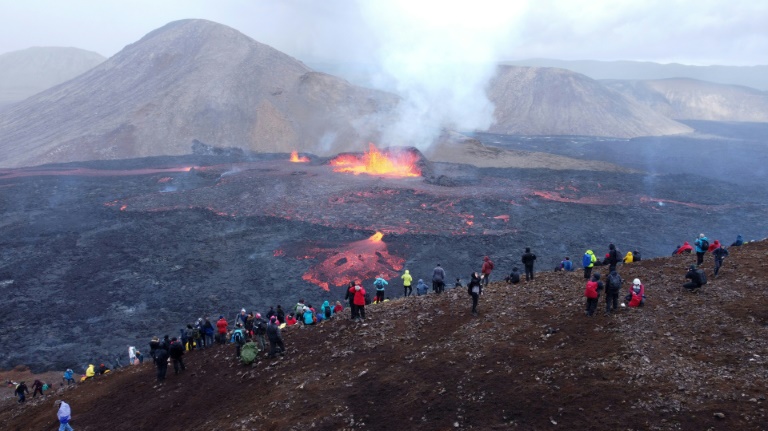
Tens of thousands of people have braved a steep, rugged trail in Iceland to catch a rare glimpse of an active volcano after it erupted last week, spewing red-hot lava into the sky.  

Tourism officials said Thursday that almost 23,000 people had made the difficult, hours-long trek to spot the volcano in the Meradalir valley, just 40 kilometres (25 miles) from the capital. 

“We’ve been here for three, four hours and we never get tired of it, it’s always moving”, said Jean-Paul Couturier, a French pensioner on vacation in Iceland.

The hike to the newly-formed crater is a 14 kilometres round-trip across tough terrain, with a 300-metre (985-foot) ascent. The walk takes about two hours from the nearest car park.

Strong winds and rain have done little to deter crowds.

On Wednesday alone — when authorities reopened the site following a three-day closure — more than 4,600 people took in the mesmerising views of the red-hot magma. 

The volcano is located in the Meradalir valley, an uninhabited area that would normally not attract more than a few visitors.

Known as the land of fire and ice, Iceland has 32 volcanic systems currently considered active, the highest number in Europe. It had an eruption every five years on average.

The latest volcano erupted in the Meradalir valley on August 3 and has continued at a fairly stable rate since, the Icelandic Meteorological Office said. 

– ‘Nature’s power’ –

“It would be very easy for it to last as long as the previous one”, vulcanologist Thorvaldur Thordarson told AFP.

Last year, lava spewed from the nearby Mount Fagradalsfjall volcano for six months, the longest eruption in Iceland in more than 50 years.

Hikers making the trek on Wednesday were well-equipped with walking sticks, hiking boots and rain gear. 

It was a sharp contrast from the shorts and flip flops worn by some of the first curious onlookers who initially rushed to the scene. 

Observers watch from a safe distance the red-orange lava fountains spurting as high as 70 meters before falling back to the ground, forming a large blanket of magma and a volcanic semi-cone as it solidified.

The lava reaches temperatures of 1,200 degrees Celsius (2,192 Fahrenheit), the hottest lava produced on Earth, and has so far flowed almost two kilometres to the south across the valley.

“The hot rock shooting out of the earth is really the first most impressive thing that you see,” American tourist James Maniscalco said.

For French tourist Clemence Ernoult, the experience was as rare as it gets. 

“You really see Nature’s power,” she said.  

“It’s something you’ll probably only see once in your life”.

Alleged British IS 'Beatle' held in jail after UK court appearance

A British man accused of being part of an Islamic State (IS) kidnap-and-murder cell known as the “Beatles” was remanded in custody Thursday on terrorism charges after Turkey deported him to the UK.

Aine Davis, 38, was an alleged member of the IS cell that held dozens of foreign hostages in Syria between 2012 and 2015 and was known to their captives as the “Beatles” because of their British accents.

Two of the four have already been brought to justice in the United States for the gruesome beheadings and killings of several American captives, while another of the quartet died in Syria.

British police arrested Davis after he was deported by Turkish authorities and landed at Luton airport near London late Wednesday.

He faces three counts under UK terrorism laws, two related to terrorism fundraising in 2014 and one related to possessing a firearm.

Appearing at a London magistrates’ court flanked by two suited police officers Thursday morning, Davis — sporting a short beard and grey T-shirt — spoke only to confirm his name and that he was of no fixed abode.

His lawyer confirmed he would not be entering a plea or seeking bail at this stage.

Chief magistrate Paul Goldspring said bail would in any case be refused partly due to Davis’ “propensity to travel on forged documents” and ordered him held in prison.

He referred the case to the crown court, which deals with serious criminal offences, with a pre-trial hearing set for September 2 at the central criminal court, known as the Old Bailey.

Goldspring noted that if convicted, Davis will face “years, not months” in jail.

– US trials –

The four members of the “Beatles” are accused of abducting at least 27 journalists and relief workers from the United States, Britain, Europe, New Zealand, Russia and Japan.

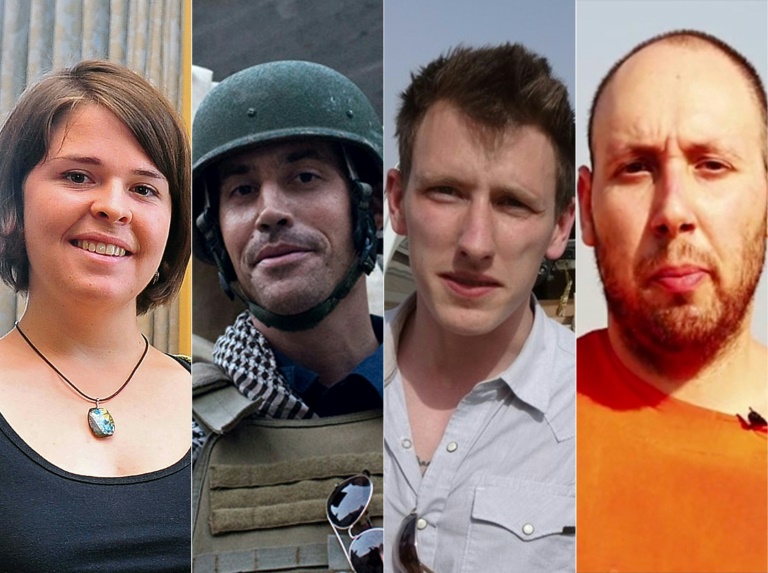
They were allegedly involved in the murders of American journalists James Foley and Steven Sotloff, as well as aid workers Peter Kassig and Kayla Mueller.

The accused cell members, who all grew up in west London, allegedly tortured and killed the four American victims, including by beheading, and IS released videos of the murders for propaganda purposes.

Alexanda Kotey, a 38-year-old former British national extradited from the UK to the US in 2020 to face charges there, pleaded guilty to his role in the deaths last September and was sentenced to life in prison in April.

El Shafee Elsheikh, 34, another former British national also extradited to the US at the same time, was found guilty of all charges in April, and will be sentenced next week.

They were captured in January 2018 by a Kurdish militia in Syria and turned over to US forces in Iraq before being sent to Britain and then the US.

There they faced federal court charges of hostage-taking, conspiracy to murder US citizens and supporting a foreign terrorist organisation.

The other “Beatles” executioner, Mohamed Emwazi, was killed by a US drone in Syria in 2015.

– Wife convicted –

Davis was arrested in Istanbul in 2015 by Turkish authorities on suspicion of being an IS member, and was using a forged travel document, the magistrates’ court heard Thursday. 

He was convicted in Turkey 18 months later, sentenced to seven-and-a-half years imprisonment, and released in July into an immigration detention centre where he remained until he was deported this week.

Detailing its case, CPS prosecutor Kashif Malik said Davis converted to Islam and adopted the name Hamza, visiting countries including Saudi Arabia and the United Arab Emirates between 2007 and 2012 with his wife Amal El-Wahabi.

In 2014, she became the first person in Britain to be convicted of funding IS jihadists after trying to send 20,000 euros — worth $25,000 at the time — to him in Syria.

She was jailed for 28 months and seven days following a trial in which Davis was described as a drug dealer before going to fight with IS in 2013.

“It’s believed that this (money) was to be collected by Mr Davis or an associate,” Malik told the court Thursday, noting it had been raised in the UK “to support terrorism”.

He said Davis had sent messages and photos to his wife from Syria.

“It is plain from images that Davis sent to El-Wahabi that he has been with fighters in Syria and was not in Syria for lawful purposes,” he added. “On occasions he was in possession of a firearm.”

A 2014 search of the couple’s London property found speeches by Osama bin Laden and prominent Al-Qaeda preacher Anwar al-Awlaki, Malik said. 

“We believe this was material left behind by Mr Davis,” he added.

Seoul seeks to ban basement flats after flooding deaths

South Korea’s capital has moved to ban the cramped basement flats made famous by Oscar-winning movie “Parasite” after four people drowned in subterranean dwellings during flooding caused by record-breaking rains this week.

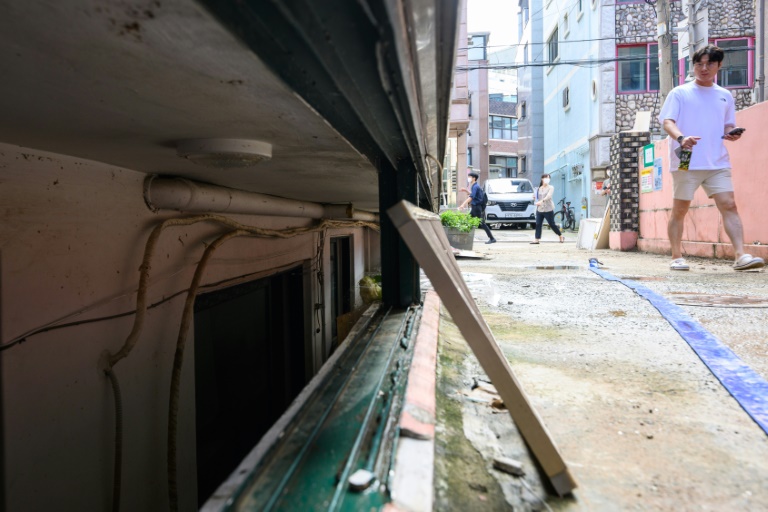
Soldiers and relief workers were clearing debris Thursday from waterlogged, mud-covered homes in Gwanak district, an AFP reporter saw, where three tenants, including a disabled woman and a teenager, died Monday.

Their deaths — trapped by floodwater in their basement apartment — have caused public outrage, with President Yoon Suk-yeol visiting their destroyed home this week before calling on officials to do more to help the poor and vulnerable during natural disasters.

The Seoul Metropolitan Government has announced they want to get rid of tiny, cramped basement flats — known as “banjiha” — which are typically cheap to rent but prone to damp and flooding.

Around 200,000 households live in such flats, which make up around five percent of housing stock in the South Korean capital, according to official figures.

Seoul said in a press release Wednesday that it will stop issuing permits to construct such homes, while pushing to gradually phase out existing basement and semi-basement flats.

The city plans to begin discussions with the national government to ban the use of basements or semi-basement spaces for residential purposes, it added.

Four out of 11 people killed in this week’s record downpours drowned after their basement flats were inundated with floodwater, officials have said.

Such abodes received global attention due to Bong Joon Ho’s “Parasite”, which won the 2020 Best Picture Oscar and features a poor family living in a dank basement home.

Activists blamed the “banjiha” deaths this week on the government’s housing policies, saying they were preventable disasters.

“We condemn the government’s negligence regarding those marginalised people in this housing,” said the Citizens’ Coalition for Economic Justice in a statement.

“As rainfall becomes stronger and more frequent under the influence of climate change, (Seoul) must embark on a fundamental change of its approach to basement residents,” it added.

Yoon has also blamed climate change for the rains and flooding, which he said were the worst since weather records began over a century ago.

“Those who struggle financially or with physical difficulties are bound to be more vulnerable to natural disasters,” he said.

European stocks dip as high inflation concerns linger

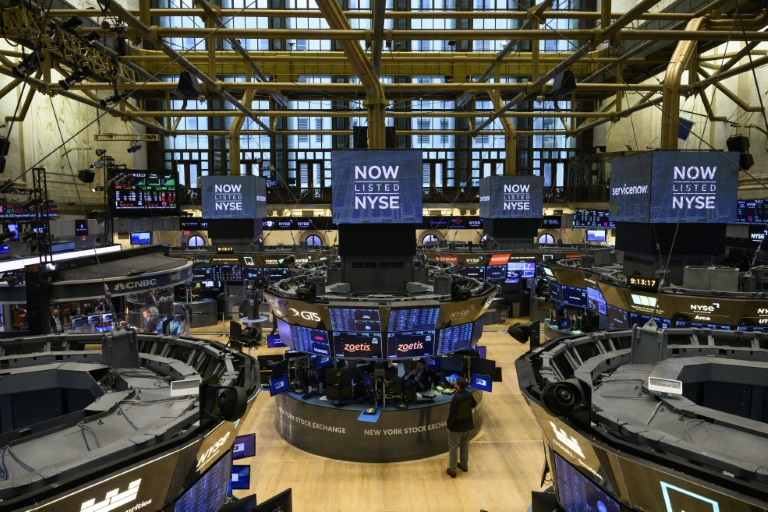
European stock markets eased on Thursday as investors took profit from the gains notched up the previous day on better-than-expected inflation data in the US.

But while overall sentiment was positive, investors remain on edge as officials at the US Federal Reserve seek to temper expectations of a possible end to the monetary policy tightening cycle, traders said.

The head of the Minneapolis Federal Reserve Bank, Neel Kashkari, warned: “We are a long way away from saying that we’re anywhere close to declaring victory”.

And according to the chief of the Chicago Federal Reserve Bank, Charles Evans, rates will continue to rise for “the rest of this year and into next year”.

“Investors are certainly in a more upbeat mood as the relief from the US inflation data ripples through the markets,” said OANDA analyst, Craig Erlam. 

However, “Fed policymakers remain keen to stress that the tightening cycle is far from done and a policy U-turn early next year is highly unlikely,” Erlam said.

Investors will therefore be watching out for further comments from policymakers over the next weeks to better gauge the likely pace of further rate hikes, as strong jobs growth shows how resilient the economy remains in face of higher borrowing costs and inflation.

“Inflation has been expected to peak over the summer for some time, so it was reassuring for markets that there are clear signs that this looks to be happening,” said Oliver Blackbourn, of Janus Henderson Investors.

“However, the Fed will doubtless be focused on the signs about underlying inflation, particularly against a very tight-looking labour market.”

On the oil market, crude prices climbed as US recession fears eased — but remained around six-month lows and below the levels seen before the Ukraine war.

– Key figures at around 1100 GMT –

London – FTSE 100: DOWN 0.4 percent at 7,479.08 points

Frankfurt – DAX: DOWN 0.1 percent at 13,686.67

Paris – CAC 40: DOWN 0.3 percent at 6,503.48

EURO STOXX 50: DOWN 0.2 percent at 3,742.36

Hong Kong – Hang Seng Index: UP 2.4 percent at 20,082.43 (close)

Shanghai – Composite: UP 1.6 percent at 3,281.67 (close)

Tokyo – Nikkei 225: Closed for a holiday

New York – Dow: UP 1.5 percent at 33,309.51 (close)

Euro/dollar: UP at $1.0336 from $1.0299 Wednesday

Pound/dollar: DOWN at $1.2206 from $1.2213

Euro/pound: UP at 84.69 pence from 84.29 pence

Dollar/yen: DOWN at 132.59 yen from 132.89 yen 

Brent North Sea crude: UP 0.8 percent at $98.16 per barrel

West Texas Intermediate: UP 0.8 percent at $92.67 per barrel

European stocks dip as high inflation concerns linger

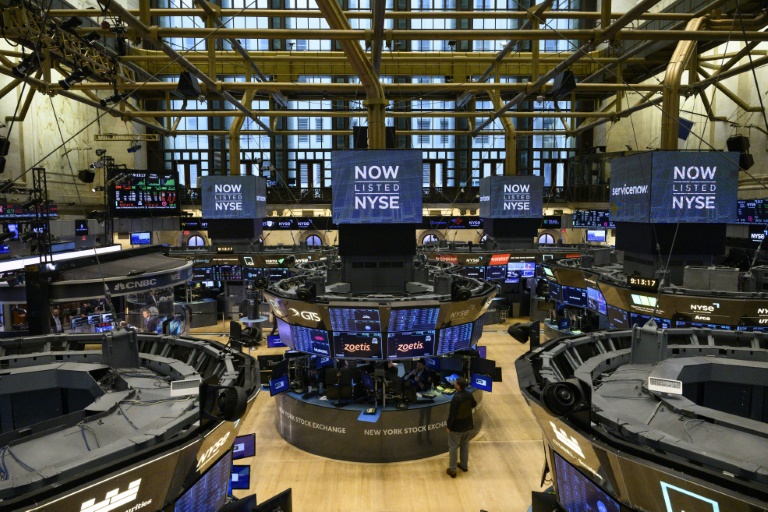
European stock markets eased on Thursday as investors took profit from the gains notched up the previous day on better-than-expected inflation data in the US.

But while overall sentiment was positive, investors remain on edge as officials at the US Federal Reserve seek to temper expectations of a possible end to the monetary policy tightening cycle, traders said.

The head of the Minneapolis Federal Reserve Bank, Neel Kashkari, warned: “We are a long way away from saying that we’re anywhere close to declaring victory”.

And according to the chief of the Chicago Federal Reserve Bank, Charles Evans, rates will continue to rise for “the rest of this year and into next year”.

“Investors are certainly in a more upbeat mood as the relief from the US inflation data ripples through the markets,” said OANDA analyst, Craig Erlam. 

However, “Fed policymakers remain keen to stress that the tightening cycle is far from done and a policy U-turn early next year is highly unlikely,” Erlam said.

Investors will therefore be watching out for further comments from policymakers over the next weeks to better gauge the likely pace of further rate hikes, as strong jobs growth shows how resilient the economy remains in face of higher borrowing costs and inflation.

“Inflation has been expected to peak over the summer for some time, so it was reassuring for markets that there are clear signs that this looks to be happening,” said Oliver Blackbourn, of Janus Henderson Investors.

“However, the Fed will doubtless be focused on the signs about underlying inflation, particularly against a very tight-looking labour market.”

On the oil market, crude prices climbed as US recession fears eased — but remained around six-month lows and below the levels seen before the Ukraine war.

– Key figures at around 1100 GMT –

London – FTSE 100: DOWN 0.4 percent at 7,479.08 points

Frankfurt – DAX: DOWN 0.1 percent at 13,686.67

Paris – CAC 40: DOWN 0.3 percent at 6,503.48

EURO STOXX 50: DOWN 0.2 percent at 3,742.36

Hong Kong – Hang Seng Index: UP 2.4 percent at 20,082.43 (close)

Shanghai – Composite: UP 1.6 percent at 3,281.67 (close)

Tokyo – Nikkei 225: Closed for a holiday

New York – Dow: UP 1.5 percent at 33,309.51 (close)

Euro/dollar: UP at $1.0336 from $1.0299 Wednesday

Pound/dollar: DOWN at $1.2206 from $1.2213

Euro/pound: UP at 84.69 pence from 84.29 pence

Dollar/yen: DOWN at 132.59 yen from 132.89 yen 

Brent North Sea crude: UP 0.8 percent at $98.16 per barrel

West Texas Intermediate: UP 0.8 percent at $92.67 per barrel

European stocks dip as high inflation concerns linger

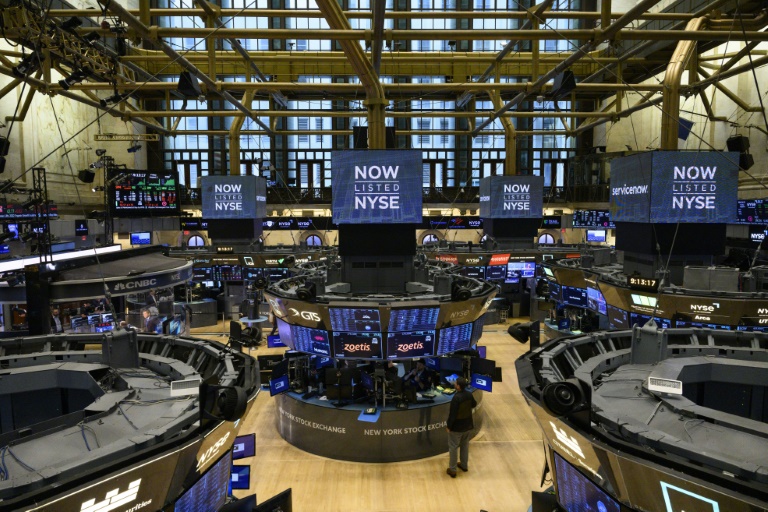
European stock markets eased on Thursday as investors took profit from the gains notched up the previous day on better-than-expected inflation data in the US.

But while overall sentiment was positive, investors remain on edge as officials at the US Federal Reserve seek to temper expectations of a possible end to the monetary policy tightening cycle, traders said.

The head of the Minneapolis Federal Reserve Bank, Neel Kashkari, warned: “We are a long way away from saying that we’re anywhere close to declaring victory”.

And according to the chief of the Chicago Federal Reserve Bank, Charles Evans, rates will continue to rise for “the rest of this year and into next year”.

“Investors are certainly in a more upbeat mood as the relief from the US inflation data ripples through the markets,” said OANDA analyst, Craig Erlam. 

However, “Fed policymakers remain keen to stress that the tightening cycle is far from done and a policy U-turn early next year is highly unlikely,” Erlam said.

Investors will therefore be watching out for further comments from policymakers over the next weeks to better gauge the likely pace of further rate hikes, as strong jobs growth shows how resilient the economy remains in face of higher borrowing costs and inflation.

“Inflation has been expected to peak over the summer for some time, so it was reassuring for markets that there are clear signs that this looks to be happening,” said Oliver Blackbourn, of Janus Henderson Investors.

“However, the Fed will doubtless be focused on the signs about underlying inflation, particularly against a very tight-looking labour market.”

On the oil market, crude prices climbed as US recession fears eased — but remained around six-month lows and below the levels seen before the Ukraine war.

– Key figures at around 1100 GMT –

London – FTSE 100: DOWN 0.4 percent at 7,479.08 points

Frankfurt – DAX: DOWN 0.1 percent at 13,686.67

Paris – CAC 40: DOWN 0.3 percent at 6,503.48

EURO STOXX 50: DOWN 0.2 percent at 3,742.36

Hong Kong – Hang Seng Index: UP 2.4 percent at 20,082.43 (close)

Shanghai – Composite: UP 1.6 percent at 3,281.67 (close)

Tokyo – Nikkei 225: Closed for a holiday

New York – Dow: UP 1.5 percent at 33,309.51 (close)

Euro/dollar: UP at $1.0336 from $1.0299 Wednesday

Pound/dollar: DOWN at $1.2206 from $1.2213

Euro/pound: UP at 84.69 pence from 84.29 pence

Dollar/yen: DOWN at 132.59 yen from 132.89 yen 

Brent North Sea crude: UP 0.8 percent at $98.16 per barrel

West Texas Intermediate: UP 0.8 percent at $92.67 per barrel

New wildfire outbreaks feared as blazes rage in France

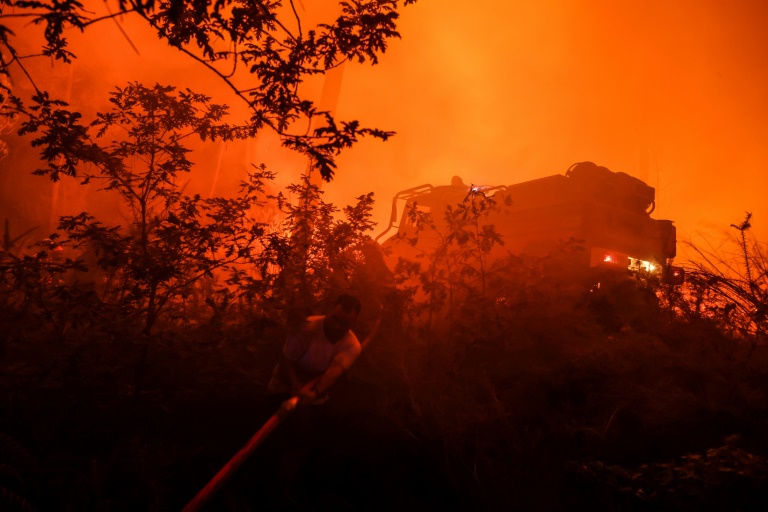
Officials warned Thursday that flare-ups could cause a massive wildfire to further spread in France’s parched southwest, site of the most intense blazes that have blackened swaths of the country this week.

Prime Minister Elisabeth Borne was to meet with authorities battling the Landiras fire south of Bordeaux, and further reinforcements are expected for the 1,100 firefighters on site, the prefecture of the Gironde department said.

France has been buffeted this summer by the historic drought that has forced water-use restrictions nationwide, as well as a series of heatwaves that experts say are being driven by climate change.

“Conditions are particularly difficult: the vegetation and soil are exceptionally dry,” the prefecture said in a statement, warning that extreme dry heat is likely until at least Sunday.

“There is a very serious risk of new outbreaks.”

Temperatures in the region could top 40 Celsius (104 Fahrenheit) on Thursday, weather forecasters predicted.

The Landiras blaze erupted in July — the driest month seen in France since 1961 — destroying 14,000 hectares and forcing thousands of people to evacuate before it was contained.

But it continued to smoulder in the tinder-dry pine forests and peat-rich soil, and officials suspect arson may have played a role in the latest flare-up, which has burned 6,800 hectares (17,000 acres) since Tuesday.  

Currently eight major wildfires are raging in France and Interior Minister Gerald Darmanin, who was also heading to meet Gironde officials Thursday, said Sweden and Italy were sending fire-fighting aircraft to help.

President Emmanuel Macron added on Twitter that Germany, Greece, Poland, Romania and Austria are also providing help.

“Across the country over 10,000 firefighters and security forces are mobilised against the flames… These soldiers of fire are our heroes,” he said.

– ‘Battled all night’ –

“You’d think we’re in California, it’s gigantic… And they’re used to forest fires here but we’re being overwhelmed on all sides — nobody could have expected this,” Remy Lahay, a firefighter deployed near Hostens in the Landes de Gascogne natural park, told AFP. 

On several nearby houses, people hung out white sheets saying “Thank you for saving our homes” and other messages of support for the weary fire battalions.

“We battled all night to stop the fire from spreading, notably to defend the village of Belin-Beliet,” Lieutenant Colonel Arnaud Mendousse of the Gironde fire and rescue service told journalists in Hostens.

Seventeen homes have been destroyed or damaged since Tuesday, and nearly 10,000 people evacuated, but no further orders to leave the area are expected “for the time being”, Mendousse said.

Acrid smoke has spread across much of the southwestern Atlantic coast and its beaches that draw huge crowds of tourists each summer, with the regional ARS health agency “strongly” urging people to wear protective face masks.

The smoke also forced the closing of the A63 motorway, a major artery toward Spain, between Bordeaux and Bayonne.

Study on serotonin and depression sparks fierce debate

A controversy in the scientific community over recent claims anti-depressants can be ineffective at treating depression has highlighted the difficulties in understanding mental health conditions.

One of the prevailing theories currently focuses on serotonin. Depression has been linked to a lack of the molecule, which is involved in transmitting emotions to the brain. 

Claims that depression has no link to a chemical imbalance in the brain related to serotonin, casting doubt on the need for anti-depressants, have sparked fierce reaction.

A study by psychiatrists Joanna Moncrieff and Mark Horowitz in the journal Molecular Psychiatry in July concluded that there was no proven link between a lack of serotonin and depression.

The authors said it queried the underlying assumption behind the use of anti-depressants, which are mostly developed to alter serotonin levels, undoing a theory that for decades acted as a framework for research.

The study is based on several previous publications, but it quickly attracted criticism — particularly its presentation by Moncrieff, known for her scepticism towards biological explanations of depression and her radical stance against the pharmaceutical industry.

“I’m broadly in agreement with the authors’ conclusions about our current efforts, though I lack their adamantine certainty,” psychiatrist Phil Cowen said on the Science Media Centre website.

“No mental health professional” would endorse the view that a complex condition like depression “stems from a deficiency in a single neurotransmitter”, Cowen added.

– ‘Mainstream’ psychiatry –

Some peers have questioned the methodology, which measured an indirect trace of serotonin rather than taking direct measurements of the molecule.

Moncrieff, who wants to break with what she calls “mainstream” psychiatry, believes the serotonin theory still occupies an important, albeit less prominent, place in the profession.

“Even if leading psychiatrists were beginning to doubt the evidence for depression being related to low serotonin, no one told the public,” the British psychiatrist wrote on her blog.

The connection between depression and serotonin is firmly rooted in the popular imagination. French author Michel Houellebecq gave the title “Serotonin” to his 2019 novel in which the main character is depressed.

Moncrieff’s undermining of the serotonin theory to argue against current anti-depressants, going beyond the conclusions of her own study, has sparked the most vehement criticism.

Swiss psychiatrist Michel Hofmann told AFP her study was “serious” and contributed to expert debates about depression.

“But I don’t think it is an article that should have any impact in the short term on the prescription of anti-depressants,” he said.

Moncrieff has warned that anti-depressant treatment should not be suddenly interrupted. But for her, the benefits of a course of anti-depressants are doubtful if it is based on a discredited theory.

But many stress that the effectiveness of the treatments has been scientifically assessed, irrespective of the primary cause of depression.

The medicines used to treat depression “are usually many and ultimately, in most cases, we don’t know what exactly makes a treatment effective”, Hofmann added.

Debates on the role of serotonin only illustrate how difficult it is to understand the biological and social workings of an illness as complex as depression.

The challenges are forcing researchers to move away from  models that are incomplete by their very nature.

“We are still at theories and we continue to search and test models against each other,” Hofmann said.

Low Rhine deepens Germany's energy crisis

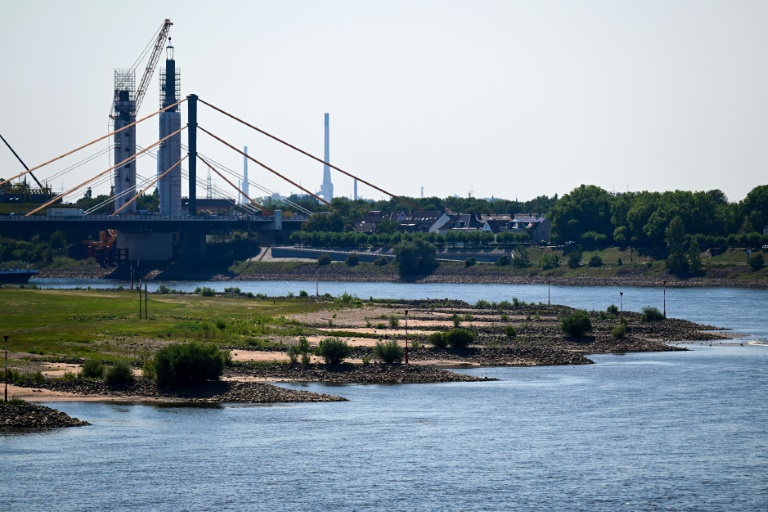
A hot, dry July made worse by climate change has raised the risk that the German economy could run aground as sinking Rhine waters make shipping along the river harder.

The prospect of severe, longer-term limits to traffic spells a new headache for the industries lined up on the river’s banks and threatens to further strain Germany’s efforts to wean itself off Russian energy imports as coal counts among key cargo moved on the waterway.

Roberto Spranzi, boss of DTG, a shipping cooperative, says the volumes that his fleet can carry are already limited by the unusually low water levels.

“At the moment we have a capacity where, we have to use three or four vessels where we would normally need one,” Spranzi tells AFP. 

Pointing at the worrying ebb at the entrance to the inland port of Duisburg in western Germany, Spranzi notes that “currently it’s at 1.70 metres (5.6 feet) In theory, the normal water level is over two metres”.

Further up the river in Kaub, a noted bottleneck for shipping where the Rhine runs narrow and shallow, the reference level is forecast to go below 40 centimetres by the end of the week and squeeze traffic further.

“We supply factories on the Rhine with their raw materials. When that’s not possible any more — or less often — that’s a threat to German industry, too,” Spranzi says.

– Coal power – 

Around four percent of freight in Germany is carried via its waterways, including the Rhine, which winds its way from Switzerland, along the border with France, through Germany’s industrial heartland and the Netherlands to the sea.

As Berlin turns to mothballed coal power capacity to plug the gap after Russia curtailed its energy deliveries, the Rhine has taken on added significance as a key artery for coal transport.

But the sinking water level has already led energy providers to warn they may have to limit output.

Uniper has said the low level of the Rhine may lead to the “irregular operation” of two of its coal plants into September.

EnBW, which runs sites in the southwestern region of Baden-Wurttermberg, has warned that deliveries of the fuel could be restricted.

The dwindling waters have seen “transport costs per tonne rise”, EnBW said in a statement, adding that it had preemptively built stocks of coal earlier in the year.

Alternative routes were available — either by road or rail — but capacity was “tight”, EnBW said.

The Rhine freight restrictions have added to the supply chain disruption seen by industry and increased the risk of scarcity. 

Across southern Germany, a shortage of fuel at the pump has been traced back to the dry weather, among other factors.

“Low water levels on the Rhine mean that in this area very important transportation of oil products, such as petrol, diesel or heating oil can’t operate as normal,” says Alexander von Gersdorff, spokesman for the German energy and fuel industry lobby.

– ‘Much earlier’ – 

A 2018 drought, which saw the Rhine’s reference depth at Kaub fall as low as 25 centimetres in October, shaved 0.2 percent off German GDP that year, according to Deutsche Bank Research.

“The low levels have come much earlier this time,” Deutsche Bank Research economist Marc Schattenberg tells AFP.

“If the problems we are now observing last longer (than in 2018), the loss of economic value becomes all the more serious.” 

Industrial heavyweights stationed along the Rhine rely on the waterway to ferry goods to and from their sites.

Duisburg-based conglomerate ThyssenKrupp said in a statement it had “taken measures” to assure its supplies of raw materials.

The chemical giant BASF, whose Ludwigshafen base sits south of the Kaub choke-point, said its production had not yet been limited by the low water levels, but warned that it could not rule out “reductions for specific units in the coming weeks”.

Close Bitnami banner
Bitnami