AFP

Arson suspected as huge French wildfire reignites

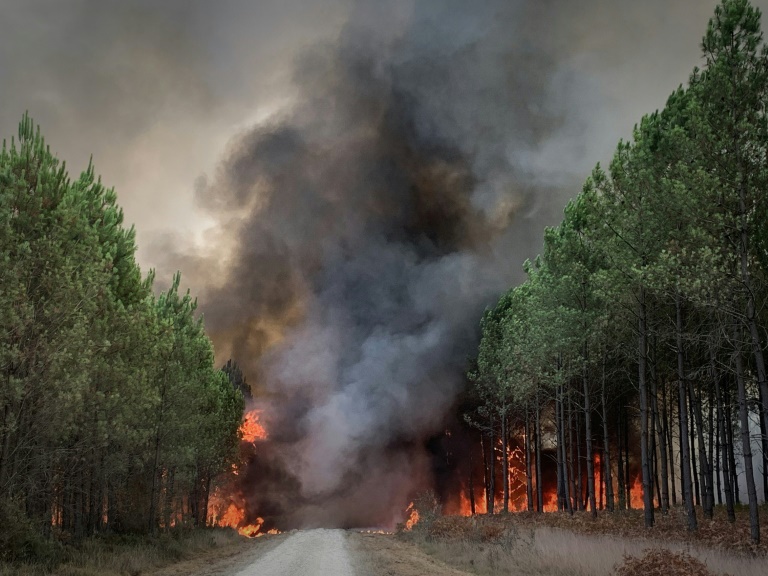
A wildfire that officials thought was under control in southwest France has reignited amid a record drought and extreme heat, possibly the result of arson, officials said Wednesday.

More than 6,000 hectares (15,000 acres) of tinder-dry forest have burned in just 24 hours in the so-called Landiras blaze, the largest of several that scorched the region last month.

It had been brought under control — but not fully extinguished — after burning nearly 14,000 hectares, before flaring up on Tuesday, forcing the evacuation of some 6,000 people.

No one has been injured but 16 homes were destroyed or damaged near the village of Belin-Beliet, and officials said six fire-fighting trucks had burned.

“The risks are very high” that parched conditions will allow the fire to spread further, said Martin Guespereau, prefect of the Gironde department.

“The weather is very unfavourable because of the heat, the dry air, the record drought and the fact that there is a lot of peat in the ground… the fire didn’t go out in July, it went underground,” he told journalists.

Interior Minister Gerald Darmanin said more than 1,000 firefighters were now battling the blaze, adding that investigators suspected arson may be involved.

“There were eight fires that erupted between 8:00 and 9:00 am (0600 and 0700 GMT) that erupted at intervals of a few hundred metres, which is extremely unusual,” he said in Mostuejouls, north of the Mediterranean city of Montpellier, where another fire was raging in the Grands Causses natural park.

He also told reporters that Sweden and Italy would send fire-fighting aircraft to France within 24 hours to help.

– ‘The sky was roaring’ –

“It’s a major fire… much more intense and fast-moving” than at the height of the Landiras blaze last month, Marc Vermeulen of the regional fire-fighting authority told journalists.

“I opened the door last night and there was (a) red wall in front of us, the sky was roaring like the ocean,” said Eliane, a 43-year-old at a temporary shelter for evacuees in Belin-Beliet.

For Christian Fostitchenko, 61, and his partner Monique, waiting at a martial arts dojo in nearby Salles, it was their second evacuation of the summer from their home in Saint-Magne.

“This time we were really scared — the flames were less than 100 metres (328 feet) from the house,” he said.

The fire was spreading toward the A63 motorway, a major artery linking Bordeaux to Spain, with thick smoke forcing the road’s closure between Bordeaux and Bayonne.

France has been buffeted this summer by a record drought that has forced water-use restrictions nationwide, as well as a series of heatwaves that many experts warn are being driven by climate change.

Wildfires have also ignited in the dry hills of the southeast and even in the normally lush areas of Brittany along the Channel.

On Wednesday, officials in western France said a wildfire near Angers and Le Mans has burned 1,200 hectares since Monday as nearly 400 firefighters struggle to contain it.
In scorched UK, source of River Thames dries up

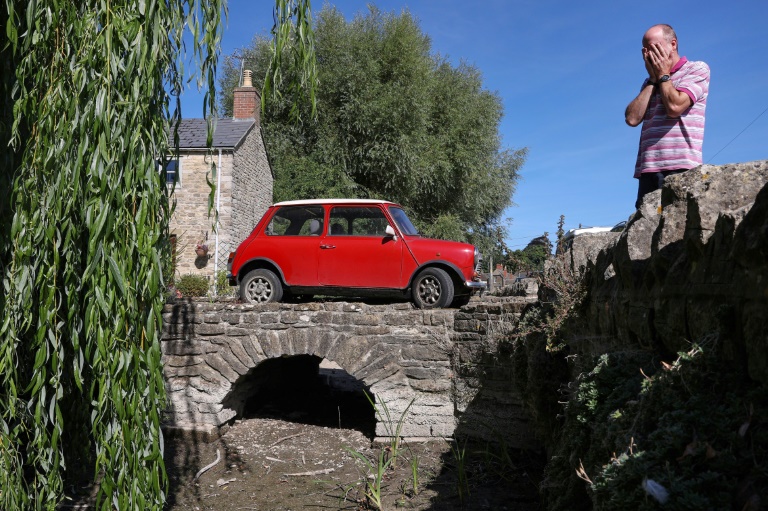
At the end of a dusty track in southwest England where the River Thames usually first emerges from the ground, there is currently scant sign of any moisture at all.

The driest start to a year in decades has shifted the source of this emblematic English river several miles downstream, leaving scorched earth and the occasional puddle where water once flowed.

It is a striking illustration of the parched conditions afflicting swathes of England, which have prompted a growing number of regional water restrictions and fears that an official drought will soon be declared. 

“We haven’t found the Thames yet,” confided Michael Sanders, 62, on holiday with his wife in the area known as the official source of the river.

The couple were planning to walk some of the Thames Path that stretches along its entire winding course — once they can find the waterway’s new starting point.

“It’s completely dried up,” the IT worker from northern England told AFP in the village of Ashton Keynes, a few miles from the source, noting it had been replaced by “the odd puddle, the odd muddy bit”. 

“So hopefully downstream we’ll find the Thames, but at the moment it’s gone.”

The river begins from a underground spring in this picturesque region at the foot of the Cotswolds hills, not far from Wales, before meandering for 215 miles (350 kilometres) to the North Sea.

Along the way it helps supply freshwater to millions of homes, including those in the British capital London.

– ‘So arid’ –

Following months of minimal rainfall, including the driest July in England since the 1930s, the country’s famously lush countryside has gone from shades of green to yellow.

“It was like walking across the savannah in Africa, because it’s so arid and so dry,” exclaimed David Gibbons.

The 60-year-old retiree has been walking the length of the Thames Path in the opposite direction from Sanders — from estuary to source — with his wife and friends.

As the group reached their final destination, in a rural area of narrow country roads dotted with stone-built houses, Gibbons recounted the range of wildlife they had encountered on their journey.

The Thames, which becomes a navigable strategic and industrial artery as it passes through London and its immediate surroundings, is typically far more idyllic upstream and a haven for birdwatching and boating.

However, as they neared the source, things changed.

“In this last two or three days, (there’s been) no wildlife, because there’s no water,” Gibbons said.

“I think water stopped probably 10 miles away from here; there’s one or two puddles,” he added from picturesque Ashton Keynes. 

Andrew Jack, a 47-year-old local government worker who lives about nine miles (15 kilometres) from the village, said locals had “never seen it as dry and as empty as this”.

The river usually run alongside its main street, which boasts pretty houses with flower-filled gardens and several small stone footbridges over the water. 

But the riverbed there is currently parched and cracked, the only visible wildlife some wasps hovering over it, recalling images of some southern African rivers during the sub-continent’s dry season.

– ‘Something’s changed’ –

There will be no imminent respite for England’s thirsty landscape.

The country’s meteorological office on Tuesday issued an amber heat warning for much of southern England and eastern Wales between Thursday and Sunday, with temperatures set to reach the mid-30s degrees Celsius.

It comes weeks after a previous heatwave broke Britain’s all-time temperature record and breached 40 degrees Celsius (104 degrees Fahrenheit) for the first time.

Climate scientists overwhelmingly agree that carbon emissions from humans burning fossil fuels are heating the planet, raising the risk and severity of droughts, heatwaves, and other such extreme weather events.

Local authorities are reiterating calls to save water, and Thames Water, which supplies 15 million people in London and elsewhere, is the latest provider to announce forthcoming restrictions.

But Gibbons was remaining sanguine.

“Having lived in England all my life, we’ve had droughts before,” he insisted.

“I think that it will go green again by the autumn.”

Jack was more pessimistic as he walked with his family along the dried-up riverbed, where a wooden measuring stick gauges non-existent water levels. 

“I think there are lots of English people who think ‘great, let’s have some European weather'”, he said.

“But we actually shouldn’t, and it means that something’s changed and something has gone wrong.

“I’m concerned that it’s only going to get worse and that the UK is going to have to adapt to hotter weather as we have more and more summers like this.”

Biden signs bill aiding veterans exposed to toxins

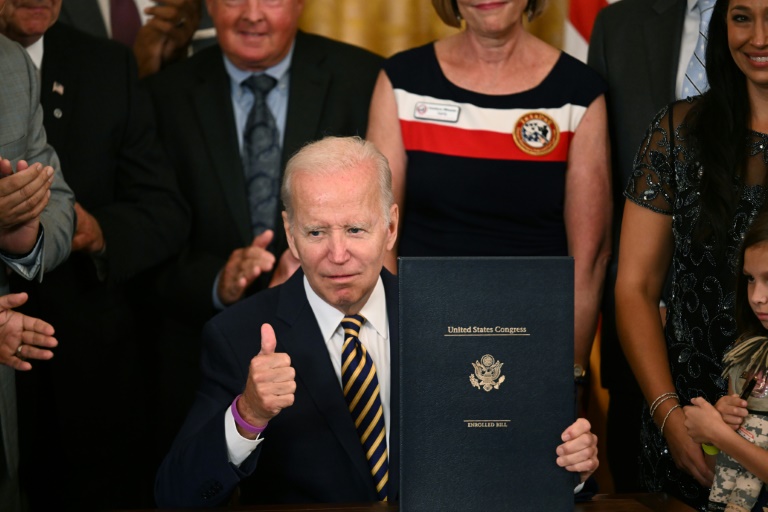
US President Joe Biden on Wednesday signed into law a bill boosting benefits for veterans exposed to toxic fumes, a cause close to his own heart after his son died of brain cancer.

Burn pits, lit up with jet fuel, were commonly used to dispose of waste in military camps during the years of the US wars in Afghanistan and Iraq. 

They exposed large numbers of servicemen and women to potentially harmful toxins, although there is not always a proven link between the exposure and later illnesses.

The PACT Act, passed by the US Senate earlier this month after fierce lobbying by veterans and celebrity comedian Jon Stewart, will formalize new rules for ensuring access to medical treatment.

“Sometimes military service can result in increased health risks for our veterans and some injuries and illnesses, like asthma, cancer and others, can take years to manifest,” the White House said.

“These realities can make it difficult for veterans to establish a direct connection between their service and disabilities resulting from military environmental exposures such as burn pits — a necessary step to ensure they receive the health care they earned.”

It described the bill as the “most significant expansion of benefits and services for toxic exposed veterans in more than 30 years.”

Biden believes the pits are at the root of the brain cancer that claimed the life of his son Beau, who served in Iraq and died in 2015 at age 46.

Recounting his own many visits to US troops in Iraq as a senator and vice president, Biden described seeing “burn pits the size of football fields” filled with the “incinerated waste of war.”

Subjected to “toxic smoke,” many of the “fittest and best warriors that we sent to war” came home and “were not the same,” encountering symptoms as varied as headaches and numbness, as well as serious diseases, Biden said.

“My son Beau was one of them.”

US inflation eases in July amid falling oil prices

US inflation eased slightly in July, according to official data Wednesday, potentially taking pressure off the Federal Reserve to hike interest rates sharply while bringing a much-needed boost to President Joe Biden just months before crucial midterm elections.

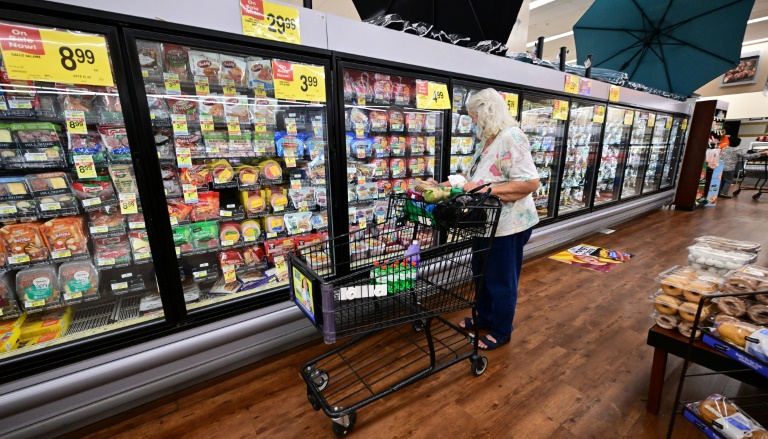
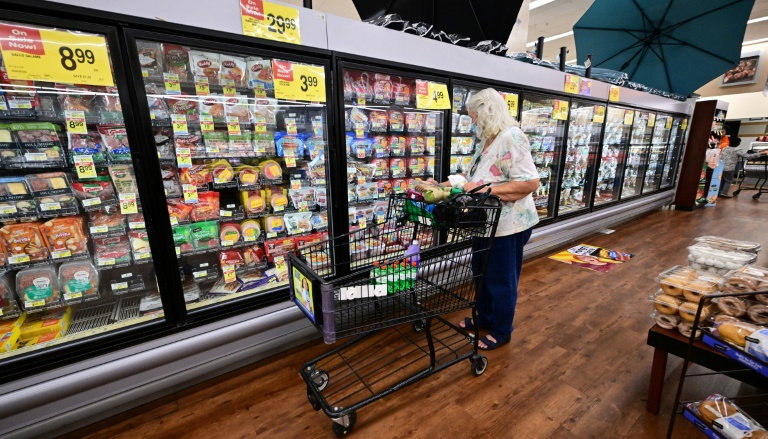
With energy costs dropping in recent weeks, the consumer price index dipped to an annual rate of 8.5 percent last month, the Labor Department reported, lower than markets were projecting.

Fueled by aggressive consumer spending of pandemic savings, global supply chain snarls, domestic worker shortages and Russia’s war on Ukraine, inflation soared 9.1 percent on-year in June, the highest in 40 years.

But the CPI was unchanged compared to June, a dramatic shift from the big increase in the prior month and defying expectations of a modest rise.

“Today we received news that our economy had zero percent inflation in the month of July. Zero percent,” Biden said at a White House event. 

“We are seeing signs that inflation may be beginning to moderate,” he said, although he acknowledged that the global challenges remain and the economy could face “additional headwinds.”

When volatile food and energy prices are excluded from the calculation, the so-called core CPI rate rose just 0.3 percent — the smallest in four months, according to the report.

Soaring prices have continued to climb in the United States, squeezing family budgets and, by extension, Biden’s popularity.

Biden’s opponents accuse the president of precipitating inflation with a gigantic $1.9 trillion coronavirus relief package, enacted in March last year shortly after assuming office.

And Republicans renewed their criticism of Biden’s economic policy, warning that Sunday’s passage in the Senate of his massive climate and health care bill titled the “Inflation Reduction Act,” would do the opposite of its stated purpose.

But the president said his economic policies are working.

In addition to cooling inflation “jobs are booming” and wages are rising “That’s what happens when you build an economy from the bottom up from the middle out,” he said

“Our work is far from over… (but) the economic plan is working.”

– Devil in the details –

Still, the devil is in the details. 

Economists caution against taking too much solace from a single good report, and they worry that the inflation slowdown linked to the drop in gasoline prices could be outweighed by rising rent and real estate prices.

The question now facing Washington is whether it will be possible to bring inflation down without plunging the world’s largest economy into recession, after two quarters of economic contraction in the first half of the year.

In a bid to tamp down inflation, the Fed has already hiked the interest rate four times to a range of 2.25 to 2.5 percent, including two consecutive 75-basis-point increases.

Fed officials have made it clear that a third jumbo rate increase remains on the table at next month’s policy meeting.

“One month’s data is too volatile to call a peak in inflation,” said Joseph Gagnon of the Peterson Institute for International Economics.

“If August data are the same, it takes 75 basis points off the table for September,” Gagnon, a former Fed economist, said on Twitter.

Wall Street soared in early trading, with the benchmark Dow gaining nearly 500 points.

But the robust jobs market, which pushed the July unemployment rate to the pre-pandemic level of 3.5 percent, has a downside. There are still nearly two jobs open for every available worker, and labor costs have risen sharply, which pushes wages up and fuels more inflation.

Rubeela Farooqi of High-Frequency Economics cautioned that despite the slower pace of increases last month, “prices remain uncomfortably high.”

“Coupled with strength in job growth and wages, the data support the case for another aggressive rate hike in September,” she said in an analysis.

US inflation eases in July amid falling oil prices

US inflation eased slightly in July, according to official data Wednesday, potentially taking pressure off the Federal Reserve to hike interest rates sharply while bringing a much-needed boost to President Joe Biden just months before crucial midterm elections.

With energy costs dropping in recent weeks, the consumer price index dipped to an annual rate of 8.5 percent last month, the Labor Department reported, lower than markets were projecting.

Fueled by aggressive consumer spending of pandemic savings, global supply chain snarls, domestic worker shortages and Russia’s war on Ukraine, inflation soared 9.1 percent on-year in June, the highest in 40 years.

But the CPI was unchanged compared to June, a dramatic shift from the big increase in the prior month and defying expectations of a modest rise.

“Today we received news that our economy had zero percent inflation in the month of July. Zero percent,” Biden said at a White House event. 

“We are seeing signs that inflation may be beginning to moderate,” he said, although he acknowledged that the global challenges remain and the economy could face “additional headwinds.”

When volatile food and energy prices are excluded from the calculation, the so-called core CPI rate rose just 0.3 percent — the smallest in four months, according to the report.

Soaring prices have continued to climb in the United States, squeezing family budgets and, by extension, Biden’s popularity.

Biden’s opponents accuse the president of precipitating inflation with a gigantic $1.9 trillion coronavirus relief package, enacted in March last year shortly after assuming office.

And Republicans renewed their criticism of Biden’s economic policy, warning that Sunday’s passage in the Senate of his massive climate and health care bill titled the “Inflation Reduction Act,” would do the opposite of its stated purpose.

But the president said his economic policies are working.

In addition to cooling inflation “jobs are booming” and wages are rising “That’s what happens when you build an economy from the bottom up from the middle out,” he said

“Our work is far from over… (but) the economic plan is working.”

– Devil in the details –

Still, the devil is in the details. 

Economists caution against taking too much solace from a single good report, and they worry that the inflation slowdown linked to the drop in gasoline prices could be outweighed by rising rent and real estate prices.

The question now facing Washington is whether it will be possible to bring inflation down without plunging the world’s largest economy into recession, after two quarters of economic contraction in the first half of the year.

In a bid to tamp down inflation, the Fed has already hiked the interest rate four times to a range of 2.25 to 2.5 percent, including two consecutive 75-basis-point increases.

Fed officials have made it clear that a third jumbo rate increase remains on the table at next month’s policy meeting.

“One month’s data is too volatile to call a peak in inflation,” said Joseph Gagnon of the Peterson Institute for International Economics.

“If August data are the same, it takes 75 basis points off the table for September,” Gagnon, a former Fed economist, said on Twitter.

Wall Street soared in early trading, with the benchmark Dow gaining nearly 500 points.

But the robust jobs market, which pushed the July unemployment rate to the pre-pandemic level of 3.5 percent, has a downside. There are still nearly two jobs open for every available worker, and labor costs have risen sharply, which pushes wages up and fuels more inflation.

Rubeela Farooqi of High-Frequency Economics cautioned that despite the slower pace of increases last month, “prices remain uncomfortably high.”

“Coupled with strength in job growth and wages, the data support the case for another aggressive rate hike in September,” she said in an analysis.

US inflation eases slightly to 8.5% in July as fuel prices dip

US inflation eased slightly in July, official data showed Wednesday, taking pressure off the Federal Reserve to hike interest rates sharply while bringing a much-needed boost to President Joe Biden just months before crucial midterm elections.

With energy costs dropping in recent weeks, the CPI dipped to an annual rate of 8.5 percent last month, the Labor Department reported.

Fueled by aggressive consumer spending of pandemic savings, global supply chain snarls, domestic worker shortages and Russia’s war on Ukraine, the consumer price index had soared 9.1 percent on-year in June, the highest in 40 years.

But July’s consumer price index was unchanged compared to the month before, well below a forecasted increase, while CPI excluding volatile food and energy goods rose just 0.3 percent — the smallest in four months — the figures showed.

Consumer prices have continued to climb in the United States, squeezing family budgets and, by extension, Biden’s popularity.

His opponents accuse the president of precipitating inflation with his gigantic $1.9 trillion coronavirus relief package, which he enacted in March last year shortly after assuming office.

And Republicans renewed their criticism of Biden’s economic policy, warning that Sunday’s passage in the Senate of his massive climate and healthcare bill titled the “Inflation Reduction Act,” would do the opposite of its stated purpose.

But the devil is in the details. 

Experts worry that the inflation slowdown linked to the drop in gasoline prices could be outweighed by rising rent and real estate prices.

“The larger issue is what happens to home ownership costs & rents,” Diane Swonk, chief economist for KPMG, wrote on Twitter.

The question now facing Washington is whether it will be possible to bring inflation down sustainably, without plunging the world’s largest economy into recession, after two quarters of economic contraction.

In a bid to tamp down inflation, the Fed has already hiked the interest rate four times to a range of 2.25 to 2.5 percent, including 75-basis-point increases at each of the past two meetings.

Fears that Wednesday’s reading would come in above forecasts, pushing the central bank to unveil another jumbo hike, weighed on equities in Asia and Europe, with most markets in the regions falling into the red. 

On the bright side, the US labor market remains dynamic and in July the unemployment rate fell to the pre-pandemic level of 3.5 percent.

But there are still nearly two jobs open for every available worker, which pushes wages up and contributes to inflation.

US inflation eases slightly to 8.5% in July as fuel prices dip

US inflation eased slightly in July, official data showed Wednesday, taking pressure off the Federal Reserve to hike interest rates sharply while bringing a much-needed boost to President Joe Biden just months before crucial midterm elections.

With energy costs dropping in recent weeks, the CPI dipped to an annual rate of 8.5 percent last month, the Labor Department reported.

Fueled by aggressive consumer spending of pandemic savings, global supply chain snarls, domestic worker shortages and Russia’s war on Ukraine, the consumer price index had soared 9.1 percent on-year in June, the highest in 40 years.

But July’s consumer price index was unchanged compared to the month before, well below a forecasted increase, while CPI excluding volatile food and energy goods rose just 0.3 percent — the smallest in four months — the figures showed.

Consumer prices have continued to climb in the United States, squeezing family budgets and, by extension, Biden’s popularity.

His opponents accuse the president of precipitating inflation with his gigantic $1.9 trillion coronavirus relief package, which he enacted in March last year shortly after assuming office.

And Republicans renewed their criticism of Biden’s economic policy, warning that Sunday’s passage in the Senate of his massive climate and healthcare bill titled the “Inflation Reduction Act,” would do the opposite of its stated purpose.

But the devil is in the details. 

Experts worry that the inflation slowdown linked to the drop in gasoline prices could be outweighed by rising rent and real estate prices.

“The larger issue is what happens to home ownership costs & rents,” Diane Swonk, chief economist for KPMG, wrote on Twitter.

The question now facing Washington is whether it will be possible to bring inflation down sustainably, without plunging the world’s largest economy into recession, after two quarters of economic contraction.

In a bid to tamp down inflation, the Fed has already hiked the interest rate four times to a range of 2.25 to 2.5 percent, including 75-basis-point increases at each of the past two meetings.

Fears that Wednesday’s reading would come in above forecasts, pushing the central bank to unveil another jumbo hike, weighed on equities in Asia and Europe, with most markets in the regions falling into the red. 

On the bright side, the US labor market remains dynamic and in July the unemployment rate fell to the pre-pandemic level of 3.5 percent.

But there are still nearly two jobs open for every available worker, which pushes wages up and contributes to inflation.

Trump to be deposed in New York civil probe

Donald Trump looks set to be deposed Wednesday in New York as part of the state attorney general’s civil probe into alleged fraud at his family business, the ex-president said on his social media network.

“In New York City tonight,” Trump posted on his Truth Social just after midnight. 

“Seeing racist N.Y.S. Attorney General tomorrow, for a continuation of the greatest Witch Hunt in U.S. history!” he added. “My great company, and myself, are being attacked from all sides. Banana Republic!”

New York Attorney General Letitia James suspects the Trump Organization fraudulently overstated the value of real estate properties when applying for bank loans, while understating them with the tax authorities in order to pay less in taxes.

Trump and his eldest children, Donald Jr and Ivanka, had been due to start testifying under oath in July but the depositions were postponed due to the death of the former president’s first wife.

The Trumps have denied any wrongdoing, and the former Republican leader has charged that the probe is politically motivated.

If James, an African-American Democrat, finds any evidence of financial misconduct, she can sue the Trump Organization for damages but can not file criminal charges, as it is a civil investigation.

James’s probe is one of several legal battles in which Trump is embroiled, threatening to complicate any bid for another run for the White House in 2024.

The deposition comes on the heels of a Federal Bureau of Investigation raid on Trump’s Florida residence in an escalation of legal probes into the 45th president that has set off a political firestorm.

The FBI declined to provide a reason for the raid, but US media outlets said agents were conducting a court-authorized search related to the potential mishandling of classified documents that had been sent to Mar-a-Lago after Trump left the White House in January 2021.

Trump to be deposed in New York civil probe

Donald Trump looks set to be deposed Wednesday in New York as part of the state attorney general’s civil probe into alleged fraud at his family business, the ex-president said on his social media network.

“In New York City tonight,” Trump posted on his Truth Social just after midnight. 

“Seeing racist N.Y.S. Attorney General tomorrow, for a continuation of the greatest Witch Hunt in U.S. history!” he added. “My great company, and myself, are being attacked from all sides. Banana Republic!”

New York Attorney General Letitia James suspects the Trump Organization fraudulently overstated the value of real estate properties when applying for bank loans, while understating them with the tax authorities in order to pay less in taxes.

Trump and his eldest children, Donald Jr and Ivanka, had been due to start testifying under oath in July but the depositions were postponed due to the death of the former president’s first wife.

The Trumps have denied any wrongdoing, and the former Republican leader has charged that the probe is politically motivated.

If James, an African-American Democrat, finds any evidence of financial misconduct, she can sue the Trump Organization for damages but can not file criminal charges, as it is a civil investigation.

James’s probe is one of several legal battles in which Trump is embroiled, threatening to complicate any bid for another run for the White House in 2024.

The deposition comes on the heels of a Federal Bureau of Investigation raid on Trump’s Florida residence in an escalation of legal probes into the 45th president that has set off a political firestorm.

The FBI declined to provide a reason for the raid, but US media outlets said agents were conducting a court-authorized search related to the potential mishandling of classified documents that had been sent to Mar-a-Lago after Trump left the White House in January 2021.

Ailing beluga put down in last-ditch French rescue bid

An ailing beluga whale that strayed into France’s Seine river was put down by vets Wednesday during a last-ditch rescue attempt to keep the animal alive, local officials said.

The fate of the whale captured the hearts of people across the world since it was first spotted in the highly unusual habitat of the river that flows through Paris, far from its usual Arctic waters.

Rescuers had worked overnight to lift the male out of the Seine by crane for transfer to a saltwater pen, in a delicate, final effort to save the life of the ailing mammal, which was no longer eating.

It was then driven at a painstakingly slow speed north to the Normandy port of Ouistreham, where vets hoped to release the animal into a habourside pen and then possibly into the wild.

But the experts unanimously decided after examining the beluga on arrival in Ouistreham that there was no other option than to put the male down, the local authority of the Calvados region said.

“Despite the technical and logistical efforts, the condition of the cetacean unfortunately deteriorated during the trip,” it said. 

“Examinations showed that the beluga was in a state of great weakness and its respiratory activity failing. The decision was therefore taken collectively, with the veterinarians, to euthanize it,” it added.

– ‘Tragic outcome’ –

After nearly six hours of work by dozens of divers and rescuers, the 800-kilogramme (1,800-pound) cetacean had been lifted from the river by a net and crane at around 4:00 am (0200 GMT) and placed on a barge under the immediate care of a dozen veterinarians.

The 24 divers involved in the operation and the rescuers handling the ropes had to try several times to lure the animal into the nets to be lifted out of the water.

The beluga was then given a health check and driven to Ouistreham.

“During the journey the vets noted a worsening of his health and in particular the breathing,” said Florence Ollivet-Courtois, a vet for the local emergency services, in a video posted on social media.

“The animal was not getting enough air and suffering visibly. We therefore decided that it made no sense to set it free and proceeded to euthanasia.”

“The transfer was risky, but essential to give an otherwise doomed animal a chance,” the Sea Shepherd NGO, which has been assisting in the rescue, said on Twitter.

“Following the deterioration of his condition, the vets took the decision to euthanize him. We are devastated by this tragic outcome that we knew was very likely,” it said.

The four-metre (13-foot) whale was discovered more than a week ago heading towards Paris and was stranded about 130 kilometres (80 miles) inland from the English Channel at Saint-Pierre-la-Garenne in Normandy.

Since Friday, the animal’s movement inland had been blocked by a lock some 70 kilometres northwest of Paris, and its health deteriorated after it refused to eat.

– Killer whale also died –

This is the second drama involving a big marine mammal in an unexpected area to grip France in the last months.

A sick killer whale — a member of the dolphin family also known as an orca — was spotted in the Seine in May but died after attempts failed to guide the animal back to the sea.

Interest in the beluga’s fate has spread far beyond France, generating a large influx of financial donations and other aid from conservation groups as well as individuals, officials said.

While belugas migrate south in the autumn to feed as ice forms in their native Arctic waters, they rarely venture so far.

According to France’s Pelagis Observatory, which specialises in sea mammals, the nearest beluga population is off the Svalbard archipelago, north of Norway, 3,000 kilometres from the Seine.

The trapped whale is only the second beluga ever sighted in France. The first was pulled out of the Loire estuary in a fisherman’s net in 1948.

Close Bitnami banner
Bitnami