AFP

Asian, European markets hit by rate fears ahead of inflation data

Equities fell Wednesday, tracking a drop on Wall Street ahead of a crucial US inflation report later in the day, which could have a huge bearing on the Federal Reserve’s plans for raising interest rates.

Investors are preparing for the consumer price figures with a sense of dread as analysts warn a forecast-beating reading would ramp up bets on another big Federal Reserve hike and reinforce recession expectations.

The US central bank has said its decision on when and by how much to tighten monetary policy will be driven by data as it struggles to walk a fine line between bringing inflation down from four-decade highs and trying not to damage the economy.

There had been hope that recent indicators showing activity slowing would give the Fed room to be less hawkish. But a bigger-than-predicted jump in jobs last month revived talk of a third straight three-quarter-point hike in September.

“The (Fed policy board) will need to make sure inflation moves back towards target sustainably before contemplating pausing its tightening cycle,” Carol Kong, of Commonwealth Bank of Australia, said.

“A strong inflation outcome today will likely reinforce the (board) is still some way away from that point yet, and see markets readjust higher their expectations for US interest rates.”

Wednesday’s figures come at a sensitive time for world markets, which have been buffeted by a range of other issues including the war in Ukraine, supply chain snarls and rising China-US tensions over Taiwan.

While the latest earning season has been less painful than feared, there are increasing signs that the economic slowdown is beginning to impact companies, with some major firms — including Apple and Amazon — providing downbeat outlooks.

Chip-maker Micron became the latest, saying revenue would likely come in at the low end of its forecasts in the fourth quarter owing to weak demand. That came a day after rival Nvidia unveiled disappointing results.

Tech firms led losses in New York, with the Nasdaq off more than one percent, and they did so in early Asian trade.

Hong Kong led losses, shedding two percent, while Shanghai, Tokyo, Sydney, Seoul, Mumbai, Wellington, Taipei, Bangkok and Jakarta also dropped.

Traders were unmoved by the news that China’s consumer price index rose last month to a two-year high but came in below expectations.

London, Paris and Frankfurt were also down in the morning.

Oil prices sank and remain stuck around six-month lows, even after news that supplies from Russia to three European countries through Ukraine had been halted as sanctions prohibited the processing of the transit payment.

The cost of the commodity has essentially wiped out all the gains seen since Russia’s invasion of its neighbour in February as expectations of a recession hit demand forecasts, while consumers are put off buying petrol owing to rising prices.

But OANDA’s Edward Moya said the market would not likely weaken further.

“Whatever crude demand destruction that occurs from a weakening global economy won’t be able to drag down oil prices much lower given how low the supply outlook remains,” he said in a note. 

– Key figures at around 0810 GMT –

Tokyo – Nikkei 225: DOWN 0.7 percent at 27,819.33 (close)

Hong Kong – Hang Seng Index: DOWN 2.0 percent at 19,610.84 (close)

Shanghai – Composite: DOWN 0.5 percent at 3,230.02 (close)

London – FTSE 100: DOWN 0.1 percent at 7,4478.76

Euro/dollar: DOWN at $1.0203 from $1.0213 Tuesday

Pound/dollar: UP at $1.2083 from $1.2071

Euro/pound: DOWN at 84.44 pence from 84.57 pence

Dollar/yen: DOWN at 135.00 yen from 135.12 yen

West Texas Intermediate: DOWN 0.8 percent at $89.79 per barrel

Brent North Sea crude: DOWN 0.6 percent at $95.69 per barrel

New York – Dow: DOWN 0.2 percent at 32,774.41 (close)

Deliveroo says losses grow, to exit Netherlands

Deliveroo, the international delivery food app, announced Wednesday a big increase in losses as investment costs ate into rising revenues, adding it planned to exit its struggling Netherlands market.

Loss after tax jumped 41 percent to £153.8 million ($186 million) compared with the first six months of last year, the British group said in a statement.

Revenue grew 12 percent to £1 billion despite easing Covid curbs and controversy over treatment of its riders.

Deliveroo said the outlook was clouded by strong inflation and the Ukraine war. 

However, company founder and chief executive Will Shu expressed confidence in the company’s ability “to adapt financially to any further changes in the macroeconomic environment”. 

– Netherlands exit –

Deliveroo said it “proposes to consult on ending its operations in the Netherlands”, noting it did “not hold a strong local position” in the country.

The company added that it “would require a disproportionate level of investment, with uncertain returns, to reach and sustain a top tier market position”.

A planned exit from the Netherlands towards the end of November follows Deliveroo’s departure from Spain last year, although the group on Wednesday said it had gained market share in the UK and Italy.

It added that overall marketing and other investment costs, including spend on technology, jumped 29 percent to almost £369 million in the first half.

Deliveroo has enjoyed strong sales growth in a short space of time but faces questions over its sustainability, highlighted by its failed stock market debut which took place in London last year.

Its initial public offering was the capital’s biggest stock market launch for a decade, valuing the group at £7.6 billion.

But its share price tumbled on launch day by almost a third from the IPO price of £3.90 as investors questioned Deliveroo’s treatment of its self-employed riders.

A French court of appeal last month found Deliveroo guilty of “undeclared work” for classifying a courier as an independent contractor instead of an employee.

In early London trading following Wednesday’s earnings update, Deliveroo’s share price rose 0.8 percent at 92 pence.

“Stay-at-home stocks like Deliveroo fared extremely well during the pandemic when restaurants and bars were shut and households were forced into lockdown,” noted Victoria Scholar, head of investment at Interactive Investor. 

“However, the reopening of the economy combined with stiff competition from the likes of Just Eat and Uber Eats and q-commerce (quick-commerce) players like Gorillas and Go Puff, as well as the cost-of-living crisis, have created an extremely challenging environment.”

Pakistan zoo cancels lion auction, plans expansion instead

A Pakistan zoo has called off plans to auction 12 lions from its ever-growing pride to private buyers, saying it would instead create new enclosures for the big cats.

The auction planned for Thursday had drawn condemnation from the WWF, which urged authorities at Lahore Safari Zoo to instead rehome them with other government wildlife facilities.

“The main reason behind the auction was the lack of space,” deputy director Tanvir Ahmed Janjua told AFP, adding officials had decided to speed up work building two new enclosures.

“Now that this issue is to be resolved soon, there is no need for the auction to take place.”

Set over 200 acres, Lahore Safari Zoo is considered one of the best in the country — where zoos are known for disregarding animal welfare. 

The Lahore facility is currently home to 29 lions, six resident tigers and two jaguars.

Zoo officials had set a reserve of 150,000 Pakistan rupees ($700) per cat — about the same price as a cow — but hoped each would fetch around two million rupees at auction.

Keeping lions, tigers and other exotic wildlife as pets is not uncommon in Pakistan, and is seen as a status symbol.

Wealthy owners post images and video clips of their big cats on social media, and rent them out as props for movies and photoshoots.

Janjua denied opposition from animal rights activists had led to the decision to cancel the auction.

“Should the lions breed more, and we see we are running out of space once again, then we can easily hold another auction,” he said.

Stranded beluga whale removed from France's Seine river

A beluga whale stranded in the Seine river in northern France for more than a week was removed from the water early Wednesday in a risky rescue operation, but officials warned it was in poor health.

After nearly six hours of work by dozens of divers and rescuers, the 800-kilogram (1,800-pound) cetacean was lifted from the river by a net and crane at around 4:00 am (0200 GMT) and placed on a barge under the immediate care of a dozen veterinarians.

The beluga, a protected species usually found in cold Arctic waters, was then given a health check and driven in a refrigerated truck toward the coastal town of Ouistreham.

Upon arrival, the beluga will be installed in a seawater lock where it will be held for observation for several days before being released into the open sea.

But officials in Eure, where the beluga was stranded, said the whale was worryingly thin.

“It bodes, according to veterinarians, for a poor vital prognosis,” the Eure prefecture said in a statement after the rescue operation, which it said was “particularly complex”. 

The four-metre (13-foot) whale was spotted more than a week ago heading towards Paris and was stranded about 130 kilometres (81 miles) inland from the Channel at Saint-Pierre-la-Garenne in Normandy.

Since Friday, the animal’s movement inland had been blocked by a lock at Saint-Pierre-la-Garenne, 70 kilometres (44 miles) northwest of Paris, and its health deteriorated after it refused to eat.

Isabelle Dorliat-Pouzet, secretary general of the Eure prefecture, said earlier that medical tests would be carried out before transporting the whale. 

“He is a male, that he is very underweight and that he has a few sores,” she said. 

– ‘A great day’ –

The animal’s rescue was hailed online after a nail-biting few days.  

“Today is a great day for this beluga whale and for everyone involved in its rescue,” conservation group Sea Shepherd said on its website.

But the operation to return it to the sea is not without risk, said Isabelle Brasseur of the Marineland sea animal park in southern France, part of a Marineland team sent to assist with the rescue.

“It could be that he dies now, during the handling, during the journey or at point B,” in Ouistreham, she told AFP Tuesday.

The 24 divers involved in the operation and the rescuers handling the ropes had to try several times between 10:00 pm and 4:00 am to lure the animal into the nets to be lifted out of the water.

As preparations for the operation got under way, people gathered along the banks of the river to observe.

“I’m hopeful that he will reach the sea and that he will not end up like the orca,” said Isabelle Rainsart, referring to a killer whale that was spotted in the Seine in May but later died. 

“We will wait to see how the transport goes, but we may have already succeeded in the hard part,” added Rainsart, who first filmed the beluga on August 2 from her garden overlooking the river.

Interest in the beluga’s fate has spread far beyond France, generating a large influx of financial donations and other aid from conservation groups as well as individuals, officials said.

While belugas migrate south in the autumn to feed as ice forms in their native Arctic waters, they rarely venture so far.

According to France’s Pelagis Observatory, which specialises in sea mammals, the nearest beluga population is off the Svalbard archipelago, north of Norway, 3,000 kilometres from the Seine.

The trapped whale is only the second beluga ever sighted in France. The first was pulled out of the Loire estuary in a fisherman’s net in 1948.

Hong Kong's Cathay Pacific narrows H1 loss, eyes better end to year

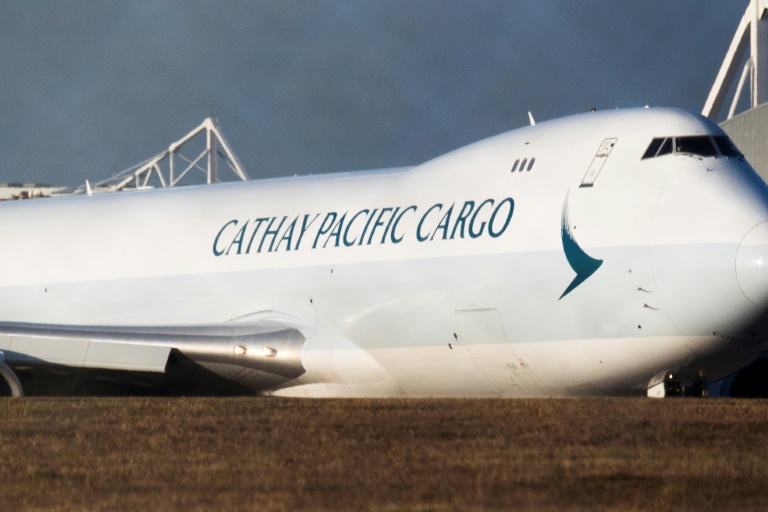
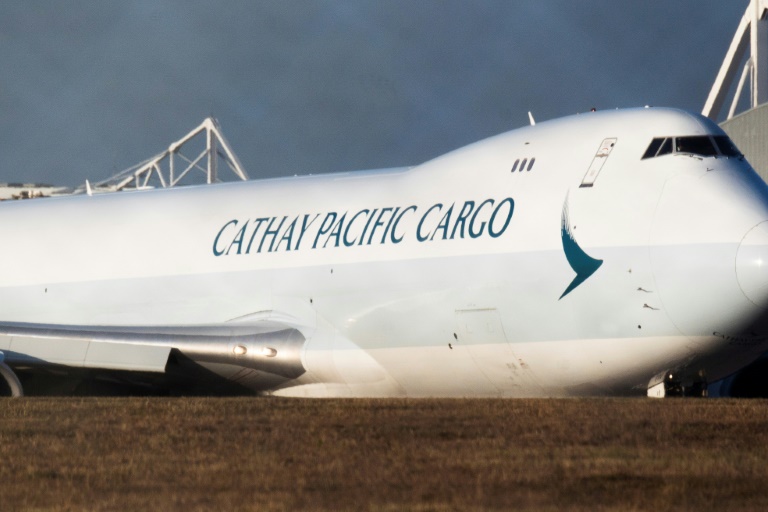
Hong Kong carrier Cathay Pacific on Wednesday reported losses had narrowed in the first half after an “extremely difficult start” to the year, but said its capacity will improve in coming months as travel sentiment improves.

The US$637 million loss in January-June was narrower than the US$968 million deficit suffered in the same period last year, as the airline benefited from strong cargo demand and cost-cutting measures.

Chairman Patrick Healey said in a statement that the first few months were “particularly unfavourable” as pandemic-related travel restrictions severely constrained Cathay’s flight operations and greatly affected demand for travel.

But he added that the airline was gearing up for borders reopening and expected a stronger second-half.

Cathay aims to boost passenger flight capacity to a quarter of pre-pandemic levels by the end of 2022, while it is looking to lift cargo capacity to 65 percent, Healey said.

The airline carried 335,000 passengers in the first half of the year, more than double that of the same period in 2021, bringing in US$263 million in revenue. Income from the cargo unit jumped 9.3 percent to US$1.5 billion.

Total revenue was up 17 percent on-year at US$2.4 billion.

Hong Kong has taken tentative steps toward reopening its borders after being internationally isolated for two and a half years owing to strict Covid rules for travellers.

On Monday authorities said visitors would now have to spend just three days in hotel quarantine, down from seven and much lower than the three weeks earlier in the year.

Cathay praised the adjustments as “positive steps” but pressed the government to “urgently provide a clear roadmap” to remove all pandemic-related restrictions on passengers and aircrew.

The firm’s ability to operate more flights “continues to be severely constrained by a bottleneck on crewing resources under the existing quarantine requirements”, Healey said on Wednesday.

Last month, Hong Kong also suspended a circuit-breaker mechanism that penalised airlines for bringing in coronavirus cases — which had affected numerous Cathay routes, including for key markets such as the United States and Britain.

The airline operated just 29 destinations in January, compared with more than 100 before the pandemic.

Hong Kong authorities are hinting at a potential international reopening in November, timed to coincide with the high-profile Rugby Sevens tournament and a banking summit.

Cathay is bringing aircraft parked overseas back to Hong Kong and is aiming to hire more than 4,000 front-line employees over the next 18 to 24 months, Healey said.

In June, Hong Kong also extended the drawdown period of a US$1 billion bridge loan to Cathay — the second time in two years — as part of a US$5 billion government bailout to help the airline weather the pandemic.

Hong Kong’s home carrier suffered a reputational blow earlier this year when a coronavirus outbreak was traced to two of its flight attendants who breached their quarantine rules. They were fired and later prosecuted.

Hong Kong's Cathay Pacific narrows H1 loss, eyes better end to year

Hong Kong carrier Cathay Pacific on Wednesday reported losses had narrowed in the first half after an “extremely difficult start” to the year, but said its capacity will improve in coming months as travel sentiment improves.

The US$637 million loss in January-June was narrower than the US$968 million deficit suffered in the same period last year, as the airline benefited from strong cargo demand and cost-cutting measures.

Chairman Patrick Healey said in a statement that the first few months were “particularly unfavourable” as pandemic-related travel restrictions severely constrained Cathay’s flight operations and greatly affected demand for travel.

But he added that the airline was gearing up for borders reopening and expected a stronger second-half.

Cathay aims to boost passenger flight capacity to a quarter of pre-pandemic levels by the end of 2022, while it is looking to lift cargo capacity to 65 percent, Healey said.

The airline carried 335,000 passengers in the first half of the year, more than double that of the same period in 2021, bringing in US$263 million in revenue. Income from the cargo unit jumped 9.3 percent to US$1.5 billion.

Total revenue was up 17 percent on-year at US$2.4 billion.

Hong Kong has taken tentative steps toward reopening its borders after being internationally isolated for two and a half years owing to strict Covid rules for travellers.

On Monday authorities said visitors would now have to spend just three days in hotel quarantine, down from seven and much lower than the three weeks earlier in the year.

Cathay praised the adjustments as “positive steps” but pressed the government to “urgently provide a clear roadmap” to remove all pandemic-related restrictions on passengers and aircrew.

The firm’s ability to operate more flights “continues to be severely constrained by a bottleneck on crewing resources under the existing quarantine requirements”, Healey said on Wednesday.

Last month, Hong Kong also suspended a circuit-breaker mechanism that penalised airlines for bringing in coronavirus cases — which had affected numerous Cathay routes, including for key markets such as the United States and Britain.

The airline operated just 29 destinations in January, compared with more than 100 before the pandemic.

Hong Kong authorities are hinting at a potential international reopening in November, timed to coincide with the high-profile Rugby Sevens tournament and a banking summit.

Cathay is bringing aircraft parked overseas back to Hong Kong and is aiming to hire more than 4,000 front-line employees over the next 18 to 24 months, Healey said.

In June, Hong Kong also extended the drawdown period of a US$1 billion bridge loan to Cathay — the second time in two years — as part of a US$5 billion government bailout to help the airline weather the pandemic.

Hong Kong’s home carrier suffered a reputational blow earlier this year when a coronavirus outbreak was traced to two of its flight attendants who breached their quarantine rules. They were fired and later prosecuted.

Experts see inflation reprieve in America

Is inflation finally slowing down in the United States?

Inflation data due to be released Wednesday is expected to show at least a partial cooling down of consumer prices and bring a breath of fresh air for US President Joe Biden just months before crucial midterm elections.

Fueled by aggressive consumer spending of pandemic savings, global supply chain snarls, domestic worker shortages, and Russia’s war on Ukraine, inflation reached 9.1 percent in June, year over year, the highest in 40 years.

But it is expected to fall to 8.6 percent in July, according to MarketWatch.

White House spokeswoman Karine Jean-Pierre said that although the administration has not seen the fresh statistics yet, “We know that gas prices have fallen.”

“And we hope those gas price declines will factor into the CPI inflation data,” Jean-Pierre told reporters Tuesday.

Consumer prices have continued to climb in the United States, squeezing family budgets and, and by extension, Biden’s popularity.

His opponents accuse Biden of precipitating inflation with his gigantic $1.9 trillion coronavirus relief package, which he enacted in March last year, shortly after assuming office.

And Republicans renewed their criticism of Biden’s economic policy, saying Sunday’s passage in the Senate of his massive climate and healthcare bill titled the “Inflation Reduction Act,” does the opposite of its stated purpose.

– Larger issue –

But the devil is in the details. 

Experts worry that the inflation slowdown linked to the drop in gasoline prices could be outweighed by rising rent and real estate prices.

“The larger issue is what happens to home ownership costs & rents,” Diane Swonk, chief economist for KPMG, wrote on Twitter.

Similar to other economists, Swonk expects to see a rise in the so-called underlying inflation rate that excludes food and energy, which had risen to 5.9 percent in June, year over year.

The question now facing Washington is whether it will be possible to bring inflation down sustainably, without plunging the world’s largest economy into recession, after two quarters of economic contraction.

In a bid to tamp down inflation, the US Federal Reserve has already hiked the interest rate four times to a range of 2.25 to 2.5 percent.

On the bright side, the US labor market remains dynamic and in July the unemployment rate fell to the pre-pandemic level of 3.5 percent.

But there are still nearly two jobs open for every available worker, which pushes wages up and contributes to inflation.

Inflation data will be released Wednesday at 8:30am local time (1230 GMT).

Experts see inflation reprieve in America

Is inflation finally slowing down in the United States?

Inflation data due to be released Wednesday is expected to show at least a partial cooling down of consumer prices and bring a breath of fresh air for US President Joe Biden just months before crucial midterm elections.

Fueled by aggressive consumer spending of pandemic savings, global supply chain snarls, domestic worker shortages, and Russia’s war on Ukraine, inflation reached 9.1 percent in June, year over year, the highest in 40 years.

But it is expected to fall to 8.6 percent in July, according to MarketWatch.

White House spokeswoman Karine Jean-Pierre said that although the administration has not seen the fresh statistics yet, “We know that gas prices have fallen.”

“And we hope those gas price declines will factor into the CPI inflation data,” Jean-Pierre told reporters Tuesday.

Consumer prices have continued to climb in the United States, squeezing family budgets and, and by extension, Biden’s popularity.

His opponents accuse Biden of precipitating inflation with his gigantic $1.9 trillion coronavirus relief package, which he enacted in March last year, shortly after assuming office.

And Republicans renewed their criticism of Biden’s economic policy, saying Sunday’s passage in the Senate of his massive climate and healthcare bill titled the “Inflation Reduction Act,” does the opposite of its stated purpose.

– Larger issue –

But the devil is in the details. 

Experts worry that the inflation slowdown linked to the drop in gasoline prices could be outweighed by rising rent and real estate prices.

“The larger issue is what happens to home ownership costs & rents,” Diane Swonk, chief economist for KPMG, wrote on Twitter.

Similar to other economists, Swonk expects to see a rise in the so-called underlying inflation rate that excludes food and energy, which had risen to 5.9 percent in June, year over year.

The question now facing Washington is whether it will be possible to bring inflation down sustainably, without plunging the world’s largest economy into recession, after two quarters of economic contraction.

In a bid to tamp down inflation, the US Federal Reserve has already hiked the interest rate four times to a range of 2.25 to 2.5 percent.

On the bright side, the US labor market remains dynamic and in July the unemployment rate fell to the pre-pandemic level of 3.5 percent.

But there are still nearly two jobs open for every available worker, which pushes wages up and contributes to inflation.

Inflation data will be released Wednesday at 8:30am local time (1230 GMT).

Stranded beluga whale rescued from France's Seine river

A beluga whale stranded in the river Seine in northern France for more than a week was removed from the water early Wednesday in the first stage of an ambitious rescue operation to return it to the sea.

After nearly six hours of work by dozens of divers and rescuers, the 800-kilogram (1,800-pound) cetacean was lifted from the river by a net and crane at around 4:00 am (0200 GMT) and placed on a barge under the immediate care of a dozen veterinarians, AFP journalists said.

The beluga, a protected species usually found in cold Arctic waters, will be placed in a refrigerated truck and transported to the coast if tests show it is fit enough, said Isabelle Dorliat-Pouzet, secretary general of the Eure prefecture.

“We are awaiting the results of the blood test and the ultrasounds and, depending on the results, a decision will be made whether or not he should take the road to the sea,” she told a press conference by the river just an hour after the whale was pulled out.

“As I speak to you, he is alive, he is on the barge, he survived. He is being treated,” Dorliat-Pouzet said.

“We could see that he is a male, that he is very underweight and that he has a few sores,” she added.

The four-metre (13-foot) whale was spotted more than a week ago heading towards Paris and was stranded about 130 kilometres (81 miles) inland from the Channel at Saint-Pierre-la-Garenne in Normandy.

Since Friday, the animal’s movement inland had been blocked by a lock at Saint-Pierre-la-Garenne, 70 kilometres northwest of Paris, and its health deteriorated after it refused to eat.

But its condition was “satisfactory”, Isabelle Brasseur of the Marineland sea animal park in southern France told AFP on Tuesday.

A seawater basin at a lock in the Channel port of Ouistreham has been readied for the animal, which will spend three days there under observation and treatment in preparation for its release into the open sea.

“There it will, we hope, have a better chance of survival,” said conservation group Sea Shepherd France, which is assisting the operation.

The beluga will be taken onto the high seas and released “far enough away from the coast” to regain its rightful place in nature, Dorliat-Pouzet said earlier.

– ‘A great day’ –

“Today is a great day for this beluga whale and for everyone involved in its rescue,” Sea Shepherd said on its website.

The “exceptional” operation to return it to the sea is not without risk for the whale, which is already weakened and stressed, said Brasseur, part of a Marineland team sent to assist with the rescue.

“It could be that he dies now, during the handling, during the journey or at point B,” in Ouistreham, she said.

The 24 divers involved in the operation and the rescuers handling the ropes had to try several times between 10:00 pm and 4:00 am to lure the animal into the nets to be lifted out of the water.

As preparations for the operation got under way, people gathered along the banks of the river to observe.

“I’m hopeful that he will reach the sea and that he will not end up like the orca,” said Isabelle Rainsart, referencing a killer whale that was spotted in the Seine in May but later died. 

“We will wait to see how the transport goes, but we may have already succeeded in the hard part,” added Rainsart, who first filmed the beluga on August 2 from her garden overlooking the river.

Interest in the beluga’s fate has spread far beyond France, generating a large influx of financial donations and other aid from conservation groups as well as individuals, officials said.

While belugas migrate south in the autumn to feed as ice forms in their native Arctic waters, they rarely venture so far.

According to France’s Pelagis Observatory, which specialises in sea mammals, the nearest beluga population is off the Svalbard archipelago, north of Norway, 3,000 kilometres from the Seine.

The trapped whale is only the second beluga ever sighted in France. The first was pulled out of the Loire estuary in a fisherman’s net in 1948.

Bollywood seeks boost with 'Forrest Gump' remake

One of India’s biggest stars is banking on a remake of Hollywood feelgood hit “Forrest Gump” to revive the fortunes of Hindi-language Bollywood, after a string of weak box-office showings.

Aamir Khan’s “Laal Singh Chaddha”, an adaptation of the 1994 US classic starring Tom Hanks, hits cinemas on Thursday ahead of India’s 75th independence celebrations.

Disappointing takings for other Bollywood A-listers have cast a pall over an industry still recovering from Covid-19 lockdown losses when many in movie-mad India turned to streaming giants like Netflix and Disney+ Hotstar.

The adaptation keeps several iconic scenes from the original — which netted six Oscars, including for Best Picture — such as a floating white feather, ping-pong playing and lots of running.

– Box of golgappas –

But there are several changes, with Gump’s “box of chocolates” line becoming “Life is just like a golgappa. Your tummy might feel full, but your heart always craves more.”

Golgappa is a popular Indian snack, while the second half of the saying — “you never know what you’re gonna get” in the original —  draws from a common Hindi phrase.

The film promises to take people through India’s history in the same way Gump stumbled through and influenced major US events like the Vietnam War.

This could irk Indian right-wing critics who have already called for a boycott of the film because of comments made by Khan in 2015 that were deemed to be unpatriotic.

Khan, the star of megahit “Dangal” (2016), and screenwriter Atul Kulkarni were coy in sharing what Indian historical settings would be featured.

Kulkarni would only say that his script was a “beautiful story about a beautiful country called India through a beautiful person called Laal Singh”.

– Remaking a ‘classic’ –

Khan, 57, admitted that he initially put off reading Kulkarni’s script, uncertain it would be possible to adapt such a “cult classic”.

“It’s like saying we are remaking ‘Mughal-e-Azam’ and ‘Mother India’. It’s not a wise thing to do,” he said, referring to two Indian classics.

“But when I heard the script, I understood he’s done it. It was a moving experience for me. I really loved it. The moment I heard it I wanted to do this.”

Bollywood star Kareena Kapoor, 41, who plays Singh’s lifelong friend Rupa, based on Robin Wright’s Jenny Curran, said the plot was “timeless” with a love story at its core.

“I wondered how they would play around with such an iconic film,” added Naga Chaitanya, a Telugu-language star from the southern film industry “Tollywood” who plays Bala, an adaptation of Gump’s shrimp-fishing Vietnam comrade Bubba.

“But the way they have conceived the film for Indian cinema is unique.”

– Competition –

Recent silver-screen hits have not come from Hindi-language Bollywood but are in other Indian languages, such as action flicks “Pushpa”, “KGF: Chapter 2” and “RRR”.

“RRR”, released in March, raked in $87 million domestically, while “KGF: Chapter 2”, which debuted a few weeks later, took in $106 million, media analyst Karan Taurani of Mumbai-based Elara Capital told AFP.

Action film “Shamshera”, released on July 22 and starring Bollywood actor Ranbir Kapoor, has so far only made $5.6 million, dashing hopes it would lure audiences back to Hindi cinema.

A rare Bollywood hit this year has been comedy horror “Bhool Bhulaiyaa 2” released on May 20 and featuring rising star Kartik Aryan, which has brought in $24 million so far.

Now, all eyes are on “Laal Singh Chaddha” and family dramedy “Raksha Bandhan” with Bollywood megastar Akshay Kumar — which also releases on Thursday.

Taurani estimates that “Laal Singh Chaddha” will make $19 million, falling short of Khan’s per-film average of $35 million.

Khan, who co-produced “Laal Singh Chaddha”, believes Bollywood hasn’t lost its mojo, blaming the early release of movies on streaming services for lower box-office takings.

“I feel that perhaps we — I’m including myself in this — as Hindi filmmakers, need to… also pick topics which are relevant to a larger audience, as opposed to picking topics which are relevant to a smaller audience,” he said.

Close Bitnami banner
Bitnami