AFP

Forever 16: America's teens succumbing to deadly fentanyl

Makayla Cox, a high school student in the US state of Virginia, thought she was taking medication that her friend had procured to treat pain and anxiety.

Instead, the pill she took two weeks after her sixteenth birthday was fentanyl, a synthetic opioid 50 times more potent than heroin. It killed her almost instantly.

After watching a movie — a prequel to “Harry Potter” — with her mother Shannon one evening in January, Makayla appeared fine as she headed to her bedroom with her husky dog that often slept on her bed.

But when Shannon entered Makayla’s room the next morning, she found her partially sitting up, perched against the headboard, orange fluid coming out of her nose and mouth.

“She was stiff. I shook her, I screamed her name, I called 911,” Shannon told AFP. “My neighbors came over and did CPR, but it was too late. After that, I just don’t remember much.”

America’s opioid crisis has reached catastrophic proportions, with over 80,000 people dying of opioid overdoses last year, most of them due to illicit synthetics such as fentanyl — more than seven times the number a decade ago.

“This is the most dangerous epidemic that we’ve seen,” said Ray Donovan, chief of operations at the US Drug Enforcement Agency (DEA). “Fentanyl is not like any other illicit narcotic, it’s that deadly instantaneously.”

And deaths are rising especially quickly among young people, who obtain counterfeit prescription drugs through social media. Unknown to them, the pills come either laced with or made of fentanyl.

In 2019, 493 American adolescents died of drug overdose, in 2021 that figure was 1,146.

– Dealers seek teens via apps –

Drug dealers reach adolescents on apps such as Snapchat, TikTok, Instagram and others, often using emojis as code. 

Oxycodone, an opioid, may be advertised as a half-peeled banana, Xanax, a benzodiazepine used to treat anxiety, as a chocolate bar, and Adderall, an amphetamine that acts as a stimulant, as a train.

Wilson Compton, deputy director of the National Institute on Drug Abuse, said the number of Americans doing drugs has largely stayed the same in recent years, but what changed is how deadly they’ve become.

One cup of heroin is equivalent to one teaspoon of fentanyl, and less than one gram can mean the difference between life and death.

“It takes very small quantities to be a poison that can stop somebody breathing,” Compton told AFP in an interview. 

Most of the illicit fentanyl in the United States is manufactured by Mexican drug cartels in clandestine labs from chemicals shipped over from China.

Because fentanyl is much more potent, it takes much less of it to fill a pill, resulting in more supply and more profit to the cartels.

One kilogram of pure fentanyl can be purchased for up to $12,000, pressed into half a million of pills that will sell for up to $30 each, raking in millions of dollars, Donovan said. And it’s also much easier to smuggle in pill form.

Last year, the DEA seized 15,000 pounds (nearly seven tons) of fentanyl — enough to kill every American. Four out of 10 seized pills contain lethal quantities of fentanyl.

– ‘One pill can kill’ –

At the agency’s headquarters, a collection of photographs titled “Faces of Fentanyl” hangs in the hallway. It features dozens of portraits of people who recently lost their lives to fentanyl. One of them reads “Makayla. Forever 16.”

An honor-roll student and a cheerleader, Makayla liked to paint, cuddle with her two huskies, Maize and Malenkai, and planned to go to university to study law, said her mother Shannon Doyle, 41, who works as a paralegal in a loan service firm.

Makayla had battled anxiety after her parents’ divorce, but things got worse during the pandemic.

Last summer she started a job at a water park, where she met a friend who introduced her to counterfeit prescription drugs.

The blue pills found in Makayla’s bed turned out to be 100 percent fentanyl. Police are investigating, but so far no arrests have been made.

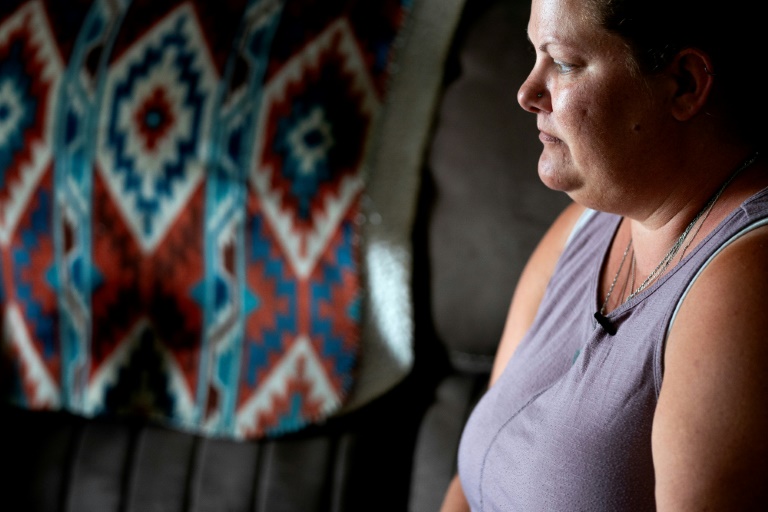
“It used to be that when you were addicted to drugs you had five, 10, 15 years to try and get over your addiction and get the help and change your life,” Shannon said at her house in Virginia Beach, a town on the Atlantic coast some 240 miles (400 kilometers) south of the US capital.

“You don’t have that chance anymore.” 

Last year the DEA launched a campaign called “One pill can kill” to raise awareness of the dangers of fentanyl, and there are efforts across America to make naloxone, a medication that can reverse an opioid overdose, more easily available, including in schools.

Makayla’s ashes are in her bedroom and Shannon still peeks into the room every morning and evening, like she did when her daughter was alive.

She started a foundation in Makayla’s name to help prevent similar tragedies — a way, she says, helps her cope with her grief.

Makayla’s best friend Kaydence Blanchard, 16, is spending the summer without her, trying to make good on the dreams the girls had: to get a driver’s license and drive to the beach.

But for Makayla “the future will never happen,” Blanchard said. “She will never complete any of the plans that we had together.”
Tourists return but Easter Islanders draw lessons from Covid isolation

During more than two years of the coronavirus pandemic, Easter Island was closed to tourism — forcing inhabitants to turn to a more sustainable way of life and relearn forgotten skills.

Now that the island’s borders are open once again, local people, including the Rapa Nui indigenous population, want to resist the temptation to return to their pre-pandemic lifestyle.

“The time has come that the ancients predicted,” Julio Hotus, a member of the Easter Island council of elders, told AFP.

Hotus said the Rapa Nui people’s ancestors had warned about the importance of maintaining food independence because of the risk the island faced of one day becoming isolated, but that recent generations had ignored the warnings.

Before the pandemic, the island’s food supply was almost exclusively provided by Chile.

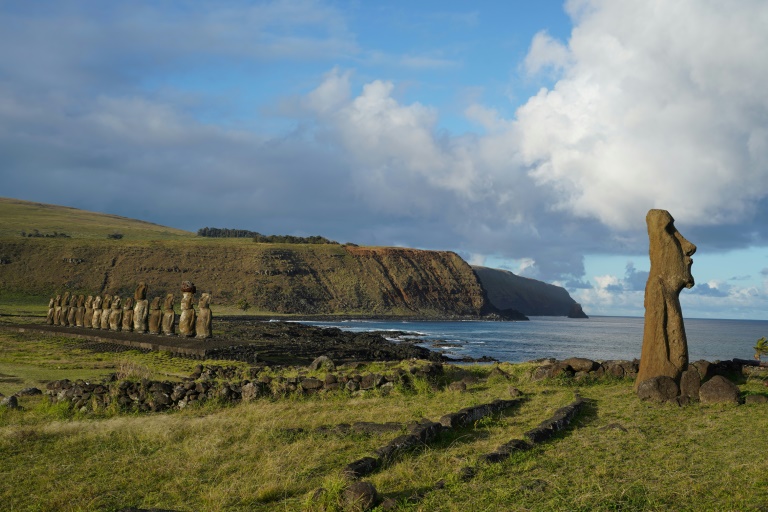
Easter Island lies 3,500 kilometers (2,100 miles) off the west coast of Chile and is world renown for its monumental statues of human figures with giant heads, called moai.

With a population of just 8,000, it used to attract 160,000 tourists a year — “an avalanche” according to Hotus — but in March 2020 Easter Island closed its borders over Covid.

– No tourists, no income –

Olga Ickapakarati used to sell small stone moai figurines to tourists but once she was left without an income, she turned to agriculture and fishing to survive, just as her ancestors had lived before contact with European explorers.

“We were all left with nothing, we were left in the wind …. but we began planting,” Ickapakarati told AFP.

She took advantage of a program that delivered seeds before the island was shut off from the outside world.

Ickapakarati planted spinach, beets, cilantro, chard, celery, basil, pineapple, oregano and tomatoes.

What she didn’t eat, she shared with neighbors, just as many families did in creating an island-wide support network.

“All the islanders are like this. They have good hearts. If I see that I have a surplus of something, I give it to another family,” said Ickapakarati, who lives with her children and grandchildren.

This new focus on sustainable living does not mean an end to tourism on Easter Island.

Last week, the first airplane of tourists for 28 months landed on the island, to much excitement from the locals desperate to see new faces.

But there will be no immediate return to the two flights a day of yesteryear. There will be just two a week for now, although the number will gradually increase.

Large hotel chains have decided to stay closed.

“We will continue with tourists, but I hope that the pandemic has taught a lesson that we can apply for the future,” said Hotus.

– ‘Archeological heritage at risk’ –

Another thing the pandemic did was to create awareness of the necessity to look after natural resources affected by climate change, such as water and energy. And also the emblematic moais.

Carved from volcanic rock by the Polynesian Rapa Nui people between 1200 and 1500, there are more than 900 on the island, which measures 24 kilometers by 12 kilometers.

The statues can measure up to 20 meters in height and weigh more than 80 tons.

Most remain at the quarry where they were originally carved but many others were carted to coastal areas to look inland, presumably for ceremonial purposes.

The moais have been damaged by heavy rainfall, strong winds and the ocean waves crashing against the statues and their bases, leading to fears for their future.

“Climate change, with its extreme events, is putting our archeological heritage at risk,” said Vairoa Ika, the local environment director.

“The stone is degrading” and needs to be protected.

“The problem with the moais is that they are very fragile,” added Pedro Edmunds Paoa, the island’s mayor, who says the statues’ worth is “incalculable.”

He said that authorities need to “forget about the tourist” vision and take protective measures, even if that means covering the statues “with glass domes”, which would ruin not just the authentic view but also tourists’ photographs.

He also wants inhabitants to make maximum use of natural resources and to prioritize locals in employment, while resurrecting the ancestral practise of fostering community solidarity.

“From now on the tourist must become a friend of the place, whereas before they were visiting foreigners,” said Edmunds Paoa.

Endangered sharks, rays caught in protected Med areas: study

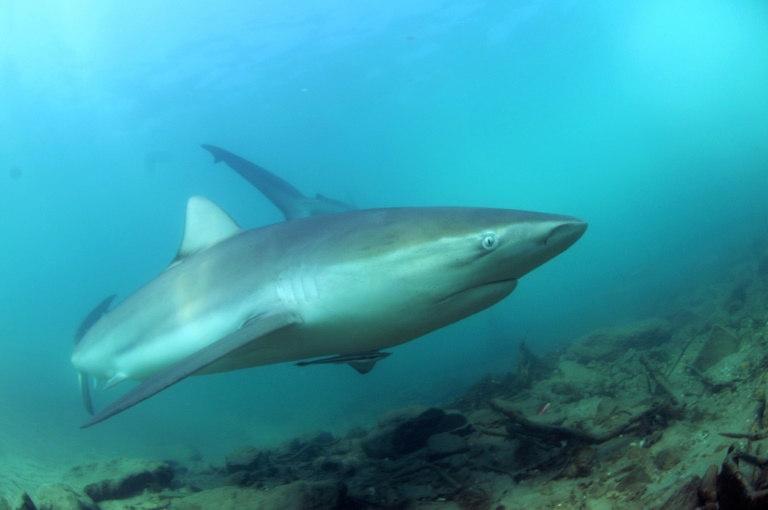
Endangered sharks, rays and skates in the Mediterranean are more frequently caught in protected than in unprotected areas, according to research published Tuesday highlighting the need for better conservation for critically threatened species.

The three types of elasmobranch are among the species most threatened by overfishing. 

While often landed as by-catch — or caught in nets of boats seeking to land other species — demand for their fins and meat has driven an estimated 71-percent decline in ocean sharks and rays since 1970. 

Although they are among the oldest marine species on Earth, their slow growth rate and late maturity mean one third of elasmobranchs are categorised by the International Union for the Conservation of Nature (IUCN) as at risk of extinction. 

While dozens of nations have banned large-scale fishing of endangered shark, ray and skate species, true global catch figures are likely to be hugely underestimated as 90 percent of the world’s fishing fleet is made up of small-scale boats.

Researchers in Italy wanted to get a better idea of how species fare in the Mediterranean’s partially protected areas, which allow some fishing with restrictions.

They used photo-sampling and image analysis to compile a database covering more than 1,200 small-scale fishing operations across 11 locations in France, Italy, Spain, Croatia, Slovenia and Greece. 

– Protected areas –

The team then used statistical models to demonstrate that catches of threatened species were higher in partially protected areas than in areas with no protection at all.

“People assume that it is large-scale trawlers that are impacting biodiversity, which is true and there’s a lot of evidence for this,” said co-author Antonio Di Franco, from the Sicily Marine Centre.

“There is less research on small-scale fishing’s impact and our research shows that there is this potential.”

The team found that catches they analysed in partially protected areas landed 24 species of shark, skate and ray — more than a third of which are endangered.

This is likely in part due to the species’ preference for coastal waters, where most small-scale fisheries prefer to operate. 

“We don’t know the activity of small-scale fisheries in general, we don’t know how many nets they actually fish or where they fish,” said Di Franco. 

Overall, in the partially protected areas studied, 517 elasmobranchs were caught compared with 358 in non-protected areas. 

In terms of mass, the weight of shark, ray or skate species caught in partially protected areas was roughly double that in non-protected areas.

More than 100 countries have committed to increase the amount of protected oceans worldwide to 30 percent by 2030.

Di Franco said there were a number of steps countries could take to help threatened species, including fitting smaller fishing boats with GPS trackers and ensuring that protected areas were joined up, allowing the species to more easily change living regions.

“Protected areas are a great potential benefit to biodiversity but the point is to look at management,” he told AFP. 

“But often countries don’t have the capacity to properly manage stocks.” 

Biden signs major semiconductors investment bill to compete against China

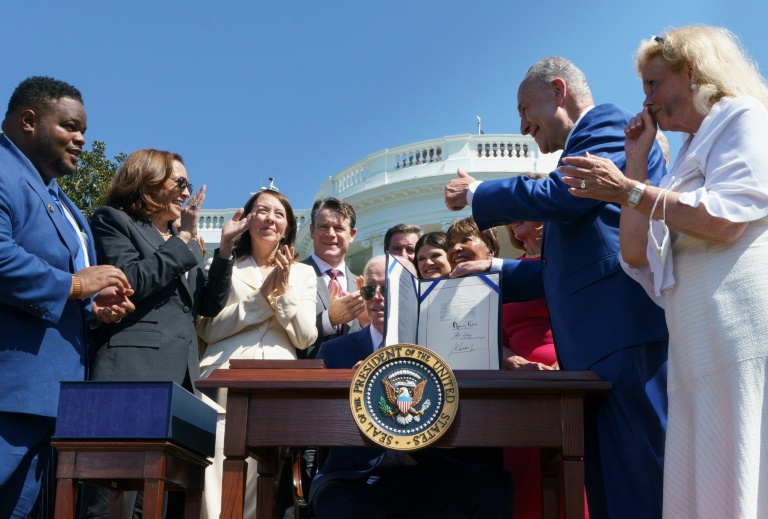
President Joe Biden signed into law Tuesday a multibillion dollar bill boosting domestic semiconductor and other high-tech manufacturing sectors that US leaders fear risk being dominated by rival China.

The Chips and Science Act includes around $52 billion to promote production of microchips, the tiny but powerful and relatively hard-to-make components at the heart of almost every modern piece of machinery.

Tens of billions of dollars more are allocated for scientific research and development.

The White House says the government commitment to bolstering high-tech industries is already drawing in large-scale private investors, with some $50 billion in new semiconductor investment alone. The lion’s share of that is a plan announced by US firm Micron to put $40 billion into domestic expansion by 2030.

Biden said at a White House speech that the cash injection from the Chips Act will help “win the economic competition in the 21st century.”

Entrepreneurs are “the reason why I’m so optimistic about the future of our country,” he said, and “the Chips and Science Act supercharges our efforts to make semiconductors here in America.”

One of the Democrat’s key themes since taking office has been the need to revamp US leadership in cutting-edge innovation and rebuild the homegrown industrial base in the face of China’s mammoth state-backed investments.

Semiconductors are of particular concern because they are vital to everything from washing machines to sophisticated weapons and nearly all are made abroad.

Although the semiconductor was invented in the United States, the country only produces around 10 percent of global supply, according to the White House, with some 75 percent of US supplies coming from east Asia.

“Today’s signing of the bipartisan Chips Act is a historic investment in America’s future. It will boost microchip production at home, strengthen our supply chains, increase domestic research and development, and bolster our national security,” said US Chamber of Commerce vice president Neil Bradley.

– Wider economic, political appeal –

Biden is also counting on the Chips Act to generate enthusiasm among voters, as his Democratic party tries to defend a thin congressional majority from a Republican takeover in this November’s midterm elections.

He told Americans that studies show the expansion of factories will create around a million construction jobs over the next six years — and these will be “union jobs” that pay “the prevailing wage.”

On Wednesday, Biden will sign another bill increasing funding for military veterans exposed to toxins. Like the Chips bill, this won bipartisan support in the usually bitterly divided Congress.

Shortly, Biden is also expected to be signing an enormous domestic investment bill — backed only by Democrats — aimed at fighting climate change and reducing health care costs.

Reflecting on the string of successes in Congress and the sudden momentum for his long stalled agenda, Biden predicted that “people will look back at this week and all we passed, and all we moved on, that we met the moment at this inflection point in history.”

“We bet on ourselves, believed in ourselves and recaptured the story, the spirit and the soul of this nation,” he said.

Biden signs major semiconductors investment bill to compete against China

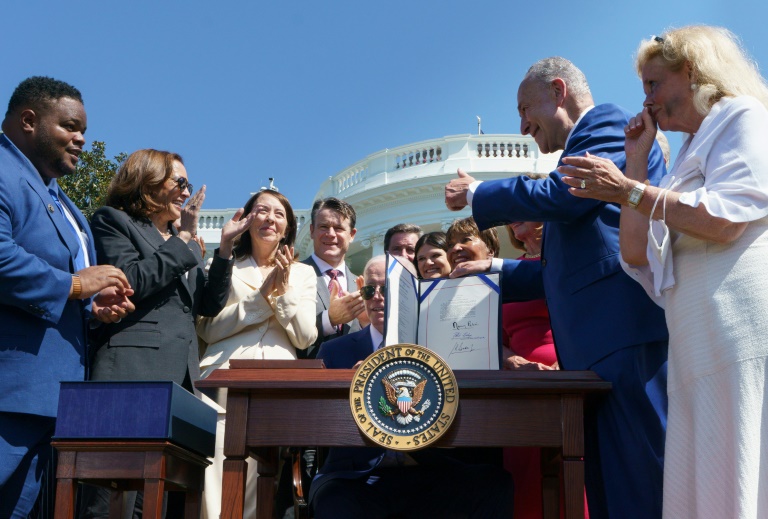
President Joe Biden signed into law Tuesday a multibillion dollar bill boosting domestic semiconductor and other high-tech manufacturing sectors that US leaders fear risk being dominated by rival China.

The Chips and Science Act includes around $52 billion to promote production of microchips, the tiny but powerful and relatively hard-to-make components at the heart of almost every modern piece of machinery.

Tens of billions of dollars more are allocated for scientific research and development.

The White House says the government commitment to bolstering high-tech industries is already drawing in large-scale private investors, with some $50 billion in new semiconductor investment alone. The lion’s share of that is a plan announced by US firm Micron to put $40 billion into domestic expansion by 2030.

Biden said at a White House speech that the cash injection from the Chips Act will help “win the economic competition in the 21st century.”

Entrepreneurs are “the reason why I’m so optimistic about the future of our country,” he said, and “the Chips and Science Act supercharges our efforts to make semiconductors here in America.”

One of the Democrat’s key themes since taking office has been the need to revamp US leadership in cutting-edge innovation and rebuild the homegrown industrial base in the face of China’s mammoth state-backed investments.

Semiconductors are of particular concern because they are vital to everything from washing machines to sophisticated weapons and nearly all are made abroad.

Although the semiconductor was invented in the United States, the country only produces around 10 percent of global supply, according to the White House, with some 75 percent of US supplies coming from east Asia.

“Today’s signing of the bipartisan Chips Act is a historic investment in America’s future. It will boost microchip production at home, strengthen our supply chains, increase domestic research and development, and bolster our national security,” said US Chamber of Commerce vice president Neil Bradley.

– Wider economic, political appeal –

Biden is also counting on the Chips Act to generate enthusiasm among voters, as his Democratic party tries to defend a thin congressional majority from a Republican takeover in this November’s midterm elections.

He told Americans that studies show the expansion of factories will create around a million construction jobs over the next six years — and these will be “union jobs” that pay “the prevailing wage.”

On Wednesday, Biden will sign another bill increasing funding for military veterans exposed to toxins. Like the Chips bill, this won bipartisan support in the usually bitterly divided Congress.

Shortly, Biden is also expected to be signing an enormous domestic investment bill — backed only by Democrats — aimed at fighting climate change and reducing health care costs.

Reflecting on the string of successes in Congress and the sudden momentum for his long stalled agenda, Biden predicted that “people will look back at this week and all we passed, and all we moved on, that we met the moment at this inflection point in history.”

“We bet on ourselves, believed in ourselves and recaptured the story, the spirit and the soul of this nation,” he said.

Biden signs major semiconductors investment bill to compete against China

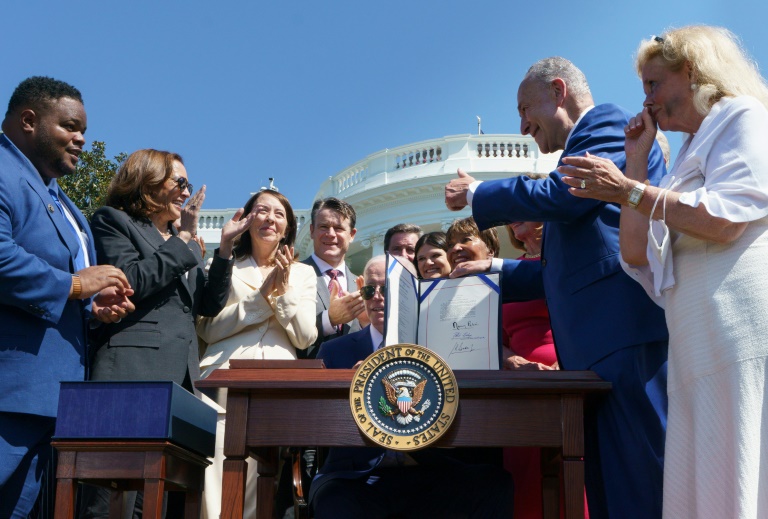
President Joe Biden signed into law Tuesday a multibillion dollar bill boosting domestic semiconductor and other high-tech manufacturing sectors that US leaders fear risk being dominated by rival China.

The Chips and Science Act includes around $52 billion to promote production of microchips, the tiny but powerful and relatively hard-to-make components at the heart of almost every modern piece of machinery.

Tens of billions of dollars more are allocated for scientific research and development.

The White House says the government commitment to bolstering high-tech industries is already drawing in large-scale private investors, with some $50 billion in new semiconductor investment alone. The lion’s share of that is a plan announced by US firm Micron to put $40 billion into domestic expansion by 2030.

Biden said at a White House speech that the cash injection from the Chips Act will help “win the economic competition in the 21st century.”

Entrepreneurs are “the reason why I’m so optimistic about the future of our country,” he said, and “the Chips and Science Act supercharges our efforts to make semiconductors here in America.”

One of the Democrat’s key themes since taking office has been the need to revamp US leadership in cutting-edge innovation and rebuild the homegrown industrial base in the face of China’s mammoth state-backed investments.

Semiconductors are of particular concern because they are vital to everything from washing machines to sophisticated weapons and nearly all are made abroad.

Although the semiconductor was invented in the United States, the country only produces around 10 percent of global supply, according to the White House, with some 75 percent of US supplies coming from east Asia.

“Today’s signing of the bipartisan Chips Act is a historic investment in America’s future. It will boost microchip production at home, strengthen our supply chains, increase domestic research and development, and bolster our national security,” said US Chamber of Commerce vice president Neil Bradley.

– Wider economic, political appeal –

Biden is also counting on the Chips Act to generate enthusiasm among voters, as his Democratic party tries to defend a thin congressional majority from a Republican takeover in this November’s midterm elections.

He told Americans that studies show the expansion of factories will create around a million construction jobs over the next six years — and these will be “union jobs” that pay “the prevailing wage.”

On Wednesday, Biden will sign another bill increasing funding for military veterans exposed to toxins. Like the Chips bill, this won bipartisan support in the usually bitterly divided Congress.

Shortly, Biden is also expected to be signing an enormous domestic investment bill — backed only by Democrats — aimed at fighting climate change and reducing health care costs.

Reflecting on the string of successes in Congress and the sudden momentum for his long stalled agenda, Biden predicted that “people will look back at this week and all we passed, and all we moved on, that we met the moment at this inflection point in history.”

“We bet on ourselves, believed in ourselves and recaptured the story, the spirit and the soul of this nation,” he said.

Jury finds ex-Twitter worker spied for Saudi royals

A former Twitter worker was found guilty on Tuesday of spying for Saudi officials keen to unmask critics on the platform.

Ahmad Abouammo was pronounced guilty on criminal counts including money laundering, fraud, and being an illegal agent of a foreign government, according to a copy of the verdict.

Prosecutors in federal court in San Francisco told jurors that Abouammo sold Twitter user information for cash and an expensive watch some seven years ago.

His defense team contended that he did nothing more than accept gifts from free-spending Saudis for simply doing his client management job.

“The evidence shows that, for a price and thinking no one was watching, the defendant sold his position to an insider of the crown prince,” US prosecutor Colin Sampson said in final remarks to the jury.

Defense attorney Angela Chuang countered that while there certainly appeared to be a conspiracy to get revealing information about Saudi critics from Twitter, prosecutors failed to prove Abouammo was part of it.

Abouammo quit Twitter in 2015 and took a job at e-commerce titan Amazon in Seattle, where he lives, according to court documents.

Jurors deliberated for three days before finding Abouammo guilty on 6 of the 11 charges against him.

Chuang conceded to the jury that Abouammo did violate Twitter employee rules by not telling the San Francisco-based company that he had received $100,000 in cash and a watch valued at more than $40,000 from someone close to the Saudi crown prince.

However, she downplayed the significance of the gift, saying it amounted to “pocket change” in Saudi culture known for generosity and lavish presents.

– Trust traded for cash? –

Abouammo was arrested in Seattle in November of 2019.

Prosecutors accused Abouammo and fellow Twitter employee Ali Alzabarah of being enlisted by Saudi officials between late 2014 and early the following year to get private information on accounts firing off posts critical of the regime.

The then-Twitter workers could use their credentials to glean email addresses, phone numbers, birth dates and other private data to identify people behind anonymous accounts, prosecutors said.

Abouammo remained free on Tuesday pending sentencing, despite concerns expressed by prosecutors that he might try to flee the country.

Alzabarah, a Saudi national, is being sought on a charge of failing to register in the United States as an agent of a foreign government as required by United States law, according to an FBI statement.

Chuang contended in court that prosecutors were trying to punish Abouammo for Alzabarah’s actions.

“As much as the government wishes that was Mr Alzabarah sitting at the table right now, it is not,” Chuang told jurors.

“And that is on them, they let Mr Alzabarah flee the country while he was under FBI surveillance.”

FBI raid on Trump's home ignites political firestorm

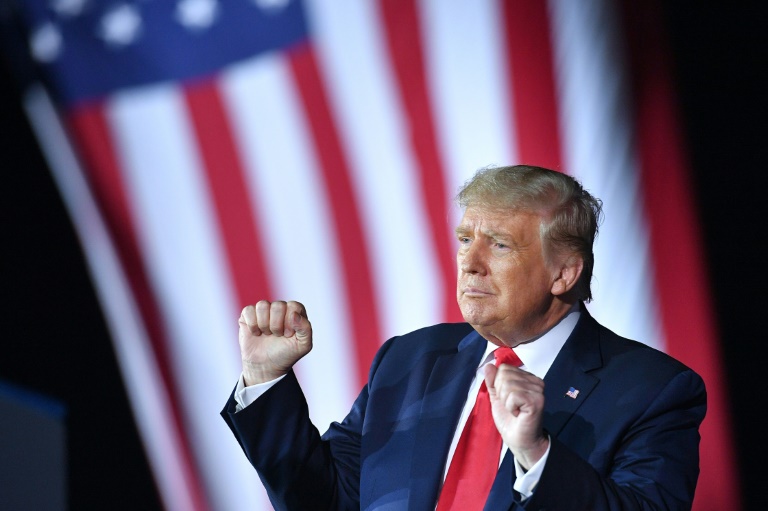
Top Republican leaders flung their support behind former US president Donald Trump on Tuesday after an extraordinary FBI raid on his palatial Florida residence sparked a political firestorm in an already bitterly divided country.

The FBI move marked a stunning escalation of legal probes into the 45th president and comes as he is weighing another White House run.

Several former advisors to the 76-year-old Trump urged him to immediately confirm that he would be a presidential candidate in 2024.

“Nothing like this has ever happened to a President of the United States before,” Trump said of the FBI operation at his Mar-a-Lago resort in West Palm Beach.

He denounced the FBI raid as a “weaponization of the Justice System” by “Radical Left Democrats who desperately don’t want me to run for President in 2024.”

At the White House, Press Secretary Karine Jean-Pierre said President Joe Biden did not have any advance notice about the raid and respected the independence of the Justice Department.

Asked about the potential for civil unrest in reaction to Trump’s legal problems, Jean-Pierre said “there’s no place for political violence in this country.”

The Federal Bureau of Investigation, which is led by Christopher Wray, a Trump appointee, declined to provide a reason for the raid.

But US media outlets said agents were conducting a court-authorized search related to the potential mishandling of classified documents that had been sent to Mar-a-Lago after Trump left the White House in January 2021.

Trump has also faced intense legal scrutiny for his efforts to overturn the results of the 2020 election and over the January 6 attack on the US Capitol by his supporters.

Since leaving office, Trump has remained the country’s most divisive figure, continuing to sow falsehoods that he actually won the 2020 vote.

A day after the  raid on Mar-A-Lago, US Representative Scott Perry — a Trump ally — said that FBI agents had confiscated his cell phone, but did not specify why it was taken.

“This morning, while traveling with my family, three FBI agents visited me and seized my cell phone,” Perry told FOX News, condemning “these kinds of banana republic tactics.”

– Allies rally round –

Leading Republicans rallied around the former president, who was not present at Mar-a-Lago when the raid took place.

Trump’s former vice president Mike Pence, a potential 2024 rival, expressed “deep concern” and said the raid smacked of “partisanship” by the Justice Department.

Kevin McCarthy, who is seeking to become speaker of the House of Representatives if Republicans win November’s midterm elections, accused the Justice Department of “weaponized politicization.”

Republican Senator Lindsey Graham, a Trump ally, said “launching an investigation of a former president this close to an election is beyond problematic.”

Representative Elise Stefanik, the third-ranking House Republican, called it a “dark day in American history.”

“If the FBI can raid a US President, imagine what they can do to you,” Stefanik tweeted, to which Democratic Representative Ted Lieu replied: “Why can’t the FBI investigate a US President? We’re not Russia, where the law doesn’t apply to the head of state and his cronies.”

Nancy Pelosi, the Democratic speaker of the House, told NBC that “no person is above the law.”

– Presidential paperwork –

In his statement, Trump did not give any indication about why the FBI raided his home but said: “They even broke into my safe!”

Andrew McCabe, a former FBI deputy director, told CNN that agents may have been looking for “something specific” related to the probe into the handling of classified information.

The National Archives said in February that it had recovered 15 boxes of documents from Mar-a-Lago and asked the Justice Department to look into Trump’s handling of classified material.

The recovery of the boxes raised questions about Trump’s adherence to presidential records laws enacted after the 1970s Watergate scandal that require Oval Office occupants to preserve records.

Trump’s former communications director Alyssa Farah Griffin told CNN the raid could fire up his supporters, a small number of whom rallied outside Mar-a-Lago on Tuesday.

“If it’s seen as some sort of massive overreach and not something incredibly serious, this is a very good day for Donald Trump,” Farah Griffin said.

For weeks, Washington has been riveted by hearings in Congress about the January 6 storming of the Capitol and Trump’s attempts to overturn the 2020 election.

Attorney General Merrick Garland has been repeatedly pushed over whether the Justice Department is building a case against Trump over the Capitol riot.

Trump is also being investigated for his efforts to alter the 2020 voting results in the state of Georgia, while his business practices are being probed in New York in separate cases.

New US strategy to make monkeypox vaccine go further

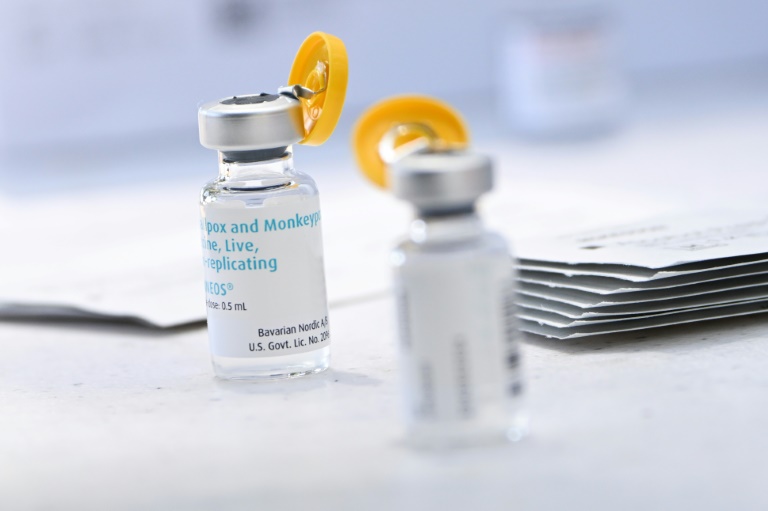
US health authorities on Tuesday authorized a new procedure for injecting the monkeypox vaccine that should make it possible to inoculate more people with the same amount of the drug, at a time when doses are running short in the country. 

The Food and Drug Administration also authorized giving the vaccine to people under the age of 18 who are considered to be at high risk of infection. 

For those over 18, health workers will now be able to administer the vaccine differently, via an intradermal injection — that is, between the upper layers of the skin — and not with a deeper, subcutaneous injection. 

The new method will “increase the total number of doses available for use by up to five-fold,” the FDA said in a statement. 

Two injections, four weeks apart, will still be necessary. 

The FDA said it was drawing on data from a 2015 clinical trial that showed a similar immune response in people given a subcutaneous injection compared to those given a fifth of the dose via an intradermal shot. 

At present, some 620,000 doses of the vaccine — manufactured by Bavarian Nordic, and marketed under the name Jynneos in the United States — have been distributed across the country.

Another 440,000 additional doses are still to be distributed, which could allow up to 2.2 million injections under the new strategy. 

The government has also ordered an additional five million doses, which will start arriving from September and run through 2023, affording the potential to administer 25 million doses. 

The decisions came after the FDA issued an emergency use authorization for the vaccine, a move that itself followed the declaration of a public health emergency last week. 

For the authorization in minors, the FDA said it had reviewed safety data for the vaccine, as well as data for another vaccine given in children against smallpox. 

“We feel very comfortable with the safety of the approach,” said Peter Marks of the FDA at a press conference, noting a recent increase in the number of children who have potentially been exposed to infected people. 

The United States has registered nearly 9,000 cases of monkeypox, a fifth of them in New York state. The vast majority of cases involve men who have had sex with men.

New US strategy to make monkeypox vaccine go further

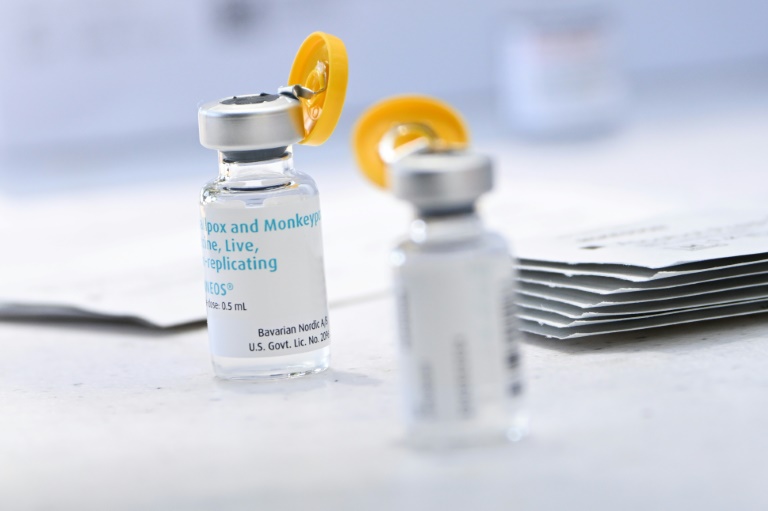
US health authorities on Tuesday authorized a new procedure for injecting the monkeypox vaccine that should make it possible to inoculate more people with the same amount of the drug, at a time when doses are running short in the country. 

The Food and Drug Administration also authorized giving the vaccine to people under the age of 18 who are considered to be at high risk of infection. 

For those over 18, health workers will now be able to administer the vaccine differently, via an intradermal injection — that is, between the upper layers of the skin — and not with a deeper, subcutaneous injection. 

The new method will “increase the total number of doses available for use by up to five-fold,” the FDA said in a statement. 

Two injections, four weeks apart, will still be necessary. 

The FDA said it was drawing on data from a 2015 clinical trial that showed a similar immune response in people given a subcutaneous injection compared to those given a fifth of the dose via an intradermal shot. 

At present, some 620,000 doses of the vaccine — manufactured by Bavarian Nordic, and marketed under the name Jynneos in the United States — have been distributed across the country.

Another 440,000 additional doses are still to be distributed, which could allow up to 2.2 million injections under the new strategy. 

The government has also ordered an additional five million doses, which will start arriving from September and run through 2023, affording the potential to administer 25 million doses. 

The decisions came after the FDA issued an emergency use authorization for the vaccine, a move that itself followed the declaration of a public health emergency last week. 

For the authorization in minors, the FDA said it had reviewed safety data for the vaccine, as well as data for another vaccine given in children against smallpox. 

“We feel very comfortable with the safety of the approach,” said Peter Marks of the FDA at a press conference, noting a recent increase in the number of children who have potentially been exposed to infected people. 

The United States has registered nearly 9,000 cases of monkeypox, a fifth of them in New York state. The vast majority of cases involve men who have had sex with men.

Close Bitnami banner
Bitnami