AFP

No charges for white woman whose accusation led to Emmett Till lynching

A grand jury in Mississippi declined to indict a white woman whose accusation that Black teenager Emmett Till propositioned her in 1955 led to his abduction and murder, which helped sparked the civil rights movement, a prosecutor said Tuesday.

The grand jury decided after seven hours of deliberation that there was insufficient evidence to indict Carolyn Bryant Donham, who was 21 at the time of Till’s killing, of complicity in his kidnap and murder, Dewayne Richardson, the prosecutor for Leflore County, said in a statement.

The decision came a month after an unserved arrest warrant from the time of the crime was found in the basement of the Leflore County courthouse for Donham, her husband Roy Bryant and his half-brother J.W. Milam. 

The two men — both now deceased — were arrested and acquitted on murder charges by an all-white jury, but Donham was never taken into custody.

The pair later admitted in a magazine interview that they had killed the boy.

Last month, US media reported that an unpublished memoir written by Donham claimed she was unaware that Till would be tortured and murdered.

In her account, she said the men brought the boy to her in the middle of the night and she denied it was him, but that he himself admitted it.

In 2004, the Justice Department had reopened the investigation, but was unable to press any charges due to the statute of limitations. 

In 2017, the author of a book on the case said Donham had confessed that Till had never made any advances. The Justice Department reopened the file again, but investigators failed to determine whether she had invented the incident or not, and the investigation was closed again in December 2021.

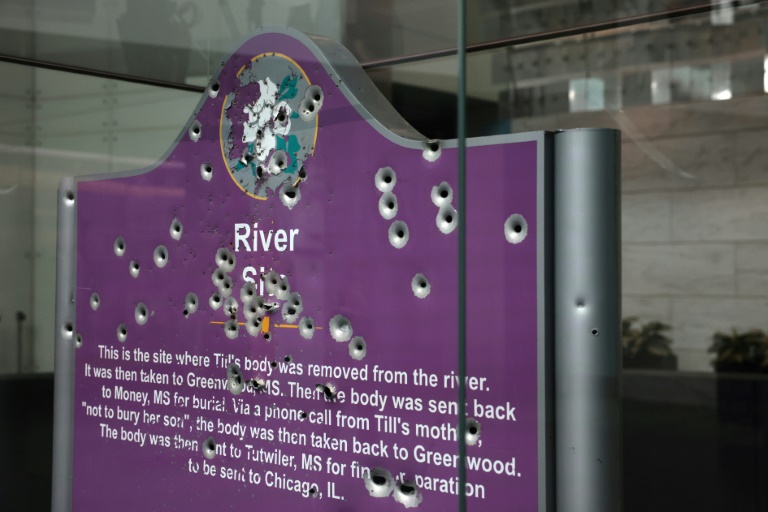
Till, who lived in Chicago, was visiting relatives in Mississippi when he and some other local children visited the store owned by the Bryants, where Donham was working alone.

She said at the time he had propositioned her and touched her on the arm, hand and waist.

His disfigured body was found a few days later in a river. The decision by his mother to have the body displayed in an open casket at the funeral brought home the horrors of lynchings and discrimination in the South, and helped trigger the civil rights movement of the 1950s and 1960s.

Till’s cousin, Reverend Wheeler Parker Jr, told CBS News that the decision was “unfortunate but predictable” after “hundreds of years of anti-Black systems that guaranteed those who killed Emmett Till would go unpunished, to this day.” 

In March, a new law named after Till came into effect making racist lynchings a federal crime with a punishment of up to 30 years in prison.
Russia says Crimea airbase blast was ammo detonation, not attack

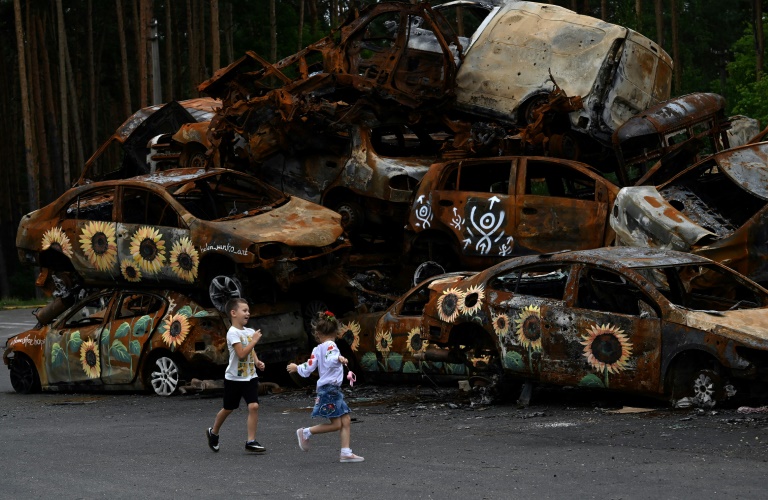
Moscow insisted Tuesday that major blasts at a key military airbase on the Russian-annexed Crimea peninsula were caused by exploding ammunition rather than Ukrainian fire.

Dramatic amateur footage shared on social media appeared to show panicked holidaymakers fleeing a Crimean beach with young children, as ballooning clouds of grey smoke rose over the horizon.

The blasts rocked the Saki airfield on the 167th day of Moscow’s invasion.

Russia annexed the Crimean peninsula in 2014 and has used the region as a staging ground for its attacks on Ukraine, but it has rarely been a target for Ukrainian forces.

The Russian defence ministry said “several aviation munitions detonated” at the base in an incident the head of the region said had left one person dead. 

Local health officials earlier said five people, including one child, had been injured.

The defence ministry said it was looking to establish the reason for the explosions but indicated the airfield was not targeted in an attack.

There was no immediate reaction from Kyiv.

Ukraine’s army, which for months pleaded for long-range artillery from Western allies, has been hitting targets deeper in Russian-held territory since some started arriving in recent weeks. 

Kyiv has also taken credit for several acts of sabotage inside Russian-held territory.

Moscow seized Crimea from Ukraine in the wake of massive nationwide street demonstrations that led to the ouster of a Kremlin-friendly president.

Those protests precipitated fighting between the army and Moscow-backed separatists in eastern Ukraine, which would lay the groundwork for Moscow’s full-scale assault on February 24 this year.

The invasion has left thousands dead, forced millions in Ukraine from their homes, and littered the country with land mines.

On Tuesday, the United States announced that it will provide $89 million for demining efforts in Ukraine.

“Russia’s unlawful and unprovoked further invasion of Ukraine has littered massive swaths of the country with landmines, unexploded ordnance, and improvised explosive devices,” the State Department said in a statement.

“These explosive hazards block access to fertile farmland, delay reconstruction efforts, prevent displaced communities from returning to their homes, and continue to kill and maim innocent Ukrainian civilians,” it said. 

– Mandatory evacuations –

The Russian invasion has led to a deep rupture in economic ties between Moscow and the West.

In response to sanctions for the invasion, Russia has squeezed gas supplies to Europe.

It announced on Tuesday that its oil deliveries through Ukraine had been halted.

Transneft, the Russian pipeline operator, said the Ukrainian side had stopped flows because it was “not receiving funds for these services”.

The Ukrainian side did not comment.

One of the impacted countries, Slovakia, confirmed flows had been halted for several days, and a spokesman for Bratislava refinery Slovnaft cited “technical problems at the bank level in connection with the payment of transit fees from the Russian side”.

The Kremlin lashed out after Ukrainian President Volodymyr Zelensky said in an interview that Europe should close their borders to Russians in response to the war. 

The Ukrainian leader told The Washington Post that current Western sanctions against Moscow were too weak, in a call that has been echoed by Russia’s neighbours Estonia and Finland.

“The irrationality of thinking in this case is off the charts,” Kremlin spokesman Dmitry Peskov told reporters.

On the frontlines, Ukraine said Russia was pursuing a campaign of bombardment of the east of the country that has left much of the industrial Donbas region in ruins.

Kyiv said Tuesday it had transported at least 3,000 people out of the battle-scarred eastern region of Donetsk since it ordered evacuations ahead of winter. 

The Ukrainian authorities are asking people to leave the area, as they do not expect to be able to provide it with heat during the cold winter months.

The presidency earlier said that three people had been killed and 19 more wounded in Russian shelling across the Donetsk region on Monday.

The head of the central region of Dnipro, meanwhile, said that 11 medical facilities had relocated there from the battle-torn Kharkiv and Lugansk regions further east.

“Those facilities transferred over 100 pieces of equipment and 10 ambulances,” Dnipro regional governor Valentyn Reznichenko said.

“The hospitals are restarting work. They are mostly receiving displaced people.”

Global stock markets retreat on eve of US inflation data

Stock markets were mostly lower and the dollar fell on Tuesday as investors nervously await the release of key US inflation data later this week.

If the official consumer price data Wednesday come in above analysts’ forecasts, the markets could see a sharp sell-off, analysts warned.

With inflation already at the highest level in 40 years, concern is growing that further interest rate increases by the world’s major central banks could go too far and tip the global economy into recession.

Federal Reserve officials in recent days have stressed that more hikes are coming to tame soaring inflation, with a third straight three-quarter point increase on the table next month.

The inflation data “could effectively set the mood for the rest of the summer,” said OANDA analyst, Craig Erlam.

“That seems quite dramatic, but if we fail to see a drop in the headline rate… it could really take the wind out of the sails of stock markets as it would be very difficult for the (Fed) to then hike by anything less than 75 basis points in September,” the expert said.

While US gasoline prices have been coming down, which takes some of the pressure off American families, the overall rate remains high.

Swissquote Bank analyst Ipek Ozkardeskaya said the recent drop in energy and commodity prices “should have a cooling effect… but higher labour costs could keep inflation sticky at undesirably high levels.”

Oil prices reversed some of the prior day’s gains and remain around six-month lows as recession fears mount and investors fret over the impact on demand. 

The markets are also keeping an eye on Iran nuclear talks after the European Union submitted a “final text” at negotiations to salvage a 2015 deal.

An agreement could open the way for Tehran to resume sales of crude on international markets, partly filling the gap left by the ban on Russian exports following the invasion of Ukraine. 

US tech shares tumbled after a second major chip maker issued an earnings warning.

“It seems that the technology sector along with the rest of the economy is slowing,” said Tom Cahill of Ventura Wealth Management.

– Key figures at around 2045 GMT –

New York – Dow: DOWN 0.2 percent at 32,774.41 (close)

New York – S&P 500: DOWN 0.4 percent at 4,122.47 (close)

New York – Nasdaq: DOWN 1.2 percent at 12,493.93 (close)

London – FTSE 100: UP 0.1 percent at 7,488.15 (close)

Frankfurt – DAX: DOWN 1.1 percent at 13,534.97 (close)

Paris – CAC 40: DOWN 0.5 percent at 6,490.00 (close)

EURO STOXX 50: DOWN 1.1 percent at 3,715.37

Tokyo – Nikkei 225: DOWN 0.9 percent at 27,999.96 (close)

Hong Kong – Hang Seng Index: DOWN 0.2 percent at 20,003.44 (close)

Shanghai – Composite: UP 0.3 percent at 3,247.43 (close)

Euro/dollar: UP at $1.0213 from $1.0194 Monday

Pound/dollar: UP at $1.2071 from $1.2079

Euro/pound: UP at 84.57 pence from 84.35 pence

Dollar/yen: UP at 135.12 yen from 134.98 yen

Brent North Sea crude: DOWN 0.1 percent at $96.57 per barrel

West Texas Intermediate: DOWN 0.1 percent at $90.70 per barrel

Global stock markets retreat on eve of US inflation data

Stock markets were mostly lower and the dollar fell on Tuesday as investors nervously await the release of key US inflation data later this week.

If the official consumer price data Wednesday come in above analysts’ forecasts, the markets could see a sharp sell-off, analysts warned.

With inflation already at the highest level in 40 years, concern is growing that further interest rate increases by the world’s major central banks could go too far and tip the global economy into recession.

Federal Reserve officials in recent days have stressed that more hikes are coming to tame soaring inflation, with a third straight three-quarter point increase on the table next month.

The inflation data “could effectively set the mood for the rest of the summer,” said OANDA analyst, Craig Erlam.

“That seems quite dramatic, but if we fail to see a drop in the headline rate… it could really take the wind out of the sails of stock markets as it would be very difficult for the (Fed) to then hike by anything less than 75 basis points in September,” the expert said.

While US gasoline prices have been coming down, which takes some of the pressure off American families, the overall rate remains high.

Swissquote Bank analyst Ipek Ozkardeskaya said the recent drop in energy and commodity prices “should have a cooling effect… but higher labour costs could keep inflation sticky at undesirably high levels.”

Oil prices reversed some of the prior day’s gains and remain around six-month lows as recession fears mount and investors fret over the impact on demand. 

The markets are also keeping an eye on Iran nuclear talks after the European Union submitted a “final text” at negotiations to salvage a 2015 deal.

An agreement could open the way for Tehran to resume sales of crude on international markets, partly filling the gap left by the ban on Russian exports following the invasion of Ukraine. 

US tech shares tumbled after a second major chip maker issued an earnings warning.

“It seems that the technology sector along with the rest of the economy is slowing,” said Tom Cahill of Ventura Wealth Management.

– Key figures at around 2045 GMT –

New York – Dow: DOWN 0.2 percent at 32,774.41 (close)

New York – S&P 500: DOWN 0.4 percent at 4,122.47 (close)

New York – Nasdaq: DOWN 1.2 percent at 12,493.93 (close)

London – FTSE 100: UP 0.1 percent at 7,488.15 (close)

Frankfurt – DAX: DOWN 1.1 percent at 13,534.97 (close)

Paris – CAC 40: DOWN 0.5 percent at 6,490.00 (close)

EURO STOXX 50: DOWN 1.1 percent at 3,715.37

Tokyo – Nikkei 225: DOWN 0.9 percent at 27,999.96 (close)

Hong Kong – Hang Seng Index: DOWN 0.2 percent at 20,003.44 (close)

Shanghai – Composite: UP 0.3 percent at 3,247.43 (close)

Euro/dollar: UP at $1.0213 from $1.0194 Monday

Pound/dollar: UP at $1.2071 from $1.2079

Euro/pound: UP at 84.57 pence from 84.35 pence

Dollar/yen: UP at 135.12 yen from 134.98 yen

Brent North Sea crude: DOWN 0.1 percent at $96.57 per barrel

West Texas Intermediate: DOWN 0.1 percent at $90.70 per barrel

US stocks sink with all eyes on consumer price data

With all eyes on back-to-back inflation data coming this week, Wall Street stocks tumbled again on Tuesday as earnings warnings tanked tech shares.

Investors may have been taking advantage of a recent upswing in share prices to cash out before the government reports on July consumer prices on Wednesday, followed by producer prices Thursday.

While the data are expected to show monthly inflation slowing from June, the annual pace is likely to remain near 40-year highs.

“There is a real concern about what numbers we can get on the inflation tomorrow, Thursday and even Friday with the consumer sentiment numbers,” said Tom Cahill of Ventura Wealth Management.

“There are a lot of things to look at between now and the end of the week and a lot of profit has been made over the past couple of weeks so I think there is a bit of profit taking going on,” he told AFP.

The three major indices opened in the red and remained there throughout the trading session.

The tech-rich Nasdaq Composite Index lost 1.2 percent to finish at 12,493.93, pulled down after Micron Technologies became the second big chipmaker to warn of downbeat revenue due to ongoing global supply snarls, following a similar caution by Nvidia on Monday.

“It seems that the technology sector along with the rest of the economy is slowing,” Cahill said.

The Dow Jones Industrial lost 0.2 percent to end the day at 32,774.41, while the broad-based S&P 500 fell 0.4 percent to 4,122.47.

Micron — which also announced a $40 billion investment in the US chip manufacturing — dropped 3.7 percent, and Nvidia fell 3.9 percent.

US 'concerned' by reports of Rwandan support for DRC rebels

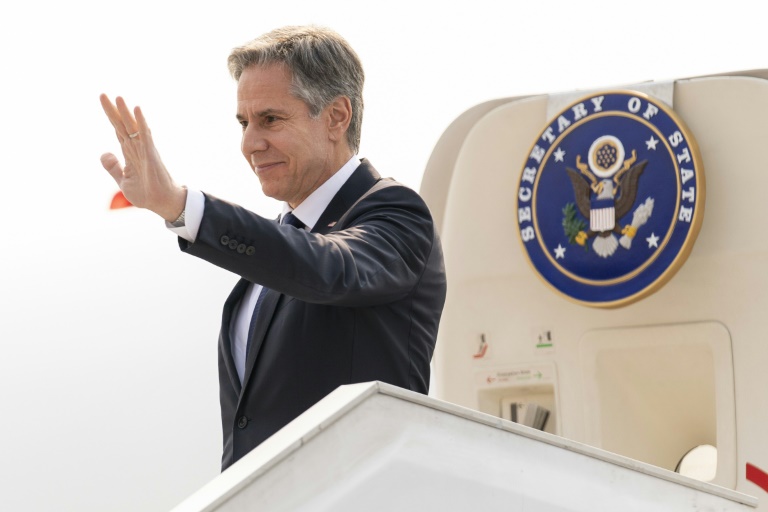
Secretary of State Antony Blinken on Tuesday said the United States was “concerned” by “credible” reports that Rwanda is supporting rebels in eastern Democratic Republic of Congo.

The resurgence of the M23 group in Congo’s restive east has exacerbated tensions between the neighbours, with Kinshasa accusing Kigali of backing the rebels.

Blinken was speaking in the Congolese capital Kinshasa, where he arrived on Tuesday for the second leg of a three-nation African tour and met President Felix Tshisekedi.

Rwanda has denied the allegations and Blinken is due to visit the country following a one-day stay in the DRC.

“We are very concerned by credible reports that Rwanda has supported the M23,” the top US diplomat told a press conference in Kinshasa. 

“All countries have to respect their neighbours’ territorial integrity. Any entry of foreign forces into the DRC must be done transparently and with the consent of the DRC.”

Blinken added that he was “not turning a blind eye” and would discuss the issue with Rwandan President Paul Kagame.

He said his trip to the region was to ensure US support for mediation efforts led by Angola and Kenya “to prevent further violence, to end conflict (and) to preserve the territorial integrity of the DRC”.

He spoke after visiting South Africa on Monday, where he said the United States was seeking a “true partnership” with Africa.

– Strained relations –

The DRC is seeking international support as it struggles with Rwanda over the M23, a primarily Congolese Tutsi group that is one of many operating in the troubled east.

After lying mostly dormant for years, the rebels resumed fighting late last year, seizing the strategic town of Bunagana on the Ugandan border in June and prompting thousands of people to flee their homes.

In a 131-page report to the UN Security Council seen last week by AFP, experts said Rwandan troops had intervened militarily inside the DRC since at least November. 

Rwanda also “provided troop reinforcements” for specific M23 operations, the experts’ report said, “in particular when these aimed at seizing strategic towns and areas”.

Congolese Foreign Minister Christophe Lutundula on Tuesday urged the United Nations to make the report public.

“We demand the Security Council publish (this) report in its entirety,” he said.

Kinshasa and Kigali have had strained relations since the mass influx of Rwandan Hutus accused of slaughtering Tutsis during the 1994 Rwanda genocide.

Relations began to thaw after Tshisekedi took office in 2019 but the M23’s resurgence has revived tensions.

The group, also known as the “March 23 Movement”, first leapt to prominence in 2012 when it briefly captured the city of Goma before a joint Congolese-UN offensive drove it out.

Kenyan President Uhuru Kenyatta has led an initiative to disarm the active rebel groups, while Angolan counterpart Joao Lourenco has worked to ease tensions between Kinshasa and Kigali.

– Rwanda and M23 –

Blinken arrived in Kinshasa from South Africa, where he said the United States was seeking a “true partnership” with Africa and was not vying with other powers for influence on the continent.

Tshisekedi was to “raise the questions of strategic partnership” between the DRC and the United States during his meeting with Blinken at the presidential palace, his office said in a statement Monday.

On the eve of Blinken’s swing through the DRC and Rwanda, Human Rights Watch (HRW) urged him to condemn the M23 attacks and press Rwanda on its rights record, which included a “brutal” crackdown on dissent.

“As in 2012, the M23 are committing war crimes against civilians,” said a HRW statement.

“Witnesses described summary killings of at least 29 people, including children, in June and July… The US should raise with Rwanda the reliable reports that it is again supporting the M23’s abusive conduct in eastern Congo.”

The M23 is just one of scores of armed groups that roam eastern DRC, many of them a legacy of two regional wars that flared late last century.

One of the bloodiest militias is the Allied Democratic Forces (ADF) — an organisation the Islamic State group describes as its “Central Africa Province” affiliate.

The US State Department placed the ADF on its list of IS-linked “terrorist” organisations in March 2021.

UK meteorologists, water firms issue warnings as extreme heatwave looms

The UK’s meteorological agency on Tuesday issued an “amber” warning for extreme heat while the country’s biggest water provider said restrictions loom, as Britain braces for another punishing heatwave later this week. 

The warning by the Met Office, covering much of southern England and parts of eastern Wales from Thursday through Sunday, predicts possible impacts to health, transport and infrastructure from the heat.  

Temperatures are set to soar to the mid-30s Celsius for several days, it noted.

The sweltering conditions come just weeks after the last heatwave pushed the mercury over 40 degrees Celsius (104 degrees Fahrenheit) for the first time in Britain.

Climate scientists overwhelmingly agree that carbon emissions from humans burning fossil fuels are heating the planet, raising the risk and severity of droughts, heatwaves, and other extreme weather events.

“Thanks to persistent high pressure over the UK, temperatures will be rising day-on-day through this week and an extreme heat warning has been issued,” Met Office deputy chief meteorologist Dan Rudman said in a statement.  

Months of exceptionally dry weather across England are taking their toll, with Thames Water — which supplies London and its surroundings — the latest water provider to warn of imminent restrictions.

The firm said it is planning to issue a so-called hosepipe ban in the coming weeks “given the long-term forecast” of hot and dry weather for the southeast.

Several other UK water suppliers have already announced similar moves ahead of this week’s heatwave, but Thames Water’s 15 million customers would make it the most impactful so far.

The Met Office has confirmed it was the driest July in England since 1935, and little or no rain is forecast for most of the parched areas in the short term.

“Water companies are already managing the unprecedented effects of the driest winter and spring since the 1970s,” said Peter Jenkins, of Water UK, which represents the industry.

“With more hot, dry weather forecast, it’s crucial we be even more mindful of our water use to minimise spikes in demand and ensure there’s enough to go around.”

The parched conditions have seen wildfires break out near houses, including on the outskirts of London, a relatively rare occurrence in Britain.

In neighbouring France, a “historic” drought currently exacerbated by a third extreme heatwave this summer has seen a spate of wildfires nationwide as well as water restrictions ordered in nearly all its 96 mainland departments.

More than 47,000 hectares have already burnt in France this year, including a record amount in July alone, according to the European Union’s satellite monitoring service EFFIS.

On Tuesday, more than 3,000 people in southern France’s Aveyron region, including holidaymakers, were evacuated as a fire swept through at least 700 hectares of vegetation without causing any injuries.

US 'concerned' by reports of Rwandan support for DRC rebels

Secretary of State Antony Blinken on Tuesday said the United States was “concerned” by “credible” reports that Rwanda is supporting rebels in eastern Democratic Republic of Congo.

The resurgence of the M23 group in Congo’s restive east has exacerbated tensions between the neighbours, with Kinshasa accusing Kigali of backing the rebels.

Blinken was speaking in the Congolese capital Kinshasa, where he arrived on Tuesday for the second leg of a three-nation African tour and met President Felix Tshisekedi.

Rwanda has denied the allegations and Blinken is due to visit the country following a one-day stay in Kinshasa.

“We are very concerned by credible reports that Rwanda has supported the M23,” the top US diplomat told a press conference in Kinshasa. 

“All countries have to respect their neighbours’ territorial integrity,” he added, saying he was “not turning a blind eye” and would discuss the issue with Rwandan President Paul Kagame.

Blinken said his trip to the region was to ensure US support for mediation efforts led by Angola and Kenya “to prevent further violence, to end conflict (and) to preserve the territorial integrity of the DRC”.

The DRC is seeking international support as it struggles with Rwanda over the M23, a primarily Congolese Tutsi group that is one of many operating in the troubled east.

After lying mostly dormant for years, the rebels resumed fighting late last year, seizing the strategic town of Bunagana on the Ugandan border in June and prompting thousands of people to flee their homes.

In a 131-page report to the UN Security Council seen last week by AFP, experts said Rwandan troops had intervened militarily inside the DRC since at least November. 

Rwanda also “provided troop reinforcements” for specific M23 operations, the experts’ report said, “in particular when these aimed at seizing strategic towns and areas”.

Kinshasa and Kigali have had strained relations since the mass influx of Rwandan Hutus accused of slaughtering Tutsis during the 1994 Rwanda genocide.

Relations began to thaw after Tshisekedi took office in 2019 but the M23’s resurgence has revived tensions.

The group, also known as the “March 23 Movement”, first leapt to prominence in 2012 when it briefly captured the city of Goma before a joint Congolese-UN offensive drove it out.

– Rwanda and M23 –

Blinken arrived in Kinshasa from South Africa, where he said the United States was seeking a “true partnership” with Africa and was not vying with other powers for influence on the continent.

Tshisekedi was to “raise the questions of strategic partnership” between the DRC and the United States during his meeting with Blinken at the presidential palace, his office said in a statement Monday.

On the eve of Blinken’s swing through the DRC and Rwanda, Human Rights Watch (HRW) urged him to condemn the M23 attacks and press Rwanda on its rights record, which included a “brutal” crackdown on dissent.

“As in 2012, the M23 are committing war crimes against civilians,” said a HRW statement.

“Witnesses described summary killings of at least 29 people, including children, in June and July… The US should raise with Rwanda the reliable reports that it is again supporting the M23’s abusive conduct in eastern Congo.”

The M23 is just one of scores of armed groups that roam eastern DRC, many of them a legacy of two regional wars that flared late last century.

One of the bloodiest militias is the Allied Democratic Forces (ADF) — an organisation the Islamic State group describes as its “Central Africa Province” affiliate.

The State Department placed the ADF on its list of IS-linked “terrorist” organisations in March 2021.

The investigations involving Donald Trump

US authorities’ search of Donald Trump’s Florida residence drew renewed attention to the various investigations involving the former president.

Prosecutors and lawmakers are looking into questions from his potential role in the US Capitol attack to his family firm’s business practices.

Here are some of the key probes:

– Capitol assault –

A series of explosive hearings by the House of Representatives panel probing the attack on the US Capitol by Trump supporters on January 6, 2021, offered a roadmap for potentially charging the ex-president with a crime.

The lawmakers leading the hearings presented their case that Trump knew he lost the 2020 election to Joe Biden, yet pressed his claims of fraud and ultimately brought his supporters to Washington for a rally that ended with a violent assault on Congress.

The House committee’s work is separate from the criminal probe that the Justice Department has launched into hundreds of people involved in the attack and US Attorney Merrick Garland has not said if his prosecutors are investigating Trump.

Besides the legal ramifications, an unprecedented prosecution of a former chief executive would likely cause a political earthquake in a country already starkly divided along partisan Democratic and Republican lines.

– ‘Find’ the votes –

Trump pressured election officials in Georgia to “find” the votes he needed to win in 2022, prompting a prosecutor in the southern state to investigate.

Fulton County District Attorney Fani Willis has impaneled a special grand jury and investigators have already interviewed dozens of witnesses.

The probe is taking in the now infamous phone call with election officials and Trump’s alleged public and private pressure on authorities, including the governor, attorney general and the secretary of state’s chief investigator.

Trump has defended himself, alleging “prosecutorial misconduct” at a rally in Texas in January, in which he called for protests against “radical, vicious, racist prosecutors,” prompting Willis to request beefed-up FBI security. 

– The Trump Organization –

Authorities in New York state have been looking into the business practices of the Trump Organization, including whether the firm misled lenders and tax authorities on the value of the firm’s real estate holdings.

However, in March the prosecutor leading a probe into the former president’s finances quit over the decision by new Manhattan district attorney Alvin Bragg not to move ahead with prosecution of the Republican billionaire. 

The investigation had probed whether Trump fraudulently overvalued multiple assets to secure loans and then undervalued them to minimize taxes.

It was launched by Bragg’s predecessor Cyrus Vance, with Bragg taking over the case when he took office in January.

The prosecutor Mark Pomerantz alleged Trump is “guilty of numerous felony violations,” according to his resignation letter published by the New York Times.

New York state Attorney General Letitia James is also pushing ahead with a civil probe of the Trump family firm’s practices on property valuations and tax reporting.

– ‘Raid’ on Florida residence –

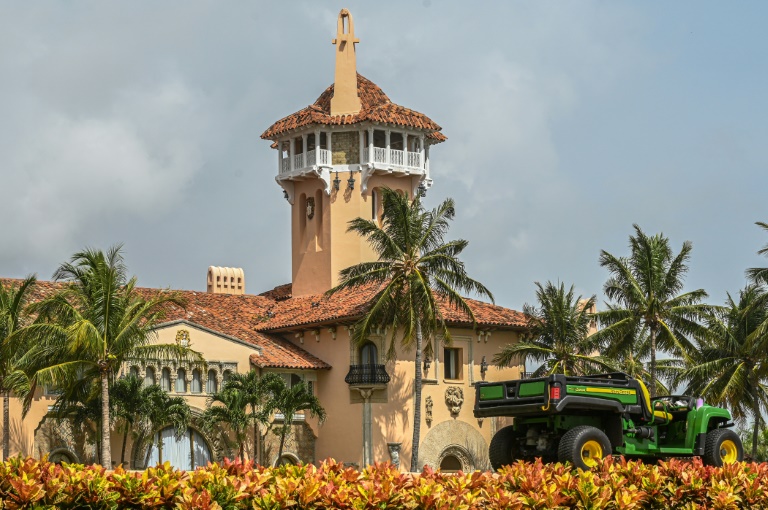
The FBI search on Monday of Trump’s Florida residence was reportedly related to the potential mishandling of classified documents that had been sent to Mar-a-Lago after he left the White House in January 2021.

Justice Department authorities declined to provide a reason for the unprecedented move against a former chief executive.

The National Archives said in February that it had recovered 15 boxes of documents from Mar-a-Lago and asked the Justice Department to look into Trump’s handling of classified information.

The recovery of the boxes raised questions about Trump’s adherence to presidential records laws enacted after the 1970s Watergate scandal that require Oval Office occupants to preserve records.

Trump called the search “prosecutorial misconduct” and “weaponization of the Justice System” by “Radical Left Democrats who desperately don’t want me to run for President in 2024.”

FBI raid on Trump's beachside estate: what we know

The FBI raid on former US president Donald Trump’s beachside Mar-a-Lago estate in Palm Beach, Florida was unprecedented and stunned America.

But facts about the raid and what lay behind it remain sparse. Here’s what we know and what questions remain unanswered:

– How the raid happened –

On Monday morning a group of FBI agents — around 30, claimed Trump’s son Eric — arrived at the palatial Mar-a-Lago. Trump was staying in New Jersey at the time.

It was not a forceful raid, as the agents notified the Secret Service, which protects the former president, before their arrival, according to NBC.

Once inside they searched the premises for hours, including opening a safe. Politico, citing a person familiar with the events, said the agents took away “paper records.”

“Nothing like this has ever happened to a president of the United States before,” Trump said in a statement, calling the raid “not necessary or appropriate.”  

– What is the FBI investigating?

The Justice Department and FBI have stayed silent on the investigation. 

Experts said that a raid directed at Trump, who could seek the presidency again in 2024, was such a politically fraught move it had to be approved by Attorney General Merrick Garland and FBI Director Christopher Wray. 

The FBI would have needed a warrant, which would require a judge’s review of their justification for pushing into an ex-president’s home.

But the warrant, which could reveal the nature of the investigation, remains secret.

Seamus Hughes deputy director of the Program on Extremism at George Washington University and an expert on court filings, said the federal prosecutor in southern Florida by practice keeps warrants sealed. 

“Each court district can set their own local rules for public access to documents,” he said.

– Classified documents? –

Eric Trump told Fox News that the raid was linked to allegations over large amount of documents the president took with him when he exited the White House in January 2021.

Early this year he was forced to turn over 15 boxes of those documents to the National Archives, which controls presidential records.

The Archives later reported to the Justice Department that the boxes included some highly classified documents.

The raid suggested there were more such records in Mar-a-Lago.

“The purpose of the raid, from what they said, was because the National Archives wanted to corroborate whether or not Donald Trump had any documents in his possession,” Eric Trump said.

– Illegal to keep presidential records?

The Presidential Records Act says all records related to official business must be turned over to the Archives. But violating the act brings little consequence.

On the other hand, US law strictly forbids people retaining classified documents, and carries stiff prison sentences.

One indication that the investigation could involve classified materials was a visit to Mar-a-Lago in June by the chief of the Justice Department’s Counterintelligence and Export Control Section, according to CNN.

That section oversees cases affecting national security, like espionage and sabotage, as well as cases involving Americans who lobby for foreign governments. 

– So is Trump under investigation?

The raid itself doesn’t necessarily mean Trump is under investigation for a crime. 

The records sought could be required in other investigations involving members of his administration, including for the probe into the January 6, 2021 attack on Congress by hundreds of Trump supporters.

But the nature of the raid, analysts say, suggests something much more weighty.

Former FBI deputy director Andrew McCabe told CNN he didn’t believe it was simply about National Archives materials.

“The idea that they would do this simply because they were not getting the sort of compliance they were looking for… seems really unimaginable to me.  It seems like they must have more than just that.”

Close Bitnami banner
Bitnami