AFP

Biden signs major semiconductors investment bill to compete against China

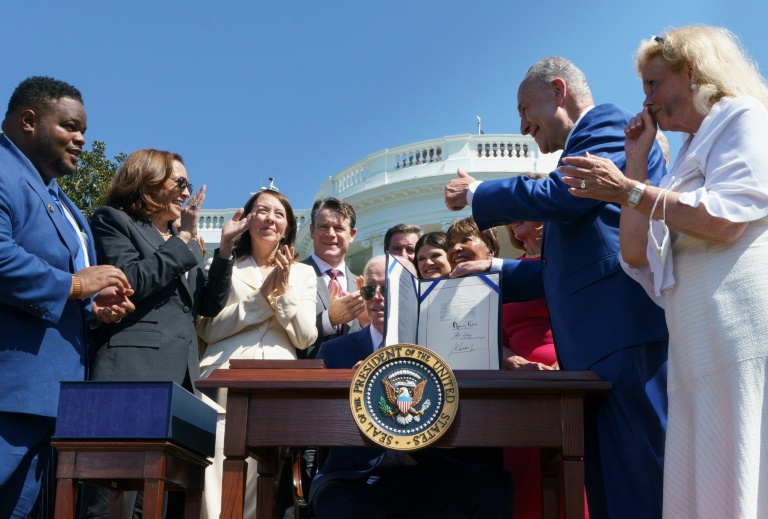
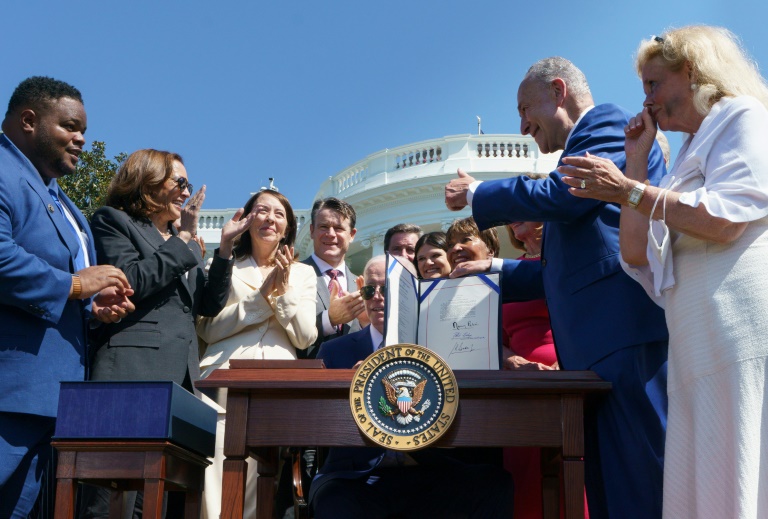
President Joe Biden signed into law Tuesday a multibillion dollar bill boosting domestic semiconductor and other high-tech manufacturing sectors that US leaders fear risk being dominated by rival China.

The Chips and Science Act includes around $52 billion to promote production of microchips, the tiny but powerful and relatively hard-to-make components at the heart of almost every modern piece of machinery.

Tens of billions of dollars more are allocated for scientific research and development.

The White House says the government commitment to bolstering high-tech industries is already drawing in large-scale private investors, with some $50 billion in new semiconductor investment alone. The lion’s share of that is a plan announced by US firm Micron to put $40 billion into domestic expansion by 2030.

Biden said at a White House speech that the cash injection from the Chips Act will help “win the economic competition in the 21st century.”

Entrepreneurs are “the reason why I’m so optimistic about the future of our country,” he said, and “the Chips and Science Act supercharges our efforts to make semiconductors here in America.”

One of the Democrat’s key themes since he took office has been the need to revamp US leadership in cutting-edge innovation and rebuild the homegrown industrial base in the face of China’s mammoth state-backed investments.

Semiconductors are of particular concern because they are vital to everything from washing machines to sophisticated weapons and nearly all are made abroad.

Although the semiconductor was invented in the United States, the country only produces around 10 percent of global supply, according to the White House, with some 75 percent of US supplies coming from east Asia.

Biden is also counting on the Chips Act to generate enthusiasm among voters, as his Democratic party tries to defend a thin congressional majority from a Republican takeover in this November’s midterm elections.

He told Americans that studies show the expansion of factories will create around a million construction jobs over the next six years — and these will be “union jobs” that pay “the prevailing wage.”

On Wednesday, Biden will sign another bill increasing funding for military veterans exposed to toxins. Like the Chips bill, this won bipartisan support in the usually bitterly divided Congress.

Shortly, Biden is also expected to be signing an enormous domestic investment bill — backed only by Democrats — aimed at fighting climate change and reducing health care costs.

Reflecting on the string of successes in Congress and the sudden momentum for his long stalled agenda, Biden predicted that “people will look back at this week and all we passed, and all we moved on, that we met the moment at this inflection point in history.”

“We bet on ourselves, believed in ourselves and recaptured the story, the spirit and the soul of this nation,” he said.
Biden signs major semiconductors investment bill to compete against China

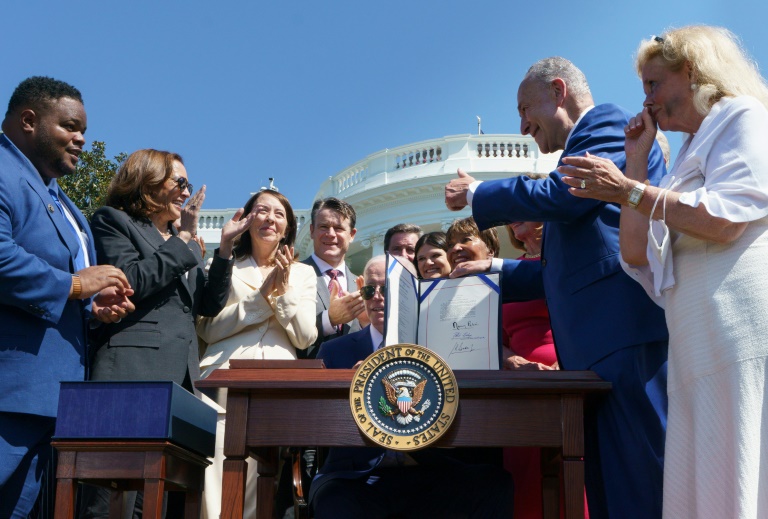
President Joe Biden signed into law Tuesday a multibillion dollar bill boosting domestic semiconductor and other high-tech manufacturing sectors that US leaders fear risk being dominated by rival China.

The Chips and Science Act includes around $52 billion to promote production of microchips, the tiny but powerful and relatively hard-to-make components at the heart of almost every modern piece of machinery.

Tens of billions of dollars more are allocated for scientific research and development.

The White House says the government commitment to bolstering high-tech industries is already drawing in large-scale private investors, with some $50 billion in new semiconductor investment alone. The lion’s share of that is a plan announced by US firm Micron to put $40 billion into domestic expansion by 2030.

Biden said at a White House speech that the cash injection from the Chips Act will help “win the economic competition in the 21st century.”

Entrepreneurs are “the reason why I’m so optimistic about the future of our country,” he said, and “the Chips and Science Act supercharges our efforts to make semiconductors here in America.”

One of the Democrat’s key themes since he took office has been the need to revamp US leadership in cutting-edge innovation and rebuild the homegrown industrial base in the face of China’s mammoth state-backed investments.

Semiconductors are of particular concern because they are vital to everything from washing machines to sophisticated weapons and nearly all are made abroad.

Although the semiconductor was invented in the United States, the country only produces around 10 percent of global supply, according to the White House, with some 75 percent of US supplies coming from east Asia.

Biden is also counting on the Chips Act to generate enthusiasm among voters, as his Democratic party tries to defend a thin congressional majority from a Republican takeover in this November’s midterm elections.

He told Americans that studies show the expansion of factories will create around a million construction jobs over the next six years — and these will be “union jobs” that pay “the prevailing wage.”

On Wednesday, Biden will sign another bill increasing funding for military veterans exposed to toxins. Like the Chips bill, this won bipartisan support in the usually bitterly divided Congress.

Shortly, Biden is also expected to be signing an enormous domestic investment bill — backed only by Democrats — aimed at fighting climate change and reducing health care costs.

Reflecting on the string of successes in Congress and the sudden momentum for his long stalled agenda, Biden predicted that “people will look back at this week and all we passed, and all we moved on, that we met the moment at this inflection point in history.”

“We bet on ourselves, believed in ourselves and recaptured the story, the spirit and the soul of this nation,” he said.

Biden signs major semiconductors investment bill to compete against China

President Joe Biden signed into law Tuesday a multibillion dollar bill boosting domestic semiconductor and other high-tech manufacturing sectors that US leaders fear risk being dominated by rival China.

The Chips and Science Act includes around $52 billion to promote production of microchips, the tiny but powerful and relatively hard-to-make components at the heart of almost every modern piece of machinery.

Tens of billions of dollars more are allocated for scientific research and development.

The White House says the government commitment to bolstering high-tech industries is already drawing in large-scale private investors, with some $50 billion in new semiconductor investment alone. The lion’s share of that is a plan announced by US firm Micron to put $40 billion into domestic expansion by 2030.

Biden said at a White House speech that the cash injection from the Chips Act will help “win the economic competition in the 21st century.”

Entrepreneurs are “the reason why I’m so optimistic about the future of our country,” he said, and “the Chips and Science Act supercharges our efforts to make semiconductors here in America.”

One of the Democrat’s key themes since he took office has been the need to revamp US leadership in cutting-edge innovation and rebuild the homegrown industrial base in the face of China’s mammoth state-backed investments.

Semiconductors are of particular concern because they are vital to everything from washing machines to sophisticated weapons and nearly all are made abroad.

Although the semiconductor was invented in the United States, the country only produces around 10 percent of global supply, according to the White House, with some 75 percent of US supplies coming from east Asia.

Biden is also counting on the Chips Act to generate enthusiasm among voters, as his Democratic party tries to defend a thin congressional majority from a Republican takeover in this November’s midterm elections.

He told Americans that studies show the expansion of factories will create around a million construction jobs over the next six years — and these will be “union jobs” that pay “the prevailing wage.”

On Wednesday, Biden will sign another bill increasing funding for military veterans exposed to toxins. Like the Chips bill, this won bipartisan support in the usually bitterly divided Congress.

Shortly, Biden is also expected to be signing an enormous domestic investment bill — backed only by Democrats — aimed at fighting climate change and reducing health care costs.

Reflecting on the string of successes in Congress and the sudden momentum for his long stalled agenda, Biden predicted that “people will look back at this week and all we passed, and all we moved on, that we met the moment at this inflection point in history.”

“We bet on ourselves, believed in ourselves and recaptured the story, the spirit and the soul of this nation,” he said.
Blinken arrives in DR Congo on 2nd leg of African tour

US Secretary of State Antony Blinken arrived in DR Congo on Tuesday for a one-day visit expected to focus on a conflict in the east of the country that has sparked tensions with Rwanda.

Blinken, on the second leg of an African tour, was met at Kinshasa’s Ndjili Airport by Foreign Minister Christophe Lutundula, the president’s office said.

He and President Felix Tshisekedi will have a “one-on-one” meeting at the presidential palace in the evening, it said in a statement. 

The Democratic Republic of Congo is seeking international support as it tussles with neighbouring Rwanda over an armed group, the M23, in the country’s deeply troubled east.

The DRC accuses Rwanda of backing the rebels — an assertion repeatedly denied by Kigali, which Blinken will visit immediately after his one-day stay in Kinshasa.

Tshisekedi “will not fail to raise the questions of strategic partnership between the DRC and the USA”, the presidential office said in a statement on Monday.

Blinken arrived from South Africa, where he said the United States was seeking a “true partnership” with Africa and was not vying with other powers for influence on the continent.

The M23 — for “March 23 Movement” — is a primarily Congolese Tutsi group.

It first leapt to prominence in 2012 when it briefly captured the eastern DRC city of Goma before a joint Congolese-UN offensive drove it out.

After lying mostly dormant for years, the rebel group resumed fighting late last year, seizing the strategic town of Bunagana on the Ugandan border in June and prompting thousands of people to flee their homes.

Kinshasa and Kigali have had strained relations since the mass influx of Rwandan Hutus accused of slaughtering Tutsis during the 1994 Rwanda genocide.

Relations began to thaw after Tshisekedi took office in 2019 but the M23’s resurgence has revived tensions.

– Rwanda and M23 –

On the eve of Blinken’s swing through the DRC and Rwanda, Human Rights Watch (HRW) urged him to condemn the M23 attacks and press Rwanda on its rights record, which included a “brutal” crackdown on dissent.

“As in 2012, the M23 are committing war crimes against civilians,” HRW said in a press release.

“Witnesses described summary killings of at least 29 people, including children, in June and July… The US should raise with Rwanda the reliable reports that it is again supporting the M23’s abusive conduct in eastern Congo.”

In a 131-page report to the UN Security Council seen last week by AFP, experts said Rwandan troops had intervened militarily inside the DRC since at least November. 

Rwanda also “provided troop reinforcements” for specific M23 operations, the experts’ report said, “in particular when these aimed at seizing strategic towns and areas”.

The M23 is just one of scores of armed groups that roam eastern DRC, many of them a legacy of two regional wars that flared late last century.

One of the bloodiest militias is the Allied Democratic Forces (ADF) — an organisation that the Islamic State group describes as its “Central Africa Province” affiliate.

The State Department placed the ADF on its list of IS-linked “terrorist” organisations in March 2021.

Endangered sharks, rays caught in protected Med areas: study

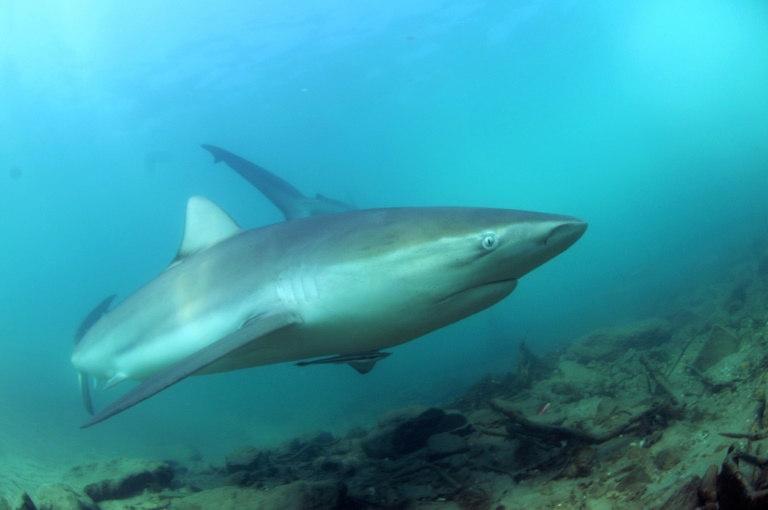
Endangered sharks, rays and skates in the Mediterranean are more frequently caught in protected than in unprotected areas, according to research published Tuesday highlighting the need for better conservation for critically threatened species.

The three types of elasmobranch are among the species most threatened by overfishing. 

While often landed as by-catch — or caught in nets of boats seeking to land other species — demand for their fins and meat has driven an estimated 71-percent decline in ocean sharks and rays since 1970. 

Although they are among the oldest marine species on Earth, their slow growth rate and late maturity mean one third of elasmobranchs are categorised by the International Union for the Conservation of Nature (IUCN) as at risk of extinction. 

While dozens of nations have banned large-scale fishing of endangered shark, ray and skate species, true global catch figures are likely to be hugely underestimated as 90 percent of the world’s fishing fleet is made up of small-scale boats.

Researchers in Italy wanted to get a better idea of how species fare in the Mediterranean’s partially protected areas, which allow some fishing with restrictions.

They used photo-sampling and image analysis to compile a database covering more than 1,200 small-scale fishing operations across 11 locations in France, Italy, Spain, Croatia, Slovenia and Greece. 

– Protected areas –

The team then used statistical models to demonstrate that catches of threatened species were higher in partially protected areas than in areas with no protection at all.

“People assume that it is large-scale trawlers that are impacting biodiversity, which is true and there’s a lot of evidence for this,” said co-author Antonio Di Franco, from the Sicily Marine Centre.

“There is less research on small-scale fishing’s impact and our research shows that there is this potential.”

The team found that catches they analysed in partially protected areas landed 24 species of shark, skate and ray — more than a third of which are endangered.

This is likely in part due to the species’ preference for coastal waters, where most small-scale fisheries prefer to operate. 

“We don’t know the activity of small-scale fisheries in general, we don’t know how many nets they actually fish or where they fish,” said Di Franco. 

Overall, in the partially protected areas studied, 517 elasmobranchs were caught compared with 358 in non-protected areas. 

In terms of mass, the weight of shark, ray or skate species caught in partially protected areas was roughly double that in non-protected areas.

More than 100 countries have committed to increase the amount of protected oceans worldwide to 30 percent by 2030.

Di Franco said there were a number of steps countries could take to help threatened species, including fitting smaller fishing boats with GPS trackers and ensuring that protected areas were joined up, allowing the species to more easily change living regions.

“Protected areas are a great potential benefit to biodiversity but the point is to look at management,” he told AFP. 

“But often countries don’t have the capacity to properly manage stocks.” 

Blinken arrives in DR Congo on 2nd leg of African tour

US Secretary of State Antony Blinken arrived in DR Congo on Tuesday for a one-day visit expected to focus on a conflict in the east of the country that has sparked tensions with Rwanda.

Blinken, on the second leg of an African tour, was met at Kinshasa’s Ndjili Airport by Foreign Minister Christophe Lutundula, the president’s office said.

He and President Felix Tshisekedi will have a “one-on-one” meeting at the presidential palace in the evening, it said in a statement. 

The Democratic Republic of Congo is seeking international support as it tussles with neighbouring Rwanda over an armed group, the M23, in the country’s deeply troubled east.

The DRC accuses Rwanda of backing the rebels — an assertion repeatedly denied by Kigali, which Blinken will visit immediately after his one-day stay in Kinshasa.

Tshisekedi “will not fail to raise the questions of strategic partnership between the DRC and the USA”, the presidential office said in a statement on Monday.

The M23 — for “March 23 Movement” — is a primarily Congolese Tutsi group.

It first leapt to prominence in 2012 when it briefly captured the eastern DRC city of Goma before a joint Congolese-UN offensive drove it out.

After lying mostly dormant for years, the rebel group resumed fighting late last year, seizing the strategic town of Bunagana on the Ugandan border in June and prompting thousands of people to flee their homes.

Kinshasa and Kigali have had strained relations since the mass influx of Rwandan Hutus accused of slaughtering Tutsis during the 1994 Rwanda genocide.

Relations began to thaw after Tshisekedi took office in 2019 but the M23’s resurgence has revived tensions.

The M23 is just one of scores of armed groups that roam eastern DRC, many of them a legacy of two regional wars that flared late last century.

One of the bloodiest militias is the Allied Democratic Forces (ADF) — an organisation that the Islamic State group describes as its “Central Africa Province” affiliate.

The State Department placed the ADF on its list of IS-linked “terrorist” organisations in March 2021.

On the eve of Blinken’s swing through the DRC and Rwanda, Human Rights Watch (HRW) urged him to condemn the M23 attacks and press Rwanda on its rights record, which included a “brutal” crackdown on dissent.

Blinken arrived from South Africa, where he said the United States was seeking a “true partnership” with Africa and was not vying with other powers for influence on the continent.

Spain police start wearing bodycams to boost security

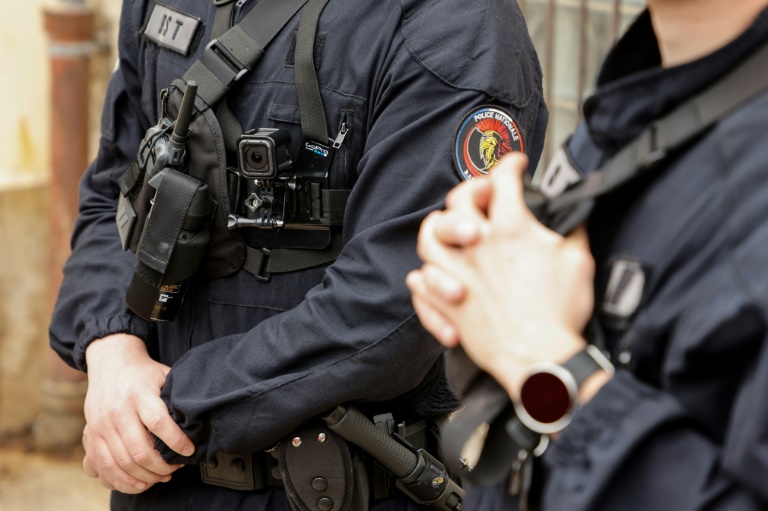
Spanish police have begun wearing body cameras to record their interactions with the public in a move aimed at ensuring greater security that is gaining ground in Europe and the US. 

The interior ministry said the bodycam was launched Monday and would be “rolled out on a gradual basis to all police officers”, without saying how many were involved in the initial stages. 

Spain’s TVE public television said the tiny cameras were being attached to the officers’ uniforms and could be activated either manually or automatically. 

The main Spanish police union JUPOL hailed the move on Twitter, saying it was in response to “a request that the union has been making”. 

“It will guarantee security, both for us to avoid any kind of misrepresentation of our interventions, as well as for the public, who will be able to clearly see the police’s professionalism and that there is no abuse of power nor excesses,” union spokesman Pablo Perez told TVE.

Forces in Europe and the United States are increasingly turning to such technology to boost transparency following a string of fatal shootings and other claims against police over the past decade.

“The cameras are being used under public safety protocols in order to record everything that happens in the event of an unwarranted offence during an operation,” Spanish Interior Minister Fernando Grande Marlaska told TVE ahead of the rollout. 

“If they are activated, it is to guarantee security and really be transparent so that the officers’ actions can be seen and checked,” the minister said.

“This means security for both the police and the public,” he added, suggesting that in time, they would also be available to Spain’s Guardia Civil rural police force.

France began trialling bodycams, known as “pedestrian cameras”, in 2013 before a gradual rollout in 2015 in a move welcomed by police, but greeted with scepticism by rights groups who said there was no guarantee they would be always activated.

Police in London and New York also began pilot schemes in 2014 with credit-card sized cameras clipped onto their uniforms with the technology gradually deployed over the following years.

But the cameras have had mixed success. The absence of any legal obligation governing their use can also limit their scope to uncover police misconduct.

Serena Williams says 'countdown' to retirement has begun

US tennis great Serena Williams announced on Tuesday that “the countdown has begun” to her retirement from the sport.

“There comes a time in life when we have to decide to move in a different direction,” the 40-year-old, 23-time Grand Slam winner said in a post on Instagram. 

“That time is always hard when you love something so much. My goodness do I enjoy tennis. But now, the countdown has begun. 

“I have to focus on being a mom, my spiritual goals and finally discovering a different, but just exciting Serena. I’m gonna relish these next few weeks.”

Williams won the last of her 23 Slams at the 2017 Australian Open when she was already pregnant with daughter, Olympia.

However, she has failed to add a 24th major which would take her level with Margaret Court’s all-time record.

Her final attempt will come at the US Open in New York later this month.

Williams stepped onto a hardcourt for the first time in a year and a half on Monday in the WTA Toronto tournament where fought through to the second round with a straight sets victory over Nuria Parrizas Diaz.

It was her first singles victory since the 2021 French Open, some 14 months ago.

The former world number one had played her first singles match in a year during a first round defeat at Wimbledon in June.

France readies rescue of beluga astray in Seine

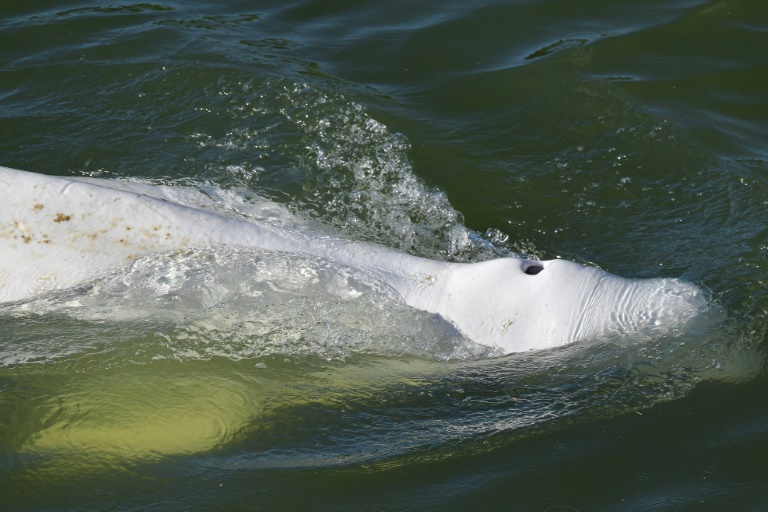
Marine experts will attempt Tuesday to rescue a beluga whale that swam up the Seine river and return it to the sea, officials said, a complex and risky operation for an animal already sick and malnourished.

The four-metre (13-foot) cetacean, a protected species usually found in cold Arctic waters, was spotted a week ago heading towards Paris, and is now some 130 kilometres inland.

“An operation to transport the beluga astray in the Seine will be attempted this evening,” said government officials in the Eure department, who are orchestrating the effort.

The animal’s progress inland has been blocked by a lock at Saint-Pierre-La-Garenne in Normandy, and its health has deteriorated after it refused to eat.

But its condition is currently “satisfactory”, Isabelle Brasseur of the Marineland sea animal park in southern France, Europe’s biggest, told AFP.

She is part of a Marineland team sent to assist with the rescue, alongside the Sea Shepherd France NGO.

“What’s exceptional is that here the banks of the Seine are not accessible for vehicles… everything is going to have to be done by hand,” Brasseur said.

So far the beluga has not turned around, and experts have dismissed any attempt to “nudge” it back toward the English Channel with boats, saying it would stress the weakened animal and probably be futile in any case.

Starting at around 8:00 pm (1800 GMT), the team will try to get the animal weighing 800 kilogrammes (nearly 1,800 pounds) onto a truck and drive it to an undisclosed seawater basin where it can be treated before being released, the Eure authorities said.

The Sea Shepherd France NGO, which is assisting the operation, said Tuesday that tranquilisation is not an option, since belugas are so-called “voluntary breathers” that need to be awake to inhale air.

– ‘Have to get it out’ –

“In any case, we have to get it out of there… and try to figure out what is wrong,” Brasseur said.

Veterinarians will keep constant surveillance during the move.

“There may be internal problems that we can’t see,” she said despite the fact that belugas are “extremely hardy” as a species.

Interest in the beluga’s fate has spread far beyond France, generating a large influx of financial donations and other aid from conservation groups as well as individuals, officials said.

Sea Shepherd on Monday issued an appeal in particular for heavy-duty ropes, nets, mattresses and other equipment. 

Belugas are normally found only in cold Arctic waters, and while they migrate south in the autumn to feed as ice forms, they rarely venture so far.

According to France’s Pelagis Observatory, specialised in sea mammals, the nearest beluga population is off the Svalbard archipelago, north of Norway, 3,000 kilometres from the Seine.

Lowest July Antarctic sea ice on record: monitor

Last month saw the lowest extent of Antarctic sea ice on record for July, according to the European Union’s satellite monitoring group. 

The Copernicus Climate Change Service (C3S) found  Antarctic sea ice extent reached 15.3 million square kilometres (5,900,000 square miles) — some 1.1 million km2, or seven percent, below the 1991-2020 average for July. 

This was the lowest ice cover for July since satellite records began 44 years ago, and followed record low Antarctic sea ice levels for June too.

C3S said the low ice values continued a string of below-average monthly extents observed since February 2022.

The service said in its monthly bulletin the Southern Ocean saw “widespread areas of below-average sea ice concentration” last month. 

Arctic sea ice cover meanwhile was four percent lower than average, making it the 12th lowest July sea ice extent on record. 

In a month that saw temperature records broken across parts of northern Europe and Britain, C3S said July was drier than average for much of the continent, noting a number of low-precipitation records in several locations. 

“These conditions affected the economy locally and facilitated the spread and intensification of wildfires,” it said. 

C3S said July was also abnormally dry across much of North America, South America, Central Asia and Australia.

Climate change makes extreme heat and drought more likely to occur.

“We can expect to continue seeing more frequent and longer periods of extremely high temperatures, as global temperatures increase further,” said senior C3S scientist Freja Vamborg. 

The service said last month was however wetter than usual in eastern Russia, northern China and in a large wet band spanning from eastern Africa across Asia to northwest India.

Close Bitnami banner
Bitnami