AFP

Spain battles northwest wildfires

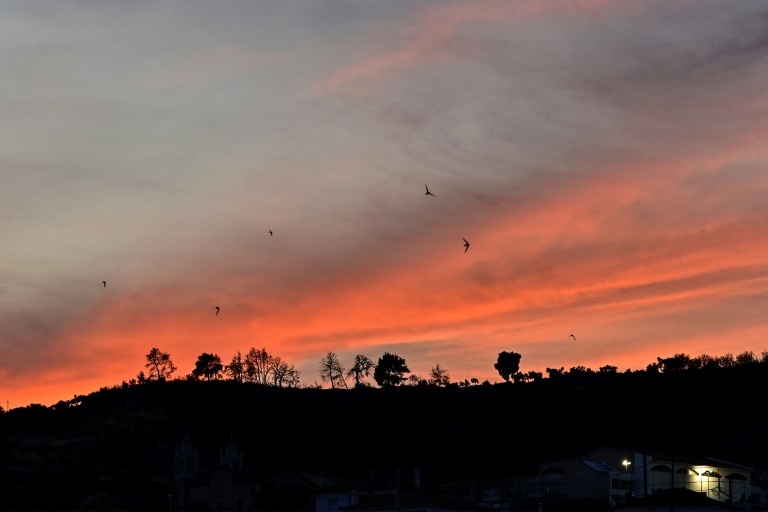
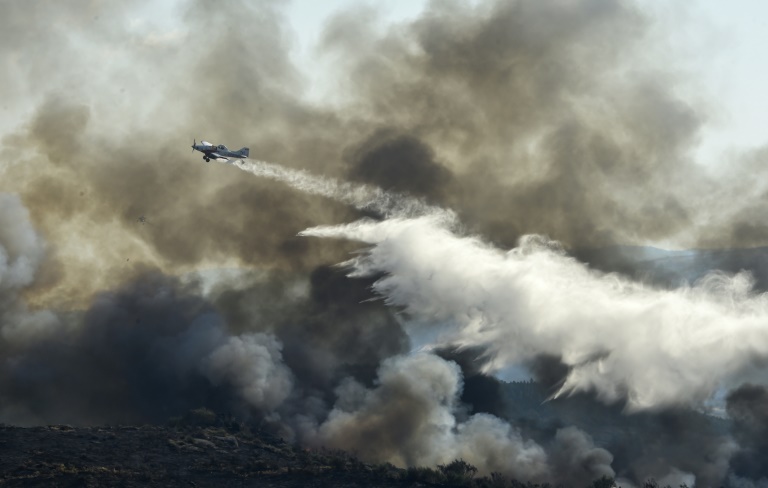
Spanish firefighters on Saturday struggled to contain wildfires that have ravaged large tracts in the northwest, as a third summer heat wave grips the country.

Firefighters were battling six blazes in Galicia that have scorched nearly 3,000 hectares (7,400 acres).

Some 700 people have been evacuated from the area around Boiro, where a blaze broke out on Thursday, according to regional officials.

But no casualties have been reported so far. 

“The situation remains complicated. Helicopters are not enough to control all of the homes,” the mayor of neighbouring A Pobra do Caraminal, Xose Lois Pinero, wrote on Facebook. 

Near the town of Verin, by the border with Portugal, authorities were managing to contain a fire that started Wednesday and is suspected to have been arson, Galicia government said.

Temperatures hit a 40.9 degrees Celsius (105.62 Fahrenheit) high on Thursday, according to the national weather agency. They have eased since, but were expected to remain around 35C across much of the country on Saturday.

Scientists say human-induced climate change is making extreme weather events including heatwaves and droughts more frequent and more intense. They in turn increase the risk of fires, which emit climate heating greenhouse gases.

Spain has faced 366 wildfires since the start of the year, fuelled by scorching temperatures and drought conditions.

The flames have destroyed more than 233,000 hectares, more than in any other nation in Europe, according to the European Union’s satellite monitoring service EFFIS.

Pfizer in talks on $5 billion acquisition: media

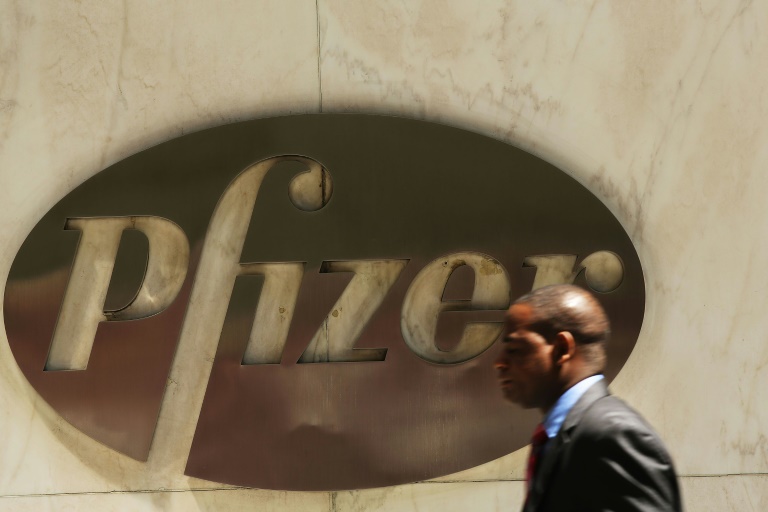
American drugmaker Pfizer is close to a deal to purchase Global Blood Therapeutics, which manufactures a recently approved drug against sickle-cell anemia, for $5 billion, the Wall Street Journal has reported.

Pfizer, one of the top makers of Covid-19 vaccines, hopes to conclude talks with GBT within days, the newspaper said Friday, citing people close to the negotiations.

But it said other takeover candidates remain in the running. 

GBT’s sickle-cell treatment, marketed as Oxbryta, was authorized for those over 12 years old in 2019 but gained federal approval in December for children aged four to 11. The blood disorder affects millions.

Sales of Oxbryta helped the laboratory generate first-quarter turnover of $55 million (up 41 percent), while the company registered a net loss of $81.4 million.

GBT, which is based in San Francisco, California, is to publish its second-quarter numbers on Monday.

Pfizer, for its part, saw its second-quarter turnover jump by 47 percent — to a record $27.74 billion — boosted by sales of its Covid vaccine and pills.

Its net profit soared by 78 percent, to $9.9 billion.

GBT shares on the New York Stock Exchange were up 33.03 percent at the close on Friday, at $63.84, for a market capitalization of more than $4 billion.

Pfizer shares slipped by 1.18 percent, to $49.27.

Pfizer in talks on $5 billion acquisition: media

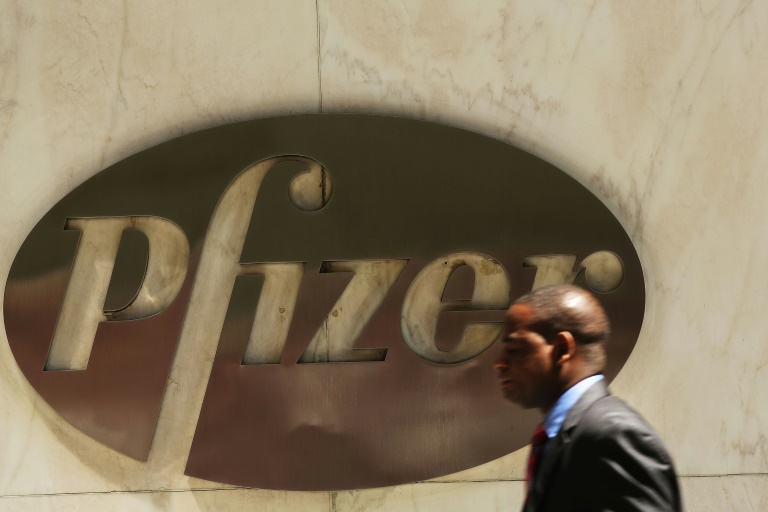
American drugmaker Pfizer is close to a deal to purchase Global Blood Therapeutics, which manufactures a recently approved drug against sickle-cell anemia, for $5 billion, the Wall Street Journal has reported.

Pfizer, one of the top makers of Covid-19 vaccines, hopes to conclude talks with GBT within days, the newspaper said Friday, citing people close to the negotiations.

But it said other takeover candidates remain in the running. 

GBT’s sickle-cell treatment, marketed as Oxbryta, was authorized for those over 12 years old in 2019 but gained federal approval in December for children aged four to 11. The blood disorder affects millions.

Sales of Oxbryta helped the laboratory generate first-quarter turnover of $55 million (up 41 percent), while the company registered a net loss of $81.4 million.

GBT, which is based in San Francisco, California, is to publish its second-quarter numbers on Monday.

Pfizer, for its part, saw its second-quarter turnover jump by 47 percent — to a record $27.74 billion — boosted by sales of its Covid vaccine and pills.

Its net profit soared by 78 percent, to $9.9 billion.

GBT shares on the New York Stock Exchange were up 33.03 percent at the close on Friday, at $63.84, for a market capitalization of more than $4 billion.

Pfizer shares slipped by 1.18 percent, to $49.27.

Turkey to pay for some Russian gas in rubles: Erdogan

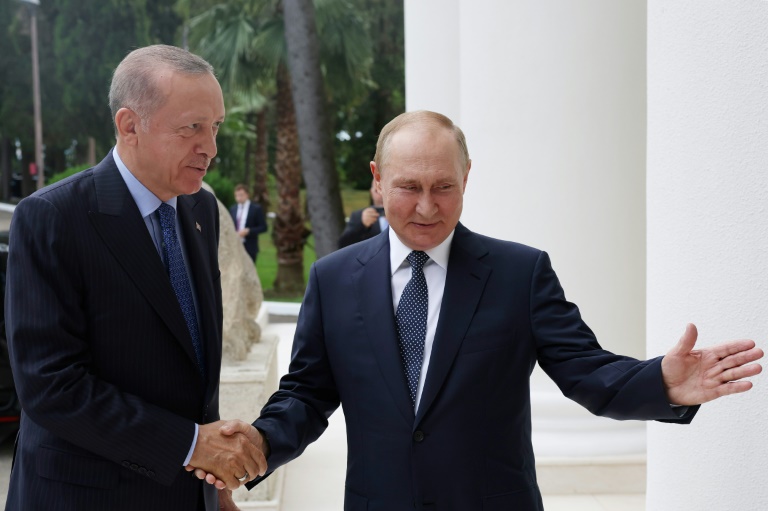
President Recep Tayyip Erdogan has confirmed that Turkey will start paying for some of its Russian natural gas imports in rubles.

The announcement was initially made by Moscow late Friday after more than four hours of talks between Erdogan and Russian President Vladimir Putin in Sochi.

The United States is leading international efforts to impose economic sanctions on Russia in response to its February invasion of Ukraine.

But NATO member Turkey has tried to remain neutral in the conflict because of its heavy dependence on Russian energy.

Russia accounted for about a quarter of Turkey’s oil imports and 45 percent of its natural gas purchases last year.

“As Turkey, our door is open to everyone,” Erdogan was quoted Saturday as telling Turkish reporters on his flight home from Sochi.

“One good thing about this Sochi visit is that we agreed on the ruble with Mr. Putin,” Erdogan said.

“Since we will conduct this trade in rubles, it will of course bring money to Turkey and Russia.”

Neither Erdogan nor Russian officials have said what portion of the gas will be covered by ruble payments.

Avoiding paying for the gas in dollars helps Turkey protect its dwindling hard currency reserves.

The Turkish government is reported to have spent tens of billions of dollars in the past year trying to prop up the lira against steep declines during its latest economic crisis.

The lira has still lost 55 percent of its value against the dollar and consumer prices have soared by 80 percent in the past 12 months.

The crisis has complicated Erdogan’s path to a third decade in power in elections due by next July.

The United States and European Union are trying to pressure Russia’s energy clients from switching to ruble payments to limit Moscow’s ability to wage its war against Ukraine.

Ruble payments help Russia avoid restrictions on dollar transactions with Moscow that the United States is trying to impose on global banks.

Turkey has refused to join the sanctions regime against Russia and instead pushed for truce talks between Moscow and Kyiv.

Erdogan and Putin pledged in Sochi to expand economic cooperation in sectors including banking and industry.

Conspiracy theorist Alex Jones ordered to pay $45 mn for false school shooting claims

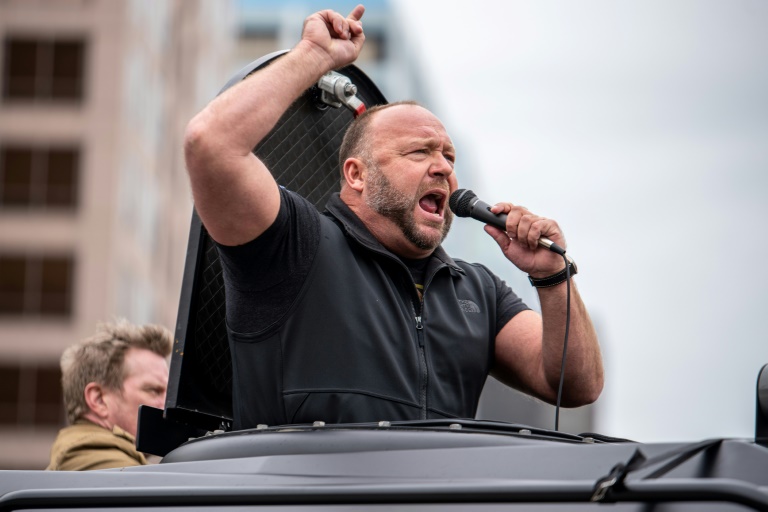
A Texas jury ordered US conspiracy theorist Alex Jones on Friday to pay $45.2 million in punitive damages for falsely claiming that the deadly 2012 Sandy Hook elementary shooting was a “hoax.”

The verdict came a day after the same jury awarded a couple whose child died at Sandy Hook $4.1 million in compensatory damages for the emotional stress caused by Jones broadcasting falsehoods for years on his InfoWars online and radio talk shows. 

The huge sum ordered from Jones, who for years gathered a sizable following for his often outlandish conspiracy claims, vindicated the lawsuits against him by families of some of the 20 schoolchildren and six adults killed by a 20-year-old man in one of the country’s deadliest school shootings.

The $49.3 million total judgement was far less than the $150 million sought by the plaintiffs in the Texas case, Neil Heslin and Scarlett Lewis, whose six-year-old son Jesse was killed.

Still, Lewis said that Jones had been “held accountable.”

“Today the jury proved that most of America is ready to choose love over fear and I’ll be forever grateful to them,” Lewis tweeted.

Jones, a vocal supporter of former president Donald Trump, claimed for years on InfoWars that the shooting in Newtown, Connecticut, was “staged” by gun control activists.

He has since acknowledged it was “100 percent real,” but the Sandy Hook families maintained that his denialism, coupled with his ability to influence the beliefs of thousands of followers, caused real emotional trauma.

He was also accused of pulling in massive profits from harmful lies and disinformation.

The judgement is not likely the end of legal woes for the 48-year-old Jones, who is also facing another defamation suit in Connecticut. 

He has been found liable in multiple defamation cases brought by parents of the Sandy Hook victims, and the Texas case was the first to reach the damages phase.

He is also under scrutiny for his participation in the January 6, 2021, assault on the US Capitol by Trump supporters.

During the hearing ahead of the decision Friday, Wesley Ball, attorney for the parents who brought the case, urged the jury to take a stand against misinformation.

“You have the ability to send a message for everyone in this country and perhaps this world to hear,” he said.

“And that is stop Alex Jones. Stop the monetization of misinformation and lies,” he added.

“Stopping Alex Jones stops the root of his message and the root of his message is fear and hate.”

The $45.2 million was close to the maximum allowed in relation to the original compensatory damages. 

InfoWars declared bankruptcy in April and another company owned by Jones, Free Speech Systems, filed for bankruptcy last week.

Randi Weingarten, president of the American Federation of Teachers union, which represented the staff at Sandy Hook, praised Friday’s verdict.

“Nothing will ever fix the pain of losing a child, or of watching that tragedy denied for political reasons,” she tweeted. “But I’m glad the parents of Sandy Hook have gotten some justice.”

Greek park fire exposes 'chronic failure': NGOs

Days after one of Greece’s top national parks narrowly escaped massive destruction from a massive fire that raged for over a week, the country’s environment ministry congratulated itself.

Among Greece’s underfunded and understaffed habitats, the Dadia national park is — on paper — one of Greece’s best protected areas as one of Europe’s most important breeding grounds for vultures and other birds of prey.

“Respect and protection of the environment was and remains a fundamental pledge of our government,” environment minister Costas Skrekas said in a statement on Tuesday.

But many Greek environmental groups differ.

Spyros Psaroudas, director of the Callisto wildlife group, says there is a “chronic failure” in Greece’s nature protection, adding that the present government seeks to create a business-friendly environment at the expense of wildlife.

“There is a lack of coordination among ministries and of a clear assignment of responsibilities…all this leads to illegal activities that are never punished,” adds Nadia Andreanidou, policy officer for the Mediterranean Association to Save the Sea Turtles (Medasset).

“It is a vicious circle and it leads to poor management of the protected areas,” she told AFP.

Forestry engineer Dimitris Vasilakis, who helped draw up Dadia’s operational plan, says the park has just four rangers to patrol 800 square kilometres (308 square miles).

The local forest service in Soufli that supervises Dadia annually receives less than 50,000 euros from the state, a fifth of what it’s supposed to, Vasilakis said.

Over 300 firefighters battled for eight days last month to keep the blaze away from the Dadia nesting grounds at the heart of the park.

On Tuesday, the environment ministry said the July 21 fire had destroyed just over 2,200 hectares (54.6 acres) of forest at Dadia. 

Early estimates suggest predator nesting grounds were largely unaffected.

The incident has put a spotlight on Greece’s long and troubled history of environmental protection.

Even as the park burned two weeks ago, the government tried to push through parliament new legislation which nearly a dozen NGOs said further weakened protective restrictions in Greece’s national parks.

On the seventh day of the fire, the legislation was unexpectedly withdrawn by the government for “further consultation”.

The planned draft law would have permitted additional activities in protected areas, including roads, tourism sites and electricity and telecoms storage facilities. 

– Legal vacuum –

Greece has been repeatedly referred to the European court of justice over its failure to protect its natural habitats.

The court rapped Athens on the issue in December 2020, noting that the country by its own admission had created safeguards for less than 20 percent of over 240 protected areas.

A key omission, environmental groups say, is the absence of legal safeguards and regulations governing Greece’s share of the Natura 2000 network — core European breeding and resting sites for rare and threatened species that are protected under EU law.

Charikleia Minotou, head of the Zakynthos programme for the protection of loggerhead turtles run by the Greek chapter of the Worldwide Fund for Nature (WWF), says there are “hundreds” of complaints and fines against illegal development that authorities fail to follow up.

And in 2018, when a presidential decree was issued to protect the gulf of Kyparissia on the Ionian Sea — a key habitat for loggerhead turtles and deep-sea whales — it was challenged by three town councils, two tourism companies and scores of local residents.

– Focus on energy –

The emphasis of the conservative government of Prime Minister Kyriakos Mitsotakis is on hydrocarbon exploration, says Minotou.

Even before the Russian attack on Ukraine in February sparked energy shortage fears across Europe, Greece had earmarked exploration sites in the Ionian Sea.  

In February, several Cuvier’s beaked whales washed up on coasts during seismic research in the Ionian. The state hydrocarbon management agency denied this was caused by its activities.

In the few instances where new legislation is introduced, the results often pose a threat to conservation, Greek environment groups say.

In 2020, Greece formed a new national body to manage its parks, the Natural Environment and Climate Change Agency (Necca). In the process, 36 park management bodies were merged into a new group of 24.

However, environment groups note that the new body has crucially excluded NGOs and local authorities and citizens’ associations from park governing boards.

“We need national parks where local society participates and is represented democratically,” says Psaroudas from the Callisto wildlife group.

Biden's cornerstone climate and health bill back before the Senate

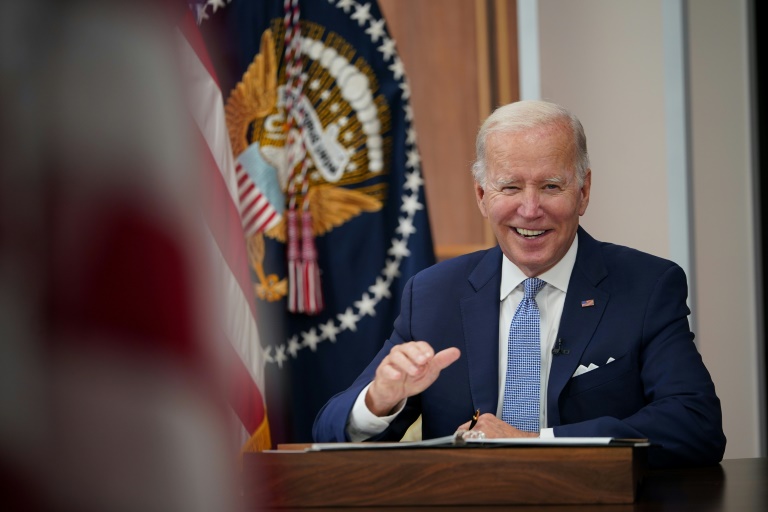
After 18 months, a possible victory for Joe Biden’s social and climate reform legislation seems within reach: Congress on Saturday will begin debating a revised version of the US President’s cornerstone bill, the fruit of numerous compromises with those on his party’s right.

Biden, who took office promising big reforms, is calling the bill “a gamechanger for working families.”

The legislation — officially the Inflation Reduction Act — includes $370 billion towards ambitious climate goals and $64 billion for health care.

That would make it the largest investment yet in clean energy by the United States, something that Biden has called “historic.”

– Sweetening the deal –

Despite yearly fires and deadly flooding in parts of the country, the climate crisis does not register high on the average household’s list of concerns, falling below issues like inflation or unemployment.

To garner support for their climate initiatives, Democrats sweetened the legislation with tax credits for producers and consumers of wind, solar and nuclear power.

Funding would additionally be allocated towards protecting forests from the increasingly extreme wildfire seasons that have ravaged the US West in recent years, a phenomenon directly linked to climate change.

– Tackling drug prices –

The bill additionally tackles exorbitant drug prices for medication such as insulin, in an attempt to partially ease the immense inequality that exists in US access to health care.

“The anguish of people not being able to pay for medicines that may save their lives will be greatly reduced,” Senate Democratic leader Chuck Schumer said.

One of the major reforms in the bill would, for example, force pharmaceutical companies to offer rebates for certain drugs if the prices are rising faster than inflation.

The cost of some medication in the United States can be up to ten times more expensive than in other wealthy nations.

The bill also aims to reduce the federal deficit via a minimum corporate tax of 15 percent for all companies with profits exceeding one billion dollars.

– ‘Defeat this bill’ –

The funding is popular with Americans, according to several polls, but has been strongly denounced by Republicans, who say Biden will stoke record-breaking inflation.

“We’re going to do everything we can to defeat this bill,” Republican Senator John Thune promised on Friday.

But Republicans’ tools to block the legislation are limited: Democrats can pass it without any votes from across the aisle. 

The Republicans could, however, try to slow down the legislative process by presenting amendments during debate.

The Senate is expected to vote on the bill early next week. After that, it will head to the House of Representatives, where Democrats have a narrow majority, for a vote there.

Biden, seeking a political win with fewer than 100 days before November’s midterm elections, is urging Congress to pass it without further delay.

What's in Biden's big climate and health bill?

Hundreds of billions of dollars for clean energy projects, cheaper prescription drugs and new corporate taxes are a few of the key items in US President Joe Biden’s massive investment plan, which the Senate will begin debating on Saturday.

Here’s a closer look at the signature elements of the plan, which could offer the Democratic leader a big political win heading into November’s crucial midterm elections.

– $370 billion for clean energy, climate-

If the legislation is passed, it will mark the biggest investment in US history in the fight against climate change.

Rather than attempting to punish the biggest polluters in corporate America, the bill put forward by Biden’s party instead proposes a series of financial incentives aimed at steering the world’s biggest economy away from fossil fuels.

Tax credits would be given to producers and consumers of wind, solar and nuclear power. 

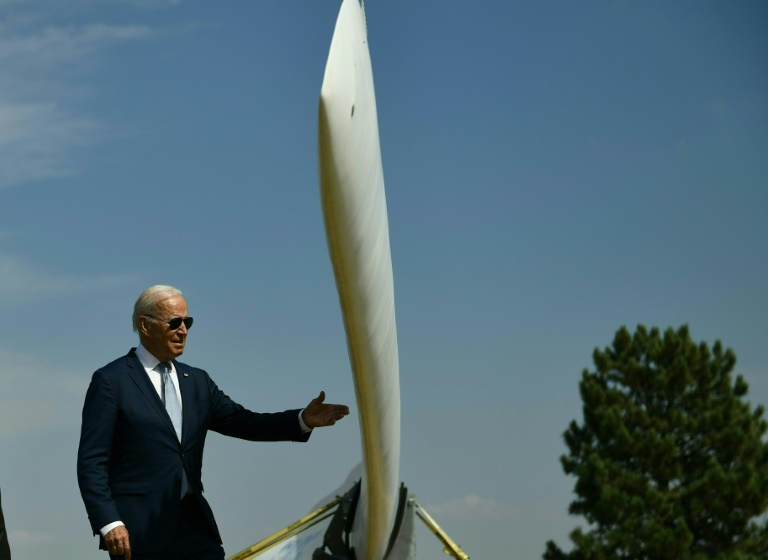
If passed, the legislation would allot up to $7,500 in tax credits to every American who buys an electric vehicle. Anyone installing solar panels on their roof would see 30 percent of the cost subsidized.

Around $60 billion would be allocated for clean energy manufacturing, from wind turbines to the processing of minerals needed for electric car batteries. 

The same amount would go towards programs to help drive investment in underprivileged communities, notably through grants for home renovation to improve energy efficiency and access to less polluting modes of transportation.

Huge investments would go into making forests less susceptible to wildfires and protect coastal areas from erosion caused by devastating hurricanes.

The bill aims to help the United States reduce its carbon emissions by 40 percent by 2030, as compared with 2005 levels.

– $64 billion for health care –

The second major aspect of the legislation is to help reduce the huge disparities in access to health care across the United States, notably by reining in skyrocketing prescription drug prices.

If the draft eventually becomes law, Medicare — the nation’s health insurance plan for those aged 65 and older, or with modest incomes — could be permitted to negotiate prices of certain medications directly with Big Pharma for the first time, likely yielding far better deals.

The plan would require pharmaceutical companies to offer rebates on certain drugs if the prices rise faster than soaring US inflation.

It also would extend benefits under Barack Obama’s signature Affordable Care Act — known colloquially as Obamacare — until 2025.

– Minimum corporate tax of 15% –

Alongside these huge investments, the so-called Inflation Reduction Act would seek to pare down the federal deficit through the adoption of a minimum corporate tax of 15 percent for all companies with profits exceeding one billion dollars.

The new tax seeks to prevent certain huge firms from using tax havens to pay far less than what they theoretically owe.

According to estimates, the measure could generate more than $258 billion in tax revenue for US government coffers over the next 10 years.

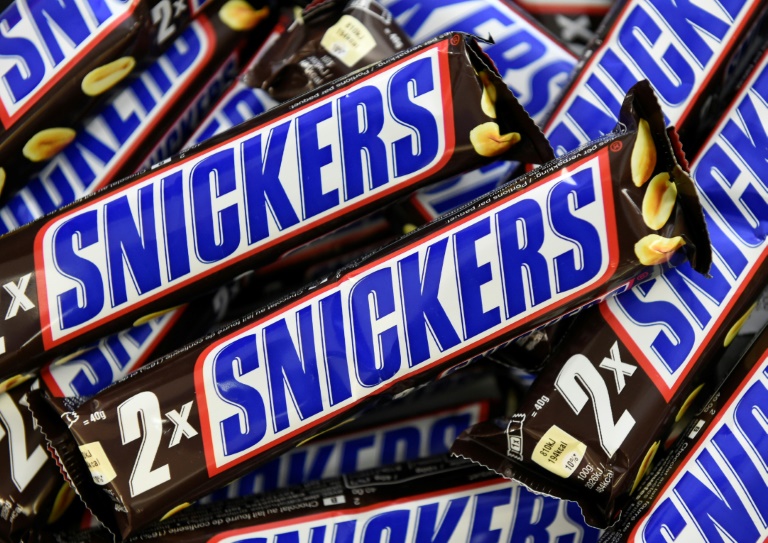
Snickers owner apologises after referring to Taiwan as a country

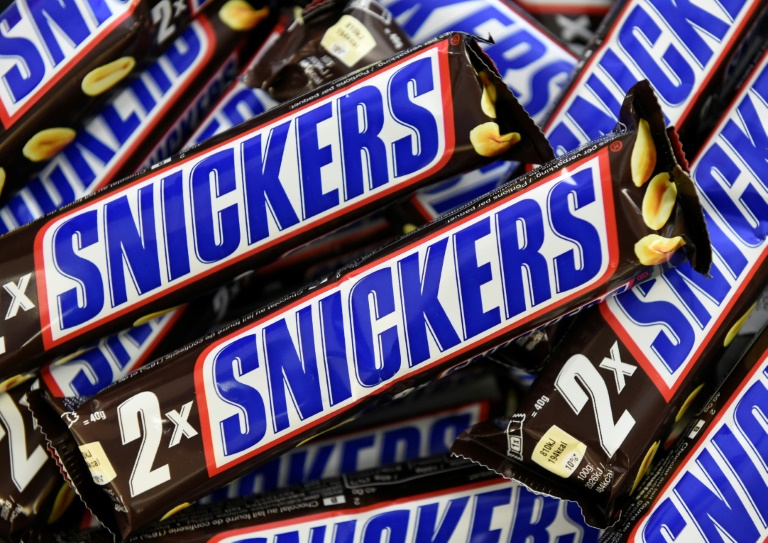
American candy giant Mars Wrigley has insisted it “respects China’s national sovereignty” and apologised after an advert for its Snickers bar referred to Taiwan as a country, sparking outrage on the mainland.

Screenshots of marketing for the nutty confectionery featuring the South Korean boyband BTS were swiftly picked up on social media in mainland China, where any suggestion the island is an independent nation is highly taboo.

“We are aware of reports on Snickers-related activities in certain regions of Asia, take this very seriously and express our deep apologies,” said a Mars Wrigley statement posted Friday on Snickers China’s Weibo page.

The company has asked Snickers’ local team to check and adjust its official website and social media account “to ensure the company’s publicity content is accurate”, it added.

“Mars Wrigley respects China’s national sovereignty and territorial integrity, and conducts business operations in strict compliance with local Chinese laws and regulations,” the statement said.

Hours after the first statement, Snickers China shared another Weibo post adding that “there is only one China in this world, and Taiwan is an inalienable part of China’s territory”.

Beijing reacted with fury this week when US House Speaker Nancy Pelosi defied its warnings and visited Taiwan — which China claims as part of its territory and has vowed to take, by force if necessary.

China said Friday it was ending cooperation with the United States on key issues including climate change, and has in recent days encircled the self-ruled democratic island with a series of military drills.

Mars Wrigley is far from the first international firm to issue an apology over worries of losing access to China’s massive consumer market.

In 2019, French luxury brand Dior apologised after using a map of China in a presentation that did not include Taiwan.

Hotel chain Marriott’s website in China was shut down by authorities for a week in 2018 after a customer questionnaire listed Taiwan, Tibet and Hong Kong as separate countries.

Snickers owner apologises after referring to Taiwan as a country

American candy giant Mars Wrigley has insisted it “respects China’s national sovereignty” and apologised after an advert for its Snickers bar referred to Taiwan as a country, sparking outrage on the mainland.

Screenshots of marketing for the nutty confectionery featuring the South Korean boyband BTS were swiftly picked up on social media in mainland China, where any suggestion the island is an independent nation is highly taboo.

“We are aware of reports on Snickers-related activities in certain regions of Asia, take this very seriously and express our deep apologies,” said a Mars Wrigley statement posted Friday on Snickers China’s Weibo page.

The company has asked Snickers’ local team to check and adjust its official website and social media account “to ensure the company’s publicity content is accurate”, it added.

“Mars Wrigley respects China’s national sovereignty and territorial integrity, and conducts business operations in strict compliance with local Chinese laws and regulations,” the statement said.

Hours after the first statement, Snickers China shared another Weibo post adding that “there is only one China in this world, and Taiwan is an inalienable part of China’s territory”.

Beijing reacted with fury this week when US House Speaker Nancy Pelosi defied its warnings and visited Taiwan — which China claims as part of its territory and has vowed to take, by force if necessary.

China said Friday it was ending cooperation with the United States on key issues including climate change, and has in recent days encircled the self-ruled democratic island with a series of military drills.

Mars Wrigley is far from the first international firm to issue an apology over worries of losing access to China’s massive consumer market.

In 2019, French luxury brand Dior apologised after using a map of China in a presentation that did not include Taiwan.

Hotel chain Marriott’s website in China was shut down by authorities for a week in 2018 after a customer questionnaire listed Taiwan, Tibet and Hong Kong as separate countries.

Close Bitnami banner
Bitnami