AFP

Snickers owner apologises after referring to Taiwan as a country

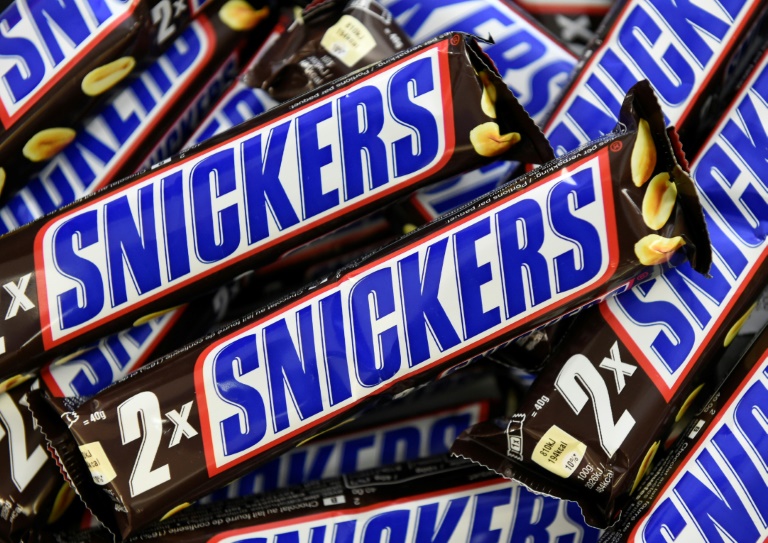
American candy giant Mars Wrigley has insisted it “respects China’s national sovereignty” and apologised after an advert for its Snickers bar referred to Taiwan as a country, sparking outrage on the mainland.

Screenshots of marketing for the nutty confectionery featuring the South Korean boyband BTS were swiftly picked up on social media in mainland China, where any suggestion the island is an independent nation is highly taboo.

“We are aware of reports on Snickers-related activities in certain regions of Asia, take this very seriously and express our deep apologies,” said a Mars Wrigley statement posted Friday on Snickers China’s Weibo page.

The company has asked Snickers’ local team to check and adjust its official website and social media account “to ensure the company’s publicity content is accurate”, it added.

“Mars Wrigley respects China’s national sovereignty and territorial integrity, and conducts business operations in strict compliance with local Chinese laws and regulations,” the statement said.

Hours after the first statement, Snickers China shared another Weibo post adding that “there is only one China in this world, and Taiwan is an inalienable part of China’s territory”.

Beijing reacted with fury this week when US House Speaker Nancy Pelosi defied its warnings and visited Taiwan — which China claims as part of its territory and has vowed to take, by force if necessary.

China said Friday it was ending cooperation with the United States on key issues including climate change, and has in recent days encircled the self-ruled democratic island with a series of military drills.

Mars Wrigley is far from the first international firm to issue an apology over worries of losing access to China’s massive consumer market.

In 2019, French luxury brand Dior apologised after using a map of China in a presentation that did not include Taiwan.

Hotel chain Marriott’s website in China was shut down by authorities for a week in 2018 after a customer questionnaire listed Taiwan, Tibet and Hong Kong as separate countries.

China drills reveal plans for Taiwan blockade: experts

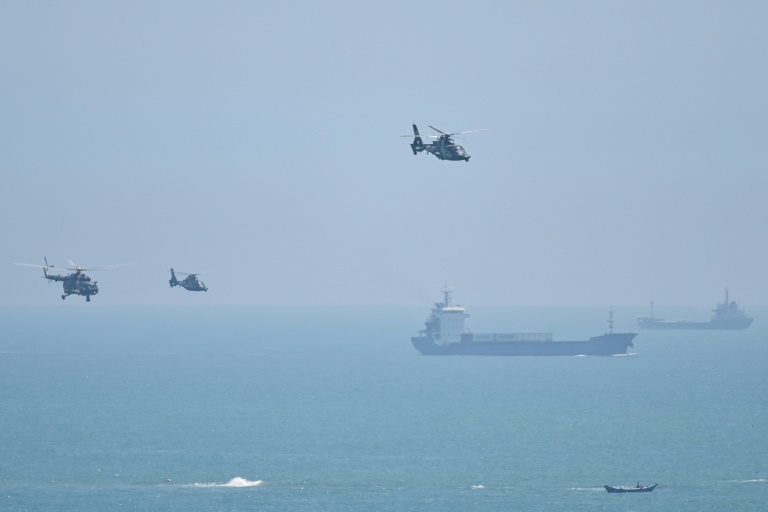
Beijing’s largest-ever exercises around Taiwan have offered key clues into its plans for a gruelling blockade in the event of a war to take the self-ruled island, and revealed an increasingly emboldened Chinese military, experts told AFP.

The visit to Taiwan by US House Speaker Nancy Pelosi — second in line to the presidency — sparked outrage from Beijing, which launched vast military manoeuvres around the island, even at the risk of partially exposing its plans to the United States and its Asian allies.

Mobilising fighter planes, helicopters and even warships, the drills aim to simulate a blockade of Taiwan and include practising an “attack on targets at sea”, according to state news agency Xinhua.

It is the first time Chinese exercises have taken place so close to Taiwan, with some of the drills happening less than 20 kilometres from the island’s coast.

Also unprecedented are Beijing’s drills on Taiwan’s eastern flank, a strategically vital area for supplies to the island’s military forces — as well as any potential American reinforcements.

China sees Taiwan as part of its territory and has vowed to one day take it, by force if necessary.

A “blockade scenario” was long speculated to be one of China’s preferred strategies were it to try and conquer the island, and this week’s drills have revealed how that might go down.

Such a besiegement would aim to prevent any entry or exit of commercial or military ships and aircraft.

But it would also deny American forces stationed in the region access to the island.

The Chinese military “obviously has all the capabilities to impose such a blockade”, Song Zhongping, an independent Chinese military commentator, told AFP.

“We already see during the current exercises that Taiwanese fighter jets and ships absolutely cannot take off or leave their ports.”

– ‘They can’t be dismissed’ –

The Chinese military fired a dozen ballistic missiles on Thursday that hit various areas around Taiwan — with some flying over the island, Beijing’s state broadcaster CCTV said on Friday.

According to Xinhua, Beijing has mobilised more than 100 planes and more than 10 frigates and destroyers — including the J-20 stealth fighter and a Type 055 destroyer, the crown jewels of China’s air and naval forces.

But beyond the big guns, these exercises make it possible to test and sharpen the level of coordination between the various army corps mobilised: land, sea, air and rocket forces, as well as strategic support, tasked with cyber warfare.

It is also a crucial test for the recently inaugurated Eastern Theatre of Operations of the Chinese army, created in 2016 and which oversees the country’s entire eastern maritime space — and therefore Taiwan.

What China has done so far demonstrates its “robust capabilities”, John Blaxland, professor of international security at the Australian National University, told AFP.

“They can’t be dismissed as some kind of less inexperienced, incapable force,” he said. 

“They clearly have the ability to coordinate their land and sea, they have the ability to deploy missile systems and they function effectively.”

These exercises also demonstrate to the Taiwanese, the Americans and the Japanese that the Chinese “have what it takes to do what they threaten to do”, he added.

“The converse, of course to this is that what they are doing is being closely studied and monitored for lessons to be learned by Taiwan, the United States, Japan and others,” Blaxland noted.

– ‘Dangerous opponent’ –

During the previous Taiwan Strait crisis from 1995 to 1996, under Bill Clinton, the US Navy transited several warships through the waterway and deployed aircraft carriers near the island.

This time, however, “the US Government is taking prudent steps to avoid unwanted escalation”, said Lonnie Henley, a former US intelligence officer and professor at the Elliott School of International Studies in Washington.

American caution is also rooted in the fact that China has greatly increased its military capabilities since 1996, when it was unable to deny the US Navy access to the area.

“In some areas the PLA might even surpass US capabilities,” noted Grant Newsham, a former US Navy officer and researcher at the Japan Forum for Strategic Studies, referring to China’s military by its official name.

“If the battle is confined to the area right around Taiwan, today’s Chinese navy is a dangerous opponent — and if the Americans and Japanese do not intervene for some reason, things would be difficult for Taiwan.”

Chinese incursions across the so-called median line between the mainland and Taiwan — never recognised by Beijing — also speak to a growing confidence, experts said.

“China has not felt comfortable to push its claims on the median line until recently,” said Blaxland. 

“We can expect them to continue to operate as if the median line is not valid. That’s been the case for a while, but it’s now accelerating.”

Actress Anne Heche hospitalized after fiery car crash: US media

US actress Anne Heche has been hospitalized in critical condition after crashing her car into a Los Angeles home, US media reported Friday.

The Los Angeles Fire Department reported that a vehicle struck a two-story house in Los Angeles’ Mar Vista neighborhood, “causing structural compromise and erupting in heavy fire.”

The female adult found in the car was “taken to an area hospital by LAFD paramedics in critical condition,” it said.

US media confirmed initial reports by celebrity gossip publication TMZ that the woman inside the blue Mini Cooper was Heche. 

The 53-year-old actress initially crashed into an apartment building garage before driving off, according to images collected by TMZ.

The same car later crashed into and “heavily damaged” the Mar Vista house. The ensuing blaze took 59 firefighters 65 minutes to confine and fully extinguish, according to the fire department.

She starred in a number of movies from the 1990s including “Six Days, Seven Nights,” “Donnie Brasco” and “I Know What You Did Last Summer.” 

Heche is also known for her role on the soap opera “Another World,” for which she won a Daytime Emmy in 1991. 

During the 1990s, she was in a high-profile relationship with talk show host Ellen DeGeneres.

Nuclear weapons a 'loaded gun', UN chief warns in Hiroshima

“Humanity is playing with a loaded gun” as crises with the potential for nuclear disaster proliferate worldwide, UN head Antonio Guterres said in Hiroshima on Saturday, the 77th anniversary of the first atomic bomb attack.

At an annual memorial, Guterres warned of the risk posed by crises in Ukraine, the Middle East and the Korean peninsula as he described the horrors endured by the Japanese city.

“Tens of thousands of people were killed in this city in the blink of an eye. Women, children and men were incinerated in a hellish fire,” he said.

Survivors were “cursed with a radioactive legacy” of cancer and other health problems.

“We must ask: What have we learned from the mushroom cloud that swelled above this city?”

Around 140,000 people died when Hiroshima was bombed by the United States on August 6, 1945, a toll that includes those who perished after the blast from radiation exposure.

Today, “crises with grave nuclear undertones are spreading fast,” Guterres said, repeating warnings he made this week at a nuclear Non-Proliferation Treaty conference in New York.

“Humanity is playing with a loaded gun.”

Before dawn, survivors and their relatives began to gather at Hiroshima’s Peace Memorial Park to pay tribute to the victims.

A silent prayer was held at 8.15 am, the moment the bomb was dropped.

The Russian ambassador was not invited to the ceremony but visited Hiroshima on Thursday to lay flowers at the memorial site.

Since Russia invaded Ukraine in February, President Vladimir Putin has made thinly veiled threats hinting at a willingness to deploy tactical nuclear weapons.

In a speech on Saturday, Hiroshima Mayor Kazumi Matsui cited Leo Tolstoy, the Russian author of “War and Peace”, saying: “Never build your happiness on the misfortune of others, for only in their happiness can you find your own.”

Three days after the Hiroshima bombing, Washington dropped a second atomic bomb on the Japanese port city of Nagasaki, killing about 74,000 people and leading to the end of World War II.

There are now fewer than 119,000 officially recognised survivors of the two nuclear attacks, according to government statistics from March.

The United States remains the only country ever to have used nuclear weapons in conflict.

But around 13,000 are now held in state arsenals worldwide, Guterres said.

Saturday was the first time Guterres attended the Hiroshima memorial in person as UN chief, with a visit last year cancelled because of the Covid-19 pandemic.

Rare flooding traps 1,000 people in US Death Valley

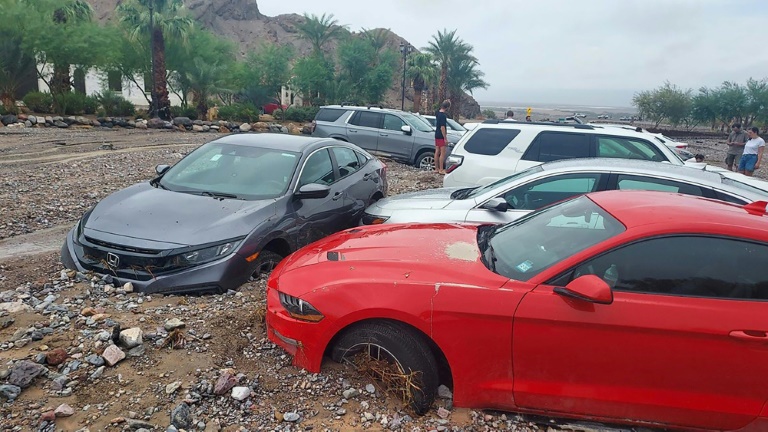
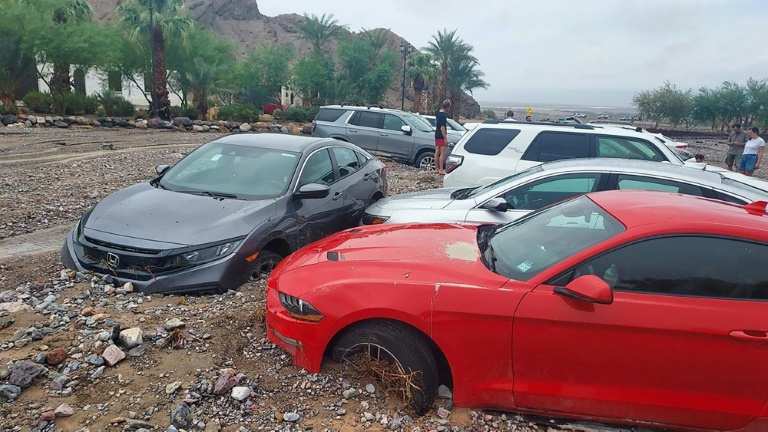
Major flooding in California’s Death Valley on  Friday stranded approximately 1,000 people, buried cars and shut down all roads into and out of the famously parched national park.

No injuries were reported, according to the National Park Service, but around 60 cars were bogged down under several feet of debris.

“Unprecedented amounts of rainfall caused substantial flooding,” the National Park Service said in a statement, adding that “there are approximately 500 visitors and 500 staff currently unable to exit the park,” which is in Eastern California’s Mojave Desert.

The floodwaters tore up sections of paved roads and pushed dumpster containers into parked cars, causing the vehicles to collide. The rain also flooded offices and hotels, the park said.

The park service added that all roads serving the park will remain off-limits until officials can determine the extent of the damage. 

A total of 1.46 inches (3.7 centimeters) of rain fell in the park’s Furnace Creek area, almost tying the previous daily record of 1.47 inches. The average annual rainfall is less than two inches a year.

Higher temperatures caused by climate change mean the atmosphere holds more moisture, unleashing more rain.

According to UN climate experts, even if the world manages to limit warming to 1.5 degrees Celsius, some regions will experience an increase in frequency, intensity and quantity of heavy rainfall.

The risk of heavy precipitation episodes increases with temperature rise.

Rare flooding traps 1,000 people in US Death Valley

Major flooding in California’s Death Valley on  Friday stranded approximately 1,000 people, buried cars and shut down all roads into and out of the famously parched national park.

No injuries were reported, according to the National Park Service, but around 60 cars were bogged down under several feet of debris.

“Unprecedented amounts of rainfall caused substantial flooding,” the National Park Service said in a statement, adding that “there are approximately 500 visitors and 500 staff currently unable to exit the park,” which is in Eastern California’s Mojave Desert.

The floodwaters tore up sections of paved roads and pushed dumpster containers into parked cars, causing the vehicles to collide. The rain also flooded offices and hotels, the park said.

The park service added that all roads serving the park will remain off-limits until officials can determine the extent of the damage. 

A total of 1.46 inches (3.7 centimeters) of rain fell in the park’s Furnace Creek area, almost tying the previous daily record of 1.47 inches. The average annual rainfall is less than two inches a year.

Higher temperatures caused by climate change mean the atmosphere holds more moisture, unleashing more rain.

According to UN climate experts, even if the world manages to limit warming to 1.5 degrees Celsius, some regions will experience an increase in frequency, intensity and quantity of heavy rainfall.

The risk of heavy precipitation episodes increases with temperature rise.

Going once, going twice… Pakistan lions up for auction

A Pakistan zoo is auctioning off a dozen lions to private collectors next week to free up space for a pride that won’t stop growing.

Lahore Safari Zoo now has so many big cats that their lions and tigers have to take it in turns to access the paddocks, said Tanvir Ahmed Janjua, the zoo’s deputy director.

“Not only will we free up more space here, but our expenses for meat to feed them will also decrease,” he told AFP.

The zoo is currently home to 29 lions, and officials plan an auction on August 11 to sell 12 of them, aged between two and five years old.

There are also six resident tigers and two jaguars.

Conservationists are opposed to the sale, with the environmental group WWF saying the creatures should be moved to other established zoos, or breeding females sterilised or given contraceptives.

“Animal exchanges and donations between zoos are a widely accepted practice,” the organisation’s Uzma Khan told AFP.

“Once an institution such as a zoo places a price tag on a wildlife species it is promoting trade — which is counterproductive to conservation,” she added.

Keeping lions, tigers and other exotic wildlife as pets is not uncommon in Pakistan, and is seen as a status symbol.

Wealthy owners post images and video clips of their big cats on social media, and rent them out as props for movies and photoshoots.

Zoo officials have set a reserve of 150,000 Pakistan rupees ($700) per cat, but hope each will fetch around two million rupees.

Not just anyone can take part in the auction, however.

Janjua said buyers will have to be registered with provincial authorities and show they have the means to provide proper care and shelter for the creatures.

Zoo veterinary officer Muhammad Rizwan Khan told AFP an initial attempt last year to auction lions fell through as potential buyers lacked the necessary documentation or licences.

Nouman Hassan, who fell foul of authorities in the past when he was filmed walking his pet tiger on a leash in Lahore, plans to take part.

“I will try to buy two to three lions for sure,” he told AFP, adding the auction was a good way to diversify the gene pool for private collectors who already owned a big cat.

With little legislation to safeguard animal welfare, zoos across Pakistan are notorious for their poor facilities, but the Lahore Safari Zoo is considered one of the best, set over 200 acres.

In April 2020 a court ordered the only zoo in the country’s capital to shut after poor facilities and mistreatment of the animals there were revealed.

The facility had drawn international condemnation for its treatment of an Asian elephant named Kaavan, who was later airlifted to retirement in Cambodia in a jumbo project spearheaded by US popstar and actress Cher. 

Veterinarian Khan said the animals at Lahore Safari Zoo were being given the best possible care — something reflected in their fecundity.

“They are experiencing a good life in captivity with us,” he said.

Screaming students under 'fire' in US police school drills

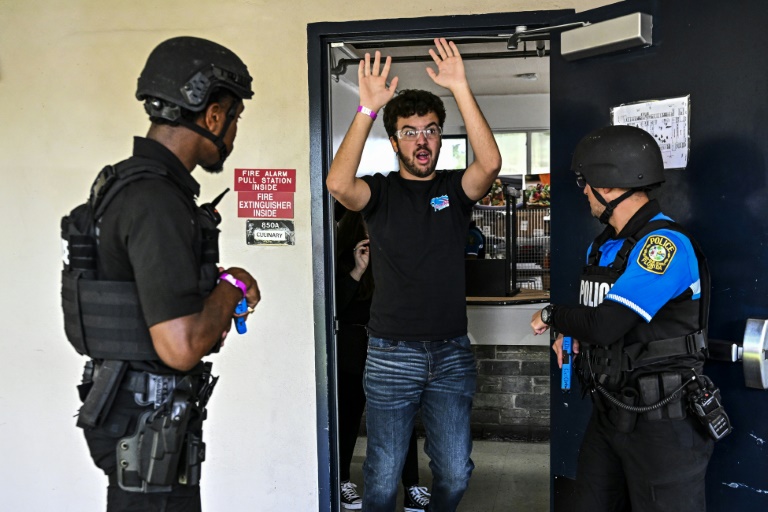
Shots ring out in a Miami school classroom. Inside, a dozen students, their clothing stained with what appears to be blood, desperately scream.

A security agent walks down the hall, more shots are heard — and a young man is swiftly knocked down.

It’s a terrifying scene — but, thankfully, it is a simulation. The bullets are blanks, and the blood and wounds are fake, as are the screams and the guns carried by the dozens of police officers taking part.

The teenagers are volunteers helping police to fine tune their reaction to school shootings in the United States, once again under the spotlight after the disastrous law enforcement response to a deadly gun rampage at an elementary school in Uvalde, Texas in May. 

There, law enforcement agents waited 73 minutes before finally engaging the shooter, who killed 21 people — most of them young children. 

The police response outraged Americans, especially after the release of surveillance footage showing officers waiting in the corridors of the elementary school as children and teachers lay dying behind the closed doors of the classrooms.

– Legacy of Columbine –

“Our rule is that the first officer on the scene confronts the shooter. Everything is done to save lives,” said Major Carlos Fernandez of the Miami-Dade Schools Police Department.

It’s a rule of thumb that has been in place for many police departments since two teenagers killed 13 people at a high school in Columbine, Colorado, in 1999.

There is no US federal guideline on the police response to school shootings. But before Columbine, the norm was for officers to wait for SWAT tactical units to intervene, Fernandez notes.

After, the priority became to stop the killing by rushing towards the gunfire and engaging the shooter as soon as possible, before helping the wounded — which the officers in Uvalde failed to do.

During the simulation in the Miami suburb of Hialeah, the false suspect is taken out of action just three minutes after the first shots were fired.

The street swarms with police cars in front of the school, as agents run down hallways and check that bathrooms and classrooms are empty. 

With everything under control, firefighters enter the building and take away four students with fake injuries. 

In the past, medical teams waited outside schools — but now police try to clear the facility as soon as possible so that they can enter quickly, Fernandez says.

– ‘Lasting emotional and physical harm’ –

This simulation, in the middle of the summer vacation, is for police, not students; and the 30 teenagers covered in gory makeup and screaming themselves hoarse have chosen to be there. 

But for the rest of the year, active shooter drills are required for public school students in at least 40 of the 50 US states.

And that, argue NGOs and trauma experts, may harm students more than it helps them — particularly when the drills edge closer to realistic simulations like the one in Hialeah, with fake blood, wounded victims and guns.

Gun control advocacy group Everytown last year studied the social media conversations of students in 114 US schools, 90 days before and 90 days after active shooter drills.

They concluded that the drills are linked to increased depression, stress, anxiety and physiological health problems in children as young as five years old, while concerns about death also shot up.

There is “almost no research affirming the value” of such drills for preventing shootings or keeping children safe when one does occur, while the evidence “suggests that they are causing lasting emotional and physical harm to students, teachers, and the larger community,” Everytown said.

Sandy Hook Promise, a nonprofit founded by some of those who lost loved ones in the shooting at Sandy Hook elementary school in Newtown, Connecticut in 2012, draws a line between safety drills such as lockdowns — which it says are “scary enough” — and “live-action simulations of fatal shootings.”

It warns of a “dangerous trend” towards simulations in schools that make drills “more traumatizing than helpful.”

But when the drills are for police rather than students, it is important that the exercises are realistic and that children take part, argues Miami-Dade Schools Police Chief Edwin Lopez.

“Our goal is to unnerve the officers as much as possible. And that involves students screaming, fire alarms going off, smoke, sound or actual gunshots,” he explains after the Hialeah drill.

“And it’s critical that children make a valuable contribution to our officers. Many of them give law enforcement the information they need on a daily basis to mitigate and prevent” shootings, he adds. 

In New York, a native tribe fights to save its land from climate change

In the Hamptons, New York’s playground for the rich and famous, a Native American tribe is battling with the latest threat to what’s left of its traditional land: climate change.

The Shinnecock, whose name means “people of the stony shore,” have lived on Long Island for 13,000 years.

Their villages stretched along the island’s eastern end before land grabs by European settlers and later US authorities reduced their territory to an 800-acre (1.25 square-mile) peninsula.

That low-lying land is now shrinking due to rising sea levels and coastal erosion, and making it increasingly vulnerable to more powerful storms.

“You’re looking at a situation where an entire nation of people who have been here for essentially forever are faced with a devastating reality that we may have to relocate,” Tela Troge, a Shinnecock attorney, told AFP.

The Shinnecock Indian Nation is a self-governing, federally recognized tribe of approximately 1,600 members.

Roughly half live on its reservation, which juts out into Shinnecock Bay beside Southampton, where multi-million-dollar mansions sit behind electric gates.

Also next door is the hamlet of Shinnecock Hills and its famous eponymous golf club, land the tribe says was stolen from them in 1859.

Warming temperatures are causing seas to expand and rise, eating away at the reservation’s coastline.

– Flooding –

Ed Terry, who makes traditional Shinnecock jewelry out of shells found on the beach, remembers the sand going out much further when he was a boy.

“You can see the erosion. Where the land was is now water. It’s like the sea is coming to us,” the 78-year-old told AFP, as he sculpted a mussel shell to be worn as earrings.

Some parts of the shoreline have already receded 150 feet (45 meters), according to studies cited by Shavonne Smith, the nation’s environment director.

She says 57 homes may have to be relocated soon and bodies possibly disinterred from the tribe’s coastal cemetery and moved elsewhere.

“If you’re talking about taking a people that are so dependent on the water — for spiritual health, recreational and sustenance — and now moving them further inland, you’re talking about a very huge, stressful, emotional, dynamic shift in who we are,” Smith told AFP.

The nation estimates its sea levels will rise by up to 4.4 feet (1.3 meters) by the end of the century. Coupled with more intense storms, this would mean frequent devastating floods.

Hurricane Sandy gave a foretaste in 2012, washing away bluffs on the shore, ripping off roofs and flooding basements and the burial grounds.

“There are studies that show by the year 2040 there’s a 100 percent chance the entire Shinnecock Nation region will get inundated by a storm,” said Scott Mandia, a climate change professor at Suffolk County Community College.

– ‘We will survive’ –

In an attempt to preserve their homeland and way of life, which includes fishing and farming, the nation is taking a nature-based approach towards tackling global warming.

It has built an oyster shell reef and placed boulders to try to hold back waves, as well as planted sea and beach grass in a bid to stop sand from shifting.

Tribe members are doing their bit too.

Troge, 35, is director of Shinnecock Kelp Farmers — a group of six Indigenous women who harvest sugar kelp and sell it as a non-chemical fertilizer.

The seaweed helps clean up water pollution, fueled by neighboring development, by absorbing carbon and nitrates that cause toxic algae blooms, which damage marine life.

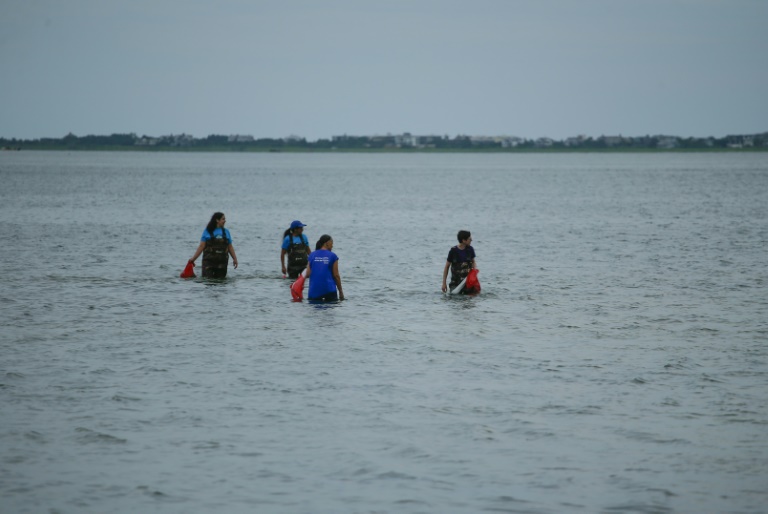
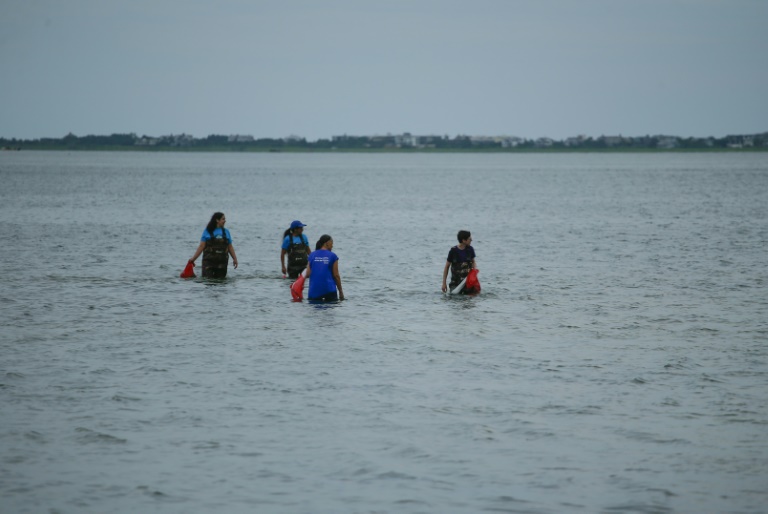
Wading into the bay waist-high, farmer Donna Collins-Smith says she is inspired by previous Shinnecock generations “and what they have preserved for us.”

“We are maintaining that and bringing it back from a state of near dead,” the 65-year-old told AFP.

Mandia, co-author of a book about rising sea levels, laments that marginalized communities “who are least responsible for” climate change are those “who are going to feel the pain the most.”

He applauds the tribe’s efforts but says they are “just buying time” before their land becomes uninhabitable.

Terry, the septuagenarian jeweler, wonders where future Shinnecock will go, since tribal boundaries are fixed. 

“We have no higher ground,” he says.

Nevertheless, Terry adds, “We are a strong people. We will survive.”

In New York, a native tribe fights to save its land from climate change

In the Hamptons, New York’s playground for the rich and famous, a Native American tribe is battling with the latest threat to what’s left of its traditional land: climate change.

The Shinnecock, whose name means “people of the stony shore,” have lived on Long Island for 13,000 years.

Their villages stretched along the island’s eastern end before land grabs by European settlers and later US authorities reduced their territory to an 800-acre (1.25 square-mile) peninsula.

That low-lying land is now shrinking due to rising sea levels and coastal erosion, and making it increasingly vulnerable to more powerful storms.

“You’re looking at a situation where an entire nation of people who have been here for essentially forever are faced with a devastating reality that we may have to relocate,” Tela Troge, a Shinnecock attorney, told AFP.

The Shinnecock Indian Nation is a self-governing, federally recognized tribe of approximately 1,600 members.

Roughly half live on its reservation, which juts out into Shinnecock Bay beside Southampton, where multi-million-dollar mansions sit behind electric gates.

Also next door is the hamlet of Shinnecock Hills and its famous eponymous golf club, land the tribe says was stolen from them in 1859.

Warming temperatures are causing seas to expand and rise, eating away at the reservation’s coastline.

– Flooding –

Ed Terry, who makes traditional Shinnecock jewelry out of shells found on the beach, remembers the sand going out much further when he was a boy.

“You can see the erosion. Where the land was is now water. It’s like the sea is coming to us,” the 78-year-old told AFP, as he sculpted a mussel shell to be worn as earrings.

Some parts of the shoreline have already receded 150 feet (45 meters), according to studies cited by Shavonne Smith, the nation’s environment director.

She says 57 homes may have to be relocated soon and bodies possibly disinterred from the tribe’s coastal cemetery and moved elsewhere.

“If you’re talking about taking a people that are so dependent on the water — for spiritual health, recreational and sustenance — and now moving them further inland, you’re talking about a very huge, stressful, emotional, dynamic shift in who we are,” Smith told AFP.

The nation estimates its sea levels will rise by up to 4.4 feet (1.3 meters) by the end of the century. Coupled with more intense storms, this would mean frequent devastating floods.

Hurricane Sandy gave a foretaste in 2012, washing away bluffs on the shore, ripping off roofs and flooding basements and the burial grounds.

“There are studies that show by the year 2040 there’s a 100 percent chance the entire Shinnecock Nation region will get inundated by a storm,” said Scott Mandia, a climate change professor at Suffolk County Community College.

– ‘We will survive’ –

In an attempt to preserve their homeland and way of life, which includes fishing and farming, the nation is taking a nature-based approach towards tackling global warming.

It has built an oyster shell reef and placed boulders to try to hold back waves, as well as planted sea and beach grass in a bid to stop sand from shifting.

Tribe members are doing their bit too.

Troge, 35, is director of Shinnecock Kelp Farmers — a group of six Indigenous women who harvest sugar kelp and sell it as a non-chemical fertilizer.

The seaweed helps clean up water pollution, fueled by neighboring development, by absorbing carbon and nitrates that cause toxic algae blooms, which damage marine life.

Wading into the bay waist-high, farmer Donna Collins-Smith says she is inspired by previous Shinnecock generations “and what they have preserved for us.”

“We are maintaining that and bringing it back from a state of near dead,” the 65-year-old told AFP.

Mandia, co-author of a book about rising sea levels, laments that marginalized communities “who are least responsible for” climate change are those “who are going to feel the pain the most.”

He applauds the tribe’s efforts but says they are “just buying time” before their land becomes uninhabitable.

Terry, the septuagenarian jeweler, wonders where future Shinnecock will go, since tribal boundaries are fixed. 

“We have no higher ground,” he says.

Nevertheless, Terry adds, “We are a strong people. We will survive.”

Close Bitnami banner
Bitnami