AFP

Death penalty jury visits Florida school shooting scene

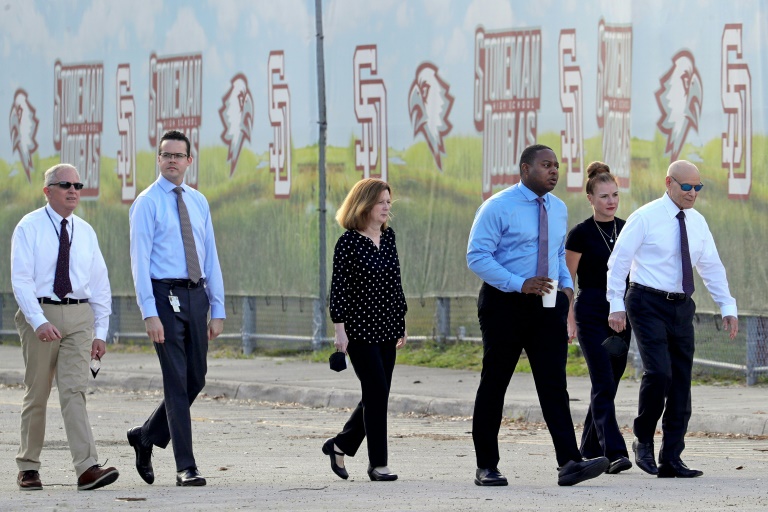
A jury deciding whether to impose the death penalty on the killer of 17 people at a Florida high school visited the still-bloodstained and bullet-scarred building on Thursday where the shooting occurred.

The 12 jurors and 10 alternates hearing the case against Nikolas Cruz, 23, spent just over 90 minutes inside Marjory Stoneman Douglas High School in Parkland, the South Florida Sun Sentinel and Miami Herald reported.

The visit by the jurors to the building, which has been kept intact by prosecutors as a crime scene, took place under high security.

A pool of journalists was allowed to tour the building afterwards but were barred from taking photographs.

The Miami Herald said dried blood stained the floor in one classroom where three students were shot dead.

In another room, desks were pockmarked with bullet holes and laptops, headphones and water bottles remained where they were left on Valentine’s Day 2018, the day of the shooting.

Cruz pleaded guilty in October to carrying out the shooting and the jury is deciding only whether he should be executed or receive life in prison.

Cruz waived his right to accompany the jury on the visit to the school where he took the lives of 14 students, an athletic director, a teacher and a coach.

Survivors of the shooting and parents of some of the victims have delivered days of wrenching testimony during the death penalty trial of Cruz, who had been expelled from the school for disciplinary reasons. 

The Florida shooting stunned a country accustomed to gun violence and sparked new efforts, led by students from the school itself who formed a group called “March for Our Lives,” to get lawmakers to pass tougher gun control laws.

Thousands turned out for demonstrations organized by the group in June following two other mass shootings: one at a Texas school that killed 19 children and two teachers, and another at a New York market that left 10 Black people dead.

Those shootings helped galvanize support for the first significant federal bill on gun safety in decades.

President Joe Biden signed the bill into law in June but it fell far short of steps he had called for, including a ban on assault weapons.

The Justice Department reached a $127.5 million settlement in March with survivors and relatives of Parkland victims who had accused the FBI of negligence for failing to act on tips received prior to the attack that Cruz was dangerous.

US declares monkeypox a public health emergency 

US President Joe Biden’s government on Thursday declared monkeypox a public health emergency, a move that should free up new funds, assist in data gathering and allow the deployment of additional personnel in the fight against the disease.

The move came as nationwide cases topped 6,600, around a quarter of them from New York state,  and experts warned swift action was needed if the outbreak is to be contained in its early stages.

“We’re prepared to take our response to the next level in addressing this virus, and we urge every American to take monkeypox seriously and to take responsibility to help us tackle this virus,” Health and Human Services secretary Xavier Becerra said in a call.

Observers believe the real number of cases could be much higher than official figures suggest, since symptoms in the current global outbreak, which began in May, have included subtle signs, such as single lesions, in addition to the more familiar widespread rashes.

This can lead to cases being missed or misdiagnosed as the presentation is similar to common sexually transmitted infections.

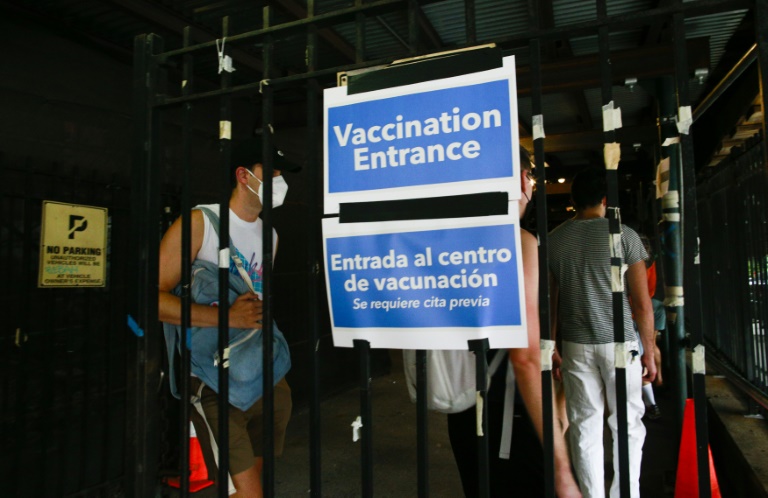
The US has so far delivered some 600,000 JYNNEOS vaccines — originally developed against monkeypox’s related virus, smallpox — but this number is still far short of the approximately 1.6 million people considered at highest risk and who need the vaccine most.

Supply chain constraints mean the country should receive its next shipment of 150,000 JYNNEOS vaccines — which was developed with US federal funding but is made by a small Danish company called Bavarian Nordic — only by September, said Dawn O’Connell, a senior HHS official.

– Sexual activity main driver –

Some 99 percent of US cases have so far been among men who have sex with men, HHS said last week, and this is the population authorities are targeting in the national vaccination strategy.

In contrast to previous outbreaks in Africa, the virus is now predominantly spread through sexual activity — but the Centers for Disease Control and Prevention says other routes are also possible, including sharing bedding, clothing, and prolonged face-to-face contact.

Authorities are carrying out specific outreach efforts to the MSM community, including advising them on new types of symptoms and suggesting reducing their number of sexual partners until vaccinated.

There are a small but rising number of women and children who have also been affected as a result of sexual or household contact.

Fortunately, there have been no reported US deaths, with all patients so far recovering. However, some have required hospitalization to treat extreme levels of pain.

Some 14,000 doses of an antiviral drug known as tecovirimat, or TPOXX by its trade name, have been delivered to treat the disease — but the drug was developed against smallpox and its efficacy against monkeypox isn’t yet fully understood.

The focus on MSMs has led to concerns of stigmatization. 

But writing in Medscape, University of California, San Francisco professor Monica Gandhi said the focus on the most affected population was helpful.

“Just like with HIV and COVID, it is important to define populations most at risk so we can prioritize targeted messaging and resources toward those groups,” she said.

– Five vaccines from one dose –

The US declaration comes after the World Health Organization also designated the outbreak an emergency last month — something it reserves for diseases of highest concern.

Also Thursday, US Food and Drug Administration commissioner Robert Califf said his agency was considering changing the way the vaccine is injected, adopting an approach that would allow five times as many people to be vaccinated based on the same supply.

The vaccine is currently administered underneath the skin, but the new technique would involve administering it within the skin, at a more shallow angle.

This “means basically sticking the needle within the skin and creating a little pocket there into which the vaccine goes, so this is really nothing highly unusual,” said Califf.

The US will first need to declare another type of emergency so the new vaccine administration method can be greenlighted, he added. ia

Russian court jails US basketball star for nine years over drug smuggling

A Russian court on Thursday sentenced US basketball star Brittney Griner to nine years in prison over drug smuggling as US President Joe Biden called the ruling “unacceptable”.

The court “found the defendant guilty” of smuggling and possessing “a significant amount of narcotics”, judge Anna Sotnikova told a court in the town of Khimki just outside Moscow.

Sotnikova sentenced Griner, one of the world’s greatest basketball players, to nine years in a Russian penal colony and said she would also have to pay a fine of one million rubles ($16,590).

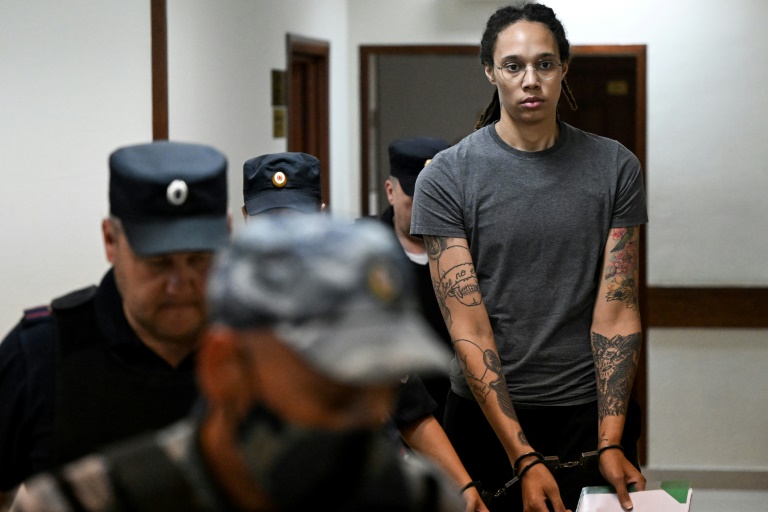
“I love my family,” Griner told journalists after the ruling as the six-foot-nine (2.06 metres) athlete was led away by members of Russia’s law enforcement. 

Her defence team told reporters the 31-year-old — known as BG to her friends and fans — was “very upset” and “very stressed”.

Biden immediately released a statement, calling the Russian court’s sentencing of Griner “unacceptable”.

“Russia is wrongfully detaining Brittney,” Biden said in the statement. 

“It’s unacceptable and I call on Russia to release her immediately so she can be with her wife, loved ones, friends and teammates.”

The US president reiterated that he would “work tirelessly and pursue every possible avenue” to repatriate Griner.

Griner’s trial accelerated in recent days as the United States and Russia discuss a potential prisoner swap that could involve the basketball star. 

The White House urged Russia later on Thursday to accept its offer of a deal for the release of Griner and former US Marine Paul Whelan, who was imprisoned on espionage charges.

“We have made a substantial offer to bring her and Paul Whelan home. We urge Russia to accept that proposal,” said White House spokeswoman Karine Jean-Pierre.

– ‘Honest mistake’ –

Griner was detained at a Moscow airport in February after she was found carrying vape cartridges with cannabis oil in her luggage. 

The arrest came just days before Moscow launched its military intervention in Ukraine.

Prosecutors had earlier requested the two-time Olympic basketball gold medallist and Women’s NBA champion be sentenced to nine and a half years in prison on drug smuggling charges.

Griner’s trial came with tensions soaring between Moscow and Washington over Russia’s military intervention in Ukraine that has sparked international condemnation and a litany of Western sanctions. 

“I made an honest mistake and I hope that your ruling doesn’t end my life here,” Griner said earlier on Thursday.

“I want the court to understand it was an honest mistake that I made while rushing, under stress, trying to recover from post-Covid and just trying to get back to my team.”  

Griner pleaded guilty to the charges, but said she did not intend to break the law or use the banned substance in Russia.

Her defence team said they were “very disappointed” by the verdict and would appeal.

“The court completely ignored all the evidence of the defence, and most importantly, the guilty plea,” lawyers Maria Blagovolina and Alexander Boykov said in a statement. 

“The verdict is absolutely unreasonable. We will certainly file an appeal.”

– ‘Bringing BG home’ –

Boykov told reporters the ruling was too harsh and many Russians usually get a suspended sentence for such a crime.

National Basketball Association and Women’s National Basketball Association leaders said the athlete’s sentence was “unjustified and unfortunate, but not unexpected”.

“The WNBA and NBA’s commitment to her safe return has not wavered and it is our hope that we are near the end of this process of finally bringing BG home to the United States,” WNBA commissioner Cathy Engelbert and NBA commissioner Adam Silver said in a joint statement.

Her WNBA team the Phoenix Mercury said it was “heartbroken” for Griner but remained “confident in the public servants working every day to return her to her family and us”.

“While we know it was never the legal process that was going to bring our friend home, today’s verdict is a sobering milestone in the 168-day nightmare being endured by our sister, BG,” the Mercury said in a statement.

Prosecutor Nikolay Vlasenko had said Griner “deliberately” proceeded through the green corridor at customs and stated she had nothing to declare “in order to conceal” the substance.

Standing inside a cage for defendants before the start of the hearing, Griner held up a photo of herself with teammates from the Russian club she plays for.

Griner was detained when she came to Russia to play club basketball with UMMC Ekaterinburg during the US off-season — a common path for American stars seeking additional income.

The WNBA star said she had permission from a US doctor to use medicinal cannabis to relieve pain from her many injuries.

– Another swap? –

US Secretary of State Antony Blinken said last week Washington had made a “substantial proposal” to Moscow to free Griner and Whelan.

A prisoner swap was discussed during a call between Blinken and Russian Foreign Minister Sergei Lavrov on Friday.

The highest-profile Russian prisoner in the United States is Victor Bout, a 55-year-old arms trafficker, dubbed the “Merchant of Death”, who is serving 25 years in jail. 

There is no official confirmation that Washington has offered to exchange him. 

Russia and the United States have already conducted one prisoner swap since the start of Moscow’s Ukraine offensive. 

In April, Washington exchanged former US Marine Trevor Reed for convicted drug smuggler Konstantin Yaroshenko.

bur-har/raz

Apple accused of mishandling sex misconduct complaints: report

 Over a dozen women accused Apple of mishandling sexual misconduct claims they lodged while working for the iPhone maker, according to a Financial Times report out Thursday. 

The 15 current and former employees of the Silicon Valley giant reported either being retaliated against or getting a disappointing or counterproductive response from the company.

Apple did not immediately reply to a request for comment, but told the newspaper it works hard to investigate misconduct complaints and added it would make changes to its training processes.

Sexual harassment or discrimination scandals have rocked Silicon Valley in the wake of the #MeToo movement, which spurred action over the tech industry’s male-dominated culture, attitudes and behavior.

One of the women cited in the story, Megan Mohr, was inspired by #metoo to report to Apple in 2018 that a male colleague had removed her shirt and bra and photographed her after a night out drinking together while Mohr briefly fell asleep.

After speaking with human resources about her claim, the company noted the worker’s conduct was potentially criminal but didn’t violate any policy in the context of his work at Apple, the story reported.

She quit her job in January, after 14 years at the firm, and is now asking the company to take a hard look at its policies, the report went on to say.

The women interviewed for the story make up a fraction of the some 165,000 people the firm employs globally.

Another woman cited in the story, Jayna Whitt, penned a blog post in which she said a romantic relationship with a fellow Apple attorney had gone bad and become dangerous.

She said the man was unstable, physically violent and emotionally abusive, but when Whitt told Apple, the firm advised her to call the police if she felt unsafe.

Her complaint to the company about the man’s behavior eventually resulted in her being reprimanded for allowing a personal relationship to interfere with her work, Whitt’s blog post says.

Apple is not the only big tech firm to face accusations about abuse or handling of misconduct claims, game studio Activision Blizzard and Elon Musk’s Tesla have both been roiled by lawsuits.

Six women sued Tesla in December, alleging a culture of sexual harassment at the electric carmaker’s California plant and other facilities that included unwanted touching, catcalls and retaliation for those who complained.

Judge says Kevin Spacey must pay $31 mn over 'House of Cards' axing

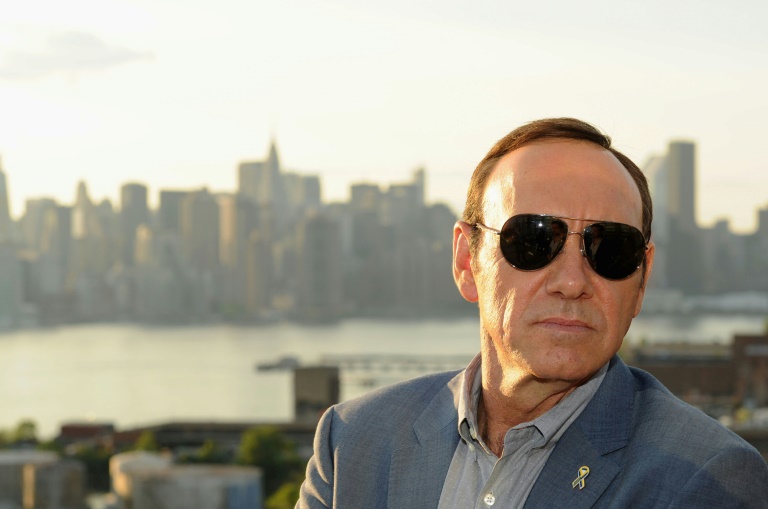
Hollywood movie star Kevin Spacey will have to pay $31 million to the production company that fired him from “House of Cards” after allegations of sexual harassment emerged, a judge ruled Thursday, dismissing his appeal against arbitration.

The ruling is the latest blow for a man once heralded as one of the finest actors of his generation, and comes weeks after he appeared in a British court charged with sexually assaulting three men.

MRC, the production company that made the popular Netflix tale of political intrigue, sought the damages after booting the star from the lead role, a move that forced them to reconfigure the show’s sixth season.

An arbitrator in 2020 ordered the “American Beauty” actor to compensate the company for losses and costs associated with the change.

Spacey’s lawyers had argued that the arbitrator exceeded the scope of his powers by considering certain evidence in deciding damages.

But Los Angeles Superior Court Judge Mel Red Recana confirmed the award of $29.5 million in damages and the remainder in costs and fees. 

The arbitrator had found that Spacey was in breach of his contract because of his alleged behavior, the judge said, noting that even if the matter was not so clear-cut, the arbitrator’s award would stand.

“Here, (Spacey) fails to demonstrate that this is even a close case,” Recana wrote in his 14-page ruling. 

Spacey has denied sexually harassing anyone.   

The wave of accusations that halted the 63-year-old’s illustrious career coincided with the rise of the #MeToo movement against abuse, sparked by the case of the all-powerful Hollywood producer Harvey Weinstein. 

Two-time Oscar winner Spacey had starred as unscrupulous US politician Frank Underwood in five seasons of “House of Cards” until the allegations of sexual harassment against co-workers were made public in the media.

MRC had to rewrite the script excluding Underwood, the main character of the series, and redesign the sixth season, chopping it from 13 to eight episodes. 

Two-time Oscar-winner Spacey last month pleaded not guilty at London’s Old Bailey court to four charges of sexual assault against three men, in cases dating back almost two decades.

Spacey had travelled from his home in the United States to appear voluntarily at the British court.

At an earlier hearing, lawyer Patrick Gibbs told the court his client “strenuously denies any and all criminality in this case.”

“He needs to answer these charges if he is to proceed with his life,” Gibbs added at the time.

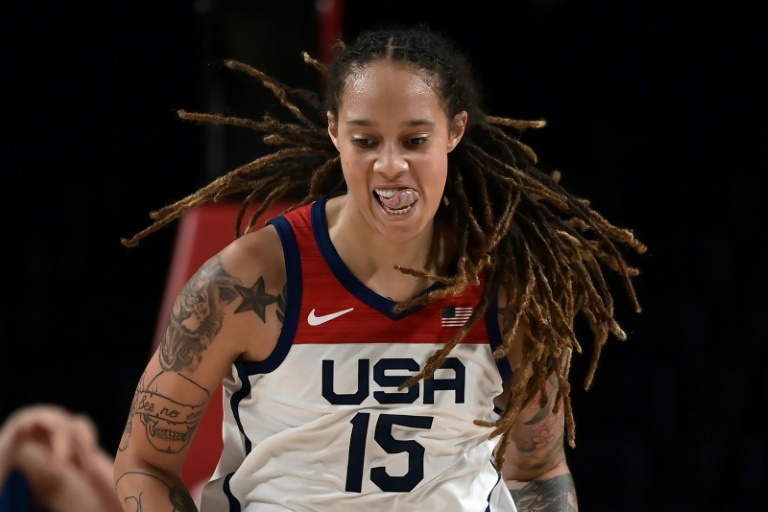
Brittney Griner, from basketball world great to Russian prisoner

Brittney Griner — a world basketball great, Olympic legend and LGBT trailblazer — now faces losing the greatest years of her career in a Russian penal colony.

The 31-year-old American was convicted Thursday by a Russian court on drugs charges and sentenced to nine years in prison, even as US officials declared she was being wrongfully detained and worked behind the scenes for her release.

Griner is among only 11 players to have won an Olympic gold medal, WNBA title, Women’s Basketball World Cup crown and US college championship.

She helped drive the US women’s national team to Olympic gold in 2016 at Rio and last year in Tokyo, giving the Americans seven consecutive Olympic crowns — matching the US men’s team from 1936-1968 for the longest title run of any team in any Olympic sport.

In February 2013, Griner came out publicly as a lesbian in an interview with Sports illustrated, becoming a sporting trailblazer.

Her endorsement deal with Nike was its first with an openly gay athlete.

Griner protested the killings of African Americans Breona Taylor and George Floyd during a nationwide wave of protests against racial injustice and police brutality in the United States in 2020, and suggested not playing the US anthem before games.

A champion at every level of basketball, she has played for years in Russia in the WNBA off-season for Ekaterinburg, a common path for American stars seeking additional income.

She won three Russian league crowns and four EuroLeague titles with the powerhouse club.

But she was detained at a Moscow airport in February after she was found carrying vape cartridges with cannabis oil in her luggage.

The WNBA star said she had permission from a US doctor to use medicinal cannabis to relieve pain from her many injuries. 

American women will seek a fourth consecutive Women’s World Cup crown later this year in Australia. Griner had been expected to be a key player on that squad, as she was on the 2014 and 2018 lineups.

The US women have not lost a game at the Olympics since 1992 and have not dropped a contest at the World Cup, the world championship tournament, since 2006.

– Record-setter –

The 6-foot-9 (2.06m) center was born in Houston and led Baylor University to the 2012 US college title. 

She set a record with 223 blocked shots in her 2009-10 freshman season, and finished with a record 748 blocks for her college career.

She was the first overall pick in the 2013 WNBA Draft by the Phoenix Mercury and helped the team win the 2014 WNBA crown. 

The eight-time WNBA All-Star center won scoring titles in 2017 and 2019, led the league in blocked shots in eight of her nine campaigns and was twice named the WNBA Defensive Player of the Year.

Griner averaged a WNBA-record 4.0 blocked shots a game in the 2015 season.

For her WNBA career, Griner has averaged 17.7 points, 7.6 rebounds, 2.8 blocked shots and 1.8 assists a game over 254 contests, all for the Mercury.

Griner married fellow WNBA player Glory Johnson in 2015 but later pleaded guilty to disorderly conduct charges and underwent domestic violence counseling.

Both Griner and Johnson were suspended seven games by the WNBA and the couple divorced in 2016.

Griner married Cherelle Watson in 2019.

Russian disinformation operation paid for pro-Ukraine war posts: Meta

A Russian outfit hired people off the street and paid them to post online comments intended to give the impression of grassroots support for Moscow’s invasion of Ukraine, Facebook owner Meta said Thursday.

The internet has been one of the fronts in the internationally condemned war, with Russia seeking to squelch criticism and promote narratives in support of the attack on its neighbor.

The deception campaign on Instagram, Facebook and other platforms was run by a “troll farm,” a disinformation operation that Meta said included people previously associated with a notorious Russian influence group.

“We’re not talking about a dedicated band of patriotic trolls,” Meta threat disruption director David Agranovich told AFP. “They were faking it, people were literally being hired off the street.”

The effort came to light after a reporter for Russian news outlet Fontanka infiltrated the operation by getting a job at its St. Petersburg office, drawing Meta’s attention.

Some of the people involved in the troll farm were previously associated with the Internet Research Agency (IRA), a Russian group that has been linked to election meddling in the United States and other countries since at least 2016, Meta said.

US authorities have offered a $10 million reward for information on election interference, and specifically is seeking details on IRA.

Meta took down the network days after Fontanka reported in April about the group, which had advertised jobs for “spammers, commenters, content analysts, designers and programmers”.

The “poorly” run operation bore similarities to efforts by the IRA some nine years ago in the way it hired just about anyone to help with online deception, Meta global threat intelligence lead Ben Nimmo told AFP.

“It’s like 2013 is calling and it wants its troll farm back,” Nimmo quipped. “It’s built on people slumping on bean bags, being paid to run fake accounts and make these posts across the internet.”

Meta’s investigation found trolls aimed comments at people’s content on Instagram, Facebook, TikTok, Twitter, YouTube, LinkedIn, VKontakte and Odnoklassniki.

Trolls apparently worked in shifts seven days per week, got daily lunch breaks and were paid about $440 a month, Meta said.

A twist, Nimmo noted, was that operators also ran a public Telegram channel urging people to leave pro-Russian comments on posts by politicians, influencers or celebrities such as Angelina Jolie or Morgan Freeman then had their trolls tend to the task.

Meta even found instances of some of the hired trolls undermining the deception effort by sprinkling pro-Ukraine comments in with their work, Agranovich said.

Meta said it took down 1,037 Instagram accounts and 45 Facebook accounts involved in the disinformation campaign.

Russian disinformation operation paid for pro-Ukraine war posts: Meta

A Russian outfit hired people off the street and paid them to post online comments intended to give the impression of grassroots support for Moscow’s invasion of Ukraine, Facebook owner Meta said Thursday.

The internet has been one of the fronts in the internationally condemned war, with Russia seeking to squelch criticism and promote narratives in support of the attack on its neighbor.

The deception campaign on Instagram, Facebook and other platforms was run by a “troll farm,” a disinformation operation that Meta said included people previously associated with a notorious Russian influence group.

“We’re not talking about a dedicated band of patriotic trolls,” Meta threat disruption director David Agranovich told AFP. “They were faking it, people were literally being hired off the street.”

The effort came to light after a reporter for Russian news outlet Fontanka infiltrated the operation by getting a job at its St. Petersburg office, drawing Meta’s attention.

Some of the people involved in the troll farm were previously associated with the Internet Research Agency (IRA), a Russian group that has been linked to election meddling in the United States and other countries since at least 2016, Meta said.

US authorities have offered a $10 million reward for information on election interference, and specifically is seeking details on IRA.

Meta took down the network days after Fontanka reported in April about the group, which had advertised jobs for “spammers, commenters, content analysts, designers and programmers”.

The “poorly” run operation bore similarities to efforts by the IRA some nine years ago in the way it hired just about anyone to help with online deception, Meta global threat intelligence lead Ben Nimmo told AFP.

“It’s like 2013 is calling and it wants its troll farm back,” Nimmo quipped. “It’s built on people slumping on bean bags, being paid to run fake accounts and make these posts across the internet.”

Meta’s investigation found trolls aimed comments at people’s content on Instagram, Facebook, TikTok, Twitter, YouTube, LinkedIn, VKontakte and Odnoklassniki.

Trolls apparently worked in shifts seven days per week, got daily lunch breaks and were paid about $440 a month, Meta said.

A twist, Nimmo noted, was that operators also ran a public Telegram channel urging people to leave pro-Russian comments on posts by politicians, influencers or celebrities such as Angelina Jolie or Morgan Freeman then had their trolls tend to the task.

Meta even found instances of some of the hired trolls undermining the deception effort by sprinkling pro-Ukraine comments in with their work, Agranovich said.

Meta said it took down 1,037 Instagram accounts and 45 Facebook accounts involved in the disinformation campaign.

Russian court jails US basketball star for nine years over drug smuggling

A Russian court on Thursday sentenced US basketball star Brittney Griner to nine years in prison over drug smuggling as US President Joe Biden called the ruling “unacceptable”.

The court “found the defendant guilty” of smuggling and possessing “a significant amount of narcotics”, judge Anna Sotnikova told a court in the town of Khimki just outside Moscow.  

Sotnikova sentenced Griner, one of the world’s greatest basketball players, to nine years in a Russian penal colony and said she would also have to pay a fine of one million rubles ($16,590).

“I love my family,” Griner told journalists after the ruling as the six-foot-nine (2.06 metres) athlete was led away by members of Russia’s law enforcement. 

Her defence team told reporters the 31-year-old — known as BG to her friends and fans — was “very upset” and “very stressed”.

Biden immediately released a statement, calling the Russian court’s sentencing of Griner “unacceptable”.

“Russia is wrongfully detaining Brittney,” Biden said in the statement. 

“It’s unacceptable and I call on Russia to release her immediately so she can be with her wife, loved ones, friends and teammates.”

The US president reiterated that he would “work tirelessly and pursue every possible avenue” to repatriate Griner.

Her trial accelerated in recent days as the United States and Russia discuss a potential prisoner swap that could involve the basketball star. 

The athlete was detained at a Moscow airport in February after she was found carrying vape cartridges with cannabis oil in her luggage. 

The arrest came just days before Moscow launched its military intervention in Ukraine.

– ‘Honest mistake’ –

Prosecutors had earlier requested the two-time Olympic basketball gold medallist and Women’s NBA champion be sentenced to nine and a half years in prison on drug smuggling charges.

Griner’s trial came with tensions soaring between Moscow and Washington over Russia’s military intervention in Ukraine that has sparked international condemnation and a litany of Western sanctions. 

“I made an honest mistake and I hope that your ruling doesn’t end my life here,” Griner said earlier on Thursday.

“I want the court to understand it was an honest mistake that I made while rushing, under stress, trying to recover from post-Covid and just trying to get back to my team.”  

Griner pleaded guilty to the charges, but said she did not intend to break the law or use the banned substance in Russia.

Her defence team said they were “very disappointed” by the verdict and would appeal.

“The court completely ignored all the evidence of the defence, and most importantly, the guilty plea,” lawyers Maria Blagovolina and Alexander Boykov said in a statement. 

“The verdict is absolutely unreasonable. We will certainly file an appeal.”

– ‘Bringing BG home’ –

Boykov told reporters that the ruling was too harsh and many Russians usually get a suspended sentence for such a crime.

National Basketball Association (NBA) and Women’s National Basketball Association (WNBA) leaders said the athlete’s sentence was “unjustified and unfortunate, but not unexpected”.

“The WNBA and NBA’s commitment to her safe return has not wavered and it is our hope that we are near the end of this process of finally bringing BG home to the United States,” WNBA commissioner Cathy Engelbert and NBA commissioner Adam Silver said in a joint statement.

Prosecutor Nikolay Vlasenko had requested a prison sentence of nine years and six months for Griner, requesting a term just short of the maximum punishment of 10 years.

Vlasenko said Griner “deliberately” proceeded through the green corridor at customs and stated she had nothing to declare “in order to conceal” the substance.

Standing inside a cage for defendants before the start of the hearing, Griner held up a photo of herself with teammates from the Russian club she plays for. 

Griner was detained when she came to Russia to play club basketball with UMMC Ekaterinburg during the US off-season — a common path for American stars seeking additional income.

The WNBA star said she had permission from a US doctor to use medicinal cannabis to relieve pain from her many injuries.

US Secretary of State Antony Blinken said last week that Washington had made a “substantial proposal” to Moscow to free Griner and former US Marine Paul Whelan, who was imprisoned on espionage charges.

A prisoner swap was also discussed during a call between Blinken and Russian Foreign Minister Sergei Lavrov on Friday.

The highest-profile Russian prisoner in the United States is Victor Bout, a 55-year-old arms trafficker, dubbed the “Merchant of Death”, who is serving 25 years in jail. 

There is no official confirmation that Washington has offered to exchange him. 

Russia and the United States have already conducted one prisoner swap since the start of Moscow’s Ukraine offensive. 

In April, Washington exchanged former US Marine Trevor Reed for convicted drug smuggler Konstantin Yaroshenko.

'Indescribable': the heat and roar of Iceland's volcano

The ground rumbles underfoot, then roars as red-orange lava fountains shoot up from the ground, the intense heat cloaking the nearby crowd awestruck by Iceland’s latest volcanic eruption.

“It’s indescribable”, says 40-year-old French tourist Magalie Viannisset, one of the curious onlookers gazing in wonder on Thursday at the fissure that opened up a day earlier in an uninhabited valley just 40 kilometres (25 miles) from Iceland’s capital Reykjavik.

“You feel it in your heart. Imagining it or seeing it on TV is nothing compared to seeing it in real life — there is heat, smells, the sound of the lava flowing”, she tells AFP. 

As the lava fountains hit the ground, a blanket of magma reaching temperatures of 1,200 degrees Celsius (2,192 degrees Fahrenheit) spreads into the valley, plumes of smoke giving off an odour of rotten eggs from the sulphur.

Occasionally, helicopters whirring overhead interrupt the roar of the lava.

Some intrepid visitors walk right up to the cooling magma, including scientists measuring its thickness and taking samples to study in their labs. 

Others, both locals and tourists overjoyed at being in the right place at the right time, keep a safer distance, taking in the dramatic views from nearby hilltops.

“It’s absolutely stunning,” says Theo, a 14-year-old Norwegian visiting with his family. 

The Icelandic Meteorological Office has estimated the fissure is around 360 metres long, with lava fountains about 10-15 metres high.

The lava covers an area of about 74,000 square metres, it said.

– ‘Feel Earth’s power’ –

Visitors must make a strenuous trek to reach the site on the Reykjanes peninsula, around two hours from the nearest car park.

Walking along the trail, people can be heard speaking English, French, Spanish, Italian, and of course Icelandic.  

The winding trail runs near the lava fields created last year by the nearby Mount Fagradalsfjall eruption, which spewed up molten rock for six months.

Like scars, cracks in the ground along the trail serve as reminders of the seismic activity that has been stirring underfoot in the region for the past year and a half.

Known as the land of fire and ice, Iceland has 32 volcanic systems currently considered active, the highest number in Europe. The country has had an eruption every five years on average.

However, until last year, the Reykjanes peninsula had not experienced one since the 13th century, when a volcano erupted for 30 years from 1210-1240.

Geophysicists have said the 2021 eruption could signal the beginning of a new period of eruptions lasting centuries. For now, the craters it left behind remain silent.

As the trail approaches the Meradalir Valleys (the Valleys of the Mares), the latest eruption comes into view, enthralling trekkers with nature’s raw force.

“You feel the power of the Earth. You look at the stone and you see it melting, it is not a usual thing”, marvels Agusta Jonsdottir, a 52-year-old Icelandic woman.

Icelanders never seem to tire of watching volcanoes.

“We came early and we were sitting in the moss, watching and enjoying for a couple of hours. And it was so calm”, says Audur Kristin Ebenezersdottir, 53.

“Just you and the nature — it’s very nice.”

str/po/jll/lcm

Close Bitnami banner
Bitnami