AFP

Markets drop over China-US tensions

Asian and European stock markets fell Tuesday as investors dumped risky equities on spiking US-China tensions over a possible visit by House Speaker Nancy Pelosi to Taiwan.

“Tensions ramped up on reports that Pelosi is due to visit Taiwan later this evening,” noted CMC Markets analyst Michael Hewson.

Traders were already skittish after a string of data showed economies beginning to take a hit from surging inflation and central bank interest rate hikes aimed at taming prices.

A possible meeting between Pelosi and Taiwanese President Tsai Ing-wen is sure to anger Beijing, which views the island as its territory and has said the White House was playing “with fire”.

While observers do not think the move will spark a conflict, US officials said China was preparing possible military provocations that could include firing missiles in the Taiwan Strait or “large-scale” incursions into Taiwan’s airspace.

Heightened tensions between the world’s two superpowers have sent shivers through trading floors, compounding worries that Russia’s invasion of Ukraine could escalate into a wider war.

– Investors ‘very nervous’ –

“We’re seeing more risk aversion as Nancy Pelosi’s trip to Taiwan generates numerous unsettling headlines at a time of strained ties between the US and China,” said OANDA analyst Craig Erlam.

“Pelosi’s proposed visit has been met with numerous threats from Beijing including an unspecified military response.

“They have continued this morning, hours ahead of the apparent arrival which is clearly making investors very nervous.”

Reports of the visit hit US stocks, with all three main indexes reversing an early rally to end in negative territory.

And Asia followed suit, though some markets recovered as the day wore on.

Hong Kong and Shanghai led losses, shedding more than two percent, while Taipei was off more than one percent along with Tokyo.

In Europe, Frankfurt fell 0.8 percent and Paris shed 0.6 percent, while London dipped just 0.2 percent with losses tempered partly by news of oil giant BP’s soaring profits.

The safe-haven yen jumped to a two-month high against the dollar.

The Taiwan dollar meanwhile sank to its lowest since April 2020 before bouncing back.

The flare-up in tensions comes less than a week after US President Joe Biden and Xi Jinping held phone talks during which the Chinese leader warned the United States not to “play with fire”.

The market selloff comes as investors try to assess the outlook for the global economy as leaders try to bring down sky-high inflation by lifting rates while at the same time maintaining growth.

Oil prices extended Monday’s steep losses that were fuelled by falling demand expectations.

– Key figures at around 1000 GMT –

London – FTSE 100: DOWN 0.2 percent at 7,401.35 points

Frankfurt – DAX: DOWN 0.8 percent at 13,377.70

Paris – CAC 40: DOWN 0.6 at 6,398.54

EURO STOXX 50: DOWN 0.7 percent at 3,680.56

Tokyo – Nikkei 225: DOWN 1.4 percent at 27,594.73 (close)

Hong Kong – Hang Seng Index: DOWN 2.4 percent at 19,689.21 (close)

Shanghai – Composite: DOWN 2.3 percent at 3,186.27 (close)

Taipei – TAIEX: DOWN 1.6 percent at 14,747.23 (close)

New York – Dow: DOWN 0.1 percent at 32,798.40 (close)

Dollar/yen: DOWN at 130.88 yen from 131.61 yen Monday

Euro/dollar: DOWN at $1.0234 from $1.0262

Pound/dollar: DOWN at $1.2214 from $1.2255

Euro/pound: UP at 83.80 pence from 83.70 pence

Brent North Sea crude: DOWN 1.1 percent at $98.98 per barrel

West Texas Intermediate: DOWN 0.5 percent at $93.40 per barrel

burs/rfj/lth
Two dead in California's largest wildfire this year

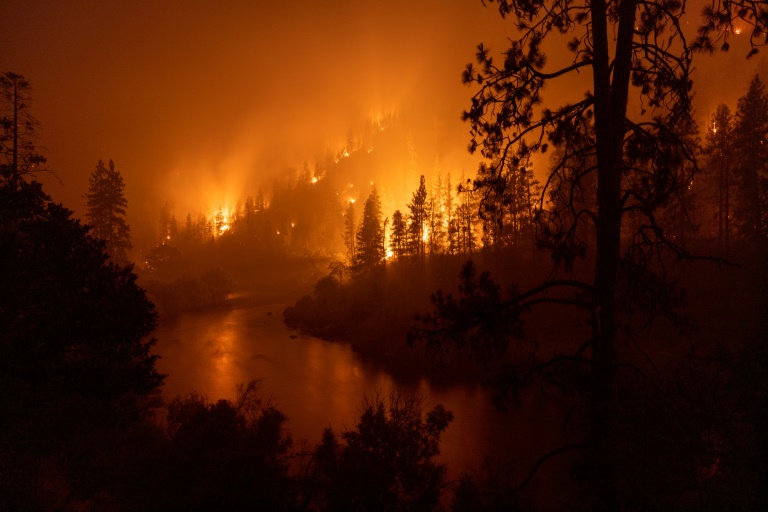
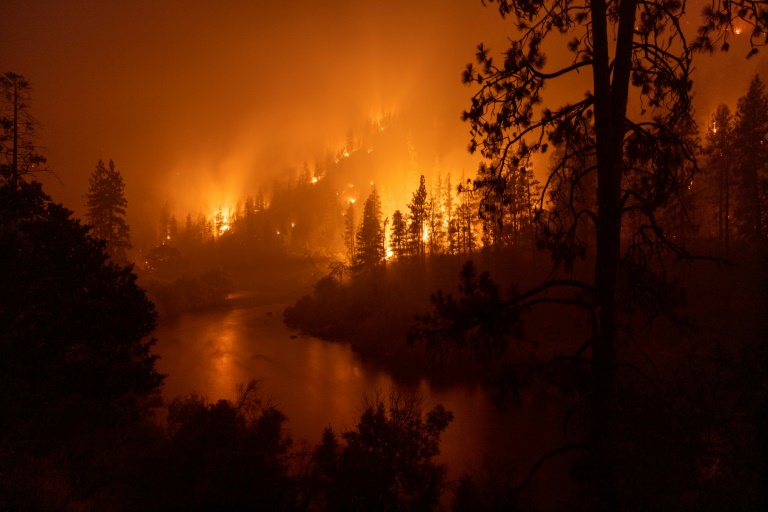
Firefighters faced “extremely dangerous” conditions Monday as they battled to save a community of 8,000 residents, with lightning strikes threatening to worsen a blaze that has already killed at least two people and become California’s biggest fire of the year.

Hundreds of personnel were involved in the fight against the fast-moving McKinney Fire, which has torn through more than 55,000 acres (22,000 hectares) near the border with Oregon, forcing thousands from their homes.

The National Weather Service meanwhile issued a warning because of the threat of dry lightning — powerful electrical strikes that come without any of the desperately needed rain.

“These conditions can be extremely dangerous for firefighters, as winds can be erratic and extremely strong, causing fire to spread in any direction,” said CalFire, an interagency website that collates fire information.

California, along with much of the western United States, is in the grip of its worst drought in more than 1,000 years.

The drought, exacerbated by man-made climate change, has left the countryside parched and exceedingly vulnerable to the wildfires that naturally break out, making the blazes hotter, faster and more destructive.

The McKinney Fire on Sunday claimed its first human lives, with the Siskiyou County Sheriff’s Office saying firefighters found two people dead inside a burned-out car in the driveway of a home in the town of Klamath River.

Sheriff Jeremiah LaRue said the pair were likely caught in the swift-moving blaze as they tried to flee.

California Governor Gavin Newsom has declared a state of emergency in Siskiyou County, and more than 2,000 residents of the rural area are under evacuation orders.

“I’m holding out trying not to leave too soon because I’m helping out my mom. She’s not in the best physical health to get around,” Rafael Franco, a resident who is in the mandatory evacuation area, told AFP.

“At the last minute if I see the fire cross the ridge where we are, we are going to head out and grab what we can and get going and hope for the best.”

Marjie Lawrence, who fled Klamath River on Friday night, said she went back to retrieve some belongings in case the fire spread to her home. 

“We are taking stuff in case the house goes, we are taking things we want, but not too many,” she said.

– Complicated firefight –

A heat wave with temperatures of over 100 degrees Fahrenheit (38 degrees Celsius), tinder-dry terrain and thunderstorms packing strong winds are complicating the efforts of firefighters battling the blaze.

“Fire growth is expected to spread in all directions,” the Klamath National Forest service said in a statement. 

“Warning for thunderstorms and lightning. Gusty outflow winds of 30 to 50 mph (50 to 80 kph) will be possible near thunderstorm cells.”

According to the Siskiyou County Sheriff’s Office, the fire has destroyed more than 100 structures — including homes, a grocery store and a community center — in the area surrounding Yreka, though it has not yet encroached upon the town of about 7,800 people.

“Surrounding areas should be ready to leave if needed. Please don’t hesitate to evacuate,” the county sheriff tweeted.

The McKinney fire is California’s largest wildfire so far this year — though it remains much smaller than last year’s Dixie Fire, which burned nearly one million acres.

– Animal rescue –

An AFP journalist working in the fire area captured a photograph of a kitten with singed whiskers cowering in between rocks in the Klamath National Forest.

As the picture ricocheted around the internet, users asked for updates, with one seemingly offering to look after the animal.

“Do you know if this kitten has been cared for and adopted at this point?” tweeted @bobbiescat.

Another journalist shared footage of a young puppy gratefully lapping at a bowl of water after emerging from the ashen ruins of a home in Klamath River.

Rescue Ranch Yreka, which took in the stricken pup, said it had received nearly 140 dogs in less than two days, and appealed for donations to help feed and care for them.

The fast-spreading blaze comes just days after the Oak Fire near Yosemite National Park destroyed dozens of buildings and forced thousands to evacuate.

California still has months of fire season ahead of it.

Other parts of the world have also faced intense wildfires this year, as scientists say climate change is making heatwaves more frequent and more intense, increasing the risk of fires.

Two dead in California's largest wildfire this year

Firefighters faced “extremely dangerous” conditions Monday as they battled to save a community of 8,000 residents, with lightning strikes threatening to worsen a blaze that has already killed at least two people and become California’s biggest fire of the year.

Hundreds of personnel were involved in the fight against the fast-moving McKinney Fire, which has torn through more than 55,000 acres (22,000 hectares) near the border with Oregon, forcing thousands from their homes.

The National Weather Service meanwhile issued a warning because of the threat of dry lightning — powerful electrical strikes that come without any of the desperately needed rain.

“These conditions can be extremely dangerous for firefighters, as winds can be erratic and extremely strong, causing fire to spread in any direction,” said CalFire, an interagency website that collates fire information.

California, along with much of the western United States, is in the grip of its worst drought in more than 1,000 years.

The drought, exacerbated by man-made climate change, has left the countryside parched and exceedingly vulnerable to the wildfires that naturally break out, making the blazes hotter, faster and more destructive.

The McKinney Fire on Sunday claimed its first human lives, with the Siskiyou County Sheriff’s Office saying firefighters found two people dead inside a burned-out car in the driveway of a home in the town of Klamath River.

Sheriff Jeremiah LaRue said the pair were likely caught in the swift-moving blaze as they tried to flee.

California Governor Gavin Newsom has declared a state of emergency in Siskiyou County, and more than 2,000 residents of the rural area are under evacuation orders.

“I’m holding out trying not to leave too soon because I’m helping out my mom. She’s not in the best physical health to get around,” Rafael Franco, a resident who is in the mandatory evacuation area, told AFP.

“At the last minute if I see the fire cross the ridge where we are, we are going to head out and grab what we can and get going and hope for the best.”

Marjie Lawrence, who fled Klamath River on Friday night, said she went back to retrieve some belongings in case the fire spread to her home. 

“We are taking stuff in case the house goes, we are taking things we want, but not too many,” she said.

– Complicated firefight –

A heat wave with temperatures of over 100 degrees Fahrenheit (38 degrees Celsius), tinder-dry terrain and thunderstorms packing strong winds are complicating the efforts of firefighters battling the blaze.

“Fire growth is expected to spread in all directions,” the Klamath National Forest service said in a statement. 

“Warning for thunderstorms and lightning. Gusty outflow winds of 30 to 50 mph (50 to 80 kph) will be possible near thunderstorm cells.”

According to the Siskiyou County Sheriff’s Office, the fire has destroyed more than 100 structures — including homes, a grocery store and a community center — in the area surrounding Yreka, though it has not yet encroached upon the town of about 7,800 people.

“Surrounding areas should be ready to leave if needed. Please don’t hesitate to evacuate,” the county sheriff tweeted.

The McKinney fire is California’s largest wildfire so far this year — though it remains much smaller than last year’s Dixie Fire, which burned nearly one million acres.

– Animal rescue –

An AFP journalist working in the fire area captured a photograph of a kitten with singed whiskers cowering in between rocks in the Klamath National Forest.

As the picture ricocheted around the internet, users asked for updates, with one seemingly offering to look after the animal.

“Do you know if this kitten has been cared for and adopted at this point?” tweeted @bobbiescat.

Another journalist shared footage of a young puppy gratefully lapping at a bowl of water after emerging from the ashen ruins of a home in Klamath River.

Rescue Ranch Yreka, which took in the stricken pup, said it had received nearly 140 dogs in less than two days, and appealed for donations to help feed and care for them.

The fast-spreading blaze comes just days after the Oak Fire near Yosemite National Park destroyed dozens of buildings and forced thousands to evacuate.

California still has months of fire season ahead of it.

Other parts of the world have also faced intense wildfires this year, as scientists say climate change is making heatwaves more frequent and more intense, increasing the risk of fires.

Hong Kong bans eating at annual food expo

Visitors to Hong Kong’s annual exhibition of global gourmet food will once again not be allowed to sample the delicacies due to coronavirus curbs, the organiser said Tuesday.

Tens of thousands of visitors and hundreds of exhibitors are expected at the five-day Food Expo starting next Thursday in the city’s Convention and Exhibition Centre.

But for the second year in a row, there will not be any tasting areas and all attendees must keep their masks on due to public health restrictions, according to Sophia Chong, acting CEO of the expo organiser, the Trade Development Council.

“We understand that visitors would like to taste the samples,” Chong said.

“We hope we can resume this arrangement after the pandemic, when it’s safe and hygienic to do it.” 

The decision was announced a day after the government said fans at November’s Hong Kong Sevens will be allowed to drink but not eat in the stands, with masks having to be worn between sips. 

Chong said they were not concerned by the measures’ impacts on the exhibition as it would be the second year of the tasting ban. 

“The number of exhibitors participating in this year’s Food Expo actually exceeded that of last year,” Chong said. 

A new round of HK$2,000 ($255) consumption vouchers will be distributed to most of the 7.5 million Hong Kong residents from Sunday, which is expected by the expo organiser to boost visitors’ appetites for shopping. 

Hong Kong has been strictly adhering to China’s zero-Covid policy, enforcing some of the world’s most severe restrictions for more than two years, including mandatory quarantine for overseas arrivals and a ban on group gatherings of more than four people in public places. 

In recent weeks, the city has been recording 3-4,000 daily infections, prompting fears of a resurgence after more than 1.2 million residents fell sick and 9,300 died in the first four months of this year.  

BP profit triples to $9.3 bn on soaring energy prices

British oil giant BP rebounded to second-quarter profit on soaring energy prices, it said Tuesday, after a big loss linked to its Russia exit following Moscow’s invasion of Ukraine.

Net profit hit $9.3 billion in the three months to June — a threefold increase from the same period last year, the company said in a results statement.

And it contrasted sharply with a $20.4-billion loss after tax in the first quarter, when it took a vast writedown after its decision to leave Russia.

BP is the latest energy major to post bumper second-quarter earnings as oil and gas prices have surged in the wake of key producer Russia’s invasion of Ukraine.

Prices also spiked after countries lifted Covid pandemic lockdowns, spurring global energy demand. 

British rival Shell revealed last week a fivefold surge in net profit to $18 billion while France’s TotalEnergies raked in nearly $6 billion.

US majors ExxonMobil and Chevron last week logged record profits for the same period.

Turning to the third-quarter outlook, BP forecast Tuesday that oil prices will “remain elevated … due to ongoing disruption to Russian supply, reduced levels of spare capacity and with inventory levels significantly below the five-year average”.

It warned gas prices will also remain “elevated and volatile” as Russia also squeezes European supplies in retaliation for Western sanctions over the assault on Ukraine.

The gas outlook was “heavily dependent on Russian pipeline flows or other supply disruptions”, BP added.

The group’s share price jumped about four percent in London trade, as investors welcomed news of a dividend hike and a $3.5-billion stock buyback.

Revenues were catapulted 86 percent to almost $68 billion from a year earlier.

– Windfall tax pleas –

At the same time, BP posted a net loss of $11.1 billion for the first half of 2022.

That was sparked by a colossal first-quarter charge of $24.4 billion, linked to a decision to exit its 19.75-percent stake in Russian energy group Rosneft as well as its other activities in the country.

That wiped out the overall benefit of high energy prices in the first half.

Gas prices, which skyrocketed in March after Russia launched its invasion of neighbouring Ukraine, surged last week after Moscow curbed crucial deliveries to Europe.

The market remains at its highest level since March after state-run Gazprom suspended gas deliveries to Latvia on Saturday.

Back in Britain, the government in May proposed a temporary windfall tax on BP and its UK rivals including Shell to help ease a cost-of-living crisis.

The proceeds will help to fund a multi-billion-pound support package for consumers hit by surging domestic electricity and gas bills.

UK annual inflation hit a new 40-year high of 9.4 percent in June.

Rocketing Chevron and ExxonMobil earnings also prompted calls for a windfall profits tax on the sector in the United States, which faces the highest inflation in four decades as well.

A similar plea was made by left-wing politicians in France after TotalEnergies published its second-quarter earnings, but President Emmanuel Macron’s government has opposed such a move.

Britain-based campaigners slammed BP on Tuesday over its latest results.

“While households are being plunged into poverty with knock-on-impacts  for the whole economy, fossil fuel companies are laughing all the way to the bank,” said Doug Parr, chief scientist at green campaign group Greenpeace UK.

Markets drop as talk of Pelosi Taiwan trip fans China-US tension

Asian markets mostly fell Tuesday on geopolitical fears after reports that House Speaker Nancy Pelosi would visit Taiwan fanned China-US tensions.

Traders were already skittish after a string of data showed economies beginning to take a hit from surging inflation and central bank interest rate hikes aimed at taming prices.

A possible meeting between Pelosi and Taiwanese President Tsai Ing-wen is sure to anger Beijing, which views the island as its territory and has said the White House was playing “with fire”.

While observers do not think the move will spark a conflict, US officials said China was preparing possible military provocations that could include firing missiles in the Taiwan Strait or “large-scale” incursions into Taiwan’s airspace.

White House National Security Council spokesman John Kirby told reporters there was “no reason for Beijing to turn a potential visit consistent with longstanding US policies into some sort of crisis”.

Still, the spike in tensions between the world’s two superpowers has sent shivers through trading floors, compounding worries that Russia’s invasion of Ukraine could escalate into a wider war.

Reports of the visit hit US stocks, with all three main indexes reversing an early rally to end in negative territory.

And Asia followed suit, though some markets recovered as the day wore on.

Hong Kong and Shanghai led losses, shedding more than two percent, while Taipei was off more than one percent along with Tokyo.

Seoul, Singapore, Mumbai, Bangkok and Jakarta were also well down, though Sydney, Wellington and Manila saw gains.

London was flat in the morning while Paris and Frankfurt fell.

The safe-haven yen jumped to a two-month high against the dollar, and the Taiwan dollar dropped 0.7 percent.

“Risk is mounting,” said Stephen Innes of SPI Asset Management.

“As Pelosi is almost sure to visit Taiwan on Tuesday, now it is in China’s hands to see if the situation escalates,” he said, adding that while “it could be little more than a tempest in a teapot still, international and Taiwan investors are pretty concerned”.

“No party wants a real war, but the risk of mishap or even aggressive war game escalation is real, which could always lead to a tactical mistake.”

The flare-up in tensions comes less than a week after US President Joe Biden and Xi Jinping held phone talks during which the Chinese president warned the United States not to “play with fire”.

However, Ayako Yoshioka, at Wealth Enhancement Group, told Bloomberg Radio the crisis may be another “short-term dislocation” for investors but “it’s always concerning when they do happen”.

The selling on markets comes as investors try to assess the outlook for the global economy as leaders try to bring down inflation by lifting rates while at the same time maintaining growth.

Data this week showed the US economy was in a technical recession, China was being battered by Covid lockdowns and Europe was on the brink of an energy crisis caused by the Ukraine war compounded by its own inflation problems.

Traders will be keeping a close eye Friday on the release of US jobs data, which will give fresh insight into the state of the economy, with a weak reading providing the Fed some room to ease back on its rate hikes.

Oil markets were mixed after Monday’s steep losses that were fuelled by falling demand expectations as economies slow. 

– Key figures at around 0810 GMT –

Tokyo – Nikkei 225: DOWN 1.4 percent at 27,594.73 (close)

Hong Kong – Hang Seng Index: DOWN 2.4 percent at 19,689.21 (close)

Shanghai – Composite: DOWN 2.3 percent at 3,186.27 (close)

Taipei – TAIEX: DOWN 1.6 percent at 14,747.23 (close)

London – FTSE 100: FLAT at 7,414.66

Dollar/yen: DOWN at 130.90 yen from 131.61 yen Monday

Euro/dollar: DOWN at $1.0224 from $1.0262

Pound/dollar: DOWN at $1.2200 from $1.2255 

Euro/pound: UP at 83.81 pence from 83.70 pence

West Texas Intermediate: UP 0.3 percent at $94.15 per barrel

Brent North Sea crude: DOWN 0.1 percent at $99.93 per barrel

New York – Dow: DOWN 0.1 percent at 32,798.40 (close)

Kansas votes on abortion rights in US test case

Voters in the Midwestern state of Kansas head to the polls Tuesday in the first major ballot on abortion since the US Supreme Court ended the national right to the procedure in June.

The vote is heavy with consequences for Kansans themselves, who will decide whether to remove the right to an abortion from the traditionally conservative state’s constitution.

But it is also being seen as a test case for abortion rights nationwide, as Republican-dominated legislatures rush to impose strict bans on the procedure following the Supreme Court’s decision to overturn Roe v. Wade.

Other states including California and Kentucky are set to vote on the issue in November, at the same time as midterm elections to Congress in which both Republicans and Democrats hope to mobilize their supporters nationwide around the question of abortion.

The Kansas ballot centers on a 2019 ruling by the state’s supreme court that guarantees access to abortion — currently up to 22 weeks. 

In response, the Republican-dominated state legislature introduced an amendment known as “Value Them Both” that would scrap the constitutional right — with the stated aim of handing regulation of the procedure back to lawmakers.

But in the opposing camp, activists see the campaign as a barely-masked bid to clear the way for an outright ban — a conservative state legislator having already introduced a bill that would ban abortion without exceptions for rape, incest, or the life of the mother. 

For Ashley All, spokeswoman for pro-abortion rights campaign Kansans for Constitutional Freedom, the amendment would deal a blow to “personal autonomy.”

Activists also complain that the phrasing of the ballot question is counterintuitive, and potentially confusing: voting “Yes” to the amendment means abortion rights being curbed, while people who wish to keep those rights intact must vote “No.” 

– All eyes on Kansas –

Abortion rights advocates in Kansas are looking nervously to neighboring Oklahoma and Missouri which are among at least eight states to have passed near-total bans — the latter making no exceptions for rape or incest — while Midwestern Indiana adopted its own rigid ban on Saturday.

Kara Miller Karns, a voter in Leawood, Kansas, said she planned to vote for the status quo on Tuesday, saying it was “not acceptable” for her daughters to grow up with fewer rights than she did. 

But in the same neighborhood, 43-year-old Christine Vasquez said she planned to back the constitutional amendment — in hope it would clear the way for a future vote on an abortion ban.

“I believe that life starts at conception,” she told AFP ahead of the ballot.

The outcome in Kansas could mean a boost or a blow to either side of the highly charged US abortion debate — and the eyes of the nation will be fixed on the state on Tuesday.

Kansas leans heavily toward the Republican party, which favors stricter abortion regulations, but a 2021 survey from Fort Hays State University found that fewer than 20 percent of Kansas respondents agreed that abortion should be illegal even in cases of rape or incest.

Two dead in California's largest wildfire this year

Firefighters faced “extremely dangerous” conditions Monday as they battled to save a community of 8,000 residents, with lightning strikes threatening to worsen a blaze that has already killed at least two people and become California’s biggest fire of the year.

Hundreds of personnel were involved in the fight against the fast-moving McKinney Fire, which has torn through more than 55,000 acres (22,000 hectares) near the border with Oregon, forcing thousands from their homes.

The National Weather Service meanwhile issued a warning because of the threat of dry lightning — powerful electrical strikes that come without any of the desperately needed rain.

“These conditions can be extremely dangerous for firefighters, as winds can be erratic and extremely strong, causing fire to spread in any direction,” said CalFire, an interagency website that collates fire information.

California, along with much of the western United States, is in the grip of its worst drought in more than 1,000 years.

The drought, exacerbated by man-made climate change, has left the countryside parched and exceedingly vulnerable to the wildfires that naturally break out, making the blazes hotter, faster and more destructive.

The McKinney Fire on Sunday claimed its first human lives, with the Siskiyou County Sheriff’s Office saying firefighters found two people dead inside a burned-out car in the driveway of a home in the town of Klamath River.

Sheriff Jeremiah LaRue said the pair were likely caught in the swift-moving fire as they tried to flee.

California Governor Gavin Newsom has declared a state of emergency in Siskiyou County, and more than 2,000 residents of the rural area are under evacuation orders.

A heat wave with temperatures of over 100 degrees Fahrenheit (38 degrees Celsius), tinder dry terrain and thunderstorms packing strong winds are complicating the efforts of firefighters battling the blaze.

“Fire growth is expected to spread in all directions,” the Klamath National Forest service said in a statement. “Warning for thunderstorms and lightning. Gusty outflow winds of 30 to 50 mph (50 to 80 kph) will be possible near thunderstorm cells.”

According to the Siskiyou County Sheriff’s Office, the fire has destroyed more than 100 structures — including homes, a grocery store and a community center — in the area surrounding Yreka, though it has not yet encroached upon the town of about 7,800 people.

“Surrounding areas should be ready to leave if needed. Please don’t hesitate to evacuate,” the county sheriff tweeted.

The McKinney fire is California’s largest wildfire so far this year — though it remains much smaller than last year’s Dixie Fire, which burned nearly one million acres.

– Animal rescue –

An AFP journalist working in the fire area captured a photograph of a kitten with singed whiskers cowering in between rocks in the Klamath National Forest.

As the picture ricocheted around the internet, users asked for updates, with one seemingly offering to look after the animal.

“Do you know if this kitten has been cared for and adopted at this point?” tweeted @bobbiescat

Another journalist shared footage of a young puppy gratefully lapping at a bowl of water after emerging from the ashen ruins of a home in Klamath River.

Rescue Ranch Yreka, which took in the stricken pup, said it had received nearly 140 dogs in less than two days, and appealed for donations to help feed and care for them.

The fast-spreading blaze comes just days after the Oak Fire near Yosemite National Park destroyed dozens of buildings and forced thousands to evacuate.

California still has months of fire season ahead of it.

Other parts of the world have also faced intense wildfires this year, as scientists say climate change is making heatwaves more frequent and more intense, increasing the risk of fires.

In Portugal, a blaze broke out in the Mafra area, north of Lisbon, over the weekend while in France at least four firefighters were seriously injured and motorways were closed.

Also over the weekend, hundreds of firefighters battled a blaze in eastern Germany, with four people injured.

Two dead in California's largest wildfire this year

Firefighters faced “extremely dangerous” conditions Monday as they battled to save a community of 8,000 residents, with lightning strikes threatening to worsen a blaze that has already killed at least two people and become California’s biggest fire of the year.

Hundreds of personnel were involved in the fight against the fast-moving McKinney Fire, which has torn through more than 55,000 acres (22,000 hectares) near the border with Oregon, forcing thousands from their homes.

The National Weather Service meanwhile issued a warning because of the threat of dry lightning — powerful electrical strikes that come without any of the desperately needed rain.

“These conditions can be extremely dangerous for firefighters, as winds can be erratic and extremely strong, causing fire to spread in any direction,” said CalFire, an interagency website that collates fire information.

California, along with much of the western United States, is in the grip of its worst drought in more than 1,000 years.

The drought, exacerbated by man-made climate change, has left the countryside parched and exceedingly vulnerable to the wildfires that naturally break out, making the blazes hotter, faster and more destructive.

The McKinney Fire on Sunday claimed its first human lives, with the Siskiyou County Sheriff’s Office saying firefighters found two people dead inside a burned-out car in the driveway of a home in the town of Klamath River.

Sheriff Jeremiah LaRue said the pair were likely caught in the swift-moving fire as they tried to flee.

California Governor Gavin Newsom has declared a state of emergency in Siskiyou County, and more than 2,000 residents of the rural area are under evacuation orders.

A heat wave with temperatures of over 100 degrees Fahrenheit (38 degrees Celsius), tinder dry terrain and thunderstorms packing strong winds are complicating the efforts of firefighters battling the blaze.

“Fire growth is expected to spread in all directions,” the Klamath National Forest service said in a statement. “Warning for thunderstorms and lightning. Gusty outflow winds of 30 to 50 mph (50 to 80 kph) will be possible near thunderstorm cells.”

According to the Siskiyou County Sheriff’s Office, the fire has destroyed more than 100 structures — including homes, a grocery store and a community center — in the area surrounding Yreka, though it has not yet encroached upon the town of about 7,800 people.

“Surrounding areas should be ready to leave if needed. Please don’t hesitate to evacuate,” the county sheriff tweeted.

The McKinney fire is California’s largest wildfire so far this year — though it remains much smaller than last year’s Dixie Fire, which burned nearly one million acres.

– Animal rescue –

An AFP journalist working in the fire area captured a photograph of a kitten with singed whiskers cowering in between rocks in the Klamath National Forest.

As the picture ricocheted around the internet, users asked for updates, with one seemingly offering to look after the animal.

“Do you know if this kitten has been cared for and adopted at this point?” tweeted @bobbiescat

Another journalist shared footage of a young puppy gratefully lapping at a bowl of water after emerging from the ashen ruins of a home in Klamath River.

Rescue Ranch Yreka, which took in the stricken pup, said it had received nearly 140 dogs in less than two days, and appealed for donations to help feed and care for them.

The fast-spreading blaze comes just days after the Oak Fire near Yosemite National Park destroyed dozens of buildings and forced thousands to evacuate.

California still has months of fire season ahead of it.

Other parts of the world have also faced intense wildfires this year, as scientists say climate change is making heatwaves more frequent and more intense, increasing the risk of fires.

In Portugal, a blaze broke out in the Mafra area, north of Lisbon, over the weekend while in France at least four firefighters were seriously injured and motorways were closed.

Also over the weekend, hundreds of firefighters battled a blaze in eastern Germany, with four people injured.

Markets sink as talk of Pelosi Taiwan trip fans China-US tension

Asian markets tumbled Tuesday on geopolitical fears after reports that House Speaker Nancy Pelosi would visit Taiwan fanned China-US tensions.

Traders were already skittish after a string of data showed economies beginning to take a hit from surging inflation and central bank interest rate hikes aimed at taming prices.

A possible meeting between Pelosi and Taiwanese President Tsai Ing-wen is sure to anger Beijing, which views the island as its territory and has said the White House was playing “with fire”.

While observers do not think the move will spark a conflict, US officials said China was preparing possible military provocations that could include firing missiles in the Taiwan Strait or “large-scale” incursions into Taiwan’s airspace.

White House National Security Council spokesman John Kirby told reporters there was “no reason for Beijing to turn a potential visit consistent with longstanding US policies into some sort of crisis”.

Still, the spike in tensions between the world’s two superpowers has sent shivers through trading floors, compounding worries that Russia’s invasion of Ukraine could escalate into a wider war.

Reports of the visit hit US stocks, with all three main indexes reversing an early rally to end in negative territory.

And Asia followed suit.

Hong Kong and Shanghai led losses, shedding around three percent, while Taipei was off about 1.8 percent. Tokyo was more than one percent lower, while Sydney, Seoul, Singapore, Wellington and Jakarta were also well down.

And on currency markets, the safe-haven yen jumped to a two-month high against the dollar, and the Taiwan dollar dropped 0.7 percent.

“Risk is mounting,” said Stephen Innes of SPI Asset Management.

“As Pelosi is almost sure to visit Taiwan on Tuesday, now it is in China’s hands to see if the situation escalates,” he said, adding that while “it could be little more than a tempest in a teapot still, international and Taiwan investors are pretty concerned”.

“No party wants a real war, but the risk of mishap or even aggressive war game escalation is real, which could always lead to a tactical mistake.”

The flare-up in tensions comes less than a week after Biden and Xi Jinping held phone talks during which the Chinese president warned the United States not to “play with fire” regarding the island.

However, Ayako Yoshioka, at Wealth Enhancement Group, told Bloomberg Radio the crisis may be another “short-term dislocation” for investors but “it’s always concerning when they do happen”.

The selling on markets comes as investors try to assess the outlook for the global economy as leaders try to bring down inflation by lifting rates while at the same time maintaining growth.

Data this week showed the US economy was in a technical recession, China was being battered by Covid lockdowns around the country, and Europe was on the brink as an energy crisis caused by the Ukraine war compounded its own inflation problems.

Traders will be keeping a close eye on the Friday release of US jobs data, which will give fresh insight into the state of the economy, with a weak reading providing the Fed some room to ease back on its rate hikes.

On oil markets, both main contracts extended Monday’s sell-off on falling demand expectations as economies slow.  

– Key figures at around 0230 GMT –

Tokyo – Nikkei 225: DOWN 1.6 percent at 27,549.41 (break)

Hong Kong – Hang Seng Index: DOWN 3.1 percent at 19,551.19

Shanghai – Composite: DOWN 2.1 percent at 3,192.45

Taipei – TAIEX: DOWN 1.9 percent at 14,700.48

Dollar/yen: UP at 130.67 yen from 131.61 yen Monday

Euro/dollar: UP at $1.0272 from $1.0262

Pound/dollar: UP at $1.2259 from $1.2255 

Euro/pound: DOWN at 83.79 pence from 83.70 pence

West Texas Intermediate: DOWN 0.7 percent at $93.24 per barrel

Brent North Sea crude: DOWN 0.8 percent at $00.19 per barrel

New York – Dow: DOWN 0.1 percent at 32,798.40 (close)

London – FTSE 100: DOWN 0.1 percent at 7,413.42 (close)

Close Bitnami banner
Bitnami