AFP

The killing of Al-Qaeda's Zawahiri: how it happened

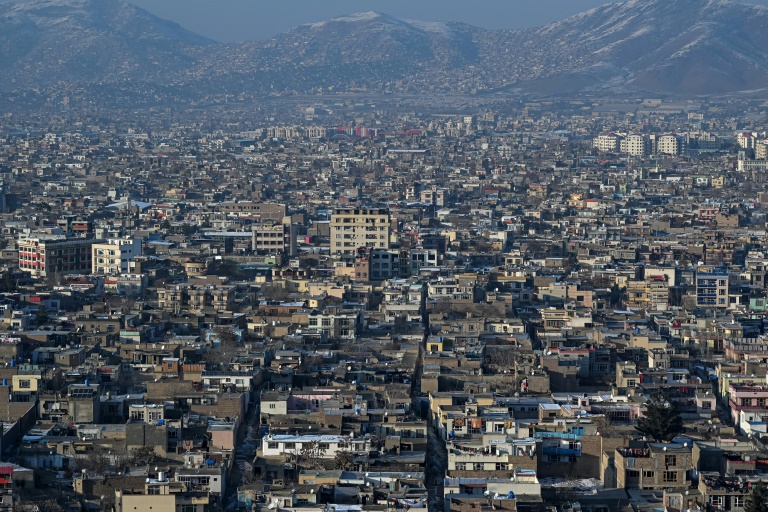
Despite a $25 million US bounty on his head, Al-Qaeda leader Ayman al-Zawahiri apparently felt comfortable enough with the Taliban’s takeover of Afghanistan to move into a home in Kabul where he would regularly appear out in the open, on his balcony.

But the US government had not given up its pursuit of one of the planners of the September 11, 2001 attacks and the heir to Osama bin Laden.

After years of tracking him down, US armed forces fired two Hellfire missiles from a drone flying above the Afghan capital, striking Zawahiri’s safe house and killing him, President Joe Biden announced on Monday.

US officials described an operation as meticulously planned as that which killed bin Laden in his Pakistan hideout in 2011.

That the leader of the violent jihadist group was in Afghanistan was not surprising: since the hard-line Islamist Taliban regained control in August, Al-Qaeda has felt more at home, analysts say. 

But finding him was still hard.

“For several years the US government has been aware of a network that we assessed supported Zawahiri,” a senior administration official told reporters.

But it was only this year that US intelligence learned that his family, his wife, his daughter and her children, had moved to the Afghan capital. 

They were careful, the official said, exercising “longstanding terrorist tradecraft” to prevent anyone tracking them to the Qaeda leader.

Still, eventually Zawahiri showed up, and never left.

“We identified Zawahiri on multiple occasions for sustained periods of time on the balcony,” the official said.

An attack plan developed over May and June. The United States constantly monitored the multi-story residence — just how the official would not say — to understand the family’s pattern of life.

– Detailed safe-house model –

They studied the construction of the home, aiming to hit Zawahiri without threatening the building’s structural integrity, to minimize the risk to civilians.

Defense and intelligence officials finalized the plan in June and presented it to Biden in the White House on July 1, using a detailed model of the residence, as was done before the bin Laden raid. 

Biden asked detailed questions on the structure, weather issues, and the risk to civilians, the official said.

Finally, on July 25, Biden — still ill with a bout of Covid-19 — made the decision. 

It took place with key cabinet officials joining the final briefing, echoing the April 28, 2011 White House meeting where president Barack Obama decided to deploy US special operations troops to enter Pakistan and get bin Laden.

At that time Biden was vice president, and he expressed doubts. The risks of things going wrong were high, bin Laden had not been clearly identified, and relations with Pakistan could suffer, he later recalled.

With Zawahiri, however, no US troops would enter the country; Zawahiri was clearly identified; and relations with the Taliban were next to nil. 

At the end of the discussion on the 25th, Biden — as Obama had done 11 years earlier — asked each participant for their view.

“All strongly recommended approval of this target,” and Biden gave the go-ahead, the official said.

The strike involved a US drone, armed with two precision-guided Hellfire missiles, which were launched at 6:18 am Sunday, Kabul time.

Zawahiri was “killed on the balcony,” the official said.

The missiles appear not to have been ordinary Hellfires, whose high explosives could have destroyed the home.

– ‘Significant blow to Al-Qaeda’ –

Apparent photographs of the building show only a few windows on one floor blown out, and the rest intact.

That points to the likely use of a non-explosive version of the Hellfire, the R9X, which deploys a series of knife-like blades from its fuselage and shreds its target but leaves nearby people and objects intact. 

The so-called “flying ginsu” missile has been used a half-dozen or more times by US forces to kill other jihadist group leaders without hurting bystanders.

The official did not provide details, but expressed strong confidence that Zawahiri had been killed and no others were hurt. 

“Zawahiri’s family members were present in other parts of the safe house at the time of the strike and were purposely not targeted and were not harmed,” he said.

The official said the strike “deals a significant blow to Al-Qaeda and will degrade the group’s ability to operate.”

“As President Biden has consistently said, we will not allow Afghanistan to become a safe haven for terrorists who might bring harm to Americans,” the official said.

The killing of Al-Qaeda's Zawahiri: how it happened

Despite a $25 million US bounty on his head, Al-Qaeda leader Ayman al-Zawahiri apparently felt comfortable enough with the Taliban’s takeover of Afghanistan to move into a home in Kabul where he would regularly appear out in the open, on his balcony.

But the US government had not given up its pursuit of one of the planners of the September 11, 2001 attacks and the heir to Osama bin Laden.

After years of tracking him down, US armed forces fired two Hellfire missiles from a drone flying above the Afghan capital, striking Zawahiri’s safe house and killing him, President Joe Biden announced on Monday.

US officials described an operation as meticulously planned as that which killed bin Laden in his Pakistan hideout in 2011.

That the leader of the violent jihadist group was in Afghanistan was not surprising: since the hard-line Islamist Taliban regained control in August, Al-Qaeda has felt more at home, analysts say. 

But finding him was still hard.

“For several years the US government has been aware of a network that we assessed supported Zawahiri,” a senior administration official told reporters.

But it was only this year that US intelligence learned that his family, his wife, his daughter and her children, had moved to the Afghan capital. 

They were careful, the official said, exercising “longstanding terrorist tradecraft” to prevent anyone tracking them to the Qaeda leader.

Still, eventually Zawahiri showed up, and never left.

“We identified Zawahiri on multiple occasions for sustained periods of time on the balcony,” the official said.

An attack plan developed over May and June. The United States constantly monitored the multi-story residence — just how the official would not say — to understand the family’s pattern of life.

– Detailed safe-house model –

They studied the construction of the home, aiming to hit Zawahiri without threatening the building’s structural integrity, to minimize the risk to civilians.

Defense and intelligence officials finalized the plan in June and presented it to Biden in the White House on July 1, using a detailed model of the residence, as was done before the bin Laden raid. 

Biden asked detailed questions on the structure, weather issues, and the risk to civilians, the official said.

Finally, on July 25, Biden — still ill with a bout of Covid-19 — made the decision. 

It took place with key cabinet officials joining the final briefing, echoing the April 28, 2011 White House meeting where president Barack Obama decided to deploy US special operations troops to enter Pakistan and get bin Laden.

At that time Biden was vice president, and he expressed doubts. The risks of things going wrong were high, bin Laden had not been clearly identified, and relations with Pakistan could suffer, he later recalled.

With Zawahiri, however, no US troops would enter the country; Zawahiri was clearly identified; and relations with the Taliban were next to nil. 

At the end of the discussion on the 25th, Biden — as Obama had done 11 years earlier — asked each participant for their view.

“All strongly recommended approval of this target,” and Biden gave the go-ahead, the official said.

The strike involved a US drone, armed with two precision-guided Hellfire missiles, which were launched at 6:18 am Sunday, Kabul time.

Zawahiri was “killed on the balcony,” the official said.

The missiles appear not to have been ordinary Hellfires, whose high explosives could have destroyed the home.

– ‘Significant blow to Al-Qaeda’ –

Apparent photographs of the building show only a few windows on one floor blown out, and the rest intact.

That points to the likely use of a non-explosive version of the Hellfire, the R9X, which deploys a series of knife-like blades from its fuselage and shreds its target but leaves nearby people and objects intact. 

The so-called “flying ginsu” missile has been used a half-dozen or more times by US forces to kill other jihadist group leaders without hurting bystanders.

The official did not provide details, but expressed strong confidence that Zawahiri had been killed and no others were hurt. 

“Zawahiri’s family members were present in other parts of the safe house at the time of the strike and were purposely not targeted and were not harmed,” he said.

The official said the strike “deals a significant blow to Al-Qaeda and will degrade the group’s ability to operate.”

“As President Biden has consistently said, we will not allow Afghanistan to become a safe haven for terrorists who might bring harm to Americans,” the official said.

Death toll from Kentucky flooding rises to 37

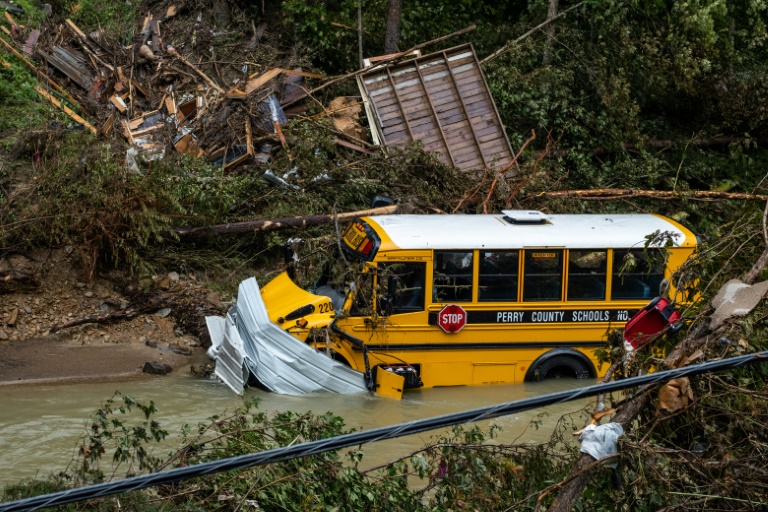
The death toll from flooding in eastern Kentucky rose to 37 on Monday as more rain hampered recovery operations and possible severe weather overnight threatened to provoke further damage.

“We are ending the day with more heartbreaking news out of Eastern Kentucky. We can confirm the death toll has now risen to 37, with so many more still missing,” tweeted Andy Beshear, governor of the south-central US state.”

“Let us pray for these families and come together to wrap our arms around our fellow Kentuckians,” he added.

Beshear has said he expects the death toll to continue to rise as search and rescue teams fan out across flood-hit areas and recover more bodies.

Their efforts were hampered by more rain on Monday, with a series of new storms forecast to arrive overnight.

“If things weren’t hard enough on the people of this region, they’re getting rain right now,” Beshear said earlier in the day. “There is severe storm potential today in all of the impacted areas.

“That is just not right.”

The National Weather Service issued flood watches for most of eastern Kentucky for the evening and into Tuesday morning, warning that “a complex of storms is expected to move over the region tonight.”

“Heavy rain rates which could lead to flash flooding along with severe thunderstorms are possible,” the weather agency tweeted.

Last week, some areas in eastern Kentucky received more than eight inches (20 centimeters) of rain in a 24-hour period, provoking unprecedented flash flooding.

The water level of the North Fork of the Kentucky River at Whitesburg rose to a staggering 20 feet within hours, well above its previous record of 14.7 feet.

Some areas in the mountainous Appalachia region are still inaccessible following the flooding that turned roads into rivers, washed out bridges and swept away houses.

The floods hit a region of Kentucky that was already suffering from grinding poverty — driven by the decline of the coal industry that was the heart of its economy.

President Joe Biden has issued a disaster declaration for the state, allowing federal aid to supplement state and local recovery efforts.

The eastern Kentucky flooding is the latest in a series of extreme weather events that scientists say are an unmistakable sign of climate change.

Nearly 60 people were killed in western Kentucky by a tornado in December 2021.

Baby boom: the endangered wildlife revival at Cambodia's Angkor Wat

The melodic songs from families of endangered monkeys ring out over the jungle near Cambodia’s Angkor Wat temple complex — a sign of ecological rejuvenation decades after hunting decimated wildlife at the site.

The first pair of rare pileated gibbons were released in 2013 as part of a joint programme between conservation group Wildlife Alliance, the forestry administration and the Apsara Authority — a government agency that manages the 12th-century ruins.

The gibbon duo, named Baray and Saranick, were born from parents rescued from the wildlife trade and produced offspring a year later.

“We have now released four different pairs of gibbons within the Angkor forest and they have gone on to breed and now seven babies have been born,” Wildlife Alliance rescue and care programme director Nick Marx told AFP.

“We are restoring Cambodia’s natural heritage back into their most beautiful cultural heritage.”

Globally, gibbons are one of the most threatened families of primates, while the pileated gibbon is listed as endangered.

Marx says his team rescues some 2,000 animals a year and many more will soon call the Angkor jungle home.

There are hopes that once the baby gibbons reach sexual maturity in about five to eight years, they will also pair up and mate.

“What we are hoping for the future is to create a sustainable population of the animals… that we released here within the amazing Angkor forest,” Marx said.

– ‘Big victory’ –

Cambodian authorities have hailed the gibbon baby boom that began in 2014.

“This means a big victory for our project,” Chou Radina from the Apsara Authority said, adding that as well as gibbons, tourists could now see great hornbills flying over Angkor Wat.

The programme has released more than 40 other animals and birds including silvered langurs, muntjac deers, smooth-coated otters, leopard cats, civets, wreathed hornbills, and green peafowl.

All were rescued from traffickers, donated or born in captivity at the Phnom Tamao wildlife sanctuary near Phnom Penh.

The Angkor Archaeological Park — which contains the ruins of various capitals of the Khmer Empire, dating from the ninth to 15th centuries — has some of the oldest rainforest in Cambodia.

It is also the kingdom’s most popular tourist destination.

Since Angkor Wat became a world heritage site in 1992, its jungle, which covers more than 6,500 hectares, has benefited from increased legal and physical protections.

There are hopes that wildlife sightings will also spark interest in local and foreign tourists and boost conservation education efforts.

– Ongoing threats –

Rampant poaching, habitat loss from logging, agriculture and dam building has stripped much wildlife from Cambodian rainforests.

Last year, authorities removed 61,000 snare traps, environment ministry spokesman Neth Pheaktra said, adding that the government had launched a campaign to discourage hunting and eating of wildlife meat.

But widespread poverty even before the pandemic left many households without much choice but to continue hunting so their families could eat protein.

Animals are also hunted for traditional medicine and to be kept as pets.

According to Global Forest Watch, from 2001-2021 Cambodia lost 2.6 million hectares of tree cover, a 30 percent decrease since 2000.

Commercial interests are trumping protection efforts in some quarters — the Phnom Tamao zoo and wildlife rescue centre is under threat from a shadowy rezoning development plan, Marx said.

Back at Siem Reap — the gateway city to Angkor Wat — villager Moeurn Sarin shops at the market for bananas, watermelon, rambutan and fish to feed the pileated gibbon families and otters.

“We are happy to conserve these animals,” the 64-year-old said, adding he likes to watch the gibbons’ tree swinging antics.

“In the future, these animals will have babies for the young generation to see.”

Beyonce to remove offensive lyric after disabled community outcry

Beyonce will remove a derogatory term for disabled people from her new song “Heated,” a spokesperson said Monday, after its use was condemned as offensive by campaigners.

The US pop megastar will re-record the track from her latest album “Renaissance” on which she originally sang the lyrics “Spazzin’ on that ass, spazz on that ass.”

“The word, not used intentionally in a harmful way, will be replaced,” a spokesperson for Beyonce told AFP via email.

Co-written with Canadian rapper Drake, the dance track appears to use the word “spaz” in the colloquial sense of temporarily losing control or acting erratically.

But disability campaigners noted that the word is derived from “spastic.” 

According to the Centers for Disease Control and Prevention, spasticity is a movement disorder involving stiff muscles and awkward movement, suffered by 80 percent of people with cerebral palsy.

In June, US singer Lizzo re-recorded her song “Grrrls” to remove the same term following complaints that it was derogatory.

Australian disability campaigner Hannah Diviney said the inclusion of the word by Beyonce “feels like a slap in the face to me, the disabled community & the progress we tried to make with Lizzo.”

“Guess I’ll just keep telling the whole industry to ‘do better’ until ableist slurs disappear from music,” she tweeted.

Beyonce’s eagerly anticipated seventh solo studio album “Renaissance” was released Friday, drawing mainly positive reviews with its nods to disco and electronic dance.

Other collaborators on the album — which leaked online in the days prior to its official release — include Nile Rodgers, Skrillex, Nigerian singer Tems, Grace Jones, Pharrell and Beyonce’s rap mogul husband Jay-Z.

In an Instagram post published soon after the album’s release, Beyonce said creating the album “allowed me a place to dream and to find escape during a scary time for the world.

“My intention was to create a safe place, a place without judgment,” she wrote.

“A place to be free of perfectionism and overthinking. A place to scream, release, feel freedom.”

Iguanas reproducing on Galapagos island century after disappearing

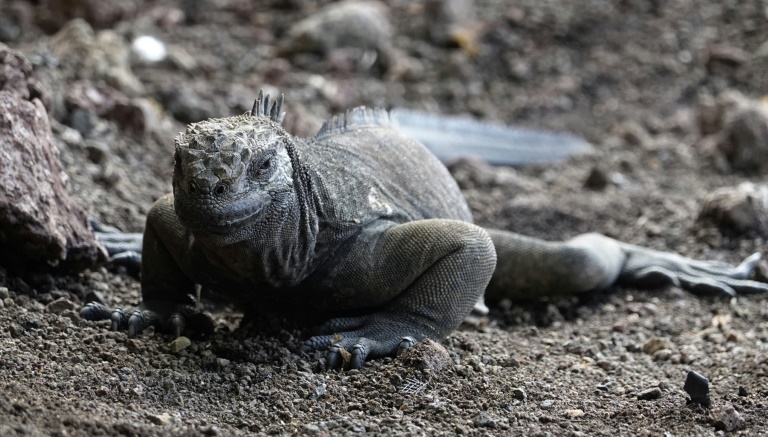
A land iguana that disappeared more than a century ago from one of the Galapagos Islands is reproducing naturally following its reintroduction there, Ecuador’s environment ministry announced Monday.

The reptile from the Conolophus subcristatus species, one of three land iguanas living on the archipelago, disappeared from Santiago Island in the early part of the 20th century according to a 1903-06 expedition there by the California Academy of Sciences, the ministry said.

In 2019, the Galapagos National Park (PNG) authority reintroduced more than 3,000 iguanas from a nearby island to restore the natural ecosystem of Santiago, which lies at the center of the Pacific archipelago.

The remote island chain was made famous by British geologist and naturalist Charles Darwin’s observations on evolution there.

In 1835, Darwin recorded a huge number of iguanas of all ages on Santiago.

PNG director Danny Rueda said “187 years later we are once again seeing a healthy population of land iguanas with adults, juveniles and newborns.

“It’s a great conservation achievement and strengthens our hopes of restoration on the islands that have been severely affected by introduced species.”

Located close to 1,000 kilometers (600 miles) off the coast of Ecuador, the Galapagos islands are home to unique flora and fauna and are a Natural World Heritage site.

W.House warns Beijing against turning Pelosi Taiwan visit into a 'crisis'

The White House on Monday warned China against overreacting to a trip by US House Speaker Nancy Pelosi to Taiwan, saying she would have every right to visit the self-ruled island despite Beijing viewing it as a highly provocative challenge.

China need not turn any visit by Pelosi into a “crisis,” White House National Security Council spokesman John Kirby told reporters, even as he warned that Beijing may be “positioning” itself for a show of military strength around the island.

Media reports have said that Pelosi, currently on an official Asia tour, will stop off in Taiwan and meet President Tsai Ing-wen on Wednesday — if so, the highest-level US visit to Taipei in decades.

Beijing, which views Taiwan as its territory, has reacted furiously to the idea, warning President Joe Biden that his administration was playing “with fire” and announcing a series of live-fire military drills in the Taiwan Straits. 

While the White House and State Department are both understood to be opposed to Pelosi’s trip, Kirby made it clear that the speaker — who is second in line to the US presidency — was entitled to go where she pleased.

“The speaker has the right to visit Taiwan,” he told reporters, adding: “There is no reason for Beijing to turn a potential visit consistent with longstanding US policies into some sort of crisis.”

Kirby cited intelligence that China was preparing possible military provocations that could include firing missiles in the Taiwan Strait or “large scale” incursions into Taiwan airspace.

Pelosi kicked her trip off Monday with a stop in Singapore, where Prime Minister Lee Hsien Loong urged her at a meeting to strive for “stable” ties with Beijing.

Her itinerary also includes Malaysia, South Korea and Japan, but the prospect of a Taiwan visit has dominated attention.

– ‘Nothing has changed’ –

Speculation about Pelosi’s plans has coincided with an uptick in military activity across the region. 

Kirby said the United States “will not be intimidated” from continuing to move freely in the Pacific region.

However, he sought to lower tension by stressing several times that US policy was unchanged toward Taiwan. This means support for its self-ruling government, while diplomatically recognising Beijing over Taipei and opposing either a full independence bid by Taiwan or a forceful takeover by China.

“Nothing has changed,” he said. “There’s certainly no reason for this to come to blows.”

Kirby confirmed that Pelosi is traveling on a military aircraft and said Washington does not fear a direct attack but warned it “raises the stakes of a miscalculation.”

Pelosi’s office has said her trip “will focus on mutual security, economic partnership and democratic governance in the Indo-Pacific region,” referring to the Asia-Pacific.

The statement did not mention Taiwan. But visits by US officials there are usually kept secret until delegations land.

China’s ambassador to the United Nations Zhang Hun labelled such a visit “very much dangerous, very much provocative” as he spoke to reporters Monday. 

“If the US insists on making the visit, China will take firm and strong measures to safeguard our sovereignty and territorial integrity,” he said at a briefing.

The Global Times, China’s state-run tabloid, suggested that Pelosi might use “emergency excuses like an aircraft fault or refuelling” to land at a Taiwanese airport.

“If she dares to stop in Taiwan, it will be the moment to ignite the powder keg of the situation in the Taiwan Straits,” Hu Xijin, a former Global Times editor and now commentator, tweeted.

And the Chinese army’s Eastern Theater Command shared footage on social media site Weibo featuring a combat-ready army with fighters and helicopters taking off, amphibious troops landing on a beach and a stream of missiles raining down on various targets.

“We will bury all enemies who invade our territory,” a short text accompanying the footage read. 

“We’re ready to fight,” it added. “Advance towards a joint combat and a victorious war.”

– Taiwan government silent –

Taiwan’s 23 million people have long lived with the possibility of an invasion, but the threat has intensified under Chinese President Xi Jinping.

American officials often make discreet visits to Taiwan to show support but a Pelosi trip would be higher-profile than any in recent history.

Taiwan’s government has remained silent on the prospect of a Pelosi visit and there has been minimal local press coverage. 

“I really hate what the Chinese are doing,” Hsu Ching-feng, a fruit vendor in Taipei, told AFP.

“But there’s nothing us common folks can do about it but ignore them.”

Two dead in California's largest wildfire this year

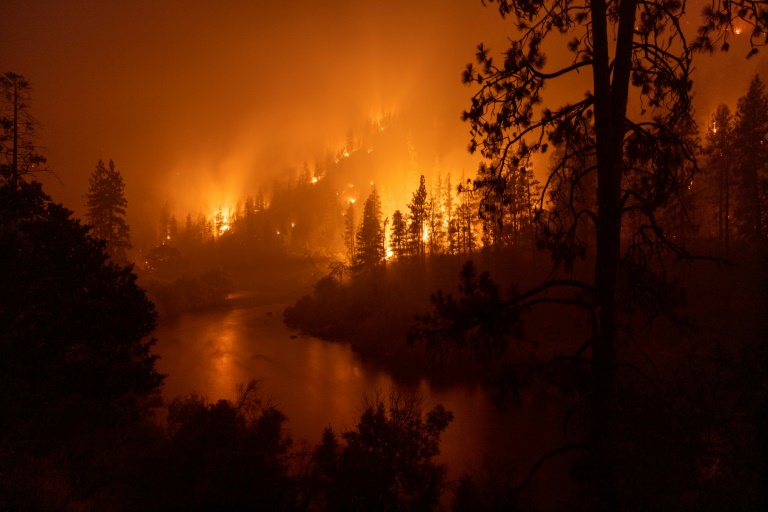
Firefighters faced “extremely dangerous” conditions Monday as they battled to save a community of 8,000 residents, with lightning strikes threatening to worsen a blaze that has already killed at least two people and become California’s biggest fire of the year.

Hundreds of personnel were involved in the fight against the fast-moving McKinney Fire, which has torn through more than 55,000 acres (22,000 hectares) near the border with Oregon, forcing thousands from their homes.

The National Weather Service meanwhile issued a warning because of the threat of dry lightning — powerful electrical strikes that come without any of the desperately needed rain.

“These conditions can be extremely dangerous for firefighters, as winds can be erratic and extremely strong, causing fire to spread in any direction,” said CalFire, an interagency website that collates fire information.

California, along with much of the western United States, is in the grip of its worst drought in more than 1,000 years.

The drought, exacerbated by man-made climate change, has left the countryside parched and exceedingly vulnerable to the wildfires that naturally break out, making the blazes hotter, faster and more destructive.

The McKinney Fire on Sunday claimed its first human lives, with the Siskiyou County Sheriff’s Office saying firefighters found two people dead inside a burned-out car in the driveway of a home in the town of Klamath River.

Sheriff Jeremiah LaRue said the pair were likely caught in the swift-moving fire as they tried to flee.

California Governor Gavin Newsom has declared a state of emergency in Siskiyou County, and more than 2,000 residents of the rural area are under evacuation orders.

A heat wave with temperatures of over 100 degrees Fahrenheit (38 degrees Celsius), tinder dry terrain and thunderstorms packing strong winds are complicating the efforts of firefighters battling the blaze.

“Fire growth is expected to spread in all directions,” the Klamath National Forest service said in a statement. “Warning for thunderstorms and lightning. Gusty outflow winds of 30 to 50 mph (50 to 80 kph) will be possible near thunderstorm cells.”

According to the Siskiyou County Sheriff’s Office, the fire has destroyed more than 100 structures — including homes, a grocery store and a community center — in the area surrounding Yreka, though it has not yet encroached upon the town of about 7,800 people.

“Surrounding areas should be ready to leave if needed. Please don’t hesitate to evacuate,” the county sheriff tweeted.

The McKinney fire is California’s largest wildfire so far this year — though it remains much smaller than last year’s Dixie Fire, which burned nearly one million acres.

– Animal rescue –

An AFP journalist working in the fire area captured a photograph of a kitten with singed whiskers cowering in between rocks in the Klamath National Forest.

As the picture ricocheted around the internet, users asked for updates, with one seemingly offering to look after the animal.

“Do you know if this kitten has been cared for and adopted at this point?” tweeted @bobbiescat

Another journalist shared footage of a young puppy gratefully lapping at a bowl of water after emerging from the ashen ruins of a home in Klamath River.

Rescue Ranch Yreka, which took in the stricken pup, said it had received nearly 140 dogs in less than two days, and appealed for donations to help feed and care for them.

The fast-spreading blaze comes just days after the Oak Fire near Yosemite National Park destroyed dozens of buildings and forced thousands to evacuate.

California still has months of fire season ahead of it.

Other parts of the world have also faced intense wildfires this year, as scientists say climate change is making heatwaves more frequent and more intense, increasing the risk of fires.

In Portugal, a blaze broke out in the Mafra area, north of Lisbon, over the weekend while in France at least four firefighters were seriously injured and motorways were closed.

Also over the weekend, hundreds of firefighters battled a blaze in eastern Germany, with four people injured.

Two dead in California's largest wildfire this year

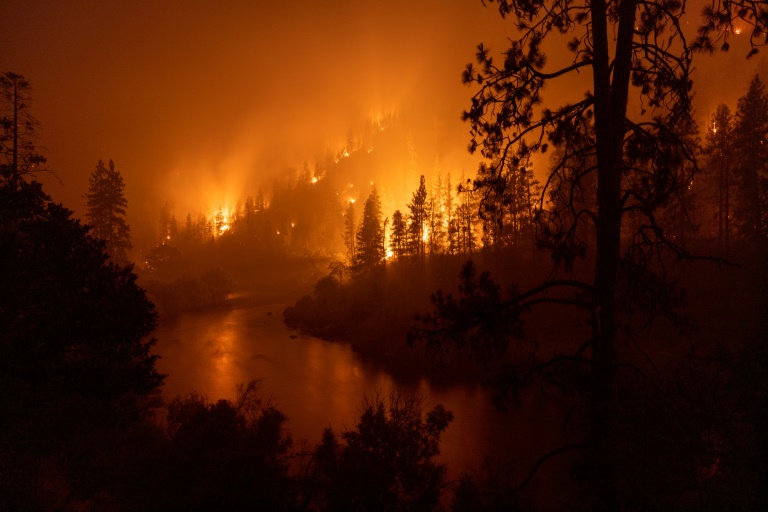
Firefighters faced “extremely dangerous” conditions Monday as they battled to save a community of 8,000 residents, with lightning strikes threatening to worsen a blaze that has already killed at least two people and become California’s biggest fire of the year.

Hundreds of personnel were involved in the fight against the fast-moving McKinney Fire, which has torn through more than 55,000 acres (22,000 hectares) near the border with Oregon, forcing thousands from their homes.

The National Weather Service meanwhile issued a warning because of the threat of dry lightning — powerful electrical strikes that come without any of the desperately needed rain.

“These conditions can be extremely dangerous for firefighters, as winds can be erratic and extremely strong, causing fire to spread in any direction,” said CalFire, an interagency website that collates fire information.

California, along with much of the western United States, is in the grip of its worst drought in more than 1,000 years.

The drought, exacerbated by man-made climate change, has left the countryside parched and exceedingly vulnerable to the wildfires that naturally break out, making the blazes hotter, faster and more destructive.

The McKinney Fire on Sunday claimed its first human lives, with the Siskiyou County Sheriff’s Office saying firefighters found two people dead inside a burned-out car in the driveway of a home in the town of Klamath River.

Sheriff Jeremiah LaRue said the pair were likely caught in the swift-moving fire as they tried to flee.

California Governor Gavin Newsom has declared a state of emergency in Siskiyou County, and more than 2,000 residents of the rural area are under evacuation orders.

A heat wave with temperatures of over 100 degrees Fahrenheit (38 degrees Celsius), tinder dry terrain and thunderstorms packing strong winds are complicating the efforts of firefighters battling the blaze.

“Fire growth is expected to spread in all directions,” the Klamath National Forest service said in a statement. “Warning for thunderstorms and lightning. Gusty outflow winds of 30 to 50 mph (50 to 80 kph) will be possible near thunderstorm cells.”

According to the Siskiyou County Sheriff’s Office, the fire has destroyed more than 100 structures — including homes, a grocery store and a community center — in the area surrounding Yreka, though it has not yet encroached upon the town of about 7,800 people.

“Surrounding areas should be ready to leave if needed. Please don’t hesitate to evacuate,” the county sheriff tweeted.

The McKinney fire is California’s largest wildfire so far this year — though it remains much smaller than last year’s Dixie Fire, which burned nearly one million acres.

– Animal rescue –

An AFP journalist working in the fire area captured a photograph of a kitten with singed whiskers cowering in between rocks in the Klamath National Forest.

As the picture ricocheted around the internet, users asked for updates, with one seemingly offering to look after the animal.

“Do you know if this kitten has been cared for and adopted at this point?” tweeted @bobbiescat

Another journalist shared footage of a young puppy gratefully lapping at a bowl of water after emerging from the ashen ruins of a home in Klamath River.

Rescue Ranch Yreka, which took in the stricken pup, said it had received nearly 140 dogs in less than two days, and appealed for donations to help feed and care for them.

The fast-spreading blaze comes just days after the Oak Fire near Yosemite National Park destroyed dozens of buildings and forced thousands to evacuate.

California still has months of fire season ahead of it.

Other parts of the world have also faced intense wildfires this year, as scientists say climate change is making heatwaves more frequent and more intense, increasing the risk of fires.

In Portugal, a blaze broke out in the Mafra area, north of Lisbon, over the weekend while in France at least four firefighters were seriously injured and motorways were closed.

Also over the weekend, hundreds of firefighters battled a blaze in eastern Germany, with four people injured.

Peru registers first death in monkeypox patient: hospital

Peru on Monday recorded its first death of a monkeypox-infected person, with more than 300 cases reported in the country to date, a health official said.

The fatality was “a patient who came to hospital in a serious condition with monkeypox and their health weakened after abandoning treatment for HIV/Aids,” according to Eduardo Farfan, director of the Dos de Mayo hospital in Lima.

The man, 45, died “of sepsis” due to a weakened immune system, said Farfan.

He had been admitted to hospital with a severe monkeypox infection and “other comorbidities,” said the director.

Farfan said his hospital was treating about eight or nine cases of monkeypox per day, on an outpatient basis.

According to the WHO, more than 18,000 monkeypox cases have been detected throughout the world outside Africa since the beginning of May, most of them in Europe.

Close Bitnami banner
Bitnami