AFP

Pelosi's Asia tour set to kick off under Taiwan cloud

US House of Representatives Speaker Nancy Pelosi was expected to begin her Asia tour Monday in the shadow of diplomatic tensions with China, with no word yet if she will make a stop in Taiwan.

Her reported plans to visit the island have sparked strong warnings from Beijing, and even unease in the White House with President Joe Biden trying to lower the temperature with China.

Beijing considers self-ruled Taiwan its territory — to be seized one day, by force if necessary — and would see a visit by Pelosi as a provocation.

“The trip will focus on mutual security, economic partnership and democratic governance in the Indo-Pacific region,” Pelosi’s office said Sunday in a statement, referring to the Asia-Pacific.

“Our delegation will hold high-level meetings to discuss how we can further advance our shared interests and values.”

The statement did not mention Taiwan.

Pelosi is expected to begin the tour in Singapore, where meetings with the prime minister and president are on the agenda.

Her itinerary also includes Malaysia, South Korea and Japan.

Her delegation includes Chairman of the House Foreign Affairs Committee Gregory Meeks, as well as members of the House Permanent Select Committee on Intelligence and the House Armed Services Committee.

– Xi warning –

The United States maintains a policy of “strategic ambiguity” over whether it would intervene militarily were China to invade Taiwan.

While it recognises Beijing’s claim to the island, it also backs Taiwan’s democratic government.

American officials often make discreet visits to Taiwan to show support, but a Pelosi visit would be higher-profile than any in recent history.

As the House speaker, she is third in line for the US presidency and one of the country’s most powerful politicians.

The last House speaker to visit was Newt Gingrich in 1997.

Biden and his Chinese counterpart Xi Jinping had a tense phone call last week that was clouded by disagreements over Taiwan.

Xi issued an oblique warning to the United States not to “play with fire” over the island.

The feverish speculation about Pelosi’s Taiwan plans has coincided with an uptick in military activity across the region, highlighting the combustibility of the issue.

US officials have sought to play down the significance of a Pelosi visit, urging calm from Chinese leaders.

“We have many differences when it comes to Taiwan, but over the past 40-plus years, we have managed those differences and done it in a way that has preserved peace and stability and has allowed the people on Taiwan to flourish,” US Secretary of State Antony Blinken said Friday.

In Taiwan, there have been mixed views about the prospect of Pelosi visiting, but figures from both the ruling party and the main opposition have said the island should not cave to Chinese pressure.


NBA mourns Celtics great and civil rights activist Bill Russell

Bill Russell, the cornerstone of a Boston Celtics dynasty that won 11 NBA titles and a powerful voice for social justice, died Sunday at the age of 88, his family said.

“Bill Russell, the most prolific winner in American sports history, passed away peacefully today at age 88, with his wife, Jeannine, by his side,” said a statement posted on Russell’s Twitter page.

US President Joe Biden and former President Barack Obama — who awarded Russell the Presidential Medal of Freedom in 2011 — were among those who paid tribute to Russell’s contributions on and off the court.

“The promise of America is that we are all created equal and deserve to be treated equally throughout our lives,” Biden said in a statement. “We’ve never fully lived up to that promise, but Bill Russell made sure we never walked away from it.”

Russell’s 11 titles with the Celtics included eight in a row from 1959-1966. Today’s NBA Finals MVP award is named for him.

He averaged 15.1 points and 22.5 rebounds per game for his career, building a famed rivalry with Wilt Chamberlain in the 1960s.

He became the first Black coach in the NBA when he served as player-coach of the Celtics in 1966 and the first Black player inducted into the Basketball Hall of Fame in 1975.

His skills revolutionized the NBA game, but Biden noted that throughout his stellar career Russell “faced the hostility and hate of racism embedded in every part of American life. Yet, he never gave up. Throughout his life, he forced us to confront hard truths. And on this day, there are generations of Americans who are reflecting on what he meant to them as someone who played for the essential truth that every person is entitled to be treated with dignity and respect.”

Russell’s family said his “understanding of the struggle is what illuminated his life.”

“Bill called out injustice with an unforgiving candor that he intended would disrupt the status quo, and with a powerful example that, though never his humble intention, will forever inspire teamwork, selflessness and thoughtful change.”

Obama said the world had “lost a giant.”

“As tall as Bill Russell stood, his legacy rises far higher — both as a player and as a person,” Obama said in a statement posted on Twitter.

“Perhaps more than anyone else, Bill knew what it took to win and what it took to lead. On the court, he was the greatest champion in basketball history. Off of it, he was a civil rights trailblazer, marching with Dr. King and standing with Muhammad Ali.

“For decades, Bill endured insults and vandalism, but never let it stop him from speaking up for what’s right. I learned so much from the way he played, the way he coached, and the way he lived his life.”

NBA Commissioner Adam Silver called Russell “the greatest champion in all of team sports,” but added that his accolades “only begin to tell the story of Bill’s immense impact on our league and broader society.

“Bill stood for something much bigger than sports: the values of equality, respect and inclusion that he stamped into the DNA of our league,” Silver said.

– Making things better –

Those beliefs, more than his prowess on the court, were what inspired Magic Johnson’s love of Russell, the Lakers legend said on Sunday as he joined in an outpouring of tributes.

“He was one of the first athletes on the front line fighting for social justice, equity, equality, and civil rights,” Johnson said. “Over the course of our friendship, he always reminded me about making things better in the Black community.”

Current Celtics stars Jayson Tatum and Jaylen Brown remembered the franchise legend, the club saying in a statement that “Bill Russell’s DNA is woven through every element of the Celtics organization.”

Michael Jordan, who for many inherited the mantle of greatest ever NBA player from Russell, said Russell “paved the way and set an example for every Black player who came into the league after him, including me.

“The world has lost a legend,” Jordan said, a comment echoed by former New York Knicks great Patrick Ewing.

Crypto clients beg for their cash back after lender's crash

An Irishman at risk of losing his farm. An American having suicidal thoughts. An 84-year-old widow’s lost life savings: People caught in the meltdown of crypto lender Celsius are pleading for their money back. 

Hundreds of letters have poured in to the judge overseeing the firm’s multi-billion-dollar bankruptcy and they are heavy with anger, shame, desperation and, frequently, regret.

“I knew there were risks,” said a client whose letter was unsigned. “It seemed a worthwhile risk.”

Celsius and its CEO Alex Mashinsky had billed the platform as a safe place for people to deposit their crypto currencies in exchange for high interest, while the firm lent out and invested those deposits.

But as the value of highly volatile crypto currencies plummeted — bitcoin alone has shed over 60 percent since November — the firm faced mounting troubles until it froze withdrawals in mid-June.

The company owed $4.7 billion to its users, according to a court filing earlier this month, and the endgame is unclear.

The letters — posted to a public online court docket — come from around the world and recount tragic results of users’ money being frozen.

“From that hard-working single mom in Texas struggling with past-due bills, to the teacher in India with all his hard-earned money deposited in Celsius — I believe I can speak for most of us when I say I feel betrayed, ashamed, depressed, angry,” wrote one client who signed their letter E.L.

While the letters vary in their level of sophistication about the crypto world — from self-confessed novices to all-in evangelists — and the monetary impacts range from a few hundred dollars to seven-figure sums, nearly all agree on one thing.

“I have been a loyal Celsius customer since 2019 and feel completely lied to by Alex Mashinsky,” wrote a client who AFP is not identifying to protect his privacy. “Alex would talk about how Celsius is safer than banks.”

Many of the letters point to the CEO’s AMA (Ask Mashinsky Anything) online chats as key to their confidence in him and the platform, which presented itself as stable until days before it froze users’ funds.

– Repeated assurances before fall –

“Celsius has one of the best risk management teams in the world. Our security team and infrastructure is second to none,” the firm wrote on June 7. 

“We have made it through crypto downturns before (this is our fourth!). Celsius is prepared,” the firm wrote.

The message also said the company had the reserves to pay its obligations, and withdrawals were being processed as normal. 

One client, who reported having $32,000 in crypto locked up at Celsius, noted the impact.

“Right up until the end, the retail investor received assurance,” the client wrote to the judge.

But that changed quickly, and on June 12 Celsius announced the freeze: “We are taking this action today to put Celsius in a better position to honor, over time, its withdrawal obligations.”

Some clients got the news in a message from the company.

“By the time I finished the e-mail, I had collapsed onto the floor with my head in my hands and I fought back tears,” wrote one man who had about $50,000 in assets with Celsius.

The clients who said they were hardest hit, including a man who said he placed $525,000 he got from a government loan on Celsius, disclosed they had considered killing themselves.

Others reported heavy stress, lack of sleep and feelings of deep shame for putting their retirement savings or their children’s college money into a platform that was far riskier than they knew.

“As a private unregulated company, Celsius does not come under any requirement for disclosure,” is how the Washington Post summarized the situation.

Celsius did not reply to a request for comment on the clients’ letters.

For people like one 84-year-old woman, who only had her roughly $30,000 in crypto savings on Celsius for a month, their hope lies in the bankruptcy proceedings.

“It’s just not unusual for people to come out of something like this with zero,” said Don Coker, an expert witness on banking and finance.

“Obviously I feel sorry for anyone who loses an investment like this, but it is just something where they need to be aware of the risks,” he said.

Crypto clients beg for their cash back after lender's crash

An Irishman at risk of losing his farm. An American having suicidal thoughts. An 84-year-old widow’s lost life savings: People caught in the meltdown of crypto lender Celsius are pleading for their money back. 

Hundreds of letters have poured in to the judge overseeing the firm’s multi-billion-dollar bankruptcy and they are heavy with anger, shame, desperation and, frequently, regret.

“I knew there were risks,” said a client whose letter was unsigned. “It seemed a worthwhile risk.”

Celsius and its CEO Alex Mashinsky had billed the platform as a safe place for people to deposit their crypto currencies in exchange for high interest, while the firm lent out and invested those deposits.

But as the value of highly volatile crypto currencies plummeted — bitcoin alone has shed over 60 percent since November — the firm faced mounting troubles until it froze withdrawals in mid-June.

The company owed $4.7 billion to its users, according to a court filing earlier this month, and the endgame is unclear.

The letters — posted to a public online court docket — come from around the world and recount tragic results of users’ money being frozen.

“From that hard-working single mom in Texas struggling with past-due bills, to the teacher in India with all his hard-earned money deposited in Celsius — I believe I can speak for most of us when I say I feel betrayed, ashamed, depressed, angry,” wrote one client who signed their letter E.L.

While the letters vary in their level of sophistication about the crypto world — from self-confessed novices to all-in evangelists — and the monetary impacts range from a few hundred dollars to seven-figure sums, nearly all agree on one thing.

“I have been a loyal Celsius customer since 2019 and feel completely lied to by Alex Mashinsky,” wrote a client who AFP is not identifying to protect his privacy. “Alex would talk about how Celsius is safer than banks.”

Many of the letters point to the CEO’s AMA (Ask Mashinsky Anything) online chats as key to their confidence in him and the platform, which presented itself as stable until days before it froze users’ funds.

– Repeated assurances before fall –

“Celsius has one of the best risk management teams in the world. Our security team and infrastructure is second to none,” the firm wrote on June 7. 

“We have made it through crypto downturns before (this is our fourth!). Celsius is prepared,” the firm wrote.

The message also said the company had the reserves to pay its obligations, and withdrawals were being processed as normal. 

One client, who reported having $32,000 in crypto locked up at Celsius, noted the impact.

“Right up until the end, the retail investor received assurance,” the client wrote to the judge.

But that changed quickly, and on June 12 Celsius announced the freeze: “We are taking this action today to put Celsius in a better position to honor, over time, its withdrawal obligations.”

Some clients got the news in a message from the company.

“By the time I finished the e-mail, I had collapsed onto the floor with my head in my hands and I fought back tears,” wrote one man who had about $50,000 in assets with Celsius.

The clients who said they were hardest hit, including a man who said he placed $525,000 he got from a government loan on Celsius, disclosed they had considered killing themselves.

Others reported heavy stress, lack of sleep and feelings of deep shame for putting their retirement savings or their children’s college money into a platform that was far riskier than they knew.

“As a private unregulated company, Celsius does not come under any requirement for disclosure,” is how the Washington Post summarized the situation.

Celsius did not reply to a request for comment on the clients’ letters.

For people like one 84-year-old woman, who only had her roughly $30,000 in crypto savings on Celsius for a month, their hope lies in the bankruptcy proceedings.

“It’s just not unusual for people to come out of something like this with zero,” said Don Coker, an expert witness on banking and finance.

“Obviously I feel sorry for anyone who loses an investment like this, but it is just something where they need to be aware of the risks,” he said.

US Speaker Pelosi confirms Asia-Pacific tour, silent on Taiwan

US House of Representatives Speaker Nancy Pelosi will lead a congressional delegation to the Asia-Pacific region, her office confirmed on Sunday, with stops in Singapore, Malaysia, South Korea and Japan.

The statement made no mention of whether the six-member delegation would visit Taiwan, a flashpoint in conversations between China and the United States in the run-up to the trip.

“The trip will focus on mutual security, economic partnership and democratic governance in the Indo-Pacific region,” Pelosi’s office said in a statement. 

The all-Democrat delegation includes Chairman of the House Foreign Affairs Committee Gregory Meeks and members of the House Permanent Select Committee on Intelligence and the House Armed Services Committee.

“Our delegation will hold high-level meetings to discuss how we can further advance our shared interests and values, including peace and security, economic growth and trade, the Covid-19 pandemic, the climate crisis, human rights and democratic governance,” said Pelosi in the statement.

Singapore’s foreign ministry confirmed Pelosi’s delegation would visit the city-state August 1-2, with meetings scheduled with President Halimah Yacob and Prime Minister Lee Hsien Loong.

– Tensions over Taiwan –

For weeks, US-China tensions had heightened over reports that Pelosi may visit the self-ruled island of Taiwan, which China sees as part of its territory to be reunited by force if necessary.

On Thursday, President Joe Biden and his Chinese counterpart Xi Jinping held a tense phone call. 

The two leaders agreed to schedule their first in-person summit but disagreements over Taiwan clouded the conversation, with Xi making an oblique warning to the United States not to “play with fire” over the island.

The United States maintains a policy of “strategic ambiguity” over whether it would intervene militarily were China to invade Taiwan, and while it recognises Beijing’s claim to the island, it also backs the democratic Taiwanese government.

In the latest warning from Beijing, Chinese air force spokesman Shen Jinke on Sunday said defending China’s territory was the military’s “sacred mission”.

“The air force has firm determination, full confidence and sufficient capabilities to defend national sovereignty and territorial integrity,” Shen said, according to the state-run People’s Daily.

Over the last two years, China has ramped up flights by fighter jets, bombers and other aircraft into Taiwan’s air defence identification zone as a way to signal displeasure and keep Taipei’s own military stretched.

“The air force’s multi-type fighter jets fly around the motherland’s Taiwan, practicing to enhance its ability to maintain national sovereignty and territorial integrity,” Shen said. 

Zelensky urges evacuation of Ukraine's frontline Donetsk

Ukraine’s president urged civilians on Saturday to evacuate the frontline Donetsk region, the scene of fierce clashes with the Russian military, as Kyiv called on the Red Cross and UN to gain access to its soldiers being held by Moscow’s forces.

The eastern Donetsk region has faced the brunt of Russia’s offensive since its assault on Kyiv failed weeks into the invasion launched on February 24.

President Volodymyr Zelensky warned in his daily address that thousands of people, including children, were still in the region’s battleground areas, with six civilians killed and 15 wounded on Friday, according to the Donetsk governor.

“There’s already a governmental decision about obligatory evacuation from Donetsk,” Zelensky said, underscoring authorities’ calls to leave the besieged region in recent weeks.

“Leave, we will help,” Zelensky said. “At this stage of the war, terror is the main weapon of Russia.”

Official Ukrainian estimates put the number of civilians still living in the unoccupied area of Donetsk at between 200,000 and 220,000.

A mandatory evacuation notice posted Saturday evening said the coming winter made it a matter of urgency, particularly for the more than 50,000 children still in the region.

“They need to be evacuated, you cannot put them in mortal danger in the winter without heating, light, without the ability to keep them warm,” Kyiv’s Ministry of Reintegration of Temporarily Occupied Territories said in a statement.

Zelensky, in his address, also once more pressed the international community, especially the United States, to have Russia officially declared a “state sponsor of terrorism”.

– Deadly jail strike –

The call came a day after a jail holding Ukrainian prisoners of war in Kremlin-controlled Olenivka was bombed, leaving scores dead, with Kyiv and Moscow trading blame. 

On Saturday, Ukrainian human rights official Dmytro Lubinets said on national television he had asked the International Committee of the Red Cross (ICRC) and the United Nations Human Rights Monitoring Mission to go to Olenivka.

The ICRC has made a request but not yet obtained authorisation from the Russians, he said.

Russia’s defence ministry accused Kyiv of striking the Olenivka prison with US-supplied long-range missiles in an “egregious provocation” designed to stop soldiers from surrendering.

It said Saturday that the dead included Ukrainian forces who had surrendered after weeks of fighting off Russia’s brutal bombardment of the sprawling Azovstal steelworks in the port city of Mariupol. 

The defence ministry said 50 Ukrainian prisoners were killed and 73 were taken to hospital with serious injuries.

Zelensky accused Russia of “deliberate mass murder of Ukrainian prisoners of war”.

– Gazprom cuts off Latvia –

Also on Saturday, Russian energy giant Gazprom suspended gas supplies to Latvia in the latest tightening of gas provision to European Union states, which have accused Russia of squeezing supplies in retaliation for Western sanctions imposed over Moscow’s invasion of Ukraine.

Latvia’s Economy Minister Ilze Indriksone told the LETA news agency that his country “was not counting on natural gas flows from Russia.”

Gazprom drastically cut gas deliveries to Europe via the Nord Stream pipeline on Wednesday to about 20 percent of its capacity. It had reduced gas flows to Europe twice in June.

The Russian state-run company had earlier announced it would choke supply to 33 million cubic metres a day — half the amount it has been delivering since service resumed last week after 10 days of maintenance work.

– Drone attack –

Russian strikes continued to rain down on Ukrainian towns and cities.

Ukrainian authorities said Russian bombardments targeting the south and east of the country had left one dead in southern Mykolaiv and one dead in eastern Bakhmut.

The death toll from a strike on a Mykolaiv bus stop on Friday climbed to seven after two men died in hospital.

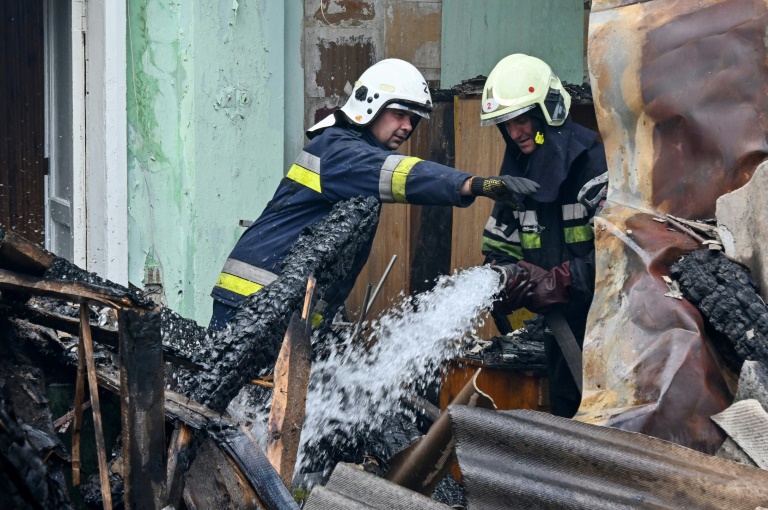
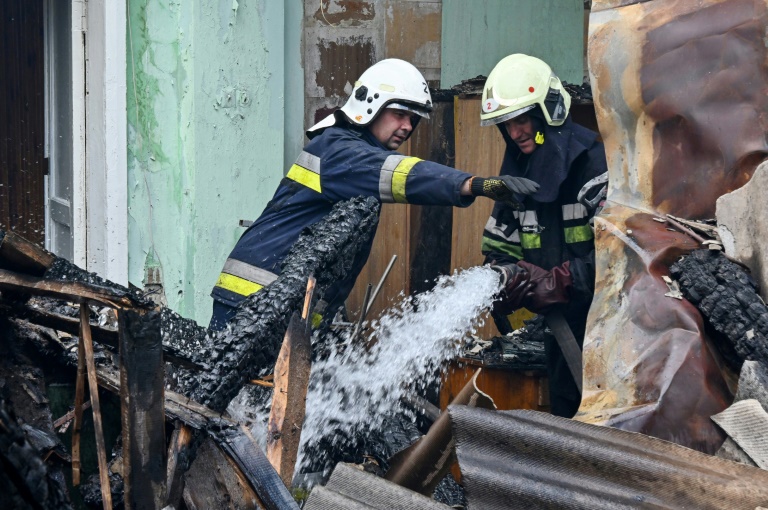
Meanwhile, in the eastern city of Kharkiv, three Russian S-300 missiles struck a school, mayor Igor Terekhov said on Telegram Saturday, adding that the main building was destroyed.

By early Sunday morning, Mykolaiv was again hit with “massive shelling”, according to its mayor.

“Probably the strongest of all time,” Oleksandr Sienkevych said in a Telegram post. 

“Powerful explosions were heard after 1 (am) at night and around 5 in the morning. A number of objects were destroyed, residential buildings were damaged. A number of fires broke out at the struck sites.”

Shortly afterwards Russia said a Ukrainian drone attack on its fleet in the Crimean port of Sebastopol wounded five people.

“This morning, Ukrainian nationalists decided to spoil the Day of the Russian Fleet” being celebrated on Sunday, the Russian-annexed city’s mayor Mikhail Razvozhayev said on Telegram.

A Ukrainian spokesman said his country’s forces had set fire to grain fields around Mariupol so they could not be used by the Russians.

Zelensky urges evacuation of Ukraine's frontline Donetsk

Ukraine’s president urged civilians on Saturday to evacuate the frontline Donetsk region, the scene of fierce clashes with the Russian military, as Kyiv called on the Red Cross and UN to gain access to its soldiers being held by Moscow’s forces.

The eastern Donetsk region has faced the brunt of Russia’s offensive since its assault on Kyiv failed weeks into the invasion launched on February 24.

President Volodymyr Zelensky warned in his daily address that thousands of people, including children, were still in the region’s battleground areas, with six civilians killed and 15 wounded on Friday, according to the Donetsk governor.

“There’s already a governmental decision about obligatory evacuation from Donetsk,” Zelensky said, underscoring authorities’ calls to leave the besieged region in recent weeks.

“Leave, we will help,” Zelensky said. “At this stage of the war, terror is the main weapon of Russia.”

Official Ukrainian estimates put the number of civilians still living in the unoccupied area of Donetsk at between 200,000 and 220,000.

A mandatory evacuation notice posted Saturday evening said the coming winter made it a matter of urgency, particularly for the more than 50,000 children still in the region.

“They need to be evacuated, you cannot put them in mortal danger in the winter without heating, light, without the ability to keep them warm,” Kyiv’s Ministry of Reintegration of Temporarily Occupied Territories said in a statement.

Zelensky, in his address, also once more pressed the international community, especially the United States, to have Russia officially declared a “state sponsor of terrorism”.

– Deadly jail strike –

The call came a day after a jail holding Ukrainian prisoners of war in Kremlin-controlled Olenivka was bombed, leaving scores dead, with Kyiv and Moscow trading blame. 

On Saturday, Ukrainian human rights official Dmytro Lubinets said on national television he had asked the International Committee of the Red Cross (ICRC) and the United Nations Human Rights Monitoring Mission to go to Olenivka.

The ICRC has made a request but not yet obtained authorisation from the Russians, he said.

Russia’s defence ministry accused Kyiv of striking the Olenivka prison with US-supplied long-range missiles in an “egregious provocation” designed to stop soldiers from surrendering.

It said Saturday that the dead included Ukrainian forces who had surrendered after weeks of fighting off Russia’s brutal bombardment of the sprawling Azovstal steelworks in the port city of Mariupol. 

The defence ministry said 50 Ukrainian prisoners were killed and 73 were taken to hospital with serious injuries.

Zelensky accused Russia of “deliberate mass murder of Ukrainian prisoners of war”.

– Gazprom cuts off Latvia –

Also on Saturday, Russian energy giant Gazprom suspended gas supplies to Latvia in the latest tightening of gas provision to European Union states, which have accused Russia of squeezing supplies in retaliation for Western sanctions imposed over Moscow’s invasion of Ukraine.

Latvia’s Economy Minister Ilze Indriksone told the LETA news agency that his country “was not counting on natural gas flows from Russia.”

Gazprom drastically cut gas deliveries to Europe via the Nord Stream pipeline on Wednesday to about 20 percent of its capacity. It had reduced gas flows to Europe twice in June.

The Russian state-run company had earlier announced it would choke supply to 33 million cubic metres a day — half the amount it has been delivering since service resumed last week after 10 days of maintenance work.

– Drone attack –

Russian strikes continued to rain down on Ukrainian towns and cities.

Ukrainian authorities said Russian bombardments targeting the south and east of the country had left one dead in southern Mykolaiv and one dead in eastern Bakhmut.

The death toll from a strike on a Mykolaiv bus stop on Friday climbed to seven after two men died in hospital.

Meanwhile, in the eastern city of Kharkiv, three Russian S-300 missiles struck a school, mayor Igor Terekhov said on Telegram Saturday, adding that the main building was destroyed.

By early Sunday morning, Mykolaiv was again hit with “massive shelling”, according to its mayor.

“Probably the strongest of all time,” Oleksandr Sienkevych said in a Telegram post. 

“Powerful explosions were heard after 1 (am) at night and around 5 in the morning. A number of objects were destroyed, residential buildings were damaged. A number of fires broke out at the struck sites.”

Shortly afterwards Russia said a Ukrainian drone attack on its fleet in the Crimean port of Sebastopol wounded five people.

“This morning, Ukrainian nationalists decided to spoil the Day of the Russian Fleet” being celebrated on Sunday, the Russian-annexed city’s mayor Mikhail Razvozhayev said on Telegram.

A Ukrainian spokesman said his country’s forces had set fire to grain fields around Mariupol so they could not be used by the Russians.

Chinese booster rocket makes uncontrolled return to Earth

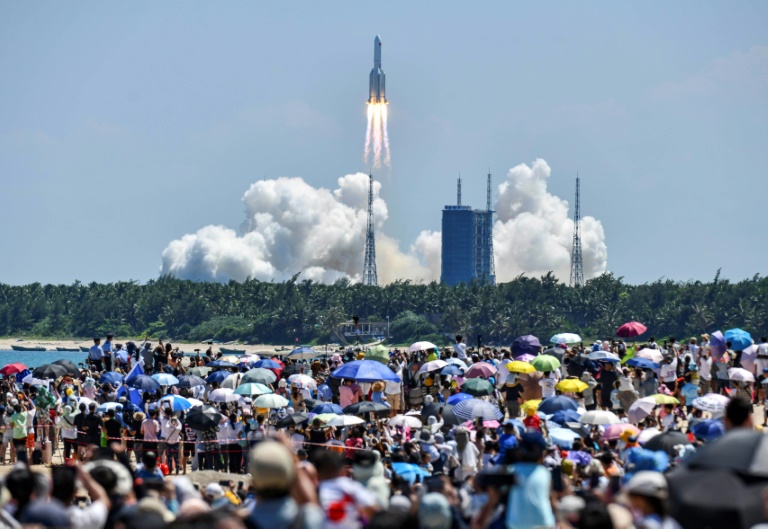
A Chinese booster rocket made an uncontrolled return to Earth on Saturday, leading US officials to chide Beijing for not sharing information about the potentially hazardous object’s descent.

US Space Command “can confirm the People’s Republic of China (PRC) Long March 5B (CZ-5B) re-entered over the Indian Ocean at approx 10:45 am MDT on 7/30,” the US military unit said on Twitter.

“We refer you to the #PRC for further details on the reentry’s technical aspects such as potential debris dispersal+ impact location,” it said.

In a statement posted to its official WeChat profile, the China Manned Space Agency later gave coordinates for an impact area in the Sulu Sea, about 35 miles (57 kilometers) off the east coast of the Philippines’ Palawan Island.

“Most of its devices were ablated and destroyed during re-entry,” the agency said of the booster rocket, which was used last Sunday to launch the second of three modules China needed to complete its new Tiangong space station.

Malaysia’s space agency said it detected rocket debris burning up on re-entry before falling in the Sulu Sea northeast of the island of Borneo.

“The debris of the rocket caught fire while entering the Earth’s airspace and the movement of the burning debris also crossed Malaysian airspace and could be detected in several areas including crossing the airspace around the state of Sarawak,” it said.

– NASA criticism –

NASA administrator Bill Nelson criticized Beijing on Twitter, saying the failure to share details of the rocket’s descent was irresponsible and risky.

“All spacefaring nations should follow established best practices, and do their part to share this type of information in advance,” Nelson wrote, “to allow reliable predictions of potential debris impact risk, especially for heavy-lift vehicles, like the Long March 5B, which carry a significant risk of loss of life and property.”

He added: “Doing so is critical to the responsible use of space and to ensure the safety of people here on Earth”.

The Tiangong space station is one of the crown jewels of Beijing’s ambitious space program, which has landed robotic rovers on Mars and the Moon, and made China only the third nation to put humans in orbit.

The new module, propelled by the Long March 5B, successfully docked with Tiangong’s core module on Monday and the three astronauts who had been living in the main compartment since June successfully entered the new lab.

When China launched its first Tiangong module in April 2021, there was a similar frenzy around the possibility of damage caused by an unpredictable booster reentry.

Objects generate immense amounts of heat and friction when they enter the atmosphere, which can cause them to burn up and disintegrate. But larger ones such as the Long March-5B may not be destroyed entirely.

In 2020, debris from another Chinese rocket fell on villages in the Ivory Coast, causing structural damage but no injuries or deaths.

China has poured billions of dollars into space flight and exploration as it seeks to build a program that reflects its stature as a rising global power.

Cyprus tourism rebounds despite sanctions-hit Russia plunge

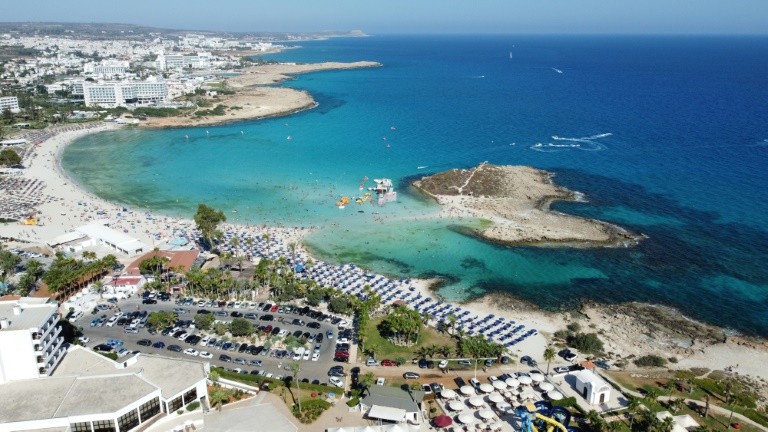
Beside sparkling Mediterranean waters at the Cypriot resort town of Ayia Napa, the bars are bouncing with foam dance parties as tourist numbers rebound following two tough years of pandemic.

But one key nationality is effectively missing: Russian visitors, as the once lucrative market has been hit by European Union sanctions imposed after Moscow invaded Ukraine.

“This year, we expected 800,000 Russian tourists,” said Haris Loizides, head of the Cyprus Hotel Association. 

The Russian market “was wiped out from one day to the next,” said Christos Angelides, head of the Pancyprian Association of Hotel Managers. “Nobody was prepared for this huge change.”

The key tourism sector, which had contributed 2.68 billion euros ($2.72 billion) in 2019, 15 percent of GDP, is still counting the cost of the disastrous years of Covid travel chaos.

In 2019, before the start of the Covid-19 pandemic, a fifth of tourists were Russian — 782,000 out of 3.9 million — making it the holiday island’s second largest market after Britain.

Last year, despite tough Covid travel restrictions, that share rose to more than 25 percent, with arrivals from Russia totalling nearly 520,000 out of 1.93 million.

Operators had hoped this summer would see Russian numbers return to pre-pandemic levels.

– Flight bans, banking sanctions –

Some 18,000 Russians are resident in Cyprus, many in the seaside town of Limassol — dubbed by some “Moscow on the Med.”

But, with EU sanctions on Russia continuing and with no let-up in the bloodshed on Ukraine’s battlefields, just 17,000 Russian tourists came to Cyprus between January and June. 

“Our hotel is doing well, but others — who had 100 percent Russian clientele — are not,” said Angelides, who is also manager of the Napa Mermaid Hotel.

Nicosia and Moscow have close political and cultural ties, but when Russia sent troops into Ukraine, the Cypriot parliament unanimously passed a resolution condemning the invasion.

Cyprus, the EU’s most easterly member, backed the bloc’s actions on Moscow, including a flight ban and sanctions barring some Russian banks from the SWIFT financial system.

The tourism ministry says fewer Russian visitors could mean some $600 million in potential lost earnings.

Overall, tourist arrivals in Cyprus are bouncing back, thanks to strong demand in other key markets following the lifting of coronavirus restrictions.

From January to June, Cyprus recorded 1.2 million visitors, nearly five times the level last year, and the white sand beaches at Ayia Napa are crowded with sunseekers and partygoers.

But that is still 25 percent down on the same period of 2019, when 1.63 million tourists came to Cyprus.

“We have somewhat limited the damage, but it is impossible to replace this huge number of customers,” Angelides added.

– ‘Big gap’ –

In the first half of this year, British tourists made up nearly two-fifths of visitors, followed by Israelis, making up seven percent of visitors, then Poland, Germany and Greece.

“There have been many attempts by several sectors to encourage tourists from other markets, such as the German, Polish, Italian and French markets,” said Charis Papacharalambous, spokesman of the Association of Cyprus Travel Agents (ACTA).

But it was still “very difficult to fill the big gap” left by Russian tourists, he added, with industry experts fearing the impact may still worsen, since many Russians previously preferred to visit later in the year.

For Loizides, from the island’s Hotel Association, the war in Ukraine has also provided another problem.

Surging global costs of fuel sparked by the conflict have driven electricity prices higher. 

With tourists turning air conditioning on full blast to counter the sweltering heat of Cyprus, hotels are struggling with “astronomical bills”, Loizides said.

“The EU must remedy this situation and help companies, especially at a time when inflation is raging,” he added.

China's July factory activity weakens on soft demand

China’s manufacturing activity logged a surprise drop in July, official data showed Sunday, on the back of weak demand and as strict zero-Covid restrictions continue to cast a pall on growth.

The Purchasing Managers’ Index (PMI), a key gauge of manufacturing activity in the world’s second-biggest economy, came in at 49.0 in July, down from 50.2 June and below the 50-point mark separating growth from contraction, National Bureau of Statistics data showed.

While sweeping Covid curbs have eased in major cities such as Shanghai and Beijing, sporadic lockdowns around the country have kept businesses and consumers worried.

“In July, the manufacturing PMI dropped… due to factors such as the traditional off-season for production, insufficient release of market demand, and decline in prosperity of high-energy-consuming industries,” said NBS senior statistician Zhao Qinghe in a statement.

Zhao added that sharp price fluctuations of raw materials had led some companies to adopt a wait-and-see approach, “weakening purchasing intentions”.

The proportion of firms saying there was insufficient market demand had also increased for four consecutive months, he said, noting this was the “main difficulty” among manufacturers.

But officials show few signs of relaxing strict pandemic curbs, with policymakers appearing to emphasise zero-Covid over growth in a Politburo meeting this week, where they vowed to strive for “the best outcome” rather than to meet economic and social targets.

“In acknowledging the difficulties, the government has finally become flexible towards this year’s growth target,” ANZ Research analysts said in a note.

Chinese leaders had originally set a full-year GDP growth target of around 5.5 percent, but with economic expansion of just 0.4 percent in the second quarter, analysts believe it is unlikely to hit that goal.

China’s non-manufacturing PMI dropped to 53.8 points as well in July, down from 54.7 in June, NBS data showed Sunday.

This follows policies to boost consumption and with a pick-up in construction activities, the NBS statement said.

Close Bitnami banner
Bitnami