AFP

China's July factory activity weakens on soft demand

China’s manufacturing activity logged a surprise drop in July, official data showed Sunday, on the back of weak demand and as strict zero-Covid restrictions continue to cast a pall on growth.

The Purchasing Managers’ Index (PMI), a key gauge of manufacturing activity in the world’s second-biggest economy, came in at 49.0 in July, down from 50.2 June and below the 50-point mark separating growth from contraction, National Bureau of Statistics data showed.

While sweeping Covid curbs have eased in major cities such as Shanghai and Beijing, sporadic lockdowns around the country have kept businesses and consumers worried.

“In July, the manufacturing PMI dropped… due to factors such as the traditional off-season for production, insufficient release of market demand, and decline in prosperity of high-energy-consuming industries,” said NBS senior statistician Zhao Qinghe in a statement.

Zhao added that sharp price fluctuations of raw materials had led some companies to adopt a wait-and-see approach, “weakening purchasing intentions”.

The proportion of firms saying there was insufficient market demand had also increased for four consecutive months, he said, noting this was the “main difficulty” among manufacturers.

But officials show few signs of relaxing strict pandemic curbs, with policymakers appearing to emphasise zero-Covid over growth in a Politburo meeting this week, where they vowed to strive for “the best outcome” rather than to meet economic and social targets.

“In acknowledging the difficulties, the government has finally become flexible towards this year’s growth target,” ANZ Research analysts said in a note.

Chinese leaders had originally set a full-year GDP growth target of around 5.5 percent, but with economic expansion of just 0.4 percent in the second quarter, analysts believe it is unlikely to hit that goal.

China’s non-manufacturing PMI dropped to 53.8 points as well in July, down from 54.7 in June, NBS data showed Sunday.

This follows policies to boost consumption and with a pick-up in construction activities, the NBS statement said.

Mountain melt shutters classic Alpine routes

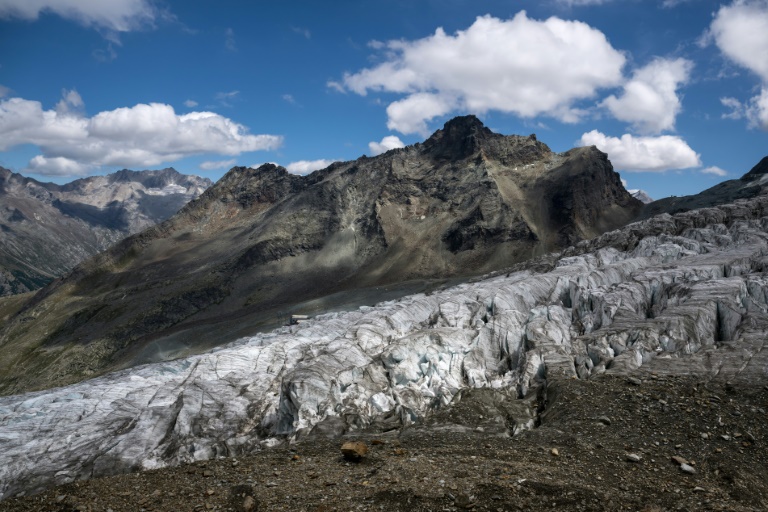
Little snow cover and glaciers melting at an alarming rate amid Europe’s sweltering heatwaves have put some of the most classic Alpine hiking routes off-limits.

Usually at the height of summer, tourists flock to the Alps and seek out well-trodden paths up to some of Europe’s most iconic peaks. 

But with warmer temperatures speeding up glacier melt and thawing permafrost — which scientists say are driven by climate change — routes that are usually safe this time of year now face hazards like falling rocks released from the ice.

“Currently in the Alps, there are warnings for around a dozen peaks, including emblematic ones like Matterhorn and Mount Blanc,” Pierre Mathey, head of the Swiss mountain guide association, told AFP.

This is happening far earlier in the season than normal, he said.

“Usually we see such closures in August, but now they have started at the end of June and are continuing in July.”

– ‘Postpone’ –

Alpine guides who usually lead thousands of hikers up towards Europe’s highest peak announced earlier this week that they would suspend ascents on the most classic routes up Mont Blanc, which straddles France, Italy and Switzerland.

The Guide Alpine Italiane said on its Facebook page that the “particularly delicate conditions” caused by the temperature spike made it necessary to “postpone the climbs”.

Mountain guides have also refrained — reportedly for the first time in a century — from offering tours up the classic route to the Jungfrau peak in Switzerland.

And they have advised against tours along routes on both the Italian and Swiss sides of the towering pyramid-shaped Matterhorn peak.

Ezio Marlier, president of the Valle D’Aosta guides association, said having to steer clear of routes most coveted by tourists was a blow after the Covid slowdowns.

“It is not easy… after two almost empty seasons to decide to halt work,” he told AFP.

He stressed that the Italian Alpine region had shut only two and that there were many other breathtaking and safe routes to take.

But he lamented that many people simply cancelled their trip when they heard their preferred route was off-limits.

“There are plenty of other things to do, but usually when people want Mont Blanc, they want Mont Blanc.”

– Dangerous glaciers –

Climbing on some of the thousands of glaciers dotting Europe’s largest mountain range is also proving trickier. 

“The glaciers are in a state that they are usually in at the end of the summer or even later,” said Andreas Linsbauer, a glaciologist at Zurich University.

“It is sure that we will break the record for negative melts,” he told AFP.

He said a combination of factors were contributing to a “really extreme” summer, starting with exceptionally little snowfall last winter, meaning there was less to protect the glaciers.

Sand also blew up from the Sahara early in the year, darkening the snow, which makes it melt faster.

And then the first heatwave hit Europe in May, with subsequent ones following in June and July, pushing up temperatures even at high altitudes.

The rapid melting can make glaciers more dangerous, as seen with the sudden collapse of Italy’s until then seemingly harmless Marmolada glacier earlier this month, which saw 11 people killed as ice and rock hurtled down the mountain.

While scientists have yet to draw clear conclusions on what caused the disaster, one theory is that meltwater may have reached the point where the glacier was frozen to the rock, loosening its grip.

– ‘Invisible threat’ –

Mylene Jacquemart, a glacier and mountain hazard researcher at Zurich’s ETH university, told AFP there were many unknowns about the catastrophe.

“But the general theme is definitely that more meltwater… makes things complicated and potentially more dangerous.”

Mathey, who said warmer temperatures had put mountain guides on high alert, also voiced concern that meltwater filtering under a glacier posed an “additional and invisible threat”.

But despite the challenges, he voiced confidence that guides would find solutions, seeking out alternative routes to keep showing off Alpine splendours.

“Resilience is really in the mountain guides’ DNA,” as is adaptability, he said.

“Humans have to adapt to nature and to the mountains, not the other way around.”

Zelensky urges evacuation of Ukraine's frontline Donetsk

Ukraine’s president urged civilians on Saturday to evacuate the frontline Donetsk region, the scene of fierce clashes with the Russian military, as Kyiv called on the Red Cross and UN to gain access to its soldiers being held by Moscow’s forces.

The eastern Donetsk region has faced the brunt of Russia’s offensive since its assault on Kyiv failed weeks into the invasion launched on February 24.

President Volodymyr Zelensky warned in his daily address that thousands of people, including children, were still in the region’s battleground areas, with six civilians killed and 15 wounded on Friday, according to the Donetsk governor.

“There’s already a governmental decision about obligatory evacuation from Donetsk,” Zelensky said, underscoring authorities’ calls to leave the besieged region in recent weeks.

“Leave, we will help,” Zelensky said. “At this stage of the war, terror is the main weapon of Russia.”

Official Ukrainian estimates put the number of civilians still living in the unoccupied area of Donetsk at between 200,000 and 220,000.

A mandatory evacuation notice posted Saturday evening said the coming winter made it a matter of urgency, particularly for the more than 50,000 children still in the region.

“They need to be evacuated, you cannot put them in mortal danger in the winter without heating, light, without the ability to keep them warm,” Kyiv’s Ministry of Reintegration of Temporarily Occupied Territories said in a statement.

Zelensky, in his address, also once more pressed the international community, especially the United States, to have Russia officially declared a “state sponsor of terrorism”.

He reiterated the call a day after a jail holding Ukrainian prisoners of war in Kremlin-controlled Olenivka was bombed, leaving scores dead, with Kyiv and Moscow trading blame. 

On Saturday, Ukrainian human rights official Dmytro Lubinets said on national television he had asked the International Committee of the Red Cross (ICRC) and the United Nations Human Rights Monitoring Mission to go to Olenivka.

The ICRC has made a request but has not yet obtained authorisation from the Russians, he said.

– ‘Egregious provocation’ –

Russia’s defence ministry accused Kyiv of striking the Olenivka prison with US-supplied long-range missiles, in an “egregious provocation” designed to stop captured soldiers from surrendering.

It said Saturday that the dead included Ukrainian forces who had surrendered after weeks of fighting off Russia’s brutal bombardment of the sprawling Azovstal steelworks in the port city of Mariupol. 

The defence ministry said 50 Ukrainian prisoners were killed and 73 were taken to hospital with serious injuries.

“All political, legal and moral responsibility for this bloody massacre of Ukrainians lies with Zelensky personally, his criminal regime and Washington, which backs them,” it said.

Zelensky laid the blame squarely on Russia.

“This was a deliberate Russian war crime, a deliberate mass murder of Ukrainian prisoners of war,” he said.

Members of the Azov regiment were among those who surrendered at Azovstal.

Azov regiment commander Mykyta Nadtochiy said he considered the attack on the jail to have been “an act of public execution”.

– Gazprom cuts off Latvia –

Also on Saturday, Russian energy giant Gazprom suspended gas supplies to Latvia, in the latest tightening of gas provision to European Union states, which have accused Russia of squeezing supplies in retaliation for Western sanctions imposed over Moscow’s invasion of Ukraine.

Conexus Baltic Grid confirmed to Latvia’s LETA news agency that Gazprom had informed it of the suspension of deliveries, but said other suppliers were continuing them.

“Today, Gazprom suspended its gas supplies to Latvia… due to violations of the conditions” of purchase, the company said on Telegram.

Latvia’s Economy Minister Ilze Indriksone told LETA that his country “was not counting on natural gas flows from Russia.”

Gazprom drastically cut gas deliveries to Europe via the Nord Stream pipeline on Wednesday to about 20 percent of its capacity. It had reduced gas flows to Europe twice in June.

The Russian state-run company had earlier announced it would choke supply to 33 million cubic metres a day — half the amount it has been delivering since service resumed last week after 10 days of maintenance work.

Gazprom cited the halted operation of one of the last two working turbines for the pipeline due to the “technical condition of the engine”.

Kremlin spokesman Dmitry Peskov has blamed EU sanctions for the limited supply.

The EU this week agreed a plan to reduce gas consumption in solidarity with Germany, where the Nord Stream pipeline runs to, warning of Russian “blackmail”.

– Grain fields set alight –

Russian strikes continued to rain down on Ukrainian towns and cities on Saturday.

Ukrainian authorities said Russian bombardments targeting the south and east of the country had left one dead in southern Mykolaiv and one dead in eastern Bakhmut.

The death toll from a strike on a Mykolaiv bus stop on Friday climbed to seven after two men died in hospital, he added.

In the eastern city of Kharkiv, three Russian S-300 missiles struck a school, mayor Igor Terekhov said on Telegram, adding that the main building was destroyed.

A Ukrainian spokesman said his country’s forces had set fire to grain fields around Mariupol so they could not be used by the Russians.

“The Mariupol resistance forces set fire to the fields with grain so that it would not be stolen by the occupiers,” Sergiy Bratchuk, a spokesman for the Odessa regional military administration said.


Zelensky urges evacuation of Ukraine's frontline Donetsk

Ukraine’s president urged civilians on Saturday to evacuate the frontline Donetsk region, the scene of fierce clashes with the Russian military, as Kyiv called on the Red Cross and UN to gain access to its soldiers being held by Moscow’s forces.

The eastern Donetsk region has faced the brunt of Russia’s offensive since its assault on Kyiv failed weeks into the invasion launched on February 24.

President Volodymyr Zelensky warned in his daily address that thousands of people, including children, were still in the region’s battleground areas, with six civilians killed and 15 wounded on Friday, according to the Donetsk governor.

“There’s already a governmental decision about obligatory evacuation from Donetsk,” Zelensky said, underscoring authorities’ calls to leave the besieged region in recent weeks.

“Leave, we will help,” Zelensky said. “At this stage of the war, terror is the main weapon of Russia.”

Official Ukrainian estimates put the number of civilians still living in the unoccupied area of Donetsk at between 200,000 and 220,000.

A mandatory evacuation notice posted Saturday evening said the coming winter made it a matter of urgency, particularly for the more than 50,000 children still in the region.

“They need to be evacuated, you cannot put them in mortal danger in the winter without heating, light, without the ability to keep them warm,” Kyiv’s Ministry of Reintegration of Temporarily Occupied Territories said in a statement.

Zelensky, in his address, also once more pressed the international community, especially the United States, to have Russia officially declared a “state sponsor of terrorism”.

He reiterated the call a day after a jail holding Ukrainian prisoners of war in Kremlin-controlled Olenivka was bombed, leaving scores dead, with Kyiv and Moscow trading blame. 

On Saturday, Ukrainian human rights official Dmytro Lubinets said on national television he had asked the International Committee of the Red Cross (ICRC) and the United Nations Human Rights Monitoring Mission to go to Olenivka.

The ICRC has made a request but has not yet obtained authorisation from the Russians, he said.

– ‘Egregious provocation’ –

Russia’s defence ministry accused Kyiv of striking the Olenivka prison with US-supplied long-range missiles, in an “egregious provocation” designed to stop captured soldiers from surrendering.

It said Saturday that the dead included Ukrainian forces who had surrendered after weeks of fighting off Russia’s brutal bombardment of the sprawling Azovstal steelworks in the port city of Mariupol. 

The defence ministry said 50 Ukrainian prisoners were killed and 73 were taken to hospital with serious injuries.

“All political, legal and moral responsibility for this bloody massacre of Ukrainians lies with Zelensky personally, his criminal regime and Washington, which backs them,” it said.

Zelensky laid the blame squarely on Russia.

“This was a deliberate Russian war crime, a deliberate mass murder of Ukrainian prisoners of war,” he said.

Members of the Azov regiment were among those who surrendered at Azovstal.

Azov regiment commander Mykyta Nadtochiy said he considered the attack on the jail to have been “an act of public execution”.

– Gazprom cuts off Latvia –

Also on Saturday, Russian energy giant Gazprom suspended gas supplies to Latvia, in the latest tightening of gas provision to European Union states, which have accused Russia of squeezing supplies in retaliation for Western sanctions imposed over Moscow’s invasion of Ukraine.

Conexus Baltic Grid confirmed to Latvia’s LETA news agency that Gazprom had informed it of the suspension of deliveries, but said other suppliers were continuing them.

“Today, Gazprom suspended its gas supplies to Latvia… due to violations of the conditions” of purchase, the company said on Telegram.

Latvia’s Economy Minister Ilze Indriksone told LETA that his country “was not counting on natural gas flows from Russia.”

Gazprom drastically cut gas deliveries to Europe via the Nord Stream pipeline on Wednesday to about 20 percent of its capacity. It had reduced gas flows to Europe twice in June.

The Russian state-run company had earlier announced it would choke supply to 33 million cubic metres a day — half the amount it has been delivering since service resumed last week after 10 days of maintenance work.

Gazprom cited the halted operation of one of the last two working turbines for the pipeline due to the “technical condition of the engine”.

Kremlin spokesman Dmitry Peskov has blamed EU sanctions for the limited supply.

The EU this week agreed a plan to reduce gas consumption in solidarity with Germany, where the Nord Stream pipeline runs to, warning of Russian “blackmail”.

– Grain fields set alight –

Russian strikes continued to rain down on Ukrainian towns and cities on Saturday.

Ukrainian authorities said Russian bombardments targeting the south and east of the country had left one dead in southern Mykolaiv and one dead in eastern Bakhmut.

The death toll from a strike on a Mykolaiv bus stop on Friday climbed to seven after two men died in hospital, he added.

In the eastern city of Kharkiv, three Russian S-300 missiles struck a school, mayor Igor Terekhov said on Telegram, adding that the main building was destroyed.

A Ukrainian spokesman said his country’s forces had set fire to grain fields around Mariupol so they could not be used by the Russians.

“The Mariupol resistance forces set fire to the fields with grain so that it would not be stolen by the occupiers,” Sergiy Bratchuk, a spokesman for the Odessa regional military administration said.
Crypto clients beg for their cash back after lender's crash

An Irishman at risk of losing his farm. An American having suicidal thoughts. An 84-year-old widow’s lost life savings: People caught in the meltdown of crypto lender Celsius are pleading for their money back. 

Hundreds of letters have poured in to the judge overseeing the firm’s multi-billion-dollar bankruptcy and they are heavy with anger, shame, desperation and, frequently, regret.

“I knew there were risks,” said a client whose letter was unsigned. “It seemed a worthwhile risk.”

Celsius and its CEO Alex Mashinsky had billed the platform as a safe place for people to deposit their crypto currencies in exchange for high interest, while the firm lent out and invested those deposits.

But as the value of highly volatile crypto currencies plummeted –- bitcoin alone has shed over 60 percent since November -– the firm faced mounting troubles until it froze withdrawals in mid-June.

The company owed $4.7 billion to its users, according to a court filing earlier this month, and the endgame is unclear.

The letters –- posted to a public online court docket –- come from around the world and recount tragic results of users’ money being frozen.

“From that hard-working single mom in Texas struggling with past-due bills, to the teacher in India with all his hard-earned money deposited in Celsius –- I believe I can speak for most of us when I say I feel betrayed, ashamed, depressed, angry,” wrote one client who signed their letter E.L.

While the letters vary in their level of sophistication about the crypto world -– from self-confessed novices to all-in evangelists –- and the monetary impacts range from a few hundred dollars to seven-figure sums, nearly all agree on one thing.

“I have been a loyal Celsius customer since 2019 and feel completely lied to Alex Mashinsky,” wrote a client who AFP is not identifying to protect his privacy. “Alex would talk about how Celsius is safer than banks.”

Many of the letters point to the CEO’s AMA (Ask Mashinsky Anything) online chats as key to their confidence in him and the platform, which presented itself as stable until days before it froze users’ funds.

– Repeated assurances before fall –

“Celsius has one of the best risk management teams in the world. Our security team and infrastructure is second to none,” the firm wrote on June 7. 

“We have made it through crypto downturns before (this is our fourth!). Celsius is prepared,” the firm wrote.

The message also said the company had the reserves to pay its obligations, and withdrawals were being processed as normal. 

One client, who reported having $32,000 in crypto locked up at Celsius, noted the impact.

“Right up until the end, the retail investor received assurance,” the client wrote to the judge.

But that changed quickly, and on June 12 Celsius announced the freeze: “We are taking this action today to put Celsius in a better position to honor, over time, its withdrawal obligations.”

Some clients got the news in a message from the company.

“By the time I finished the e-mail, I had collapsed onto the floor with my head in my hands and I fought back tears,” wrote one man who had about $50,000 in assets with Celsius.

The clients who said they were hardest hit, including a man who said he placed $525,000 he got from a government loan on Celsius, disclosed they had considered killing themselves.

Others reported heavy stress, lack of sleep and feelings of deep shame for putting their retirement savings or their children’s college money into a platform that was far riskier than they knew.

“As a private unregulated company, Celsius does not come under any requirement for disclosure,” is how the Washington Post summarized the situation.

Celsius did not reply to a request for comment on the clients’ letters.

For people like one 84-year-old woman, who only had her roughly $30,000 in crypto savings on Celsius for a month, their hope lies in the bankruptcy proceedings.

“It’s just not unusual for people to come out of something like this with zero,” said Don Coker, an expert witness on banking and finance.

“Obviously I feel sorry for anyone who loses an investment like this, but it is just something where they need to be aware of the risks,” he said.

Crypto clients beg for their cash back after lender's crash

An Irishman at risk of losing his farm. An American having suicidal thoughts. An 84-year-old widow’s lost life savings: People caught in the meltdown of crypto lender Celsius are pleading for their money back. 

Hundreds of letters have poured in to the judge overseeing the firm’s multi-billion-dollar bankruptcy and they are heavy with anger, shame, desperation and, frequently, regret.

“I knew there were risks,” said a client whose letter was unsigned. “It seemed a worthwhile risk.”

Celsius and its CEO Alex Mashinsky had billed the platform as a safe place for people to deposit their crypto currencies in exchange for high interest, while the firm lent out and invested those deposits.

But as the value of highly volatile crypto currencies plummeted –- bitcoin alone has shed over 60 percent since November -– the firm faced mounting troubles until it froze withdrawals in mid-June.

The company owed $4.7 billion to its users, according to a court filing earlier this month, and the endgame is unclear.

The letters –- posted to a public online court docket –- come from around the world and recount tragic results of users’ money being frozen.

“From that hard-working single mom in Texas struggling with past-due bills, to the teacher in India with all his hard-earned money deposited in Celsius –- I believe I can speak for most of us when I say I feel betrayed, ashamed, depressed, angry,” wrote one client who signed their letter E.L.

While the letters vary in their level of sophistication about the crypto world -– from self-confessed novices to all-in evangelists –- and the monetary impacts range from a few hundred dollars to seven-figure sums, nearly all agree on one thing.

“I have been a loyal Celsius customer since 2019 and feel completely lied to Alex Mashinsky,” wrote a client who AFP is not identifying to protect his privacy. “Alex would talk about how Celsius is safer than banks.”

Many of the letters point to the CEO’s AMA (Ask Mashinsky Anything) online chats as key to their confidence in him and the platform, which presented itself as stable until days before it froze users’ funds.

– Repeated assurances before fall –

“Celsius has one of the best risk management teams in the world. Our security team and infrastructure is second to none,” the firm wrote on June 7. 

“We have made it through crypto downturns before (this is our fourth!). Celsius is prepared,” the firm wrote.

The message also said the company had the reserves to pay its obligations, and withdrawals were being processed as normal. 

One client, who reported having $32,000 in crypto locked up at Celsius, noted the impact.

“Right up until the end, the retail investor received assurance,” the client wrote to the judge.

But that changed quickly, and on June 12 Celsius announced the freeze: “We are taking this action today to put Celsius in a better position to honor, over time, its withdrawal obligations.”

Some clients got the news in a message from the company.

“By the time I finished the e-mail, I had collapsed onto the floor with my head in my hands and I fought back tears,” wrote one man who had about $50,000 in assets with Celsius.

The clients who said they were hardest hit, including a man who said he placed $525,000 he got from a government loan on Celsius, disclosed they had considered killing themselves.

Others reported heavy stress, lack of sleep and feelings of deep shame for putting their retirement savings or their children’s college money into a platform that was far riskier than they knew.

“As a private unregulated company, Celsius does not come under any requirement for disclosure,” is how the Washington Post summarized the situation.

Celsius did not reply to a request for comment on the clients’ letters.

For people like one 84-year-old woman, who only had her roughly $30,000 in crypto savings on Celsius for a month, their hope lies in the bankruptcy proceedings.

“It’s just not unusual for people to come out of something like this with zero,” said Don Coker, an expert witness on banking and finance.

“Obviously I feel sorry for anyone who loses an investment like this, but it is just something where they need to be aware of the risks,” he said.

Kentucky flooding death toll rises to 25

Devastating flooding in Kentucky has killed 25 people and the toll is expected to rise, the southern US state’s governor said Saturday, as rescuers and residents continued a harrowing search for survivors.

Torrential rain earlier this week caused unprecedented flash flooding in 13 counties in eastern Kentucky.

Many roads and bridges in that mountainous region — an area high in poverty due to the declining coal industry — have been damaged or destroyed. With cell phone service seriously disrupted, finding survivors has been difficult.

“I’m worried we are going to be finding bodies for weeks to come. Keep praying,” Governor Andy Beshear said in a midday news briefing, shortly after tweeting that the death toll had risen to 25 from 16 a day earlier.

The Democratic governor confirmed that “we are still in the search and rescue phase,” saying, “We will get through this together.”

Beshear said an earlier report that six children were among the dead was inaccurate; two of them had turned out to be adults.

The four children, US media reported, were lost in a heart-rending drama. Members of a family, clinging to a tree after a fast-rising stream had engulfed their mobile home, saw their children torn from their grip, one after another, by powerfully surging waters.

Beshear said national guard units from Kentucky, Tennessee and West Virginia had made more than 650 air rescues since the flooding began Wednesday evening, while state police and other state personnel had registered some 750 water rescues.

He said the search was “tremendously stressful and difficult,” with mudslides and flooded roads blocking travel.

Seventeen-year-old Chloe Adams was home alone in Whitesburg when she awoke to the sound of water rushing into her grandfather’s house, where she lives.

“There was water as far as I could see,” she told CNN. “I had a panic attack.”

Realizing she needed to swim to safety, she put her dog, Sandy, in a plastic tub. They made it only to the roof of a nearby shed, barely above the roaring waters.

She and Sandy sat there, shivering, for five hours until a cousin arrived in a kayak to rescue them.

– More rain ahead –

Some areas in eastern Kentucky had reported receiving more than eight inches (20 centimeters) of rain in a 24-hour period.

In Whitesburg, the water level of the North Fork of the Kentucky River rose to a staggering 20 feet within hours, well above its previous record of 14.7 feet.

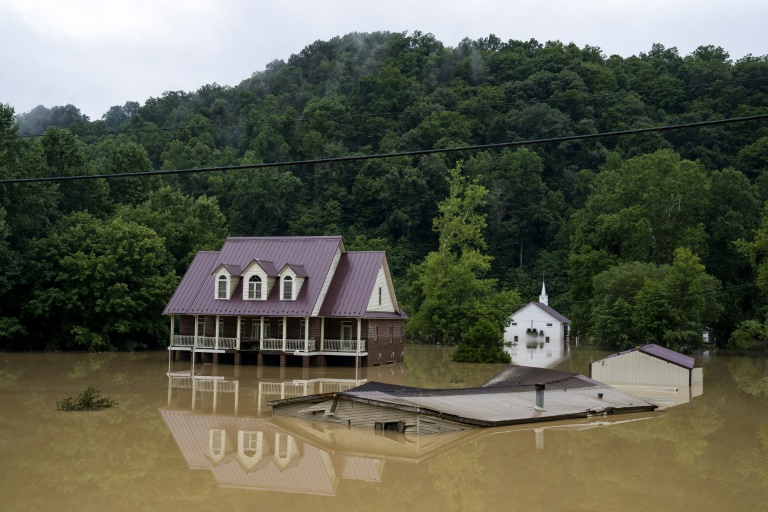
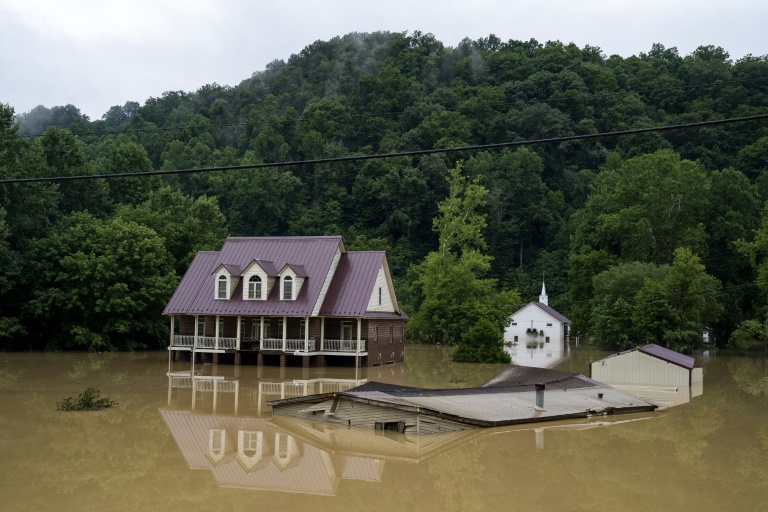
The flooding turned many roads into rivers, and some houses in low-lying areas were almost completely submerged, with just their rooftops visible.

Scenes on social media showed houses ripped from their moorings and deposited amid masses of debris along riverbanks or even atop a bridge.

The weather offered a respite on Saturday, but more rain was expected the following day, with one to two additional inches expected. The National Weather Service has issued flood watches or warnings for most of the area through Sunday.

Beshear told CNN on Saturday that the impending rain posed a challenge, and “while we don’t think it’ll be historic rain, it’ll be hard.”

Once waters begin to recede, he said, further devastation — and death — would likely emerge.

He said during the briefing that 15 emergency shelters had been opened in schools, churches and state parks, though at least one had been “overwhelmed.”

Some 18,000 homes remained without power, Beshear said, and thousands were without safe water supplies. 

The governor noted that the Federal Emergency Management Agency had sent 18 tractor-trailers of water so far. Other federal workers were arriving to process claims.

President Joe Biden has issued a disaster declaration for the area, allowing federal aid to supplement state and local recovery efforts.

The flooding is the latest in a series of extreme weather events that scientists say are an unmistakable sign of climate change.

Nearly 60 people were killed in western Kentucky by a tornado in December 2021 — a disaster that Beshear said offered lessons for current efforts on the other end of the state.

“We learned a lot of lessons in western Kentucky on those devastating tornados about seven months ago, so we are providing as much support as we can and we are moving fast from all over the state to help out,” he said on CNN.

In his briefing, Beshear expressed compassion for hard-hit residents.

“We can’t imagine the grief you’re going through right now,” he said.

Kentucky flooding death toll rises to 25

Devastating flooding in Kentucky has killed 25 people and the toll is expected to rise, the southern US state’s governor said Saturday, as rescuers and residents continued a harrowing search for survivors.

Torrential rain earlier this week caused unprecedented flash flooding in 13 counties in eastern Kentucky.

Many roads and bridges in that mountainous region — an area high in poverty due to the declining coal industry — have been damaged or destroyed. With cell phone service seriously disrupted, finding survivors has been difficult.

“I’m worried we are going to be finding bodies for weeks to come. Keep praying,” Governor Andy Beshear said in a midday news briefing, shortly after tweeting that the death toll had risen to 25 from 16 a day earlier.

The Democratic governor confirmed that “we are still in the search and rescue phase,” saying, “We will get through this together.”

Beshear said an earlier report that six children were among the dead was inaccurate; two of them had turned out to be adults.

The four children, US media reported, were lost in a heart-rending drama. Members of a family, clinging to a tree after a fast-rising stream had engulfed their mobile home, saw their children torn from their grip, one after another, by powerfully surging waters.

Beshear said national guard units from Kentucky, Tennessee and West Virginia had made more than 650 air rescues since the flooding began Wednesday evening, while state police and other state personnel had registered some 750 water rescues.

He said the search was “tremendously stressful and difficult,” with mudslides and flooded roads blocking travel.

Seventeen-year-old Chloe Adams was home alone in Whitesburg when she awoke to the sound of water rushing into her grandfather’s house, where she lives.

“There was water as far as I could see,” she told CNN. “I had a panic attack.”

Realizing she needed to swim to safety, she put her dog, Sandy, in a plastic tub. They made it only to the roof of a nearby shed, barely above the roaring waters.

She and Sandy sat there, shivering, for five hours until a cousin arrived in a kayak to rescue them.

– More rain ahead –

Some areas in eastern Kentucky had reported receiving more than eight inches (20 centimeters) of rain in a 24-hour period.

In Whitesburg, the water level of the North Fork of the Kentucky River rose to a staggering 20 feet within hours, well above its previous record of 14.7 feet.

The flooding turned many roads into rivers, and some houses in low-lying areas were almost completely submerged, with just their rooftops visible.

Scenes on social media showed houses ripped from their moorings and deposited amid masses of debris along riverbanks or even atop a bridge.

The weather offered a respite on Saturday, but more rain was expected the following day, with one to two additional inches expected. The National Weather Service has issued flood watches or warnings for most of the area through Sunday.

Beshear told CNN on Saturday that the impending rain posed a challenge, and “while we don’t think it’ll be historic rain, it’ll be hard.”

Once waters begin to recede, he said, further devastation — and death — would likely emerge.

He said during the briefing that 15 emergency shelters had been opened in schools, churches and state parks, though at least one had been “overwhelmed.”

Some 18,000 homes remained without power, Beshear said, and thousands were without safe water supplies. 

The governor noted that the Federal Emergency Management Agency had sent 18 tractor-trailers of water so far. Other federal workers were arriving to process claims.

President Joe Biden has issued a disaster declaration for the area, allowing federal aid to supplement state and local recovery efforts.

The flooding is the latest in a series of extreme weather events that scientists say are an unmistakable sign of climate change.

Nearly 60 people were killed in western Kentucky by a tornado in December 2021 — a disaster that Beshear said offered lessons for current efforts on the other end of the state.

“We learned a lot of lessons in western Kentucky on those devastating tornados about seven months ago, so we are providing as much support as we can and we are moving fast from all over the state to help out,” he said on CNN.

In his briefing, Beshear expressed compassion for hard-hit residents.

“We can’t imagine the grief you’re going through right now,” he said.

Chinese booster rocket makes uncontrolled return to Earth: US officials

A Chinese booster rocket made an uncontrolled return to Earth on Saturday, US Defense Department officials said, as they chided Beijing for not sharing information on the potentially hazardous object’s descent.

US Space Command “can confirm the People’s Republic of China (PRC) Long March 5B (CZ-5B) re-entered over the Indian Ocean at approx 10:45 am MDT on 7/30,” the US military unit said on Twitter, referring to China’s official name.

“We refer you to the #PRC for further details on the reentry’s technical aspects such as potential debris dispersal+ impact location,” it said.

The Long March 5B rocket was used last Sunday to launch an uncrewed spacecraft, named Wentian, carrying the second of three modules China needed to complete its new Tiangong space station.

NASA administrator Bill Nelson criticized Beijing on Twitter Saturday, saying that the failure to share the details of the rocket’s descent was irresponsible and risky.

“All spacefaring nations should follow established best practices, and do their part to share this type of information in advance,” Nelson wrote, “to allow reliable predictions of potential debris impact risk, especially for heavy-lift vehicles, like the Long March 5B, which carry a significant risk of loss of life and property.”

He added: “Doing so is critical to the responsible use of space and to ensure the safety of people here on Earth”.

The Tiangong space station is one of the crown jewels of Beijing’s ambitious space program, which has landed robotic rovers on Mars and the Moon, and made China only the third nation to put humans in orbit.

The new module, propelled by the Long March 5B, successfully docked with Tiangong’s core module on Monday and the three astronauts who had been living in the main compartment since June successfully entered the new lab.

China has poured billions of dollars into space flight and exploration as it seeks to build a program that reflects its stature as a rising global power.

Biden again tests positive for Covid, returns to isolation

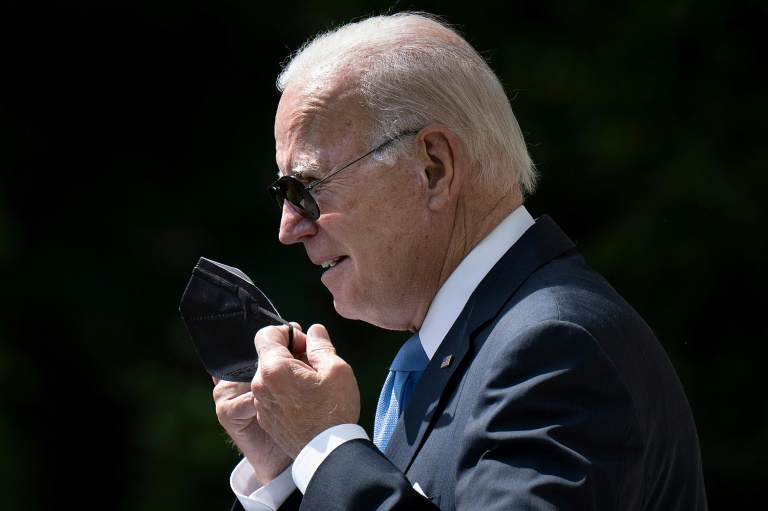
Joe Biden has tested positive for Covid-19 for a second time and is returning to isolation, his White House doctor said Saturday, attributing the result to “rebound” positivity from treatment the US president received.

Biden “tested positive late Saturday morning, by antigen testing,” following four consecutive days of negative tests, and “will reinitiate strict isolation procedures,” presidential physician Kevin O’Connor wrote in a memorandum.

“This in fact represents ‘rebound’ positivity,” O’Connor said, referring to a situation in which patients treated with the drug Paxlovid — as Biden was — clear the virus but test positive after completing their course.

“The president has experienced no re-emergence of symptoms and continues to feel quite well. This being the case, there is no reason to reinitiate treatment at this time,” he added.

In a tweet, Biden seemed to seek to minimize the situation.

“Folks, today I tested positive for COVID again. This happens with a small minority of folks,” he wrote. “I’ve got no symptoms but I am going to isolate for the safety of everyone around me. I’m still at work, and will be back on the road soon.”

Biden canceled planned trips to  Delaware and Michigan, the White House said.

– ‘Specifically conscientious’ –

The second positive test came just three days after O’Connor said Biden had tested negative and no longer needed to isolate, which he had been doing since receiving a first positive result on July 21.

Biden has for the most part been conspicuously careful about observing Covid protocols — in contrast to his predecessor Donald Trump, who sometimes mocked those who wore masks.

“The President continues to be very specifically conscientious to protect any of the Executive Residence, White House, Secret Service and other staff whose duties require any (albeit socially distanced) proximity to him,” O’Connor said.

As the oldest US president in history — he will turn 80 in November — Biden’s health receives constant attention.

On Wednesday, he had ended his earlier five-day Covid isolation, appearing energetic as he told cheering aides that his quick recovery should inspire Americans to take advantage of free vaccines and treatments.

He contrasted his seemingly quick recovery to Trump’s more serious bout with the disease in October 2020, before vaccines were available.

“When my predecessor got Covid, he had to get helicoptered to Walter Reed Medical Center,” Biden said. “He was severely ill. Thankfully, he recovered. When I got Covid, I worked from upstairs of the White House.”

He added that being fully vaccinated, taking preventative tests, then using the Paxlovid therapeutic prevents deaths and is available at no cost.

“You don’t need to be president to get these tools,” he said.

O’Connor had warned after clearing Biden from his first round of Covid that the president would wear a mask for 10 days when around others and continue to test regularly in case of a “rebound.” 

O’Connor says Biden is generally in good health. He has been fully vaccinated and received two booster shots against the coronavirus.

Close Bitnami banner
Bitnami