AFP

VW's new CEO faces twin challenges of Porsche, software problems

When Oliver Blume ascends to the top job at German automaker Volkswagen in September, he will be faced with taming the challenges that led to the fall of his predecessor, Herbert Diess, last week.

Serial technical troubles at Europe’s largest carmaker, as well as fractious relationships with workers’ representatives spelled the end of the road for Diess as chief executive, who was ousted in a supervisory board coup.

Blume is moving up from Porsche, VW’s premium sports car brand, which is set to go public later this year during a turbulent time for markets. 

In his four years at the helm of Volkswagen, 63-year-old Diess steered the legacy carmaker out of its 2015 “dieselgate” emissions-cheating scandal onto an ambitious programme to become the world’s biggest electric car manufacturer by 2025.

But difficulties at VW’s software arm, Cariad, a pet project of Diess’s, have delayed key plans and made it harder to catch up with competitors like US manufacturer Tesla.  

Software is the “number-one challenge”, said Matthias Schmidt, an auto analyst based in Berlin.

Bringing software development in-house, shedding outside suppliers and keeping control of computing architecture of the car, is difficult to achieve, but has potentially huge financial benefits.

Blume “needs to decide whether he will continue to follow Diess’s plan” or make a strategic decision to “buy it in” and “live with the consequence of seeing that potential profit centre vanish”, Schmidt told AFP.

“The idea of doing everything in a centralised way will probably be rethought,” said German automotive expert Ferdinand Dudenhoeffer.

– Unanimous vote –

In addition to the troubles at Cariad, Diess’s position as CEO was weakened by running battles with workers’ representatives.

The tendency of Austrian-born Diess to rub people up the wrong way and the proliferation of internal spats were the main reason for his exit, according to a source at the carmaker.

There were no dissenters on the vote to finally eject him, just before the start of the summer holidays.

Diess “had enemies” and was “not liked by the politicians or the works council” represented on the supervisory board, Dudenhoeffer said.

The outgoing CEO’s propensity for conflict was “very important” to get the group to face up to its past and find a new direction, he said.

But the task at hand was to carry out the changes Diess had identified as necessary, not to keep bashing heads together, Dudenhoeffer added.

– ‘Cooperative’ –

Blume is likely to steer clear of the provocative comparisons with US competitors and strongly worded tweets that won Diess few friends. 

The new chief, who has spent his entire career at Volkswagen, is more “cooperative” than Diess, who was hired from rival German carmaker BMW, Dudenhoeffer said.

Chief financial officer Arno Antlitz will bring continuity to the top team at Volkswagen, adding chief operating officer to his portfolio of roles.

Blume will “continue Diess’s big strategic projects”, said Dudenhoeffer, including making VW’s own batteries, building a modern factory close to its headquarters in Wolfsburg and developing mobility services with the reacquisition of rental company Europcar.

Blume will take the steering wheel of the group on September 1, while also retaining his CEO role at Porsche, which is set for a stock market entry in the last three months of 2022.

Blume would likely stay at Porsche through the flotation before having to “concentrate on managing the VW group machine”, said Schmidt.

The future CEO “will be judged on VW’s success in China” and the US, two key markets where Volkswagen has struggled in recent times, said Dudenhoeffer.
McDonald's tracking inflation impact as Russia exit hits profits

McDonald’s reported lower profits Tuesday following the hit from its Russia withdrawal, as it keeps a close eye on restaurant traffic amid rising consumer inflation.

The US restaurant chain scored higher comparable sales in most major markets except China, where Covid-19 restrictions hit sales.

This included a strong performance in Europe, where the chain highlighted France and Germany as especially robust markets. 

However, Chief Executive Chris Kempczinski cited surveys showing weakening consumer sentiment as a source of unease.

“The headline is Europe is doing very well for us,” Kempczinski told analysts on a conference call. 

“What is weighing on our mind is consumer sentiment,” he said, adding that the company is pondering how heavily to “lean in” to value offerings in Europe.

“Because of this uncertainty around consumer sentiment, we’re having to plan for more scenarios,” he said.

McDonald’s reported profits of $1.2 billion, down 46 percent from the year-ago period on a three percent drop in revenues to $5.7 billion.

Results were dented by $1.2 billion in costs connected to McDonald’s sudden sale of its Russia business in the wake of the country’s invasion of Ukraine.

As a more affordable restaurant chain, McDonald’s is potentially positioned to pick up sales from lower-income consumers.

But the company is also seeing cost pressures.

In the United States, McDonald’s expects about 12-14 percent inflation on food and paper in 2022 and a little over 10 percent on labor, said Chief Financial Officer Kevin Ozan.

McDonald’s expects a moderation in US inflation in the fourth quarter. Such an ebbing in pressure is not expected in overseas markets.

“In general, on the inflation side it will hit a little bit harder than in the US and little bit longer than in the US,” Ozan said.

McDonald’s shares edged down 0.2 percent to $249.77 in early trading.

Eurozone stocks slide, gas prices soar

Eurozone equities sank Tuesday, as natural gas prices surged after Russia tightened the screw on supplies in fresh Ukraine fallout.

Investors also digested major earnings updates on the eve of another likely large US interest rate hike aimed at tackling soaring inflation.

General Motors reported a big drop in second-quarter profits owing to a semiconductor shortage.

Google parent Alphabet, Coca-Cola, Microsoft and McDonald’s are also publishing results Tuesday.

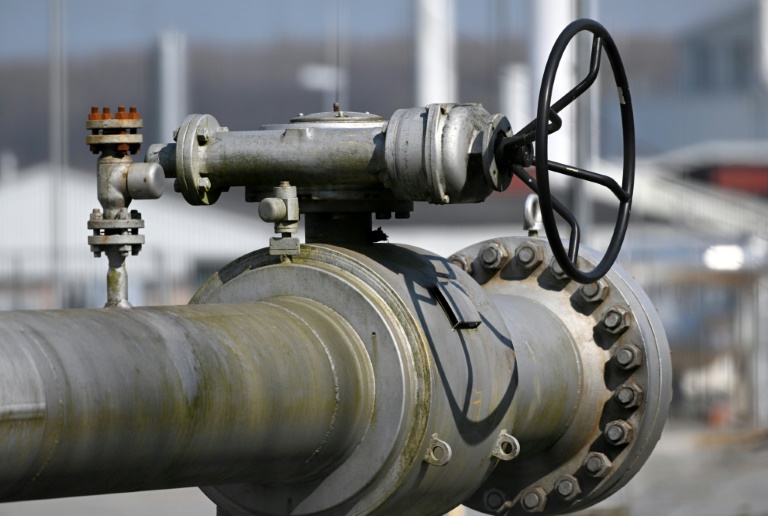
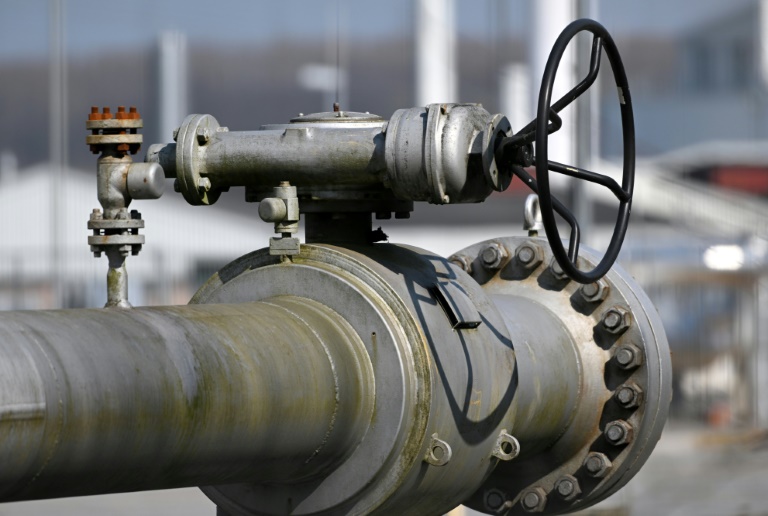
Europe gas reference price Dutch TTF surged more than 10 percent to 198.00 euros per megawatt hour, one day after Russia’s Gazprom said it would cut daily gas deliveries to Europe via the Nord Stream pipeline.

“With no clear timeline for when capacity is likely to increase, the prospect of further uncertainty over gas supplies is weighing on European markets today,” CMC Markets analyst Michael Hewson told AFP.

Frankfurt’s DAX slumped 0.9 percent while the CAC in Paris shed 0.5 percent. 

“The euro is also under pressure as it becomes increasingly apparent that a slowing economy will make it increasingly difficult for the ECB to hike aggressively as we head into the winter months. Good luck raising rates against that sort of backdrop,” he added.

It fell by more than one percent to under $1.0150.

Eurozone bond yields also fell as investors fled to the relative safety of government debt.

Oil prices also leapt on concerns of a broader squeeze on global energy supplies, while the euro remained on the back foot against the dollar.

Gazprom will cut the gas deliveries to 33 million cubic metres a day — about 20 percent of the pipeline’s capacity — from Wednesday.

That has heightened market worries over supplies during the northern hemisphere winter later this year.

At the same time, European Union member states have reached agreement on how to cut their consumption of gas by 15 percent and reduce their dependence on Russian energy.

Gas prices remain way below the record March peak of 345 euros struck after Russia launched its assault on Ukraine.

Markets.com analyst Neil Wilson predicted a “big push to fill (gas) stockpiles in what is left of the summer, at any price, to avert a winter crisis”.

EU states have accused Russia of squeezing supplies in retaliation for Western sanctions.

Elsewhere Tuesday, Asian stock markets closed mixed.

Investors welcomed news that e-commerce giant Alibaba would seek a primary listing in Hong Kong, which could pave the way for it to be traded by mainland Chinese investors.

Wall Street opened lower, with a profit warning by Walmart rattling investors.

The retailer said it expects its earnings per share in its non-standard second quarter, which wraps up at the end of this month, to be down by 8-9 percent with an even bigger reduction next year.

Walmart shares tumbled more than eight percent at the start of trading.

“The basis for Walmart’s warning, though, is the real issue for the broader market,” said Patrick J. O’Hare at Briefing.com.

The retailer said food and fuel inflation was pushing consumers to defray discretionary spending on general merchandise.

“That is causing concerns about a trickle-down effect to other retailers, as well as suppliers to Walmart, that is weighing on sentiment and earnings expectations,” said O’Hare.

He said this was also fanning fears the US Federal Reserve, which meets Wednesday and Thursday, will pursue aggressive rate hikes to tame inflation.

– Key figures at around 1330 GMT –

Frankfurt – DAX: DOWN 0.9 percent at 13,092.50 points

Paris – CAC 40: DOWN 0.5 percent at 6,205.54

London – FTSE 100: UP 0.2 percent at 7,323.32

EURO STOXX 50: DOWN 0.8 percent at 3,576.87

New York – Dow: DOWN 0.2 percent at 31,917.53

Tokyo – Nikkei 225: DOWN 0.2 percent at 27,655.21 (close)

Hong Kong – Hang Seng Index: UP 1.7 percent at 20,905.88 (close)

Shanghai – Composite: UP 0.8 percent at 3,277.44 (close)

Euro/dollar: DOWN at $1.0140 from $1.0223 Monday

Pound/dollar: DOWN at $1.2016 from $1.2046 

Euro/pound: DOWN at 84.46 pence from 84.83 pence

Dollar/yen: DOWN at 136.45 yen from 136.65 yen

Brent North Sea crude: UP 1.6 percent at $106.87 per barrel

West Texas Intermediate: UP 1.5 percent at $98.17 per barrel

burs-rl/raz

Eurozone stocks slide, gas prices soar

Eurozone equities sank Tuesday, as natural gas prices surged after Russia tightened the screw on supplies in fresh Ukraine fallout.

Investors also digested major earnings updates on the eve of another likely large US interest rate hike aimed at tackling soaring inflation.

General Motors reported a big drop in second-quarter profits owing to a semiconductor shortage.

Google parent Alphabet, Coca-Cola, Microsoft and McDonald’s are also publishing results Tuesday.

Europe gas reference price Dutch TTF surged more than 10 percent to 198.00 euros per megawatt hour, one day after Russia’s Gazprom said it would cut daily gas deliveries to Europe via the Nord Stream pipeline.

“With no clear timeline for when capacity is likely to increase, the prospect of further uncertainty over gas supplies is weighing on European markets today,” CMC Markets analyst Michael Hewson told AFP.

Frankfurt’s DAX slumped 0.9 percent while the CAC in Paris shed 0.5 percent. 

“The euro is also under pressure as it becomes increasingly apparent that a slowing economy will make it increasingly difficult for the ECB to hike aggressively as we head into the winter months. Good luck raising rates against that sort of backdrop,” he added.

It fell by more than one percent to under $1.0150.

Eurozone bond yields also fell as investors fled to the relative safety of government debt.

Oil prices also leapt on concerns of a broader squeeze on global energy supplies, while the euro remained on the back foot against the dollar.

Gazprom will cut the gas deliveries to 33 million cubic metres a day — about 20 percent of the pipeline’s capacity — from Wednesday.

That has heightened market worries over supplies during the northern hemisphere winter later this year.

At the same time, European Union member states have reached agreement on how to cut their consumption of gas by 15 percent and reduce their dependence on Russian energy.

Gas prices remain way below the record March peak of 345 euros struck after Russia launched its assault on Ukraine.

Markets.com analyst Neil Wilson predicted a “big push to fill (gas) stockpiles in what is left of the summer, at any price, to avert a winter crisis”.

EU states have accused Russia of squeezing supplies in retaliation for Western sanctions.

Elsewhere Tuesday, Asian stock markets closed mixed.

Investors welcomed news that e-commerce giant Alibaba would seek a primary listing in Hong Kong, which could pave the way for it to be traded by mainland Chinese investors.

Wall Street opened lower, with a profit warning by Walmart rattling investors.

The retailer said it expects its earnings per share in its non-standard second quarter, which wraps up at the end of this month, to be down by 8-9 percent with an even bigger reduction next year.

Walmart shares tumbled more than eight percent at the start of trading.

“The basis for Walmart’s warning, though, is the real issue for the broader market,” said Patrick J. O’Hare at Briefing.com.

The retailer said food and fuel inflation was pushing consumers to defray discretionary spending on general merchandise.

“That is causing concerns about a trickle-down effect to other retailers, as well as suppliers to Walmart, that is weighing on sentiment and earnings expectations,” said O’Hare.

He said this was also fanning fears the US Federal Reserve, which meets Wednesday and Thursday, will pursue aggressive rate hikes to tame inflation.

– Key figures at around 1330 GMT –

Frankfurt – DAX: DOWN 0.9 percent at 13,092.50 points

Paris – CAC 40: DOWN 0.5 percent at 6,205.54

London – FTSE 100: UP 0.2 percent at 7,323.32

EURO STOXX 50: DOWN 0.8 percent at 3,576.87

New York – Dow: DOWN 0.2 percent at 31,917.53

Tokyo – Nikkei 225: DOWN 0.2 percent at 27,655.21 (close)

Hong Kong – Hang Seng Index: UP 1.7 percent at 20,905.88 (close)

Shanghai – Composite: UP 0.8 percent at 3,277.44 (close)

Euro/dollar: DOWN at $1.0140 from $1.0223 Monday

Pound/dollar: DOWN at $1.2016 from $1.2046 

Euro/pound: DOWN at 84.46 pence from 84.83 pence

Dollar/yen: DOWN at 136.45 yen from 136.65 yen

Brent North Sea crude: UP 1.6 percent at $106.87 per barrel

West Texas Intermediate: UP 1.5 percent at $98.17 per barrel

burs-rl/raz

Former US women's goalie Solo convicted of driving impaired: reports

Former US women’s goalkeeper Hope Solo has pleaded guilty to driving while impaired, according to media reports, and says she is “slowly coming back” after undergoing alcohol treatment.

The 40-year-old, who received a two-year suspended sentence, helped the US soccer squads win 2008 and 2012 Olympic gold medals and the 2015 Women’s World Cup title.

She was arrested in March after police found her passed out behind the wheel of a car in a shopping center parking lot in North Carolina, with her two-year-old twins in the vehicle.

Tests showed she had a blood alcohol concentration of three times the legal limit and THC in her system.

On Monday, the soccer star was handed a suspended jail sentence of two years by the Forsyth County District Attorney’s Office, the Winston-Salem Journal said.

She also received an active sentence of 30 days, offset by 30 days’ credit for time spent in in-patient alcohol treatment this year, according to the newspaper’s report.

Charges of misdemeanor and child abuse, and resisting a public officer, were dismissed, according to the newspaper.

“I underestimated what a destructive part of my life alcohol had become,” Solo posted on social media on Monday evening.

“I made a huge mistake. Easily the worst mistake of my life,” she wrote on Instagram. 

“It’s been a long road, but I am slowly coming back from taking time off,” she wrote, thanking her friends, family, attorneys, and staff at the treatment facility — though without directly mentioning the conviction.

Solo, who is married to former NFL player Jerramy Stevens, has had brushes with the law before.

In 2014 she was arrested at her home in Washington state for allegedly assaulting her half-sister and 17-year-old nephew at a family gathering.

Solo said at the time that she acted in self-defense and the case was later dismissed.

Misery for millions as monsoon pounds Pakistan port city

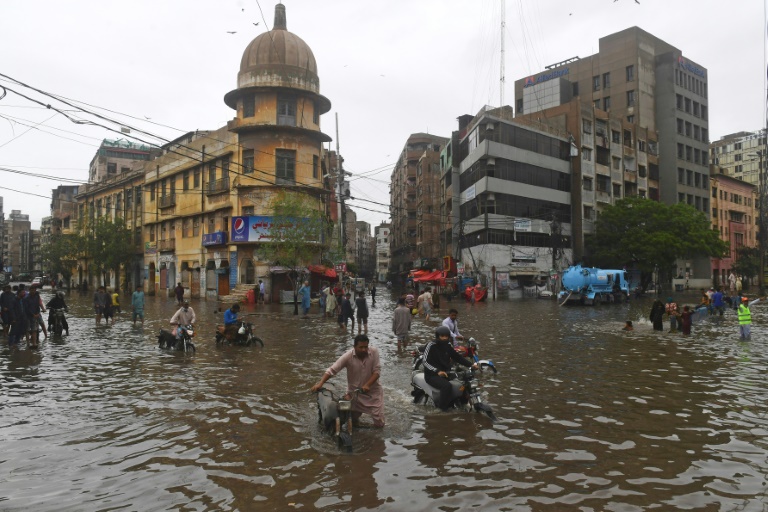
Shazad Akbar carried his four-year-old daughter on his shoulders Tuesday as he and his wife waded through knee-high water flooding a street in Surjani, a poor part of Pakistan’s port city of Karachi.

His wife fell sick overnight, but Akbar couldn’t take her to a doctor as heavy monsoon rains fell until morning, causing misery for the city of 15 million.

“I can only manage to come out now,” Shazad told AFP as his burqa-clad wife hid behind him.

The monsoon, which usually lasts from June to September, is essential for irrigating crops and replenishing lakes and dams across the Indian subcontinent, but also brings a wave of destruction each year.

This year’s monsoon is being felt hardest in cities, where poor infrastructure and services lead to clogged drains and culverts — and the collapse of the sewage system.

The result is widespread flooding, particularly in low-lying areas, and usually in poor neighbourhoods.

In Rahim Goth, a slum in the west of the city, locals were attempting to bail water from their shacks and dwellings using buckets, pots and jugs.

But their efforts appeared futile as they tipped the contents into streets already several feet deep.

– Climate change –

Sardar Sarfaraz, director of the Pakistan Meteorological Department, told AFP an “unprecedented” 568 millimetres (22.3 inches) of rain had fallen in the city this month — nearly triple Karachi’s recent averages and more than four times that of two decades ago.

Environmentalist Arif Zubair conceded monsoons can regularly cause natural havoc, but is clear what is to blame for the worsening situation — climate change.

“(It) has engulfed all of South and Southeast Asia,” he told AFP Tuesday.

“The recent (heavy) rains have certainly been an indicator of global climate change.”

Pakistan ranks eighth on a list of countries most vulnerable to extreme weather caused by climate change, according to the environment NGO Germwatch.

But the effects of climate change are also exacerbated by the mismanagement and negligence of authorities and policymakers, who critics accuse of being oblivious to the problems ahead.

Coastal Karachi is particularly prone to flooding because the city has expanded with scant planning on a landscape ill-suited to urban development.

“We are sitting on a climate bomb,” Arif said.

Over 300 people have died as a result of the heavy monsoon rains this year, which have also washed away more than 600 kilometres (375 miles) of roads and 50 bridges, according to the National Disaster Management Authority (NDMA).

It said more than 10,000 homes had been damaged — with Baluchistan province the worst hit.

In Rahim Goth, many residents have moved to rooftops to escape the flooding, stretching tarpaulin between poles to give them shelter from the incessant rain.

“People (officials) come every year to inquire about us, but every year we are doomed,” Afsari Bano told AFP as she tried to cook a family meal.

She said most of the family’s belongings — furniture, bedding and other possessions — were destroyed by flooding two years ago, and they were only just recovering.

Now she was surrounded by water in which floated soiled nappies and other garbage.

“Swarms of flies and mosquitos will follow now,” the 50-year housewife said.

“If someone dies — Allah forbid as life and death is in his hand — it is next to impossible to hold a funeral.”

China's 'Silicon Valley' tightens rules over Covid flare-up

China’s biggest tech hub is rushing to stamp out a fresh Covid outbreak, ordering some of the country’s biggest manufacturers to operate in a ‘closed loop’ to reduce infections, state media reported.

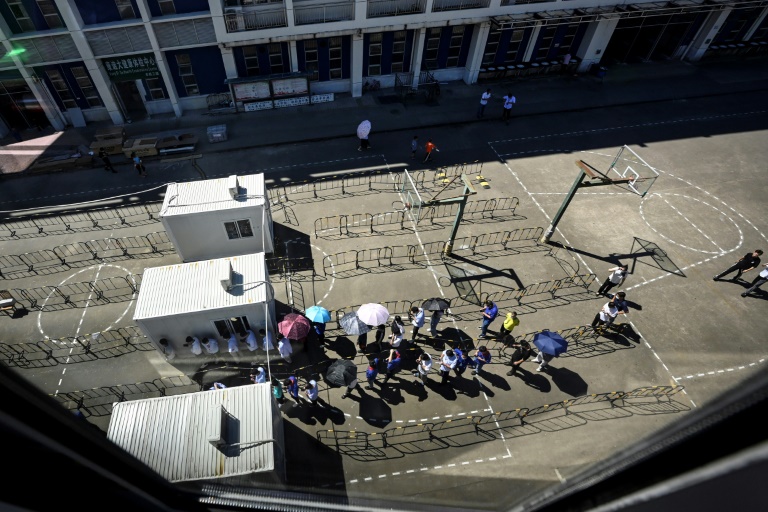
The city of Shenzhen, which borders Hong Kong, reported just 19 Covid cases Tuesday as the city’s health authority said the risk of “large-scale spread is low”.

But Beijing’s reluctance to budge from its strict zero-Covid policy had led to daily mass testing for the 13 million residents of Shenzhen for over a week and the closure of at least three subway stations by Tuesday.

Top manufacturers including iPhone maker Foxconn, electric carmaker BYD, drone maker DJI and telecom equipment maker ZTE are among the companies told to operate under a “closed-loop” production system. 

It would restrict movement of employees for seven days, state-run business news site Yicai reported Monday.

The closed-loop operation mode involves control measures such as locking workers within a compound and conducting daily nucleic acid testing. 

Bloomberg News reported Tuesday that a government notice told companies to reduce unnecessary interaction between non-manufacturing staff and factory floors to curb infection.

Health officials had earlier said all cases found in Shenzhen from July 15 were infected with the highly contagious Omicron subvariant BA.2.

While it is expensive and reduces the scale of production, manufacturers — including Tesla’s site south of Shanghai in the past — have opted to operate in a closed-loop instead of resorting to full shutdown during local Covid flareups.

Strict virus controls have threatened global supply chains and cooled China’s economy with Q2 growth coming in at a dismal 0.4 percent — the weakest growth since the pandemic started.

China reported 976 covid cases Tuesday, with the biggest outbreaks reported in the southern Guanxi region and Gansu province in the northwest. 

China's 'Silicon Valley' tightens rules over Covid flare-up

China’s biggest tech hub is rushing to stamp out a fresh Covid outbreak, ordering some of the country’s biggest manufacturers to operate in a ‘closed loop’ to reduce infections, state media reported.

The city of Shenzhen, which borders Hong Kong, reported just 19 Covid cases Tuesday as the city’s health authority said the risk of “large-scale spread is low”.

But Beijing’s reluctance to budge from its strict zero-Covid policy had led to daily mass testing for the 13 million residents of Shenzhen for over a week and the closure of at least three subway stations by Tuesday.

Top manufacturers including iPhone maker Foxconn, electric carmaker BYD, drone maker DJI and telecom equipment maker ZTE are among the companies told to operate under a “closed-loop” production system. 

It would restrict movement of employees for seven days, state-run business news site Yicai reported Monday.

The closed-loop operation mode involves control measures such as locking workers within a compound and conducting daily nucleic acid testing. 

Bloomberg News reported Tuesday that a government notice told companies to reduce unnecessary interaction between non-manufacturing staff and factory floors to curb infection.

Health officials had earlier said all cases found in Shenzhen from July 15 were infected with the highly contagious Omicron subvariant BA.2.

While it is expensive and reduces the scale of production, manufacturers — including Tesla’s site south of Shanghai in the past — have opted to operate in a closed-loop instead of resorting to full shutdown during local Covid flareups.

Strict virus controls have threatened global supply chains and cooled China’s economy with Q2 growth coming in at a dismal 0.4 percent — the weakest growth since the pandemic started.

China reported 976 covid cases Tuesday, with the biggest outbreaks reported in the southern Guanxi region and Gansu province in the northwest. 

Higher prices boost Coca-Cola's Q2 results

Higher prices for soda helped Coca-Cola score better-than-expected quarterly profits in spite of higher operating costs and the drag of the strong US dollar in international markets, the company announced Tuesday.

The soft drink brand benefited from a 12 percent increase in global pricing, with the biggest price increases in Europe/Middle East Africa, Latin America and North America.

An exception was Asia Pacific, where the company flagged China’s Covid-19 lockdowns as a weak area in spite of higher sales in India and the Philippines. 

Coca-Cola executives have said they are monitoring the response to higher prices. When the company last reported results in April, executives said they had yet to see a meaningful pullback from consumers to the price changes made to that point.

Results also were boosted by resurgent sales in away-from-home venues such as entertainment and professional sports locales. 

But the beverage giant pointed to a drag from higher operating costs and marketing spending compared to the prior year. The strong US dollar also dented revenues in overseas markets.

Net income fell to $1.9 billion, a 28 percent decline from the same period of last year, in part due to strong sales in the current quarter from goods with lower profit margins. 

Revenues rose 12 percent to $11.3 billion.

“Our results this quarter reflect the agility of our business, the strength of our streamlined portfolio of brands, and the actions we’ve taken to execute for growth in the face of challenges in the operating and macroeconomic environment,” said Chief Executive James Quincey.

Coca-Cola shares climbed 1.1 percent to $62.87 in pre-market trading.

Record number of French regions face water restrictions

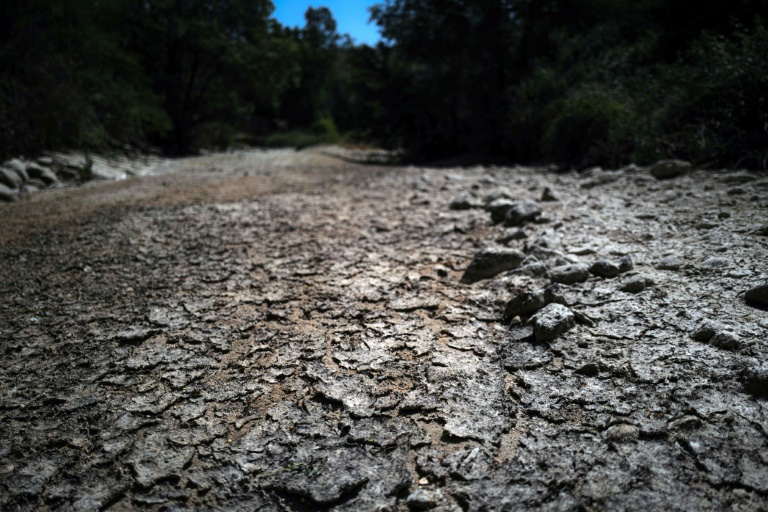
A record 90 out of 96 mainland French regions face water restrictions due to an ongoing drought, official figures showed on Tuesday, as scorching temperatures and low rainfall cause supply shortages in many areas.

Only a handful of “departments” around the country are exempt from the restrictions, including the Paris area, the government’s drought website Propluvia shows.

A colour-coded map indicates that the most severe measures — including a ban on irrigation for farmland — are in place in the northwest in the Loire river basin, as well as the southeast around the Rhone.

Areas in the southwest around the Tarn and Lot rivers are also in the highest red category, while even the normally verdant Alps are suffering from severe aridity.

“We have a record number of departments with restrictions,” the environment ministry said in a statement.

France experienced its third-driest spring on record this year after 2011 and 1976, according to the national weather service, with rainfall 45 percent below average levels.

Two severe heatwaves in May and latterly in July — when temperatures soared above 40 Celsius (100 degrees Fahrenheit) — have further reduced water levels while searing farmland and forests.

Two huge blazes near Bordeaux in southwest France over the last fortnight have destroyed more than 20,000 hectares of tinder-dry forest and required around 2,000 firefighters to bring them under control.

Local authorities are restricting access to many wooded areas as a precaution, including the Calanques National Park along the Mediterranean coast near Marseille which is popular with tourists.

burs-adp/spm

Close Bitnami banner
Bitnami