AFP

Stocks wobble as markets begin big week

European and American stocks moved in mixed directions Monday as markets began a busy week, with the US Federal Reserve poised to lift interest rates again and some of the world’s biggest companies scheduled to publish their latest earnings reports.

Asian markets ended lower.

The Fed is widely tipped to hike borrowing costs by 0.75 percentage points Wednesday as it battles soaring inflation.

US second-quarter gross domestic product data are due Thursday, with some observers warning it could show a second successive contraction — which is considered a technical recession.

Investors are also awaiting the release of earnings from business titans Apple, Amazon and Google parent Alphabet.

“Recent risk-on moves appear to be on thin ice as markets gear up for another bout of earnings and a crucial Fed rate decision,” said market analyst Joshua Mahony at trading platform IG.

Despite the deluge of market-moving news on the calendar, European stocks had been trading higher across the board until an announcement by Russia’s Gazprom that it was cutting back gas deliveries to Germany due to a faulty turbine, which pulled down the DAX index in Frankfurt.

It ended the day down 0.3 percent, while the CAC in Paris climbed 0.3 percent and London’s FTSE 100 rose 0.4 percent.

“Gazprom and turbine problems aside, today’s more resilient tone appears to suggest that the prospect of further economic weakness might act as a catalyst that could prompt central banks to pare back some of their more hawkish rhetoric when it comes to raising rates,” said Michael Hewson at CMC Markets.

On Wall Street, both the Dow and S&P 500 were showing modest gains in late morning trade, while the tech-heavy Nasdaq Composite was lower.

Markets were roiled last week when the European Central Bank finally began ramping up interest rates to tackle runaway consumer prices in the eurozone.

The ECB had surprised investors Thursday with a bigger-than-expected rate increase of 0.5 percentage points.

Consumer prices are soaring worldwide after economies reopened from pandemic lockdowns and as the war in Ukraine keeps energy prices elevated.

That, in turn, has sparked aggressive rate hikes from major central banks to try and dampen inflationary pressures.

Federal Reserve chiefs have already said their main priority was bringing inflation down from four-decade highs, even at the expense of growth.

“We still see further downside for risky assets as recession fears accumulate and central banks remain committed to fighting inflation at the expense of growth,” said Standard Chartered strategist Eric Robertsen.

Others warned that while inflation could begin to ease, the Fed could still push borrowing costs to around five percent and was unlikely to lower rates as soon as many traders hope.

– Key figures at around 1530 GMT –

New York – Dow: UP 0.3 percent at 31,996.90 points

EURO STOXX 50: UP 0.2 percent at 3,604.16

London – FTSE 100: UP 0.4 percent at 7,306.30 (close) 

Frankfurt – DAX: DOWN 0.3 percent at 13,210.32 (close)

Paris – CAC 40: UP 0.3 percent at 6,237.55 (close)

Tokyo – Nikkei 225: DOWN 0.8 percent at 27,699.25 (close)

Hong Kong – Hang Seng Index: DOWN 0.2 percent at 20,562.94 (close)

Shanghai – Composite: DOWN 0.6 percent at 3,250.39 (close)

Euro/dollar: UP at $1.0214 from $1.0213 Friday

Pound/dollar: UP at $1.2041 from $1.1999 

Euro/pound: DOWN at 84.82 pence from 85.11 pence

Dollar/yen: UP at 136.70 yen from 136.12 yen

Brent North Sea crude: UP 1.7 percent at $104.90 per barrel

West Texas Intermediate: UP 1.6 percent at $96.25 per barrel

burs-rl/raz

Stocks wobble as markets begin big week

European and American stocks moved in mixed directions Monday as markets began a busy week, with the US Federal Reserve poised to lift interest rates again and some of the world’s biggest companies scheduled to publish their latest earnings reports.

Asian markets ended lower.

The Fed is widely tipped to hike borrowing costs by 0.75 percentage points Wednesday as it battles soaring inflation.

US second-quarter gross domestic product data are due Thursday, with some observers warning it could show a second successive contraction — which is considered a technical recession.

Investors are also awaiting the release of earnings from business titans Apple, Amazon and Google parent Alphabet.

“Recent risk-on moves appear to be on thin ice as markets gear up for another bout of earnings and a crucial Fed rate decision,” said market analyst Joshua Mahony at trading platform IG.

Despite the deluge of market-moving news on the calendar, European stocks had been trading higher across the board until an announcement by Russia’s Gazprom that it was cutting back gas deliveries to Germany due to a faulty turbine, which pulled down the DAX index in Frankfurt.

It ended the day down 0.3 percent, while the CAC in Paris climbed 0.3 percent and London’s FTSE 100 rose 0.4 percent.

“Gazprom and turbine problems aside, today’s more resilient tone appears to suggest that the prospect of further economic weakness might act as a catalyst that could prompt central banks to pare back some of their more hawkish rhetoric when it comes to raising rates,” said Michael Hewson at CMC Markets.

On Wall Street, both the Dow and S&P 500 were showing modest gains in late morning trade, while the tech-heavy Nasdaq Composite was lower.

Markets were roiled last week when the European Central Bank finally began ramping up interest rates to tackle runaway consumer prices in the eurozone.

The ECB had surprised investors Thursday with a bigger-than-expected rate increase of 0.5 percentage points.

Consumer prices are soaring worldwide after economies reopened from pandemic lockdowns and as the war in Ukraine keeps energy prices elevated.

That, in turn, has sparked aggressive rate hikes from major central banks to try and dampen inflationary pressures.

Federal Reserve chiefs have already said their main priority was bringing inflation down from four-decade highs, even at the expense of growth.

“We still see further downside for risky assets as recession fears accumulate and central banks remain committed to fighting inflation at the expense of growth,” said Standard Chartered strategist Eric Robertsen.

Others warned that while inflation could begin to ease, the Fed could still push borrowing costs to around five percent and was unlikely to lower rates as soon as many traders hope.

– Key figures at around 1530 GMT –

New York – Dow: UP 0.3 percent at 31,996.90 points

EURO STOXX 50: UP 0.2 percent at 3,604.16

London – FTSE 100: UP 0.4 percent at 7,306.30 (close) 

Frankfurt – DAX: DOWN 0.3 percent at 13,210.32 (close)

Paris – CAC 40: UP 0.3 percent at 6,237.55 (close)

Tokyo – Nikkei 225: DOWN 0.8 percent at 27,699.25 (close)

Hong Kong – Hang Seng Index: DOWN 0.2 percent at 20,562.94 (close)

Shanghai – Composite: DOWN 0.6 percent at 3,250.39 (close)

Euro/dollar: UP at $1.0214 from $1.0213 Friday

Pound/dollar: UP at $1.2041 from $1.1999 

Euro/pound: DOWN at 84.82 pence from 85.11 pence

Dollar/yen: UP at 136.70 yen from 136.12 yen

Brent North Sea crude: UP 1.7 percent at $104.90 per barrel

West Texas Intermediate: UP 1.6 percent at $96.25 per barrel

burs-rl/raz

Adele announces rescheduled Vegas residency dates

Adele delighted fans Monday by detailing the dates for her rescheduled shows in Las Vegas, after postponing them earlier this year the day before she was due to start.

The residency entitled “Weekends With Adele” at the Colosseum at Caesar’s Palace will feature eight extra shows in addition to the 24 rescheduled dates, and is slated to run from November 18, 2022 through March 25, 2023.

“Words can’t explain how ecstatic I am to finally be able to announce these rescheduled shows. I truly was heartbroken to have to cancel them,” the Grammy Award-winning superstar said on her website.

“But after what feels like an eternity of figuring out logistics for the show that I really want to deliver, and knowing it can happen, I’m more excited than ever!”

In a tearful video in January the artist had pushed back the sold-out show saying it wasn’t ready, blaming “delivery delays and Covid.”

“Now I know for some of you it was a horrible decision on my part, and I will always be sorry for that, but I promise you it was the right one,” the 34-year-old said in her statement Monday.

“To be with you in such an intimate space every week has been what I’ve most been looking forward to and I’m going to give you the absolute best of me. Thank you for your patience, I love you.”

Last fall the British performer released her first record in six years — “30” — a cathartic, big-ballad album that lays bare the emotional torture of navigating divorce.

The album’s first single “Easy On Me” reigned over the US and British singles charts for weeks, proving the enduring strength of Adele’s prowess as a hitmaker with broad appeal.

Panama govt, protesters edge closer in talks to end road closures

The Panamanian government and protesters edged closer Monday to an agreement to end a weeks-long living cost revolt that has blocked roads, interrupted food supplies and damaged the economy.

Authorities agreed in the early morning hours to reduce the price of 72 basic consumer items by some 30 percent on average.

“The national government has every intention of continuing dialogue and today has shown it also has the will to reach agreements,” Labor Minister Doris Zapata said on the fifth day of marathon talks in Penonome, 150 kilometers (93 miles) southwest of the capital Panama City.

“There is already the first step on the road to solving the problems of the social crisis that this country is experiencing,” said Fernando Abrego, a spokesman for one of the demonstrators. 

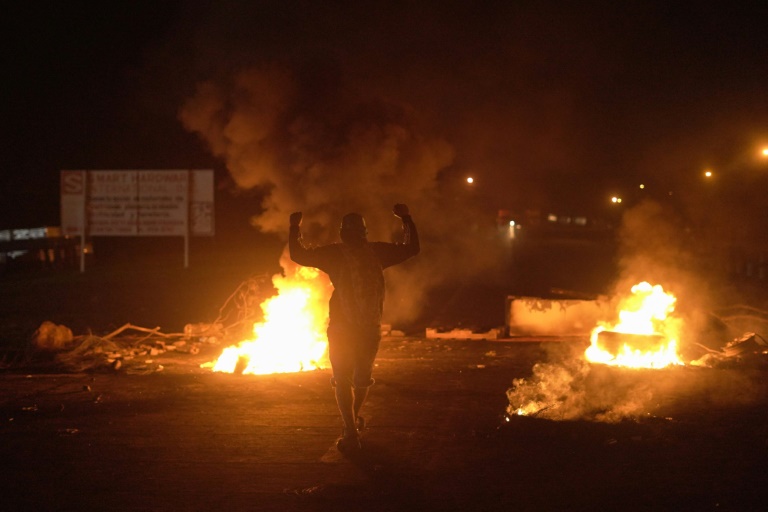
For three weeks, amid worsening economic woes for Panama, protesters demanding lower fuel, food and medicine prices have blockaded the crucial Pan-American Highway and other major roads with stalled trucks and burning tires. Some have clashed with police.

Despite its dollarized economy and impressive growth figures, the country of 4.4 million people has one of the world’s highest rates of social inequality, with poor access to health services, education and clean drinking water in some areas.

The demonstrations have triggered food and fuel shortages in some parts of the country, and the business sector says some $500 million has been lost.

Even before the talks started, the government had lowered the price of 18 basic products and that of fuel from $5.20 per gallon to $3.25 in an unsuccessful bid to end the standoff.

Protesters had demanded a lowering of the price of 82 products and want a limit to be imposed on company profits, a measure the government has rejected.

Other demands include reducing the price of medicines and electricity, increasing investment in education and the public health system, and measures against government corruption.

Luis Sanchez, another spokesman for the protesters, said some roads have been opened in a gesture of good faith.

But the government asked for all blockades to be ended.

“There is a population distressed by the closures,” said Zapata.

Philippines' Marcos Jr unveils economic blueprint for 'turbulent time'

Philippine President Ferdinand Marcos Jr vowed Monday to slash poverty, rein in soaring food prices and boost renewable energy, as he unveiled an ambitious blueprint for his six-year term. 

In his first State of the Nation address, Marcos Jr offered a laundry list of targets, ranging from getting children back into classrooms, easing the debt burden of farmers, and expanding internet access.  

Unlike his predecessor Rodrigo Duterte, who used to frequently go off script in a stream of consciousness and threaten to kill people, Marcos Jr stuck to a prepared speech that was methodical and heavy on numbers.

After inheriting an economy ravaged by Covid-19 lockdowns and inflation, the new president expressed cautious optimism for the future — even as the war in Ukraine and supply chain disruptions drive up food and fuel prices.

“I do not intend to diminish the risks and challenges that we face in this turbulent time in global history,” he told the audience of lawmakers, diplomats and judges.

“And yet I see sunlight filtering through these dark clouds. We have assembled the best Filipino minds to help navigate us through this time of global crisis.”

Marcos Jr, who is the son and namesake of the country’s late dictator, spoke for 74 minutes without mentioning human rights, corruption or peace talks with militant groups. 

Instead, the 64-year-old scion focused on the economy, clean energy, agriculture, and helping poor Filipinos.

Marcos Jr vowed to more than halve the poverty rate to single digits by the end of his term and offer financial relief to many farmers, including forgiving debts.

Renewable energy was “at the top of our climate agenda”, he said, insisting it was time to reconsider building nuclear power plants in the disaster-prone country.

He also pledged to boost agricultural productivity and bring down food prices.

“These will not be done in one day, one month or one year. But we need to start now,” he said.

– Peaceful rallies – 

Marcos Jr was swept to power by a landslide in the May 9 elections, completing his family’s remarkable comeback from pariahs in exile to the peak of political power.

Hours before his speech, several thousand protesters marched peacefully along a major avenue to oppose his victory and criticise his first weeks in office.

“He’s just sitting around, he’s busying himself revising history instead of doing the urgent work of stopping the rising costs of commodities especially food, distributing land to farmers and raising the wages of workers,” said Angelo Suarez, who volunteers for an agricultural workers union.

Outside Congress, thousands of Marcos Jr supporters wearing red, his campaign colour, also gathered, waving the Philippine flag and holding signs with slogans such as “Progress”.

Congressman Ralph Recto said the new president’s speech was “brave, not boring” and gave the country a “fiscal reality check”.

The higher cost of living is worsening the financial misery of millions of Filipinos already struggling to feed their families.

The central bank recently raised interest rates for the third straight month as it struggles to rein in surging energy prices.

Inflation hit 6.1 percent in June, the highest level in nearly four years.

Greek firefighters in uphill battle to save famed natural park

Greek firefighters on Monday battled a raging fire threatening the Dadia National Park, known for its black vulture colony, as the country scorched under a blistering heatwave.

The Mediterranean country is reeling under a heatwave that began on Saturday and is expected to last 10 days. Temperatures were set to rise to 42 degrees Celsius (107 degrees Fahrenheit) in some regions and the country is battling three major wildfires.

Scientists say human-induced climate change is amplifying extreme weather — including the heatwaves, droughts and floods seen in several parts of the planet in recent weeks — and say these events will become more frequent and more intense.

On Monday, 320 firefighters, two water-bombing planes and four helicopters were deployed to contain the fire at the Dadia park, which broke out on Thursday.

Some villages in the area have been evacuated. The flames have already destroyed nearly 500 hectares (1,220 acres) of woodland.

Dadia is one of the most important protected areas in Europe, offers ideal habitat for rare birds and is home to the only breeding population of black vultures in the Balkans. 

It hosts three out of the four vulture species of Europe — the black vulture, the griffon vulture and the Egyptian vulture — and 36 of Europe’s 38 species of raptors.

Its varied habitats also support 104 butterfly species, 13 amphibian species, 29 reptile species and about 65 mammal species, 24 out of which are bats.

“It’s an uphill battle, a fight to ensure the survival of this exceptional ecosystem,” the minister for climate crisis and civil protection, Christos Stylianidis, said on Monday after visiting the affected area over the weekend.

“After this difficult fight, experts must look into redressing the problems sparked by the fire,” he said, underscoring the need to buttress the “resistance of the ecosystem in the future”.

The civil protection agency said on Monday there was a high risk of forest fires given the heatwave and the strong winds.

Fires have raged in the north, east and south of the country, including on the tourist island of Lesbos, where around 200 people were ordered to leave the village of Vryssa on Sunday to escape the flames.

The international community has agreed that climate change poses an existential threat to human systems and the natural world — but there are a myriad ways to take action. 

Earth’s average temperature has warmed just over 1.1 degrees Celsius since the industrial era and the United Nations says it is currently on track to warm some 2.7C this century. 

Stock markets drift lower as traders prepare for big week

Equity markets in Asia and Europe slipped Monday at the start of a key week for equities as the Federal Reserve prepares to lift interest rates again and some of the world’s biggest companies report earnings.

While the US central bank is widely expected to hike borrowing costs by 75 basis points, traders will be poring over policymakers’ views on the outlook for the world’s biggest economy as they try to rein in inflation while nurturing growth.

The decision comes a day before second-quarter gross domestic product data is released, with some observers warning it could show a second successive contraction, which is considered a technical recession.

All three main indexes on Wall Street ended last week with a loss, ending a three-day rally, following a big data miss on the crucial services sector.

Asia and Europe fared little better, with Tokyo, Hong Kong, Shanghai, Sydney, Taipei, Mumbai, Manila, Jakarta and Wellington all in the red, while London, Paris and Frankfurt dropped in early trade.

There were small gains in Singapore, Bangkok and Seoul.

Investors are also awaiting the release of earnings from business titans Apple, Amazon and Google parent Alphabet.

The figures will provide a clearer idea about the impact of surging inflation and rising interest rates on consumer spending and companies’ bottom lines.

But analysts remain cautious about the outlook, while attention on trading floors turns from rising prices to economic growth, with some saying a slowdown could allow banks to ease up on their monetary tightening.

Fed chiefs have already said their main priority was bringing inflation down from four-decade highs, even at the expense of growth.

“We still see further downside for risky assets as recession fears accumulate and central banks remain committed to fighting inflation at the expense of growth,” said Standard Chartered strategist Eric Robertsen.

And Stephen Innes at SPI Asset Management added: “While rising jobless claims, softer home sales, and a buildup in gasoline inventory show the Fed front-loading rate hikes are causing a slowdown and bringing inflation under control, the issue is at what cost.”

Others warned that while inflation could begin to ease, the Fed could still push borrowing costs to around five percent and were unlikely to lower rates as soon as many traders hope.

The economic slowdown — and the expected hit to demand — continues to put pressure on oil prices, with both main contracts well down Monday.

Crude has given up most of the gains seen since Russia’s invasion of Ukraine, and Vandana Hari, of Vanda Insights, said she saw further losses.

“While prices have been volatile, I expect renewed downward pressure on crude,” she said, adding that the Fed decision “will likely serve as a fresh reminder of the economic headwinds ahead”.

– Key figures at around 0810 GMT –

Tokyo – Nikkei 225: DOWN 0.8 percent at 27,699.25 (close)

Hong Kong – Hang Seng Index: DOWN 0.2 percent at 20,562.94 (close)

Shanghai – Composite: DOWN 0.6 percent at 3,250.39 (close)

London – FTSE 100: DOWN 0.3 percent at 7,258.20

Euro/dollar: DOWN at $1.0206 from $1.0220 on Friday

Pound/dollar: UP at $1.2008 from $1.1998 

Euro/pound: DOWN at 85.00 pence from 85.07 pence

Dollar/yen: UP at 136.40 yen from 136.05 yen

West Texas Intermediate: DOWN 1.6 percent at $93.22 per barrel

Brent North Sea crude: DOWN 1.3 percent at $101.88 per barrel

New York – Dow: DOWN 0.4 percent at 31,899.29 (close)

— Bloomberg News contributed to this story —

Stock markets drift lower as traders prepare for big week

Equity markets in Asia and Europe slipped Monday at the start of a key week for equities as the Federal Reserve prepares to lift interest rates again and some of the world’s biggest companies report earnings.

While the US central bank is widely expected to hike borrowing costs by 75 basis points, traders will be poring over policymakers’ views on the outlook for the world’s biggest economy as they try to rein in inflation while nurturing growth.

The decision comes a day before second-quarter gross domestic product data is released, with some observers warning it could show a second successive contraction, which is considered a technical recession.

All three main indexes on Wall Street ended last week with a loss, ending a three-day rally, following a big data miss on the crucial services sector.

Asia and Europe fared little better, with Tokyo, Hong Kong, Shanghai, Sydney, Taipei, Mumbai, Manila, Jakarta and Wellington all in the red, while London, Paris and Frankfurt dropped in early trade.

There were small gains in Singapore, Bangkok and Seoul.

Investors are also awaiting the release of earnings from business titans Apple, Amazon and Google parent Alphabet.

The figures will provide a clearer idea about the impact of surging inflation and rising interest rates on consumer spending and companies’ bottom lines.

But analysts remain cautious about the outlook, while attention on trading floors turns from rising prices to economic growth, with some saying a slowdown could allow banks to ease up on their monetary tightening.

Fed chiefs have already said their main priority was bringing inflation down from four-decade highs, even at the expense of growth.

“We still see further downside for risky assets as recession fears accumulate and central banks remain committed to fighting inflation at the expense of growth,” said Standard Chartered strategist Eric Robertsen.

And Stephen Innes at SPI Asset Management added: “While rising jobless claims, softer home sales, and a buildup in gasoline inventory show the Fed front-loading rate hikes are causing a slowdown and bringing inflation under control, the issue is at what cost.”

Others warned that while inflation could begin to ease, the Fed could still push borrowing costs to around five percent and were unlikely to lower rates as soon as many traders hope.

The economic slowdown — and the expected hit to demand — continues to put pressure on oil prices, with both main contracts well down Monday.

Crude has given up most of the gains seen since Russia’s invasion of Ukraine, and Vandana Hari, of Vanda Insights, said she saw further losses.

“While prices have been volatile, I expect renewed downward pressure on crude,” she said, adding that the Fed decision “will likely serve as a fresh reminder of the economic headwinds ahead”.

– Key figures at around 0810 GMT –

Tokyo – Nikkei 225: DOWN 0.8 percent at 27,699.25 (close)

Hong Kong – Hang Seng Index: DOWN 0.2 percent at 20,562.94 (close)

Shanghai – Composite: DOWN 0.6 percent at 3,250.39 (close)

London – FTSE 100: DOWN 0.3 percent at 7,258.20

Euro/dollar: DOWN at $1.0206 from $1.0220 on Friday

Pound/dollar: UP at $1.2008 from $1.1998 

Euro/pound: DOWN at 85.00 pence from 85.07 pence

Dollar/yen: UP at 136.40 yen from 136.05 yen

West Texas Intermediate: DOWN 1.6 percent at $93.22 per barrel

Brent North Sea crude: DOWN 1.3 percent at $101.88 per barrel

New York – Dow: DOWN 0.4 percent at 31,899.29 (close)

— Bloomberg News contributed to this story —

Chinese astronauts set up new lab on space station

Astronauts entered the new lab module of China’s space station for the first time Monday, in a major step towards completing the orbital outpost by the end of the year.

The station is one of the crown jewels of Beijing’s ambitious space programme, which has landed robotic rovers on Mars and the Moon, and made China only the third nation to put humans in orbit.

Once completed, Tiangong — or “heavenly palace” — will be constantly crewed by rotating teams of three astronauts, who will conduct scientific experiments and help test new technologies.

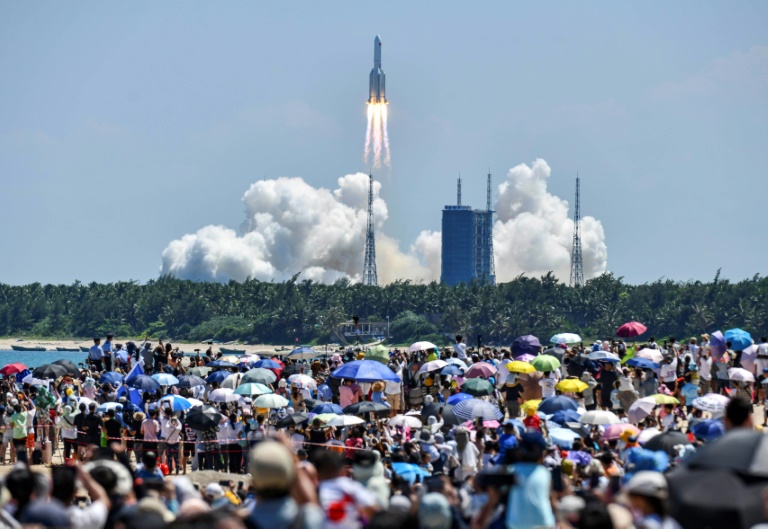
Wentian, the second of Tiangong’s three main sections, docked with the station’s core module Tianhe on Monday after successfully launching from southern China a day earlier, state media reported.

A few hours after docking, the three astronauts — who have been living in the core module since June — opened the hatch and entered Wentian, footage from state broadcaster CCTV showed.

The crew, dressed in blue jumpsuits, were seen floating around the brightly lit module before facing the camera and saluting.

Wentian will focus on life sciences and biotechnology research, according to official news agency Xinhua, including cell research and growth experiments on plants, fruit flies and zebrafish.

The module will have living space for three additional astronauts, housing up to six people during crew transitions, state media said.

The third and final module, another lab named Mengtian, is scheduled for launch in October.

Tiangong, once completed, is expected to remain in low orbit 400-450 kilometres (250-280 miles) above Earth for at least 10 years.

Next year, China is also planning to launch a space telescope with a field of view 350 times that of NASA’s Hubble Space Telescope.

The telescope will be positioned in the same orbit as Tiangong, allowing the station to dock with it for refuelling and servicing when needed.

China has poured billions of dollars into space flight and exploration as it seeks to build a programme that reflects its stature as a rising global power.

The programme has rapidly yielded successes in the last two decades, including launching the first Chinese astronauts, a historic first controlled landing on the far side of the Moon, and delivering a rover to the surface of Mars.

And after several missions to test the technologies needed for a constantly crewed outpost, it is set to finish Tiangong this year.

The station when completed is expected to have a mass of 90 tonnes, around a quarter of the International Space Station — from which China has been excluded by the United States.

The ISS — a collaboration between the United States, Russia, Canada, Europe and Japan — is due to be retired after 2024, although NASA has said it could potentially remain functional beyond 2028.

Indonesia foot and mouth outbreak prompts NZ, Australia restrictions

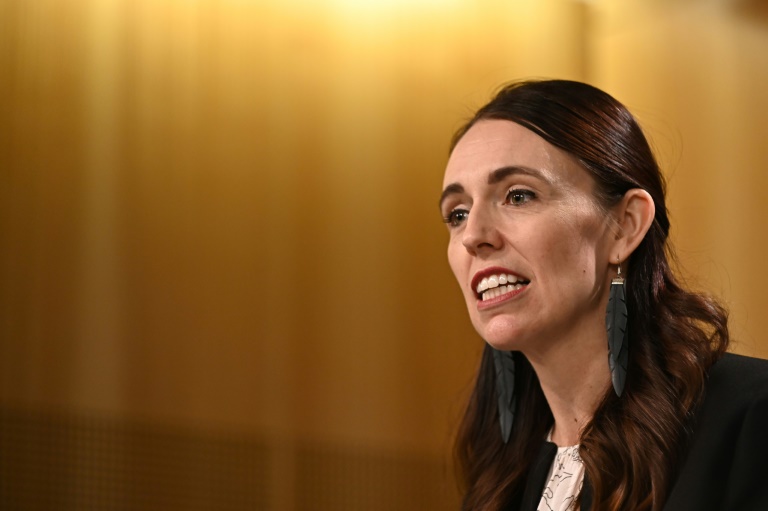
Prime Minister Jacinda Ardern warned an outbreak of foot-and-mouth disease in Indonesia could cost thousands of New Zealand jobs, as her nation and neighbouring Australia stepped up border biosecurity restrictions.

“While not a threat to humans, it would devastate our national herd. Essentially, all animals that are of cloven hoof are at risk,” Ardern told reporters in Wellington.

Ardern warned that the disease, first detected in Indonesia in April, has the potential to threaten up to 100,000 jobs in New Zealand’s agriculture sector.

Foot and mouth disease is a severe, highly contagious viral disease of livestock.

It can have a significant economic impact, especially on a country like New Zealand which exported around 17 million sheep and two million cattle in the eight months up until May 2022. 

A foot-and-mouth outbreak has ripped through two Indonesian provinces, killing thousands of cows and infecting hundreds of thousands more.

Ardern said New Zealand has never had an outbreak — and wants to keep it that way by tightening border restrictions.

“We want to make sure that we’ve got all our settings in place to protect ourselves from this emerging threat,” she added.

There are currently no direct flights from Indonesia to New Zealand, but Ardern said it is important to stop it from entering the country, potentially via Australian tourists who had visited south-east Asia.

Travellers from Indonesia will not be allowed to bring meat products into New Zealand, baggage will be screened and there will be disinfectant mats at airports to clean footwear.

In Australia, parcels and baggage from China and Indonesia are now being checked and there are also foot mats at airports in response to the disease.

Canberra has so far rejected opposition calls to close the border to Indonesia completely, but further measures have not been ruled out.

Ardern said her government is working with Australian authorities to try to further reduce the risk.

New Zealand is set to fully open its borders at midnight on Sunday to all visitors.

New Zealand’s Biosecurity Minister Damien O’Connor said “vigilance is absolutely crucial” as the disease could also affect up to 77 percent of the country’s wildlife population, including wild deer, pigs and sheep.

He referred to how foot and mouth devastated British farming in 2001 when millions of cattle and sheep had to be slaughtered.

Close Bitnami banner
Bitnami