AFP

Airbus tails Boeing in Farnborough jet orders tussle

European planemaker Airbus trailed its fierce US rival Boeing in an orders battle on the second day of the Farnborough airshow on Tuesday, as southern England buckled under a record heatwave.

Airbus finally opened its orders account with a $1.1-billion order for 12 Airbus A220-300 passenger jets from Delta Airlines.

The new jets are due for delivery from 2026, and bring its total firm A220 order to 107 of the single-aisle aircraft.

However, Boeing already had the upper hand after clinching a $13.5-billion order for Boeing’s crisis-hit MAX from Delta on the first day of Farnborough on Monday.

The US carrier ordered 100 medium-haul MAX jets with an option for 30 more, and swiftly afterwards Japan’s ANA agreed to buy 20 MAX 8 jets worth $2.4 billion.

The MAX jet, which suffered two deadly crashes in 2018 and 2019, is experiencing a rush of interest at this year’s five-day Farnborough spectacle southwest of London.

Independent aviation analyst Howard Wheeldon said customers were giving the MAX a thumbs-up, at an airshow where Boeing normally saves its biggest deal for the end.

“This is a vote of confidence and a sign that they are now moving forward from the MAX crisis and in the right direction,” Wheeldon told AFP.

Boeing then won another massive boost Tuesday as investment fund 777 Partners ordered up to 66 of the MAX passenger aircraft worth a combined $8 billion.

It also sealed a $1.5-billion deal with leasing company AerCap for five more 787 Dreamliner jets.

Customers are expected to win a discount on list prices as is traditionally the case for big orders.

– Emissions –

Wheeldon sounded a note of caution over the post-Covid recovery despite growing sector-wide optimism over the outlook at the airshow.

“There will be other orders but none of this suggests that the industry itself is moving forward,” added Wheeldon.

“Ticket prices have risen steeply and aircraft are far from full. Shortage of staff and other skills continues to impact and there are no quick fixes.

“This is an industry that has been in turmoil because of Covid but also one that knows the pressures from other factors such as climate change and rising costs are not easily solved.”

Aviation analyst John Strickland said the latest edition of Farnborough — the first since 2018 — was not “flush” with orders.

But “it marks a moment of rehabilitation for Boeing”, he added.

Farnborough this year partly focuses on the themes of decarbonisation and sustainability in a sector often criticised for its impact on emissions and climate change.

The UK government has launched a new “Jet Zero” strategy and vowed that aviation emissions should not return to pre-Covid levels. 

The plan, presented by Transport Secretary Grant Shapps at Farnborough, requires UK domestic aviation and English airports to attain net zero carbon emissions by 2040.

Yet environmental campaign group Greenpeace has slammed the strategy as a short-term move that shifted responsibility away from government.

Greenpeace UK programme director Emily Armistead dismissed the plan as “vague aspirations to technological innovation”, which would fail to cut emissions in the short to medium term.

She accused the government of failing to have the courage to regulate aviation emissions.

“This isn’t a plan to do that, just a delaying tactic and a very expensive waste of time,” she added.


Court battle opens in Musk, Twitter buyout fight

The high stakes court battle between Elon Musk and Twitter kicked off on Tuesday, as the social media firm tries to force the entrepreneur to honor their $44 billion buyout deal.

The first hearing was centering on Twitter’s push to set a trial date for as early as September in a case focused on Musk’s move to walk away on allegations the platform misled him about its tally of fake accounts.

Billions of dollars are at stake, but so is the future of the platform that Musk has said should allow any legal speech, an absolutist position that has sparked fears the network could be used to incite violence.

The hearing is being held in the eastern state of Delaware.

“Questions have been raised about Twitter’s future, and they don’t want this to drag on for very long,” said Carl Tobias, a University of Richmond law professor. 

Musk’s legal team has filed papers arguing that date is far too soon for such a complex matter, and instead proposed mid-February.

Twitter lawyers noted the deal is supposed to close toward the end of October, just six months after Musk launched an unsolicited bid that the company’s board first resisted but then supported.

The world’s richest person has backed away from the deal in recent months as tech stocks have tumbled, and Twitter’s value has fallen well below the $54.20 per share he offered.

– Musk willingness to fight –

Rather than Silicon Valley, where Twitter is based, the company has lodged its lawsuit against Musk in Delaware.

The firm is incorporated in the tiny state like scores of other companies, and the case will happen in the Delaware Chancery Court that has deep experience in business disputes.

“The Chancery Court, which handles most of these matters, is very expert in corporate law, and more particularly, mergers and acquisitions. So this is the place to go,” Tobias added.

Kathaleen McCormick, the judge overseeing the case, comes with a no-nonsense reputation.

She also reportedly has the distinction of previously ordering a reluctant buyer into completing a corporate merger.

A forced closing of the Twitter deal is a scenario that some analysts consider possible.

“(Wall) Street and legal experts across the board view Twitter as having a ‘strong iron fist upper hand,’ heading into the Delaware court battle after months of this fiasco and nightmare,” analyst Dan Ives wrote last week.

He also noted that less likely options include Musk paying a $1 billion breakup fee and being able to walk away, or winning outright on his fake-account argument.

After pausing the deal in May, Musk’s lawyers announced in July he was “terminating” the agreement because of skepticism over Twitter’s false or spam accounts tally and allegations the firm was not forthcoming with details.

Tuesday’s hearing will be just the first step in what could be a lengthy legal fight that could end in a trial, but also a settlement.

“Musk has shown his willingness to take things all the way to the end in Delaware court,” said Adam Badawi, a University of California at Berkeley law professor.

“I think settling is not necessarily his instinct.”

Court battle opens in Musk, Twitter buyout fight

The high stakes court battle between Elon Musk and Twitter kicked off on Tuesday, as the social media firm tries to force the entrepreneur to honor their $44 billion buyout deal.

The first hearing was centering on Twitter’s push to set a trial date for as early as September in a case focused on Musk’s move to walk away on allegations the platform misled him about its tally of fake accounts.

Billions of dollars are at stake, but so is the future of the platform that Musk has said should allow any legal speech, an absolutist position that has sparked fears the network could be used to incite violence.

The hearing is being held in the eastern state of Delaware.

“Questions have been raised about Twitter’s future, and they don’t want this to drag on for very long,” said Carl Tobias, a University of Richmond law professor. 

Musk’s legal team has filed papers arguing that date is far too soon for such a complex matter, and instead proposed mid-February.

Twitter lawyers noted the deal is supposed to close toward the end of October, just six months after Musk launched an unsolicited bid that the company’s board first resisted but then supported.

The world’s richest person has backed away from the deal in recent months as tech stocks have tumbled, and Twitter’s value has fallen well below the $54.20 per share he offered.

– Musk willingness to fight –

Rather than Silicon Valley, where Twitter is based, the company has lodged its lawsuit against Musk in Delaware.

The firm is incorporated in the tiny state like scores of other companies, and the case will happen in the Delaware Chancery Court that has deep experience in business disputes.

“The Chancery Court, which handles most of these matters, is very expert in corporate law, and more particularly, mergers and acquisitions. So this is the place to go,” Tobias added.

Kathaleen McCormick, the judge overseeing the case, comes with a no-nonsense reputation.

She also reportedly has the distinction of previously ordering a reluctant buyer into completing a corporate merger.

A forced closing of the Twitter deal is a scenario that some analysts consider possible.

“(Wall) Street and legal experts across the board view Twitter as having a ‘strong iron fist upper hand,’ heading into the Delaware court battle after months of this fiasco and nightmare,” analyst Dan Ives wrote last week.

He also noted that less likely options include Musk paying a $1 billion breakup fee and being able to walk away, or winning outright on his fake-account argument.

After pausing the deal in May, Musk’s lawyers announced in July he was “terminating” the agreement because of skepticism over Twitter’s false or spam accounts tally and allegations the firm was not forthcoming with details.

Tuesday’s hearing will be just the first step in what could be a lengthy legal fight that could end in a trial, but also a settlement.

“Musk has shown his willingness to take things all the way to the end in Delaware court,” said Adam Badawi, a University of California at Berkeley law professor.

“I think settling is not necessarily his instinct.”

French farms use huge fans to keep dairy cows cool

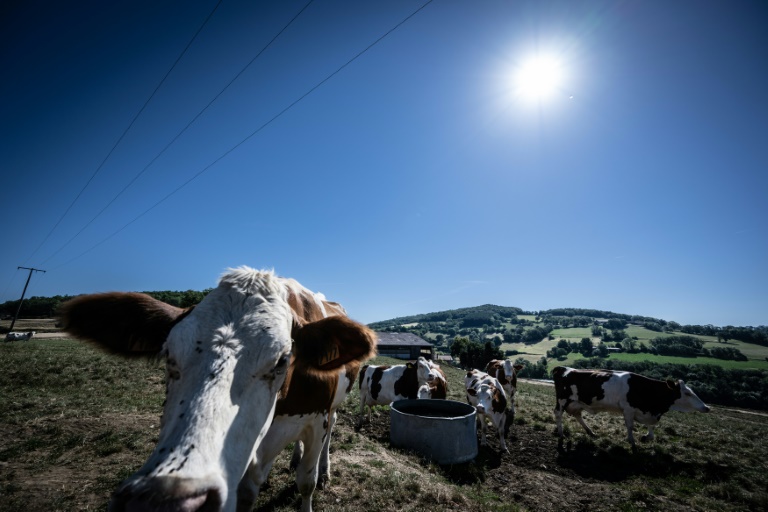
With new record high temperatures being set across France it isn’t just humans that are suffering: even cows high in the mountains need fans to get through the heatwave.  

Despite sitting at an altitude of 780 metres (2,600 feet), the mercury has climbed to 34 degrees Celsius (93 Fahrenheit) at Nicolas Joannon’s farm nestled in the mountains near the eastern city of Lyon.

It’s too hot for Lila, Glee, Pistachio and the rest of his herd of 35 dairy cows to spend the afternoon outside.

But thankfully for them, Joannon has installed two giant fans, measuring 4.5 meters (nearly 15 feet) in diameter, inside his barn.

They can now relax in their straw-bedded stalls under the swirling blades that bring the temperature down a few degrees.

Breeders need to constantly adapt as the climate changes, Joannon says.

“As temperatures rise, animals are under heat stress, they tend to eat less and produce a little less milk,” says the 34-year-old who runs his 45-hectare (110 acres) family farm.

“But if they are put in good conditions to go through the heatwave, immediately after it’s over the animals will regain their initial production level and continue to produce quality milk for consumers,” he adds.

In 2020 Joannon had two fans installed at a cost of 9,000 euros ($9,000).

The fan blades start turning automatically — the hotter it gets, the faster they go.

Joannon says the cows are less lethargic since the fans have been installed.

 – 180 litres of water per day –

Dairy cows are very sensitive to temperature. Starting from 22C (71F) and 50 percent humidity, they accumulate heat in their bodies, which reduces milk production. 

While each animal produces between 28 and 38 litres of milk per day, the heat can result in a two-litre daily drop. 

“At 22C, a cow can adapt, but starting from 28-30C, it will suffer,” says Alexandre Batia, 44, in charge of barn ventilation at Rhone Breeding Council, an association that advises breeders.  

Around one in five dairy farms in the region has already installed fans in their barns, and the waiting list for the Council’s help has grown.

But fans need to compliment good practices, he says, such as feeding cows in the evening and adding extra water troughs as they can drink up to 180 litres (47 gallons) of water per day.

Bertrand Fagoo, a project manager at the French Livestock Institute (IDELE), says that until recently heat stress had only been a problem in southern France, but breeders across the country now need to adapt their practices.

For him, the installation of fans is a “secondary improvement” that has to come after making buildings more open and providing more shade. 

“We shouldn’t stir up hot, stale air in a closed space,” says the 53-year-old researcher.

Batia says water misting animals may be another option, but it carries the risk of raising the humidity level in the building.

It is also advisable to “ventilate buildings homogeneously”, he says, because “otherwise, the cows clump in the most comfortable areas, blocking the circulation and accumulating heat.” 

Fire and destruction at Europe's biggest sand dune

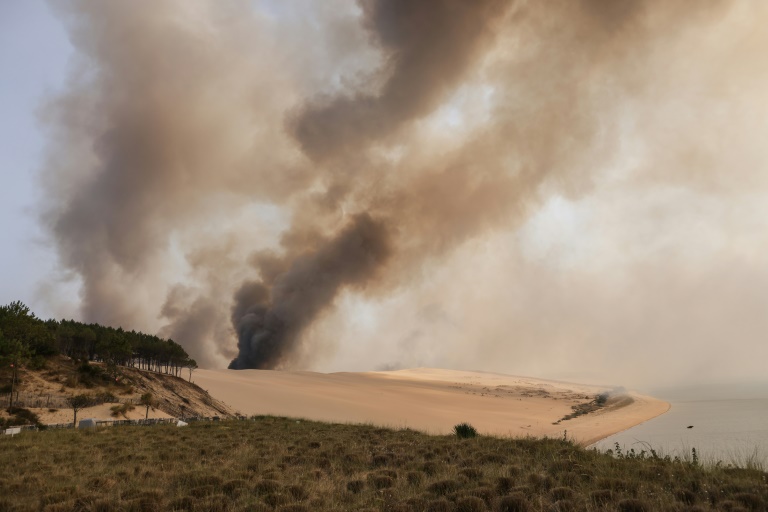
In a usual July on Europe’s biggest sand dune, holidaymakers clamber to its peak to admire the panoramic views of the Atlantic Ocean beyond. This year, its heights are deserted, shrouded in smoke, with fire service planes buzzing overhead.

The Dune du Pilat is a famous attraction on France’s west coast, with its sands rising abruptly out of thick pine forests that shade bustling camp sites and caravan parks in the summer months.  

This year, the forests are ablaze, sending up thick clouds of smoke that blot out the sun as they drift over the ocean or towards the city of Bordeaux, 60 kilometres (36 miles) to the north east.

Around 6,500 hectares (16,000 acres) of forest have burned so far near the dune — an area 12 km long and 7.0 km wide — with another 12,800 hectares lost to a separate and bigger fire further inland to the east.

“We were faced with a wall of fire that was 40-50 metres high. It was a tinderbox,” fire service spokesman Matthieu Jomain told AFP on Tuesday from a blackened area next to the dune. 

“There were sparks being carried several hundred metres by the wind,” he added.

Around 2,000 firefighters are battling round the clock to bring the infernos under control, backed by helicopters and Canadair fire planes which swoop down into the ocean to fill their tanks.

Around 20,000 people have been evacuated near the dune, including residents in the tourist town of La Teste-de-Buch where the temperature hovered around 40 Celsius (104 degrees Fahrenheit) on Tuesday.

“The firemen rang the doorbell to tell us we had to evacuate right away and then the police arrived five minutes later and told us the same thing,” a pensioner told AFP as he left with his partner and pets in a car.

– ‘Amazing’ firefighters – 

At least five campsites have been destroyed by the flames, including one that featured in a popular recent series of French comedy films called “Camping”.

“I had a message from a fireman saying ‘we’re sorry’,” the director of the gutted “Camping de la Dune” site, Franck Couderc, told BFM television.

“They shouldn’t be sorry. It’s amazing what they did,” he said.

The local zoo has begun evacuating its animals, which were in danger of inhaling the smoke, with 363 out of 850 already sent in a special convoy to a facility near Bordeaux.

Around a dozen animals succumbed to the stress and heat, however, the national environment ministry said.

The whole area around the Dune du Pilat lives off tourists in the summer months, who are drawn to the nearby Bay of Arcachon, surfing beaches to the south, or the upmarket Cap Ferret area with its five-star hotels.

“It’s heartbreaking,” said Patrick Davet, the mayor of La Teste-de-Buch.

“Economically, it’s going to be very difficult for them and very difficult for the town because we are a tourist town, and we need the season,” he added.

burs-adp/jh/cdw

Biden highlights decline in US gasoline prices

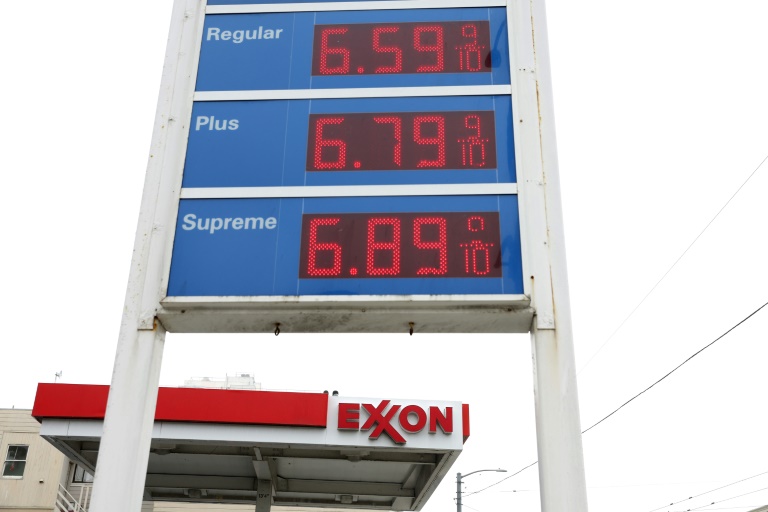
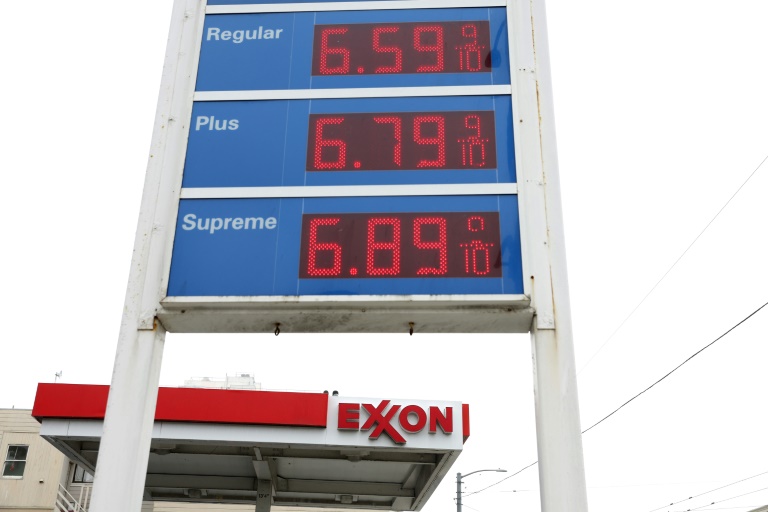
US gasoline prices have fallen from historic highs earlier in the summer, a retreat highlighted by a politically beset White House as a sign of moderating inflation.

President Joe Biden, who has seen his approval rating tumble amid the worst pricing pressures in decades, took to Twitter to point out that prices at the pump have fallen for more than a month, saving the average driver about $25 a month.

“I know those extra dollars and cents mean something. It’s breathing room,” Biden tweeted Monday night. “And we’re not done working to get prices even lower.”

Since hitting an all-time high of $5.016 a gallon on June 14, prices have fallen the last 35 days amid rising worries over economic growth and an easing in the physical crude oil market.

Gasoline prices are now at a national average of $4.495 per gallon, down 10 percent from a month ago but up 42 percent from the year-ago level, according to the American Automobile Association.

The biggest factor in the pullback has been the drop in crude oil prices due to worries that a slowing economy or recession will dent energy demand. 

Crude prices rose to around $130 a barrel soon after the Russian invasion of Ukraine prompted fears of the loss of a major supply source at a time of rising demands.

Analysts say those fears were generally not realized and that most Russian crude oil has continued to flow to buyers in markets such as India and China.

Compared with March, US crude oil production has also risen about 400,000 barrels a day, according to US data.

The added US production, coupled with more Saudi oil added in the recent period, means the tightness of the crude market “has eased,” said Again Capital’s John Kilduff, who also cited as a factor unusually tepid gasoline consumption shown in the most recent weekly US energy report. 

Some of the drop in gasoline use likely is a response to price. But it also reflects shifting labor practices after the pandemic.

“Up until the pandemic, work from home was kind of considered an outlier,” said Bill O’Grady, chief market strategist of Confluence Investment Management.

Under today’s more flexible arrangements, “when the gasoline price goes up, instead of coming in five days a week, you may only come in three or two,” O’Grady said.

– Will prices keep falling? –

A White House memo predicted gasoline prices would continue to fall through the “near term,” highlighting Biden’s actions such as a historically large release of oil from the Strategic Petroleum Reserve — which analysts think had its primary impact as soon as it was announced in late March.  

The White House memo also noted that the decline in gasoline prices has gotten a fraction of the media coverage that the run-up in prices earlier in the spring received.

“Despite the data, you wouldn’t know gas prices are coming down from watching the evening news or reading the paper,” the memo said.

Kilduff also expects gasoline prices to fall further, noting a long-running seasonal trend that typically sees gasoline prices retreat after July 4.

“My forecast is for prices to continue to slide lower into the fall,” Kilduff said, adding that prices will remain high by historical standards.

While O’Grady thinks prices will continue to fall, he added that there is always a risk in late summer that Gulf of Mexico hurricanes could impair key refineries.

“That can send gasoline prices up significantly,” he said.

Biden highlights decline in US gasoline prices

US gasoline prices have fallen from historic highs earlier in the summer, a retreat highlighted by a politically beset White House as a sign of moderating inflation.

President Joe Biden, who has seen his approval rating tumble amid the worst pricing pressures in decades, took to Twitter to point out that prices at the pump have fallen for more than a month, saving the average driver about $25 a month.

“I know those extra dollars and cents mean something. It’s breathing room,” Biden tweeted Monday night. “And we’re not done working to get prices even lower.”

Since hitting an all-time high of $5.016 a gallon on June 14, prices have fallen the last 35 days amid rising worries over economic growth and an easing in the physical crude oil market.

Gasoline prices are now at a national average of $4.495 per gallon, down 10 percent from a month ago but up 42 percent from the year-ago level, according to the American Automobile Association.

The biggest factor in the pullback has been the drop in crude oil prices due to worries that a slowing economy or recession will dent energy demand. 

Crude prices rose to around $130 a barrel soon after the Russian invasion of Ukraine prompted fears of the loss of a major supply source at a time of rising demands.

Analysts say those fears were generally not realized and that most Russian crude oil has continued to flow to buyers in markets such as India and China.

Compared with March, US crude oil production has also risen about 400,000 barrels a day, according to US data.

The added US production, coupled with more Saudi oil added in the recent period, means the tightness of the crude market “has eased,” said Again Capital’s John Kilduff, who also cited as a factor unusually tepid gasoline consumption shown in the most recent weekly US energy report. 

Some of the drop in gasoline use likely is a response to price. But it also reflects shifting labor practices after the pandemic.

“Up until the pandemic, work from home was kind of considered an outlier,” said Bill O’Grady, chief market strategist of Confluence Investment Management.

Under today’s more flexible arrangements, “when the gasoline price goes up, instead of coming in five days a week, you may only come in three or two,” O’Grady said.

– Will prices keep falling? –

A White House memo predicted gasoline prices would continue to fall through the “near term,” highlighting Biden’s actions such as a historically large release of oil from the Strategic Petroleum Reserve — which analysts think had its primary impact as soon as it was announced in late March.  

The White House memo also noted that the decline in gasoline prices has gotten a fraction of the media coverage that the run-up in prices earlier in the spring received.

“Despite the data, you wouldn’t know gas prices are coming down from watching the evening news or reading the paper,” the memo said.

Kilduff also expects gasoline prices to fall further, noting a long-running seasonal trend that typically sees gasoline prices retreat after July 4.

“My forecast is for prices to continue to slide lower into the fall,” Kilduff said, adding that prices will remain high by historical standards.

While O’Grady thinks prices will continue to fall, he added that there is always a risk in late summer that Gulf of Mexico hurricanes could impair key refineries.

“That can send gasoline prices up significantly,” he said.

Rare twin giraffes born in Kenya

Rare twins have been born to a Maasai giraffe in Nairobi’s national park, the Kenyan wildlife minister said Tuesday.

“This is an extremely rare occurrence,” Najib Balala said on Twitter in a post accompanied by a picture of the mother watching over her offspring.

The world’s tallest species was listed as “vulnerable to extinction” on the International Union for Conservation of Nature’s 2016 Red List of threatened wildlife.

Only about 117,000 giraffe remain in the wild, according to the Giraffe Conservation Foundation. It said the numbers of the gentle long-necked giant in Africa have plummeted by 30 percent over the last 30 years, describing it as a “silent extinction”.

Kenya is home to three subspecies of giraffe, the Maasai, the reticulated and the Rothschild.

Nairobi National Park lies just seven kilometres (four miles) from the heart of the Kenyan capital, and is a tourist magnet for its wildlife including lions, leopards, rhinos and buffalos which graze against a backdrop of distant skyscrapers.

At 15 months, giraffes have one of the longest gestation periods for mammals. They give birth standing up, which means their calves drop just under two metres (six feet) to the ground. 

This startling introduction to life gets them up and running around in less than an hour. A newborn calf is bigger than the average adult human. 

Only a handful of twin births have been documented worldwide with most often not surviving. 

In the wild, giraffes can live up to 25 years, while in captivity they can survive more than 35 years.

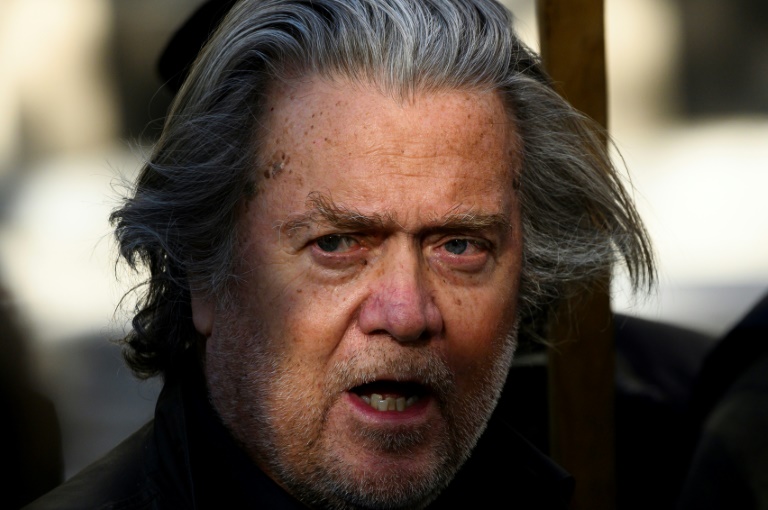
Steve Bannon: Loyal to Trump, from White House to court

Steve Bannon — the anti-establishment outsider who helped bring Donald Trump to the White House — is now on trial for refusing to testify about the January 6, 2021 assault on the US Capitol.

The 68-year-old former investment banker rose to prominence as the head of far-right news outlet Breitbart before latching onto the Trump phenomenon and guiding the billionaire to the presidency.

Trump rewarded Bannon by naming him chief strategist, a major victory for the alt-right that sent shudders through the political mainstream.

He held the post for less than a year before being fired, but Bannon’s loyalty to Trump survived.

He vowed to fight for Trump from outside the White House, pushed the president’s discredited allegations of fraud in the 2020 election, and refused to testify to lawmakers investigating the Capitol attack, claiming to be covered by presidential executive privilege.

Bannon recently reversed course and agreed to testify after allegedly receiving Trump’s blessing, but it was too late.

If founded guilty, he faces up to a year in prison for each of two charges of contempt of Congress.

After serving in the US Navy and making his name at Goldman Sachs during the 1980s boom years, Bannon founded his own investment bank before selling it to Societe Generale in 1998 and going on to be a Hollywood producer.

Some of his projects were standard entertainment fare, but documentaries on late president Ronald Reagan, populist darling Sarah Palin and the Tea Party movement brought him into right-wing circles.    

He became an investor in Andrew Breitbart’s eponymous media venture, which aimed to buck what its founder saw as the progressive left’s grip on the news agenda. 

Democrats and liberals were in the site’s crosshairs, but moderate Republican lawmakers also felt its lash, accused of failing to stand up to president Barack Obama.

– Outsider to insider –

Breitbart died in 2012 and Bannon took over, promoting Trump’s candidacy before officially joining his campaign.

He was one of the most influential figures in the White House, and was behind some of Trump’s most controversial moves, including his ban on some travelers from abroad and pulling the United States out of the Paris climate change agreement.

After frequent clashes, including with Trump himself, Bannon was pushed out in August 2017, returning to Breitbart.

His participation in Michael Wolff’s gossipy and damaging book “Fire and Fury” angered the president, who dubbed him “Sloppy Steve” and suggested he “cried when he got fired and begged for his job” — but their relationship survived.

Bannon stepped down from Breitbart in early 2018.

In 2020, he was charged with conspiracy to commit wire fraud over funds raised to build a wall on the border with Mexico — a flagship Trump policy that the president had falsely promised would be paid for by the US’s southern neighbor.

Trump pardoned Bannon — who had pleaded not guilty to the fraud charge — on his last day in office, two weeks after Trump supporters stormed the US Capitol in an attempt to prevent the certification of Joe Biden’s election victory.

Bannon was one of dozens of people called to testify before the House committee about the assault. 

Investigators believe that he and other Trump advisors could have information on links between the White House and the rioters.

According to the House committee, Bannon spoke with Trump on January 5 — the same day he told listeners of his podcast that “all hell is going to break loose tomorrow.”

Stocks advance despite Apple report concerns

Stock markets mostly advanced on Tuesday despite fresh recession worries on a report tech titan Apple may scale back hiring and investment.

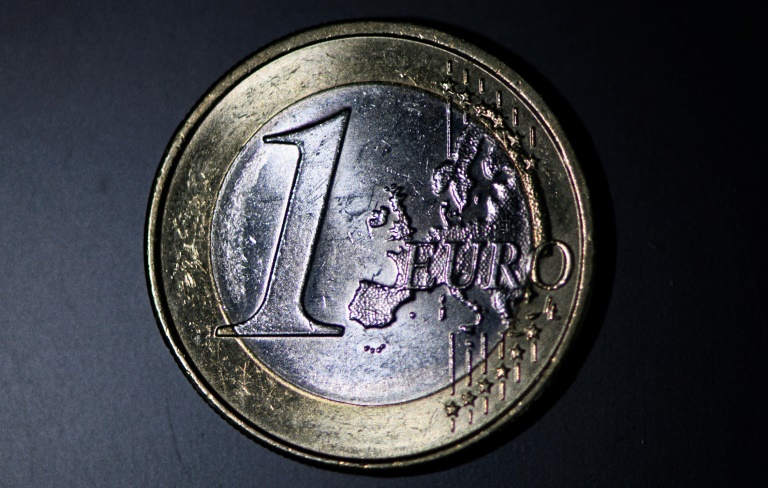
Meanwhile, the euro rallied against the dollar as traders looked ahead to a key European Central Bank meeting later this week, while oil gave up some of its strong gains on Monday.

European stocks were higher in afternoon trading, with London up 0.5 percent and both Frankfurt and Paris climbing 0.7 percent.

Wall Street opened higher, with the blue-chip Dow adding 0.7 percent, and the broader S&P 500 and tech-heavy Nasdaq Composite rising more than one percent.

Asian equity indices closed mixed after an overnight sell-off on Wall Street fuelled by fresh recession worries on the Bloomberg report on Apple’s plans.

“Apple put the cat among the pigeons following a media report that it plans to pull back hiring and growth spending next year in anticipation of the possible economic downturn,” noted Richard Hunter, head of markets at Interactive Investor.

Apple’s shares were 0.4 percent up shortly after trading began.

The euro meanwhile jumped around one percent against the dollar, as traders mulled whether the European Central Bank could hike interest rates more than expected to fight runaway inflation.

The ECB has signalled it would raise eurozone interest rates on Thursday for the first time in more than a decade but is under pressure to do more to tackle spiralling prices.

It intends to raise borrowing costs by a quarter point, the first such move since 2011. 

“In all likelihood, the ECB will raise interest rates by 25 basis points this week and follow this up with a 50-basis-point move in September,” noted Matthew Ryan, head of market strategy at financial firm Ebury.

“That said, we do not rule out a 50-basis-point rate hike at this week’s meeting. 

“We have already seen most major central banks deliver bumper rate increases in recent weeks in an attempt to control rampant price growth,” Ryan added.

The Federal Reserve’s aggressive rate tightening this year has sent the dollar soaring against most other currencies in recent weeks.

Last week, the euro fell below parity with the dollar for the first time in nearly 20 years, also on growing fears of a eurozone recession as high inflation hampers growth. 

On Tuesday, the dollar briefly hit a record high above 80 rupees, with the Indian unit hammered by massive outflows of capital as the economy struggles.

While some are predicting inflation may have reached its peak, oil prices — the key driver of soaring costs — remain elevated.

Both main contracts fell Tuesday after rocketing more than five percent Monday on expectations that Saudi Arabia would not open up the taps further, with a plea by US President Joe Biden seeming to have fallen on deaf ears.

Traders were keeping a nervous eye on Europe, where a 10-day maintenance shutdown of the Nord Stream 1 pipeline from Russia is due to end this week.

Many fear Vladimir Putin will keep it shut in retaliation for sanctions imposed on Moscow for invading Ukraine. 

That would deal another blow to the already creaking eurozone economy and could send crude prices soaring.

Supply fears are trumping worries about a demand hit in China from another possible lockdown in Shanghai as officials struggle to contain another Covid-19 outbreak.

– Key figures at around 1330 GMT –

London – FTSE 100: UP 0.5 percent at 7,258.68 points

Frankfurt – DAX: UP 0.7 percent at 13,050.89

Paris – CAC 40: UP 0.7 percent at 6,131.94

EURO STOXX 50: UP 0.7 percent at 3,537.00

New York – Dow: UP 0.7 percent at 31,293.30

Tokyo – Nikkei 225: UP 0.7 percent at 26,961.68 (close)

Hong Kong – Hang Seng Index: DOWN 0.9 percent at 20,661.06 (close)

Shanghai – Composite: FLAT percent at 3,279.43 (close)

Euro/dollar: UP at $1.0246 from $1.0146 on Monday

Pound/dollar: UP at $1.2019 from $1.1950 

Euro/pound: UP at 85.21 pence from 84.88 pence

Dollar/yen: DOWN at 137.49 yen from 138.13 yen

West Texas Intermediate: DOWN 1. percent at $101. per barrel

Brent North Sea crude: DOWN 1. percent at $105. per barrel

burs-rl/bp

Close Bitnami banner
Bitnami