AFP

Biden sets up sanctions in ramped-up effort on US detainees

President Joe Biden on Tuesday opened the way for sanctions against governments that unjustly imprison Americans and ordered more detailed travel warnings after a series of high-profile detentions.

Biden signed an executive order billed as expanding the set of tools for the US government in what Secretary of State Antony Blinken said was a “relentless” effort to free citizens overseas.

“When Americans are taken captive abroad, we must do everything in our power to secure their release,” Blinken said in a statement.

The move comes after wide media coverage of the detention in Russia on drug charges of basketball star Brittney Griner, whose wife initially said Biden was not doing enough.

The executive order authorizes government agencies to impose financial sanctions or travel bans on foreign officials or non-state actors involved in unjust detentions of Americans.

“Using sanctions may not always help secure someone’s release, so we will therefore be judicious and strategic in our use of this authority,” a US official told reporters on condition of anonymity.

“But the families of those held know their loved ones’ case(s) best, and we intend to hear from them, hear their good ideas and listen to their recommendations,” he said.

The State Department, in its travel advisories for Americans, will also begin to highlight in which nations there is an elevated risk of unjust detention.

The initial group of nations that will bear a “D” mark for detention risk will be China, Iran, Myanmar, North Korea, Russia and Venezuela, another official said.

Successive administrations have made the plight of prisoners and hostages a top priority. 

Despite soaring tensions over the Ukraine war, the Biden administration in April arranged with Russia to swap Trevor Reed, an ex-Marine jailed for allegedly attacking police while drunk, for a Russian pilot convicted of drug smuggling.

In Iran, the Biden administration has insisted it cannot revive a languishing nuclear deal without the release of jailed Americans.

One of them, Siamak Namazi, a businessman convicted on charges he denies of seeking to topple the clerical state, recently spoke out from prison and urged Biden to secure his freedom regardless of nuclear diplomacy.

At least 11 Americans are known to be held in Venezuela, although two others were freed in March after rare US contact with President Nicolas Maduro, a leftist leader considered illegitimate by Washington.

UK breaches 40C for first time as heatwave batters Europe

A fierce heatwave left western Europe sweltering on Tuesday, fuelling ferocious wildfires and stretching emergency services, as it swept north and pushed temperatures in Britain over 40 degrees Celsius (104 degrees Fahrenheit) for the first time.

After the UK’s warmest night on record, the Met Office said 40.2C had been provisionally recorded by lunchtime at Heathrow Airport, in west London, taking the country into uncharted territory.

Britain’s previous all-time temperature record of 38.7C, set in Cambridge in eastern England in 2019, had already been smashed earlier Tuesday.

“For the first time ever, 40 Celsius has provisionally been exceeded in the UK,” the Met Office meteorological agency said, warning “temperatures are still climbing in many places”.

Experts blame climate change for the latest heatwave and note the more frequent extreme weather will only worsen in years to come.

The high temperatures have triggered an unprecedented red alert for extreme heat in much of England, where some rail lines were closed as a precaution and schools shuttered in some areas.

All trains were cancelled from London’s usually busy Kings Cross station, leaving many travellers stranded. 

“It’s a little frustrating,” said American tourist Deborah Byrne, trying to reach Scotland.

But with road surfaces and runways melting and rails buckling, Transport Secretary Grant Shapps conceded much of Britain’s infrastructure “is just not built for this temperature”. 

Tim Wainwright, chief executive of the charity WaterAid, said the situation should be “the wake-up call the world needs to stop climate change from claiming any more lives”. 

– Wildfires –

In France, towns and cities in the country’s west registered their highest-ever temperatures Monday, the national weather office said.

The western region of Brittany — normally cool and often wet in summer — set new record highs Monday above 40C. 

Despite cooler air from the Atlantic offering some respite there Tuesday, dozens of departments remained on orange alert, with temperatures still expected to top 40C in the east and south and violent thunderstorms forecast locally.

The heatwave — the second to engulf parts of Europe in recent weeks — has contributed to deadly wildfires in France, Greece, Portugal and Spain, destroying vast tracts of land.

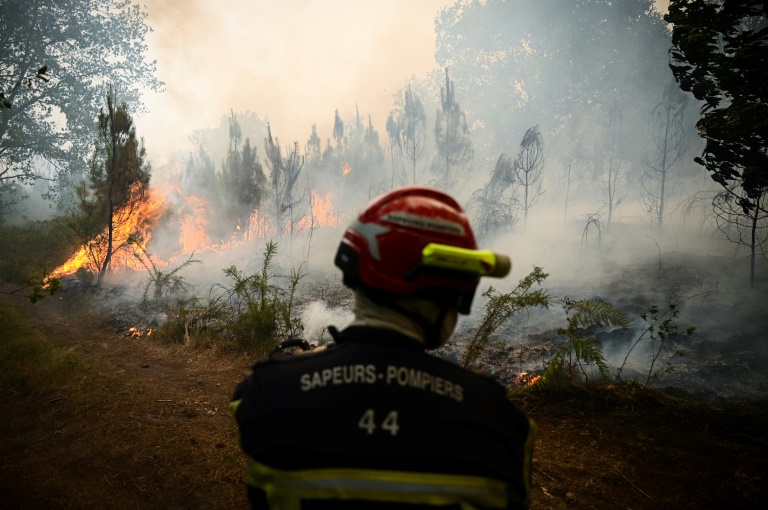
Firefighters in France’s southwest were still struggling to contain two massive fires that have caused widespread destruction and forced tens of thousands of people to leave their homes.

Nearly 1,700 firefighters from all over the country, supported by significant air resources, are battling the two blazes that have so far burned more than 19,000 hectares (42,000 acres) of forest.

“It’s heartbreaking,” said Patrick Davet, mayor of La Teste-de-Buch, the site of one inferno which has prompted mass evacuations.

“Economically, it’s going to be very difficult for them and very difficult for the town because we are a tourist town, and we need the (tourist) season.”

In Brittany’s Finistere region, hundreds of firefighters, specialised vehicles and waterbombing aircraft were tackling blazes.

– Deaths –

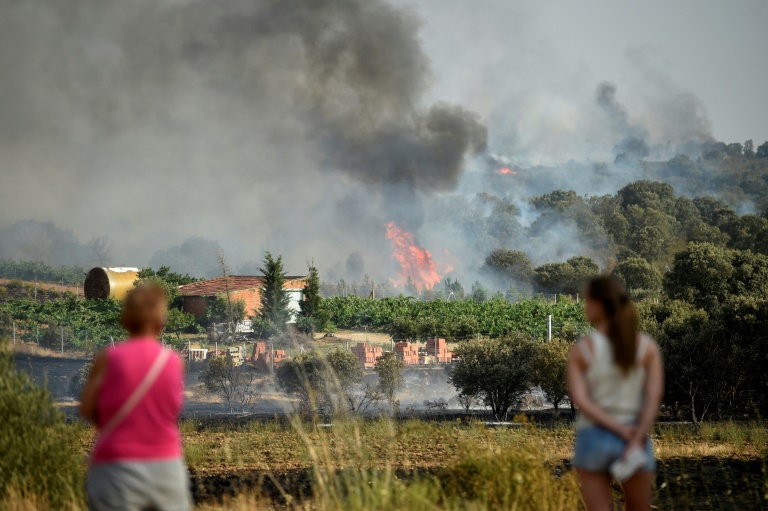
In Spain — nearly 10 days into the latest heatwave — more than a dozen fires continued to rage Tuesday, including in the northwest province of Zamora, which already experienced a huge fire last month.

Known as one of the largest wolf reserves in Europe, it saw nearly 30,000 hectares of land reduced to ashes during the June blaze.

Nearly 6,000 people had to be evacuated from there this week after flames destroyed several thousand hectares of meadows and forests, regional authorities said. 

Rail traffic between Madrid and Galicia, in the northwest, remained suspended after fires on either side of the tracks.

Several people have died in recent days due to the blazes while separately, an office worker in his 50s died from heatstroke in Madrid.

In Portugal, more than 1,400 firefighters were fighting fires in the centre and north of the country, despite a clear drop in temperatures in recent days.

A couple in their 70s died Monday after they ran off the road while trying to escape the flames in their car.

Almost the entire country has been on high alert for wildfires despite a slight drop in temperatures, which last Thursday hit 47C — a record for July.

The fires have already killed two other people, injured around 60 and destroyed between 12,000 and 15,000 hectares of land there.

– Heat –

Elsewhere, temperatures could locally exceed 40C in Belgium near the French border, prompting the Royal Meteorological Institute to issue its highest alert level.

Big state-run museums, primarily in Brussels, took the unusual step of offering free access Tuesday to over-65s to help them stay cool.

In Germany, temperatures were expected to reach up to 40C in the west.

On Monday, two firefighters were injured while beating back a forest fire in a mountainous area in Saxony state.

The hot summer so far has raised fears of drought, with the German Farmers’ Association president warning of “major losses” in food production.

Henning Christ, who grows wheat and other crops in Brandenburg state, told AFP his farm was 20 percent below its average annual yield.

“We’ve had almost no rain for months, coupled with high temperatures,” he said. 

“We have become used to drought and dry periods to some extent, but this year has been very unusual.”

burs-jj/phz/bp

'Not a switch': UAE pushes for fair energy transition

The world’s transition to clean energy sources must be “just” and financed by the hydrocarbon trade, the climate change minister of oil-rich United Arab Emirates told AFP.

Mariam Almheiri was interviewed in France where a fierce heatwave set record temperatures as western Europe wilted under a scorching sun and wildfires that devoured forests.

Experts are blaming climate change and predict more frequent extreme weather to come.

“It’s not a switch. We’re not ready yet. And oil and gas will still be part of the energy mix for some time”, she said in an interview Monday as UAE President Sheikh Mohamed bin Zayed Al-Nahyan visited Paris for energy talks.

“We need… a just transition because every country is not at the same level,” the minister of climate change and the environment added, stressing the UAE was using its oil and gas wealth to ramp up renewable sources. 

“You need to build your equipment from what energy you got to do that,” she said. “Clean and renewable energy costs money.”

The international community largely agrees that climate change poses an existential threat to the planet and future of mankind. 

But action to cut carbon pollution and prepare for the accelerating impact is lagging, as is support for vulnerable countries confronting the ravages of a changing climate.

– ‘We will provide’ –

Adding to the pressure has been Russia’s invasion of Ukraine that has sent food and energy prices spiralling.

Western sanctions aimed at crippling major energy producer Russia have resulted in sharply higher fuel costs in Europe and the United States, with inflation soaring as a result.

This has pushed the Unites States and Europe to try to persuade oil-rich countries like the UAE to increase energy supplies to bring prices back under control.

“Look at what we’re going through right now. Months ago, people were pointing their fingers at us going: ‘Why are you still producing?’ Now they’re coming to say: ‘Please produce, please produce.'”

A top oil producer in OPEC, the UAE’s rapid growth since the 1970s has been driven by its energy wealth.

But having diversified its economy over the decades, the desert country of one million locals and nine million foreigners relies less and less on petrol, with revenues now making up only 30 percent of GDP.

At the same time, it forecasts that the oil and gas industry would need to invest over $600 billion every year until 2030 just to keep up with expected demand.

“We are a country that has oil and gas as a natural resource. We don’t have water… so as long as the world needs oil and gas we will provide,” said Almheiri.

The country was built on oil, but is spending billions to develop enough renewable energy to cover half of its needs by 2050. 

It is building two of the world’s largest solar power plants in the capital Abu Dhabi and Dubai.

It has also joined the nuclear club, with its Barakah nuclear power station, the first in the Arab world.

And last year, it launched a “strategic initiative” targeting carbon neutrality by 2050.

– Two-pronged approach –

Meteorologists are predicting more frequent and intense episodes of extreme weather in coming years.

“The increase in the frequency, duration, and intensity of these events over recent decades is clearly linked to the observed warming of the planet and can be attributed to human activity,” the World Meteorological Organisation said. 

Heatwaves of the future will depend largely on how rapidly the global economy can decarbonise.

While several towns and cities in France recorded their highest ever temperatures on Monday, the Gulf region is also at risk.

In the region, summer means suffering for anyone working outside, along with risks of dehydration, heat stroke and heart failure.

Countries of the energy-rich Gulf have banned working outdoors in the hottest hours of the day.

A study in the journal Nature Climate Change found that within this century, parts of the Gulf region could be hit by “unprecedented events of deadly heat as a result of climate change”.

Almheiri said her country, which next year is hosting the United Nations Climate Change Conference COP28, has adopted a “two-pronged approach” while advocating further investments in oil and gas.

“We are ramping up our renewables because we have targets of where we want to reach, and we are decarbonising our oil and gas.”

Ukraine lawmakers vote to sack prosecutor general, security chief

Ukrainian lawmakers on Tuesday endorsed the president’s decision to sack the country’s top prosecutor and security chief, rubber stamping Ukraine’s largest political shake-up since Russia invaded.

The overhaul was confirmed as Russian President Vladimir Putin was in Tehran with his Turkish counterpart to discuss a possible agreement to unblock Black Sea exports of Ukrainian grain.

Several Ukrainian deputies writing on social media at the parliamentary session in Kyiv said lawmakers had overwhelmingly backed President Volodymyr Zelensky’s shock call to remove the officials.

“Parliament voted to dismiss Iryna Venediktova as prosecutor general,” said David Arakhamia, a lawmaker affiliated to Zelensky. Other deputies said the plea to remove security chief Ivan Bakanov secured the necessary 226 votes.

Zelensky asked parliament to approve the dismissals less than 48 hours after announcing late Sunday that he was suspending the senior law enforcement officials and that 650 cases of suspected treason were under investigation.

He replaced Bakanov on Monday and described the shake up in the security services as an “audit” and said that 28 security officials were facing dismissal.

“Different levels, different directions. But the grounds are similar — unsatisfactory job performance,” Zelensky said.

Venediktova, who met regularly with counterparts from EU countries and the United States wrote on social media on Monday that she had “things to be proud of in her post and showed good results”.

– Tehran summit –

Putin and Turkish President Recep Tayyip Erdogan, who arrived in Tehran on Monday, were due to meet in the Iranian capital on Tuesday to discuss mechanisms to export grain from Ukraine.

On Wednesday, Russian and Ukrainian delegations are due to meet in Istanbul alongside Turkish and UN representatives, with hopes rising for an announced accord.

The EU’s foreign policy chief Josep Borrell warned this week that the grain impasse was “an issue of life and death for many human beings.”

NATO member Turkey has been using its good relations with both the Kremlin and Kyiv to try to broker an agreement on a safe way to deliver the grain.

Along the Black Sea coast, Kyiv said Tuesday that Russian forces had rocked the southern and coastal region of Odessa with a barrage of seven cruise missiles, wounding at least six people including a child. 

“One (missile) was shot down by air defences. Six hit a village. As a result, several residential buildings and other facilities were destroyed and caught fire,” the Ukraine presidency said.

The Russian defence ministry claimed that strikes on Odessa had destroyed a stockpile of Western-supplied weapons.

– Kramatorsk shelled –

Russian Defence Minister Sergei Shoigu ordered Russian troops earlier this week to prioritise the destruction of long-range artillery supplied by the United States and Ukraine’s other Western allies.

Observers credit the weapons with altering battlefield dynamics, giving Ukraine the capacity to hit Russian arms depots and command posts deep inside territory controlled by Moscow.

The heaviest fighting in recent weeks, however, has centred not on the south but in Ukraine’s eastern Donbas region. 

Kramatorsk, one of the last-remaining Donbas cities under Ukrainian control, was hit by Russian strikes on Tuesday, AFP journalists said.

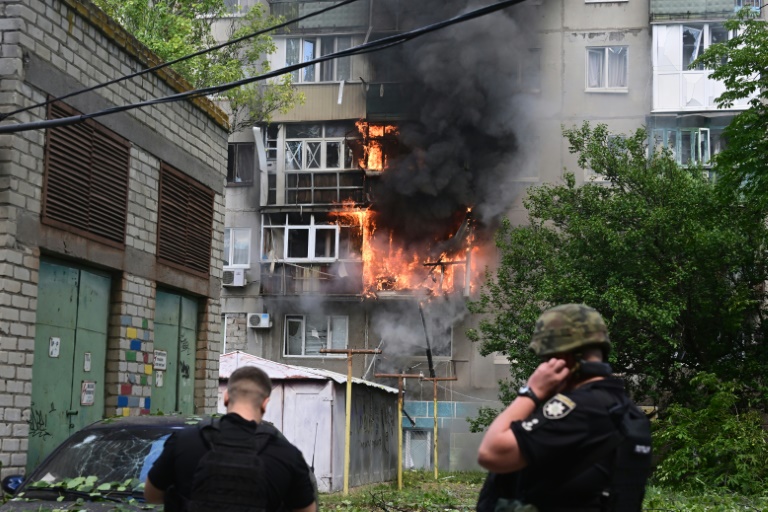
The head of the region, Pavlo Kyrylenko, said one person was killed, and distributed video of the attack showing flames jumping from the inside a residential building.

AFP journalists said a four-story residential building was hit and saw panicked neighbours seeking medical attention from rescue workers in the aftermath.

One man with a bloodied head lay on the ground, before being taken away by the emergency services.

“He was just walking by and was hit,” said one woman, who declined to give her name, visibly shaken after the bombardment.

Russian strikes on Monday killed six people in the town of Toretsk, which has a population of around 30,000 and is not far from Kramatorsk.

burs-jbr/jm

Brad Pitt says retirement still a long way off

Brad Pitt scotched talk of imminent retirement as he travelled to Paris for the premiere of his Jackie Chan-inspired action caper “Bullet Train”. 

The 58-year-old had worried fans that his acting days may be numbered after a GQ interview last month in which he said he was in the “last semester” of his career. 

But Pitt told AFP: “I’m not getting out by any means.

“It seems that might have been taken as a statement of retirement. That’s not what I was saying,” he said. 

“I’m over that hump of middle age and so I’m looking at that last leg… how do I want to spend that time? At my age, you’ve made enough mistakes… now there’s a comfort in applying that kind of wisdom.”

“Bullet Train”, which is being released around the world over the next two weeks, sees Pitt trying something new in an action comedy from the director of “John Wick”, David Leitch. 

Pitt plays a reluctant hit-man fighting off rivals on a Japanese train. 

“It’s  much more fun than the regular punch-up. It’s infused with humour and character,” he said. 

“I can’t say enough about Jackie Chan and what he’s done, and to be in that arena, even close to that, is something I hadn’t done before.” 

Pitt will next be seen in “Babylon” about Hollywood’s golden age, directed by Damien Chazelle (“La La Land”). 

That will partner him again with Margot Robbie — the pair starred in Quentin Tarantino’s “Once upon a Time in Hollywood”, which won Pitt an Oscar in 2020. 

But Pitt said he takes particular enjoyment from production duties with his company Plan B. 

The company has three best picture Oscar winners to its name — “The Departed”, “Twelve Years a Slave” and “Moonlight” — and will soon release the hotly tipped “Blonde” about Marilyn Monroe.

“I really like what we’ve been able to do on the producing end. You get to be part of stories, foster new talent,” he said. 

Unlike other major movie stars such as Tom Cruise, Pitt is not as wedded to the nostalgia of movie theatres. 

“I like the dichotomy, the streamer as well as the theatre experience, because films were getting so expensive to do and to market that it was either big tent-pole movies or very small intimate movies and there was no room for anythings in-between. Streamers have opened it up for more voices,” he said. 

Nonetheless, Pitt said he had recently loved going to watch “Elvis” in a cinema. 

“I’m a big fan of Austin Butler, I think he’s going to do great work,” said Pitt of the film’s star.  

“It was so much fun to be there again. There’s a place for both.”

Boeing wins $8bn order in latest boost for MAX jets

US planemaker Boeing won a fresh boost Tuesday for its crisis-hit MAX aircraft, as investment fund 777 Partners ordered up to 66 of the passenger aircraft worth a combined $8 billion.

The announcement, on the second day of Farnborough airshow, comprises a firm order for 30 medium-haul single-aisle 737 MAX-8-200s plus options to purchase up to 36 more from the same family.

The Miami-based fund operates Flair Airlines in Canada and Bonza Aviation in Australia.

Josh Wander, the fund’s managing partner and co-founder, said the MAX-8-200 jets — configured with more seats than the MAX-8 — would help ramp up the capacity of both carriers.

Tuesday’s news takes the fund’s total Boeing order book to 134 models in the 737 MAX family.

“This new order marks another milestone in the robust growth of our aviation businesses and concurrently, our partnership with Boeing,” Wander added in a statement.

The MAX jet, which suffered two deadly crashes in 2018 and 2019, is experiencing a rush of interest at this year’s Farnborough, southwest of London.

US airline Delta on Monday announced a deal to buy 100 MAX passenger aircraft worth a combined $13.5 billion.

Japan’s ANA has agreed to buy 20 of MAX 8 jets worth $2.4 billion.

Europe heat sparks harmful ozone pollution, 'extreme' fire risk

Europe’s searing heatwave is generating very high levels of harmful ozone pollution, the region’s atmospheric monitoring service warned Tuesday, adding that large areas of western Europe also face “extreme” danger of wildfires. 

Record temperatures, which scientists say are driven by climate change, are predicted in France and Britain Tuesday as suffocating heat that has gripped southwest Europe and sparked ferocious wildfires moves northwards.

“Tinder dry conditions and extreme heat are exacerbating the risk of wildfires,” according to a statement from the Copernicus monitoring service. 

The organisation’s emergency management service has warned that a large proportion of western Europe is in “extreme fire danger” with some areas of “very extreme fire danger”. 

The heatwave is also causing high levels of ground-level ozone, Copernicus said. 

Unlike the protective layer in the upper atmosphere, this is a major greenhouse gas and component of urban smog that harms human health and inhibits photosynthesis in plants. 

“The potential impacts of very high ozone pollution on human health can be considerable both in terms of respiratory and cardio-vascular illness,” said Mark Parrington, Senior Scientist from the Copernicus Atmosphere Monitoring Service.  

Ozone is formed as emissions from fossil fuels and other man-made pollutants react in the presence of sunlight and Copernicus said cutting emissions of these pollutants is “crucial”. 

Scientists have already detected “extremely high surface ozone pollution” across western and southern Europe, particularly over the Iberian Peninsula and parts of northern Italy.

Daily maximum levels of surface ozone, which normally peaks during the middle of the day, reached unhealthy levels in Portugal, Spain and Italy, according to Copernicus. 

Scientists now warn that, while the situation is likely to ease across the Iberian Peninsula, very high surface ozone levels are now being seen in areas of northern and western parts of the continent as temperatures rise. 

The ozone levels in these regions are forecast to peak in the next few days, before easing.

Copernicus also predicted no relief from the wildfires that have engulfed swathes of forests across parts of southern Europe.  

– One million ozone pollution deaths –

In southwest France, two massive fires have created apocalyptic scenes of destruction, despite  much of the country’s entire firefighting capacity being deployed.

Copernicus said total carbon emissions from the wildfires in Spain so far in July are the highest seen for the June-July period since 2003.  

Parrington said high surface ozone can lead to sore throats, coughing, headaches and an increased risk of asthma attacks.

The Clean Air Alliance estimates that ozone pollution causes approximately one million additional deaths per year.

Ozone is also a key concern for agricultural regions and food security. 

In January, researchers estimated that persistently high levels of ozone pollution in Asia are costing China, Japan and South Korea an estimated $63 billion annually in lost rice, wheat and maize crops.

European stocks steady amid Apple report concerns

Europe’s main stock markets steadied and the euro rallied against the dollar Tuesday as traders looked ahead to a key European Central Bank meeting later this week. 

Asian equity indices closed mixed after an overnight sell-off on Wall Street fuelled by fresh recession worries.

“Apple put the cat among the pigeons following a media report that it plans to pull back hiring and growth spending next year in anticipation of the possible economic downturn,” noted Richard Hunter, head of markets at Interactive Investor.

The euro meanwhile jumped more than one percent against the dollar, as traders mulled whether the European Central Bank could hike interest rates more than expected to fight runaway inflation.

The ECB has signalled it would raise eurozone interest rates on Thursday for the first time in more than a decade but is under pressure to do more to tackle spiralling prices.

It intends to raise borrowing costs by a quarter point, the first such move since 2011. 

“In all likelihood, the ECB will raise interest rates by 25 basis points this week and follow this up with a 50-basis-point move in September,” noted Matthew Ryan, head of market strategy at financial firm Ebury.

“That said, we do not rule out a 50-basis-point rate hike at this week’s meeting. 

“We have already seen most major central banks deliver bumper rate increases in recent weeks in an attempt to control rampant price growth,” Ryan added.

The Federal Reserve’s aggressive rate tightening this year has sent the dollar soaring against most other currencies in recents weeks.

Lst week, the euro hit parity with the dollar for the first time in nearly 20 years, also on growing fears of a eurozone recession as high inflation hampers growth. 

On Tuesday, the dollar briefly hit a record high above 80 rupees, with the Indian unit hammered by massive outflows of capital as the economy struggles.

While some are predicting inflation may have reached its peak, oil prices — the key driver of soaring prices — remain elevated.

Both main contracts fell Tuesday after rocketing more than five percent Monday on expectations that Saudi Arabia would not open up the taps further, with a plea by US President Joe Biden seeming to have fallen on deaf ears.

Traders were keeping a nervous eye on Europe, where a 10-day maintenance shutdown of the Nord Stream 1 pipeline from Russia is due to end this week.

Many fear Vladimir Putin will keep it shut in retaliation for sanctions imposed on Moscow for its invasion of Ukraine. 

That would deal another blow to the already creaking eurozone economy and could send crude prices soaring.

Supply fears are trumping worries about a demand hit in China from another possible lockdown in Shanghai as officials struggle to contain another Covid-19 outbreak.

– Key figures at around 1100 GMT –

London – FTSE 100: UP 0.2 percent at 7,240.04 points

Frankfurt – DAX: UP 0.1 percent at 12,978.47

Paris – CAC 40: UP 0.1 percent at 6,094.85

EURO STOXX 50: FLAT at 3,512.87

Tokyo – Nikkei 225: UP 0.7 percent at 26,961.68 (close)

Hong Kong – Hang Seng Index: DOWN 0.9 percent at 20,661.06 (close)

Shanghai – Composite: FLAT percent at 3,279.43 (close)

New York – Dow: DOWN 0.7 percent at 31,072.61 (close)

Euro/dollar: UP at $1.0257 from $1.0146 on Monday

Pound/dollar: UP at $1.2017 from $1.1950 

Euro/pound: UP at 85.32 pence from 84.88 pence

Dollar/yen: DOWN at 137.52 yen from 138.13 yen

West Texas Intermediate: DOWN 1.0 percent at $101.63 per barrel

Brent North Sea crude: DOWN 1.1 percent at $105.08 per barrel

Indian rupee breaches 80 per dollar, hits new record low

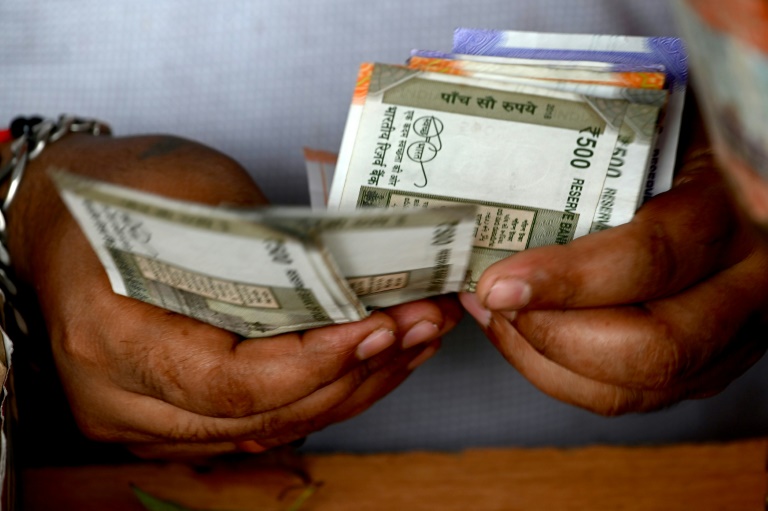
The Indian rupee fell to more than 80 per US dollar for the first time on record Tuesday, as the greenback extended its rally and foreign capital outflows intensified.

The rupee hit 80.0600 against the US dollar in early trade, Bloomberg data showed, before paring losses on suspected central bank intervention to close at 79.9487.

High inflation and rising interest rates in the United States coupled with fears of an impending recession in the world’s biggest economy have fuelled a broad dollar rally in recent weeks as investors become increasingly risk-averse.

Tighter US monetary policy has exacerbated outflows from emerging markets such as India, where foreign investors have withdrawn a net $31 billion in debt and equity this year.

Data released last week showed that US consumer price inflation hit a fresh four-decade high in June, exceeding market forecasts and stoking expectations of another large Federal Reserve rate hike next week.

In a written statement to the Indian parliament on Monday, finance minister Nirmala Sitharaman attributed the rupee’s sharp fall to external reasons.

“Global factors such as the Russia-Ukraine conflict, soaring crude oil prices and tightening of global financial conditions are the major reasons for the weakening of the Indian Rupee against the US dollar,” she said.

At the same time, the Indian currency has strengthened against the British pound, the Japanese yen and the euro in 2022 so far, Sitharaman added.

But higher crude prices have resulted in a deteriorating trade balance in a country that imports 80 percent of its oil.

India’s merchandise trade deficit widened to a record $26.18 billion in June, official data showed last week, largely because of higher crude and coal import prices.

In its monthly economic review, the finance ministry said costlier imports could widen the current account deficit and cause the rupee to depreciate further.

Consumer price inflation in India, the world’s sixth-largest economy, cooled slightly to 7.01 percent in June after hitting an eight-year high of 7.79 percent in April.

But price rises have persisted well above the central bank’s two-to-six percent target range despite consecutive interest rate hikes in May and June.

The central bank has also sold more than $34 billion of its foreign currency reserves in an effort to stabilise the rupee.

“The near-term outlook for the rupee will continue to be weak as it tracks developments on the oil and gas front in international markets,” forex market expert K Harihar told AFP.

“The weakness will persist until trade deficit numbers come down or capital inflows counter it,” he said, adding that the rupee could fall to 81 per US dollar without an agreement between Europe and Russia on gas supply.

The rupee’s move followed Russia’s Gazprom telling Europe late Monday that it cannot guarantee gas supplies following maintenance work on its Nord Stream pipeline.

India’s benchmark Sensex index closed 0.45 percent higher on Tuesday.

'Not a switch': UAE pushes for fair energy transition

The world’s transition to clean energy sources must be “just” and financed by the hydrocarbon trade, the climate change minister of oil-rich United Arab Emirates told AFP.

Mariam Almheiri was interviewed in France where a fierce heatwave set record temperatures as western Europe wilted under a scorching sun and wildfires that devoured forests.

Experts are blaming climate change and predict more frequent extreme weather to come.

“It’s not a switch. We’re not ready yet. And oil and gas will still be part of the energy mix for some time”, she said in an interview Monday as UAE President Sheikh Mohamed bin Zayed Al-Nahyan visited Paris for energy talks.

“We need… a just transition because every country is not at the same level,” the minister of climate change and the environment added, stressing the UAE was using its oil and gas wealth to ramp up renewable sources. 

“You need to build your equipment from what energy you got to do that,” she said. “Clean and renewable energy costs money.”

The international community largely agrees that climate change poses an existential threat to the planet and future of mankind. 

But action to cut carbon pollution and prepare for the accelerating impact is lagging, as is support for vulnerable countries confronting the ravages of a changing climate.

– ‘We will provide’ –

Adding to the pressure has been Russia’s invasion of Ukraine that has sent food and energy prices spiralling.

Western sanctions aimed at crippling major energy producer Russia have resulted in sharply higher fuel costs in Europe and the United States, with inflation soaring as a result.

This has pushed the Unites States and Europe to try to persuade oil-rich countries like the UAE to increase energy supplies to bring prices back under control.

“Look at what we’re going through right now. Months ago, people were pointing their fingers at us going: ‘Why are you still producing?’ Now they’re coming to say: ‘Please produce, please produce.'”

A top oil producer in OPEC, the UAE’s rapid growth since the 1970s has been driven by its energy wealth.

But having diversified its economy over the decades, the desert country of one million locals and nine million foreigners relies less and less on petrol, with revenues now making up only 30 percent of GDP.

At the same time, it forecasts that the oil and gas industry would need to invest over $600 billion every year until 2030 just to keep up with expected demand.

“We are a country that has oil and gas as a natural resource. We don’t have water… so as long as the world needs oil and gas we will provide,” said Almheiri.

The country was built on oil, but is spending billions to develop enough renewable energy to cover half of its needs by 2050. 

It is building two of the world’s largest solar power plants in the capital Abu Dhabi and Dubai.

It has also joined the nuclear club, with its Barakah nuclear power station, the first in the Arab world.

And last year, it launched a “strategic initiative” targeting carbon neutrality by 2050.

– Two-pronged approach –

Meteorologists are predicting more frequent and intense episodes of extreme weather in coming years.

“The increase in the frequency, duration, and intensity of these events over recent decades is clearly linked to the observed warming of the planet and can be attributed to human activity,” the World Meteorological Organisation said. 

Heatwaves of the future will depend largely on how rapidly the global economy can decarbonise.

While several towns and cities in France recorded their highest ever temperatures on Monday, the Gulf region is also at risk.

In the region, summer means suffering for anyone working outside, along with risks of dehydration, heat stroke and heart failure.

Countries of the energy-rich Gulf have banned working outdoors in the hottest hours of the day.

A study in the journal Nature Climate Change found that within this century, parts of the Gulf region could be hit by “unprecedented events of deadly heat as a result of climate change”.

Almheiri said her country, which next year is hosting the United Nations Climate Change Conference COP28, has adopted a “two-pronged approach” while advocating further investments in oil and gas.

“We are ramping up our renewables because we have targets of where we want to reach, and we are decarbonising our oil and gas.”

Close Bitnami banner
Bitnami