AFP

Jury selection begins in trial of Trump aide Bannon

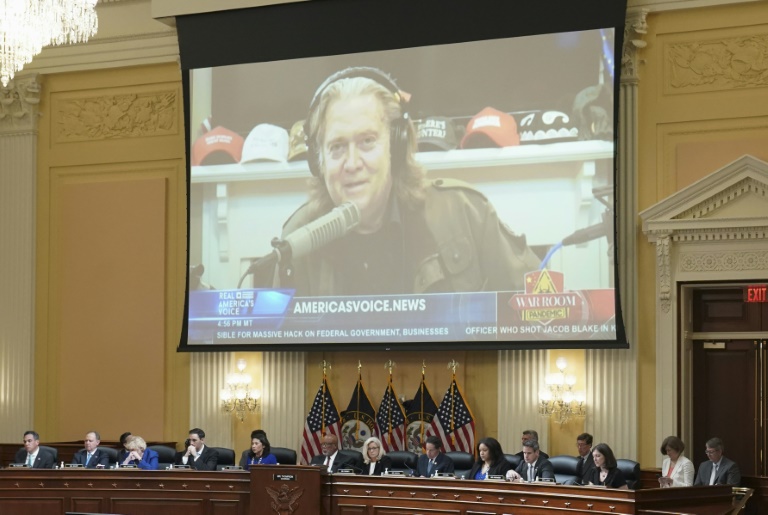
Jury selection begins Monday in the trial of former Donald Trump advisor Steve Bannon for defying a subpoena to testify before lawmakers investigating the attack on the US Capitol.

Bannon, who led Trump’s successful 2016 presidential election campaign, was among dozens of people called to testify about the storming of Congress by Trump supporters.

Bannon was indicted on two charges of contempt of Congress after refusing to testify to a House of Representatives committee probing the violence.

His lawyers sought to delay the start of the trial so that it would not take place at the same time as the committee’s public hearings, but the judge refused last week.

Thousands of Trump supporters, many associated with ultra-nationalist and white supremacist groups, stormed the Capitol on January 6, 2021 in an effort to block the certification of Democrat Joe Biden’s election victory. 

They had been egged on by Trump in a fiery speech during which he repeated his false claims of election fraud.

According to the House committee probing the riot, Bannon spoke to Trump the previous day.

Investigators believe Bannon and other Trump advisors could have information on links between the White House and the rioters.

After refusing to testify for months, Bannon finally agreed to cooperate with the investigation, a move prosecutors said was a “last-ditch attempt to avoid accountability” by stalling his trial for contempt.

Judge Carl Nichols ruled it should go ahead anyway, saying “I see no reason for extending this case any longer.”

If convicted of contempt, Bannon, 68, faces a minimum sentence of 30 days and a maximum of one year in prison on each count.

He was Trump’s strategy chief at the White House before being sacked in 2017.

Bannon was charged with conspiracy to commit wire fraud and money laundering after allegedly defrauding thousands of donors to a campaign to fund Trump’s anti-migrant wall along the southern border.

In Trump’s final hours in office, he pardoned Bannon.

More than 850 people have been arrested in connection with the attack on Congress. The assault left at least five people dead and 140 police officers injured.

Trump was impeached for a historic second time by the House after the riot — he was charged with inciting an insurrection — but was acquitted by the Senate.

US school shooter faces death penalty at sentencing trial

A young man who gunned down 17 people at his former high school in Florida went on trial in the southern US state on Monday, with jurors set to hand down either the death penalty or a life sentence.

Nikolas Cruz took an AR-15 assault rifle into Marjory Stoneman Douglas High School on Valentine’s Day in 2018 and killed 17 students and staff members.

Cruz, who was 19 at the time of the shooting, has already pleaded guilty to 17 counts of first-degree murder and 17 counts of attempted murder for those wounded during the massacre.

The trial in Fort Lauderdale — a rare instance of a mass shooter facing a jury, as they often either take their own lives or are killed by police — is being held to determine his sentence.

The death penalty requires a unanimous decision by the jury. Cruz will otherwise be handed life without parole.

The Florida shooting stunned a country accustomed to gun violence and sparked new efforts, led by students from the school itself, to get lawmakers to pass tougher gun control laws.

Parkland survivors founded “March for Our Lives,” organizing a rally that drew hundreds of thousands of people to Washington, DC in 2018.

Thousands turned out for demonstrations organized by the group last month following two other mass shootings: one at a Texas elementary school that killed 19 young children and two teachers, and another at a New York supermarket that left 10 Black people dead.

Those shootings helped galvanize support for the first significant federal bill on gun safety in decades.

President Joe Biden signed the bill into law in late June. It included enhanced background checks for younger buyers and federal cash for states introducing “red flag” laws that allow courts to temporarily remove weapons from people who are considered a threat.

– Nine-minute massacre –

But the measure fell far short of steps Biden had called for, including an assault weapons ban.

Cruz bought the weapon he used in the 2018 attack legally, despite having a documented history of mental health problems.

Expelled from school for disciplinary reasons, Cruz was known to be fixated on firearms — and had reportedly been identified as a potential threat to his classmates.

On the day of the attack, Cruz arrived at the school in an Uber, began shooting indiscriminately at students and staff, and fled nine minutes later, leaving behind a scene of carnage.

He was arrested nearby shortly afterward.

Footage recovered from his phone showed he had filmed his plans to attack his former school, saying his goal was to kill “at least 20 people.”

Cruz told a detective after his arrest that he heard demons ordering him to “buy weapons, kill animals and destroy everything.”

The US Justice Department in March announced that it had reached a $127.5 million settlement with survivors and relatives of victims of the shooting, settling all 40 related civil cases.

In lawsuits, survivors and relatives accused the Federal Bureau of Investigation of negligence for failing to act on tips received prior to the attack that Cruz was dangerous.

According to the Gun Violence Archive website, more than 24,000 people have been killed by firearms in the United States so far this year, including more than 13,000 who died by suicide.

Britain, France face hottest day as Europe fires rage

Britain and France went on heatwave alert on Monday facing record temperatures as southwest Europe wilted under a scorching sun and ferocious wildfires devoured more forests.

Forecasters in Britain warned of havoc in a country unprepared for the onslaught of extreme heat that authorities said was putting lives at risk.

The mercury was set to rise to 38 Celsius (104 Fahrenheit) in London Monday — not far below Britain’s all-time record of 38.7C — and could breach the 40C mark for the first time by Tuesday, meteorologists said.

Scientists blame climate change and predict more frequent and intense episodes of extreme weather.

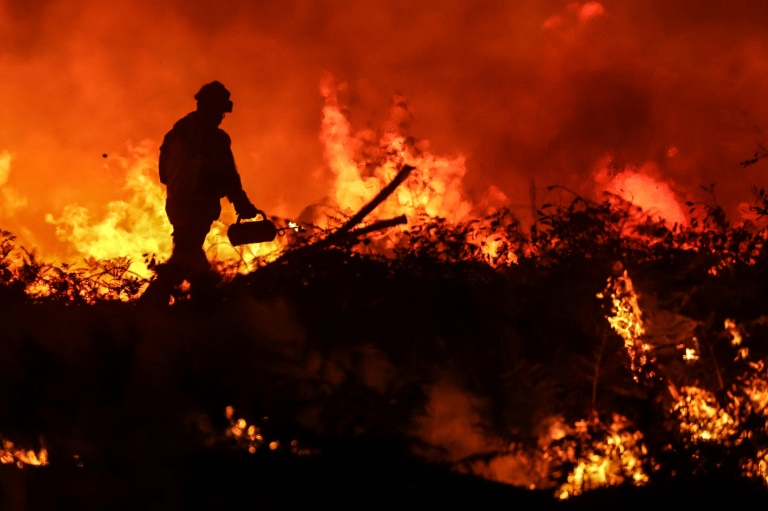
Across the Channel firefighters failed to contain two massive fires in France’s southwest that have created apocalyptic scenes of destruction.

For six days, armies of firefighters and a fleet of waterbombing aircraft have struggled against blazes that have mobilised much of France’s entire firefighting capacity.

Forecasters have put 15 French departments on the highest state of alert for extreme temperatures, including in the western Brittany region where the Atlantic coastal city of Brest was expected to hit 40 Celsius Monday, nearly twice its usual July temperature average.

By early afternoon, Brest had already beaten its all-time record of 35.2 C set in 1949.

The European heatwave, spreading north, is the second to engulf parts of the southwest of the continent within only weeks.

– ‘Heat apocalypse’ –

Blazes burning in France, Greece, Portugal and Spain have destroyed thousands of hectares of land and forced thousands of residents and holidaymakers to flee.

In France’s Landes forest, in the southwest Aquitaine region, temperatures “will be above 42 degrees Celsius” on Monday, forecaster Olivier Proust said.

In the Gironde region, further north, firefighters on Monday continued their battle against forest blazes that have devoured nearly 14,000 hectares (35,000 acres) since Tuesday.

An area of nine kilometres (5.5 miles) long and eight kilometres wide was still ablaze near the Dune de Pilat, Europe’s highest sand dune, turning picturesque landscapes, popular campsites and pristine beaches into a scorching mess.

Another 8,000 people were being evacuated near the dune Monday as changing winds blew thick smoke into residential areas, officials said.

“The smoke is toxic,” firefighter spokesman Arnaud Mendousse told AFP. “Protecting the population is a matter of public health.”

The evacuations added to the 16,000 tourists or residents already forced to decamp in France, many to emergency shelters.

“In some southwestern areas, it will be a heat apocalypse,” meteorologist Francois Gourand told AFP.

In Spain, fire burning in the northwestern province of Zamora claimed the life of a 69-year-old shepherd, regional authorities said, the second death after that of a fireman a day before in the same area.

Authorities have reported around 20 wildfires still raging from the south to Galicia in the far northwest, where blazes have destroyed around 4,500 hectares of land. 

In Portugal, almost the entire country remained on high alert for wildfires despite a slight drop in temperatures which had hit 47C — a record for the month of July — last Thursday.

– ‘Get on with it’ –

Fires have killed two, injured around 60 and destroyed between 12,000 and 15,000 hectares of land in Portugal.

In Britain, the government, already on the ropes after a series of scandals and Prime Minister Boris Johnson’s resignation, drew fresh criticism for failing to take the situation seriously enough.

“This is serious heat that could actually, ultimately, end in people’s deaths because it is so ferocious,” College of Paramedics chief executive Tracy Nicholls told Sky News.

The Sun tabloid headlined its coverage of the heat “British Bake Off”, observing that the “scorcher” was making the UK hotter than Ibiza where, indeed, temperatures were a comparatively paltry 30C on Monday.

“It is a bit frightening,” Karina Lawford, 56, told AFP as she took a stroll by the sea in Tankerton on the north Kent coast, saying the heat reminded her of Australia where she lives.

Britain’s chief meteorologist Paul Davies said the heatwave was “entirely consistent with climate change”, telling Sky News the “brutality” of the heatwave was “astounding” but could become a regular occurrence “by the end of the century”.

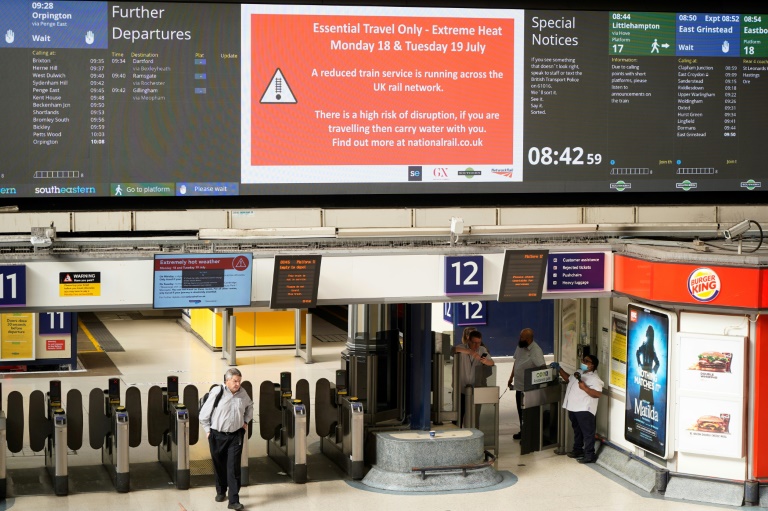
Network Rail, which is responsible for rail infrastructure, said the main east coast route out of London King’s Cross to York and Leeds would be shut between 1100 GMT and 1900 GMT on Tuesday.

But some in Britain, like 64-year-old plumber Dave Williams, were dismissive of the wall-to-wall coverage of the heatwave.

“Just get on with it,” he told AFPTV. “The way they talk about it is as if we’ve never had a summer.”

Among people heading to the beaches for respite was Abu Bakr, a bank worker, who also put the British heatwave into perspective.

“I come from Sudan,” he said as he relaxed on Brighton beach. “Forty, forty-five degrees is just the norm. This is as good as it can be.”

burs-jh/pvh

Stellantis ending Jeep production in China

US-European carmaker Stellantis said on Monday it was ending production in China of its Jeep SUV after failing to acquire a majority stake in its joint venture with local firm GAC.

GAC-Stellantis is one of two joint ventures in China embarked on by Stellantis, which was formed in January 2021 last year by the merger of Fiat-Chrysler and PSA.

“Stellantis intends to cooperate with GAC Group in an orderly termination of the joint venture formed in March 2010, which has been loss-making in recent years,” the group said.

It said the move was “due to a lack of progress in the previously announced plan for Stellantis to take a majority share” in the business.

The decision to wave goodbye to GAC would show up as “a non-cash impairment charge of approximately 297 million euros ($302 million) in its first-half 2022 results”, due out on July 28.

Stellantis said it would henceforth “focus on distributing imported vehicles for the Jeep brand in China”.

The group — which also includes the Peugeot, Alfa Romeo and Citroen brands — had hoped to increase its stake in China Guangzhou Automobile Group (GAC) to 50-75 percent.

The move was made possible by a change in Chinese regulations allowing deeper involvement by foreign investors, on condition they obtain Beijing’s approval.

Stellantis told AFP its decision to pull out was “not linked” to a decision by the Chinese government.

The group had announced in January that the acquisition of the hoped-for majority stake in the joint venture with GAC was the first step towards streamlining its activities in the world’s biggest vehicle market.

GAC protested at the time because the deal had not been signed.

Jeep, which is rolling out electric vehicles, was to be one of Stellantis’s main conduits for expanding in China. 

The group reported sales of 152 billion euros ($154 billion) in 2021 and aims to reach 200 billion in 2030. 

Stellantis’s main activity in China is the manufacture and sale of Peugeots and Citroens, via a joint venture with local automaker Dongfeng. 

China is also a key market for its luxury Maserati brand and a target for its premium brand DS.

Jeep sold just 20,000 vehicles in China in 2021 and at the end of last year, GAC-Stellantis terminated production at one of its two assembly lines. 

Jeep is now concentrating on offering a wider array of imported electric vehicles.

Boeing wins $13.5-bn MAX jets deal as Farnborough opens

US aerospace giant Boeing on Monday fired the first shot in an orders battle with European rival Airbus at Farnborough airshow, clinching a $13.5-billion deal for 100 MAX planes from Delta Airlines in a huge vote of confidence for the crisis-hit jet.

The deal marks a huge turnaround for the MAX jet which had suffered two deadly crashes in 2018 and 2019.

Outgoing British Prime Minister Boris Johnson meanwhile opened the prestigious five-day event as the avation sector plots its recovery from heavy Covid fallout.

US carrier Delta lodged its first ever order for medium-haul MAX aircraft, with options for 30 more of the fuel-efficient planes as it seeks to replace its ageing fleet and cut damaging emissions.

Boeing revealed also that Japanese airline ANA had agreed to purchase 20 of its smaller MAX 8 jets — worth $2.4 billion — plus two 777-8 freight planes.

– ‘More sustainable future’ –

“The Boeing 737-10 will be an important addition to Delta’s fleet as we shape a more sustainable future for air travel, with an elevated customer experience, improved fuel efficiency and best-in-class performance,” said Delta chief executive Ed Bastian.

The news comes as airlines worldwide seek to replace ageing fleets with fuel-efficient planes that emit less carbon dioxide.

The first visitors to Farnborough, southwest of London, were meanwhile hit by scorching temperatures amid Europe’s ongoing heatwave.

Defence aerospace companies are also expected to emerge as big winners, with Russia’s invasion of Ukraine boosting spending on nations’ armed forces.

Russian companies have been banned from Farnborough due to the war.

The event coincides with fast-moving political turmoil in Britain after Johnson’s recent announcement that he is stepping down as Conservative party leader, sparking a fractious contest to replace him also as prime minister.

– ‘Handing over controls’ –

“This government believes in aviation and its power to bring jobs and growth to the entire country,” Johnson said Monday as the event opened. 

“After three years in the cockpit… I am now handing over the controls seamlessly to someone else. I don’t know who,” he added, sparking laughter from delegates.

Johnson also said that the government was “investing massively in defence”.

This year’s event — one of the world’s largest civilian and defence shows — is the first global aviation get-together since the Paris airshow in 2019, before Covid hit.

Farnborough was cancelled in 2020 as the Covid health crisis grounded aircraft and ravaged the sector.

Global air traffic is gradually recovering and in May reached more than two-thirds of its pre-pandemic level, according to the International Air Transport Association.

That recovery has however faced headwinds from rocketing inflation fuelled by historically high energy prices and higher wages, while staff shortages constrain airports and spark flight cancellations.

– Air displays –

Ahead of the event, Britain issued a historic red warning for extreme heat, with southern England temperatures potentially exceeding 40C on Monday or Tuesday for the first time.

It comes as visitors to Farnborough will witness air displays by Britain’s Red Arrows and South Korea’s Black Eagles, as well as from the US-made F-35 stealth fighter.

Airbus and Boeing are showcasing their latest twin-aisle passenger aircraft, the A350-900 and the 777X.

Goldman Sachs profits tumble despite strong trading results

Goldman Sachs reported a 48 percent drop in quarterly earnings Monday after setting aside more funds in case of bad loans, but shares rose as it topped analyst estimates.

The US investment bank became the latest financial heavyweight to suffer a decline in second-quarter results as the weakening macroeconomic environment prompts them to hold funds in case of defaults.

Operations were mixed, but Goldman scored a big jump in revenues tied to trading amid volatile markets.

Profits were $2.8 billion for the second quarter following an eight percent slide in revenues to $11.9 billion.

Goldman established $667 million in provisions, a shift from the year-ago period when earnings were boosted by $92 million in reserve releases.

Goldman Chief Executive David Solomon referred in a press release to “increased volatility and uncertainty” in the environment, praising the bank’s performance “in these challenging markets.” 

Other bank executives last week alluded to similar worries amid rising inflation, the war in Ukraine and other factors, but said the US economy still appeared to be on solid footing for now.

In terms of operations, Goldman suffered a drop in revenues connected to mergers and acquisition advising and loan underwriting. 

The bank’s own investments in equities reported a $221 million loss in the period. But Goldman scored an increase in its consumer banking.

Shares rose 3.8 percent to $305.05 in pre-market trading.

Malaysia seizes animal parts worth $18 mn

Malaysian customs officials said Monday they seized a stash of rare animal parts worth $18 million thought to have come from Africa, including elephant tusks, rhino horns and pangolin scales. 

The Southeast Asian nation is a hub for wildlife trafficking, with animal parts shipped through the country to lucrative regional markets.  

Authorities foiled a smuggling attempt on July 10 when they uncovered the illicit cargo in Port Klang, on Malaysia’s west coast, hidden in a container along with timber. 

The shipment included an estimated 6,000 kilograms (13,200 pounds) of elephant tusks — Malaysia’s biggest single seizure of elephant ivory, said customs department chief Zazuli Johan.

There were also 29 kilograms of rhino horns, 100 kilos of pangolin scales, and 300 kilos of animal skulls and other bones, he told a press conference. 

The seizure had an estimated value of 80 million ringgit ($18 million), he said, adding it was believed to have come from Africa, without giving more details.

Zazuli said Malaysia was not the shipment’s final destination, but did not say where it was heading.

Animal parts such as elephant tusks and pangolin scales are popular in countries where they are used in traditional medicine, including China and Vietnam.   

There have been no arrests over the seizure. 

Kanitha Krishnasamy — Southeast Asia director at wildlife trade monitoring group Traffic — hailed the “significant seizure”.

“This medley of threatened species in a single seizure is concerning, and it certainly verifies the suspicion that criminals continue to use Malaysian ports to move contraband wildlife,” she said.

Europe's hottest summers

Europe’s increasingly frequent heatwaves are back under the spotlight over devastating wildfires and with sweltering temperatures forecast to hit record highs in Britain and France this week.

In just over two decades, the continent has experienced its five hottest summers since 1500.

– 2022: Double trouble –

A heatwave engulfing western Europe, the second in a month, sparks huge wildfires and threatens to smash records in Britain and France.

Fires in France, Greece, Portugal and Spain force thousands of residents and tourists to flee and kill several people, including a Spanish shepherd and a firefighter.

Britain braces for an all-time high of 40 degrees Celsius (104 degrees Fahrenheit) or more. Brittany in France could also register similar temperatures in what would be a regional record.

The weather warnings come hot on the heels of a scorching spell in June, where parts of Europe, from Spain to Germany, sizzled at unseasonal highs of between 40C to 43C.

– 2021: Hottest ever –

Last year is Europe’s hottest summer on record, according to the European climate change monitoring service Copernicus.

Between late July and early August 2021, Greece endures what Prime Minister Kyriakos Mitsotakis calls the country’s worst heatwave in over 30 years, with temperatures hitting 45C in some regions.

In Spain, temperatures reach 47C in parts of the south, according to national weather agency AEMET.

The heat and drought spark large wildfires along the Mediterranean, from Turkey and Greece to Italy and Spain.

– 2019: Northern Europe swelters –

The summer of 2019 brings two heatwaves, which leave around 2,500 people dead, according to the Centre for Research on the Epidemiology of Disasters of Belgium’s Louvain University.

In France, temperatures hit a record 46C on June 28 in the southern town of Verargues. Thousands of schools are closed.

On July 24 and 25, northern Europe fries in record heat. Temperatures of 42.6C are recorded at Lingen in northwestern Germany, 41.8C in Begijnendijk in northern Belgium and 38.7C in the eastern English city of Cambridge.

– 2018: Drought drains the Danube –

The second half of July and beginning of August 2018 sees very high temperatures across much of Europe and rivers running dry due to drought.

The Danube falls to its lowest level in 100 years in some areas, notably exposing World War II tanks in Serbia that were submerged since the conflict.

Portugal and Spain suffer hugely destructive forest fires.

– 2017: Months of mugginess –

Much of Europe, but especially the south, sweats from late June to well into August. 

Spain set a record of 47.3C on July 13 in the southern town of Montoro.

Persistent drought sparks forest fires in Portugal.

– 2015: Back-to-back heatwaves –

It’s heatwave after heatwave throughout the summer of 2015 which leaves an estimated 1,700 people dead in France.

In Britain, roads melt and trains are delayed in the hottest July on record, with temperatures reaching 36.7C at Heathrow airport.

– 2007: Greek forests ablaze –

Central and southern Europe are parched by drought throughout June and July, provoking a spate of forest fires in Italy, North Macedonia and Serbia. 

In Hungary, 500 people die as a result of the heat. 

– 2003: 70,000 dead –

Britain, France, Italy, Spain and Portugal all experience exceptional heat in the first half of August, with Portugal suffering a record 47.3C at Amareleja in the south.

An EU study of 16 nations puts the number of excess deaths across the bloc during the heatwave as high as 70,000, with France and Italy each seeing between 15,000 and 20,000 fatalities, according to various reports since.

In France, most of the victims are elderly people in an episode that traumatises the country and leads to the implementation of new systems of protection during heatwaves.

Stocks climb, dollar slides as risk appetite returns

Stock markets rallied and the dollar slid against the euro and pound on Monday on returning risk appetite as recession fears eased slightly.

Oil prices jumped almost two percent, even though investors continued to fret over Russia’s war in Ukraine, a Covid spike in China and central banks quickly raising interest rates.

“After a volatile week which ended on a high note, the positive momentum has spilled over across the major global markets,” noted Richard Hunter, head of markets at Interactive Investor.

“Investors will nonetheless remain on high alert this week, as further economic data provides further colour, while the need for caution against a further possible supply shock for oil and the likelihood of an interest rate hike from the ECB (European Central Bank) increases.”

Wall Street raced higher on Friday after June retail sales came in above forecasts and banking giant Citigroup’s April-June results beat expectations.

The positivity extended into Monday, with strong gains for Asian and European stock markets.

While a strong set of economic data has of late boosted bets on the US Federal Reserve lifting borrowing costs more, the latest figures were not seen as being large enough to warrant a sharper rate hike next week — easing recession fears.

Market analysts widely expect the US central bank to announce a 75 basis-point lift, though some have suggested a one percentage-point increase could be on the cards to try and cool decades-high inflation.

– ECB to act –

The ECB is set on Thursday to raise its interest rates for the first time in more than a decade.

To try and counteract a steep rise in prices, the central bank has said it intends to raise borrowing costs by a quarter point, the first such move since 2011. 

The ECB’s delay in acting compared with other central banks that have announced a series of increases — coupled with fears of a eurozone recession — saw the euro fall to parity with the dollar last week.

But on Monday, the European single currency was up 0.7 percent against the dollar, which slumped one percent versus the British pound.

– Key figures at around 1045 GMT –

London – FTSE 100: UP 1.3 percent at 7,250.29 points

Frankfurt – DAX: UP 1.3 percent at 13,034.22

Paris – CAC 40: UP 1.4 percent at 6,119.30

EURO STOXX 50: UP 1.4 percent at 3,525.71

Hong Kong – Hang Seng Index: UP 2.7 percent at 20,846.18 (close)

Shanghai – Composite: UP 1.6 percent at 3,278.10 (close)

Tokyo – Nikkei 225: Closed for a holiday

New York – Dow: UP 2.2 percent at 31,288.26 (close)

Euro/dollar: UP at $1.0159 from $1.0088 on Friday

Pound/dollar: UP at $1.1977 from $1.1865 

Euro/pound: DOWN at 84.81 pence from 85.00 pence

Dollar/yen: DOWN at 138.19 yen from 138.54 yen

Brent North Sea crude: UP 2.3 percent at $103.49 per barrel

West Texas Intermediate: UP 2.0 percent at $99.58 per barrel

Britain, France brace for hottest day as Europe fires rage

Britain and France went on heatwave alert on Monday bracing for record temperatures as southwest Europe wilted under a scorching sun and ferocious wildfires devoured more forests.

Britain could hit 40 Celsius (104 Fahrenheit) for the first time, forecasters said, causing havoc in a country unprepared for the onslaught of extreme heat that authorities said was putting lives at risk.

Britain’s current record temperature stands at 38.7 Celsius. Scientists blame climate change and predict more frequent and intense episodes of extreme weather.

Across the Channel firefighters failed to contain two massive fires in France’s southwest that have created apocalyptic scenes of destruction.

For six days, armies of firefighters and a fleet of waterbombing aircraft have struggled against blazes that have mobilised much of France’s entire firefighting capacity.

Forecasters have put 15 French departments on the highest state of alert for extreme temperatures, including in the western Brittany region where the Atlantic coastal city of Brest was expected to hit 40 Celsius Monday, nearly twice its usual July temperature average.

The European heatwave, spreading north, is the second to engulf parts of the southwest of the continent within only weeks.

– ‘Heat apocalypse’ –

Blazes burning in France, Greece, Portugal and Spain have destroyed thousands of hectares of land and forced thousands of residents and holidaymakers to flee.

In France’s Landes forest, in the southwest Aquitaine region, temperatures “will be above 42 degrees Celsius” on Monday, forecaster Olivier Proust said.

In the Gironde region, further north, firefighters on Monday continued their battle against forest blazes that have devoured nearly 14,000 hectares (35,000 acres) since Tuesday.

An area of nine kilometres (5.5 miles) long and eight kilometres wide was still ablaze near the Dune de Pilat, Europe’s highest sand dune, turning picturesque landscapes, popular campsites and pristine beaches into a scorching mess.

Firefighters said Monday was shaping up to be one of the most challenging days since the fires started because of the relentless heat, as another 3,500 people were being told to leave their homes as a precaution.

The wildfires in France have forced more than 16,000 people, residents or tourists, to decamp. Seven emergency shelters have been set up for evacuees.

France’s interior ministry announced it would send an extra three firefighting planes, 200 firefighters and more trucks.

“In some southwestern areas, it will be a heat apocalypse,” meteorologist Francois Gourand told AFP.

– Temperatures hit 47C –

The chapel of a historic hospital in the southeast city of Lyon, Grand Hotel Dieu, offered refuge to tourists on Sunday including Jean-Marc, 51, who was visiting from Alsace.

“We came back to admire the place, but we can’t leave, it’s too hot outside. We say a prayer before the fire!” he quipped.

French cyclist Mikael Cherel, taking part in the Tour de France’s 15th stage between Rodez and Carcassonne in southern France on Sunday, said he had “never known such a hot day on a bike”.

In Spain, fire burning in the northwestern province of Zamora claimed the life of a 69-year-old shepherd, regional authorities said, the second death after that of a fireman a day before in the same area.

Authorities have reported around 20 wildfires still raging from the south to Galicia in the far northwest, where blazes have destroyed around 4,500 hectares of land. 

In Portugal, almost the entire country remained on high alert for wildfires despite a slight drop in temperatures which had hit 47C — a record for the month of July — last Thursday.

– ‘So ferocious’ –

Fires have killed two, injured around 60 and destroyed between 12,000 and 15,000 hectares of land in Portugal.

In London, the mercury was set to rise to highs of 38C on Monday as chief meteorologist Paul Davies warned there was a “good chance now of hitting 40C or 41C” on Tuesday.

“This is entirely consistent with climate change,” he told Sky News, describing the “brutality” of the expected heat as “astounding”. 

The government, already on the ropes after a series of scandals and Prime Minister Boris Johnson’s resignation, drew fresh criticism for failing to take the situation seriously enough.

“This is serious heat that could actually, ultimately, end in people’s deaths because it is so ferocious,” College of Paramedics chief executive Tracy Nicholls told Sky News.

Many people fled to the beaches, including Abu Bakr, a bank worker, who put the British heatwave into perspective.

“I come from Sudan,” he told AFPTV on Brighton beach on Sunday. “Forty, forty-five degrees is just the norm. This is as good as it can be.”

burs-jh/jm

Close Bitnami banner
Bitnami