AFP

UN urges Africa to swap commodities for tech

The UN’s trade body on Thursday said African economies were vulnerable to a triple shock as it urged governments to pave the way for tech startups that would  ease dependence on commodities.

“A recent analysis by the UN Global Crisis Response Group on Food, Energy and Finance, which analyses the global economic cost by the war in Ukraine, indicates that Africa and especially sub-Saharan Africa is now one of the world’s most exposed regions to the current crisis,” Rebeca Grynspan, secretary-general of the United Nations Conference on Trade and Development (UNCTAD), said at the launch of the body’s latest Africa report. 

“One out of two Africans — that means over 600 million people — are severely vulnerable to food, energy and finance shocks, all at once,” she added.

The report recommended diversifying away from both commodities exports, on which many African economies continue to depend, and traditional service sectors — such as travel and transport — towards more knowledge-intensive services.

“We have been talking about diversification as long as I can remember, and how Africa can diversify its economy, and the fact is  that we’ve been looking at it through the lens of diversifying within the commodity sector,” said Paul Akiwumi, a director with UNCTAD. 

“Now it’s also very timely because of technology,” he added.

He pointed to budding fintech, healthtech, agritech, e-mobility and other tech-focused sectors in African countries.  

“Africa has a growing educated middle class who need these jobs, and these types of small and medium size enterprises provide high skilled jobs — operational officers, finance officers, government liaison relations officers, software engineers, HR managers, administrative accountants,” he said. 

Akiwumi said governments must provide entrepreneurs the necessary regulatory frameworks, as well as training and capacity building. 

He also said they must implement the African Continental Free Trade Area (AfCFTA) agreement, a trade pact that came into force last year, to scale up developments across the continent.

Russian strikes kill 20 as Zelensky urges 'special tribunal' for Moscow

Russian missiles struck Vinnytsia in central Ukraine Thursday, killing at least 20 people including three children, in what President Volodymyr Zelensky called “an open act of terrorism”.

The midday attack on the city hundreds of kilometres from the frontlines and invading Russian troops came as EU officials convened in The Hague to discuss war crimes in Ukraine.

The charred remains of upturned cars surround by burnt debris were seen in images distributed by officials next to a business gutted by a fire with brown smoke billowing nearby.

“There were eight rockets, two of which hit the centre of the city. Twenty people have died, including three children. There a large, large number of wounded,” Zelensky said during an address European official at The Hague.

The Ukrainian leader led a moment of silence before urging European and International Criminal Court officials during an address to open a “special tribunal” into Russia’s invasion.

“I believe it is inevitable that International Criminal Court will bring accountability to those guilty of crimes under its jurisdiction: war crimes, crimes against humanity, genocide.”

– War crimes tribunal –

The ICC in The Hague opened an investigation into possible war crimes in Ukraine just days after Moscow’s forces invaded and it dispatched dozens of investigators to the country to gather evidence.

Russia invaded on February 24 and the conflict has seen thousands of people killed, destroyed cities and forced millions to flee their homes.

“Every day, Russia kills civilians, kills Ukrainian children, carries out missile attacks on the civilian facilities where there is no military target. What is this, if not an open act of terrorism?” Zelensky said after the Vinnytsia attack.

A Ukraine military spokesman said its forces had managed to knock out two from a barrage of cruise missiles that were launched from a Russian submarine in the Black Sea and caused widespread damage in Vinnytsia.

Deadly strikes in central Ukraine have become relatively rare, but the war has raged around cities like Mykolaiv in the south which the presidency said was hit by a “massive missile strike”.

“Two schools, transport infrastructure and a hotel were damaged,” the presidency said in its morning military update early Thursday.

The skeletal insides of one building gutted by the strikes were visible in images distributed by local officials, with municipal workers clearing bricks and rubble strewn after the attack.

The heaviest fighting in Ukraine, however, has focused recently on the industrial Donbas region in the east.

– ‘Total victory’ –

Moscow-backed troops there said Thursday they were closing in on their next target, after wresting control of sister cities Lysychansk and Severodonetsk two weeks ago.

“Siversk is under our operational control, which means that the enemy can be hit by our aimed fire all over the area,” a pro-Moscow rebel official, Daniil Bezsonov, was cited as saying by Russian state-run news agency TASS.

In a Ukrainian trench position along the eastern frontline, a 25-year-old soldier who goes by the nom de guerre Moryak was working to fortify defences.

“We hide when they shell, we dig when it’s calm,” another soldier nearby told AFP journalists.

A fellow serviceman in their trench dismissed the idea Ukrainian and Russian forces could reach an agreement to halt fighting, explaining their goal was “total victory”.

– High-stakes grain talks –

Several rounds of negotiations to end the fighting at the beginning of the conflict fell through, but delegations from Kyiv and Moscow met in Istanbul this week to discuss unblocking Ukraine’s grain exports.

The meeting involving UN and Turkish officials ended after more than three hours with an agreement to meet again in Turkey next week.

Zelensky said “the entire world” was counting on the negotiations to finalise a deal.

The conflict has pushed up grain prices and Europe is suffering from sky-rocketing energy bills stemming from sanctions on Russia and Moscow’s move to limit gas flows to Europe.

US Treasury Secretary Janet Yellen said Thursday that Russia’s war in Ukraine posed the “greatest challenge” to the global economy, as G20 ministers prepare to start talks in Indonesia.

The European Commission meanwhile slashed growth forecasts for the eurozone, saying the consequences from the war in Ukraine were continuing to destabilise the economy because of record high inflation.

burs-jbr/cdw

US firm named in Beirut blast lawsuit denies wrongdoing

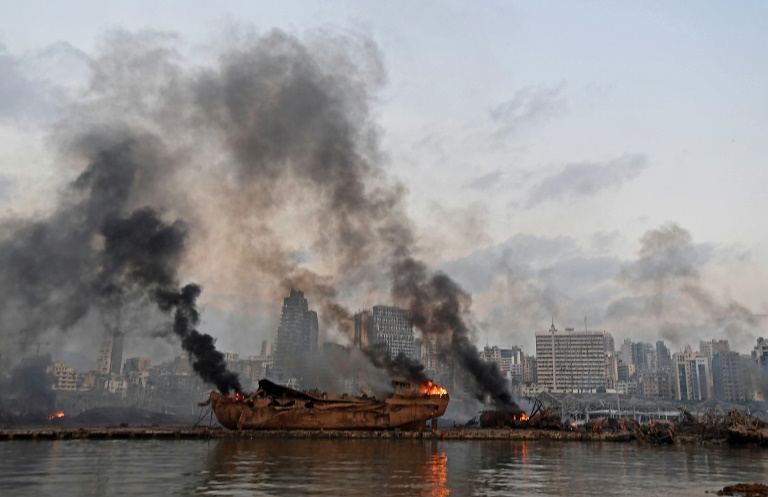
A US firm targeted in a $250 million lawsuit over the 2020 port explosion in Beirut that killed more than 200 people has denied any wrongdoing in the tragedy.

TGS, a US-Norwegian geophysical services group, said it is aware of the suit filed this week in a Texas court by nine plaintiffs who are all US citizens, but said it has not yet been formally served with the papers.

“We deny each and every allegation raised in the lawsuit, and intend to vigorously defend this matter in court,” TGS said in a statement issued late Wednesday.

TGS owns the British firm Spectrum Geo, which a decade ago chartered the Rhosus ship, which was carrying the ammonium nitrate that was subsequently unloaded at Beirut port and exploded on August 4, 2020.

Besides the fatalities, the blast wounded thousands of people and ravaged entire neighborhoods. It was described as one of the largest non-nuclear explosions in recent history.

Accountability Now, a Swiss foundation assisting the plaintiffs, said Spectrum had “entered into a series of highly profitable but suspicious contracts” with the energy ministry in Beirut to transport seismic survey equipment from Lebanon allegedly to Jordan aboard the Rhosus.

The minister at the time was Gebran Bassil, President Michel Aoun’s son-in-law, who has denied any wrongdoing in connection with the explosion.

Spectrum had chartered the derelict Moldovan-flagged Rhosus — but the ship never actually set sail. 

The Lebanese investigation into the blast has faced systematic and blatant political obstruction from day one.

In its statement, TGS said it had carried out a comprehensive investigation of the circumstances that brought the Rhosus to the port of Beirut and that Spectrum had no responsibility for the explosion.

“We are confident that we will prevail in this matter,” TGS said.

US vows to use all means to stop Iran nuclear bomb in new Israel pact

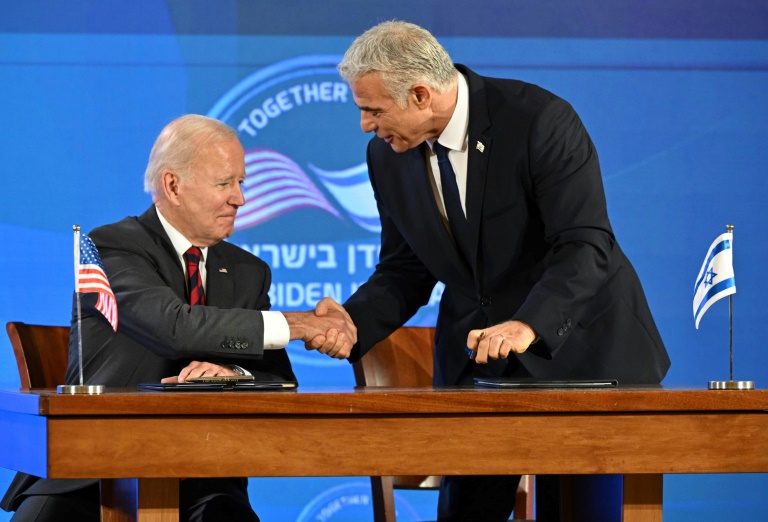
The US and Israel signed a new security pact on Thursday reinforcing their common front against Iran, as President Joe Biden pledged to use “all” American power to stop the Islamic republic from acquiring nuclear weapons.

The Jerusalem Declaration on joint security was inked by Israeli Prime Minister Yair Lapid and Biden, as the US leader was making his first trip to the Middle East as president.

It commits the United States to “never to allow Iran to acquire a nuclear weapon”, stating that it “is prepared to use all elements of its national power to ensure that outcome”.

A landmark deal that imposed curbs on Iran’s suspect nuclear programme in exchange for sanctions relief was torpedoed in 2018 by former US president Donald Trump. Efforts to revive the accord have been stalled since March.

Asked on Thursday how long the US was prepared to give those efforts, Biden said “we’re not going to wait forever” for a response from the Islamic republic.

Israel, which has the Middle East’s sole but undeclared nuclear arsenal, is staunchly opposed to the deal with Iran, which has always denied seeking the bomb.

Lapid warned “words” and “diplomacy” were not enough to thwart Iran’s alleged nuclear ambitions.

“Diplomacy will not stop them. The only thing that will stop Iran is knowing that if they continue to develop their nuclear program the free world will use force. The only way to stop them is to put a credible military threat on the table,” Lapid told reporters alongside Biden.

Iran’s ultra-conservative President Ebrahim Raisi warned Wednesday that if Biden’s trip to the Middle East was aimed at safeguarding Israel’s security, he was destined to fail.

US “efforts will not create security for the Zionists in any way,” said.

– Saudi oil –

Biden touched down in Israel on Wednesday, his 10th visit to the Jewish state since 1973, when he came as a newly elected senator.

He is scheduled to meet Israeli President Isaac Herzog and an old acquaintance, opposition leader Benjamin Netanyahu later Thursday, before holding talks with Palestinian president Mahmud Abbas in the occupied West Bank on Friday.

Air Force One will then make the first publicly acknowledged direct flight between Israel and Saudi Arabia, where Biden will meet Arab leaders.

Russia’s invasion of Ukraine will remain a top priority for the Biden administration during his regional tour, with volatile oil prices due to be the focus of talks with Saudi officials.

The president will seek to persuade Saudi Arabia to pump more oil in order to drive down prices, which have fuelled US inflation to the highest levels in decades.

– ‘Israel wants peace’ –

Since landing, Biden has repeatedly renewed Washington’s long-standing call for a two-state solution to the Israeli-Palestinian conflict, but made clear Thursday that he has no plans to reverse Trump’s controversial decision to recognise Jerusalem as Israel’s capital.

Lapid is serving as caretaker prime minister ahead of elections in November — Israel’s fifth vote in less than four years — and is therefore not expected to launch new talks with Palestinians.

But the centrist premier restated his support for a two-state solution.

“I haven’t changed my position. A two-state solution is a guarantee for a strong, democratic state of Israel, with the Jewish majority.”

“We send with you, to all the nations of the region, including of course the Palestinians, a message of peace. Israel wants peace and believes in peace. We will never yield an inch of our security,” Lapid said alongside Biden.

A US official said the administration would announce during the visit “a significant funding package” for hospitals that serve Palestinians in Israeli-annexed east Jerusalem, which Palestinians claim as their future capital.

It will also announce measures towards providing 4G internet access in the West Bank and Israeli-blockaded Gaza Strip, the US official said, addressing a persistent Palestinian frustration.

But, with Israel in political limbo ahead of its election, Biden is not expected to push Lapid for significant policy changes regarding the Palestinians.

“We are not going to come in with a top down peace plan because we don’t believe that would be the best approach,” the US official said.

But, “if the two parties are prepared to talk, we will be there,” the official added.

aue-bs/dv

Baby elephant pulled from Thailand manhole in dramatic rescue

A baby elephant was dramatically rescued from a manhole in central Thailand after his mother was sedated to allow the operation to proceed, wildlife officials said.

The calf fell into the drainage trough on the outskirts of the Royal Hills golf course in Nakhon Nayok province in the early hours of Wednesday morning.

Its distressed mother, believed to belong to an elephant herd travelling through the nearby jungle, stayed with the infant as it was unable to climb out of the steep pit.

The pair were discovered by a passing resident, who quickly alerted wildlife officials and Khao Yai National Park authorities to the pachyderm’s plight.

Would-be rescuers were initially unable to help the baby elephant due to the presence of its worried mother, and were forced to tranquilise the older creature.

Unfortunately, the mother elephant then tumbled partially into the hole before being pulled out — with the help of a digger — and later revived, according to the the Department of National Parks, Wildlife and Plants Conservation.

The calf was eventually rescued from the pit and reunited with its mother, with park authorities confirming the pair had safely returned to the jungle.

Russian strikes kill 17 in central Ukraine

Russian missiles struck Vinnytsia in central Ukraine Thursday, killing at least 17 people including a child, in what President Volodymyr Zelensky called “an open act of terrorism”.

The midday attack on the city hundreds of kilometres from the frontlines and invading Russian troops came as EU officials convened in The Hague to discuss war crimes in Ukraine.

The charred remains of several upturned cars were seen in images distributed by officials next to a business gutted by a fire with brown smoke billowing from the impact site.

“At least 17 people have died, including two children. Dozens are injured. Residential buildings, administrative and commercial buildings have suffered significant destruction and damage,” Ukraine’s prosecutor general said in statement.

Zelensky, who had called for a tribunal in The Hague to hold Moscow accountable for war crimes, described Russia as a “killer country” after the attack.

“Every day, Russia kills civilians, kills Ukrainian children, carries out missile attacks on the civilian facilities where there is no military target. What is this, if not an open act of terrorism?” the Ukraine leader said on social media.

– War crimes tribunal? –

In opening remarks at the Hague conference organised by the International Criminal Court and the European Commission, Ukraine Foreign Minister Dmytro Kuleba said Russia should be held responsible for its actions in Ukraine. 

“All we want is the crime of aggression to not remain unpunished,” he told EU and ICC officials.

In a later tweet, Kuleba described the Vinnytsia attack as “a war crime”.

The International Criminal Court in The Hague opened an investigation into possible war crimes in Ukraine just days after Moscow’s forces invaded and it dispatched dozens of investigators to the country to gather evidence.

Russia invaded Ukraine on February 24 and the conflict has seen thousands of people killed, destroyed cities and forced millions to flee their homes.

Deadly Russian strikes in central Ukraine have become relatively rare, but the war has raged around cities like Mykolaiv in the south which the presidency said was hit by a “massive missile strike”.

“Two schools, transport infrastructure and a hotel were damaged,” the presidency said in its morning military update early Thursday.

The skeletal insides of one building gutted by the strikes were visible in images distributed by local officials, with municipal workers clearing bricks and rubble strewn after the attack.

The heaviest fighting in Ukraine however has focused recently on the industrial Donbas region in the east.

– ‘Total victory’ –

Moscow-backed troops there said Thursday they were closing in on their next target, after wresting control of sister cities Lysychansk and Severodonetsk two weeks ago.

“Siversk is under our operational control, which means that the enemy can be hit by our aimed fire all over the area,” a pro-Moscow rebel official, Daniil Bezsonov, was cited as saying by Russian state-run news agency TASS.

In a Ukrainian trench position along the eastern frontline, a 25-year-old soldier who goes by the nom de guerre Moryak was working to fortify defences.

“We hide when they shell, we dig when it’s calm,” he told AFP journalists.

A fellow serviceman in their trench dismissed the idea Ukrainian and Russian forces could reach an agreement to halt fighting, explaining their goal was “total victory”.

– High-stakes grain talks –

Several rounds of negotiations to end the fighting at the beginning of the conflict fell through, but delegations from Kyiv and Moscow met in Istanbul this week to discuss unblocking Ukraine’s grain exports.

The high-stakes meeting involving UN and Turkish officials in Istanbul broke up after slightly more than three hours with an agreement to meet again in Turkey next week.

“The success of this story is needed not only for our state, but also — without exaggeration — for the entire world,” Zelensky said in his evening address Wednesday after the talks.

The conflict in Ukraine has pushed up grain prices and Europe is suffering from sky-rocketing energy bills stemming from sanctions on Russia and Moscow’s move to limit gas flows to Europe.

US Treasury Secretary Janet Yellen said Thursday that Russia’s war in Ukraine posed the “greatest challenge” to the global economy, as G20 ministers prepare to start talks in Indonesia.

The European Commission meanwhile slashed growth forecasts for the eurozone, saying the consequences from the war in Ukraine were continuing to destabilise the economy because of record high inflation.

burs-jbr/bp

JPMorgan Chase reports lower profits, gives cautious economic outlook

JPMorgan Chase reported a drop in second-quarter profits on Thursday, reflecting the impact of a weakening macroeconomic outlook that led it to set aside funds in case of bad loans.

The big US bank’s earnings came in at $8.6 billion for the quarter, down 28 percent from the year-ago period in results that missed analyst expectations.

Revenues were $30.7 billion, up one percent.

Chief Executive Jamie Dimon said key elements in the US economy remained healthy, such as the job market and consumer spending. 

But headwinds — including high inflation, geopolitical uncertainty and fast-changing Federal Reserve policy to sharply curtail liquidity — “are very likely to have negative consequences on the global economy sometime down the road,” Dimon said.

The bank added $428 million in credit reserves due to a “modest deterioration in the economic outlook.” In the year-ago period, JPMorgan’s profits were boosted by a $3 billion release in reserves.

JPMorgan enjoyed a boost from higher net interest income following Fed interest rate increases. But the bank also incurred higher expenses on salaries, technology and marketing.

In corporate and investment banking, JPMorgan posted higher revenues in its trading businesses, but lower investment banking fees.

Dimon said the bank performed well in the quarter and was “prepared for whatever happens” in the global economy.

JPMorgan temporarily suspended share buybacks to meet new federal stress tests requirements for managing risk assets, Dimon said.

Shares fell 2.8 percent to $108.82 in pre-market trading.

Russia's war in Ukraine 'greatest challenge' to global economy: Yellen

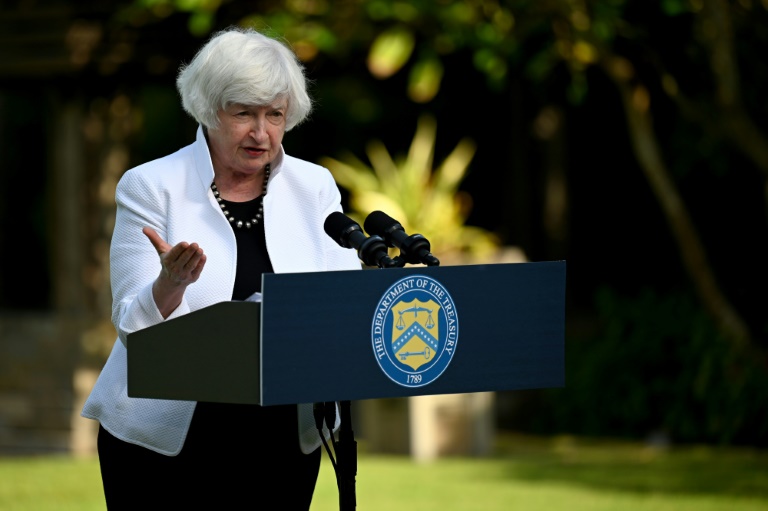
Russia’s war in Ukraine poses the greatest threat to the global economy, US Treasury Secretary Janet Yellen said Thursday as G20 ministers prepare to start talks in Indonesia.

Moscow’s invasion has sent inflation soaring at a time when the world is struggling to recover from the Covid-19 pandemic, endangering the gains of the past two years and threatening widespread hunger and poverty.

“Our greatest challenge today comes from Russia’s illegal and unprovoked war against Ukraine,” she said on the resort island of Bali ahead of a meeting between finance ministers from the world’s top economies and central bank governors on Friday and Saturday.

“We are seeing negative spillover effects from that war in every corner of the world, particularly with respect to higher energy prices, and rising food insecurity,” she added.

“Representatives of Putin’s regime have no place at this forum.”

Yellen said she will continue to press G20 allies at the meeting for a price cap on Russian oil to choke off Putin’s war chest and pressure Moscow to end its invasion while bringing down energy costs.

“A price cap… is one of our most powerful tools to address the pain that Americans and families across the world are feeling at the gas pump and the grocery store,” she said.

“A limit on the price of Russian oil would deny Putin revenue his war machine needs.”

She expressed hope that India and China would join such a cap, saying it “would serve their own interests” to put downward pressure on prices for consumers globally.

– Silent on walkout –

But she refused to be drawn on whether Western officials will stage a multi-nation walkout when Russian officials speak, as they did at a G20 meeting in Washington in April.

“It cannot be business as usual,” she said. “I can tell you that I can certainly expect to express in the strongest possible terms my views on Russia’s invasion.”

“I expect that many of my colleagues will do the same.”

Russian Finance Minister Anton Siluanov will only attend the talks virtually, a week after Foreign Minister Sergei Lavrov found himself outnumbered by G20 counterparts in their criticism of Moscow’s military assault.

Ukraine is a vital exporter of wheat, grains and sunflower oil, but shipments have been disrupted since Russia invaded in February, creating a policy headache for world leaders as well as the risk of a humanitarian crisis.

The Treasury chief, who arrived in Indonesia after meeting her Japanese counterpart in Tokyo, said it was “troubling” to see the impacts of the war, contributing to higher energy prices, food insecurity and the rising prospect of hunger globally.

She said she will press G20 countries to do more for developing countries “given the deteriorating global economic conditions” since Moscow’s invasion.

“A key objective of this trip is to push G20 creditors including China to finalise debt restructuring for developing countries now facing debt distress,” she said.

Turning to Sri Lanka, whose leader fled the country this week after mass protests over the country’s dire economic crisis, Yellen said she hoped Beijing — a major creditor of the South Asian island — would step in to help.

“Sri Lanka is clearly unable to repay that debt and it’s my hope that China will work with Sri Lanka to restructure the debt,” she said.

– Global outlook ‘darkened’ –

Yellen’s comments echo the head of the International Monetary Fund, who said Wednesday that the global economic outlook had “darkened significantly” because of Moscow’s invasion, just months after it revised down its global growth forecast for 2022 and 2023.

The IMF is “projecting a further downgrade to global growth” in 2022 and 2023, Kristalina Georgieva said in a blog post published ahead of this weekend’s meeting.

The risk of “social instability” was also increasing because of rising food and energy prices, she wrote.

But there was substantive progress made in attempts to break the impasse on Wednesday after Russia and Ukraine met in Turkey for their first direct talks since March on a deal to relieve the food crisis caused by blocked Black Sea grain exports.

UN Secretary General Antonio Guterres called it a “ray of hope to ease human suffering and alleviate hunger around the world” ahead of another planned round of talks next week.

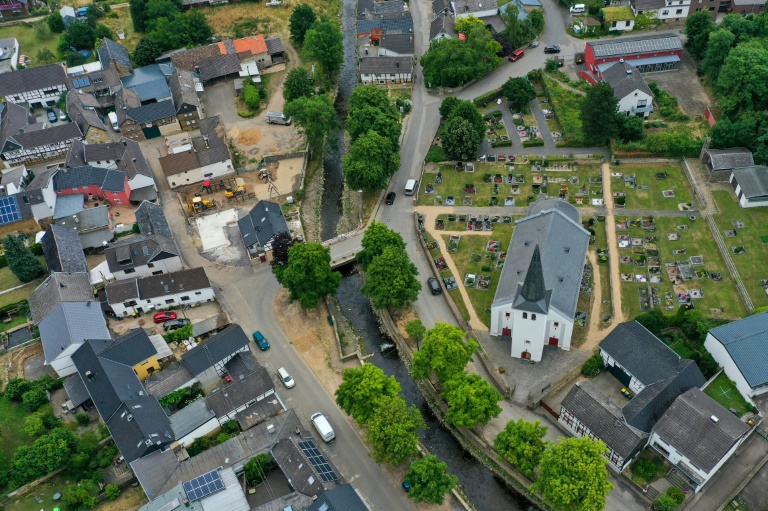
Flood anniversary prompts sadness and soul-searching in Germany

Germany on Thursday paid tribute to more than 180 people killed in severe floods a year ago, as concerns mount over climate change and the country looks to overhaul its planning for future disasters.

President Frank-Walter Steinmeier embarked on a tour of the stricken Ahr valley, while Chancellor Olaf Scholz was to attend a memorial ceremony in the hard-hit town of Bad Neuenahr-Ahrweiler.

A series of events are also planned in neighbouring Belgium, where 39 people were killed in the deluge.

“I came here again on this anniversary of the flood’s horror to show that we haven’t forgotten the people of the Ahr valley,” Steinmeier said. “We know how many are still struggling to rebuild their homes.”

Severe floods pummelled parts of the German Rhineland over two days in July last year, ripping through entire towns and villages and destroying bridges, roads, railways and swathes of housing.

Between 100 and 150 millimetres (four and six inches) of rain fell between July 14 and 15, according to the German weather service — an amount that would normally be seen over two months. 

Forecasters had issued warnings, yet many residents were simply unaware of the risks of such violent flooding, with dozens found dead in their cellars.

The disaster prompted criticism of Germany’s flood warning system and a criminal inquiry was opened into local officials for “negligent homicide”.

The government has since pledged to introduce phone alerts in the form of “cell broadcasting” and to reinstall sirens, many of which have been taken down in recent years.

– ‘Major failures’ –

Introducing a new disaster management plan on Wednesday, Interior Minister Nancy Faeser admitted there had been “major failures over the past years and decades”.

The government is planning a new annual civil protection day from 2023 to raise awareness of how to respond in a disaster and “make our country more crisis-proof”, Faeser said.

The disaster also raised concerns about climate change, with one international study showing that man-made global warming had made the floods up to nine times more likely.

A year on, Germany is set for more extreme weather with temperatures of up to 40 degrees Celsius (104 degrees Fahrenheit) expected this week as a heatwave sweeps across Europe. 

Ralph Tiesler, president of the BBK federal disaster management agency, told the Funke media group on Wednesday he believed some areas in Germany may become uninhabitable due to extreme weather events. 

“I say that some areas should not be resettled due to climate change and the acute threat of severe weather disasters and floods,” he said.

Bad Neuenahr-Ahrweiler, a town of 30,000 people famed for its thermal baths and wellness tourism, was among the areas hardest hit by the floods.

Over 2,000 people have since left the town, but the majority have chosen to stay and rebuild their homes — even as promised help is slow to arrive.

– Relief package –

A return to the way things were “will still take time”, town mayor Guido Orthen told AFP, with the rebuild very much a work in progress. 

“We still have temporary infrastructure, temporary playgrounds, temporary schools, temporary roads that make life possible,” he said.

With former chancellor Angela Merkel still in charge at the time of the floods, the government pledged a total of 30 billion euros ($30 billion) in federal and state aid to help with the reconstruction effort. 

But in the state of Rhineland-Palatinate, only 500 million euros in aid has been handed out of the total 15 billion euros set aside.  

In neighbouring North Rhine-Westphalia, 1.6 billion euros of government support has been approved for use, out of a total of 12.3 billion euros.

Frustration is building among those trying to rebuild their lives.

“We want to exist in the eyes of Germany,” Iris Muenn-Buschow told AFP from the dilapidated ground floor of her home in the town of Sinzig.

“We have the impression that everything else that goes on in the world is more important than what happens here in Germany,” she said.  

Western Europe heatwave to peak in scorching Spain

The heatwave sweeping across southwestern Europe was expected to peak on Thursday in Spain, with blistering temperatures already fuelling wildfires across the Iberian Peninsula and France. 

The region’s second heat this summer is forecast to hit southern Spain with some of the harshest temperatures. 

“For Thursday, we expect it to be the hottest day of this heatwave,” said Spain’s state meteorological agency AEMET.

The valleys around three major rivers — the Guadiana, Guadalquivir and Tagus — will experience temperatures OF 40 degrees Celsius (104 Fahrenheit), it said.

Most of Spain went on high alert Wednesday, and AEMET said some regions were “suffocating” — especially worst-affected Andalusia in the south, Extremadura in the southwest and Galicia in the northwest.

The health ministry told people to drink plenty of fluids, wear light clothes and stay in the shade or air-conditioning.

The Andalusian city of Almonte saw the mercury hit 45.6 degrees Celsius at 5:30 pm (1530 GMT) on Wednesday.

Several other southern cities such as Seville and Cordoba recorded temperatures above 44C.

In western Spain near the border with Portugal, forest fires have already razed at least 3,500 hectares (8,600 acres).

Between January 1 and July 3, more than 70,300 hectares of forest went up in smoke in Spain, the government said — almost double the average of the past 10 years.

– French wildfires –

Temperatures in Spain are expected to ease at the end of the week, but the stifling heat is set to move through France and Britain.

London has issued an “amber” alert — the second highest of three levels — while one UK climate official said there was a chance Britain’s highest temperature — 38.7C recorded on July 25, 2019 in Cambridge — could be surpassed.

Meteorological services in France also warned the situation would “become intense between Sunday and Tuesday” — possibly exceeding 40C before dipping by Wednesday. 

Two wildfires in southwestern France have since Tuesday ripped through 3,700 hectares (9,100 acres) of pine trees forcing thousands of campers to evacuate.

Further inland, 500 people were evacuated around the French village of Guillos as their homes came under threat from advancing fire.

“There were flames at the top of the trees 30 metres high,” mayor Mylene Doreau told AFP. 

“We could see them moving towards the village, it was scary.”

Some 600 firefighters have been battling the blazes in the region, aided by waterbomber aircraft.

To limit the risk of accidental fire, some cities — including Toulouse and Lourdes — made changes to their Bastille Day celebrations on Thursday. Nimes simply cancelled the traditional fireworks altogether.

– ‘The end of the world’ –

Heatwaves have become more frequent due to climate change, scientists say, the previous ones in France, Portugal and Spain having taken place only last month.

Last week, an avalanche triggered by the collapse of the largest glacier in the Italian Alps — due to unusually warm temperatures — killed 11 people.

In Greece, a helicopter helping to fight a forest blaze on the island of Samos on Wednesday crashed into the Aegean Sea, said the coastguard. Two crew members were killed.

And in Portugal — on alert for wildfires for days — one person had died in a forest blaze, authorities said, after a body was found in a burned area in the northern region of Aveiro.

Around 60 others have been injured, over 700 people evacuated and nearly 30 homes destroyed or damaged.

Over 2,000 firefighters were battling four major fires in Portugal on Thursday morning.

Portuguese Prime Minister Antonio Costa warned that Thursday would be the “most serious” day of the heat wave because temperatures were expected to rise and winds were stronger.

“Today is the day where we have to be the most careful,” he said.

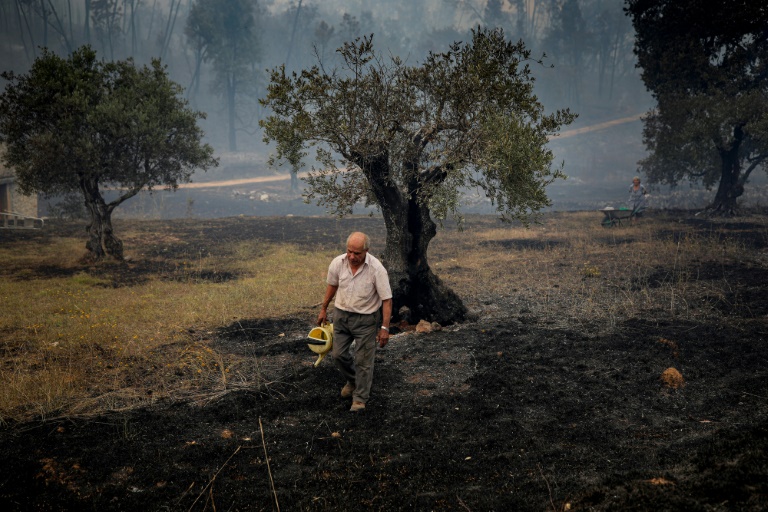
At Leiria, central Portugal, locals fought to save their village as fires closed in on them.

“Everything burned yesterday except the houses, because the people are very brave and defended them themselves,” said 77-year-old farmer Adelino Rodrigues.

“The firefighters arrived much later.”

“It looked like the end of the world,” he said.

It brought back memories of the devastating wildfires in 2017, which claimed the lives of more than 100 people in Portugal.

burs-tpe/ds/bp

Close Bitnami banner
Bitnami